
You're probably here because you've gone past the casual “maybe” stage. You've saved photos, tried holding two tiny studs against your nose in the mirror, and realised that nose piercing both sides looks very different from a single nostril. It feels more balanced, more styled, and also a bit more serious.
That hesitation is normal. Two fresh nostril piercings raise practical questions that most guides skim over. Should you do both at once or test one side first? Will they look symmetrical on a real face, not just in an edited photo? And is healing two nostrils double the work, or a different experience altogether?
In England, a large population study surveyed 10,503 adults and found that 10.0% had ever had a body piercing other than the earlobe, with the nose accounting for 19% of all reported piercing sites, making it the second most common site after the navel in the study summary here. So if you're considering it, you're not looking at something obscure. You're looking at a well-established piercing choice, and for many people, two nostrils are the next step.
Why People Choose Two Nostril Piercings
A lot of people don't wake up one morning and suddenly book two nostrils. They circle around the idea first. One week it's a saved photo with tiny matching gems. The next it's someone they pass on the train wearing two subtle studs that somehow change the whole face.
For some, the decision starts with one existing nostril piercing that no longer feels finished. They've had a single stud for years, then realise adding the other side would make the look feel complete. For others, it's the opposite. They know from the start they want something more intentional than a lone accent.
It changes the balance of the face
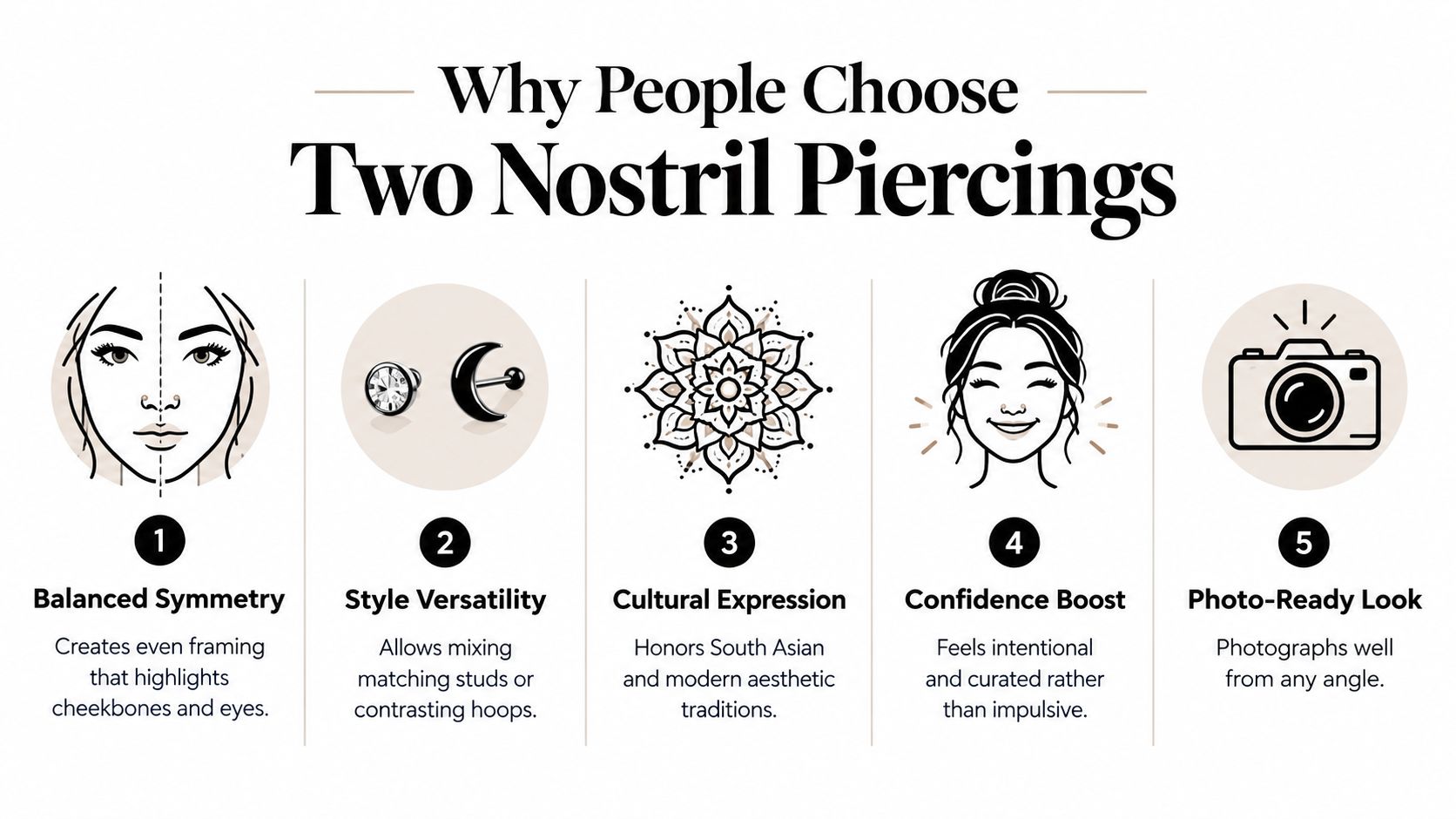
Two nostril piercings frame the centre of the face in a way one stud doesn't. If someone has broader nostrils or stronger cheekbones, a pair can look very natural. On a narrower nose, the same idea can still work, but placement becomes much more important so the jewellery doesn't look crowded.
It gives more styling room later
A fresh setup usually starts simple, but many people are thinking ahead. They like the option of matching ends now, then small hoops later, or one side with a plain bead and the other with a gem. Two sides open that door.
Practical rule: If you already know you like jewellery to be part of your look, not just a tiny detail, two nostrils often make more sense than trying to force one piercing to do all the visual work.
There's also a cultural and aesthetic pull for some clients. Paired nostril jewellery can connect with South Asian styling traditions, or with a modern curated look that feels deliberate rather than random.
Sometimes one appointment feels easier than two decisions
This surprises first-timers, but many people choose both sides because they know they'll keep second-guessing themselves if they only do one. Getting both done at once can feel cleaner mentally. One decision. One healing phase. One moment of commitment.
That doesn't make it the right choice for everyone, but it does explain why so many people end up comparing both options so carefully.
What Double Nostril Piercing Actually Means
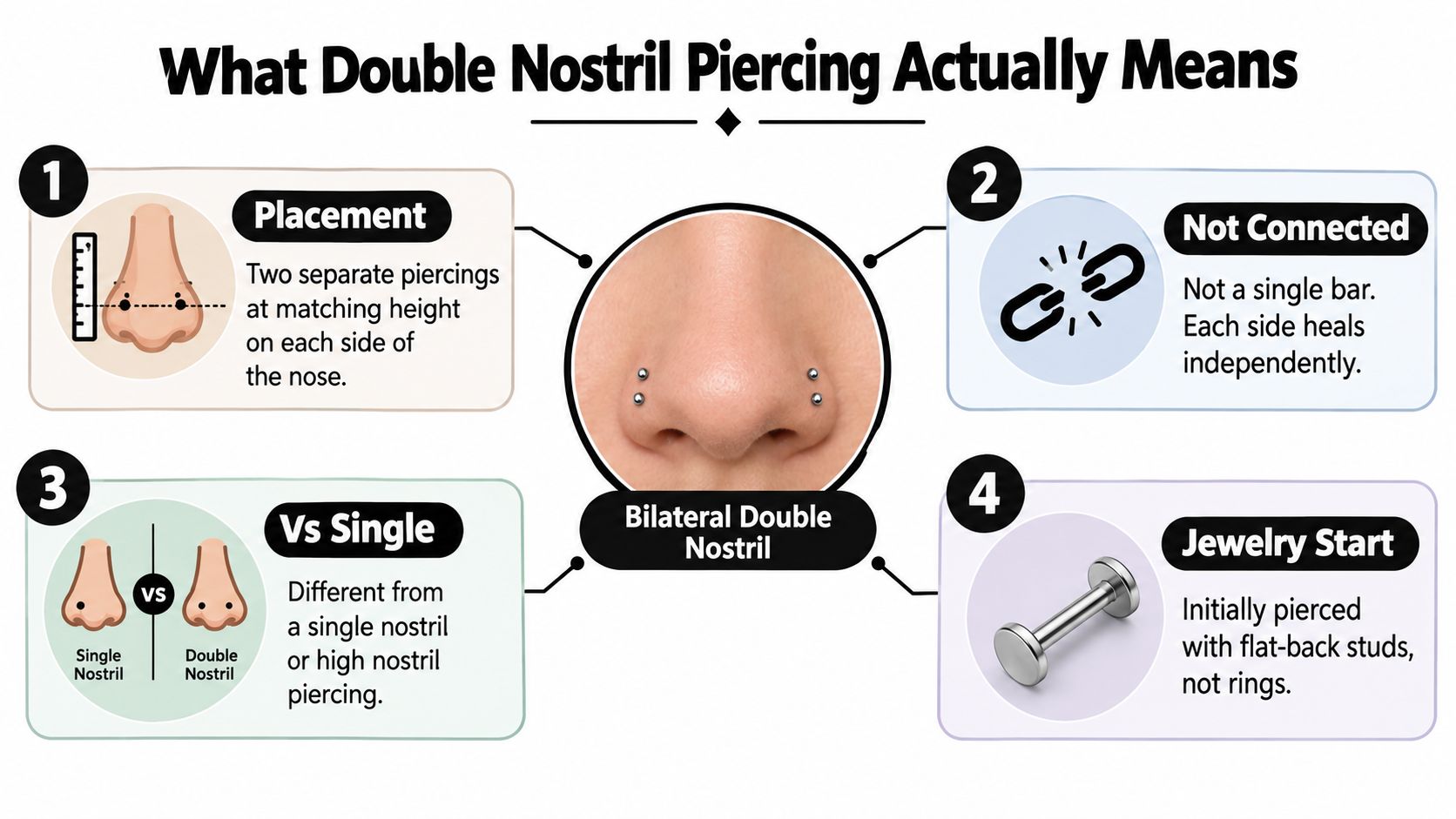
A double nostril piercing usually means two separate piercings, one in each nostril, placed to look balanced when you face forward. The key word is separate. They are not linked under the skin, and they do not behave like a single piercing.
What it is not
People often mix this up with other nose piercings, especially if they're booking for the first time.
- Not a septum: A septum goes through the tissue inside the nose between the nostrils.
- Not a bridge: A bridge sits across the upper nose between the eyes.
- Not one connected piece: Bilateral nostrils are two independent channels, each with its own entry and internal healing tract.
That independence matters more than many expect.
Why two sides don't act like one job done twice
Each nostril is pierced through soft tissue near the nostril rim. Even when the placements are matched closely, your body may treat them differently. One side can swell more. One can catch on a towel. One can calm down quickly while the other stays temperamental.
Two nostrils can look symmetrical on day one and still heal at different speeds. That's normal, not a sign that the piercer “got one wrong”.
The common point of confusion
Many first-timers assume that if the jewellery matches, the healing will match too. It rarely works that neatly. You still have two cleaning points, two chances for snagging, and two posts that may need checking as swelling changes.
UK guidance also treats nose piercing as a regulated cosmetic piercing category. In some local council guidance, under 16s may not receive body piercing except ear, nose and navel piercing, and 14 to 16-year-olds may be pierced with parental consent, while under 18s cannot have nose cartilage pierced as outlined in this UK piercing framework summary. For a standard bilateral nostril setup, that distinction matters because fleshy nostril placement is different from cartilage work.
Doing Both Sides at Once or One at a Time
This is the first real fork in the road. You're not just choosing a look. You're choosing how you want to experience the process.
The quick comparison
| Factor | Both Sides at Once | Staggered (4–8 Weeks Apart) |
|---|---|---|
| Pain window | One appointment, one concentrated sting | Two separate appointments |
| Symmetry on day one | Immediate balanced look | Temporary uneven look while waiting |
| Healing logistics | One combined healing period | Two healing phases, started at different times |
| Sleeping comfort | More awkward early on | Easier if only one side is fresh |
| Decision flexibility | Commit before seeing one healed side | Assess the first placement before adding the second |
| Swelling management | Both sides may feel tender together | Less to manage at one time |
When doing both at once makes sense
If you already know you want the final look, doing both sides together can be the cleaner option. You only need one booking, one prep routine, and one stretch of being careful with your nose.
It also helps if visual balance matters to you straight away. Some clients hate the in-between stage where one nostril is pierced and the other isn't.
A good studio setup matters here. If you're checking hygiene standards before booking, it helps to understand why many clients specifically ask about single-use sterile needles and studio safety practices.
When staggering is the smarter move
Staggering suits people who are curious but not fully certain. If you've never had a facial piercing before, one nostril can teach you a lot about your tolerance for tenderness, your habit of touching your face, and whether your job or glasses make the healing process annoying.
It also gives your piercer a chance to refine the second side around your real anatomy, not just a theoretical mirror image. Human noses aren't perfectly symmetrical. Nostrils often sit slightly differently, and a good bilateral placement works with that rather than fighting it.
The honest trade-off
There's no universal winner. Simultaneous piercing gives you one recovery period, but that period can feel more intense. Staggered piercing spreads the hassle out, but it also extends the total timeline and leaves you in an in-between look for a while.
If you're torn, ask yourself three things:
- How sure am I about wanting both sides?
- How much does immediate symmetry matter to me?
- Would I rather handle one awkward healing phase or two milder ones?
Those answers usually point you in the right direction.
How Long Two Nostrils Take to Heal
Expectations need to be realistic. A double nostril may stop feeling dramatic fairly quickly, but “not very sore” and “healed” are not the same thing.
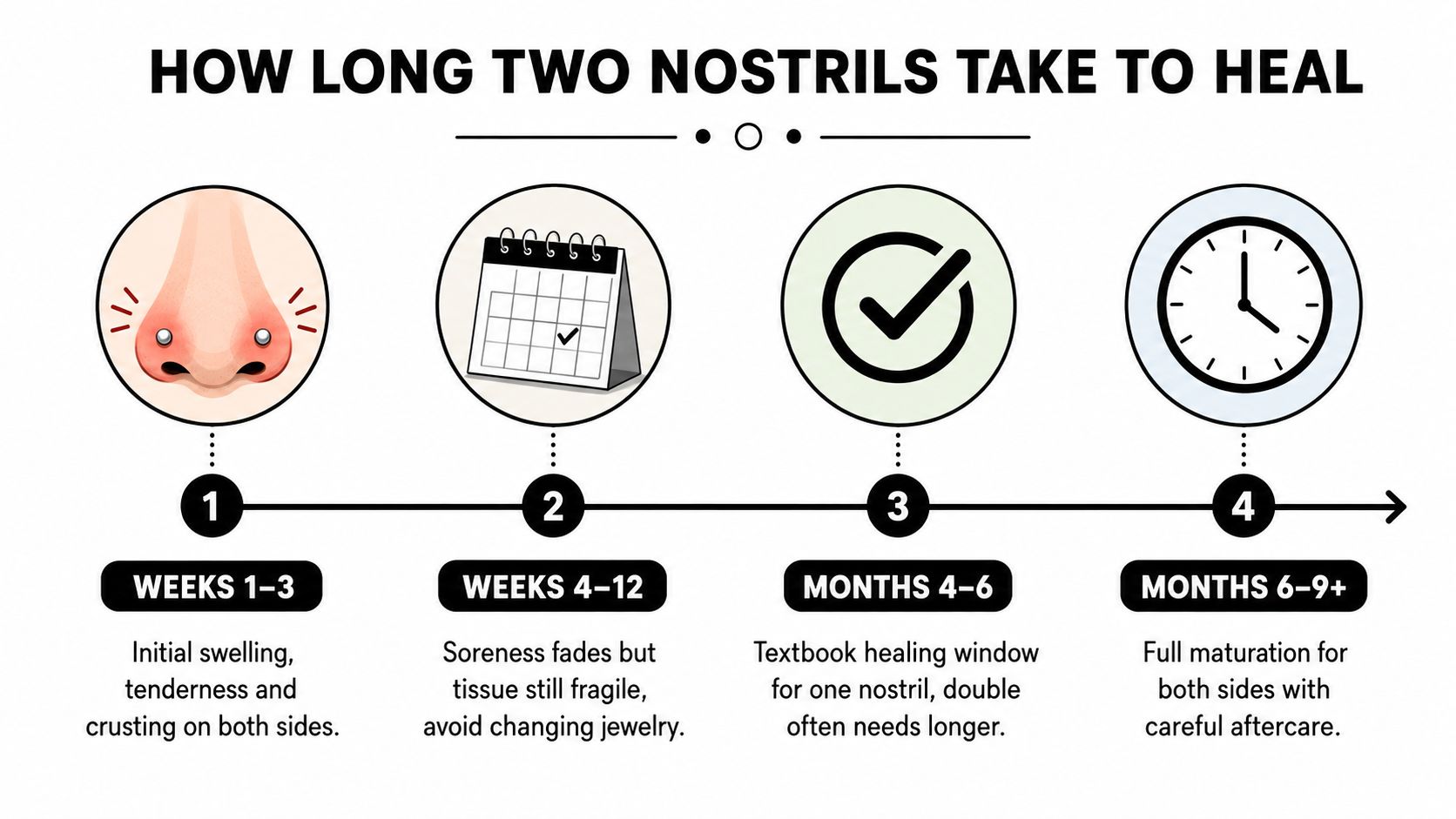
UK guidance and studio aftercare commonly place nostril healing in a 4 to 6 month window, with some guidance extending normal healing to 6 to 9 months because nostril tissue is thin, mobile, and easily re-irritated by talking, wiping, sleeping on the face, or snagging jewellery in this UK aftercare guidance.
What the timeline feels like in real life
The first stretch is usually about tenderness, crusting, and working out how often you almost hit your own nose without noticing. Then things calm down. That calm can be misleading.
A nostril piercing often enters a phase where it seems fine until something irritates it. Sleeping awkwardly, catching a jumper, blowing your nose repeatedly, or swapping jewellery too early can all wake it up again. With two piercings, those little disruptions have twice the chance to happen.
If you want a wider overview of expectations, this guide on nostril piercing healing time is useful for comparing the normal stages.
Why one side often lags behind
The tissue is similar on both sides, but your habits aren't. You likely favour one sleeping side. You wipe your nose one way. You catch one side more often when changing clothes or drying their face.
Healing is rarely mirror-perfect. If one side settles before the other, that's common.
UK-focused guidance also reports nostril healing as at least six weeks to several months, with one source giving 3 to 6 months for nostril healing and another noting 2 to 4 months for each nostril in a double-nose setup in this double nose piercing guide. The practical takeaway is simple. Don't plan on changing jewellery after only a few weeks just because the piercings look calmer.
Signs of progress versus false confidence
A healing piercing is usually moving in the right direction when tenderness reduces, discharge lessens, and the jewellery sits more calmly. That still doesn't mean the channel is mature.
False confidence usually looks like this:
- It doesn't hurt, so I changed the jewellery
- It looked straight yesterday, so I slept on it
- It only needed one quick wipe with a towel
Two nostrils reward patience more than toughness.
Picking Jewellery for a Fresh Double Nostril
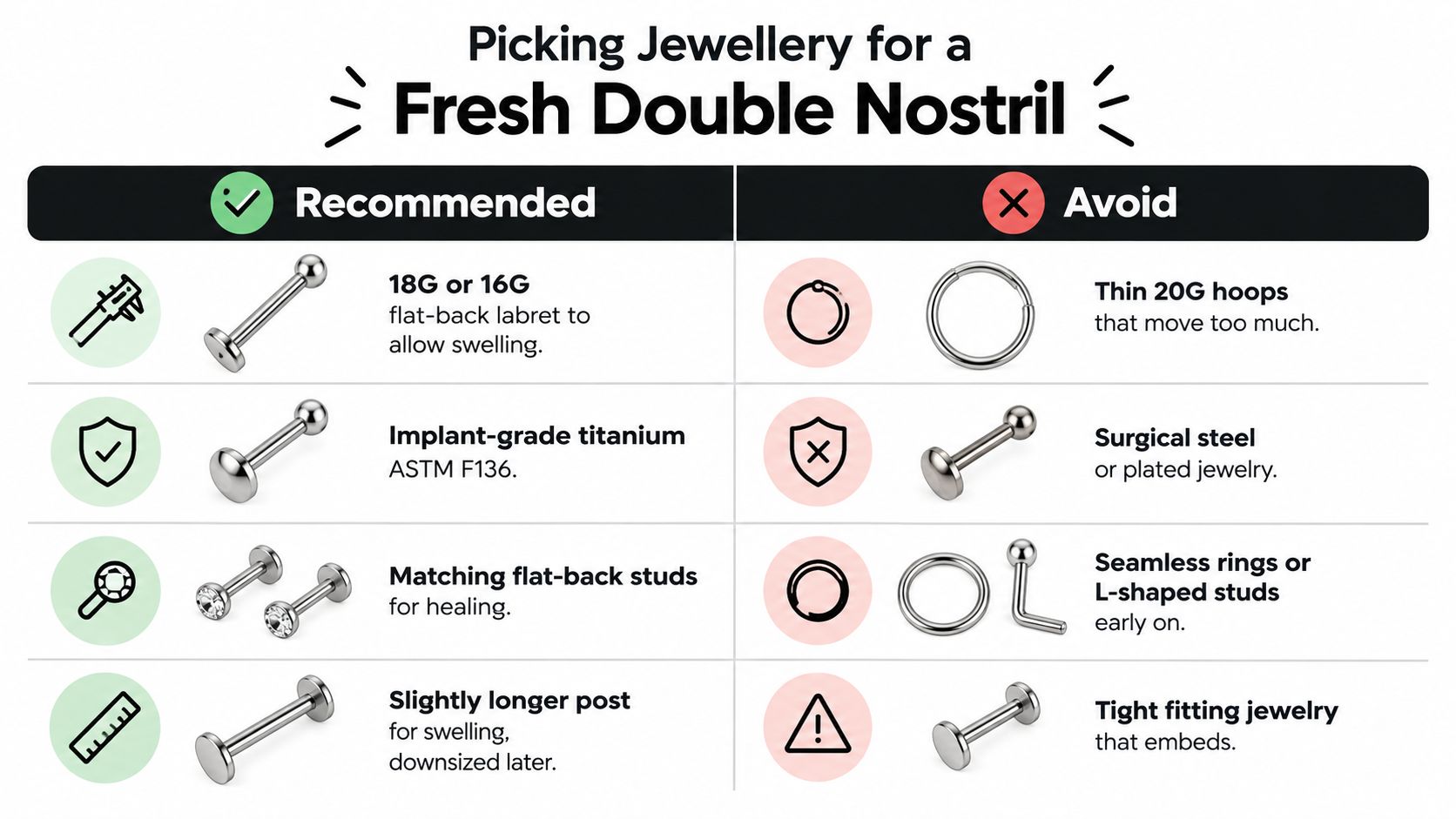
Jewellery choice isn't just about style at the start. It affects swelling room, movement, snag risk, and whether each side gets the calmest possible chance to heal.
Start with stable jewellery, not your dream hoop
For a fresh double nostril, most first-timers do better with flat-back studs rather than rings. Studs move less, spin less, and put less shifting pressure on the new channels.
Rings can look brilliant later, but early healing and ring movement don't usually make a peaceful combination. When both nostrils are fresh, reducing motion matters even more.
Metal quality matters more when there are two wounds
Because bilateral nostrils create two fresh channels, there's less room for “it'll probably be fine” jewellery. Implant-grade materials are chosen to reduce unnecessary irritation. If one side is slightly more reactive than the other, lower-quality metal can make that mismatch more obvious.
Matching jewellery often simplifies things at the beginning. Same shape, same profile, same cleaning routine. But matching doesn't always mean identical forever. Some faces suit tiny differences once everything is healed.
For clients comparing styles and starter options, nostril piercing jewellery choices can help make sense of what works for healing versus what only looks good in photos.
What to discuss before the needle goes in
Ask your piercer about these points before placement is marked:
- Post length: Fresh piercings need room for swelling. Too tight can become a problem quickly.
- End size: Very tiny tops can disappear visually on some noses, while oversized tops can dominate the centre of the face.
- Backing style: Flat-backs are often easier to live with than shapes that twist or catch.
- Future plan: If you want hoops later, placement should account for that now.
Jewellery choice is a healing decision first and a styling decision second. That mindset saves a lot of avoidable trouble.
Don't force symmetry with the wrong jewellery
This is a subtle point, but it matters. Some noses need slightly different angles or post lengths on each side to look symmetrical from the front. If a piercer uses identical jewellery dimensions on both sides without considering anatomy, the finished result may look less even.
Balanced doesn't always mean mechanically identical. It means visually right on your face.
Day-to-Day Aftercare With Two New Piercings
The simplest useful mindset is this. You don't have one nose piercing with an extra matching one. You have two healing channels that need calm, clean conditions every day.
Independent UK aftercare advice commonly recommends sterile saline cleaning no more than twice daily, keeping the area dry, and avoiding touching, turning, or removing jewellery during healing in this UK nose piercing aftercare article.
A routine that's easy to stick to
Morning and evening is enough. Spray or cleanse each side separately with sterile saline, let softened debris loosen naturally, and avoid picking crusts off with fingernails or cotton buds if they're stuck.
Keep the skin around the piercings free from makeup, perfume, lotions, and heavy skincare products. Those products don't need to go directly into the piercing to irritate it. Close is often close enough.
Sleeping is where many people struggle
If you sleep on your side or bury your face into the pillow, two fresh nostrils can become annoying fast. Pressure increases irritation, and repeated pressure on the same side often explains why one nostril gets grumpy while the other stays calm.
Helpful habits include:
- Change your pillowcase often: Clean fabric lowers the amount of grime rubbing against the area.
- Use a travel pillow if needed: Some side sleepers find it easier to keep pressure off the nose.
- Slow down when dressing: Knitwear, hoodies, towels, and collars are common snag points.
When to expect a check-in
Bilateral nostril piercings are treated as two separate healing channels, so guidance that recommends saline twice daily, keeping the area dry, avoiding swimming for 2 to 3 weeks, and arranging a follow-up at around 6 weeks for possible downsizing applies to each side in this nostril aftercare guidance. Downsizing matters because the extra length that helps with early swelling can become a snag risk once the tissue settles.
When to get advice rather than guess
Local UK council guidance notes that the inner surface of the nose harbours bacteria and that complications following nose piercing may be greater than for lower ear lobe piercing. It also warns about localised swelling, scarring, jewellery embedding, and infection, and advises getting medical help if redness, swelling, and pain do not improve within 24 hours in this council code of practice.
If one side starts sinking into the tissue, becomes increasingly painful, or changes in a way that worries you, contact your piercer promptly. Guesswork tends to make nose problems worse, not better.
Myths About Healing Two Sides Together
One of the most common myths is that if both sides were pierced in the same appointment, they should heal at the same rate. They often don't. Faces aren't perfectly symmetrical, and habits definitely aren't. The side you sleep on, touch more often, or catch when drying your face usually tells on you.
Another myth is that twisting jewellery helps keep the hole open. It doesn't. Rotating jewellery through a fresh channel can irritate the tissue and restart tiny tears that were trying to settle.
A few myths worth dropping early
- “If it's crusting, I should move the stud.” Crusting by itself doesn't mean the jewellery needs rotating.
- “More cleaning means faster healing.” Over-cleaning can dry the area out and keep it irritated.
- “Two nostrils means double the long-term pain.” The brief sting is one part of the experience. Daily care is the part that decides whether healing feels easy or frustrating.
UK public guidance also notes there are no nationally recognised competence requirements for body piercing in this government infection prevention and control guidance. That's one reason advice can sound inconsistent from place to place. Technique, placement quality, and jewellery choice vary more than many first-timers realise.
The myth under all the others
The biggest misunderstanding is thinking a double nostril is only a style decision. It's also a behaviour test. If you can leave jewellery alone, clean each side gently, and be patient with uneven healing, two nostrils are very manageable. If you know you pick, fiddle, or change jewellery impulsively, that's useful information too.
Booking Checklist and Quick Answers
Before you book, slow the process down just enough to ask better questions. A calm consultation often tells you more than the studio photos.
Booking checklist
- Confirm needle method: Ask directly whether they use sterile single-use needles for nostril piercings.
- Ask about jewellery materials: Implant-grade options should be easy for the studio to explain.
- Discuss bilateral marking: The piercer should mark both sides and check symmetry from multiple angles.
- Ask about downsizing: You want to know when they normally review post length after swelling settles.
- Check age and consent rules: If the client is younger, confirm exactly what the studio requires before arrival.
- Get contact details saved: Questions often come up after the appointment. Keep the studio number handy. You can call 01202 9000 50 or message 07752913846 on WhatsApp.
One practical option for comparing UK studios, jewellery, and appointment information is Piercing Near Me, which lists piercing services and booking routes for Croydon and Bournemouth.
Quick answers first-timers often need
Can both sides be done in one appointment?
Yes, that's a standard way to do bilateral nostrils if the placement and your anatomy are suitable.
Can I change the jewellery at 6 weeks?
Usually that's too early for a cosmetic change. A piercer may review sizing around then, but that isn't the same as treating the piercing as healed.
Will glasses get in the way?
Sometimes, depending on how they sit and where the piercings are placed. Bring or wear your usual frames to the appointment if you're unsure.
What if one side heals badly and the other is fine?
That can happen. One side may need more time, a different post length, or a check on placement and pressure habits.
Should I wait if I'm unsure?
Yes. Doubt isn't failure. If you need more time to decide between one nostril and both sides, waiting is the sensible move.
A good booking doesn't feel rushed. It feels clear.
If you're weighing nose piercing both sides and want help comparing placement, jewellery, healing, and studio standards, Piercing Near Me makes that process easier. You can use it to explore UK piercing guidance, look at nostril options, and connect with studios in Croydon or Bournemouth before you book.