
You've probably done the same thing most labret clients do before they book. You've seen a lower lip piercing on someone online, saved a few photos, zoomed in on the jewellery, and then hit the same questions. Would that suit my face? Would it wreck my teeth? Is it a stud or a ring? And how bad does it hurt?
Those are the right questions.
A labret lip piercing can look clean, subtle, bold, or sharply alternative depending on the placement and jewellery. But it isn't a one-style-fits-all piercing. The best result depends on your lip shape, how your teeth and gums sit, whether you wear braces, how much movement you have in the area, and what kind of jewellery you realistically want to wear day to day. Good decision-making matters just as much as the piercing itself.
What Is a Labret Lip Piercing
A labret lip piercing usually means a piercing placed below the lower lip, most often in the centre. If you've seen a small bead or gem sitting just under the lip with a flat disc resting inside the mouth, that's the classic version.

People often use the word “labret” as if it means one exact look. In practice, it covers a family of lower-lip and lower-lip-adjacent placements. That's why you'll hear terms like side labret, vertical labret, or Ashley piercing. They're related, but they don't sit in the same way and they don't use the same jewellery.
There's also a lot more history behind this piercing than many people realise. Labret-style piercing goes back a long way. Museum and fashion-history sources trace it to around 1000 BCE, and another historical account places labret use in North-West American Coast cultures about 3,000 years ago, which you can read in this fashion history overview of the labret. That matters because it reminds people that this isn't just a modern trend. It's an old form of body adornment that has evolved into many contemporary styles.
What makes it different from other lip piercings
A classic labret sits under the lower lip and exits inside the mouth. That's different from:
- Monroe or Madonna piercings, which sit above the upper lip
- Vertical labrets, which pass through the lip itself rather than into the mouth
- Snake bites, which are usually two lower lip piercings, one on each side
Practical rule: If the jewellery has a flat back resting inside your mouth, you're usually looking at a classic labret-style placement rather than a vertical one.
For first-timers, the term is confusing because people use it to describe both one specific piercing and a broader category. The easiest way to think about it is this: the classic labret is the centred lower-lip piercing, and the labret family includes several variations built around that area.
Exploring Labret Variations and Placements
Once you know the classic version, the next step is choosing the exact look you want. Clients often change their mind during consultation. They arrive asking for “a labret”, then realise they want a side placement, a lip-only piercing, or a paired style.
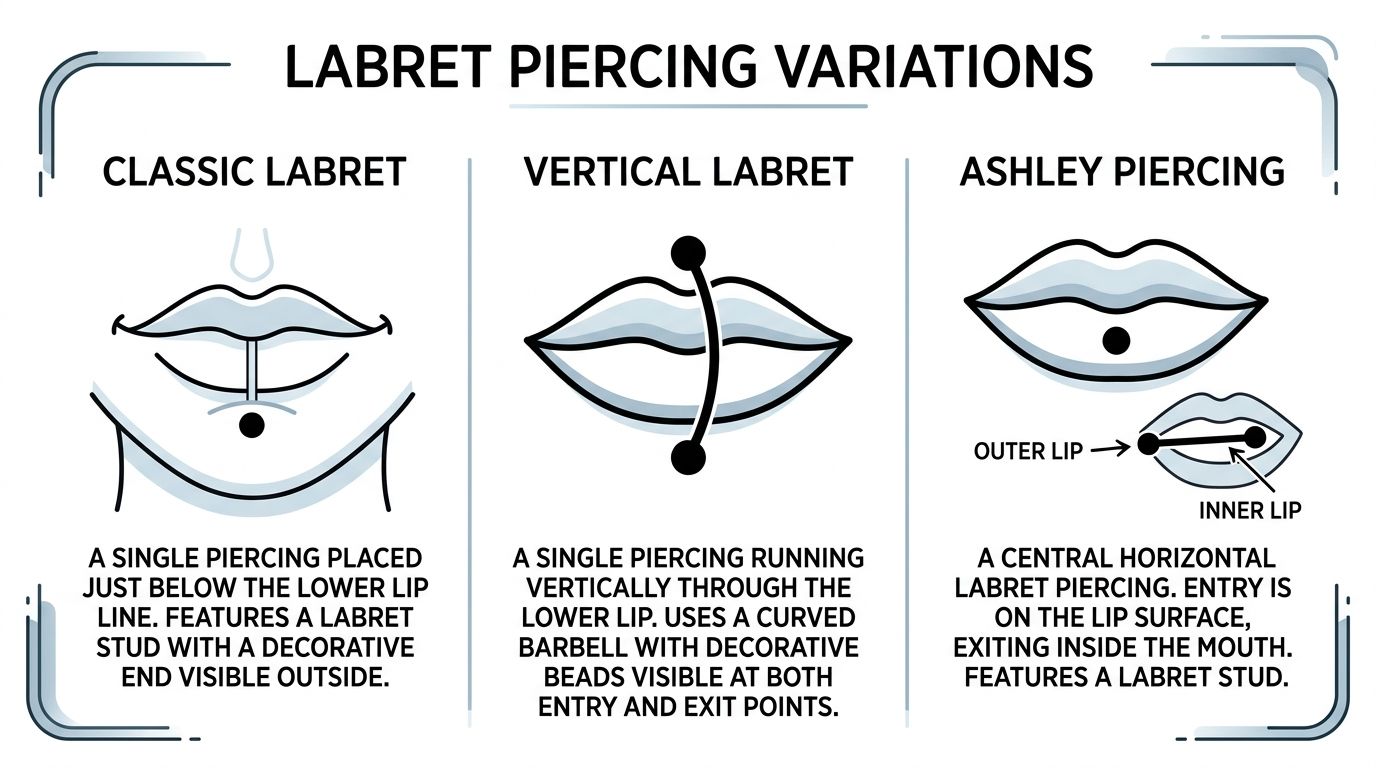
The main labret styles
Classic labret
A single piercing centred below the lower lip. It usually looks neat and balanced, and it's commonly fitted with a flat-back labret stud during healing.Side labret
The same basic idea, but moved to the left or right rather than the centre. It gives an asymmetrical look and is also usually started with a flat-back stud.Vertical labret
This piercing goes through the lower lip tissue so both ends of the jewellery show. It's commonly worn with a curved barbell and doesn't place a backing inside the mouth.Ashley piercing
Sometimes called an inverse vertical labret, this sits through the lip itself with the visible end on the lip and the other end hidden inside. It creates a very specific centred look and is more anatomy-sensitive.Snake bites
A paired style with one piercing on each side below the lower lip. These are typically healed with two flat-back studs rather than starting with rings.
How each one looks in real life
The easiest way to choose is to stop thinking in names and start thinking in movement, visibility, and contact.
A classic labret tends to look the most versatile. It can read minimal with a tiny ball or gem, and later it can suit a different jewellery style if your anatomy allows it. If you like clean symmetry and want something that sits just below the lip line, this is often the most straightforward option.
A side labret looks a bit less formal and a bit more stylised. Some people prefer it because it breaks up the face in a flattering way rather than drawing the eye directly to the centre.
A vertical labret is usually chosen by people who love the look of lip jewellery itself. Because both ends are visible, the piercing becomes more of a feature. It also appeals to clients who want to avoid internal mouth contact.
If your biggest concern is what touches your teeth and gums, that concern should come up before style photos do.
A simple way to narrow it down
Ask yourself these three questions:
Do you want the jewellery below the lip or through the lip?
Below the lip usually points to a classic or side labret. Through the lip points more towards a vertical labret or Ashley.Do you want a subtle look or a statement look?
A single centred stud is usually subtler. Two visible ends on the lip are usually bolder.Do you want future ring options, or do you prefer studs?
Not every placement gives the same long-term jewellery possibilities.
Quick comparison table
| Style | Where it sits | Typical starter jewellery | Main visual effect |
|---|---|---|---|
| Classic labret | Below lower lip, centred | Flat-back stud | Clean, balanced |
| Side labret | Below lower lip, off-centre | Flat-back stud | Asymmetrical |
| Vertical labret | Through lower lip | Curved barbell | Both ends visible |
| Ashley | Through lower lip, centred | Lip-specific jewellery chosen by piercer | Minimal outer look on the lip |
| Snake bites | Two lower placements | Two flat-back studs | Paired, stronger look |
Choosing Your Jewellery and Anatomy Considerations
The best jewellery for a fresh labret isn't just about appearance. It's about controlling movement, reducing friction, and giving the tissue room to settle without letting the jewellery cause extra problems.
For most fresh classic labret piercings, a flat-back stud is the sensible starting point. A ring moves more, spins more, catches more, and tends to create more irritation while the piercing is trying to establish a stable channel. The flat disc inside the mouth also spreads pressure differently than a ring pressing and shifting against the area.
Why the starter choice matters
When clients ask for a ring straight away, I understand the appeal. Rings look finished. They photograph well. They often match the image that made you want the piercing in the first place.
But healing tissue doesn't care about aesthetics. It cares about stability.
A well-fitted stud usually gives you:
- Less movement while eating and talking
- Less contact with teeth than poorly chosen jewellery
- A cleaner healing environment because the piercing isn't constantly rotating
- More predictable swelling management during the first stage of healing
If you want to browse the style of jewellery people usually mean when they say “labret stud”, this guide to flat back earring studs is useful for visual reference.
Anatomy decides more than preference
This is the part many online guides gloss over. Not everyone is suited to every lower lip piercing, and not every classic labret should sit in exactly the same spot.
A piercer should look at more than just whether the mark appears centred. They should also consider:
- Your lip fullness
- How far your lower lip rolls inward when you talk
- Your gum line
- Your tooth position
- Whether the backing is likely to knock or rest against a problem area
- Any history of dental sensitivity, braces, or gum irritation
That's why two clients can ask for the “same” labret and leave with slightly different placement. A tiny adjustment can change how the jewellery sits inside the mouth.
The best placement isn't always the one that looks most centred at first glance. It's the one that looks good and behaves well inside the mouth.
What to ask in your consultation
You don't need technical jargon. Just ask direct questions.
- Will this backing sit against my gums or teeth?
- Am I better suited to a classic labret or a vertical version?
- Do I have enough room for safe placement?
- What jewellery would you start with for healing, and why?
- If I want a different style later, will this placement still work?
That conversation tells you a lot about your piercer. A good piercer won't rush through it. They'll explain what your anatomy allows, what it doesn't, and where compromise gives you a safer long-term result.
The Piercing Procedure and Pain Expectations
A lot of the fear around a labret comes from not knowing what the appointment feels like. Once you know the sequence, it stops feeling mysterious.
In England, a BMJ-published survey estimated that 10% of adults had ever had a body piercing, based on 1,049 of 10,503 respondents, and lip piercings accounted for 4% of the 1,934 piercings reported. The same study found piercing was more common among 16 to 24-year-olds, with lip and tongue piercings especially concentrated in that age group, which gives a useful baseline for mouth-adjacent placements like labrets in the wider market. You can read that in the BMJ survey on body piercing in England.
What the appointment usually feels like
You'll arrive, go through ID and consent, and then have a placement discussion. This is the part where you should speak up. If you want a centred look, a tiny gem, or you're worried about tooth contact, say it before anything is marked.
The piercer will clean the area, mark the placement, and show you the mark. Take your time checking it. Smile, relax your mouth, and look straight on. Lower lip piercings can look different when your face is moving versus when it's fully still.
After that, the setup should feel calm and organised. The actual piercing is quick. You'll usually feel pressure first, then a short sharp pinch, and then the jewellery goes in.
How painful is it really
It's often built up in the mind more than the piercing deserves.
A labret usually feels like a fast, hot pinch followed by watering eyes and a strange awareness of your lip for a few minutes. The area is sensitive, so it isn't nothing, but it's also over quickly. What clients often dislike more than the piercing itself is the swelling afterwards and getting used to the longer initial bar.
Eat beforehand, drink water, and arrive rested. People who come in shaky, hungry, or anxious usually have a rougher experience than people who prepare well.
How to prepare on the day
A short checklist helps:
- Eat a proper meal so you're not light-headed
- Brush your teeth and arrive with a clean mouth
- Avoid alcohol before your appointment
- Don't put heavy lip product on the area
- Bring questions instead of guessing
When you leave, your lip will probably feel swollen, awkward, and more noticeable than painful. That's normal. Talking and eating may feel clumsy at first, especially while you adjust to the extra length on the jewellery.
Your Labret Healing Timeline and Aftercare Essentials
Healing a labret properly means respecting one awkward fact. It heals in two environments at once. You've got skin on the outside and a wet, bacteria-rich mouth on the inside. That's why aftercare needs to be steady, simple, and clean.
In the UK, a labret should be treated as an invasive skin-piercing procedure. Official local authority guidance requires autoclaved instruments, sterile single-use needles, hand hygiene, skin antisepsis, and proper aftercare instructions. That standard reflects the practical contamination risk at a site constantly exposed to saliva and oral flora. The same guidance context also supports why flat-back posts are preferred over rings during initial healing, because they reduce movement and tooth contact. A clear summary appears in this guide to labret piercings and hygiene requirements.
What to expect as it heals
The first stage is usually about swelling and adjustment. The jewellery may feel too long, your lip may look puffier than expected, and eating can feel clumsy.
Then the piercing starts to calm down. It won't mean it's fully healed. It just means it's becoming less reactive. That's where people get overconfident and start touching it, changing jewellery too early, or skipping cleaning.
A plain saline spray for piercing aftercare makes the routine easier because it keeps the external cleaning simple and consistent.
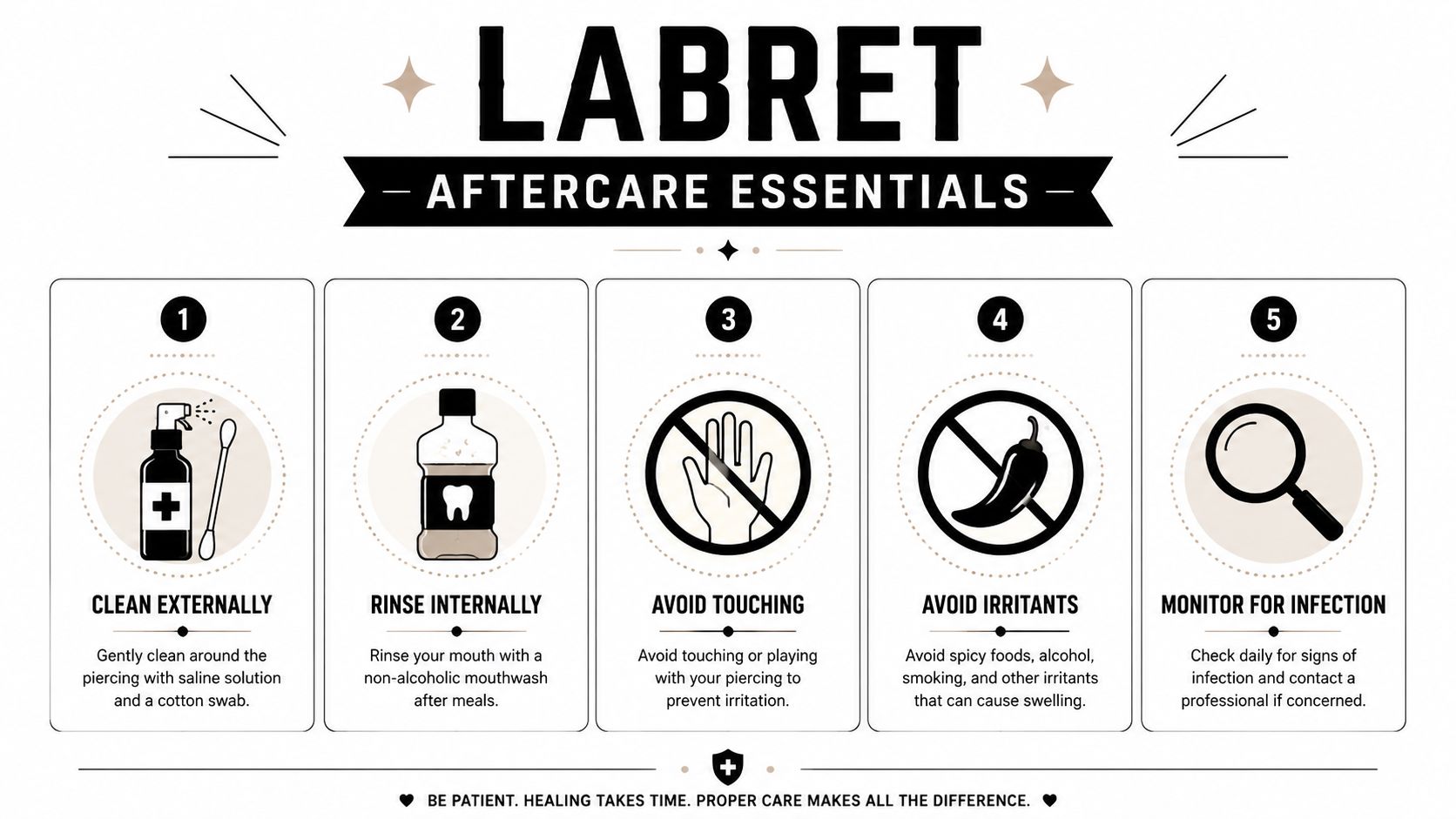
Daily aftercare routine
For most clients, the basics look like this:
- Clean the outside gently with sterile saline. Let it soften any crusting instead of picking at it.
- Rinse the inside of the mouth with an alcohol-free mouthwash after eating, if your piercer recommends it, or follow the aftercare instructions given at your appointment.
- Wash your hands first if you need to go anywhere near the area.
- Leave the jewellery alone unless you are cleaning around it carefully.
- Keep cosmetics and skincare off the entry point around the lower lip.
Dos and don'ts that make healing easier
Do sleep carefully
Try not to mash the piercing into the pillow or catch it while turning.Do eat thoughtfully
Softer foods are often easier at the start. Take smaller bites and chew slowly until the long jewellery feels less foreign.Don't twist or spin the jewellery
That old advice causes irritation rather than helping.Don't switch to a ring early
A piercing that looks calm can still be fragile.Don't smoke around fresh irritation if you can avoid it
Anything that dries or aggravates the mouth can make things less comfortable.
A realistic healing mindset
Most problems come from impatience, not from the piercing being impossible to heal.
Your lip may settle enough to feel “fine” before it is ready for jewellery changes or rough handling. Healing needs consistency. If something feels more swollen, sorer, or more irritated after a small mistake, go back to calm aftercare rather than panicking.
A comfortable day doesn't equal a healed piercing. Judge healing over time, not by one good morning in the mirror.
Understanding Risks and Avoiding Complications
A labret can heal beautifully, but it does have real risks. The honest conversation isn't just about infection. It's also about what sits inside your mouth every day after healing.
A major gap in a lot of UK-facing labret advice is oral health. General body piercing guidance often focuses on avoiding infection, watching swelling, and seeking help for complications. That still matters, but it doesn't answer enough questions about braces, gum recession, dental sensitivity, or long-term contact with teeth and gums. Educational piercer material notes that placement should reduce gum-line contact and that some styles lower the risk of tooth and gum damage more than others. That point is discussed in this educational video on labret oral-health considerations.
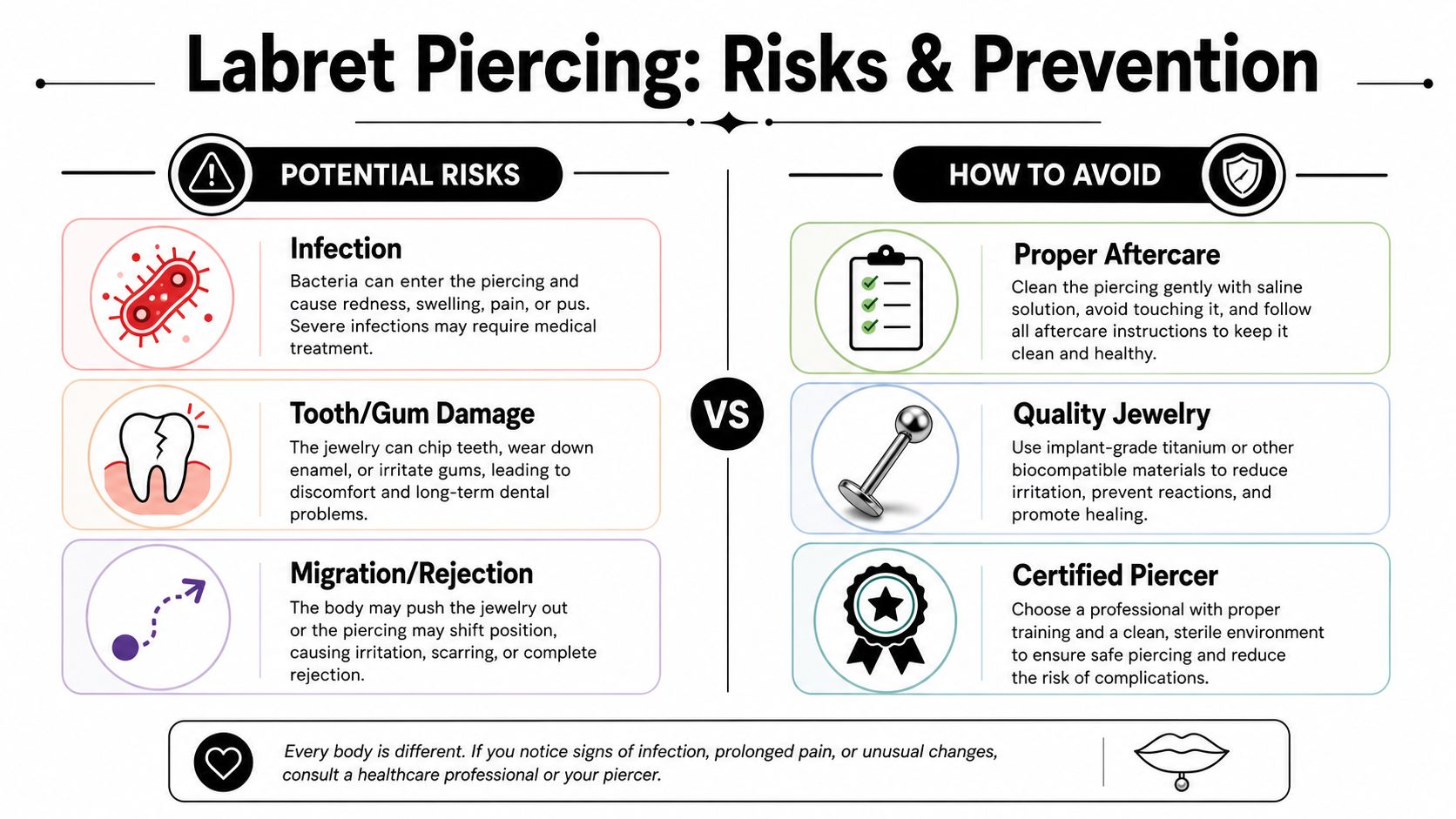
The risks people don't always think about
The obvious risk is infection, especially if the piercing is touched with dirty hands, cleaned badly, or exposed to avoidable irritation.
The less obvious risk is repeated contact. If the backing constantly knocks against a tooth or rubs one area of gum, that's not something to ignore just because the outside looks fine. Placement and jewellery fit matter because long-term friction matters.
There's also the problem of poor style matching. Sometimes the piercing itself is fine, but the client wanted a jewellery style their anatomy doesn't support well. That mismatch can create a lot of unnecessary trouble.
When a labret may not be your best option
A classic labret might not be the smartest choice, or it may need very careful planning, if you have:
- Braces or other orthodontic hardware
- A history of gum recession
- Noticeable dental sensitivity
- A habit of biting or playing with oral jewellery
- Minimal space for the backing to sit comfortably
In those cases, another lower-lip variation may be safer for your anatomy and lifestyle.
Normal healing or a complication
Some signs are common early on. Mild swelling, tenderness, a bit of clear or pale crusting, and that “this feels weird in my mouth” stage are all expected.
More concerning signs include:
- Swelling that keeps worsening instead of easing
- Heat and throbbing that feels increasingly angry
- Discharge that looks unusual for healing
- Jewellery pressing hard into tissue
- Sharp ongoing tooth or gum contact
If you're unsure, contact your piercer promptly. If you have signs that suggest a medical issue, seek medical care. Don't remove jewellery on your own in a panic unless you've been properly advised, because that can complicate things further.
Labret Piercing Cost and Booking in Croydon and Bournemouth
A good labret piercing isn't something to shop for on price alone. You're paying for safe technique, sterile procedure, proper jewellery, correct placement, and aftercare support. Those things matter much more than saving a small amount and ending up with poor positioning or low-quality metal.
Because prices vary by studio, jewellery choice, and whether you're having a single or paired lip piercing, it's best to check a current studio list rather than relying on random figures online. You can compare current options on this piercing prices page.
What you should expect from a reputable studio
When you book, look for a studio that takes time with consultation and doesn't treat a labret as a quick in-and-out facial piercing. You want:
- Single-use sterile needles
- Strong hygiene standards
- Experienced piercers who assess anatomy
- Quality jewellery suitable for healing
- Clear aftercare and realistic advice about oral risks
That matters whether you're in Croydon or Bournemouth. The right studio should be willing to explain why a certain placement suits you, why another doesn't, and whether your preferred jewellery can safely wait until the piercing is settled.
Ready to ask questions or book
If you're considering a labret and want proper guidance before committing, contact Timebomb Tattoo & Piercing for advice on placement, jewellery, and suitability.
- Phone: 01202 9000 50
- WhatsApp: 07752913846
If you already know the style you want, bring reference photos. If you're undecided, that's fine too. A solid consultation is exactly where those decisions should be made.
If you want help finding a reputable studio, comparing options, or booking with confidence, visit Piercing Near Me. It's a useful starting point for clients in Croydon, Bournemouth, and nearby areas who want safe practice, experienced piercers, and clear aftercare.