

You clean it in the mirror, tilt your head towards the light, and wonder whether what you're seeing is normal or the start of a problem. The area looks red. It's sore when you catch it on a towel. There's a bit of crust around the jewellery. That's the point where you might start searching for infected piercing symptoms and getting worried fast.
That worry is understandable. A fresh piercing is a wound, so some tenderness, swelling, and light discharge can be part of ordinary healing. The difficulty is knowing when normal irritation has tipped into an actual infection, and when you need advice from a piercer or medical help from a GP.
This guide is the calm version of that answer. It separates routine healing from true warning signs, shows you what matters most, and gives you a simple action plan so you know what to do next.
That New Piercing Is Sore Is It Normal
Individuals typically don't panic on the day they get pierced. They panic on day two, three, or four.
That's when the piercing feels more noticeable. The initial excitement wears off, the area can look slightly red, and the jewellery may feel awkward when you sleep, dress, wash your hair, or put in earphones. A lot of clients assume that if it's still sore after the first day, something must be wrong. Usually, that isn't the case.
A healing piercing often feels tender rather than alarming. It can be a bit swollen. It may sting when cleaned. You might also notice a pale, clear, or whitish fluid drying around the entry or exit point and forming what clients often call “crusties”. That alone doesn't mean infection.
A new piercing should gradually settle, even if it has small ups and downs. Trouble starts when the symptoms intensify instead of easing.
What makes people misread a healing piercing
The main problem is that normal inflammation and early infection can look similar at first. Both can involve redness, warmth, and soreness. The difference is the pattern.
With normal healing, symptoms are usually local and manageable. With infection, the area tends to become more angry, more painful, and more obviously unwell.
A few common examples cause confusion:
- Sleeping pressure: A side sleeper can wake up with a swollen, irritated ear that looks worse than it is.
- Over-cleaning: Harsh products can dry the skin and create redness that mimics infection.
- Knocks and snags: Hairbrushes, headphones, clothing, and phone pressure can trigger irritation without bacteria being the main issue.
The question to ask yourself
Don't just ask, “Is it red?” Ask, “Is it getting worse, spreading, and producing the kind of discharge that suggests infection?”
That's the line that matters. If you know how to judge that properly, you're far less likely to ignore a genuine infection or overreact to ordinary healing.
Normal Healing vs True Infection Symptoms
A worried client usually asks me one version of the same question. “Is this still healing, or is it infected?” The safest way to answer is to look at the pattern, not one symptom on its own.
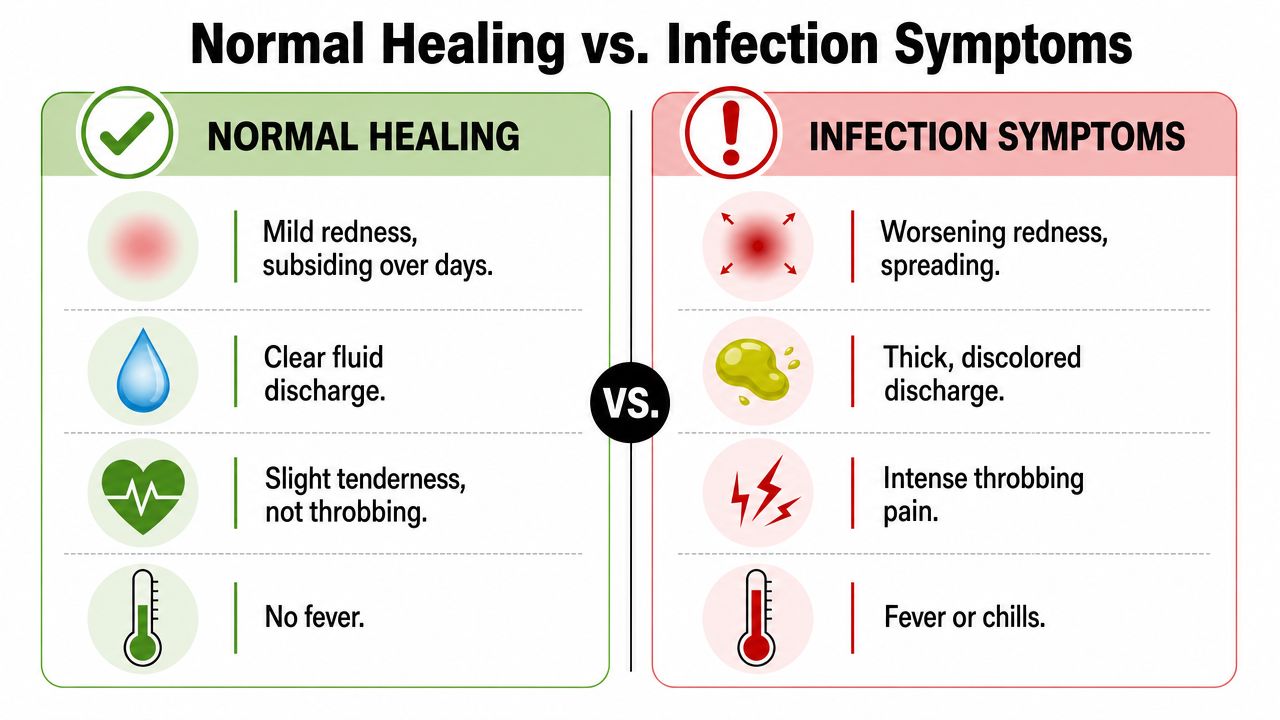
A practical side by side check
| Normal healing | True infection symptoms |
|---|---|
| Mild redness close to the piercing | Redness that worsens or spreads outward |
| Light swelling that settles or fluctuates after sleep or a knock | Swelling that keeps building, feels tight, or starts to press on the jewellery |
| Tenderness, mainly when touched, cleaned, or caught | Pain that becomes more constant, sharper, throbbing, or hot |
| Clear, pale, or whitish fluid that dries into crust | Thick yellow or green discharge, especially if it stays wet or smells unpleasant |
| Mild warmth early on | Noticeable heat that persists or increases |
| Feels irritated but otherwise manageable | May come with feeling unwell, feverish, or shivery |
The key difference is direction. A healing piercing has small ups and downs, but the overall trend should be calmer. Infection tends to become more inflamed, more painful, and more obvious over a day or two rather than less.
What the discharge usually tells you
Discharge causes a lot of unnecessary panic.
A healing piercing often produces lymph. It is usually thin, clear to off-white, and dries into a light crust around the entry or exit point. That can look unpleasant, but it is common in routine healing.
Pus looks different. It is usually thicker, more opaque, and more likely to stay wet around the jewellery. NHS guidance on infected piercings also lists spreading redness, swelling, and pus as warning signs that need attention, especially if symptoms are not improving with basic care (NHS advice on infected piercings).
Practical rule: Dry, pale crust can be normal. Thick, coloured, smelly discharge needs a closer look.
Don't confuse infection with other problems
A piercing can look angry without being infected. Pressure from sleeping, low-quality jewellery, over-cleaning, trapped moisture, and repeated snagging can all produce redness and swelling.
Migration and rejection can also confuse the picture because the area may stay sore and irritated for reasons that are not primarily bacterial. If the skin looks thinner, the jewellery is sitting more shallowly, or the angle seems to be changing, this guide to piercing rejection signs helps separate that from infection.
Why cartilage needs more caution
Cartilage piercings deserve a lower threshold for concern. They often swell more dramatically than lobes, and once they become significantly inflamed, they can deteriorate faster and are harder to settle.
If an upper ear piercing becomes very swollen, very hot, increasingly painful, or starts producing thick discharge, contact a piercer or a doctor promptly. With cartilage, waiting to “see how it goes” is often the wrong trade-off.
A Detailed Look at Common Infection Signs
Clients often message after a shower or before bed saying the piercing suddenly looks worse than it did that morning. That is usually the moment to stop guessing and check the pattern of symptoms, not just one detail.
A piercing that is irritated can look dramatic. A piercing that is infected usually feels and behaves differently as well. The useful question is not “does it look bad?” It is “is it getting more inflamed, more painful, and more active rather than gradually settling?”
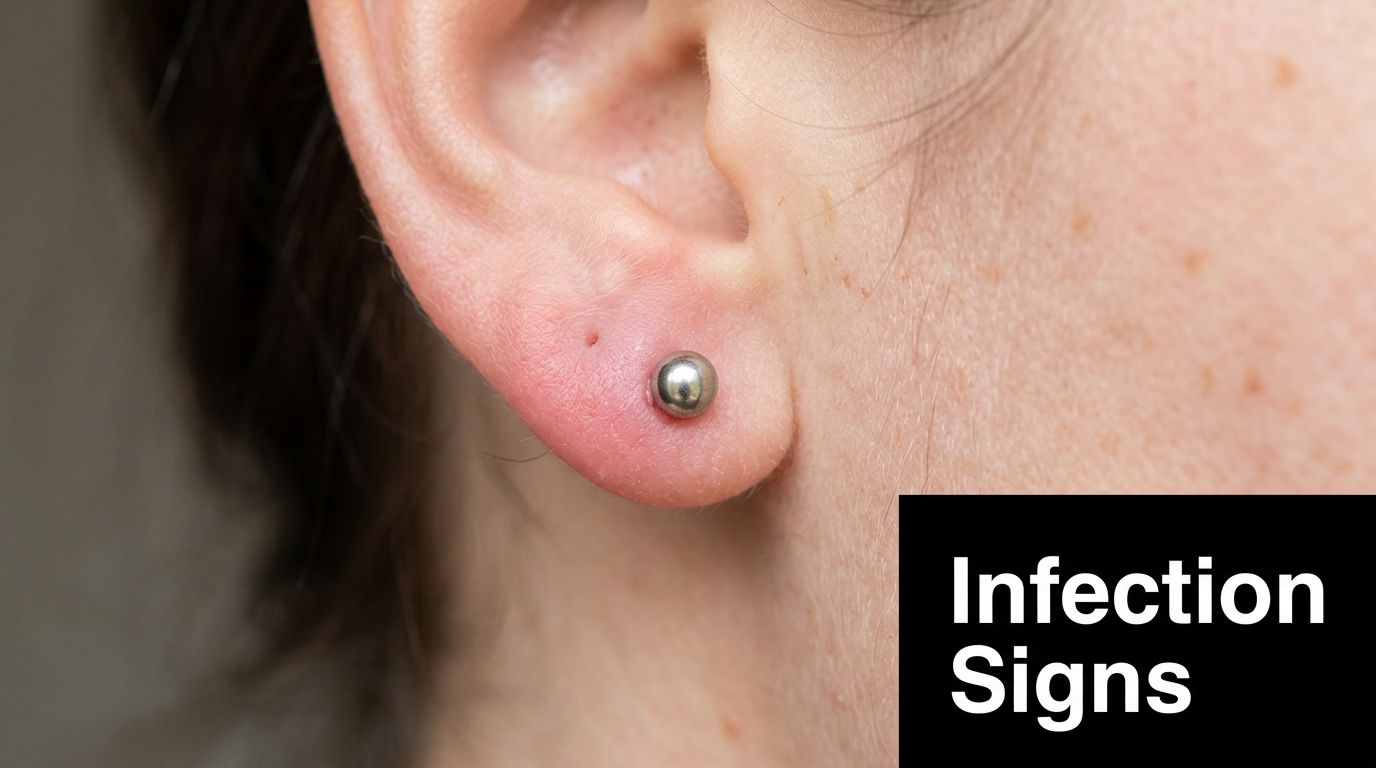
Pain that changes character
Normal healing soreness usually has a reason. You catch the jewellery on a towel, roll onto it in your sleep, or knock it while changing clothes, and it complains for a while.
Infection-type pain is often present even when the area is left alone. People describe it as deeper, hotter, more pressurised, or throbbing. If the piercing hurts at rest and the pain is increasing day by day rather than easing, that deserves attention.
Redness that spreads beyond the piercing channel
Some local redness close to a new piercing is expected, especially in the early stage or after irritation. What concerns me more is redness that starts extending into the surrounding skin.
On lighter skin, that may look bright red and wider than before. On darker skin, it may look deeper in colour, more purple, or more inflamed than the surrounding area. Compare the size of the red area from one day to the next. If it is clearly expanding rather than staying close to the entry and exit points, treat that as a warning sign.
Heat and swelling that keep building
Fresh piercings can feel warm. Trouble starts when the area feels distinctly hot and stays hot.
Swelling from infection often looks dense and tense rather than puffy. The jewellery can start sitting tightly, leave pressure marks, or stop having any visible clearance around the post or bar. That is a practical sign clients can check in the mirror.
If the tissue looks like it is starting to rise over the jewellery, get advice quickly.
Discharge that looks like pus, not healing fluid
This is one of the easiest places to get confused. Normal healing fluid usually dries into a pale or slightly yellow crust. It is often thin and dries without much fuss.
Discharge that points more strongly to infection tends to be thicker and wetter. It may look white, yellow, or green, and it can keep reappearing instead of drying up once and settling. An unpleasant smell also makes infection more likely, especially when it appears alongside worsening pain, heat, and swelling.
The pattern matters more than any single symptom
One crusty morning is not enough to call it infected. One day of extra soreness after sleeping on it is not enough either.
What raises concern is a cluster of signs that are all moving in the wrong direction:
- Pain that is becoming more constant or more intense
- Redness that is spreading outward
- Noticeable heat at the site
- Swelling that makes the jewellery look tight
- Thick, discoloured, or persistent discharge
That combination is the practical difference between a piercing that needs calming down and one that may need treatment. If you are unsure, compare how it looked yesterday, how it feels at rest, and whether the symptoms are staying local or spreading. That gives you a much clearer answer than colour alone.
Red Flags That Require Medical Attention
You wake up, look in the mirror, and the piercing does not just look irritated. The redness has spread, the area feels hotter than the skin around it, and you feel rough in yourself as well. That is the point where I tell clients to stop troubleshooting at home and get medical advice.
A sore piercing can often be settled with better aftercare and a jewellery check. A worsening piercing with spreading symptoms is different. The practical question is no longer, "Is this normal healing or irritation?" It becomes, "Is this staying local, or is it starting to affect the surrounding tissue or your whole body?"
When home care is no longer the right plan
If the area is getting more swollen, more painful, or more inflamed day by day, do not keep switching between salt soaks, ointments, tea tree oil, and internet advice. That usually adds irritation and delays proper treatment.
Good aftercare supports healing. It does not fix a developing infection. If you need a refresher on proper cleaning while you arrange help, follow a simple aftercare routine for cleaning a new piercing, then leave it alone.
Red flags to treat as urgent
Get medical attention promptly if you notice any of these signs:
- Redness or swelling spreading beyond the piercing site: A problem that is extending into the surrounding skin needs more than watchful waiting.
- Fever, chills, or feeling generally unwell: Once you have body-wide symptoms, this is no longer just a local piercing issue.
- Thick discharge with a strong odour: Persistent pus is more concerning than the pale crust seen in normal healing.
- Jewellery starting to sink in or become trapped: Embedding can turn into a pressure problem quickly, especially if swelling continues.
- A hot, swollen cartilage piercing: Helix, tragus, conch, and other cartilage placements need faster medical review than a mild lobe problem.
Cartilage is the one I worry about sooner. It has a poorer blood supply than soft earlobe tissue, so infections there can become harder to settle and more damaging if they are left to run on.
What to avoid while you wait to be seen
Keep the area clean. Keep the jewellery stable. Do not start experimenting.
- Do not squeeze or drain it yourself: That can push irritation deeper and damage the channel.
- Do not use harsh antiseptics unless a clinician tells you to: Strong products often inflame tissue that is already struggling.
- Do not remove the jewellery on impulse: In some cases, removal makes assessment harder or allows the surface to close over. If a doctor advises removal, follow that advice.
If you are unsure whether it is doctor territory or piercer territory, use a simple rule. Local irritation, pressure issues, or jewellery fit problems are usually worth a call to a professional piercer first. Spreading redness, fever, marked swelling, or a cartilage piercing getting rapidly worse should be assessed medically. As noted earlier, that difference matters more than any single symptom on its own.
How to Prevent Piercing Infections
You leave the studio with a piercing that looked clean and felt fine. Three days later it is tender, a bit swollen, and you start wondering whether you are seeing normal healing, irritation from daily knocks, or the start of an infection. Prevention is what keeps that question from becoming urgent.
Good prevention starts before aftercare. A well-placed piercing with suitable jewellery is less likely to stay angry, trap pressure, or get repeatedly disturbed while it heals. Poor angle, cheap metal, and jewellery that is too short create problems early, and those problems can look worrying even when bacteria are not the main issue.
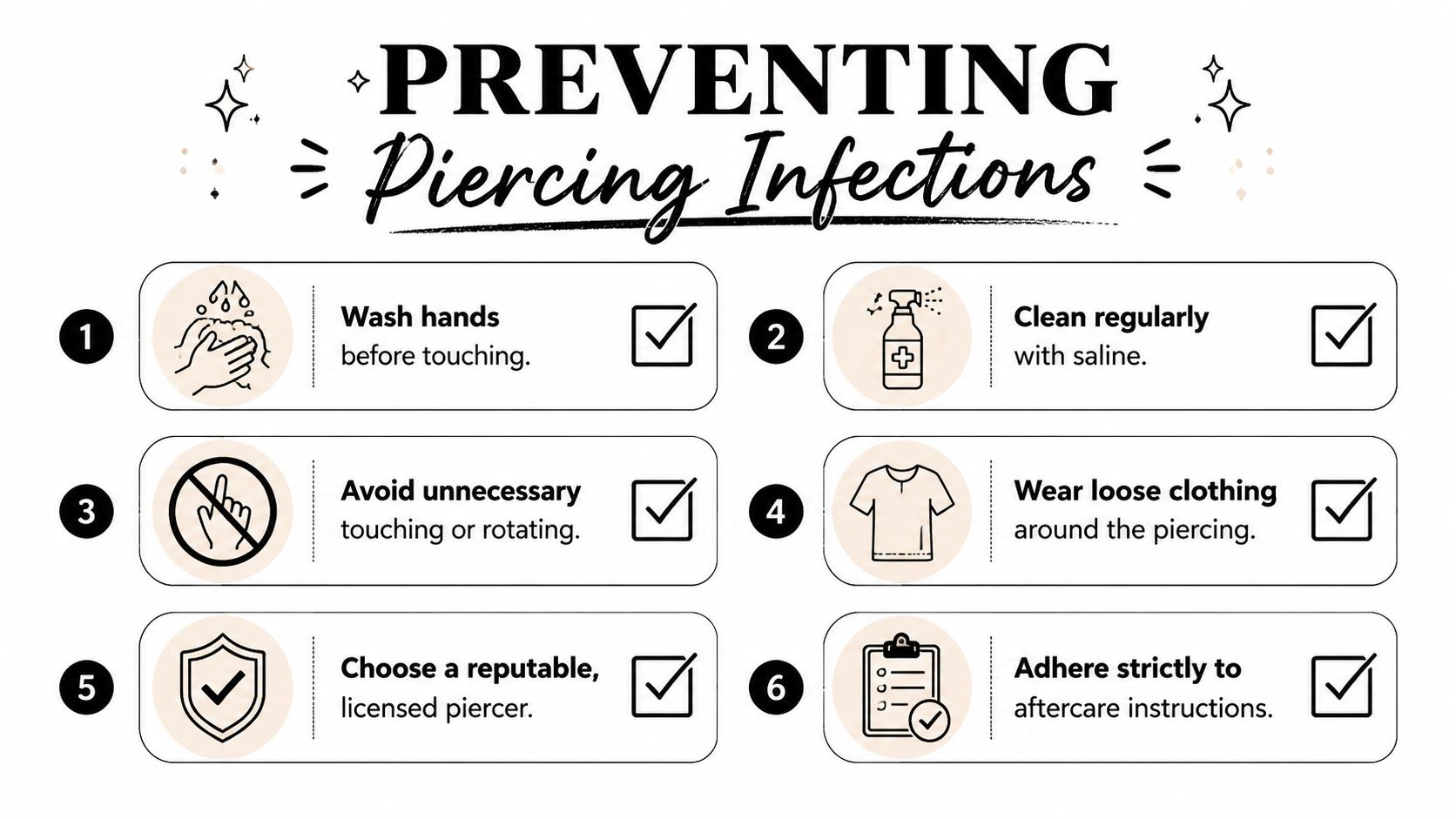
What reduces risk before you're pierced
Choose a studio that treats setup and hygiene seriously. A reputable piercer should use single-use sterile needles, clean technique, and jewellery made for fresh piercings, preferably implant-grade materials rather than unknown alloys.
Placement matters just as much. If the piercing sits at a poor angle or the post has no room for normal swelling, the area can stay irritated from day one. That irritation is often mistaken for infection later, which is why a good start matters.
Healing also depends on whether the piercing suits your anatomy and routine. If you sleep on one side, wear helmets, use earbuds all day, or have hair that constantly catches, those details should shape the jewellery choice and placement plan.
Daily Habits That Help
Simple aftercare usually works best. The goal is to keep the area clean, dry, and undisturbed, not to keep treating it all day.
- Wash your hands before touching it: If you do not need to touch it, leave it alone.
- Use sterile saline for gentle cleaning: Clean off obvious debris, then stop. Scrubbing slows healing.
- Keep the jewellery still: Twisting, turning, and lifting the jewellery irritate the channel.
- Reduce friction and pressure: Towels, tight clothing, phones, headphones, and sleep pressure are common setbacks.
- Keep hair and products off the site: Makeup, hairspray, creams, and perfume can all trigger irritation.
For a clear routine, follow this guide on how to clean a new piercing safely.
Small habits make a real difference. Clean pillowcases, fresh towels, and giving the piercing space to settle are often more useful than adding another product.
Remedies that sound helpful but usually aren't
I see more trouble from over-cleaning than under-cleaning. People get nervous, start trying three or four products, and end up with tissue that is dry, inflamed, and harder to judge.
Avoid:
- Alcohol-based products: These dry the tissue and can increase stinging and redness.
- Hydrogen peroxide: It is too harsh for routine piercing care.
- Thick ointments: These can smother the area and trap moisture and debris.
- Tea tree oil and home mixes: These are common causes of irritation.
- Constant checking: Repeated handling keeps the piercing unsettled.
Less interference usually gives you a calmer, easier heal.
Your Action Plan Contact a Piercer or Your GP
When you're worried, the best response is a simple decision path. Not every unhappy piercing needs a doctor. Not every sore piercing should be ignored either.
Use this as your next-step filter.
If it looks irritated but not infected
If the piercing is mildly sore, slightly red close to the site, and producing only light clear or whitish crust, treat it like an irritated healing piercing.
Do this:
- Return to basic aftercare
- Stop touching and rotating the jewellery
- Reduce pressure, friction, and snagging
- Ask a professional piercer to assess the fit and angle
If you want a more detailed overview of what professional support can look like, this page on infected piercing treatment options is a useful reference.
If you suspect a mild local infection
If the area is getting hotter, more swollen, and more painful, with thicker discharge, contact a professional piercer promptly for non-medical guidance and a visual check. A good piercer can often tell whether the issue looks like irritation, pressure, poor jewellery fit, or something that should go straight to a clinician.
Call us on 01202 9000 50 or message WhatsApp 07752913846 if you need practical piercing advice.

If you have red flag symptoms
Go to your GP or urgent care if you have spreading redness, worsening swelling, foul-smelling pus, fever, chills, or feel generally unwell. That's the point where medical treatment may be needed.
For cartilage piercings, be even more cautious. A helix or conch that becomes very hot, swollen, and increasingly painful deserves faster escalation than people often realise.
The right question isn't “Can I manage this myself?” It's “Am I seeing a local irritation, or a problem that's now bigger than aftercare?”
If you're unsure, don't guess for too long. A piercer can help with the piercing side of the problem. A doctor can treat the medical side. Knowing which lane you're in is the whole point.
Call 01202 9000 50 or send a WhatsApp message to 07752913846 if you want a professional opinion on whether your piercing looks irritated, pressured, or seriously concerning.
If you need clear, practical support, Piercing Near Me helps you find trusted professional advice and safe studios, including guidance for common healing problems before they turn into bigger ones.