
You're probably here because you want that clean, polished look. A pair of small gold hoop earrings that works with everything, feels easy to wear, and doesn't look overdone. On paper, it sounds simple.
Then you start shopping or browsing piercing ideas and the confusion kicks in. Real gold or gold-plated. Huggie or clicker. Tiny and snug, or slightly larger. Safe for a fresh piercing, or only safe once fully healed. That's where people make expensive mistakes, or worse, end up with irritation, swelling, or jewellery that looks good for a week and feels awful after that.
I'm writing this the way I'd explain it in the studio chair. If you want small gold hoop earrings, you need both style advice and piercing advice. Most articles give you one or the other. Very few tell you how to get the gold look you want without compromising healing, comfort, or long-term ear health.
The Enduring Appeal of Small Gold Hoops
Small gold hoop earrings stay popular because they solve a style problem beautifully. They're minimal without being boring, noticeable without shouting, and they suit almost every wardrobe. You can wear them with work clothes, gym basics, a date-night outfit, or a stack of other ear jewellery and they still make sense.
That's exactly why people underestimate them.
A client will often come in with a screenshot of a very tight, shiny little gold hoop and say, “I want this.” What they usually mean is the look. What they don't yet know is that two hoops can look nearly identical online and behave completely differently in a piercing. One may be safe, smooth, and comfortable. The other may be plated over poor-quality metal, too tight for swelling, and awkward to clean.
Small hoops are simple in appearance, but they're not a simple piercing decision.
This is where style-led advice often falls short. A 2025 Beauty & Care survey of UK residents found that 78% of consumers report skin irritation from non-implant-grade gold alloys, which is exactly why “gold look” and “safe for a healing piercing” should never be treated as the same thing.
Why people get caught out
A few common scenarios come up again and again:
- You buy by appearance only. The hoop looks perfect online, but the metal isn't suitable for a new or sensitive piercing.
- You choose the tiniest possible diameter. It gives the snug effect you want, but creates pressure on the piercing.
- You pick a closure that's difficult to handle. Then the jewellery twists, catches, or gets forced during cleaning.
- You assume all gold jewellery is premium. Some gold-coloured hoops are only surface-finished, and that matters.
The good news is that you can absolutely get the look you want. You just need to choose in the right order. First material. Then fit. Then closure. Then styling.
Not All Gold Is Created Equal Your Material Guide
The biggest mistake I see is people asking for “gold” when what they really want is a gold appearance. Those aren't always the same thing, and in piercing, that difference matters.
For a healing piercing, the first question isn't “How yellow is it?” It's “What is this made from?”
What's safe for a fresh piercing
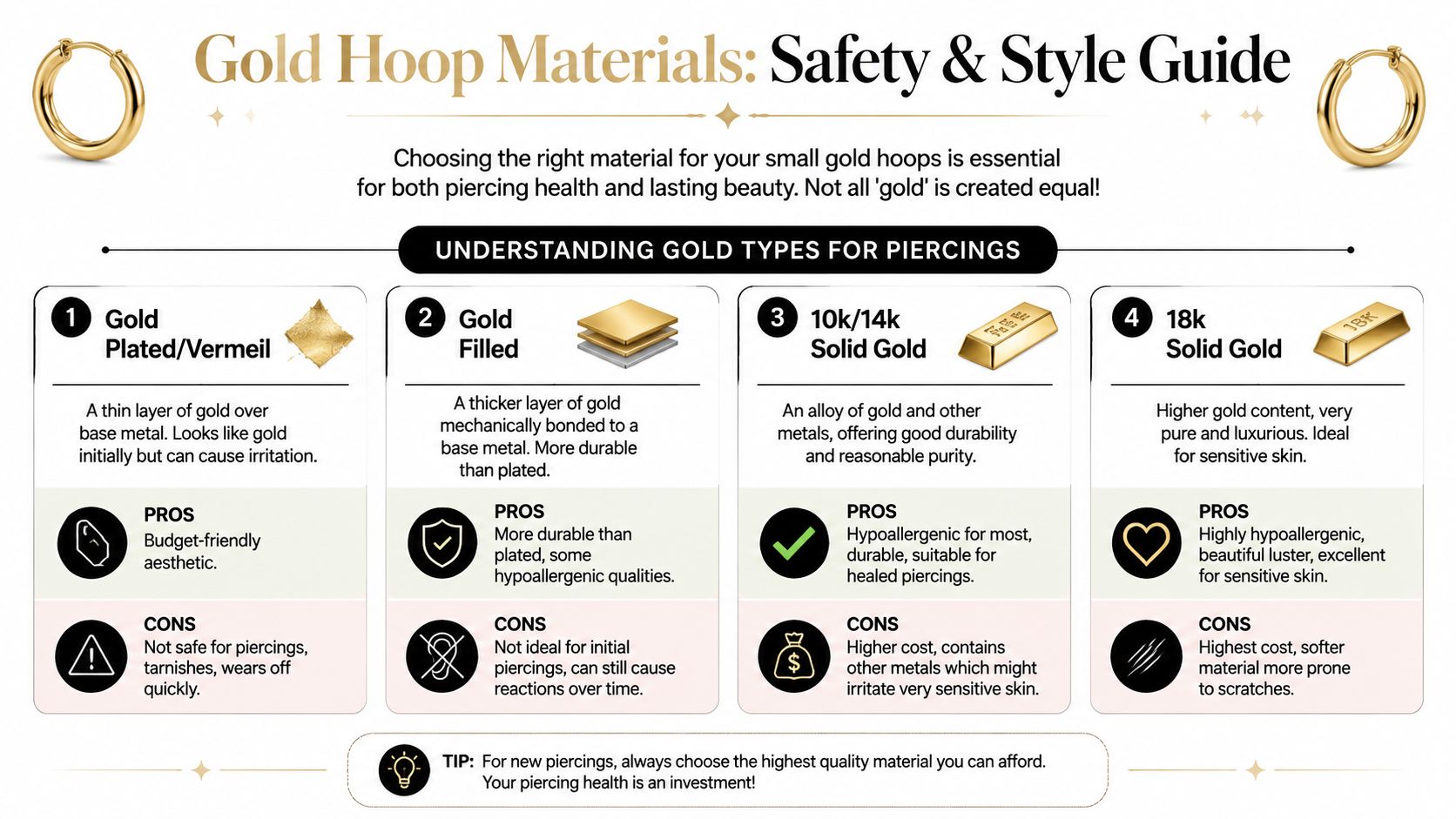
According to the Association of Professional Piercers guidance on jewellery for initial piercings, gold is appropriate for initial piercings only if it is 14k or 18k, nickel-free, and cadmium-free. The same guidance also states that gold higher than 18k is too soft for body jewellery. That softness matters because jewellery for a healing piercing must hold its shape and surface quality well.
So if you're choosing actual gold for a new piercing, the shortlist is narrow. It has to be the right karat and free from problem metals.
Why plated jewellery causes problems
Gold-plated jewellery is one of the most misunderstood options. It can look lovely at first, but the base metal underneath is what worries professional piercers. Once plating starts to wear, the ear may react to what's beneath the surface. Even before visible wear, poor-quality plating and rough finishing can make a piercing harder to settle.
For fashion wear in a fully healed ear, some people tolerate plating just fine. For a new piercing, it's a gamble I wouldn't recommend.
Here's the practical hierarchy I use in plain terms:
- Best for healing piercings. Implant-grade titanium, or suitable 14k or 18k nickel-free, cadmium-free gold.
- Often fine for healed piercings. Solid gold styles chosen with care.
- Best kept out of healing piercings. Plated or low-quality alloy jewellery.
Why many piercers choose titanium with a gold finish
This surprises clients at first, but it makes sense once you hear the logic. If you want the gold look with the least fuss, implant-grade titanium with a medical PVD coating is often the smartest option.
UK piercing stock for sensitive clients commonly uses ASTM F136 implant-grade titanium, with the gold colour created through medical PVD coating or high-quality gold plating. The verified guidance also notes that the plating should be at least 1.5 microns thick to help prevent early tarnishing and nickel exposure in sensitive skin, as described in this UK gold hoop body jewellery guidance.
That's why “titanium gold earrings” isn't a contradiction. It's often the professional answer to a very normal client request. If you want to understand that option better, have a look at these titanium gold earrings.
Practical rule: If the piercing is new, healing, or easily irritated, choose the safest base material first and the colour second.
Hallmarks and what they tell you
In the UK, hallmarked gold matters. Verified UK retail information notes that 22ct gold contains exactly 91.6% pure gold by weight, and certified hallmarked 22ct gold hoop earrings must bear the maker's mark, the gold content mark, and the assayer's mark, as outlined in this 22ct hoop earring reference.
For everyday small hoop earrings, you'll also see plenty of 18ct yellow gold, which contains 75% pure gold. If you're buying gold jewellery rather than piercing jewellery, hallmarking and composition are worth asking about every time.
Finding Your Perfect Fit A Sizing And Diameter Chart
A hoop can be made from excellent material and still be the wrong choice if the fit is off. Size affects comfort, pressure, swelling room, and how easy the jewellery is to clean.
The first measurement typically noticed is diameter, usually shown in millimetres. For example, UK retailers commonly sell small gold hoops in sizes such as 11mm, and verified market information notes that 11mm is a commercially standardised size for small hoops in the British market, with examples from UK jewellers including T H Baker and Pragnell, referenced in this UK hoop size overview.
That doesn't mean 11mm is right for every piercing.
Diameter matters more than people think
A hoop that sits too tightly can pull on the piercing channel. That's especially risky in a newer lobe or cartilage piercing, where even a small amount of tension can keep the area irritated.
Verified clinical guidance for small hoops says the inner diameter is critical, and that a minimum inner diameter of 12mm is recommended for snug styles to reduce pressure-point trauma during the 6–8 week lobe healing phase, as noted in this small hoop sizing guidance.
That's why the hoop you loved in a photo may need to be slightly larger in real life. Fresh piercings need room.
Diameter and gauge are not the same
People often mix these up.
- Diameter is the width of the circle.
- Gauge is the thickness of the wearable part that goes through the piercing.
If you only focus on the diameter, you can still end up with jewellery that feels wrong. A thicker hoop can look bolder and feel more substantial. A thinner hoop can look more delicate. Your anatomy, placement, and healing stage decide what works best.
Hoop Diameter Guide for Common Ear Piercings
| Piercing Placement | Recommended Initial Diameter (mm) |
|---|---|
| Lobe | 12mm or larger if swelling room is needed |
| Helix | Piercer assessment needed, often larger than a snug healed fit |
| Tragus | Piercer assessment needed based on anatomy |
| Conch | Piercer assessment needed, often requires more room than expected |
| Daith | Piercer assessment needed based on ear shape and entry angle |
For placements beyond the lobe, I don't recommend self-selecting a hoop size online for an initial piercing. Cartilage anatomy varies too much.
A hoop should sit comfortably around the tissue. It should never look as if it's squeezing the piercing into place.
A better way to choose your size
Use this order:
- Choose the placement. Lobe and cartilage don't behave the same way.
- Assess swelling room. Fresh piercings need more space than healed ones.
- Match the visual goal. A neat huggie look often comes later, after healing.
- Let a piercer measure you. That's how you avoid buying twice.
The safest-looking jewellery choice is often not the smallest one in the tray. It's the one that fits your ear properly.
A Guide to Hoop Closure Types
A hoop's closure changes how secure it feels, how easy it is to insert, and how much movement happens at the piercing site. That matters much more than is often realised.
Clickers or hinged segment rings
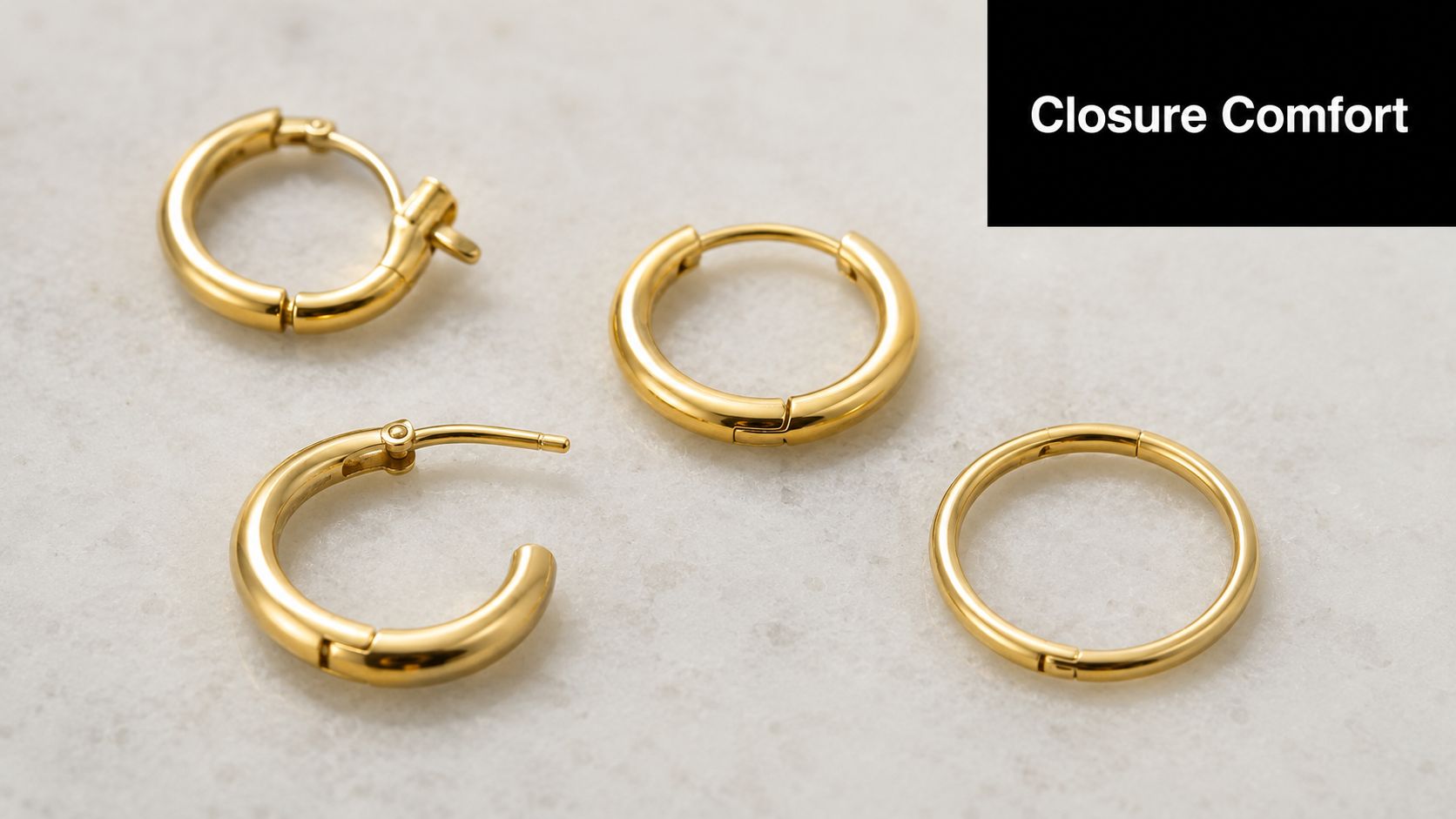
These are usually the easiest for clients to understand. A small segment opens on a hinge and clicks shut cleanly. They feel secure, look neat, and don't require as much fiddling as some other styles.
For many healed piercings, clickers are the most user-friendly option. In some fresh piercings, they can also work well when chosen in the correct size and quality.
Seamless rings
Rings with a barely visible closure have a very clean look because the join is subtle. That's the appeal. The downside is that they can be awkward to open and close correctly, especially at home.
If they're bent badly during handling, they may stop lining up properly. In a healing piercing, excess movement from difficult jewellery changes can cause unnecessary irritation.
Captive bead rings
A captive bead ring holds a small bead in place under tension. These are classic in professional piercing because they're reliable and versatile. They also work well in placements where a bead can help with handling.
Some clients love them. Others find them less convenient for day-to-day wear because the bead can feel more technical or less minimal than a plain hoop.
Which closure suits which client
Here's the short version:
- Choose clickers if you want easier handling and a polished finish.
- Choose continuous rings if you love a very clean look and don't plan to change them yourself often.
- Choose captive bead rings if your piercer recommends them for stability or placement-specific reasons.
If you're new to piercings, don't pick the closure based on looks alone. Pick the one you're most likely to live with comfortably.
Styling Your Ear From Single Hoops to Curated Stacks
Once the safety basics are handled, small gold hoop earrings become one of the easiest jewellery styles to build around. They're flexible. A single hoop can look quiet and refined, while a few carefully placed hoops can give your ear shape and character.
Start with one anchor piece
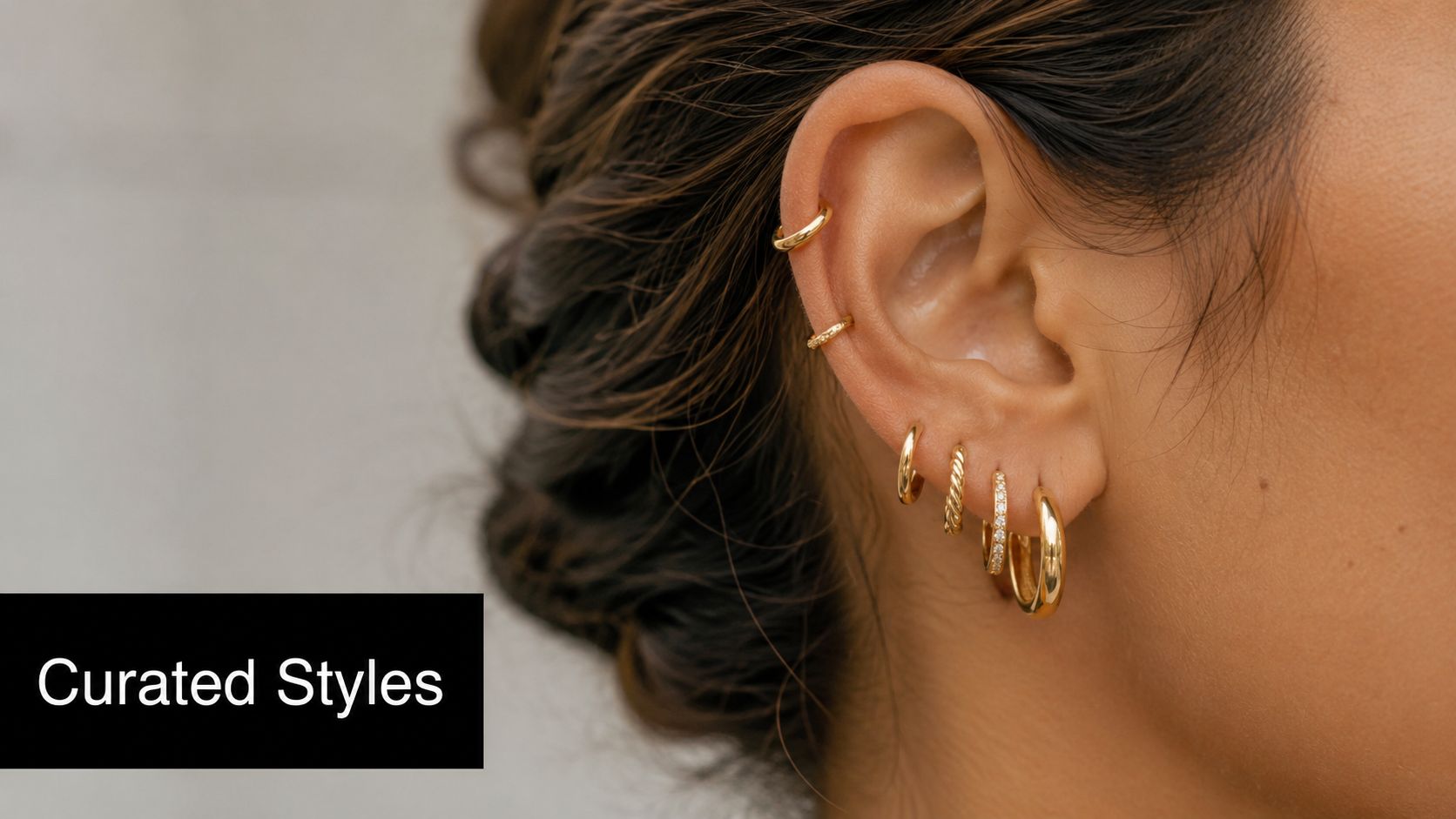
The easiest way to style an ear is to choose one hoop as the visual anchor. This is typically the first lobe piercing. A simple small gold hoop there gives you a base that works whether the rest of the ear is bare or fully curated.
Then decide what mood you want:
- Clean and minimal. One lobe hoop and a tiny stud elsewhere.
- Balanced stack. Matching or similar hoops moving up the ear.
- Soft contrast. A plain hoop paired with a textured or stone-set piece.
Use size changes to create shape
A curated ear looks best when it has rhythm. That usually means the lower hoop is slightly more prominent, with smaller pieces as the eye moves upward. You don't need dramatic differences. Even a subtle change in diameter can make the stack feel intentional.
For example:
- first lobe with a small classic hoop
- second lobe with a slimmer, slightly tighter hoop
- helix with a delicate hoop or stud
- tragus with a very minimal piece
That kind of arrangement feels polished without looking crowded.
Mix placement, not chaos
People often think a stacked ear means “more”. It doesn't. It means the placements talk to each other. If every hoop is chunky, the ear can look heavy. If every piece is tiny and identical, the stack can disappear.
A better approach is to mix one or two variables:
- Texture. Smooth hoop with a twisted or faceted hoop
- Width. One slightly thicker hoop, others finer
- Placement. Keep the lower ear softer and let cartilage add detail
If you're planning a fuller look, this guide to designing stunning full ear piercings is worth saving.
The best stacked ear doesn't look crowded. It looks considered.
Match the style to your routine
A beautiful ear stack still has to work with your life. If you wear headphones often, sleep on one side, or need something office-friendly, keep the profile low and the shapes smooth. Small gold hoop earrings are ideal for that because they add warmth and detail without getting in the way.
If you're just starting, begin with one or two placements and wear them for a while. A curated ear doesn't have to be finished in one appointment to look good.
Cleaning and Aftercare for Lasting Shine and Health
Good jewellery can still fail if aftercare is poor. Most problems I see after a hoop piercing come from overhandling, harsh products, or jewellery changes done too soon.
For healing piercings, your focus is simple. Keep the area clean, keep your hands off it, and let the jewellery sit still.
The standard daily routine
For the piercing itself:
- Use sterile saline. Clean away dried discharge gently.
- Leave the hoop alone. Don't twist it just to “stop it sticking”.
- Rinse after showers. Warm water helps soften buildup.
- Dry carefully. Pat dry with clean disposable material or let it air dry.
For the jewellery surface, remember that safe piercing jewellery should be finished to a very high standard. Verified piercing guidance notes that metallic jewellery should have an extremely smooth surface finish to reduce bacteria adhesion and irritation, achieved through processes that comply with ASTM F86 for surface finish and passivation, as described in this professional jewellery standards resource.
That smooth finish helps you. It also means you shouldn't attack the jewellery with abrasive cloths, alcohol, or random cleaning hacks from social media.
What to avoid
This list solves a lot of problems before they start:
- Don't rotate the hoop. Movement irritates the channel.
- Don't use harsh antiseptics. They can dry and inflame the area.
- Don't sleep directly on a fresh piercing if you can avoid it.
- Don't swim in pools or hot tubs during early healing.
- Don't remove jewellery too soon because the outside “looks fine”.
If you want a more detailed routine, this aftercare guide on how to clean a new piercing gives a useful step-by-step refresher.
Keeping the gold look looking good
For healed jewellery worn as fashion pieces, gentle cleaning is enough. Warm water, mild soap, and a soft cloth usually do the job. For gold-finished titanium, keep it simple and avoid abrasive polishing products that can wear the finish faster.
If your hoop starts looking dull quickly, don't assume that's normal. It may be a sign the finish quality wasn't good enough to begin with.
Book Your Safe Piercing at Timebomb Tattoo & Piercing
If you've read this far, you already know the actual answer to “What small gold hoop should I get?” is usually, “Let's look at your ear properly first.”
That's not a sales line. It's the truth. The right hoop depends on your anatomy, the placement, whether the piercing is fresh or healed, how snug you want the final look, and what material your skin is likely to tolerate best. A professional consultation saves you from choosing blindly.
At Timebomb Tattoo & Piercing in Croydon and Bournemouth, that conversation should cover the details that matter in real life:
- Anatomy assessment so the hoop suits your ear rather than just a trend photo
- Accurate measurement for diameter and wearable fit
- Material guidance so you're not guessing what “gold” means
- Safe technique using single-use sterile needles
- Aftercare support so you know what's normal and what isn't
Why a studio consultation matters
Online shopping can show you styles. It can't examine your ear.
A piercer can tell you whether the hoop you want is realistic for a fresh piercing, whether you should start with a larger ring and size down later, and whether a clicker, captive bead ring, or another option will behave better in your placement. That's the difference between jewellery that only photographs well and jewellery that heals properly.
For clients in Croydon and Bournemouth, it also helps to have access to jewellery that has been selected with piercing safety in mind, not just fashion appeal.
A good piercing appointment should leave you with fewer questions, not more.
Contact Timebomb Tattoo & Piercing
If you want advice before booking, reach out directly and ask the practical questions. A good studio won't mind.
- Phone: 01202 9000 50
- WhatsApp: 07752913846
If you're unsure whether your planned hoop is suitable for a first piercing, or you've already bought jewellery and want an honest opinion on whether it's safe to wear, ask before anything goes into the ear. That one decision can save you a lot of irritation later.
If you're ready to find a reputable studio, compare options, and book with confidence, Piercing Near Me makes it easier to connect with safe, professional piercing services, including trusted guidance for Timebomb Tattoo & Piercing in Croydon and Bournemouth.