
Thinking about a new piercing is an exciting step in personalising your look, but it's essential to be well-informed before making a choice. With so many different types of piercing available, from the classic earlobe stud to more intricate cartilage placements, understanding what each involves is key to a successful and happy healing process. This guide is designed to give you a clear, straightforward overview of some of the most popular options out there.
We will break down 12 distinct piercings, covering crucial details for each one. You'll find practical information on what to expect in terms of pain, typical healing times, and the best aftercare practices to follow. We also dive into the specifics of recommended jewellery materials, such as implant-grade titanium, to ensure your new piercing not only looks great but also heals safely and comfortably.
Our goal is to provide honest, actionable advice to help you make a confident decision that aligns with your style and lifestyle. Whether this is your very first piercing or an addition to a growing collection, this detailed roundup will equip you with the knowledge needed to choose wisely.
At Timebomb Tattoo & Piercing, our professional piercers in both our Croydon and Bournemouth studios are committed to the highest standards of safety and hygiene. We exclusively use single-use, sterile needles and high-quality, implant-grade jewellery for every client. If you're ready to take the next step or have any questions, you can reach our team directly to discuss your ideas.
Contact Timebomb Tattoo & Piercing:
- Phone: 01202 900050 (Bournemouth) / 020 8686 7730 (Croydon)
- WhatsApp: 07752 913846 (Bournemouth) / 07902 490584 (Croydon)
1. Earlobe Piercing (Lower ear lobe)
Often the first foray into the world of body modification, the classic earlobe piercing is a timeless and versatile choice. Located in the fleshy, lower part of the ear, this area’s soft tissue and excellent blood flow contribute to a relatively quick and straightforward healing process. This makes it an ideal starting point for anyone new to getting pierced, and it's one of the most popular different types of piercing we perform at Timebomb.
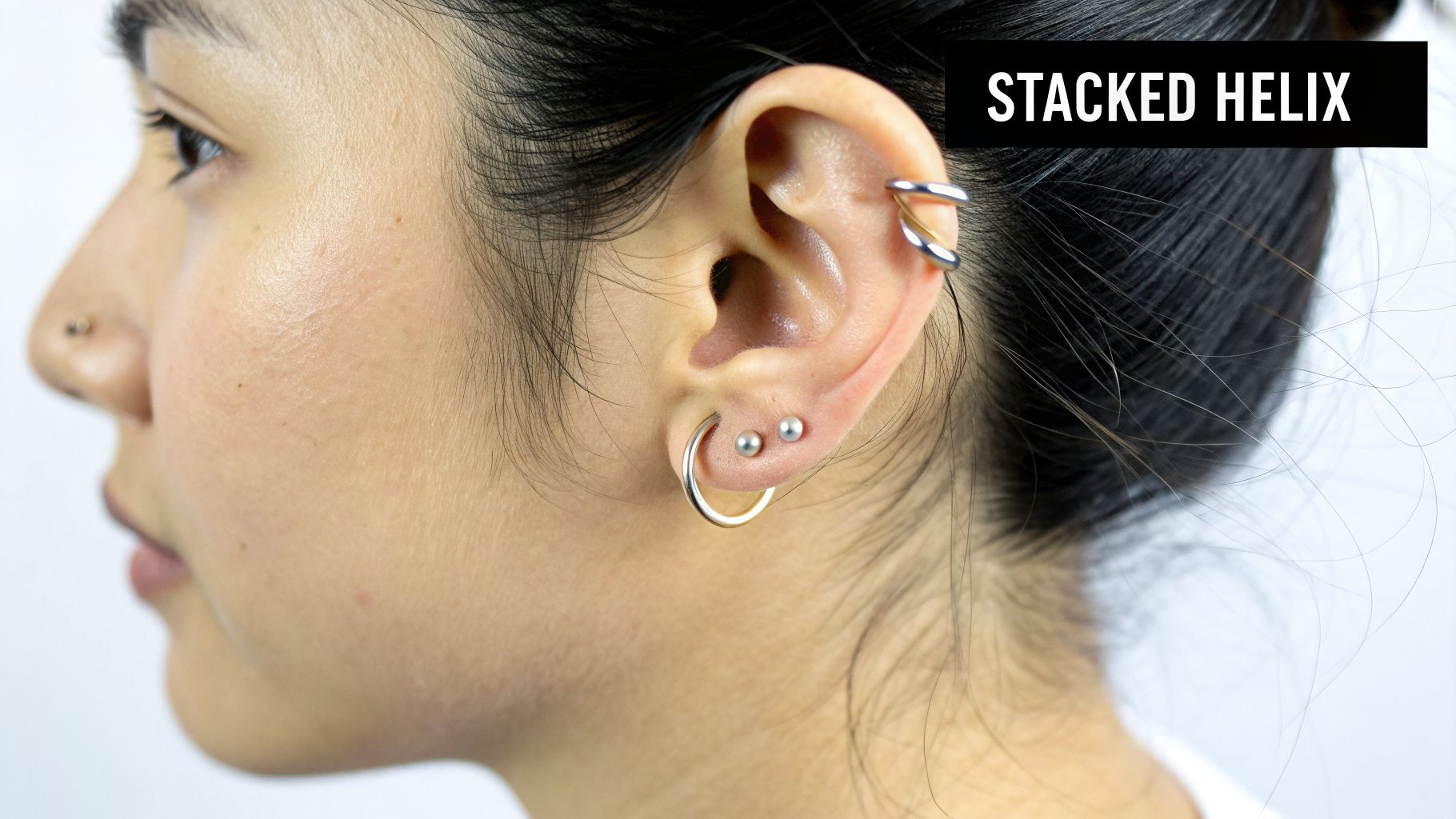
Its popularity stems from both its minimal discomfort and its adaptability. A single stud offers a subtle look, while multiple lobe piercings can be curated into a unique "constellation" or "stack" style. The options for jewellery are nearly endless once healed, from delicate studs to statement hoops.
Earlobe Piercing Fast Facts
- Pain Level: 2/10 (often described as a brief pinch)
- Healing Time: 6-8 weeks
- Best Initial Jewellery: Implant-grade titanium or surgical steel labret studs or barbells. These materials are highly biocompatible, reducing the risk of irritation.
Aftercare Tip: Clean the piercing twice daily with a sterile saline solution. Avoid rotating the jewellery, as this can irritate the healing tissue (known as a fistula). Simply spray the front and back, and gently pat dry with clean, non-woven gauze or kitchen roll.
Thinking about your first piercing or adding to your collection? The earlobe is a fantastic, low-commitment option. You can book your appointment at our Croydon or Bournemouth studios by calling 01202 900050 (Bournemouth) / 020 8686 7730 (Croydon) or sending a message to our WhatsApp at 07752 913846 (Bournemouth) / 07902 490584 (Croydon).
2. Helix Piercing (Outer curved cartilage of upper ear)
A step up from the lobe, the helix piercing is arguably one of the most popular and versatile cartilage piercings available. Located on the upper, outer rim of the ear, this placement provides a perfect canvas for self-expression, making it one of the most requested different types of piercing at our studios. Its high visibility allows for a wide range of jewellery styles, from subtle studs to eye-catching hoops.
The enduring popularity of the helix comes from its customisable nature. A single helix offers a classic look, while a "double" or "triple" helix creates a curated, stacked effect that can be personalised with mixed metals or gemstone settings. As it pierces through cartilage rather than soft tissue, it requires a bit more care and patience during healing but rewards with a stylish and distinctive look.
Helix Piercing Fast Facts
- Pain Level: 4/10 (often described as a sharp but quick pressure)
- Healing Time: 6-9 months, sometimes longer.
- Best Initial Jewellery: Implant-grade titanium labret stud. A stud is less likely to be caught or moved during healing compared to a hoop.
Aftercare Tip: Be mindful of how you sleep. Try to sleep on the opposite side to avoid putting pressure on the new piercing, or use a travel pillow and place your ear in the hole. This minimises irritation and helps the healing process.
Ready to add a classic cartilage piercing to your look? You can book your appointment at our Croydon or Bournemouth studios by calling 01202 900050 (Bournemouth) / 020 8686 7730 (Croydon) or sending a message to our WhatsApp at 07752 913846 (Bournemouth) / 07902 490584 (Croydon).
3. Conch Piercing (Inner ear shell)
A truly distinctive cartilage piercing, the conch is located in the inner, bowl-shaped part of the ear known as the concha. This placement creates a striking look, sitting deeper and more sheltered within the ear's structure than other popular cartilage piercings. Its unique position makes it a fantastic centrepiece for a curated ear, and it’s one of the most requested different types of piercing for clients wanting to make a statement.
The versatility of the conch piercing is a major part of its appeal. Once healed, it can be styled with a simple, elegant stud for a subtle effect or a bold hoop that encircles the outer cartilage for a more dramatic appearance. This adaptability allows for significant personal expression, from delicate boho-inspired setups to more ornate, alternative looks.
Conch Piercing Fast Facts
- Pain Level: 6/10 (a sharp pressure, more intense than a lobe piercing)
- Healing Time: 6-12 months (cartilage takes longer to heal)
- Best Initial Jewellery: Implant-grade titanium labret stud or barbell. These are essential for initial healing due to their biocompatibility and low-profile design, which minimises irritation.
Aftercare Tip: Be patient and diligent with your cleaning routine. Clean twice daily with sterile saline solution and avoid sleeping on the pierced ear for several months to prevent pressure and irritation. Avoid using headphones that press directly on the area during the initial healing period.
Ready to add this standout piercing to your collection? Our expert piercers at Timebomb can guide you through the process. Book your appointment at our Croydon or Bournemouth studios by calling 01202 900050 (Bournemouth) / 020 8686 7730 (Croydon) or sending a message to our WhatsApp at 07752 913846 (Bournemouth) / 07902 490584 (Croydon).
4. Septum Piercing (Nasal septum divider)
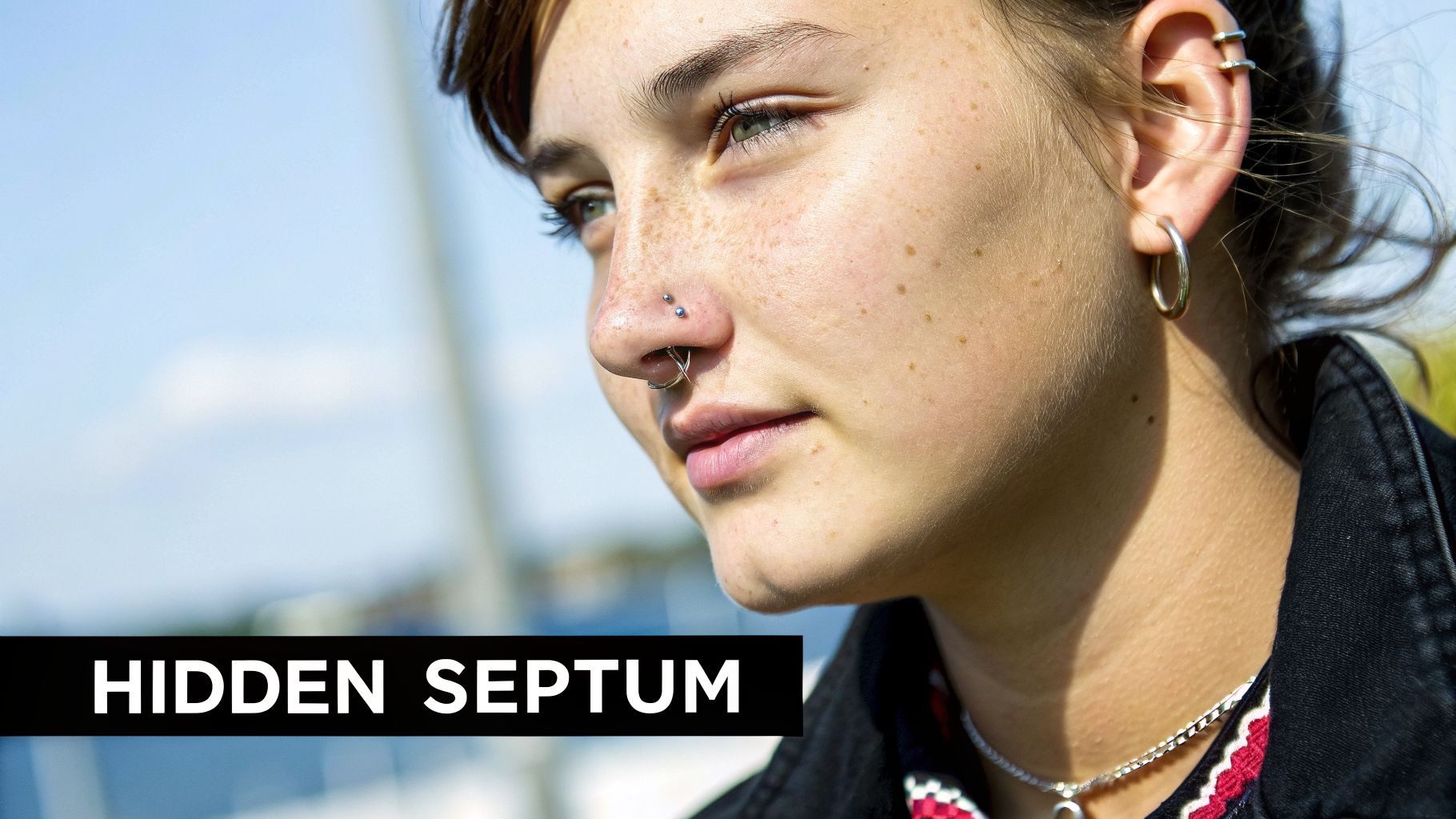
Once a hallmark of alternative subcultures, the septum piercing has become a mainstream and stylish facial accessory. Positioned through the thin membrane of skin that separates the nostrils, its appeal lies in its striking look and surprising practicality. When done correctly, the piercer targets the soft tissue known as the "sweet spot," making the experience less intense than piercing through cartilage. This placement is a key consideration among the different types of piercing available.
Its versatility is a major draw. Jewellery like a circular barbell can be easily flipped up and hidden inside the nose, making it suitable for professional environments or personal preference. This 'now-you-see-it, now-you-don't' feature allows you to control its visibility without having to remove the jewellery, which is perfect for a healing piercing.
Septum Piercing Fast Facts
- Pain Level: 3-4/10 (often described as a sharp sting that makes your eyes water)
- Healing Time: 6-8 weeks for initial healing, but up to 6 months to fully mature.
- Best Initial Jewellery: Implant-grade titanium circular barbells or clickers. These materials are inert and reduce the chance of irritation, while the style allows for easy cleaning.
Aftercare Tip: Proper placement is crucial. An experienced piercer will avoid the cartilage. Clean twice daily by gently spraying sterile saline solution inside each nostril. Try to avoid blowing your nose forcefully and be mindful of nasal sprays during the healing period.
Ready for a statement facial piercing? Our expert piercers at Timebomb ensure correct placement for a comfortable heal. Call us at 01202 900050 (Bournemouth) / 020 8686 7730 (Croydon) or message our WhatsApp at 07752 913846 (Bournemouth) / 07902 490584 (Croydon) to book your appointment in Croydon or Bournemouth.
5. Nostril Piercing (Outer nose side)
Placed on the crease of the nostril, this is one of the most universally recognised and popular facial piercings. The nostril piercing carries deep cultural significance in many parts of the world, particularly in South Asian traditions, and has become a staple of modern alternative and mainstream fashion. It’s a wonderfully customisable placement that can suit almost any face shape.
The versatility of a nostril piercing is a huge part of its appeal. Once fully healed, it can be adorned with a tiny, subtle stud for a minimalist look, or a fitted ring for a bolder statement. Some clients even opt for bilateral piercings (one on each side) for a symmetrical effect. This is another of the most requested different types of piercing at our studios.
Nostril Piercing Fast Facts
- Pain Level: 4/10 (often described as a sharp pinch that makes your eyes water momentarily)
- Healing Time: 4-6 months, sometimes longer for a ring to be comfortably worn.
- Best Initial Jewellery: Implant-grade titanium or surgical steel labret-style stud or nostril screw. These designs are secure and minimise movement, which is crucial for initial healing.
Aftercare Tip: Be very mindful of your new piercing. Avoid catching it on towels or clothing. When cleaning, spray sterile saline solution on the outside and inside of the nostril twice daily and gently pat dry. Avoid applying makeup directly over the fresh piercing.
A nostril piercing is a fantastic way to express your personal style. To discuss placement or book an appointment, call our Croydon or Bournemouth studios at 01202 900050 (Bournemouth) / 020 8686 7730 (Croydon) or drop a message to our WhatsApp at 07752 913846 (Bournemouth) / 07902 490584 (Croydon).
6. Navel (Belly Button) Piercing (Umbilicus area)
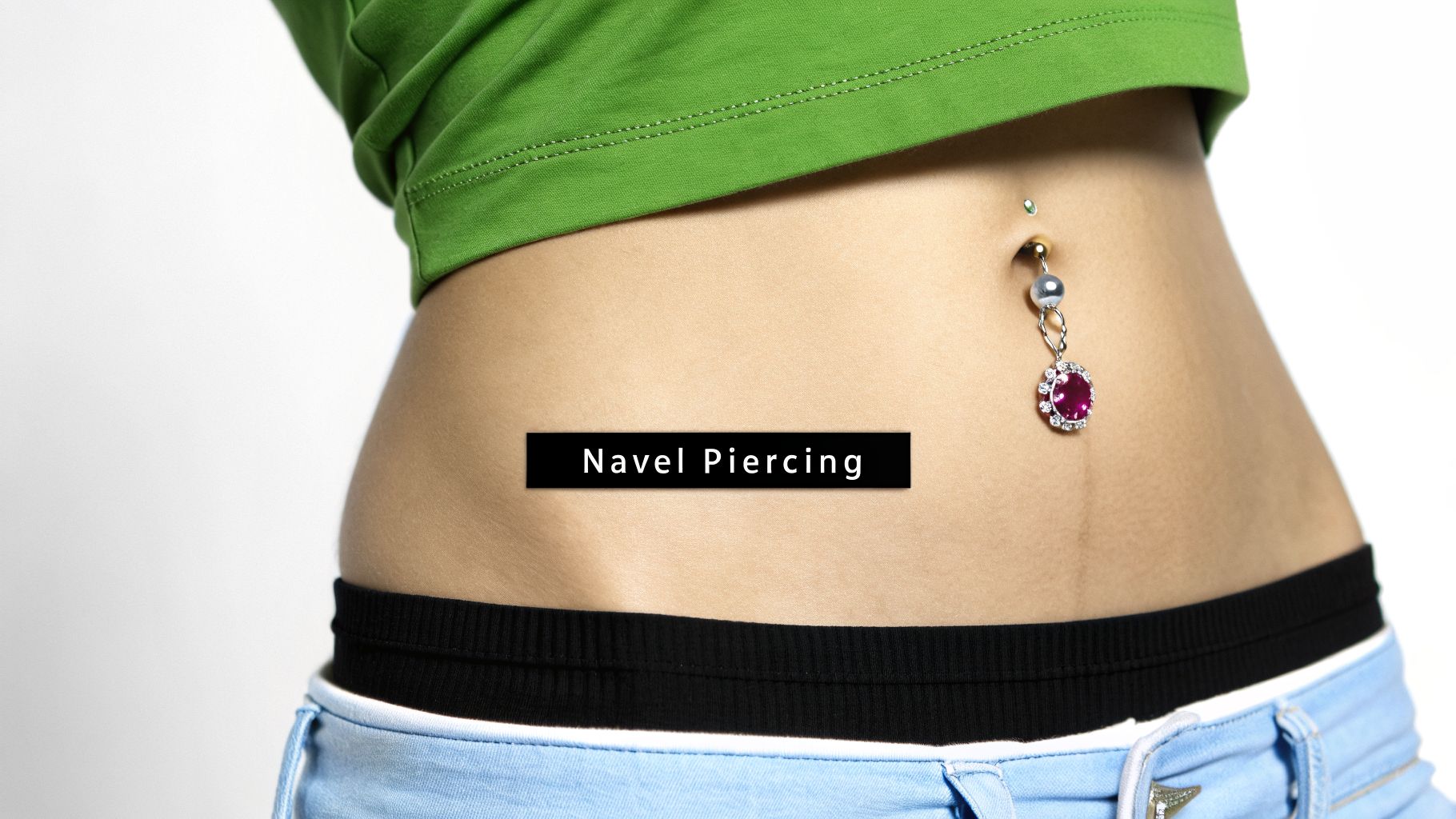
A true icon of 90s fashion, the navel piercing has remained one of the most popular body modifications for decades. Located in the skin on the rim of the umbilicus, this piercing is perfect for showcasing decorative jewellery. Its popularity comes from its stylish appeal and the fact it can be easily concealed under clothing, making it a versatile choice for many. It's a classic example of the different types of piercing that blend personal expression with fashion.
The suitability of a navel piercing is highly dependent on individual anatomy. A successful piercing requires a distinct "lip" of tissue at the top of the navel for the jewellery to sit comfortably without undue pressure. Our expert piercers at Timebomb always conduct a thorough anatomy check to ensure this piercing is a viable and safe option for you. Once healed, the jewellery options are vast, from simple titanium studs to elaborate, dangling barbells with gemstones.
Navel Piercing Fast Facts
- Pain Level: 4/10 (often described as a sharp but quick pressure)
- Healing Time: 6-12 months, can vary significantly
- Best Initial Jewellery: Implant-grade titanium curved barbells (or banana bars). This material minimises the risk of allergic reactions and irritation during the long healing period.
Aftercare Tip: Wear loose, low-rise clothing to avoid friction and pressure from tight waistbands. Clean the area twice daily with a sterile saline solution. It is crucial to avoid submerging the piercing in bodies of water like pools, baths, or the sea for at least the first six weeks.
If you’re considering this classic body piercing, an anatomy consultation is the first step. You can book your appointment at our Croydon or Bournemouth studios by calling 01202 900050 (Bournemouth) / 020 8686 7730 (Croydon) or sending a message to our WhatsApp at 07752 913846 (Bournemouth) / 07902 490584 (Croydon).
7. Dermal Anchor (Single-point body implant)
A unique and modern choice among different types of piercing, the dermal anchor offers a minimalist yet striking look. Unlike traditional piercings that have an entry and exit point, a dermal is a single-point piercing where a base or "anchor" is placed beneath the skin, leaving a single decorative top visible on the surface. This technique allows for placement on flat areas of the body where a standard piercing wouldn't be possible, such as the collarbones, cheekbones, or chest.
The versatility of dermal anchors allows for creative expression, from a subtle sparkle on a cheekbone to symmetrical placements along the collarbones. Due to the specialist nature of this piercing, it's vital to choose a highly experienced piercer, like our professionals at Timebomb, to ensure correct placement and minimise the risk of rejection. They offer a distinct aesthetic that truly stands out.
Dermal Anchor Fast Facts
- Pain Level: 4/10 (often described as a brief, sharp pressure)
- Healing Time: 1-3 months, but can vary significantly based on placement and aftercare.
- Best Initial Jewellery: Implant-grade titanium dermal anchor with a basic, low-profile top. This reduces the chances of snagging during the initial healing period.
Aftercare Tip: Dermal anchors are delicate. Clean twice daily with a sterile saline solution, but avoid any movement, twisting, or pressure on the jewellery. Be extra cautious with clothing, towels, and high-contact activities to prevent it from catching or being dislodged.
Considering a dermal anchor? A thorough consultation is key. To discuss placement options with our expert team, call our Croydon or Bournemouth studios on 01202 900050 (Bournemouth) / 020 8686 7730 (Croydon) or send a message to our WhatsApp at 07752 913846 (Bournemouth) / 07902 490584 (Croydon).
8. Industrial Piercing (Double ear cartilage scaffold)
The industrial piercing is a bold and eye-catching choice that makes a definitive style statement. This unique piercing consists of two separate holes in the upper ear cartilage, one in the helix and another in the forward-helix, connected by a single straight barbell. It’s one of the more complex different types of piercing, as precise alignment is crucial for both aesthetics and successful healing.
Its striking appearance, popularised by punk and alternative subcultures, requires specific ear anatomy. Not every ear has the defined cartilage ridge needed to support an industrial piercing safely, which is why a professional consultation is essential. The team at Timebomb will always assess your ear's shape to ensure this piercing is a viable and safe option for you.
Industrial Piercing Fast Facts
- Pain Level: 7/10 (Two cartilage piercings are created in one sitting, leading to higher initial discomfort)
- Healing Time: 9-12 months, and can sometimes take longer
- Best Initial Jewellery: A custom-fitted, implant-grade titanium straight barbell. The length must be perfect to avoid pressure on the healing cartilage.
Aftercare Tip: Be extremely gentle. Clean twice daily with a sterile saline solution, being careful not to snag the long barbell on hair or clothing. Avoid sleeping on the piercing for the entire healing period to prevent migration and irritation bumps.
An industrial piercing demands commitment but offers a powerful look. To see if your anatomy is suitable, book a consultation at our Croydon or Bournemouth studios by calling 01202 900050 (Bournemouth) / 020 8686 7730 (Croydon) or sending a message to our WhatsApp at 07752 913846 (Bournemouth) / 07902 490584 (Croydon).
9. Rook Piercing (Inner ear cartilage fold)
For those seeking a more distinctive cartilage piercing, the rook offers a striking and stylish option. This piercing is placed vertically through the antihelix, the small ridge of cartilage between the inner and outer parts of the upper ear. Its unique positioning makes it highly visible, creating a sophisticated focal point, especially when adorned with a curved barbell or a small hoop.
The rook is considered one of the more advanced different types of piercing, not only due to its placement through thick cartilage but also because its suitability depends heavily on individual ear anatomy. A well-defined ridge is necessary for a successful piercing, which is something our expert piercers at Timebomb will always assess during a consultation. Once healed, it provides a fantastic canvas for jewellery like ornate rose gold hoops or curved barbells with gemstone settings.
Rook Piercing Fast Facts
- Pain Level: 6/10 (a sharp pressure, more intense than lobe piercings)
- Healing Time: 6-12 months, and can sometimes take longer.
- Best Initial Jewellery: Implant-grade titanium curved barbells. This shape accommodates initial swelling and the material minimises the risk of an allergic reaction or irritation.
Aftercare Tip: Be patient with the healing process. Clean twice daily with a sterile saline solution and avoid sleeping on the piercing. Be particularly careful with headphones or earbuds, as they can put pressure on the area and delay healing.
A consultation is essential to see if your ear is suitable for a rook piercing. You can book an appointment at our Croydon or Bournemouth studios by calling 01202 900050 (Bournemouth) / 020 8686 7730 (Croydon) or sending a message to our WhatsApp at 07752 913846 (Bournemouth) / 07902 490584 (Croydon).
10. Daith Piercing (Innermost ear cartilage curve)
Tucked away in the innermost fold of cartilage just above the ear canal, the daith piercing is a truly distinctive choice. This piercing passes through a thick ridge, making it one of the more advanced different types of piercing available. Its unique placement allows for ornate hoops and curved barbells to sit snugly, creating an eye-catching and intricate feature within the ear's landscape.
The daith has grown in popularity not only for its striking aesthetic but also due to anecdotal claims of it helping with migraines. While not medically proven, its beauty is undeniable. The jewellery options are stunning, ranging from minimalist surgical steel rings to elaborate gold and gemstone-studded clickers, making it a real statement piece for any curated ear project.
Daith Piercing Fast Facts
- Pain Level: 6/10 (a sharp, intense pressure, but it's over quickly)
- Healing Time: 6-12 months, and sometimes longer. Patience is key.
- Best Initial Jewellery: Implant-grade titanium curved barbells, circular barbells (horseshoes), or captive bead rings (CBRs). Hoops are often used, but must have a large enough diameter to accommodate swelling.
Aftercare Tip: Cleaning is crucial due to its protected location. Gently spray sterile saline solution directly onto the area twice daily. Avoid using earbuds, in-ear headphones, or stethoscopes during the initial, and often extended, healing period to prevent irritation and infection.
Due to the specific anatomy required, a consultation is recommended. Our expert piercers at Timebomb can assess your ear and discuss if a daith is the right fit for you. Call us on 01202 900050 (Bournemouth) / 020 8686 7730 (Croydon) or message our WhatsApp at 07752 913846 (Bournemouth) / 07902 490584 (Croydon) to book your appointment.
11. Tragus Piercing (Front ear cartilage protrusion)
The tragus piercing is a stylish cartilage piercing located on the small, pointed piece of cartilage that sits just in front of the ear canal. This distinctive placement has become a popular choice among piercing enthusiasts, offering a look that can be both subtle and eye-catching. Its position makes it a fantastic accent piece, complementing other ear piercings beautifully.
Popularised by alternative fashion and modern ear curation trends, the tragus is a versatile spot. Once healed, it can be adorned with a variety of jewellery, from tiny minimalist studs to elegant hoops and curved barbells. It is important to note that the size and shape of the tragus can vary from person to person, so our piercers will always assess your anatomy to ensure it's a suitable placement for you.
Tragus Piercing Fast Facts
- Pain Level: 5/10 (a sharp but very quick pressure)
- Healing Time: 6-9 months, sometimes longer.
- Best Initial Jewellery: Implant-grade titanium labret studs. Their flat back design sits comfortably against the ear and minimises snagging.
Aftercare Tip: Be very careful with earbuds during the initial healing period, as they can cause pressure and introduce bacteria. Clean twice daily with a sterile saline solution, avoiding the ear canal itself. It’s also wise to sleep on the opposite side to prevent irritation.
Ready for this unique cartilage placement? You can book your tragus piercing at our Croydon or Bournemouth studios by calling 01202 900050 (Bournemouth) / 020 8686 7730 (Croydon) or sending a message to our WhatsApp at 07752 913846 (Bournemouth) / 07902 490584 (Croydon).
12. Vertical Labret Piercing (Upper lip centre)
A striking and less common facial piercing, the Vertical Labret pierces vertically through the centre of the lower lip, with both ends of the jewellery visible. Unlike a standard labret which sits inside the mouth, this piercing exits below the lip line, meaning the jewellery never touches your teeth or gums. This unique placement makes it a popular choice within alternative and contemporary body modification communities.
This piercing offers a distinctive aesthetic that stands out from more traditional lip piercings. It draws attention to the lower lip, creating a symmetrical and bold statement. Because it avoids contact with the inside of the mouth, it can be a more comfortable long-term option for some, reducing the risk of dental wear associated with other oral piercings.
Vertical Labret Piercing Fast Facts
- Pain Level: 5/10 (A sharp pinch, with swelling being the main discomfort)
- Healing Time: 6-8 weeks
- Best Initial Jewellery: Implant-grade titanium curved barbell. This material is hypoallergenic, and a curved barbell is shaped correctly to sit comfortably within the lip's anatomy during healing.
Aftercare Tip: Clean the exterior twice daily with a sterile saline solution. For the inside, rinse your mouth with an alcohol-free antimicrobial mouthwash after eating, drinking, or smoking. Stick to soft foods for the first couple of weeks to minimise irritation.
Considering a facial piercing that’s a bit different? The vertical labret is a fantastic choice. You can book your appointment at our Croydon or Bournemouth studios by calling 01202 900050 (Bournemouth) / 020 8686 7730 (Croydon) or sending a message to our WhatsApp at 07752 913846 (Bournemouth) / 07902 490584 (Croydon).
12 Piercing Types Comparison
| Piercing | Complexity (🔄) | Resources & Aftercare (⚡) | Healing & Impact (⭐ / 📊) | Ideal Use Cases (💡) | Key Advantages (⭐) |
|---|---|---|---|---|---|
| Earlobe Piercing (Lower ear lobe) | 🔄 Low — simple soft-tissue puncture | ⚡ Low — basic aftercare, sterile needle, titanium/stainless jewelry | ⭐⭐⭐⭐ — 6–8 weeks; low complication rate 📊 | 💡 Beginners, quick first piercing, workplace-friendly | ⭐ Fast healing, affordable, versatile jewelry |
| Helix Piercing (Outer curved cartilage) | 🔄 Moderate — cartilage placement, multiple slots possible | ⚡ Moderate — long-term cartilage aftercare, implant-grade metals | ⭐⭐ — 6–9 months; cartilage healing slower 📊 | 💡 Stacked ear looks, visible aesthetic statements | ⭐ Versatile styling, eye-catching, can be hidden by hair |
| Conch Piercing (Inner ear shell) | 🔄 Moderate–High — deep cartilage location | ⚡ High — rigorous cleaning, avoid headphones, titanium required | ⭐⭐ — 8–12 months; higher swelling/infection risk 📊 | 💡 Statement centerpiece for curated ear setups | ⭐ Supports larger/statement jewelry, distinctive look |
| Septum Piercing (Nasal septum divider) | 🔄 Moderate — targets thin membrane not cartilage | ⚡ Moderate — simple saline care, quality clickers/barbells | ⭐⭐⭐ — 6–8 weeks; concealable option increases usability 📊 | 💡 Versatile for hidden professional look or visible style | ⭐ Easy to hide, relatively quick healing, low daily impact |
| Nostril Piercing (Outer nose side) | 🔄 Low — soft tissue, routine procedure | ⚡ Low — minimal aftercare, hypoallergenic metals advised | ⭐⭐⭐⭐ — 4–6 weeks; low pain and fast recovery 📊 | 💡 Cultural/traditional looks, subtle facial accent | ⭐ Quick healing, customizable, widely accepted |
| Navel (Belly Button) Piercing (Umbilicus) | 🔄 Moderate — superficial but anatomically variable | ⚡ Moderate–High — strict cleaning, avoid tight clothing/water | ⭐⭐ — 6–9 months; higher infection/rejection risk 📊 | 💡 Fashion/seasonal exposure, concealment under clothing | ⭐ Good for decorative/large pieces, flattering placement |
| Dermal Anchor (Single-point implant) | 🔄 High — implant beneath skin, specialist required | ⚡ High — expert placement, vigilant aftercare, possible removal | ⭐ — 8–12+ weeks; notable migration/rejection risk 📊 | 💡 Creative body-art, single-point accents on flat areas | ⭐ Unique single-point aesthetic, highly customizable tops |
| Industrial Piercing (Double cartilage scaffold) | 🔄 High — two precise cartilage punctures connected | ⚡ High — long aftercare, anatomy-dependent, custom barbell | ⭐ — 9–12 months; prolonged healing and higher complication rate 📊 | 💡 Bold, alternative/edgy styles needing strong visual impact | ⭐ Distinctive, dramatic visual statement |
| Rook Piercing (Inner ear cartilage fold) | 🔄 High — deep ridge placement needs skill | ⚡ High — careful cleaning, anatomy assessment essential | ⭐⭐ — 6–10 months; deep cartilage healing, higher pain 📊 | 💡 Advanced ear collections, curved-barbell showcase | ⭐ Distinctive placement for curved jewelry, dimensional look |
| Daith Piercing (Innermost ear cartilage curve) | 🔄 High — deep, curved-fold piercing, demanding technique | ⚡ High — expert piercer, careful cleaning, avoid earbuds | ⭐ — 6–9 months; high pain and access challenges 📊 | 💡 Artistic/ discreet ear styling, advanced piercers' work | ⭐ Intricate and artistic; sits protected yet visible |
| Tragus Piercing (Front ear cartilage) | 🔄 Moderate — small cartilage protrusion | ⚡ Moderate — avoid earbuds, sterile saline care | ⭐⭐ — 6–8 months; moderate cartilage recovery 📊 | 💡 Discreet facial accent, pairs well with other ear piercings | ⭐ Visually distinct yet protected, versatile jewelry |
| Vertical Labret Piercing (Upper lip centre) | 🔄 Moderate — oral tissue with internal component | ⚡ Moderate — oral hygiene, antimicrobial rinses, curved barbells | ⭐⭐ — 6–8 weeks; oral environment requires diligence 📊 | 💡 Unique facial statement, alternative lip styling | ⭐ Striking look, relatively fast oral healing when cared for |
Ready to Get Pierced? Contact Us Today!
We've explored a fascinating world of self-expression, journeying through the many different types of piercing available. From the classic simplicity of an earlobe stud to the bold statement of an industrial bar or the subtle shimmer of a dermal anchor, each piercing offers a unique way to celebrate your personal style. Understanding the specifics of placement, pain levels, healing times, and aftercare is the first crucial step in making an informed and confident decision.
This guide was created to empower you with that knowledge. You now have a solid foundation for distinguishing between a rook and a daith, appreciating the aftercare needs of a navel piercing, and selecting the right implant-grade jewellery for a new nostril piercing. This information isn't just trivia; it's your toolkit for a safe, successful, and beautiful piercing experience. It ensures you can communicate effectively with your piercer, set realistic expectations for healing, and care for your new addition properly from day one.
Your Personal Piercing Journey
Choosing a piercing is a deeply personal decision. What works beautifully for one person might not suit the anatomy or lifestyle of another. For instance, while a helix piercing is a versatile choice for many, those who frequently wear over-ear headphones might find a conch or tragus piercing more practical during the healing phase. Similarly, a navel piercing requires careful consideration of your daily activities and clothing choices to avoid irritation.
The key takeaway is that the "best" piercing is the one that aligns with your anatomy, aesthetic, and commitment to aftercare. By considering these factors, you move from simply admiring different types of piercing to strategically selecting one that will integrate seamlessly into your life and bring you joy for years to come.
Key Insight: A successful piercing experience is a partnership between you and your piercer. Your role is to research and follow aftercare instructions diligently, while our role is to provide a sterile environment, precise placement, and expert guidance.
Taking the Next Step with Confidence
Now that you're equipped with this detailed information, the path forward is clear. The next stage is to translate your ideas into reality in a professional, hygienic, and supportive setting. At Timebomb Tattoo & Piercing, we pride ourselves on creating a welcoming space where your safety and satisfaction are our top priorities. Our experienced piercers in both our Croydon and Bournemouth studios are not just technicians; they are artists who are passionate about helping you achieve your desired look.
We specialise in a personalised approach. During your consultation, we'll discuss your ideas, assess your anatomy to ensure the viability of the piercing you want, and help you select the perfect piece of high-quality, implant-grade jewellery. Whether it's your very first piercing or an adventurous new addition to your collection, we are here to guide you every step of the way. Your comfort and confidence are paramount.
Are you ready to bring your piercing vision to life? We're here to answer any remaining questions and get you booked in.
- To Speak With Our Team: Call us directly on 01202 900050 (Bournemouth) / 020 8686 7730 (Croydon)
- For Quick Enquiries: Send a message to our WhatsApp at 07752 913846 (Bournemouth) / 07902 490584 (Croydon)
Don't wait any longer to get the piercing you've been dreaming of. Contact the friendly team at Timebomb Tattoo & Piercing today and let's begin your journey.
Finding a trusted, local piercer is the most important part of exploring the different types of piercing. If you're looking for verified studios across the UK, Piercing Near Me is an excellent resource that connects you with vetted professionals in your area. You can find our Timebomb studios and other top-rated piercers on their platform at Piercing Near Me.