
A stud piercing on a nose is one of those timeless choices that never seems to go out of fashion. It’s a small, often straight or L-shaped piece of jewellery worn through the nostril, and for many, it's the perfect first step into the world of facial piercings because of its simple elegance.
Your Guide to the Timeless Nose Stud Piercing
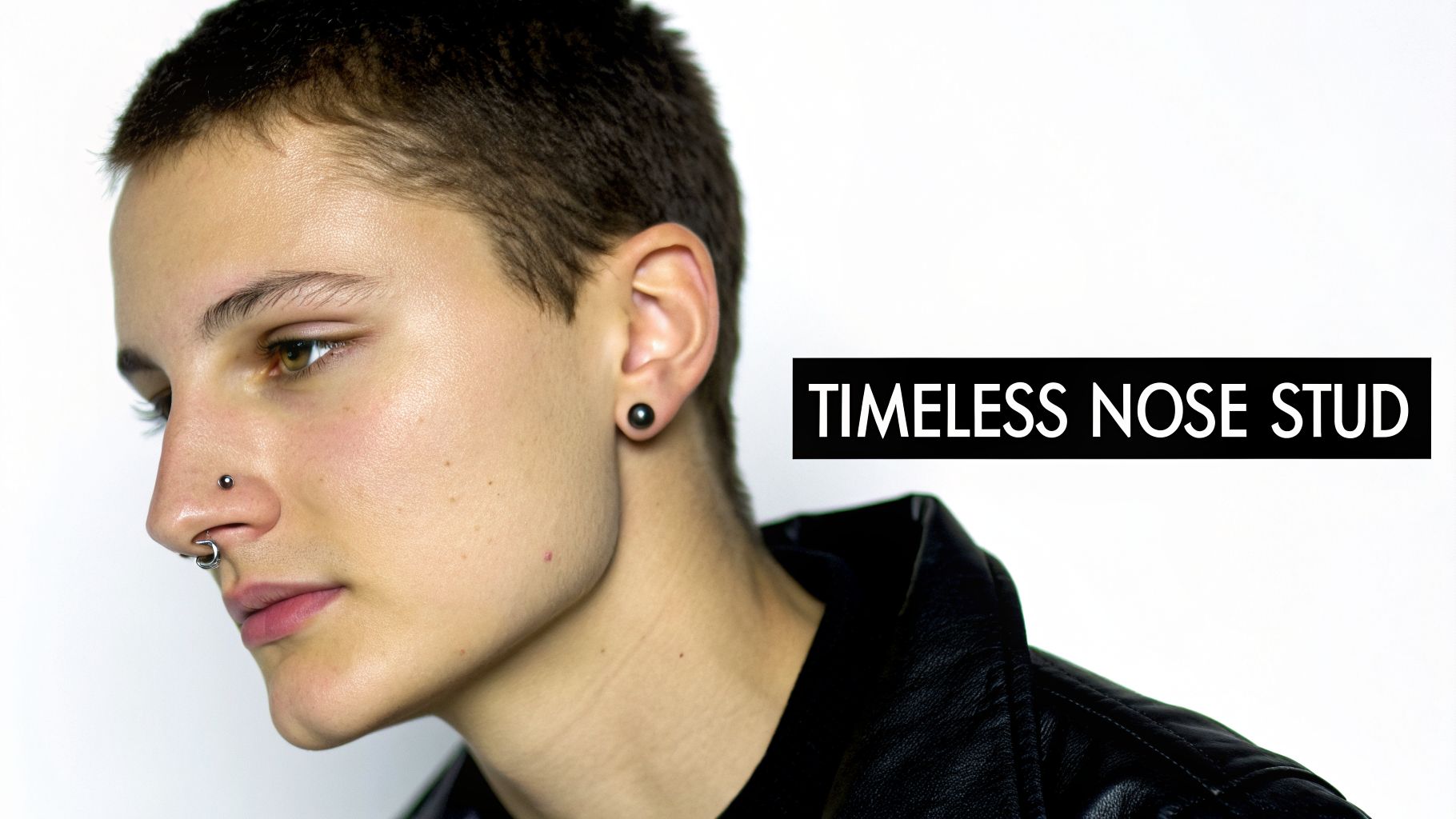
So, you’re thinking about getting a nose stud? It’s a brilliant choice. As professional piercers, we see trends come and go, but the classic nostril stud remains one of the most consistently requested piercings year after year. It's that perfect little accent that just works.
This guide is designed to give you the honest, no-fluff advice you need, drawing from years of hands-on experience in the studio. We'll walk you through everything, from finding a piercer you can trust to what you should actually be doing during the healing process.
Why the Nose Stud Remains So Popular
The real beauty of a nose stud lies in its versatility. It can be incredibly subtle—a tiny, sparkling gem—or a bit more of a statement piece. It’s this adaptability that makes it such a fantastic starting point if you're new to piercings. It’s a small addition that can make a huge difference to how you feel.
And it’s not just an observation; the numbers back it up. In the UK, body art is more popular than ever, with 46% of women aged 16-24 having a non-earlobe piercing. Reputable studios use sterile, single-use equipment, which keeps the risk of blood-borne infections very low, which is great news for anyone feeling a little nervous. You can find more details on these piercing industry statistics and safety trends on Wifitalent.com.
The mark of a truly great piercer is not that they never make mistakes, but how they handle them. A professional will prioritise your health and comfort, own up to any issues, and work with you to find a solution.
Before you book that appointment, it helps to have a clear picture of what the entire journey looks like. It’s not just about the five minutes in the piercing chair; it’s about good preparation and even better aftercare.
Here's a quick rundown of the essential facts to give you a clear idea of what to expect.
Nose Stud Piercing Key Facts
| Aspect | What to Expect |
|---|---|
| Pain Level | A quick, sharp pinch that’s over in a second. Most people rate it a 3-4 out of 10. |
| Healing Time | Expect 4-6 months for it to heal completely before you can safely change the jewellery. |
| Initial Jewellery | Always implant-grade titanium. We use a threadless (push-fit) or internally threaded labret stud. |
| Aftercare Routine | Clean it twice a day with a sterile saline solution. No twisting, touching, or harsh chemicals! |
| Typical Cost | In the UK, you’re looking at around £35 - £65, which usually covers the service and basic jewellery. |
Getting a nose piercing is a commitment, but armed with the right information, it’s a straightforward and rewarding experience.
Choosing Your Piercer and First Piece of Jewellery
Let's be honest, the most crucial part of getting a new piercing happens long before a needle ever gets near you. Choosing a truly skilled piercer and the right starter jewellery is everything. It sets the stage for a smooth, easy heal and a piercing you’ll love for years. A great piercer isn’t just a technician; they're your guide for the entire journey.
So, how do you find "the one"? Start by getting online and looking at their work. Any piercer worth their salt will have a solid portfolio on Instagram or their studio website. Don't just look at the fresh, shiny photos—hunt for the healed ones.
Healed work is where you see a piercer's real talent. It shows you they understand placement and give solid aftercare advice. For a stud piercing on nose, look to see if the jewellery sits flush against the skin and if it’s positioned to flatter the client’s anatomy. That’s the mark of a true professional.
Vetting the Studio and Piercer
Once you’ve found a portfolio that impresses you, it's time to do a little more digging. Google reviews are a great place to start, but you have to learn how to read them. Look for themes—are people consistently raving about how clean the studio is and how comfortable the piercer made them feel? That’s what you want to see.
A couple of bad reviews aren't always a red flag, but pay close attention to how the studio responds. A professional, accountable reply is a good sign; getting defensive is not.
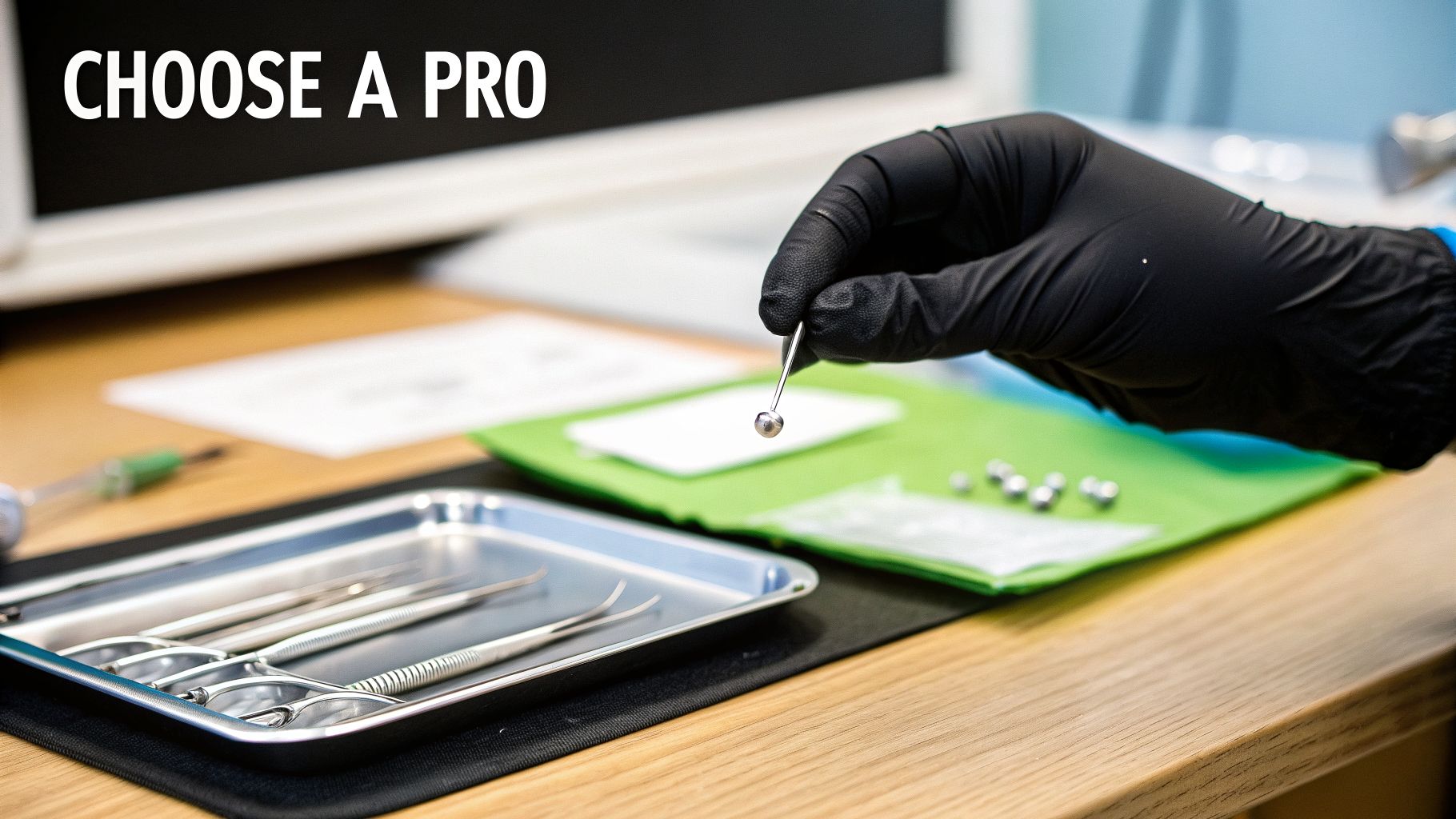
Next, you need to be absolutely sure about their hygiene. This is non-negotiable. Here’s what to look for in a safe studio:
- An Autoclave: This machine sterilises jewellery and tools with steam. Any good studio will have one and should be happy to show you its recent spore test results, which prove it's killing all the nasty stuff.
- Single-Use Needles: Your piercer must open a brand-new, sterile needle packet right in front of you. If you see a piercing gun, run. They're never appropriate for any piercing, especially not on nose cartilage.
- A Spotless Environment: The piercing room should feel clinical. Surfaces should be non-porous and wiped down before you get started.
A great piercer will happily walk you through their sterilisation process. If you ask about their safety procedures and they get cagey or dismissive, that's your cue to leave. Your health is the absolute top priority.
Selecting Your First Nose Stud
The jewellery you start with is just as important as the person who puts it in. The material and style of your initial stud have a huge impact on your healing. You’ll see a lot of places offering "surgical steel," but that's a vague term for a material that can contain nickel, a very common allergen.
For a new piercing, there’s really only one material we trust. Your piercer should be using implant-grade titanium (ASTM F-136). It’s the same stuff used in medical implants, and for good reason—it’s completely nickel-free and biocompatible, meaning the risk of an allergic reaction is almost zero. Solid 14k or 18k gold is another safe bet, but titanium is the undisputed champion for initial piercings.
This demand for quality is growing.
Comparing Initial Stud Styles
Finally, you’ll get to pick the style of your first stud. The design you choose affects how secure and comfortable it is while you heal. A good piercer will guide you here, recommending a style that suits your nostril shape and daily life.
These are the go-to styles for a fresh piercing:
| Stud Style | How It Works | Pros | Cons |
|---|---|---|---|
| Threadless (Push-Fit) | A decorative top has a tiny pin that’s bent and pushed into a hollow post. The tension holds it securely. | Super secure, sits flat inside the nose, and is easy for a piercer to swap out. | Can be a bit fiddly to change yourself at first. |
| Internally Threaded | The decorative top has a screw that goes into the post. This keeps the threads from dragging through your new piercing. | Also very secure and safe for healing tissue. | The post can feel a bit bulkier inside your nose compared to threadless. |
| L-Bend Stud | Exactly what it sounds like—the post is bent into a 90-degree angle to keep it from falling out. | Easy to take in and out on your own (once fully healed). | Much less secure; it’s known for falling out, especially at night. |
| Nostril Screw | The post is shaped like a C-curve that's designed to hug the inside wall of the nostril. | Stays in place quite well once you get it in. | Can be tricky to insert and doesn't always fit every nostril shape comfortably. |
For a brand new stud piercing on nose, almost any reputable piercer in the UK—including our teams in Croydon and Bournemouth—will recommend a threadless post. Its security and low-profile design give your piercing the best possible start. If you're wondering how jewellery choice affects the final bill, check out our guide on nose piercing costs.
What Actually Happens During Your Nose Piercing Appointment
So, you’ve decided to go for it. Walking into a piercing studio can feel a little daunting, especially if it’s your first time, but knowing exactly what’s in store can turn those jitters into pure excitement. A professional appointment for a stud piercing on your nose should feel calm, clean, and all about you.
When you arrive, we’ll get the boring-but-important bit out of the way first: the paperwork. You’ll need to fill out a consent form and show a valid photo ID. This is to confirm you understand the process and to verify your age—in the UK, you generally need to be 16 with parental consent for a nostril piercing, or 18 to get it done on your own.
The Placement Chat
With the forms sorted, the fun begins. Your piercer will take you to a clean, private station to chat about where you want your new stud to sit. This isn't a rush job; it’s a proper consultation to find the perfect spot for your face.
We’re experts in facial anatomy, so we’ll look at the unique shape of your nose, the natural curve of your nostril, and even how your expression changes when you smile. Based on this, we'll suggest a placement that will not only look fantastic but also heal beautifully.
Of course, you get the final say. We’ll use a single-use, skin-safe pen to make a tiny dot, and you can take all the time you need to check it in the mirror. Seriously, don’t be shy about asking us to move it a millimetre here or there. It has to be perfect for you.
The whole point is to find a placement that looks like it was always meant to be there. A great piercer works with you, combining your vision with their experience to get a result you'll love.
The Piercing Itself
Once you’ve given the thumbs-up on the placement, it’s time. Your piercer will put on fresh gloves and thoroughly clean the area on and around your nostril. You'll see them open a sealed, sterilised pouch containing a brand-new piercing needle. This is non-negotiable.
We only ever use a hollow, single-use needle specifically designed for piercing. It creates a clean, precise opening for the jewellery, making the whole process swift and minimising trauma to the tissue.
- Sterile, Single-Use Needle: This is the gold standard for a reason. It's incredibly sharp, which means a quicker, cleaner piercing with a much smoother healing journey ahead.
- No Piercing Guns, Ever: If you ever walk into a studio and they pull out a piercing gun for a nose piercing, walk right back out. Guns use blunt force to ram the jewellery through, which shatters cartilage, causes massive trauma, and dramatically increases the risk of infection and nasty scarring.
Your piercer will instruct you to take a nice deep breath in, and as you slowly breathe out, they’ll pass the needle through in one smooth, quick motion. It’s over in a flash. They’ll immediately follow the needle with your chosen sterilised jewellery, secure it in place, and give the area one final clean.
But what does it feel like? Honestly, it’s a quick, sharp pinch. Most people describe it as a surprising sting that makes their eyes water—that's just a reflex, it happens to almost everyone!—and then it's done. The sharp feeling is incredibly brief and quickly settles into a dull, warm throb. On a pain scale of 1 to 10, most people rate a nose stud at a 3 or 4. The anticipation is almost always worse than the actual piercing.
Before you go, your piercer will run you through the aftercare routine, explaining exactly how to clean it and what to avoid. You’ll also get a printed guide to take home. This is the perfect time to ask any last-minute questions before you head out to show off your brilliant new piercing.
Your Day-by-Day Guide to Healing a Nose Stud Piercing
So, you’ve got your new nose stud. Congratulations! The piercing itself is just the beginning. Now comes the most important part: the aftercare. How well your new stud piercing on nose heals is almost entirely down to you and your commitment to a simple, consistent routine. Think of this as your personal playbook for a happy, healthy piercing.
The first couple of weeks are when your piercing is at its most delicate. You're going to see some redness, feel a bit of tenderness, and notice some swelling. This is all completely normal. It’s just your body’s natural response, sending everything it needs to the area to start the healing process.
You'll also probably see some clear or yellowish fluid that dries into what we call "crusties" around the stud. I know it's incredibly tempting to pick them off, but please resist the urge! That’s just lymph fluid, a sign that your body is cleaning the wound from the inside out. Picking at it only irritates the fragile new skin trying to form.
The First Few Weeks: What to Expect
This initial healing stage, which usually lasts from week one to week four, is the most intense. The swelling will likely peak in the first few days before it starts to calm down. It’s absolutely crucial to be extra gentle during this time and protect your piercing from any bumps or snags.
This is when you’ll lock in your daily cleaning routine. Being consistent here is your best defence against complications and the secret to a smooth recovery.
- Initial Swelling: Your nose might feel a bit puffy and sore, especially to the touch. This is expected and should subside within a week or two.
- Tenderness and Redness: The skin right around the piercing will be sensitive and a little red. That's just your immune system getting to work.
- Minimal Bleeding: It’s not uncommon to see a tiny pin-prick of blood in the first day or so. It should stop very quickly.
- "Crusties" Forming: That discharge is a good thing! It shows your body is flushing out the wound naturally.
Before you even get to this healing stage, the piercing appointment itself is a quick and professional process, setting you up for success from the start.
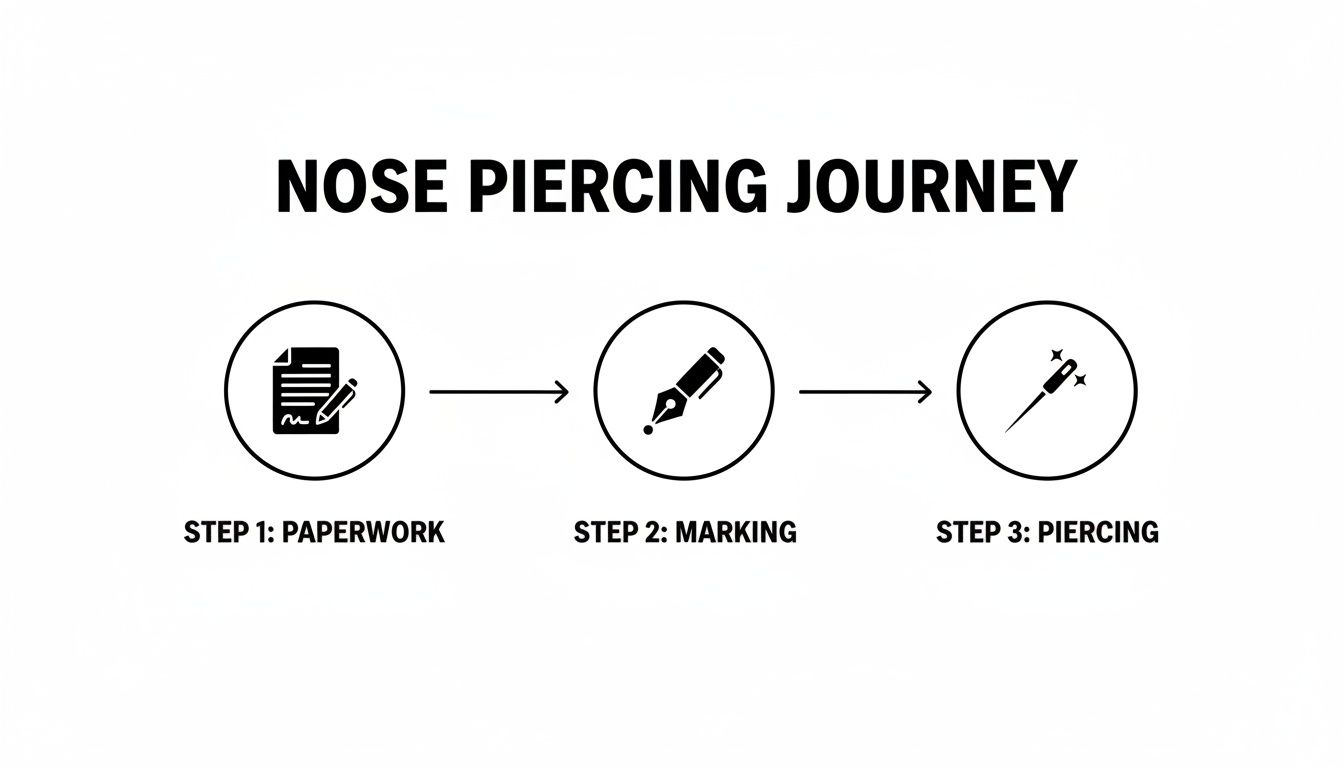
As you can see, a reputable piercer follows a methodical approach: handling the paperwork, carefully marking the perfect placement, and then performing the piercing swiftly. This professional standard is your first step toward a great healing experience.
Your Simple Daily Cleaning Routine
You can forget all the old-fashioned advice about harsh soaps, alcohol, or twisting the jewellery. Modern aftercare is so much simpler and far more effective. Your piercer will give you their specific instructions, but the gold standard relies on just one thing.
All you really need is a sterile saline solution. The best kind comes in a pressurised spray can, as it stays sterile and is easy to apply. It’s perfectly balanced to clean your piercing without causing any dryness or irritation.
Here’s the simple routine to follow twice a day:
- Wash your hands thoroughly with soap and warm water. Never, ever touch a healing piercing with dirty hands.
- Generously spray the saline solution on the outside of your piercing.
- Gently pat the area dry with a clean piece of non-woven gauze or kitchen roll. Stay away from cotton buds or towels, as their fibres can get snagged and cause major irritation.
That’s it. No twisting. No turning. Moving the jewellery back and forth just tears the delicate new skin channel (the fistula) that your body is working so hard to build. This is a fast track to irritation bumps and a much longer healing time.
To make it even clearer, here’s a breakdown of what you can expect over the next few months and how your aftercare fits in.
Nose Stud Healing Stages and Care Routine
| Healing Phase (Timeline) | What to Expect | Key Aftercare Actions |
|---|---|---|
| Phase 1: Inflammation (Week 1-4) | Redness, swelling, tenderness, and clear/yellowish discharge ("crusties"). | Clean twice daily with sterile saline. Avoid touching, snagging, or sleeping on it. Do not submerge in water. |
| Phase 2: Maturation (Months 2-6) | Redness and swelling subside. Discharge lessens. Piercing may feel fine but is still healing internally. | Continue cleaning once or twice daily. Do NOT change the jewellery yet. Be mindful of snags. |
| Phase 3: Fully Healed (6+ Months) | No pain, discharge, or redness. Jewellery moves freely when clean. The fistula is strong and robust. | You can reduce cleaning. Once confirmed healed by a piercer, you can safely change your jewellery. |
This timeline is a general guide. Everyone heals at their own pace, so listen to your body and don't rush the process.
Critical Things to Avoid During Healing
What you don’t do is just as important as your cleaning routine. Steer clear of these common mistakes, and you’ll save yourself a lot of potential hassle.
- Keep Your Hands Off: Unless you're cleaning it with freshly washed hands, leave your piercing completely alone.
- Avoid Soaking It: For the entire healing period, stay out of swimming pools, hot tubs, lakes, and the sea. These are breeding grounds for bacteria.
- Be Careful with Cosmetics: Keep foundation, powder, and skincare products away from the piercing itself to prevent them from clogging the area and causing infection.
- Watch Out for Snags: Be extra careful when washing your face, blowing your nose, or pulling clothes over your head. A nasty snag can be painful and seriously set back your healing.
The total healing time for a nostril piercing is generally 4-6 months, though for some people, it can take a bit longer. Patience truly is key. Once your piercer gives you the all-clear, you can finally have fun trying out different jewellery styles.
What to Do When Your New Piercing Gets Angry
Even with the most diligent aftercare, sometimes a new piercing just decides to have a bit of a drama. Before you start to panic, take a breath. Most of the time, these little flare-ups are minor and completely manageable at home once you know what you’re dealing with.
First, let's get clear on what's normal and what's not. Seeing some "crusties" (that dried yellow-ish fluid) is a perfectly normal part of healing. An infection, however, is a different beast entirely. We're talking thick green or dark yellow pus, the area feeling hot to the touch, significant swelling, and sometimes even a nasty smell. That's your cue to see a professional, fast.
The Dreaded Piercing Bump
The number one thing people come to us worried about is that little lump that can appear next to their stud. Everyone’s mind immediately jumps to the word "keloid," but I can tell you from experience that true keloids are incredibly rare. They're a specific type of genetic scarring and not something that just pops up on a whim.
What you're almost certainly looking at is a simple irritation bump. Think of it as your piercing's way of shouting, "Something is bothering me!" It might look like a small, angry pimple or a fleshy bubble right by your stud piercing on the nose. They’re annoying, for sure, but they’re solvable. The trick is to play detective and figure out what’s causing the irritation.
Nine times out of ten, the culprit is one of these:
- Getting Knocked Around: Catching your stud on a towel, rolling onto it in your sleep, or subconsciously fiddling with it are the top offenders.
- The Wrong Jewellery: A stud made from low-grade metal, a post that's too short and pressing into the skin, or a style that moves around too much (like an L-bend) can all cause friction and irritation.
- Too Much Moisture: If you're not drying the area properly after cleaning, you're creating a perfect little swamp for bacteria to hang out and cause trouble.
- Harsh Chemicals: Ditching your saline spray for things like alcohol, tea tree oil, or antibacterial soap is a guaranteed way to make things much, much worse.
To calm a bump down, strip your routine back to the absolute basics. Be militant about your twice-daily sterile saline soaks, pat the area completely dry afterwards, and make a conscious effort not to touch, twist, or bump the piercing. Once you remove the source of the problem, the bump should start to calm down and shrink over a few weeks.
Please, don't fall for the old wives' tales you see online. Crushing aspirin into a paste or dabbing on neat tea tree oil will not help. You're just giving your fragile, healing skin a chemical burn, which will escalate the problem significantly. Stick to saline and give it time.
Other Common Hiccups
Bumps aren't the only issue you might run into. Knowing how to react to other little mishaps will keep them from turning into big problems.
So, your jewellery fell out. What now? If the piercing is brand new (we're talking less than a few weeks), that hole can shrink with surprising speed—sometimes in a matter of minutes. If it happens, wash your hands and the jewellery thoroughly with soap and water, then try to gently re-insert it. If you feel any resistance at all, do not force it. Get to your piercer as soon as you can. We have special tools called insertion tapers that can guide it back in safely without causing trauma.
What if the stud suddenly feels way too tight? This is usually just temporary swelling after you've snagged or knocked it. For a day or two, try holding a clean cloth soaked in cold water against the area for a few minutes at a time. This can work wonders for bringing swelling down. If it doesn't ease up or feels uncomfortably tight, come and see your piercer. We can swap the post out for a slightly longer one, giving the tissue room to breathe and settle down. It’s a simple fix that provides instant relief and stops the stud from embedding.
Booking Your Nose Piercing in Croydon or Bournemouth
So, you're ready for your new stud piercing on a nose? Fantastic. Getting your appointment locked in at our Timebomb Tattoo & Piercing studios in either Croydon or Bournemouth couldn't be easier.
When you walk through our doors, you’re not just another appointment. You’re meeting a team of experienced piercers who genuinely love what they do. We’ll walk you through everything, from picking out the perfect piece of implant-grade jewellery to making sure you're comfortable and confident before we even begin. Your safety is our absolute priority, which is why we only ever use sterilised, single-use needles for every single piercing.
"Had my nose pierced by the team in Croydon. They were so calming and professional, explaining everything clearly. The whole process was quick and virtually painless. I couldn't be happier!" - A recent client.
Getting your slot booked is simple. Just head to the booking page for your preferred studio below. You'll find all our contact details and addresses there, too. We can't wait to see you and help you bring your piercing idea to life.
- Book for Croydon: [Link to Croydon booking page]
- Book for Bournemouth: [Link to Bournemouth booking page]
If you want to get a better feel for what we do, check out our guide to body piercing in Bournemouth.
Your Nose Stud Piercing Questions Answered
It's completely normal to have a few questions swirling around before you commit to a new piercing. We get it. Here are the answers to the most common queries we hear from clients at our Croydon and Bournemouth studios, based on years of experience.
How Much Does a Nose Stud Piercing Cost in the UK?
You can expect the cost for a professional nose stud piercing in 2024 to be somewhere between £35 and £65. That price should always include the piercing service itself and a basic, high-quality stud made from implant-grade titanium.
Of course, the final price tag can shift based on the studio's location and the piercer’s experience. If you fall in love with a more decorative piece of initial jewellery, like something with a gemstone or a solid gold design, that will bump up the cost. It's always a good idea to ask what's included in the fee when you book.
Can I Get a Nose Piercing with Allergies or Sensitive Skin?
Yes, absolutely. The secret to a happy piercing for anyone with sensitive skin is all in the metal. Any reputable piercer will only ever use implant-grade titanium (ASTM F-136) for a fresh piercing.
This material is completely biocompatible and nickel-free, which means the chances of your body having a bad reaction are incredibly low. It really is the safest bet for anyone with metal allergies. Just make sure you mention any sensitivities during your consultation so your piercer can take the right precautions.
Here's the golden rule: if your skin is reactive, never, ever skimp on jewellery quality. Implant-grade titanium is the industry standard for a reason—it gives your piercing the best possible start.
When Can I Change My Nose Stud to a Hoop?
This is where patience really pays off. You absolutely must wait until your nostril piercing is fully healed before swapping your stud for a hoop. For most people, that's a minimum of four to six months, though sometimes it can take even longer.
Switching to a ring too soon is probably the number one reason we see people develop irritation bumps. The curve of a hoop puts a whole new kind of pressure on the healing fistula (the piercing channel), and it can get angry very quickly. The best thing you can do is pop back in for a check-up; your piercer can give you the green light when it's genuinely ready.
Will My Nose Piercing Leave a Noticeable Scar?
If you decide to retire your nose piercing down the line, you'll likely be left with a very small mark. Once a well-healed piercing has been empty for a while, the scar usually just looks like a tiny, vacant pore. It's honestly very discreet and most people would never even spot it.
How the scar looks ultimately comes down to your skin and how well the piercing healed in the first place. Your best strategy for minimising any scar is to nail your aftercare and avoid infections or bumps from the get-go.
Ready to book your appointment with a team you can trust? Visit Piercing Near Me to find your local studio in Croydon or Bournemouth and schedule your consultation today. Book your appointment online.
Trackbacks/Pingbacks