
You've just got home, your ear is warm, the bar feels a little prominent when you lie down, and you're already wondering whether that's normal or the start of a problem. That's the part of industrial piercing healing that often surprises individuals; the piercing can look calm one day and annoyed the next, especially when sleep, headphones, and hair keep brushing it. The honest version is simple: an industrial is two cartilage wounds healing together, so the recovery is long, behavior-sensitive, and much more dependent on daily friction than most ear piercings.
Understanding the Industrial Piercing Healing Journey
An industrial piercing is not one wound, it's two cartilage channels connected by a single bar. That matters, because both ends have to settle at the same time, and the jewellery itself can keep the area under gentle tension while the tissue tries to stabilise. Cartilage also has less forgiving blood flow than soft earlobe tissue, which is why the healing process tends to be slower and easier to disrupt.
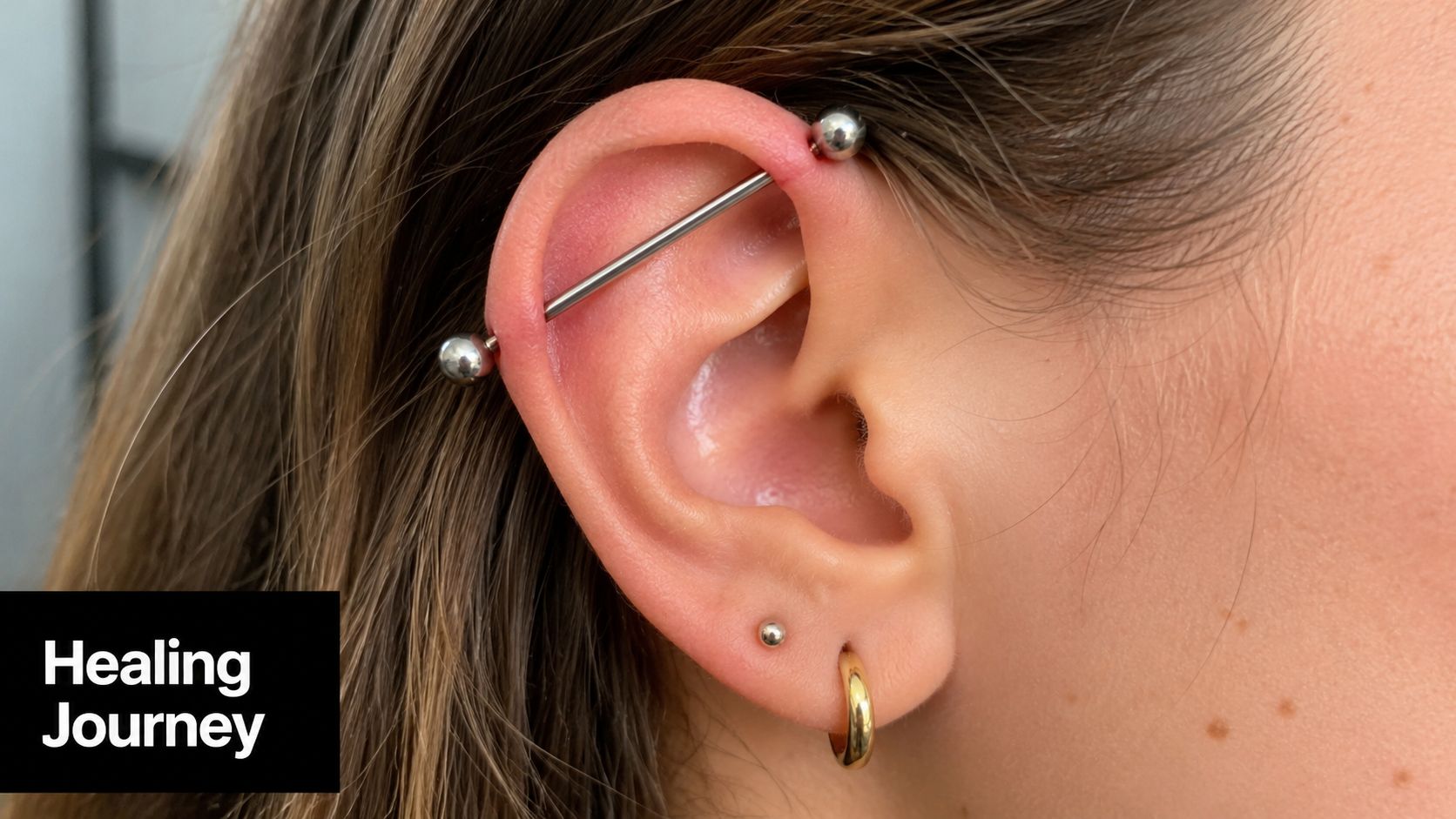
A useful way to think about it is this. A lobe piercing is a soft tunnel through yielding material, while an industrial is more like building a stable passage through firm, easily irritated structure. That's why the historical England survey of 10,503 people aged over 16 matters here, it found that about 10% had body piercings outside the earlobe, with 46.2% of women aged 16–24 reporting such piercings, and it also recorded complications in 31% of piercings and professional help in 15.2% of cases, which underlines how non-lobe piercings already carried meaningful aftercare needs in England body piercing survey background.
Practical rule: if your industrial only feels “fine” when nothing touches it, that's not the same thing as healed.
For first-time clients in places like Croydon and Bournemouth, the big mindset shift is patience. Industrial piercing healing is a marathon, not a quick tidy-up after a minor puncture. The piercing can look reasonable long before the inside has matured, so quiet skin on the outside doesn't automatically mean the channels are stable enough for jewellery changes, sleep pressure, or hard knocks.
Realistic Healing Timelines and Stages
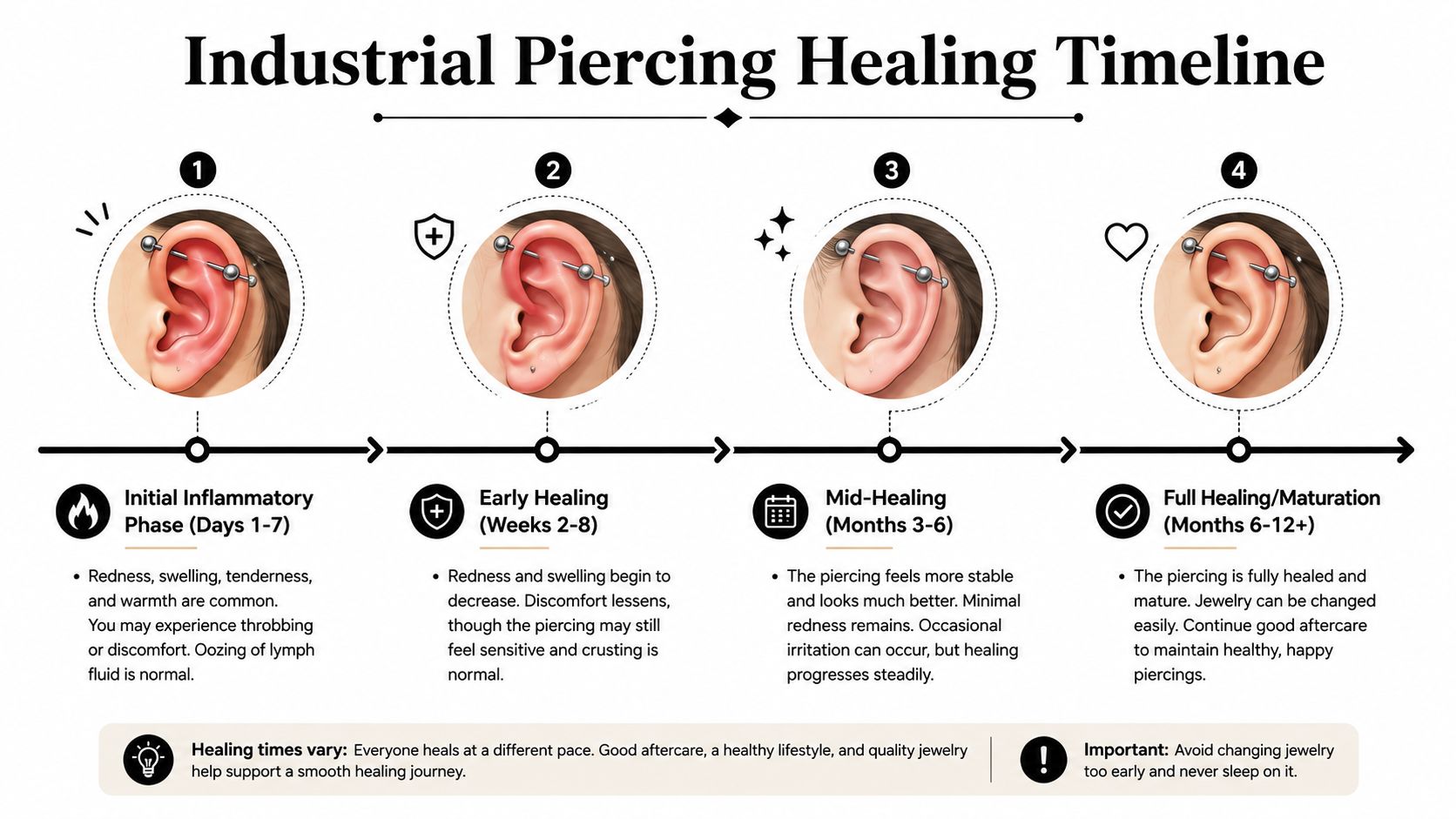
The most useful timeline is the one that matches what you see and feel, not just a neat headline number. A typical industrial piercing sits in the 6 to 12 month range for full healing, and some UK-facing studio guidance stretches that further, with initial healing around 3 to 4 months and full healing sometimes taking 12 to 18 months, even close to 2 years for a few clients industrial timeline guide. That spread is not confusion, it reflects how easily cartilage gets set back by pressure, snagging, repeated movement, or a poor sleep position.
What each phase tends to feel like
In the first 1 to 7 days, the piercing is usually in an inflammatory phase. Swelling, redness, tenderness, and a little bleeding can all be normal, because the tissue is reacting to the trauma of being pierced healing stages overview.
Between weeks 2 and 4, swelling often starts to settle and crusting becomes more noticeable. That does not mean the piercing is getting worse, it usually means the body is moving into early repair while the surface is still trying to protect the channel.
By months 2 to 4, the tissue is building around the jewellery more actively. This is often when people say it feels much better day to day, and that is true, but it is also when they get careless, sleep on it, or decide to change the bar too early. Hair snagging, over-cleaning, and pressure from headphones can keep that quiet irritation going even when the ear looks calmer.
By months 5 to 8, the piercing can appear settled for long stretches, then flare after a bad night's sleep or a long session with on-ear headphones. A detailed healing model places maturation through this middle period and complete healing around months 9 to 12 healing stages overview. That late-stage calm can be misleading if you are still knocking the bar, pressing on it in bed, or catching it while styling your hair.
A separate guide on cartilage healing and recovery notes that about 68% of people in a 2023 survey felt their industrial was completely healed within nine months industrial healing stages. That is useful context, but it should not tempt you into assuming your own piercing is on the same schedule. The safer reading is this, visible improvement often arrives by months 3 to 6, while mature healing usually lands much later.
Daily Aftercare Routine for Optimal Healing
The routine that works is boring, consistent, and gentle. Twice-daily cleaning with saline made for wound care, or soap and water, is the core standard in UK-relevant medical advice from Mayo Clinic, along with avoiding hydrogen peroxide, iodine, swimming, and twisting the jewellery while it heals Mayo Clinic piercings advice. That advice fits industrials because they're cartilage piercings, and cartilage punishes rough handling.
A routine that fits real life
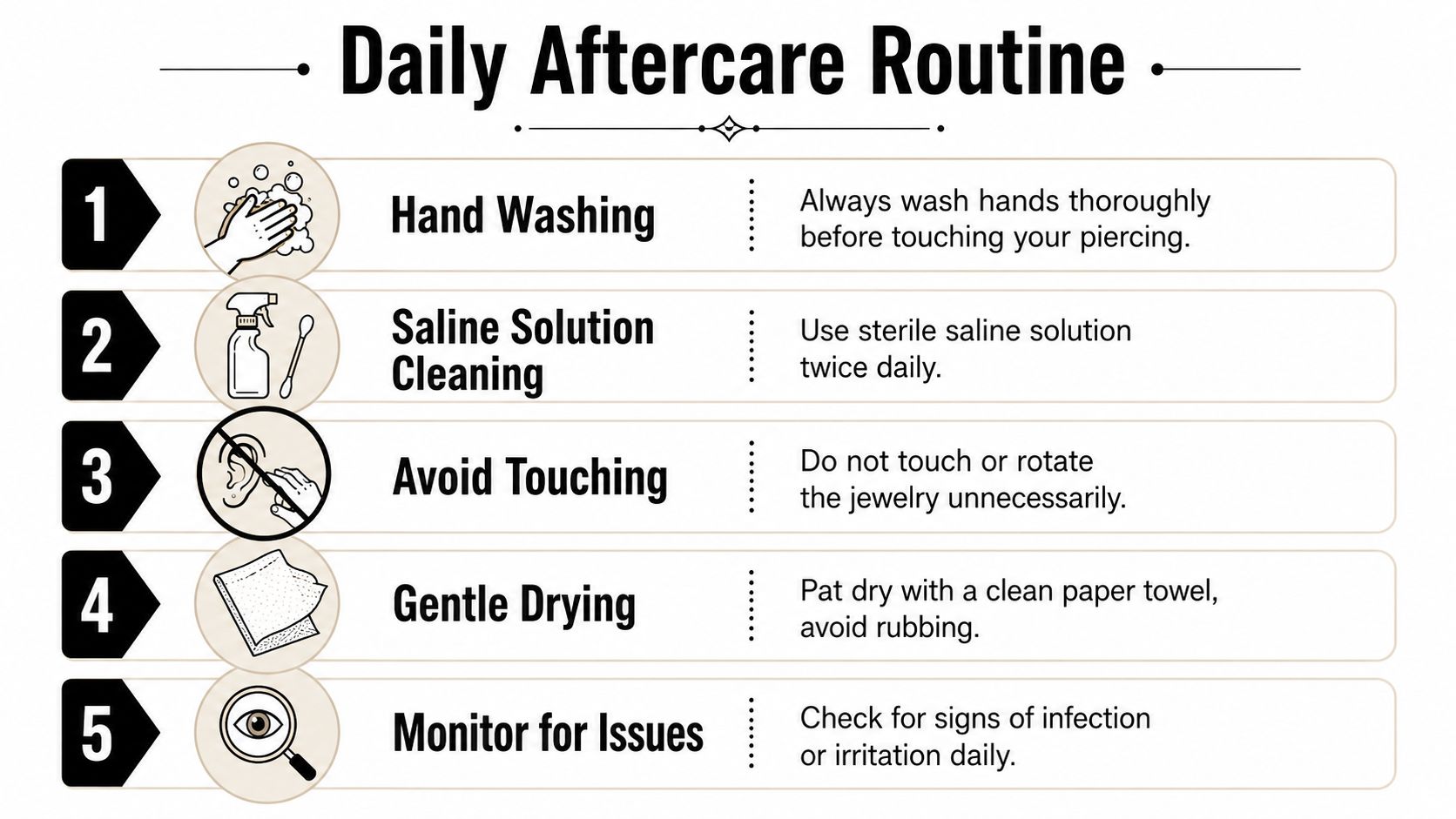
Start with clean hands every single time. Touching a healing industrial with unwashed fingers is one of the fastest ways to turn a calm day into an irritated one.
Use sterile saline twice a day, morning and evening. If you're building the habit, tie it to things you already do, like brushing your teeth or washing your face. That keeps the care regular without turning your bathroom shelf into a medical station.
Good aftercare is subtraction, not piling on products.
Dry the area gently with a clean paper towel or sterile gauze, then leave it alone. Towels and rough fabrics can snag, and leaving moisture around the bar invites more crusting and irritation than people expect.
Keep your hands away from the bar and ends. The jewellery isn't something to rotate, wiggle, or “check” every time you pass a mirror, because movement keeps restarting the tiny internal repair process.
One practical way to think about this is simple:
- Wash first: clean hands before any care.
- Rinse lightly: use saline, then stop.
- Dry without friction: pat, don't rub.
- Leave the jewellery still: no twisting or turning.
- Watch the skin: look for change, not just discomfort.
If you want a product-style saline reference, the key is preservative-free sterile saline, not a harsh antiseptic spray. A lot of people over-clean because they think more effort equals faster healing, but industrial cartilage usually does better with less interference, not more. For a quick product-specific overview, see saline spray guidance.
Hidden Friction Points That Delay Healing
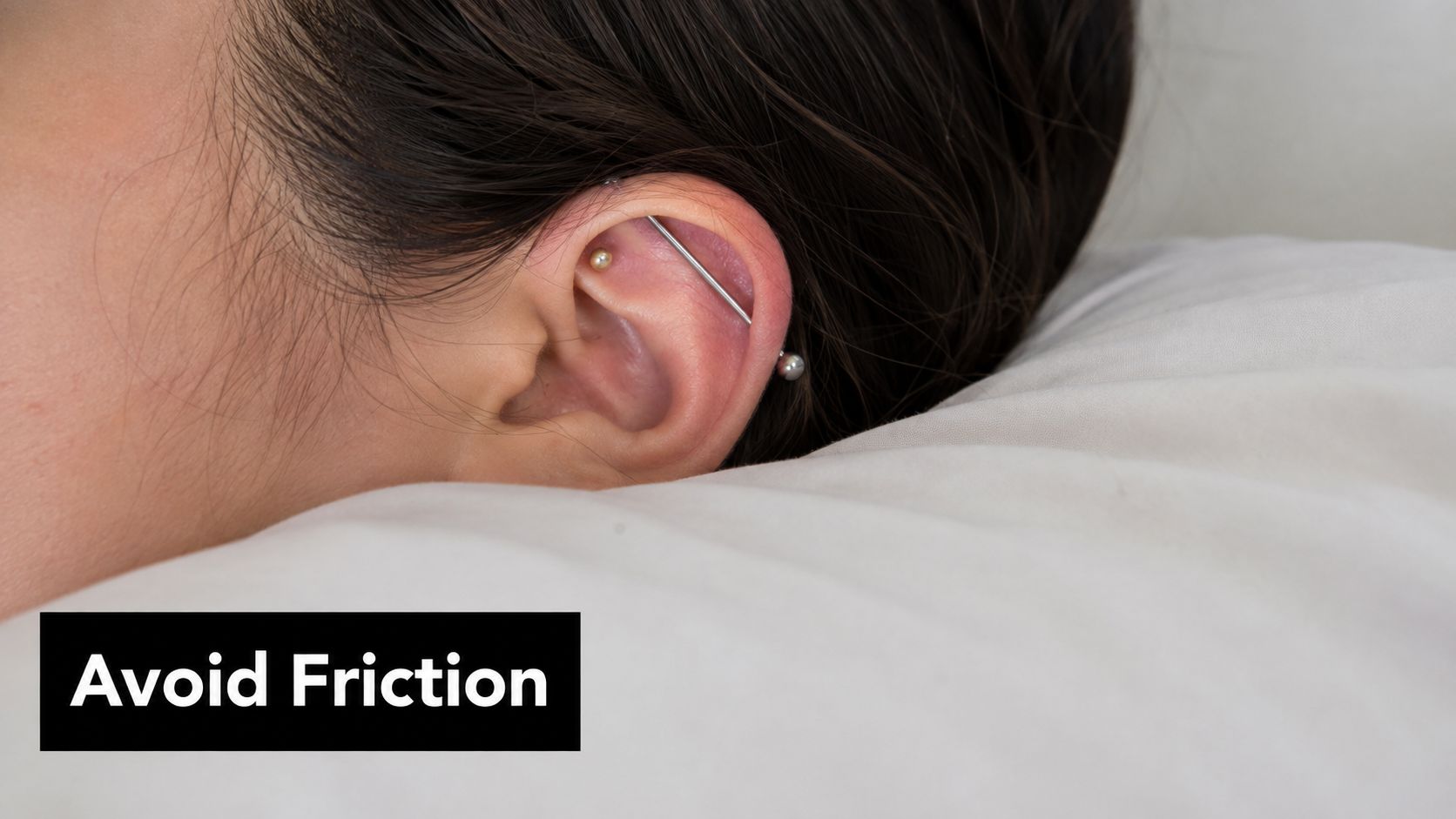
The biggest problem with an industrial usually isn't the cleaning routine, it's the stuff that keeps bumping the piercing after you've done everything else right. Sleeping on it, over-the-ear headphones, hair snagging, helmet straps, and dirty pillowcases all create tiny repeated insults that cartilage remembers for longer than people do aftercare friction guidance. That's why a piercing can look almost settled, then flare back up for no obvious reason.
The everyday habits that quietly restart irritation
Sleeping pressure is the one I see most often. If your ear spends the night pinned into a pillow, the bar and the entry points get compressed, and that can keep the piercing “intermittently angry” for weeks.
Over-the-ear headphones cause a similar issue. They don't always hurt in the moment, but they press directly on the cartilage and make the piercing work against constant contact, which is exactly what you don't want while the channels are stabilising.
Hair seems harmless until it isn't. Long strands can catch the bar, styling products can sit around the area, and even a quick brush can tug the jewellery just enough to restart redness.
If it hurts only after sleep, headphones, or grooming, the cause is usually friction, not failure.
A few practical changes make a real difference. Use a travel pillow or donut pillow so the ear sits in the centre opening, switch to earbuds instead of big headphones, keep hair tied back on bad healing days, and change pillowcases regularly so the skin isn't sitting against grime all night. I'd also keep helmets and anything tight around the ear to a minimum where possible.
The hard part is that these irritants are ordinary parts of daily life, so people underestimate them. An industrial doesn't just ask for a saline rinse, it asks for a quieter environment around the ear for months. That's a significant trade-off; the piercing is visually bold, but the healing process rewards boring habits and punishes small, repeated contact.
Spotting Complications Versus Normal Healing
Normal healing and a complication can look similar at first glance, especially with cartilage. Mild swelling, light crusting, and occasional tenderness are all part of the expected recovery pattern, while worsening heat, spreading redness, thick discharge, or jewellery that seems to be shifting are the signs that deserve more attention infection warning signs.
| Symptom | Normal Healing | Potential Complication |
|---|---|---|
| Mild swelling | Common in the early period and after minor knocks | Swelling that keeps increasing or makes the ear feel hot |
| Crusting | Dry discharge around the entry points | Thick yellow or green discharge, especially with pain |
| Tenderness | Comes and goes when the area is touched or slept on | Pain that worsens instead of settling |
| Redness | Local, short-lived, and linked to irritation | Redness spreading beyond the piercing area |
| Jewellery movement | Slight settling as swelling changes | Migration, thinning skin, or the bar looking off-centre |
“Piercing bumps” are usually irritation bumps, not something mysterious. They often show up after pressure, snagging, or over-cleaning, and they tend to calm down when the source of friction is removed. The fastest way to make a small bump bigger is to keep prodding it, squeezing it, or trying a different product every day.
A true infection is different from ordinary irritation. If the area is getting hotter, more painful, or producing discharge that doesn't fit the normal crusting pattern, it's time to stop guessing and get advice. Rejection is a separate issue again, and the clue there is gradual migration or skin thinning rather than a brief flare-up.
When to Contact Your Piercer or Doctor
Some industrial issues are studio problems, and some are medical problems. A piercer can often help with irritation bumps, jewellery fit, and the timing of a downsize, but severe pain, spreading redness, systemic symptoms, or signs of an allergic reaction need medical attention rather than guesswork. That split matters because a lot of frustration comes from people trying to treat everything the same way.
A follow-up with your piercer makes sense when the bar feels too long, keeps catching, or seems to be moving as swelling drops. That's where proper downsizing helps, because excess movement can create the same irritation people then blame on the piercing itself. It's also the right time to ask whether the jewellery material or placement is contributing to the problem.
Medical attention is the right call if symptoms point beyond routine irritation. A piercing that gets hotter, more swollen, or more painful over time shouldn't be left to “see how it goes,” especially if you're getting pus, spreading redness, or feeling unwell.
Asking for help isn't overreacting. It's part of responsible cartilage aftercare.
For local support, Timebomb Tattoo & Piercing in Croydon and Bournemouth can handle follow-up checks and jewellery-related questions. You can call 01202 9000 50 or WhatsApp 07752913846 to arrange a consultation, especially if you're unsure whether your industrial needs a simple adjustment or a proper review.
If you want practical, studio-level guidance on healing, jewellery care, and what normal recovery should look like, explore Piercing Near Me for trusted piercing advice and local booking support. It's a straightforward way to compare your healing with real aftercare standards, then take the next step with confidence.