
That new piercing looks amazing, but is the soreness you're feeling a normal part of the process or a warning sign? It's a question we get asked all the time. The short answer is that irritation symptoms are mild and localised, while signs of a real infection are usually severe and spreading.
If you're dealing with intense, throbbing pain, seeing thick green or yellow pus, or noticing redness spreading far from the piercing itself, it's time to take it seriously.
Is It an Infection or Just Irritation?
It's easy to worry when a fresh piercing feels tender and looks a bit angry. But remember, every new piercing is a small wound that your body needs to heal, and some initial reaction is perfectly normal. Most of the time, what you're seeing is just standard irritation, not a full-blown infection.
For the first few days or even weeks, you can expect some slight redness right around the jewellery, a little bit of swelling, and some tenderness to the touch. You'll also likely see a clear or whitish fluid that dries into a crust. This isn't pus; it’s lymph fluid, a completely normal part of your body's healing process.
Knowing the Difference Between Normal Healing and Red Flags
The confusion often happens because the early signs of irritation and infection can look pretty similar. The real giveaway is the intensity of the symptoms and how they progress. Irritation tends to be a bit fussy but should slowly get better, whereas an infection will almost always get worse.
Here’s a quick rundown of what's normal:
- Mild Redness: A small, pinkish halo directly around the piercing site is standard.
- Minor Swelling: Some localised puffiness is just your body's natural response to the new addition.
- Clear Fluid: A thin, watery, and odourless discharge (lymph) that forms 'crusties' is a good sign of healing.
From our experience, the healing journey is a partnership. We do our part in the studio to give you a clean, perfect piercing, but after you walk out the door, it's up to you and your body. A little irritation is a common bump in the road, but it's crucial not to mistake it for the serious signs of an infection that needs immediate attention.
Normal Healing vs Potential Infection at a Glance
To make it even clearer, this side-by-side comparison helps you quickly spot whether your piercing is just settling in or if it's waving a red flag.
| Symptom | Normal Healing (Irritation) | Potential Infection (Red Flag) |
|---|---|---|
| Pain | Mild tenderness that lessens over time. | Throbbing, persistent, or worsening pain. |
| Swelling | Localised, minor swelling around the jewellery. | Significant, spreading swelling that feels hot. |
| Redness | A small pink halo directly at the piercing site. | Dark red or red streaks spreading from the site. |
| Discharge | Clear, white, or pale-yellow fluid (lymph) that forms crust. | Thick, cloudy, green, or dark yellow pus with a bad odour. |
| Heat | The area may feel slightly warm to the touch initially. | The surrounding skin feels very hot. |
| Overall | Symptoms are stable or slowly improving. | Symptoms progressively worsen over 24-48 hours. |
Looking at the two side-by-side, it's much easier to see the difference between a bit of fussy healing and something that requires a closer look.
A Quick Visual Guide
Sometimes, a picture is worth a thousand words. This chart breaks down the visual cues to help you distinguish between a normal healing process and the warning signs of a potential infection.
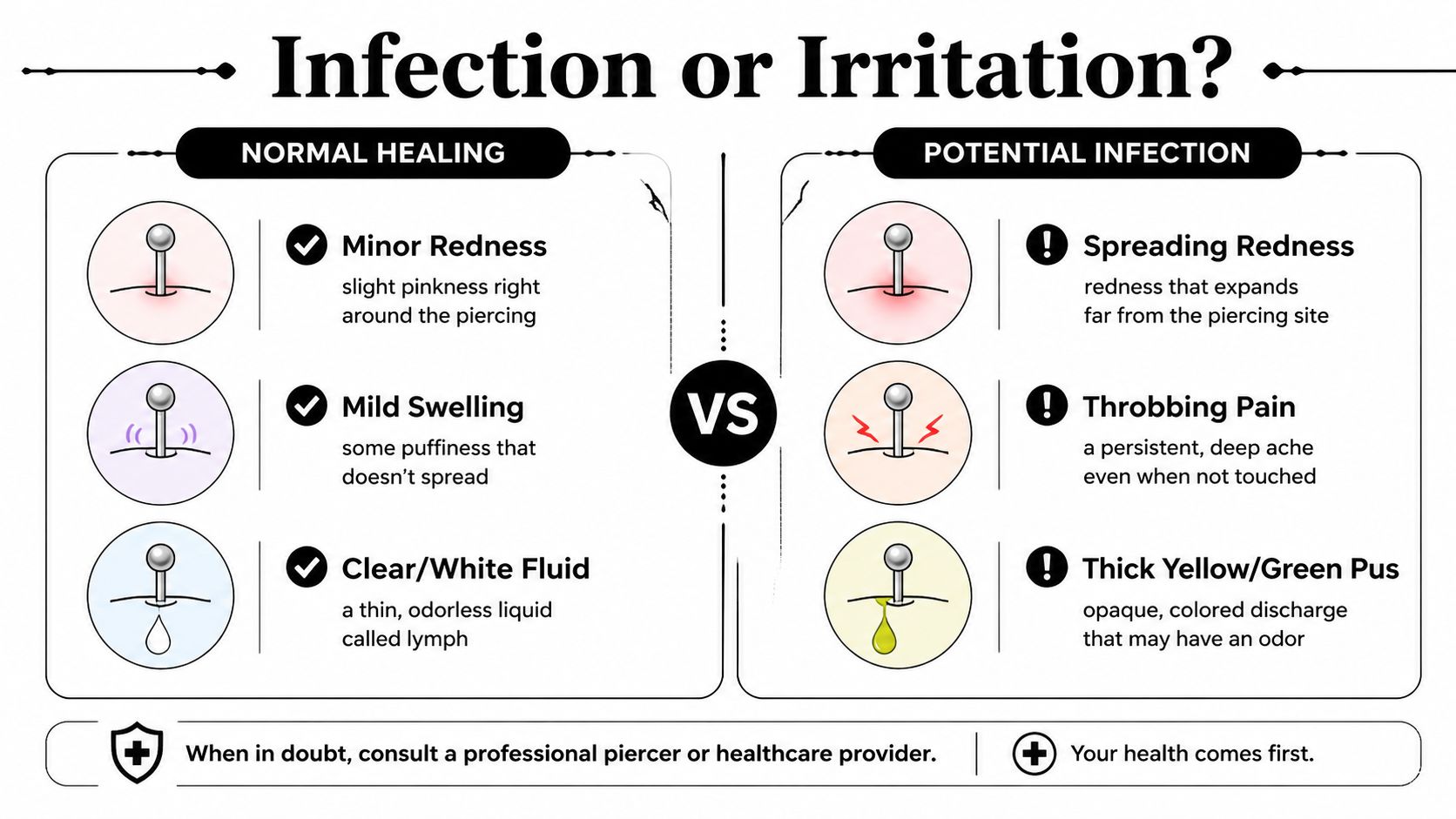
As you can see, a little bit of redness is perfectly fine, but redness that starts to spread is a concern. Likewise, clear fluid is normal, but thick, coloured pus is a definite sign that something isn't right. Learning to spot these differences is your best tool for keeping your piercing happy and healthy.
Remember, everyone heals differently, and some piercings take longer than others. For a better idea of what to expect, check out our guide on ear piercing healing times.
If you’re ever unsure, please don't guess. The professional piercers at our partner studios in Croydon and Bournemouth are always here to help. A quick check-in can save you a lot of worry. For urgent questions, call us on 01202 900050 (Bournemouth) / 020 8686 7730 (Croydon) or send a message to our WhatsApp at 07752 913846 (Bournemouth) / 07902 490584 (Croydon).
Key Signs Your Piercing Is Actually Infected
Alright, so we’ve covered the normal healing grumbles that every piercing goes through. Now it’s time to get serious and talk about the undeniable signs that point to a genuine infection. This isn’t about the piercing being a bit fussy; this is about your body sending out clear distress signals that you absolutely shouldn't ignore.
Knowing the difference between simple irritation and a brewing infection comes down to spotting symptoms that are getting worse, not better. These are persistent, escalating issues that go way beyond typical healing discomfort.
Worsening Pain and Swelling
A fresh piercing is always going to be a bit tender, but that soreness should slowly fade over time. An infected piercing does the exact opposite. The pain gets noticeably more intense, often shifting from a localised tenderness to a deep, throbbing ache you can feel even when you’re not touching it.
We're not talking about the sting you feel when you accidentally catch it on your jumper. This is a constant, distracting pain. The swelling also becomes much more obvious, making the skin around the jewellery look tight and stretched rather than just a little puffy.
Spreading Redness and Radiating Heat
One of the most reliable clues is how the redness is behaving. During normal healing, you might see a small pinkish ring right around the piercing hole. With an infection, that redness begins to expand outwards, sometimes covering a large patch of skin. If you see red streaks spreading away from the piercing, that's a serious sign and you need to seek medical help immediately.
Another tell-tale symptom is heat. A new piercing can feel slightly warm, but an infected one will radiate heat. You’ll be able to feel it just by hovering your hand over the area. It will feel noticeably hot to the touch, which is your body’s way of showing it's fighting off bacteria.
The difference between an irritated cartilage piercing and an infected one is day and night. Irritation might make it sore to sleep on, but an infection will cause the entire ear to feel hot, swollen, and throb with a persistent, deep ache. Trust your gut—if it feels aggressively angry, it probably is.
The Appearance of True Pus
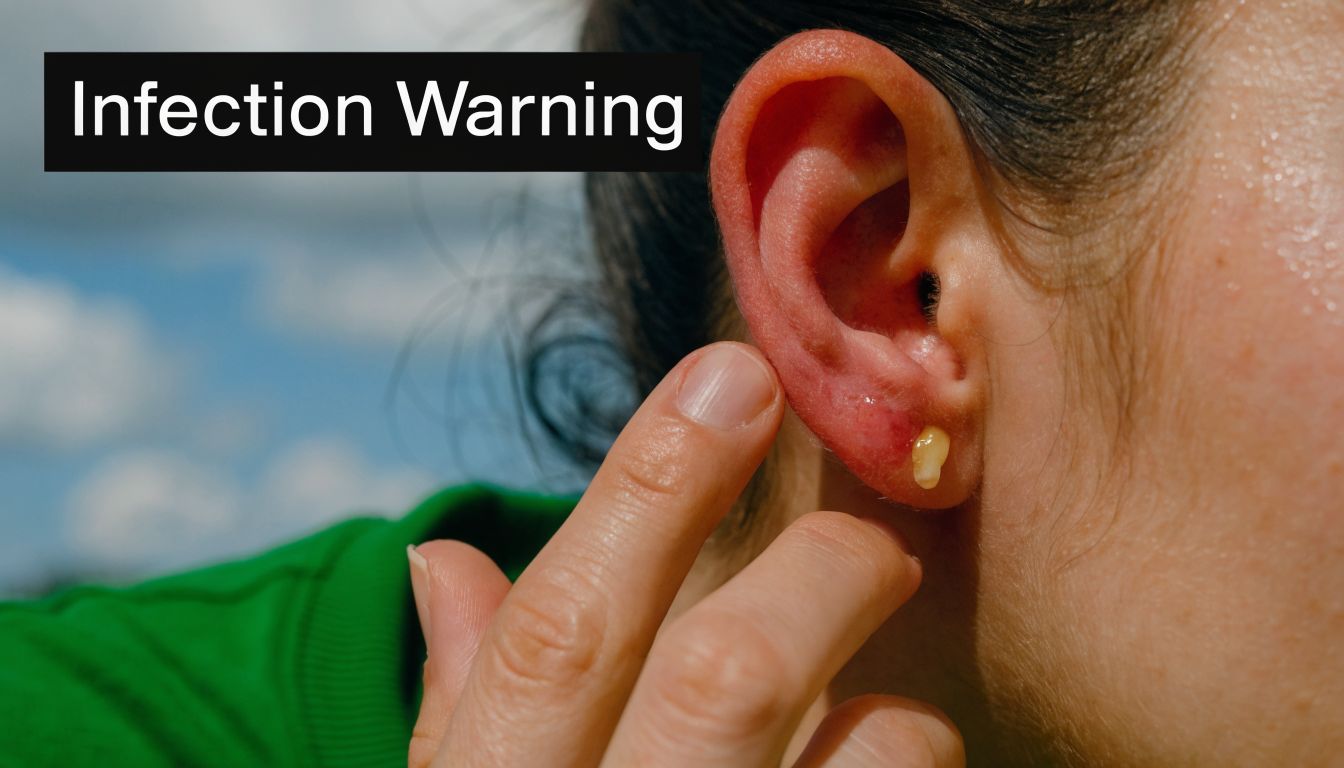
This is probably the most definitive sign of an infection. It's really important to know the difference between the normal lymph fluid your body produces during healing and actual pus. Lymph is a thin, clear, or whitish-yellowish fluid that dries into 'crusties' – that's totally normal.
Pus, however, is a clear sign of a bacterial problem. Here’s how to spot it:
- Thick and Opaque: Unlike the watery lymph fluid, pus is thick, creamy, and you can't see through it.
- Colour: It’s usually a distinct yellow, green, or even brownish colour.
- Unpleasant Odour: An infection often comes with a noticeable, unpleasant smell.
If you’re seeing a thick, coloured, and smelly discharge when cleaning your piercing, bacteria have definitely set up camp. Getting pierced at a professional studio like Timebomb Tattoo & Piercing in Croydon or Bournemouth gives you the best start, but proper aftercare is what prevents this.
A 2005 British survey found that around 15% of people with piercings needed to see a doctor for treatment, often due to this kind of spreading inflammation. You can read more about piercing complication statistics to understand the risks.
Feeling Unwell and Systemic Symptoms
Sometimes, the signs of an infection go beyond the piercing itself. If it becomes more serious, it can start to affect your entire body.
You need to pay close attention if you start experiencing any of these systemic symptoms alongside the local ones:
- Fever or Chills: Developing a temperature or feeling hot and cold is a major red flag.
- Nausea: A significant infection can make you feel sick to your stomach.
- General Malaise: This is that classic feeling of being generally unwell, exhausted, and just completely run down.
If you have obvious signs of infection at the piercing site and you start to feel unwell, this is no longer a 'wait and see' situation. These symptoms mean the infection could be spreading, and it’s time to get medical advice quickly. If you're ever worried, please don't hesitate to reach out to us on WhatsApp at 07752 913846 (Bournemouth) / 07902 490584 (Croydon) or call 01202 900050 (Bournemouth) / 020 8686 7730 (Croydon) for guidance.
Your Immediate Home Care Plan for a Suspected Infection
Okay, so you think your piercing might be getting infected. The first thing to do is take a deep breath. How you handle it in the next few hours can make all the difference, either calming things down or making them a whole lot worse. Here’s your immediate action plan from a piercer's perspective.
The single most important rule is this: do not remove the jewellery. I know it’s tempting, but taking out the post or ring is the worst thing you can do right now. This allows the piercing to close from the outside, trapping any infection inside your body. That’s how a simple irritation turns into a painful abscess that might need to be medically drained. Leave it in.
The Right Way to Clean It
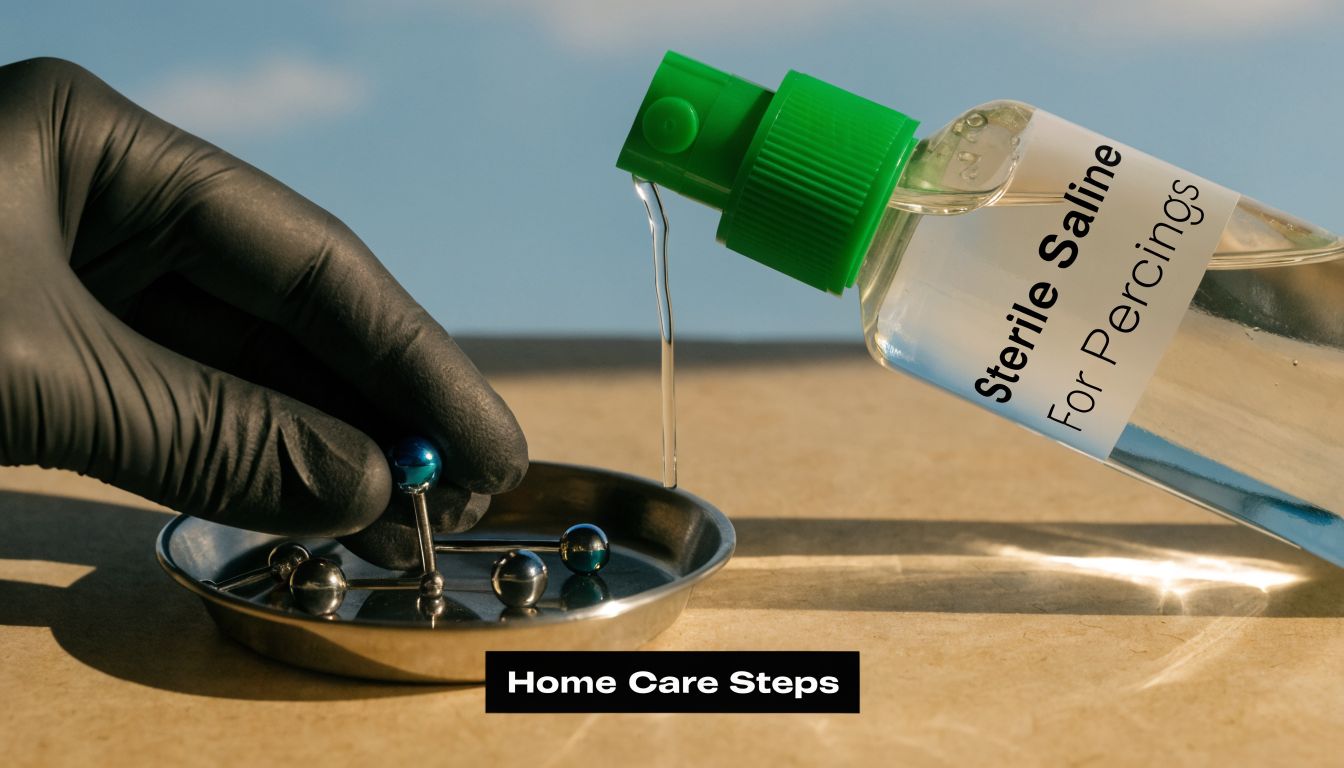
When a piercing is angry, your job is to soothe it, not attack it. Aggressive scrubbing or twisting the jewellery will only drive bacteria deeper and tear the new tissue that’s trying to form. The only thing that should touch your piercing is a sterile saline solution.
Your new cleaning routine is simple and gentle:
- Hands First, Always: Before you go anywhere near your piercing, wash your hands thoroughly with warm water and antibacterial soap.
- Saline Spray or Soak: Give the piercing a good spray from the front and back with your saline solution. You can also soak a clean piece of non-woven gauze in the saline and just hold it gently against the area for a couple of minutes.
- Pat, Don't Rub: Use a fresh paper towel or more non-woven gauze to gently pat the piercing dry. Steer clear of bath towels – they’re a magnet for bacteria and can easily snag on your jewellery.
Stick to this gentle clean twice a day. It might feel like you should be doing more, but over-cleaning can strip away good bacteria and cause even more irritation.
What You Absolutely Must Not Do
In a moment of panic, it's easy to reach for the "strong stuff" under the sink. Please don't. Many common household products will only make a bad situation much, much worse.
We’ve seen it countless times: a client with a minor irritation panics and uses alcohol or peroxide, thinking it’ll kill the germs. Instead, it destroys the fragile new skin cells, derailing the healing process and making the piercing more susceptible to a real infection.
Put these things back in the cupboard and never let them near your piercing:
- Harsh Chemicals: Rubbing alcohol, hydrogen peroxide, surgical spirits, and antibacterial soaps like Dettol or Hibiscrub are far too aggressive. They cause chemical burns on a healing wound.
- Ointments and Creams: Do not apply any thick creams, oils, or balms. They block oxygen from getting to the piercing and create a sticky trap for dirt and bacteria.
- Twisting and Turning: This is old, bad advice. Forcing the jewellery to move rips the delicate healing channel (the fistula) and drags surface bacteria into the wound.
- DIY Salt Soaks: While saline is just salt and water, getting the ratio right at home is almost impossible. Using unsterilised table salt and tap water can introduce a whole new set of bacteria to the area. Stick to pre-packaged sterile saline.
You can find a complete breakdown of the best cleaning practices in our full guide on how to clean a new piercing. It’s a great resource for getting the fundamentals right from day one.
If you’ve followed this advice and things aren't looking better within 24-48 hours—or if they're getting worse—it’s time to get a professional opinion. For a quick assessment or if you just need some reassurance, give us a call on 01202 900050 (Bournemouth) / 020 8686 7730 (Croydon) or message us on WhatsApp at 07752 913846 (Bournemouth) / 07902 490584 (Croydon).
Right, you’ve got a piercing that’s looking a bit angry, and now you’re playing the worrying game of “Who do I call?” The confusion over whether this is a job for your piercer, your GP, or A&E can pile on the stress. Let's break it down so you know exactly who to turn to and when.
Think of your piercer as your first line of defence for almost everything. Once a problem tips over into a genuine bacterial infection, however, it becomes a medical issue. Knowing where that line is makes all the difference.
When to Contact Your Professional Piercer
Your piercer should be your best friend during the healing process. Honestly, we’ve seen it all—from piercings that heal without a whisper of trouble to ones that throw a full-on tantrum. We can spot the difference between normal healing weirdness and a real problem in a heartbeat. For almost any non-emergency worry, we’re the ones to call first.
Get in touch with your piercer for things like:
- General Irritation: Is it a bit red, a bit swollen, maybe a little crusty, but not excruciatingly painful or oozing green stuff? This is our territory. We can take a look and suggest a small tweak to your aftercare or simply give you the peace of mind that what you're seeing is totally normal.
- Jewellery Woes: Is the bar now looking way too long now that the initial swelling has subsided? Or maybe it’s feeling too tight? If you think you might be reacting to the metal, we can help. Changing jewellery in a new piercing requires the right sterile equipment and a gentle hand, so let us handle it.
- The Dreaded Bumps: Ah, irritation bumps. They look scary, but they’re incredibly common. A good piercer can help you play detective to find the cause—usually pressure from sleeping, jewellery movement, or too much moisture—and create a solid plan to get rid of it.
For any of these issues, or just for reassurance, your best bet is to send us a clear photo or book a quick check-up. You can always pop a message over to our studio WhatsApp on 07752 913846 (Bournemouth) / 07902 490584 (Croydon) for a fast, expert opinion.
When to Visit Your GP
Now, if the situation escalates beyond simple irritation and starts ticking the boxes for a proper infection, it’s time to see a doctor. Your GP is the person who can officially diagnose an infection and, crucially, prescribe the antibiotics needed to treat it. A piercer cannot legally do this.
It’s time to make that GP appointment if you're seeing:
- Proper Pus: We’re not talking about the thin, whitish fluid (lymph) that’s normal. We mean a thick, opaque discharge that’s yellow or green, often with an unpleasant smell, that keeps coming back even after you've cleaned the area.
- Symptoms Getting Worse: You've been babying your piercing and following your aftercare perfectly for a day or two, but the pain, redness, and swelling are getting worse, not better.
- Feeling Unwell: This is a big one. If you’re starting to feel fluey—running a bit of a temperature, feeling shivery, or just generally unwell—it could be your body trying to fight off a spreading infection.
A quick word of advice: don't put off seeing a doctor if you genuinely suspect an infection. We're experts in piercings and aftercare, but only a doctor can treat a bacterial infection. Waiting too long can turn a simple issue into a much more serious complication.
When You Need to Go to A&E Immediately
In very rare situations, a piercing infection can become a genuine medical emergency. These symptoms are your body's fire alarm, signalling that the infection is spreading in a way that could become dangerous very quickly.
Go straight to your nearest Accident & Emergency department if you notice any of these red flags:
- Red Lines Spreading Out: If you see distinct red streaks moving away from the piercing, this is a classic sign of lymphangitis. It means the infection is travelling through your lymphatic system and needs immediate medical intervention.
- High Fever and Sickness: A high temperature combined with chills, confusion, or a racing heart are signs of a severe systemic infection, potentially sepsis. This is a medical emergency.
- Extreme Swelling: The swelling is severe, spreading fast, and perhaps even changing the shape of your ear, nose, or face. For tongue, lip, or septum piercings, this is especially dangerous as it could obstruct your breathing.
- Unbearable Pain: The pain is so bad that over-the-counter painkillers aren't touching it.
These emergency signs are not common, but it's vital to know what they look like. Never, ever "wait and see" with these symptoms. And if you're ever in any doubt and need immediate advice on what to do next, our studio phone line is always available at 01202 900050 (Bournemouth) / 020 8686 7730 (Croydon).
Of course. Here is the rewritten section, crafted to sound like an experienced human expert and formatted according to your requirements.
How to Prevent Piercing Infections from the Start
Look, knowing how to spot an infection is important, but preventing one in the first place is the real goal. The best problem is one you never have to deal with, right? A smooth, easy heal all comes down to two things: a quality piercing from a real professional and you following the aftercare advice properly.
The entire foundation for a happy piercing is set the second that needle goes through. I can't say this enough: the single most important choice you'll make in this whole process is who you let pierce you. A true professional doesn't just put a hole in you; they create a clean, controlled, and safe starting point that drastically cuts down your risk from day one.
Choose Your Piercer and Jewellery Wisely
This is the one area where you absolutely cannot cut corners. Choosing a skilled piercer and the right jewellery is non-negotiable if you want to avoid problems later. Any decent studio will be completely open about their safety and sterilisation procedures.
Here’s what you should see as the absolute bare minimum:
- Sterile, Single-Use Needles: Your piercer must open a new, sealed, sterilised needle packet right in front of you. If they even think about using a piercing gun, especially on cartilage, walk out. Guns cause blunt force trauma and can't be properly sterilised.
- Implant-Grade Jewellery: The first piece of jewellery that goes into your fresh piercing has to be made from body-safe material. We’re talking implant-grade titanium (ASTM F-136), implant-grade steel (ASTM F-138), or solid 14k/18k gold. Cheap materials like mystery "surgical steel" often contain nickel, which can cause nasty reactions and stop you from healing.
- A Spotless Environment: The room should be visibly clean. Look for disinfected surfaces, proper hand-washing stations, and fresh disposable gloves being used for everything.
These standards are the bedrock of our partner studios in Croydon and Bournemouth. We're firm believers that starting with the right procedure and the right materials is half the battle won.
Honestly, we see the piercing itself as just 1% of the job. The other 99% is all you. We can do everything perfectly in the studio, but if you don't take the aftercare seriously, you're just asking for trouble.
The Best Aftercare Is Simple Aftercare
Once you walk out of that studio door, the responsibility is yours. Your body is trying to heal a wound, and your only job is to give it a clean, undisturbed space to work its magic. The good news is that the most effective aftercare is also the simplest.
The whole thing boils down to consistency and a "less is more" mindset. Your body has this healing thing down; you just need to keep bacteria away and stop fiddling with it.
Here’s all you need to do:
- Clean it twice a day. Gently spray the front and back of the piercing with a packaged sterile saline solution. Don't rub, scrub, or twist anything. Just spray and let it be.
- Keep it dry. After you've cleaned it or had a shower, gently pat the area completely dry with a clean paper towel or a bit of non-woven gauze. Moisture is a playground for bacteria.
- Leave it the hell alone. This is honestly the hardest part for most people. Don't touch it, twist it, or turn the jewellery. Every time you fidget with it, you're introducing germs and irritating the delicate new tissue that's trying to form.
That's it. That simple routine is all it takes. Using the right material from the get-go also gives you a huge head start. If you’re curious about the different options, you can learn more about the benefits of using implant-grade titanium piercing jewellery in our detailed guide.
Little Lifestyle Habits That Make a Big Difference
Your new piercing is part of your body, and how you treat your body as a whole really affects how well it heals. A healthy you means a faster, smoother heal.
Think about these things, especially in the first few weeks:
- No Soaking. For at least the first 4-6 weeks, stay out of pools, hot tubs, lakes, and the sea. They are teeming with bacteria that would love to set up shop in a new piercing.
- Help Your Immune System. Eating well, drinking plenty of water, and getting enough sleep gives your body the fuel it needs to repair itself. If you're stressed and run down, your healing will take a hit.
- Watch Out for Bumps and Snags. This one takes some getting used to. Try not to sleep on the piercing. A travel pillow is a lifesaver for ear piercings – just put your ear in the hole! Be careful with phones, headphones, hats, and even your glasses.
If you're ever worried about your piercing or just want someone to take a look and tell you it's all good, please don't hesitate to get in touch. You can call us for advice on 01202 900050 (Bournemouth) / 020 8686 7730 (Croydon) or drop a message to our WhatsApp at 07752 913846 (Bournemouth) / 07902 490584 (Croydon).
Common Questions About Piercing Infections
When a new piercing starts looking red and angry, it’s easy to let your mind run wild with worst-case scenarios. We get it. Over the years in our Croydon and Bournemouth studios, we’ve heard every question imaginable, and a little bit of worry is completely normal.
The key is to not panic. Instead, let's get you some clear, straightforward answers from piercers who have seen it all before.
Can I Just Make My Own Salt Water at Home?
This question comes up all the time, and we can see why – it sounds like a simple, money-saving hack. But our answer is always a hard and fast no. Making a truly safe saline solution at home is practically impossible.
The biggest issue is getting the salt-to-water ratio perfect. If it's too salty, you’ll dry out and irritate the delicate healing tissue, making everything worse. If it's too weak, it simply won't be effective. You need a sterile, isotonic saline solution (that’s 0.9% salt) to match your body's natural fluids. Anything else is just asking for trouble.
And it’s not just about the ratio. There are other hidden risks:
- Bacteria: Your kitchen salt and tap water are far from sterile. Using them can introduce nasty bacteria directly into what is essentially an open wound.
- Additives: A lot of table salt is iodised, which is incredibly harsh on a piercing. Even the non-iodised kind often contains anti-caking agents that can cause serious irritation.
You should only ever use a pre-packaged sterile saline wound wash spray. They’re designed specifically for this purpose, guaranteeing the solution is pure, properly balanced, and will actually help your piercing heal, not hinder it.
Should I Take the Jewellery Out if It Looks Infected?
Listen closely, because this is the most important piece of advice you’ll get: never, ever remove your jewellery from a suspected infection. We know your first instinct might be to just get it out of there, but it is the absolute worst thing you can do.
When you remove the jewellery, the tiny holes of the piercing can close up incredibly fast—sometimes in a matter of minutes. If there's an infection, this traps all the bacteria inside the piercing channel with no way to get out. This is how a simple infection can quickly develop into a painful abscess.
An abscess is a sealed-off pocket of pus that builds up under the skin and often needs to be drained by a doctor. Leaving the jewellery in keeps the channel open, allowing pus and fluid to drain while you get the proper medical treatment you need, like antibiotics. Let your piercer or GP be the one to make the call on when, or if, the jewellery should come out.
How Long Does a Piercing Infection Take to Heal?
When you’re in pain, you just want to know when it’s going to end. The good news is that with proper medical care, a true infection can clear up fairly quickly.
Once you’ve seen a GP and started a course of antibiotics, you should start feeling better within a couple of days. Here’s what you can generally expect:
- First 24-48 Hours: The worst of the pain, swelling, and redness should start to calm down.
- Within a Week: Most of the major symptoms, especially any pus, should be significantly reduced or gone completely.
- 1-2 Weeks: The infection itself should be cleared. The piercing might still feel a bit tender, but it’s on the road to recovery.
It is absolutely crucial that you finish the entire course of antibiotics prescribed by your doctor. Don't be tempted to stop just because it looks and feels better. Stopping early can let the infection roar back to life, sometimes even stronger than before. If you have any worries during this time, our team is here to help. You can call us on 01202 900050 (Bournemouth) / 020 8686 7730 (Croydon) or send a message via WhatsApp to 07752 913846 (Bournemouth) / 07902 490584 (Croydon).
At Piercing Near Me, our entire mission is to connect you with professional piercers who put your safety and well-being first. If you’re in the Croydon or Bournemouth area and want a studio that insists on sterile needles, implant-grade jewellery, and provides fantastic ongoing support, we’re here to help you book with total confidence. Find your perfect piercing and book your appointment with us today.
Trackbacks/Pingbacks