
You’ve found a piercing you love. Maybe it’s a neat helix stud, a small nostril spark, or a navel bar you’ve saved three times already. Then the questions start. What metal is safest? What does “implant-grade” mean? Is titanium really better, or is it just a buzzword?
Those questions are sensible. Good studios hear them every day from first-time clients, nervous adults, and parents booking for teens. These individuals don’t need more jargon. They need clear answers from someone who handles fresh piercings every day and knows which details matter during healing.
That’s why titanium piercing jewellery gets so much attention in professional studios. Not all jewellery sold as “titanium” is the same, and not every studio checks the paperwork behind it. If you want a piercing that has the best chance of healing calmly, the material in that fresh piercing matters from the very first moment.
Your Piercing Journey Starts with Safe Jewellery
You’re sitting in the studio chair with a screenshot of the piercing you want, and then the nerves kick in. “I know where I want it. I just don’t know what should go in it.”
That question matters more than many first-time clients realise. A fresh piercing is healing tissue, so the first piece of jewellery has a job to do. It needs to sit calmly in the body, with a smooth finish and a material your skin is less likely to argue with.
This is often where confusion starts. Placement gets most of the attention because it is the part you can see in the mirror. In the studio, though, one of the first safety checks is the jewellery itself.
Why first-timers get confused
Retail sites and market stalls often use reassuring-sounding labels such as “surgical steel”, “medical grade”, “hypoallergenic”, and “titanium”. Those terms do not all mean the same thing, and some of them tell you far less than they appear to.
A good piercer should be able to answer a simple question plainly. What metal would they choose for a fresh piercing in their own body, or for their teenager? In professional studios, the answer is often implant-grade titanium, because the choice is based on healing behaviour, polish, and documented material standards, not marketing language.
That last part matters. A professional studio should not merely say a piece is safe. They should be able to show what it is, where it came from, and which standard it meets. If you have been reading about UK body jewellery standards and studio-quality jewellery, that is exactly the kind of evidence you want to ask for.
What makes this choice feel safer
Titanium has a strong reputation in piercing for a reason. Piercers trust it because high-quality implant-grade titanium is known for being light, stable, and well suited to healing tissue when it has been manufactured and finished to the right standard.
The key point is simple. “Titanium” on its own is not enough.
For a new piercing, the safer choice is titanium with a recognised implant standard and traceable paperwork behind it. That is a bit like buying a child car seat. The label alone is not the reassurance. The reassurance comes from the tested standard, the proper fit, and the proof of its authenticity.
Once you know to ask about certification, polish quality, and studio sourcing, the whole process feels much clearer. You are no longer relying on a sales claim. You are checking the same details that careful professional piercers check every day.
What Is Implant-Grade Titanium Jewellery
“Titanium” sounds simple, but in piercing it’s only half the answer. The more important words are implant-grade.
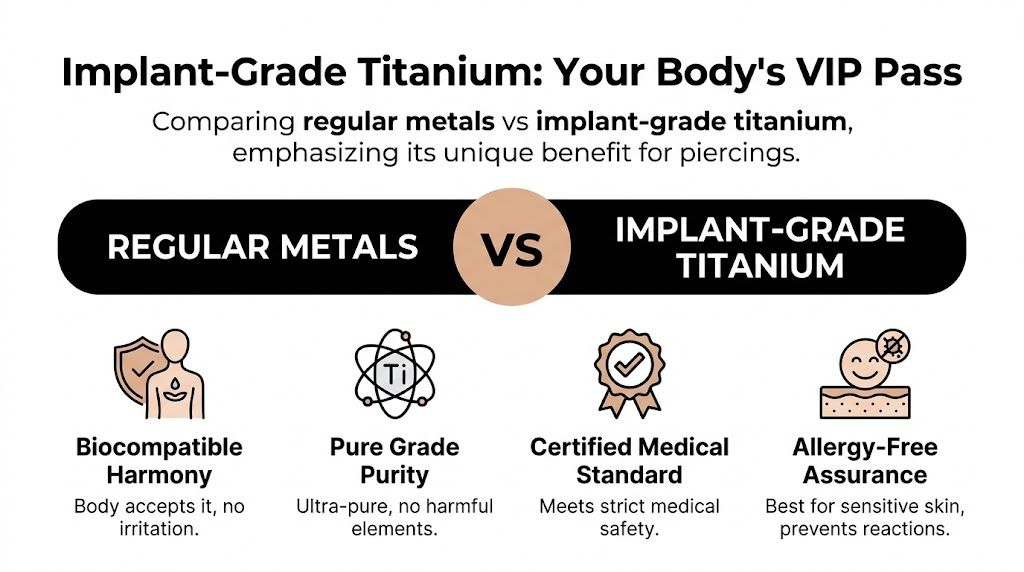
Think of implant-grade titanium as a kind of VIP pass for your body. It tells you the metal meets a standard intended for use inside the human body, not just for general manufacturing. That’s why professional piercers pay close attention to the exact grade, not just the word stamped on a packet.
What ASTM F136 means
The term you want to know is ASTM F136. You may also see it written as Ti-6Al-4V ELI or Grade 23. Those codes can look intimidating, but for a client they really mean one practical thing. The material has been made to a recognised implant standard that suits the demands of healing tissue.
The Association of Professional Piercers recommends implant-grade titanium meeting ASTM F136 for new and unhealed piercings, and this standard keeps nickel content below 0.05%, which helps reduce irritation risk. The same guidance notes that it's far less likely to cause irritation than non-implant grades, while industrial grades can corrode in the body, according to this detailed guide to ASTM F136 titanium in piercing jewellery.
Why “titanium” alone isn’t enough
Often, people get caught out. A seller might say a piece is titanium, but that still doesn’t tell you whether it’s the right grade for a fresh piercing. There are titanium grades used in other industries that aren’t the best choice for healing tissue.
For a healed piercing, your options may widen. For a brand-new piercing, the standard needs to be stricter. You want jewellery that is:
- Biocompatible so the body is less likely to react badly
- Precisely finished so the surface is smooth
- Traceable so the studio can confirm what it really is
- Chosen for healing, not just for appearance
Why professional studios avoid vague labels
“Surgical steel” is one of the most misunderstood terms in piercing. It sounds clinical, so people assume it’s always ideal. In reality, that label can hide a lot of variation, and steel can contain nickel. For some people that won’t cause trouble, but for others it can be the reason a piercing stays angry, itchy, or unsettled.
Titanium gives studios a cleaner answer. It’s easier to recommend a material with a recognised implant standard than to rely on broad marketing language.
Here’s a simple comparison:
| Material | Biocompatibility | Hypoallergenic | Weight | Best for Initial Piercing? |
|---|---|---|---|---|
| Implant-grade titanium | High | Yes, commonly chosen for sensitive clients | Light | Yes |
| Non-implant-grade titanium | Variable | Not always reliable for fresh piercings | Light | No |
| Surgical steel | Variable | Not ideal for everyone due to possible nickel content | Heavier | Sometimes, but not the top choice |
| Plated jewellery | Poor for healing | Unreliable | Variable | No |
If you want to explore more about materials and standards used in the UK market, this guide to UK body jewellery gives useful background.
Practical rule: If a studio says “we use titanium”, your next question should be “Is it implant-grade ASTM F136, and can you verify that?”
The Unmatched Benefits of Titanium for Piercings
Once you understand the grade, the next question is obvious. Why do so many professional piercers prefer it?
The answer isn’t just “because it’s high quality”. It’s because titanium piercing jewellery helps with the things clients experience during healing. Less irritation. Less weight. Less chance of the jewellery reacting badly to daily life.
Better for sensitive skin
When someone says a piercing is “angry”, they usually mean redness, itching, tenderness, or that nagging cycle where it settles and flares up again. The jewellery can be part of that problem.
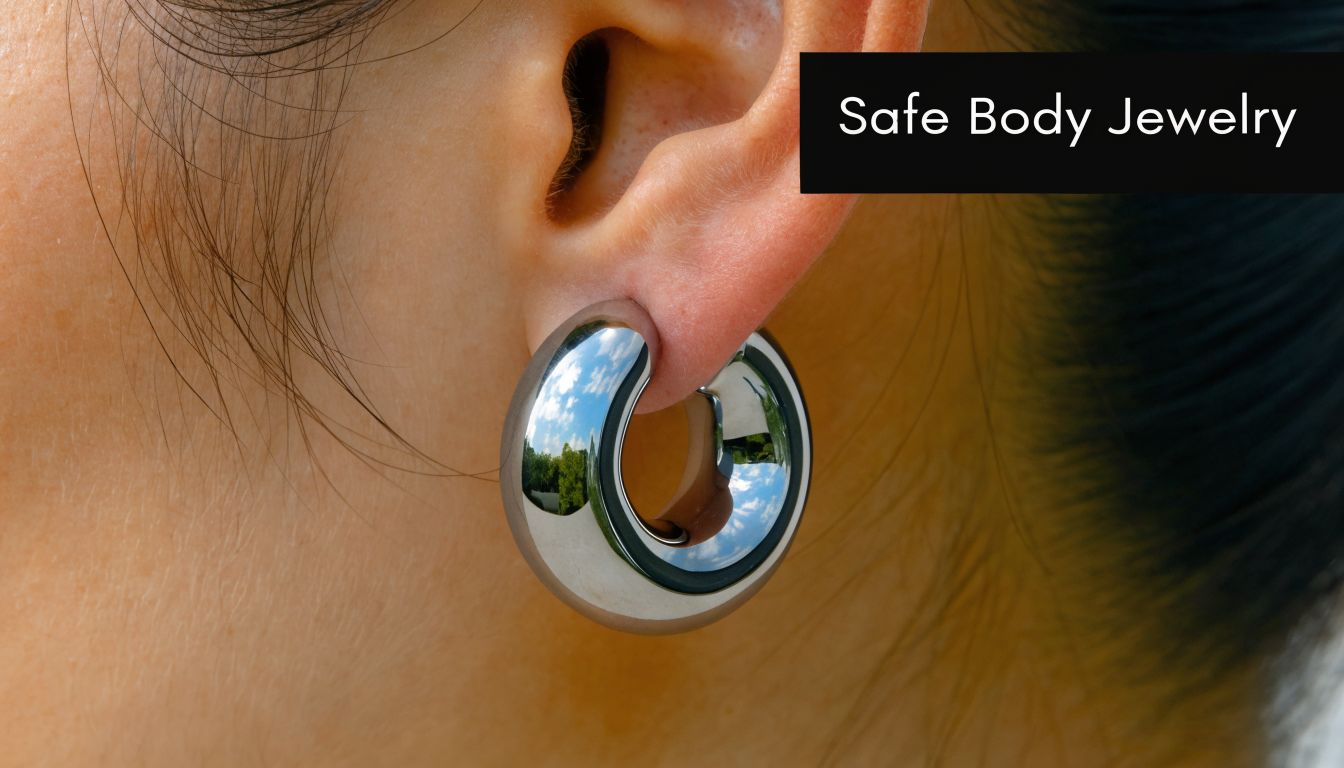
Titanium is widely chosen because it’s hypoallergenic and doesn’t raise the same concerns people often have with metals that may contain nickel. In UK piercing practice, that’s a big reason it became so dominant.
Titanium piercing jewellery became widely used in the UK from the 1990s, and professional piercers now widely recommend implant-grade (ASTM F136) titanium.
Lighter jewellery means less stress on a fresh piercing
A fresh piercing doesn’t want extra pressure. Cartilage in particular can become grumpy if jewellery feels heavy, shifts too much, or keeps getting knocked by hair, pillows, headphones, or clothing.
Titanium’s lighter feel makes a real difference in day-to-day comfort. A client may not describe it in technical terms. They’ll just say it feels less “there”. That matters with helix, conch, nostril, and navel placements where movement can quickly become irritating.
It stays stable and doesn’t tarnish
Some metals change over time. They can dull, tarnish, or react poorly to moisture and the normal environment around a healing piercing. Titanium is valued because it resists corrosion well and keeps a clean, stable surface.
That’s important for two reasons:
- Hygiene matters because smooth, stable jewellery is easier to keep clean
- Appearance matters too because clients want jewellery that still looks polished after the excitement of piercing day wears off
A piece of jewellery can be pretty and still be wrong for a fresh piercing. The best jewellery does both jobs at once. It looks good and behaves well during healing.
Why this matters in real life
For a first lobe piercing, titanium may mean a calmer healing period. For cartilage, it can mean the difference between “a bit tender but fine” and “constantly sore and catching on everything.” For facial piercings, where the jewellery sits in full view every day, stable colour and finish also matter.
That mix of comfort, low reactivity, and durability is why many experienced piercers won’t compromise on implant-grade titanium for fresh work.
How to Choose Your First Titanium Jewellery Piece
Choosing your first jewellery piece is a bit like choosing the right shoes for a long walk. If the shape or fit is wrong, you feel it quickly, even if the material itself is good.
That is why experienced piercers do not start with colour or style alone. They look at where the piercing sits, how that area swells, what tends to catch on it, and whether the jewellery can sit still while the tissue settles.
Start with the right style for the placement
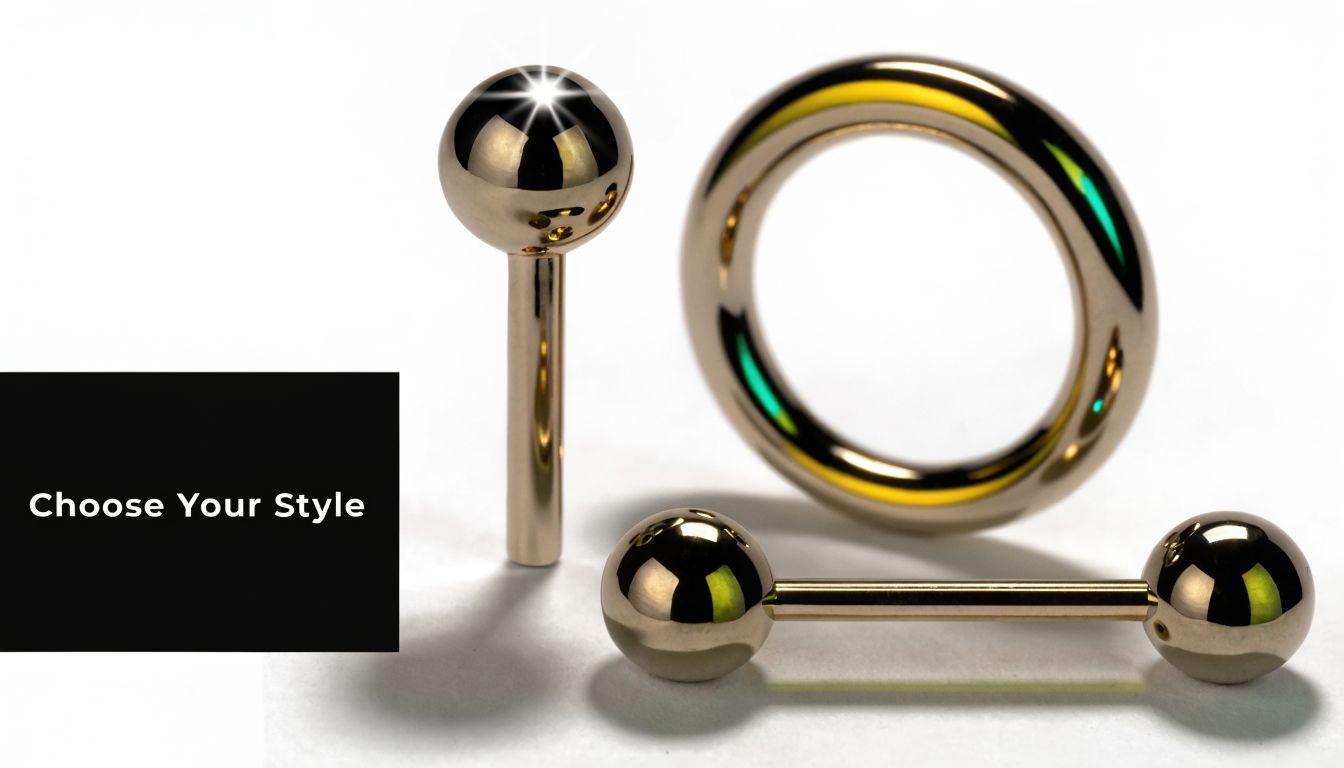
Different piercings need different jewellery shapes to heal well. A nostril may suit a flat-back labret. A navel usually needs a curved barbell. Many cartilage piercings do better with a stud during early healing, even if a ring is the look you eventually want.
Good studios separate themselves from sales talk. A professional piercer should explain why one shape is safer for that placement, not just say “titanium is best” and leave you to guess the rest.
If you are choosing jewellery for ear piercings, this guide to the best earrings for newly pierced ears gives a helpful starting point. Your piercer should still match that general advice to your anatomy.
Threadless and internally threaded options
These terms sound technical, but the difference is simple once you see how the jewellery goes in.
Externally threaded jewellery has the screw ridges on the post itself. In a fresh piercing, those ridges can scrape through the channel.
Internally threaded jewellery keeps the wearable part smoother because the thread sits inside the bar.
Threadless jewellery uses a tension-fit pin instead of screw threads. The post that passes through the piercing stays smooth, which is one reason many high-standard studios prefer it for fresh work.
A first-time client usually does not need to memorise every term. You just need to know the practical question to ask: Is this piece threadless or internally threaded? If a studio cannot answer clearly, that tells you something about their setup.
Coloured titanium and anodising
Colour causes a lot of confusion.
Gold-tone titanium, blue titanium, and purple titanium are often made by anodising. That process changes the surface oxide layer of the titanium itself. It does not work like paint, and it is different from plating a cheaper metal and hoping the top layer stays intact.
For a healing piercing, that difference matters. Plated jewellery can wear away and reveal whatever is underneath. Anodised implant-grade titanium keeps the same base metal throughout, which is why many professional studios are happy to use it for fresh piercings.
If you want a gold look, ask a direct question: Is this anodised implant-grade titanium, or is it plated?
Fit matters as much as material
Even perfect titanium can become a poor choice if the fit is wrong.
Fresh piercings usually need a little extra room for swelling. That is why the first post or bar is often longer than the one you will wear later. Parents sometimes worry that the jewellery looks “too long” on day one. In many cases, that extra space is deliberate and protective.
A piercer should be choosing three things carefully:
- Gauge, the thickness of the jewellery
- Length or diameter, depending on the style
- A downsize plan, so the longer initial piece can be changed once swelling drops
That last point is easy to miss. The first piece is not always the forever piece. In a well-run studio, choosing your jewellery includes planning the check-up and the later downsize, because a bar that was helpful in week one can become annoying in week six if it keeps snagging on hair, towels, or headphones.
Good jewellery choice is really a combination of safe material, the right shape, proper construction, and sizing that matches the healing stage. That is the standard you want from a studio, especially if they claim their titanium is implant-grade.
How to Verify Your Titanium Jewellery Is Genuinely Safe
A studio saying “we use titanium” is a start. It isn’t proof.
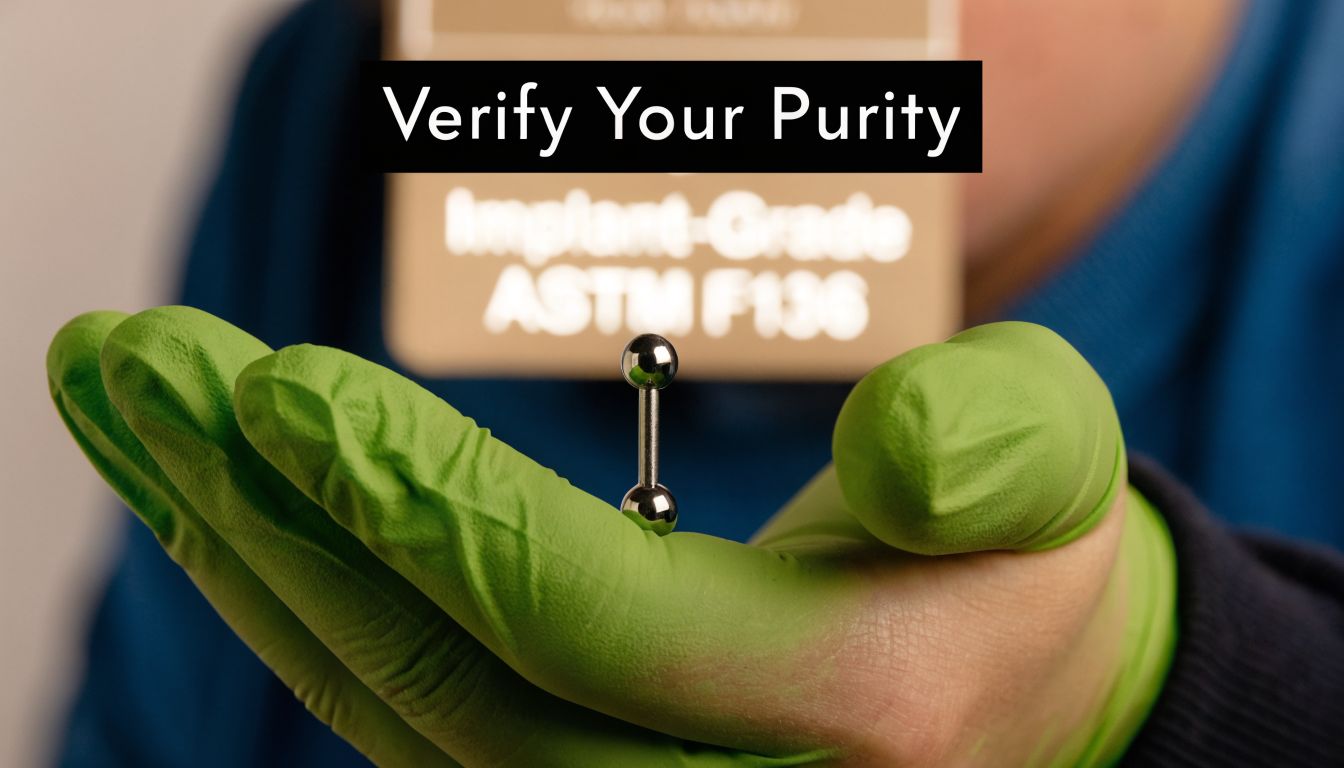
The difference between a polished, professional setup and a weaker one often shows up in the paperwork, the sourcing, and how confidently staff answer basic safety questions. If a piercer really uses implant-grade titanium, they should be able to explain what it is and where it came from.
Ask for the exact standard
The first question is simple.
Ask: Is this implant-grade titanium meeting ASTM F136?
That question does two useful things. It tells the studio you care about real standards, and it moves the conversation away from fuzzy labels like “medical metal” or “premium titanium”.
If the answer is clear and confident, that’s encouraging. If the reply becomes vague, dismissive, or oddly defensive, pay attention.
Ask about mill certificates
A mill certificate is a document that helps trace the material and confirm its specification. Clients don’t always realise they can ask about this, but they can.
Many clients aren't aware of the UK rules on nickel release, such as the BS EN 1811 test standard, so it's worth asking your studio what its jewellery is made from. The same source notes that asking to see proof of implant-grade titanium, such as mill certificates, helps ensure the jewellery meets legal and safety standards, according to this article on titanium safety and UK compliance checks.
What good answers sound like
You don’t need a lecture in metallurgy. You just want signs that the studio has proper systems in place.
Good questions to ask include:
- What grade is your initial jewellery? You’re listening for ASTM F136, Grade 23, or Ti-6Al-4V ELI.
- Can you verify the supplier and certification? A reputable studio should know.
- Do you use implant-grade titanium for all fresh piercings? Strong studios usually have a consistent policy.
- Is your coloured jewellery anodised or plated? Anodised is the safer answer for a fresh piercing.
- How do you record jewellery details for each client? This shows whether the studio is organised.
Look beyond the jewellery tray
Verification isn’t only about the metal. It’s about the whole studio culture around safety.
A careful studio usually shows that standard in other ways too:
| What to check | Why it matters |
|---|---|
| Clear answers about ASTM F136 | Shows the staff know the difference between grades |
| Traceable jewellery sourcing | Reduces the risk of mystery imports |
| Single-use sterile needles | Supports clean, modern piercing practice |
| Proper aftercare guidance | Suggests the studio cares about healing, not just the sale |
| Willingness to discuss downsizing | Shows long-term thinking, not a rushed appointment |
You should never feel awkward asking what’s going into your body. A professional piercer expects those questions.
UK-specific details clients often miss
Many first-time clients assume anything sold in the UK must already meet a suitable standard. That isn’t always a safe assumption. Imported jewellery can vary, and online marketplaces often blur the line between fashion jewellery and proper piercing jewellery.
That’s why it helps to ask direct questions instead of relying on product descriptions alone. “Titanium look”, “hypoallergenic style”, and “surgical finish” are not the same as documented implant-grade titanium.
The safest studio doesn’t just claim quality. It can prove it.
Caring For Your Titanium Piercing and Jewellery
Good jewellery gives your piercing a strong start. Good aftercare helps you keep that advantage.
The routine itself is simple. What usually causes trouble is overcleaning, touching, twisting, or swapping jewellery too early because the outside looks calmer than the inside feels.
Keep aftercare simple
For most fresh piercings, simple care wins.
- Use sterile saline to clean as advised by your piercer
- Wash your hands first before going anywhere near the area
- Don’t twist or rotate the jewellery
- Leave crusts to soften naturally rather than picking at them
- Avoid unnecessary pressure from sleeping, headphones, tight clothing, or snagging
If you want a straightforward overview of suitable cleaning products and technique, this saline spray aftercare guide is a helpful starting point.
What normal healing can look like
Fresh piercings can be slightly red, a bit swollen, and occasionally tender. You may also notice some clear or pale fluid drying around the jewellery. That can be part of normal healing.
What worries clients is that normal healing doesn’t always look pretty. A calm piercing can still look a little crusty or moody on some days, especially if it’s been slept on or knocked.
Signs that need attention
It’s a good idea to contact your piercer if you notice:
- Increasing heat around the area
- Strong or worsening pain
- Thick yellow or green discharge
- Swelling that seems to be intensifying rather than settling
- Jewellery starting to feel embedded or too tight
A professional piercer can often tell the difference between irritation and a developing problem very quickly, and they may advise whether you also need medical assessment.
Healing should gradually move in the right direction, even if it has off days. If things are getting steadily worse, don’t just hope for the best.
The truth about titanium allergy
People often say they’re “allergic to everything metal”, which usually reflects past bad experiences rather than a confirmed titanium allergy.
True titanium allergies are extremely rare, and starting with implant-grade titanium avoids the nickel found in most surgical steel. Switching a healed but irritated piercing from steel to titanium often helps, as described in this report summary on titanium sensitivity and switching from steel.
Don’t skip the downsize
Many clients treat the downsize appointment as optional. It isn’t.
The longer post used at the start helps with swelling, but once that swelling drops, excess length can cause movement, snagging, and irritation. Downsizing to a better fit often makes a piercing feel more stable and comfortable very quickly.
That’s one of the simplest ways to protect the good start your titanium jewellery gave you.
Book Your Piercing with Confidence in Croydon and Bournemouth
Choosing a piercing studio gets easier once you know what to look for. You’re not just comparing styles or prices. You’re looking at whether the studio uses single-use sterile needles, whether the staff can explain implant-grade jewellery clearly, and whether they take aftercare and downsizing seriously.
That’s why experienced studios stand out so quickly. They don’t dodge questions about titanium piercing jewellery. They welcome them. They can explain why implant-grade titanium is used, how the jewellery is selected for your anatomy, and what support you’ll get once you leave the chair.
If you’re booking in Croydon or Bournemouth, look for a studio that treats first-timers with patience and treats safety as standard practice, not an upgrade. The best appointments feel calm, informed, and well organised from start to finish.
If you’d like to speak to Timebomb Tattoo & Piercing about placement, jewellery choice, or booking, call 01202 900050 (Bournemouth) / 020 8686 7730 (Croydon) or message on WhatsApp 07752 913846 (Bournemouth) / 07902 490584 (Croydon). If you’re feeling nervous, that first conversation often makes a huge difference. A good piercer would much rather answer your questions before the appointment than have you sit at home worrying.
Frequently Asked Questions About Titanium Jewellery
Is anodised titanium safe for a new piercing
Yes, when it’s genuine implant-grade titanium that has been properly anodised. Anodising changes the surface oxide layer of the metal itself. It isn’t paint, and it isn’t plating. That means there’s no coloured coating sitting on top waiting to chip off into a fresh piercing.
Can I be allergic to implant-grade titanium
A true allergy is rare, but if you have a history of strong metal reactions, tell your piercer before the appointment. In practice, many “metal allergy” stories come from reactions to lower-quality alloys, nickel exposure, rough finishes, or poorly fitting jewellery rather than to verified implant-grade titanium.
Why does titanium sometimes cost more than surgical steel
The difference usually comes from the grade, the finish, and the manufacturing quality. Implant-grade titanium jewellery is chosen because it meets a recognised standard and is often made with smoother, safer construction such as internal threading or threadless systems. For a fresh piercing, it’s better to think of it as paying for safer healing conditions rather than just paying for a metal.
Is titanium only for people with sensitive skin
No. Sensitive skin is one reason people choose it, but many clients without known allergies still start with titanium because they want the most stable option for healing.
Can I switch to titanium if my healed piercing is irritated
Often, yes. If a healed piercing is unhappy in another metal, a professional jewellery change to implant-grade titanium can be a smart next step. It’s best done with your piercer’s help so the fit and style suit the piercing properly.
If you’re comparing studios, placements, and aftercare advice, Piercing Near Me helps you find safe, professional piercing guidance in one place. You can explore trusted information, learn what high standards look like, and take the next step towards booking with more confidence.
Trackbacks/Pingbacks