
A lot of people read about ear piercing after they have already chosen the outfit, saved the inspiration photo, and started feeling that mix of excitement and nerves. The usual questions arrive fast. What metal is safest? Should you choose a stud or a hoop? Is gold always best? If your ears are sensitive, it can feel like one wrong choice will ruin the whole experience.
That worry is sensible. A fresh piercing is a small wound, and the jewellery sitting in it matters from day one. The best earrings for newly pierced ears are not just the prettiest ones in the tray. They are the ones your body can tolerate calmly while the tissue settles, swells, and heals.
I’m writing this in the same way I’d explain it to someone in the studio chair at Timebomb Tattoo. Clear, honest, and without the myths. If you understand the material, the fit, and the aftercare, your first piercing becomes much simpler.
Your Guide to a Great First Piercing
You have booked the appointment, picked a day, and now the practical questions start. What should the first earring be like? Can you choose something pretty, or do you need to settle for something plain until it heals? Those nerves are common, especially if this is your first piercing.
At Timebomb Tattoo & Piercing in Croydon and Bournemouth, we explain starter jewellery the same way we explain a good pair of walking shoes. Your first pair is there to support you properly, fit the job, and avoid rubbing while everything settles. With a fresh piercing, the jewellery needs to leave space for swelling, stay secure, and sit calmly against healing skin.
That matters for longer than many people expect. The NHS advice on body piercing aftercare notes that ear lobe piercings usually take 6 to 8 weeks to heal. Cartilage often takes longer, which is one reason your first jewellery choice should be made with healing in mind, not just the look in the mirror on day one.
Booking the right studio is part of that decision. The method used to make the piercing affects how much the tissue is disturbed and what jewellery can be fitted safely from the start. If you want a plain-English comparison before you choose, this guide on piercing gun vs needle explains the difference clearly.
A good first piercing should feel straightforward.
That usually means choosing a studio that follows proper hygiene procedures, uses suitable implant-grade materials, and fits jewellery sized for your anatomy rather than whatever happens to be in stock. General online advice is useful, but local action matters more. If you are booking in the UK, ask direct questions about sterilisation, jewellery standards, and whether your starter pieces include implant-grade titanium such as ASTM F136 where appropriate. At our Croydon and Bournemouth studios, those are normal questions, and they should be.
Tip: Choose the safest starter jewellery first. Then choose the decorative style within those safe options.
A safe first earring can still look polished and personal. The best studios do not make you choose between healing well and liking how your piercing looks.
The Science of Safe Piercing Jewellery
A fresh piercing behaves like a healing wound because that is exactly what it is. The jewellery becomes the object your body has to heal around. If the metal is unstable or irritating, the tissue stays angry. If the metal is biocompatible, the ear usually settles much more smoothly.
Why implant grade matters
The clearest example is implant-grade titanium. According to this ASTM F136 titanium overview, implant-grade titanium conforming to ASTM F136 is the benchmark material for initial piercings and is nickel-free. That matters because metal sensitivities, especially to nickel, are common in the UK.
That is why professional piercers talk about titanium so often. It is not marketing language. It is about reducing the chance that your body sees the jewellery as a problem.
Consider a house foundation
If you build on weak ground, cracks appear later. With piercing jewellery, those “cracks” look like soreness that will not settle, crusting that gets worse instead of better, pressure bumps, or a piercing that feels tender every time it is touched.
A good starter earring should do four things:
- Stay inert: It should not release irritating substances into healing tissue.
- Remain smooth: The surface should not scrape the channel as the ear moves.
- Hold securely: It should not wobble or fall out during early healing.
- Allow swelling room: The post should not squeeze the ear when swelling peaks.
Why titanium is so often the first choice
Titanium is lightweight, highly tolerated, and practical for people who are unsure whether their skin reacts to metals. It is also a strong option for clients who know they have sensitive ears from past reactions to cheap fashion jewellery.
Key takeaway: For a first piercing, the safest starting point is usually an implant-grade titanium stud fitted correctly by a professional.
That choice gives the piercing the calmest environment possible while the body gets to work.
Decoding Your Starter Earring Options
You are in the studio chair, the tray is in front of you, and several studs look almost identical. One has a clear gem. One is plain silver-toned. One is gold-toned. The part that decides how calmly your ear heals is usually the part you cannot see at a glance: the metal quality, the backing, and the fit.
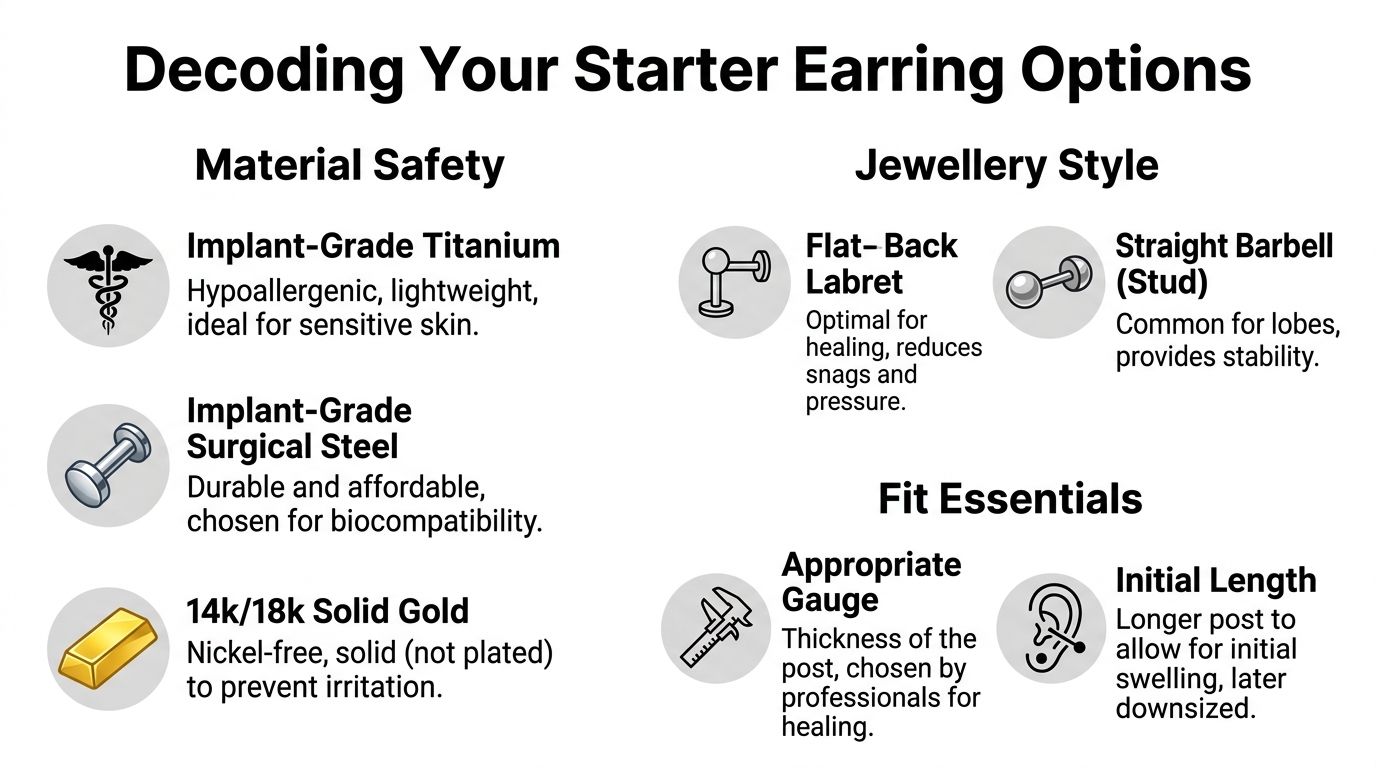
Comparing the main starter materials
A good way to choose starter jewellery is to split the decision into two questions. What look do you want? What material gives a healing piercing the best chance to stay settled?
| Material | What it’s like for a fresh piercing | Best suited to |
|---|---|---|
| Implant-grade titanium | Commonly chosen for first piercings because it is light, stable, and well tolerated | First-time clients, sensitive skin, cautious healers |
| Implant-grade surgical steel | Can be appropriate in professional settings, but suitability depends on exact alloy and client sensitivity | Clients with no history of metal reactions who want a polished steel look |
| Nickel-free solid gold | Can work for fresh piercings if the quality and design are right, but it needs careful selection | Clients who want a gold finish from the start and are advised it suits their piercing |
Earlier, we covered why implant-grade titanium is such a common first choice. In practical terms, it gives your body fewer reasons to stay irritated. That matters even more in the UK, where a safe piercing appointment should involve clear jewellery specifications rather than vague labels like "surgical metal" or "hypoallergenic."
The standards themselves can sound technical. A simple way to read them is this: professional starter jewellery should be made from materials intended for close contact with the body and finished smoothly enough for healing tissue. The UK Association of Professional Piercers jewellery standards guidance is a useful reference if you want to see how materials such as ASTM F136 titanium are described in a professional UK piercing context.
That is the gap many clients need help with. General advice online may say "choose titanium," but your next step is making sure a real studio can tell you exactly what grade of titanium they stock, how the piece is fitted, and whether it suits your anatomy. At Timebomb Tattoo & Piercing in Croydon and Bournemouth, that conversation should be normal, not awkward.
The backing matters more than many people realise
The front of the earring gets all the attention. The back does most of the work.
For a healing piercing, professional studios usually recommend a flat-back labret or another secure, properly fitted stud rather than a butterfly back from fashion jewellery. A butterfly back has small gaps and pressure points. Those areas can trap dried discharge, press into swelling tissue, and make cleaning harder than it needs to be.
Flat backs are popular for simpler reasons. They sit more neatly against the ear, catch less on hair and towels, and feel steadier during day-to-day life. If you sleep on your side or wear over-ear headphones, that lower profile can make a noticeable difference.
If you are curious about close-fitting styles for later, this guide to what huggie earrings are and when to wear them explains why they suit healed piercings better than fresh ones.
Fit decides whether good jewellery works well
Material is only half the answer. Fit works like shoe sizing. Even excellent materials become a problem if the piece is too tight, too long, or poorly balanced for the ear.
A starter earring needs enough room for normal swelling without so much extra length that it shifts constantly. The thickness matters too, because the post should support a clean, stable channel rather than a flimsy one. That is why experienced piercers choose jewellery for the actual ear in front of them, not from a one-size tray.
Here is a simple check. If a new stud already looks pressed into the ear on day one, it may be too short. If it hangs forward, twists repeatedly, or catches on everything, the fit may be off in the other direction.
For many first-time lobe clients, a flat-back implant-grade titanium stud remains the safest and easiest place to start. It is a practical choice, and it also makes local action easier. When you book in Croydon or Bournemouth, you can ask for that material by name and expect a professional answer about grade, fit, and suitability.
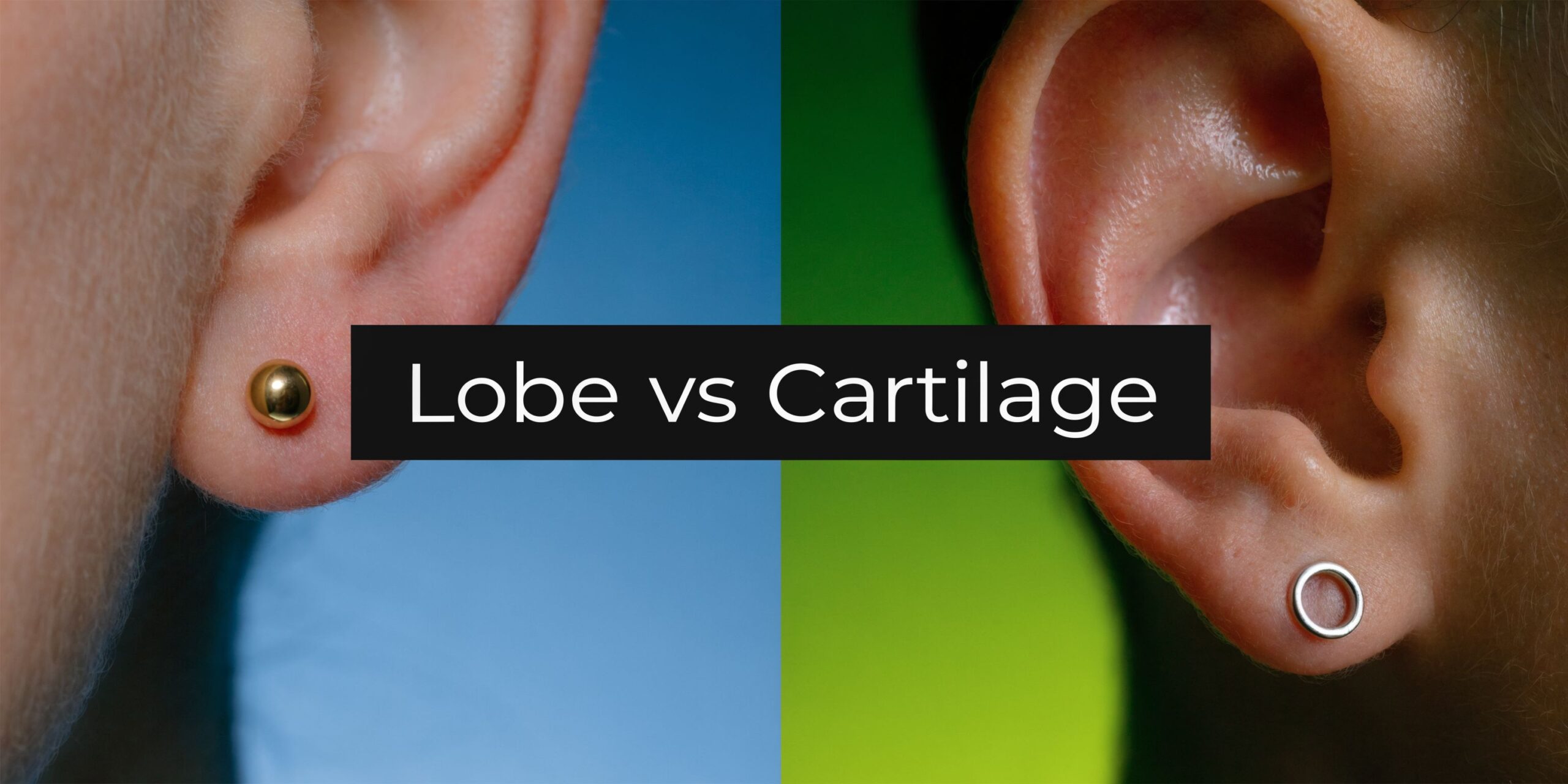
Lobe Piercings Versus Cartilage Piercings
Lobes and cartilage both sit on the ear, but they do not behave the same way after piercing. That is where many first-timers get caught out. Advice that works for a lobe can be a poor choice for a helix or conch.
Why lobes are usually easier
The earlobe is soft tissue with better blood flow than cartilage. That is one reason lobe piercings tend to be more forgiving during healing. They still need good jewellery and good aftercare, but they usually settle faster and with less drama if left alone.
A straightforward lobe piercing often works best with a lightweight, low-profile stud that does not swing, drag, or twist around.
Why cartilage needs more planning
Cartilage is firmer, slower to calm down, and much less tolerant of pressure. Hair brushes, headphones, phone use, helmets, sleep position, and even taking jumpers off can irritate it.
According to this guidance on starter earring fit, starter posts for newly pierced ears need extra length to allow for swelling in the first few days. The same source says flat-back designs snag less than butterfly backs, which helps healing.
That is exactly why an experienced piercer often chooses a longer initial post for cartilage than a client expects. It is not because the jewellery “looks too long”. It is because the tissue may swell significantly in the first few days.
A simple comparison
| Area | Best starter style | Main reason |
|---|---|---|
| Lobe | Flat-back stud or stable straight stud | Soft tissue benefits from simple, low-movement jewellery |
| Helix or other cartilage | Longer flat-back stud | Extra room helps manage swelling and lowers pressure |
| Fresh cartilage hoop | Usually avoided | Movement and pressure can make healing much harder |
Why hoops are rarely ideal at the start
People often love the look of a hoop in a helix. That makes sense aesthetically. For healing, though, a hoop moves more, rotates through the channel, catches more easily, and can create ongoing irritation.
Piercer’s advice: Start with stable jewellery. Move to decorative shapes once the piercing has properly healed and your piercer confirms the timing is right.
For a lobe, you are choosing comfort and simplicity. For cartilage, you are choosing patience and protection.
Your Six Week Piercing Aftercare Guide
The best earrings for newly pierced ears can still run into trouble if aftercare is messy. Good aftercare is not complicated, but it does need consistency. Most problems I see are caused by over-cleaning, fidgeting, or changing jewellery too early.
The daily routine that works
Keep it boring. That is usually the secret.
- Wash your hands first. Touching a fresh piercing with unwashed hands adds trouble quickly.
- Use sterile saline. Gently clean the area as advised by your piercer.
- Let the area dry. A clean paper towel or letting it air dry is usually better than rubbing it.
- Leave the jewellery alone. No twisting, no spinning, no “checking if it moves”.
Harsh products often make things worse. Alcohol, peroxide, tea tree oil, and homemade salt mixes can be too aggressive for healing skin.
What each stage usually feels like
The first few days
Mild warmth, tenderness, and light swelling are common. The ear may feel more noticeable at night or after you knock it by accident.
Keep hair away where possible. Be careful with hoods, headphones, and towels.
Weeks two to four
At this stage, people often get overconfident. The piercing may look better from the outside, but the inside is still settling. You might notice a little dried lymph, often called “crusties”. That is usually part of normal healing.
Sleeping directly on the piercing can still irritate it, especially if the backing presses into the skin.
Around the six week point for many lobes
Some lobe piercings look and feel calm by this stage, but that does not always mean they are ready for any jewellery you fancy. Before changing anything, it helps to compare your experience with a fuller guide on ear piercing healing times.
A few rules that save people trouble
- Do not twist the jewellery. Fresh tissue does not need movement. It needs stability.
- Do not remove it for cleaning. Starter jewellery should stay in place.
- Do not sleep on it if you can help it. Pressure creates irritation.
- Do not switch to hoops or fashion earrings early. Even if the front looks healed, the channel may not be.
Aftercare shortcut: Clean gently, dry carefully, and stop fiddling. Most healthy piercings respond well to calm treatment.
A well-fitted stud and a quiet aftercare routine usually make the biggest difference.
Common Piercing Problems and When to Seek Help
You wake up, catch sight of your new earring in the mirror, and notice the ear looks a bit pink and puffy. That moment worries a lot of first-time clients. In many cases, it is irritation rather than anything serious, but knowing how to tell the difference matters.
A fresh piercing is a small wound with jewellery sitting through it. If the post gets knocked, pressed, or rubbed, the tissue often complains. That is why a piercing can seem fine one day and grumpy the next.
Irritation usually has a cause
Common triggers include pressure from sleep, hair wrapping round the backing, over-ear headphones, helmets, phones, and jewellery that is too short or made from poor-quality metal. Cleaning can cause trouble too if it is too harsh or too frequent.
Irritation often looks local. You may see mild redness near the entry point, tenderness after a snag, or a small fluid-filled bump beside the channel. The ear can feel sore without looking dramatically infected.
That pattern matters. A piercing that is irritated often improves once you remove the source of friction or pressure.
Metal reactions can look like healing problems
This part confuses people. An allergic or sensitivity-type reaction does not always announce itself clearly. It can show up as itchiness, persistent redness, dry skin around the piercing, or soreness that never quite settles.
The metal is sometimes the issue, not your aftercare.
Nickel is a well-recognised cause of allergic contact dermatitis in the UK. The NHS notes that nickel allergy is common and often triggered by jewellery, especially in people with pierced ears. You can read more in the NHS guide to contact dermatitis. That is one reason reputable UK studios pay close attention to jewellery specifications from the start. If your starter jewellery is implant-grade titanium such as ASTM F136, you remove one of the most common avoidable risks before healing even begins.
That gap between general advice and local action is important. It is one thing to read that safe materials matter. It is another to sit down in a studio in Croydon or Bournemouth and have a piercer show you exactly what is going into your ear, explain the grade, and confirm the fit.
A simple way to read what your ear is doing
| What you notice | More likely cause | What to do |
|---|---|---|
| Mild warmth, light swelling, and tenderness in the early stage | Normal healing | Leave the jewellery alone, keep aftercare gentle, and monitor |
| Soreness after sleeping on it, wearing tight headphones, or catching it | Irritation | Reduce pressure and friction, then watch for improvement over the next day or two |
| Itching, ongoing redness, flaky skin, or repeated sensitivity | Possible metal reaction | Speak to your piercer about the jewellery material and whether a change is needed |
| Spreading redness, increasing heat, throbbing pain, or discharge that looks worrying | Needs professional assessment | Contact your piercer promptly and seek medical advice |
When to ask for help
Contact your piercer early if the jewellery starts to feel tight, the backing seems to press into the skin, the swelling is increasing instead of easing, or the piercing keeps flaring up for no clear reason.
Seek medical advice if redness is spreading, pain is getting worse rather than better, you feel unwell, or there is significant swelling, heat, or discharge. Piercers can assess jewellery, fit, and irritation sources. GPs and other medical professionals assess infection and wider health concerns. Sometimes you need both.
Keep the jewellery in place unless a qualified professional tells you to remove it. Closing the surface while irritation or infection is still active can make the problem harder to assess.
Most piercing problems are easier to sort out at the first warning sign. A calm check from an experienced piercer often saves a lot of stress later.
Book Your Safe Piercing in Croydon or Bournemouth
The easiest way to choose the best earrings for newly pierced ears is to start in a studio that already does the hard filtering for you. You should not have to guess whether something labelled “surgical” is suitable for a fresh piercing. Your piercer should be able to explain the metal, the fit, and the reason for the jewellery choice without hesitation.
For clients in Croydon or Bournemouth, that local step matters. Nickel allergy is common, which is why non-implant-grade jewellery is a poor choice for a new piercing, according to this discussion of piercing-related allergies. The same source notes that reputable studios in places such as Croydon and Bournemouth follow strict HSE guidance and use ASTM F136 titanium to reduce that risk.
At Timebomb Tattoo & Piercing, we focus on that safer start. You can ask about jewellery materials, post length, backing style, and whether a placement suits your lifestyle before the needle ever comes near your ear.
If you want to book or ask a quick question, contact the studio directly:
- Phone: 01202 900050 (Bournemouth) / 020 8686 7730 (Croydon)
- WhatsApp: 07752 913846 (Bournemouth) / 07902 490584 (Croydon)
A proper consultation is not a formality. It is where safe healing begins.
Your Piercing Jewellery Questions Answered
Can I start with hoops?
For most fresh lobe and cartilage piercings, a stud is usually the calmer option. Hoops move more and catch more easily. They can be a lovely later choice once healing is established.
Is gold better than titanium?
Not automatically. Gold can be suitable if it is high quality and appropriate for fresh wear, but implant-grade titanium is often the safer default for a new piercing because it is widely trusted for biocompatibility and sensitivity concerns.
Do I need to twist my earrings while cleaning?
No. Twisting tends to irritate healing tissue. Clean the area as advised and leave the jewellery still.
When can I change my starter earrings?
That depends on the placement and how the piercing is healing. Many people try too soon because the outside looks settled before the inside is ready. If in doubt, ask your piercer before changing anything.
What backing is best for sleeping?
A flat-back style is usually much kinder than a butterfly back for a fresh piercing because it sits more smoothly against the ear and is less likely to dig in.
What if my ear is sore after a haircut or sleeping on it?
That is often irritation rather than a serious complication. Return to gentle aftercare, avoid pressure, and monitor it closely. If it stays sore, swells noticeably, or the jewellery feels tight, contact your piercer.
How do I choose the best earrings for newly pierced ears if I have sensitive skin?
Start by telling your piercer that your skin reacts easily. In most cases, implant-grade titanium is the simplest and safest place to begin.
If you’re ready to find safe, professional help nearby, Piercing Near Me makes it easier to book with trusted studios, compare piercing advice, and take your next step with confidence.
Trackbacks/Pingbacks