
When it comes to the piercing gun vs needle debate, any professional will tell you the same thing: a sterile, single-use professional needle is the only safe choice. There’s really no contest. A piercing gun essentially uses brute force to shove a blunt stud through your skin, causing a lot of unnecessary damage. In contrast, a hollow needle creates a clean, precise opening that sets you up for a much healthier and faster heal.
Understanding the Core Differences
Choosing how you get pierced is probably the biggest factor in how well it turns out. The low cost and walk-in convenience of a piercing gun might seem tempting, especially for a first piercing, but the hidden risks just aren't worth it. We're talking about serious tissue damage, questionable sterilisation, and a much higher chance of complications. There's a reason professional piercers only use needles—we care about your long-term health and the quality of your piercing far more than getting it done in 30 seconds.
Let’s get into the mechanics. A professional needle piercing is a proper, skilled procedure. We use a razor-sharp, hollow needle to create a clean channel by removing a minuscule piece of tissue. This minimises trauma, which means less pain and swelling, and gives your jewellery a perfect path to sit in while it heals.
A piercing gun, on the other hand, is more like a heavy-duty office hole punch. It violently rams a relatively blunt stud through your flesh. This action literally shatters and tears the surrounding tissue, which is especially damaging in delicate cartilage. It’s a crush injury, not a clean piercing.
The difference in technique has very real consequences. The risks are well documented. Guns can't be properly sterilised and cause more blunt-force trauma, which makes infection more likely. Professional needle piercings done in registered studios have a much lower risk of infection.%. To see how this fits into the bigger picture, you can learn more about the European body piercing market and its safety standards.
To really see the difference, a quick side-by-side comparison makes it obvious.
Quick Comparison Piercing Gun Vs Needle
For those who just want the bottom line, here’s a straightforward breakdown of how the two methods stack up.
| Factor | Piercing Gun | Professional Needle |
|---|---|---|
| Method | Blunt force trauma; stud tears through tissue. | Sharp incision; needle cleanly parts tissue. |
| Tissue Impact | Causes a "crush injury," high trauma, and swelling. | Minimal trauma, creates a clean channel for healing. |
| Sterilisation | Often made of plastic; cannot be fully sterilised in an autoclave. | Single-use, pre-sterilised needle; 100% sterile procedure. |
| Healing | Slower, more painful; higher risk of complications. | Faster, cleaner healing; lower risk of infection. |
| Jewellery | Low-quality, "one-size-fits-all" studs with butterfly backs. | Implant-grade, body-safe materials sized for swelling. |
| Best For | Not recommended by professionals for any piercing. | All piercings, including lobes, cartilage, and body. |
As you can see, choosing a needle isn't just a matter of preference. It's about making a conscious decision for a safer, healthier, and ultimately more successful piercing from day one.
The Mechanics of Trauma Vs Precision
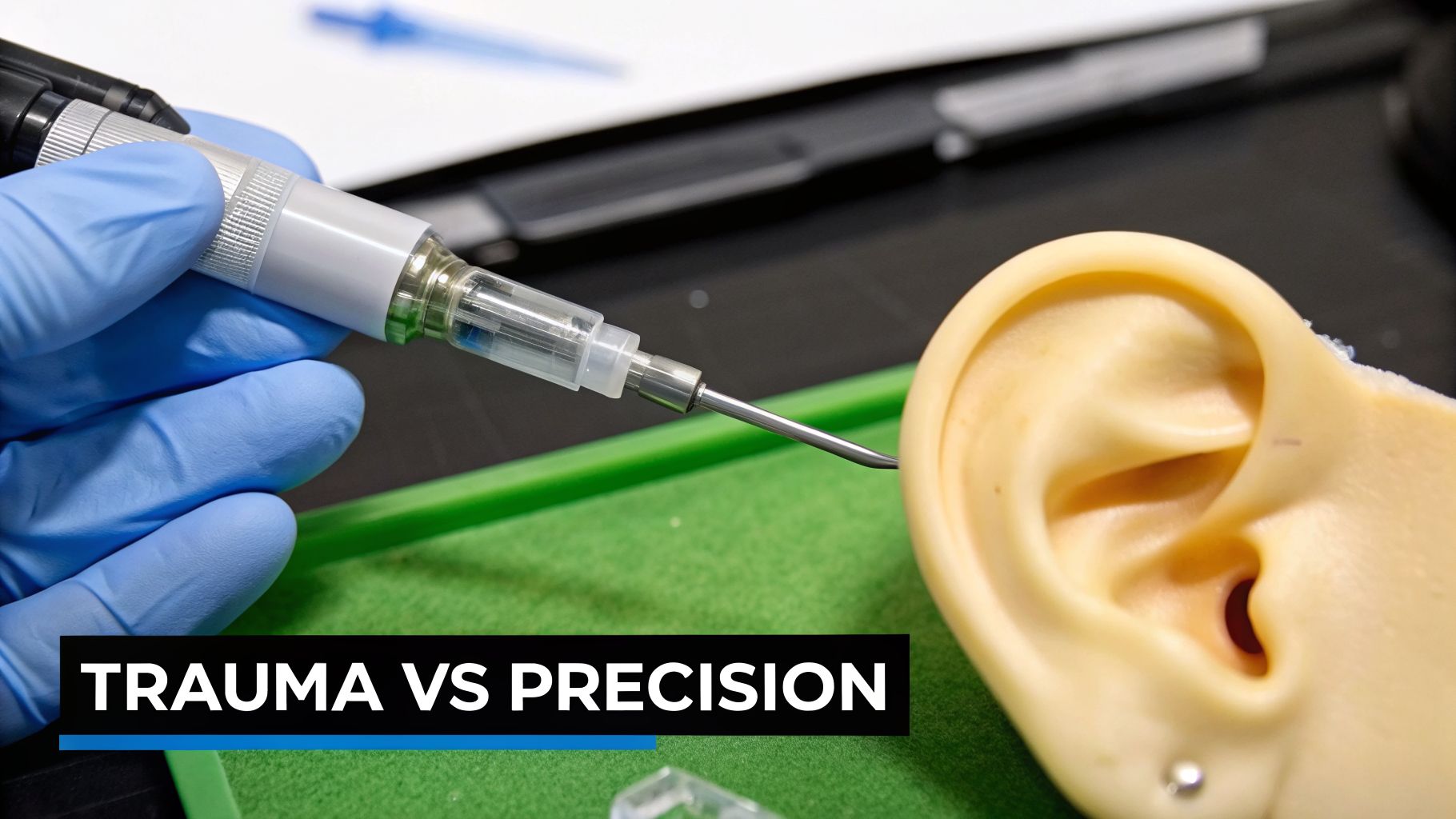
When we talk about the piercing gun vs needle debate, what we’re really discussing is the difference between an injury and a procedure. One method uses brute force to make a hole, while the other is all about surgical precision.
A piercing gun works by using a spring-loaded mechanism to slam a relatively blunt stud through your skin. This isn't a clean cut; it's blunt force trauma. The gun essentially tears the tissue apart, shoving it aside to make way for the stud. Think of it like punching a nail through a piece of wood—it splinters and shatters the area around it.
This process leaves behind a wound with ragged edges, surrounded by crushed and traumatised tissue. This is especially risky for cartilage piercings (like a helix or tragus). The sheer force can shatter the delicate cartilage structure, leading to permanent lumps, prolonged healing, and a lot of unnecessary pain.
The Piercer's Precision Tool
A professional piercing needle, on the other hand, is a completely different beast. It's a purpose-built, incredibly sharp, hollow instrument designed for one thing: creating a clean piercing.
When a piercer uses a needle, they aren't using force at all. Instead, the needle glides through the skin, cleanly separating the tissue and removing a tiny piece of flesh. This creates a perfect, smooth channel for the jewellery to sit in, causing minimal damage to the surrounding cells. It’s this precise, surgical-style approach that leads to a faster, cleaner, and less complicated healing process.
A piercing gun creates a crush injury, similar to slamming your finger in a door. A needle, however, creates a clean incision, like a surgeon's scalpel. The difference in tissue impact is immense and directly affects healing, pain, and the final look of your piercing.
Ultimately, one method is a violent, uncontrolled punch. The other is a delicate, controlled incision. This fundamental mechanical difference is why needles are safer, cleaner, and the only choice for a professional piercer.
The Unseen Danger of Sterilisation
Beyond the physical damage, the biggest failing of the piercing gun is that it cannot be properly sterilised. Professional piercing studios, like our partners at Timebomb Tattoo & Piercing in Croydon and Bournemouth, use a medical-grade machine called an autoclave. This device uses high-pressure steam and intense heat to kill 100% of bacteria and blood-borne pathogens.
A typical plastic piercing gun would simply melt inside an autoclave. Wiping it down with an alcohol swab isn't nearly enough to sterilise its internal parts.
This creates a huge risk of cross-contamination. Tiny, invisible particles of blood from a previous client can get inside the gun's mechanism and be passed on to the next person, potentially transmitting serious infections. Even the newer models with disposable cartridges can't solve this problem, as the reusable gun itself remains a point of contact and contamination.
Why a Needle is Hygienically Superior:
- Single-Use: Every needle used by a professional piercer is brand new, sealed in a sterile packet, and used only on you.
- Fully Disposable: The moment the piercing is done, the needle is immediately and safely thrown away in a medical sharps container.
- No Cross-Contamination: With a single-use needle, there is absolutely zero chance of passing on infections from one client to another.
- Sterile Field: A professional piercer works in a meticulously clean environment, wearing gloves and using sterile tools, just as you'd see in a medical clinic.
Opting for a needle isn't just about a better-looking piercing or an easier heal; it's about safeguarding your health. The clean, single-use nature of a piercing needle is the only way to guarantee a truly hygienic and safe procedure. When you weigh the piercing gun vs needle on mechanics and hygiene, there’s no contest.
How Healing and Infection Risks Compare
When you get a piercing, you're creating a small, open wound. How that wound is made has a massive impact on how well it heals, and this is where the conversation about piercing guns versus needles gets serious. It’s not just about looks; it's about your health.
Getting pierced with a professional, single-use needle is the best start you can give your new piercing. A hollow needle is incredibly sharp, so it cleanly removes a tiny piece of tissue to create a perfect channel. This causes very little trauma to the surrounding area, which means less pain, less swelling, and a much smoother path to a healed piercing.
A piercing gun, on the other hand, is a different story entirely. It uses blunt force to ram a stud through your tissue. This doesn't create a clean channel; it creates a crush injury, tearing and shattering the tissue. Your body has a much harder time healing this kind of jagged wound, leading to way more swelling, tenderness, and a longer, more complicated recovery.
The Problem with Butterfly Backs
The jewellery itself is a huge part of the problem. Piercing guns use studs with those classic "butterfly" backs, which are completely unsuitable for a fresh piercing.
- Traps Bacteria: That enclosed butterfly-style back is a perfect little trap for bacteria, dirt, and dead skin cells. It creates a warm, moist environment where an infection can easily take hold.
- Restricts Swelling: New piercings always swell. A tight butterfly back leaves no room for this, and as the tissue expands, the stud can quickly become embedded. We see it all the time—it's incredibly painful and often requires a trip to a doctor or a professional piercer to get it cut out.
- Impairs Cleaning: It’s practically impossible to clean a piercing properly when it has a tight stud and butterfly back. You can't get to the front and back of the piercing site, which dramatically increases your infection risk.
This is why professional piercers, like the brilliant teams at our partner studios Timebomb Tattoo & Piercing, will never use them. They use implant-grade titanium labrets or barbells with longer posts to start. This gives the piercing plenty of room to swell comfortably, and the flat-back or ball-end design makes cleaning easy and lets air circulate to keep things dry.
"The jewellery itself is a tool for healing. A butterfly back stud is a trap for bacteria and a source of compression. A proper, implant-grade titanium labret gives the piercing space to breathe and heal, dramatically reducing the likelihood of infection and embedding."
Healing Timelines and Complications
The difference in healing times is stark. A lobe piercing done correctly with a needle might be settled in 6-8 weeks. The same piercing done with a gun will almost always take longer and is far more likely to run into trouble. For a more detailed breakdown, have a look at our guide on ear piercing healing times.
The trauma from a gun doesn't just slow things down; it opens the door to other problems. Complications like hypertrophic scarring (those dreaded bumps) and keloids (a more aggressive type of overgrown scar tissue) are far more common with gun piercings. The body essentially overreacts to the blunt force trauma and goes into overdrive trying to repair the damage.
The data backs this up. Infections are more common where piercing guns are used than in professional studios using needles. When it comes to the piercing gun vs needle debate, all the evidence points one way: the needle offers a safer, cleaner, and far more reliable healing process.
Why Piercing Placement Is A Non-Negotiable
When weighing up a piercing gun versus a needle, there’s one factor that instantly ends the debate: the location. While we’d never recommend a gun for any piercing, using one on cartilage is downright dangerous. The soft, fleshy earlobe is a completely different world from the firm cartilage in your helix, conch, or nose.
A piercing gun is a crude instrument. It works by using brute force to ram a blunt-ended stud through your tissue, which is essentially a crush injury. On a soft lobe, that’s bad enough. But when that same force hits cartilage, the outcome can be catastrophic. Cartilage isn’t soft or forgiving; it’s a delicate structure that can literally shatter on impact.
When cartilage shatters, it doesn’t heal properly. This can lead to permanent bumps, a collapse of your ear's natural shape, and painful scarring that’s tough to get rid of. The jagged, torn tissue is also a magnet for nasty infections.
Cartilage and Body Piercings Are Needle-Only Territory
For these exact reasons, any professional piercer worth their salt will tell you that all cartilage and body piercings are strictly needle-only procedures. This isn't just a matter of preference; it's a fundamental standard of safety.
This hard-and-fast rule covers every piercing that isn't on the soft lower lobe, including:
- Ear Cartilage: Helix, forward helix, tragus, anti-tragus, conch, daith, and rook.
- Facial Piercings: Nostrils, septum, eyebrows, and lips.
- Body Piercings: Navels, nipples, and surface piercings.
Before we dive deeper, it's helpful to have a clear guide on which method is appropriate for different parts of the body. The following table breaks it down, highlighting why guns are a major risk for anything beyond the lobe.
Method Suitability by Piercing Location
| Piercing Location | Recommended Method | Reason & Risk Factor |
|---|---|---|
| Earlobe | Needle (Strongly Recommended) | A needle creates a clean channel. A gun causes blunt force trauma, leading to more pain and swelling. |
| Cartilage (Helix, Tragus, etc.) | Needle (Only Option) | Guns can shatter cartilage, causing permanent damage, disfigurement, and severe scarring. |
| Nostril / Septum | Needle (Only Option) | Guns cannot achieve precise placement and the blunt stud damages delicate cartilage. The jewellery is also unsuitable. |
| Eyebrow / Lip | Needle (Only Option) | Guns lack the precision for curved anatomy and the jewellery is too short, risking embedding during swelling. |
| Navel / Nipple | Needle (Only Option) | These areas require specific angles and jewellery that only a needle procedure can provide. Guns cause excessive trauma. |
Ultimately, choosing a gun for anything other than a lobe is a gamble with your health. The tool is simply not designed for the complex anatomy and healing needs of other placements.
This flowchart paints a pretty clear picture of the two paths you can take.
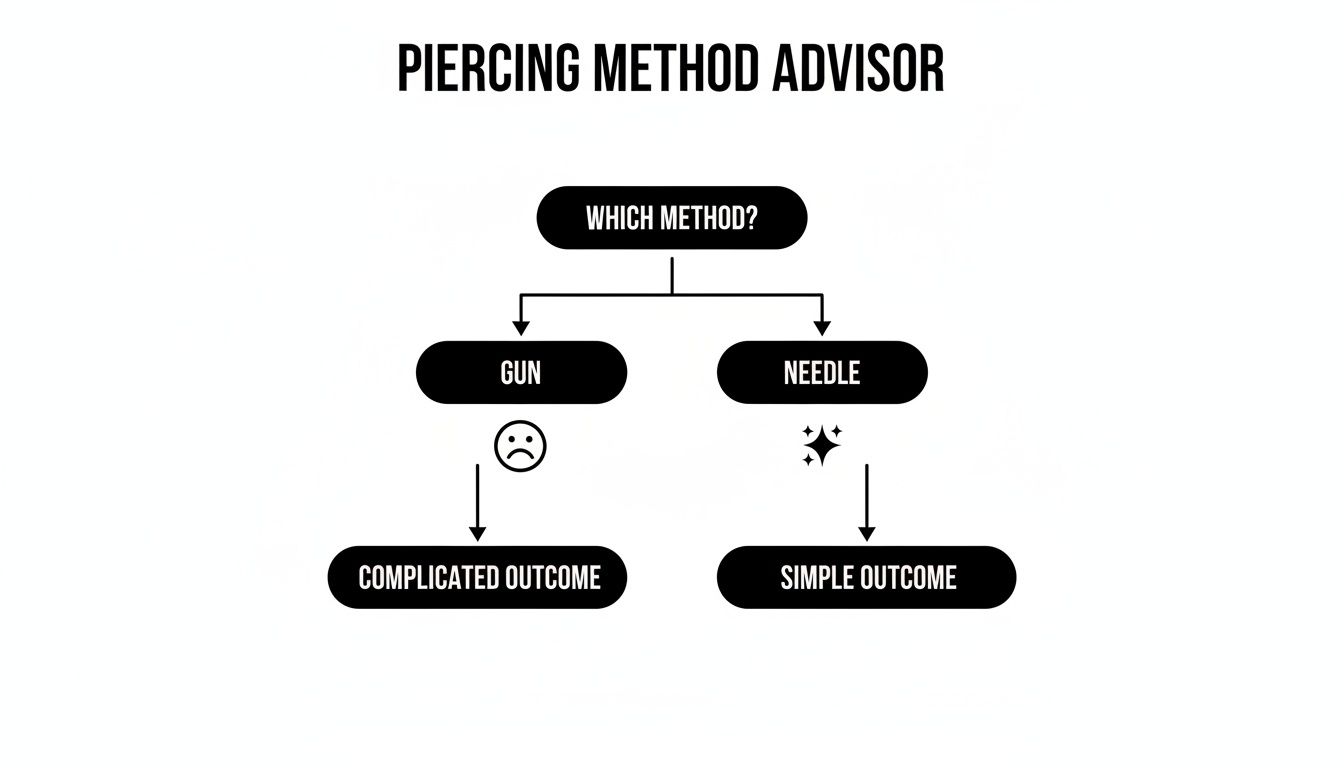
As you can see, the gun leads to a messy, unpredictable outcome. The needle, on the other hand, offers a simple, professional, and safe result every time.
The Art of a Curated Ear
The "curated ear" trend is a perfect example of why a professional piercer’s skill is so essential. Arranging multiple piercings to complement your anatomy and create a unique style is a true art form. This is where a needle-wielding expert really shines.
A professional piercer using a hollow needle will always:
- Assess your anatomy: They’ll look at the unique shape of your ear to find the perfect spot and angle for each piercing.
- Plan for the future: They’ll make sure there’s enough room between piercings for them to heal and for the jewellery you want to wear later on.
- Guarantee precision: A needle gives the piercer millimetre-perfect control, something a clumsy, spring-loaded gun could never do.
A curated ear project is like architectural design for your body. It relies on the piercer's expertise to work with your specific anatomy, ensuring each piercing not only looks good but is also placed for optimal healing and long-term viability. A gun simply cannot offer this level of control or safety.
This is precisely why you need to go to a professional studio. The talented piercers at our recommended studios, Timebomb Tattoo & Piercing in Croydon and Bournemouth, will work with you to map out your dream project safely. They’ll help you bring your vision to life without risking your health. For anything beyond a basic lobe, the needle isn’t just the best choice—it's the only one.
Finding a Safe and Reputable Piercer in the UK
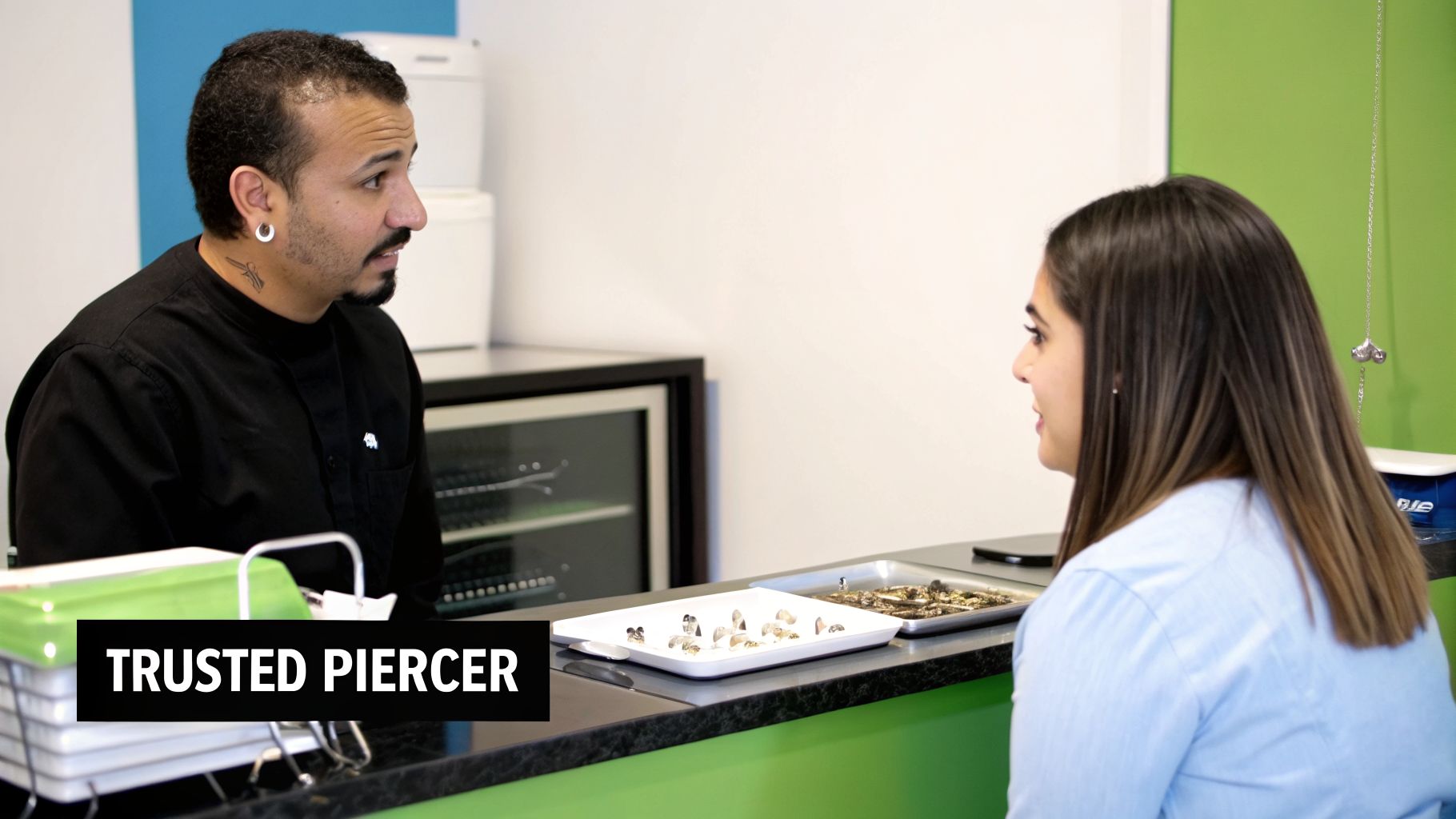
So, you know the difference between a piercing gun and a needle. That’s the first crucial step. Now you need to find a professional you can actually trust to use the right tool for the job.
Here in the UK, the piercing industry is regulated on a local level. This means every studio has to register with its local council and follow specific health and safety bylaws, but the exact standards can differ from one area to another. While the Health and Safety Executive (HSE) provides the main guidance, it's the local authorities who do the inspections and issue the licences.
A good piercer won't just be registered; they'll have their licence proudly on display. This is your proof that they meet the required hygiene standards. When you’re checking out a studio, make sure that licence is clearly visible and up to date.
You also need to be aware of the rules on age and consent. For most piercings, you have to be 16 or older. However, many studios set their own “18 and over” policy for more intimate or advanced piercings. Don't forget to bring a valid photo ID – any truly professional studio will always ask for it.
What to Look for in a Professional Studio
The moment you step into a piercing studio, your gut will tell you a lot. It should feel clean, almost clinical. If it looks messy or unprofessional, trust that instinct and walk right back out. Beyond the overall vibe, there are some non-negotiables to confirm before you let anyone near you with a needle.
A great studio will welcome your questions and be transparent about their practices. Here’s a quick checklist of what to look for:
- Needle-Only Policy: Ask them straight up: "Do you only use single-use, pre-sterilised needles for every piercing?" The only acceptable answer is a firm "yes." If they even mention using a gun for anything, it’s a massive red flag.
- Sterilisation Viewing: Every professional studio must have an autoclave. This is the machine that uses steam and pressure to properly sterilise equipment. Don't be afraid to ask to see it, along with their sterilisation records. Transparency here is key.
- Jewellery Quality: Ask what their jewellery is made of. The answer should be implant-grade titanium, niobium, or solid 14k/18k gold. Be very wary if they offer "surgical steel," as the term is unregulated and can often contain nickel, a common irritant.
- Piercer Portfolio: A good piercer will have a portfolio. Ask to see it and look for clear pictures of both fresh and fully healed piercings. You want to see work that is straight, well-placed, and features appropriate jewellery for the placement.
A piercer who is happy to educate you is a true professional. They should patiently walk you through the entire process—placement, your anatomy, jewellery options, and aftercare—without making you feel rushed. Your comfort and informed consent should always be their main priority.
Asking the Right Questions
Never feel shy about interviewing your piercer. Their responses will reveal everything about their commitment to safety and quality, and a genuine professional will respect your diligence. This is where using a trusted directory like Piercing Near Me can be invaluable, as it points you towards pre-vetted artists who meet these high standards.
When you’re having that chat, you can also discuss the specifics of what you want. For example, a good piercer can give you the pros and cons of getting a stud piercing on the nose versus starting with a ring.
By taking the time to properly vet your studio and piercer, you're not just buying a piercing; you're investing in your health and a great long-term result. The teams at Timebomb Tattoo & Piercing in their Croydon and Bournemouth shops are a perfect example of this professional standard, making sure every client leaves feeling confident and happy with their new piercing.
The True Cost of a Piercing
When you’re weighing up a piercing gun vs needle, it’s easy to get fixated on the initial price. That piercing gun offer at the local shopping centre looks like a steal, right? But what seems like a bargain upfront can quickly become the far more expensive option once you factor in what can go wrong.
The low price of a gun piercing rarely covers the true cost of the procedure. It doesn't account for the very real possibility of complications from an unsafe method. Think infections, jewellery getting swallowed by your skin, or even shattered cartilage. These issues almost always mean a trip to the doctor, a course of antibiotics, or worse, corrective procedures to fix the damage. Suddenly, that "saving" has vanished.
Short-Term Savings Vs Long-Term Health
The real cost isn't just measured in pounds and pence; it’s paid in pain, stress, and your time. When you pay for a professional needle piercing, you’re investing in expertise. You're paying for a technician who has dedicated years to their craft, uses a sterile, single-use needle, and performs a precise procedure designed for optimal healing. That higher initial cost is buying you peace of mind.
On the other hand, a cheap gun piercing often comes bundled with terribly outdated and genuinely harmful aftercare advice. You’ll likely be told to twist the stud daily and clean it with harsh chemical solutions—two things guaranteed to irritate a new piercing and seriously delay healing.
The "cheap" piercing becomes incredibly expensive when it requires a doctor's intervention, a corrective procedure, or having to get it re-pierced correctly anyway. Investing in a professional needle piercing from the start is an investment in your safety and a beautiful, stress-free result.
That money you thought you saved ends up being spent on fixing a problem that was completely preventable from the beginning. To get a better understanding of what a professional service entails, have a look at our guide on how much a nose piercing costs, which breaks down the factors that contribute to a safe piercing.
Comparing Aftercare Costs and Consequences
The aftercare routine alone highlights the difference in long-term cost. A professional piercer will set you up with a simple, effective, and incredibly affordable aftercare plan.
Needle Piercing Aftercare: We recommend sterile saline solution. That’s it. A single can costs very little and will last you through the entire initial healing stage, keeping your piercing clean without causing any irritation. The jewellery is implant-grade titanium, which is hypoallergenic and long enough to allow for natural swelling, preventing it from becoming painfully embedded.
Gun Piercing Aftercare: You'll often be pushed to buy a branded "cleaning solution." These are usually just overpriced antiseptics with alcohol or other harsh ingredients. Not only do they dry out the skin and damage the healing tissue, but they can create the very complications you’ll then have to spend more money to fix.
Ultimately, the price of a professional needle piercing covers so much more than the piercing itself. It includes the piercer's training, a surgically clean environment, a single-use, purpose-designed needle, high-quality implant-grade jewellery, and expert aftercare advice. This is what makes it the safest, and in the long run, the most cost-effective choice.
Still got questions about the whole piercing gun versus needle debate? It's completely normal. Let's run through some of the most common things people ask so you can feel 100% confident in your choice.
Does a Needle Piercing Hurt More Than a Gun Piercing?
This might surprise you, but a needle piercing is almost always less painful. A piercing gun is fast, yes, but it slams a blunt stud through your tissue. That's not a piercing; it's a crush injury, and the throbbing, swelling, and lingering soreness afterwards is your body's reaction to that trauma.
A professional piercer, on the other hand, uses a surgically sharp, hollow needle. It creates a clean, precise opening with a quick, sharp pinch that fades almost immediately. The result? A much less painful experience and a far smoother healing journey.
Is It Ever Safe to Get a Piercing with a Gun?
Honestly, no. Not a single professional piercing body anywhere in the world would ever recommend using a gun, even for earlobes. The risks are just too high. You're dealing with blunt force trauma, unsuitable jewellery, poor placement, and plastic components that can't be properly sterilised, which is a recipe for cross-contamination.
Proper piercing is about precision and absolute hygiene. A piercing gun fails on both counts.
Think of it this way: a "successful" gun piercing just means you got lucky. The tool's inherent dangers don't vanish just because someone's lobe healed without an obvious disaster. A professional needle piercing follows a strict, safe protocol every single time, removing luck from the equation.
My First Piercing Was with a Gun and It Healed Fine Why Not Do It Again?
We hear this one all the time. While it's great that your first experience went smoothly, it was more a stroke of luck than a sign that the method is safe. The fundamental problems with piercing guns—the tissue damage, the non-sterilisable parts, and the low-quality jewellery—are present every single time one is used.
Just because you got away with it once doesn't change the fact that you're rolling the dice on shattered cartilage, infection, and wonky angles with the next one. Choosing a professional needle piercing means you’re guaranteed a high standard of safety, precision, and quality every single time. It's about making a safe choice, not just a lucky one.
What Should I Do If I Have a Piercing Done with a Gun That Is Painful or Looks Infected?
First things first: do not remove the jewellery. Taking it out can trap bacteria inside the healing channel, which can easily lead to a nasty abscess.
Your best move is to immediately visit a reputable, needle-only piercing studio for a consultation. A trained piercer can take a proper look. They might be able to swap out the cheap, irritating stud for a high-quality, implant-grade titanium labret with enough length to allow for swelling. If they suspect a serious infection, they'll advise you to see your GP straight away.
Ready to book your next piercing with a team that puts your health and safety first? Visit Piercing Near Me to find your local professional studio and get the high-quality piercing experience you deserve. Book your appointment at https://piercingnearme.co.uk today.
Trackbacks/Pingbacks