
You pull on a coat, catch the collar on your ear, and feel the familiar sting. The piercing looked like a small, harmless addition months ago, yet it's still sore, crusty, or suddenly swollen. You may be wondering why your ear piercing isn't healing, and whether you've somehow caused the problem.
Slow healing doesn't usually mean you made one dramatic mistake. Pressure from sleep, a jewellery problem, repeated snags, harsh cleaning, irritation, or a genuine infection can all keep a piercing unsettled. The right response depends on which of those is happening.
When Your Ear Piercing Still Hurts Months Later
A piercing is a controlled wound with jewellery sitting inside it. The body has to form and strengthen a skin-lined channel around that jewellery, so the outside can look calm before the inside is ready for normal pressure and movement.
That's why a piercing can seem healed, then flare after a snag, a jewellery change, or several nights sleeping on it. A small amount of tenderness after pressure doesn't automatically mean infection, but ongoing or worsening symptoms deserve a closer look.
Start with the location
Your first useful question is whether the piercing is in the soft earlobe or in cartilage. Lobes usually recover more easily because they're soft tissue, while cartilage has a poorer blood supply and is more vulnerable to deeper infection. The healing window is therefore longer and the consequences of ignoring serious symptoms can be greater.
Your next question is what the dominant symptom feels like:
- Tender after pressure: irritation or repeated trauma may be involved.
- Very itchy with dry, flaky skin: contact irritation from jewellery or a product is possible.
- Hot, increasingly painful, swollen, or producing yellow or green discharge: infection needs medical consideration.
- Jewellery pressing into the skin or changing angle: the fit or placement needs prompt professional review.
UK guidance recognises infection and trauma as common enough concerns to warrant specific advice. The NHS guidance on infected piercings advises urgent assessment if swelling, worsening pain, pus, fever, or jewellery embedded in the skin develops.
Practical rule: Treat a piercing that's getting worse as a problem to assess, not a wound to punish with more cleaning.
The rest of the decision is straightforward. Compare your symptoms with a normal healing pattern, remove avoidable sources of irritation, protect the piercing from pressure, and know when a piercer or healthcare professional should take over. Finding the cause early often gives the tissue a chance to settle without turning a manageable irritation into a larger problem.
What Normal Ear Piercing Healing Actually Looks Like
Healing isn't a single moment when the piercing suddenly becomes safe. It's more like fresh paint drying. The surface may appear finished while the layer underneath remains vulnerable to pressure, friction, and movement.
A conventional earlobe piercing normally heals in six to eight weeks when aseptic technique and suitable care are used, according to UK pharmacy guidance on ear and face piercing infections. That gives you a useful benchmark, but it doesn't mean every lobe can tolerate early jewellery changes or rough handling at that point. Cartilage generally needs substantially longer because its blood supply is poorer.
A simple visual reference
During the early stage, mild tenderness, light redness, and a little swelling can be expected. Itching can appear as the channel forms, and clear or pale lymph fluid may dry into small crusts around the jewellery. Those crusts aren't automatically pus, especially if the surrounding skin isn't becoming hotter, redder, or more painful.
The pattern matters more than one isolated sensation. A brief twinge after catching the stud on clothing is different from pain that throbs at rest and increases each day.
For a practical healing-time reference, use this ear piercing healing-times guide alongside your piercing's location and recent history. Ask yourself whether the symptoms are slowly improving, staying unchanged, or spreading. Slow improvement can still be normal, particularly in cartilage. A steady decline isn't something to explain away as patience.
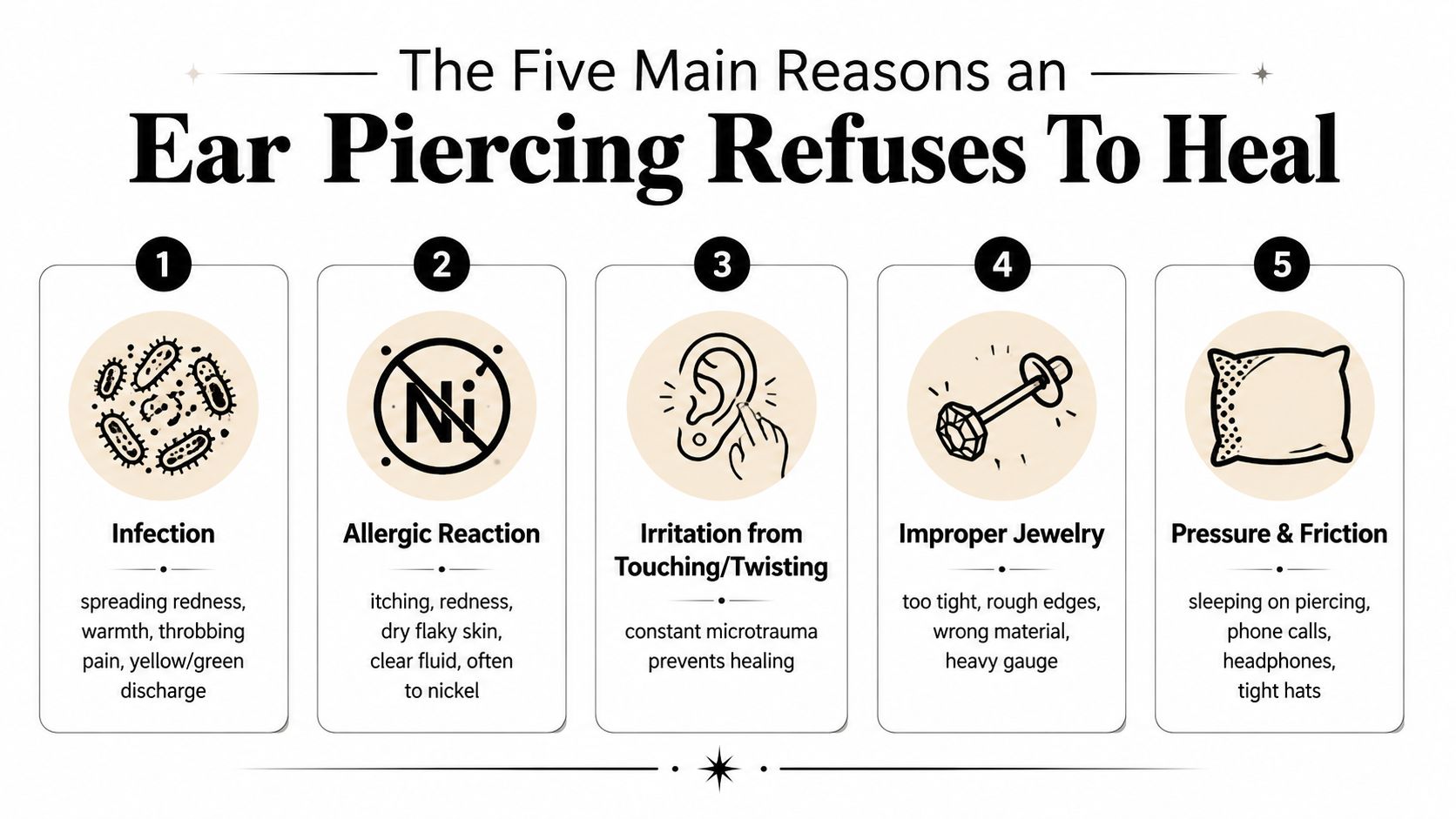
The Five Main Reasons an Ear Piercing Refuses To Heal
The phrase “not healing” covers several different problems. Infection, irritation, unsuitable jewellery, trauma, and aftercare mistakes can look similar at first, but they need different responses.
Infection
Infection becomes more concerning when redness spreads rather than staying close to the hole, the skin feels hot, pain becomes throbbing, swelling increases, or discharge turns yellow or green. Fever adds urgency. Don't squeeze the area or force the jewellery through a swollen channel.
The UK government's infection-prevention guidance classifies body piercing as a procedure with infection risk and possible transmission of bloodborne viruses, including hepatitis B, hepatitis C, and HIV. That's why sterile technique, clean hands, and appropriate aftercare matter, rather than because every irritated piercing is infected.
Irritation
Irritation is often quieter. The piercing may be pink, tender after contact, slightly crusty, or surrounded by a small bump, but you may not have spreading heat or systemic symptoms. Common triggers include sleeping on the ear, catching the jewellery on hair, applying strong products, and cleaning so aggressively that the new skin keeps getting damaged.
A piercing can become irritated by too much attention. Repeatedly wiping, rotating, or checking it creates fresh friction each time.
Jewellery fit and material
Jewellery that's too short can press against swelling. Rough edges can scrape the channel, while a heavy or poorly balanced piece can pull on the tissue. Some people also develop contact irritation from nickel or another metal, with itchiness, redness, dryness, flaking, or clear fluid around the jewellery.
A professional piercer can assess whether the post length, angle, backing, and material are suitable. Don't solve a tight jewellery problem by forcing the piece or changing it yourself while the channel is unstable.
Repeated trauma
Hairbrushes, towels, hoodies, face coverings, headphones, telephones, and sports equipment can all catch an ear. One significant snag may restart swelling, while small daily knocks keep the tissue in a cycle of repair.
Cartilage placements can be especially exposed to pillow pressure and headphone contact. If symptoms repeatedly appear after a particular activity, that pattern is useful evidence.
Aftercare errors
Over-cleaning, twisting the jewellery, using alcohol or hydrogen peroxide, applying essential oils, or using antibiotic creams without a diagnosis can all irritate healing tissue. Removing the jewellery too early may allow the channel to narrow or close around inflammation, making later assessment more difficult.
UK local authority aftercare advice recommends washing hands before cleansing, avoiding touch for at least 48 hours, and cleaning no more than twice a day. Symptoms overlap, so focus on the strongest pattern rather than trying to label the piercing from one photograph.
A Simple Home Routine That Supports Stubborn Healing
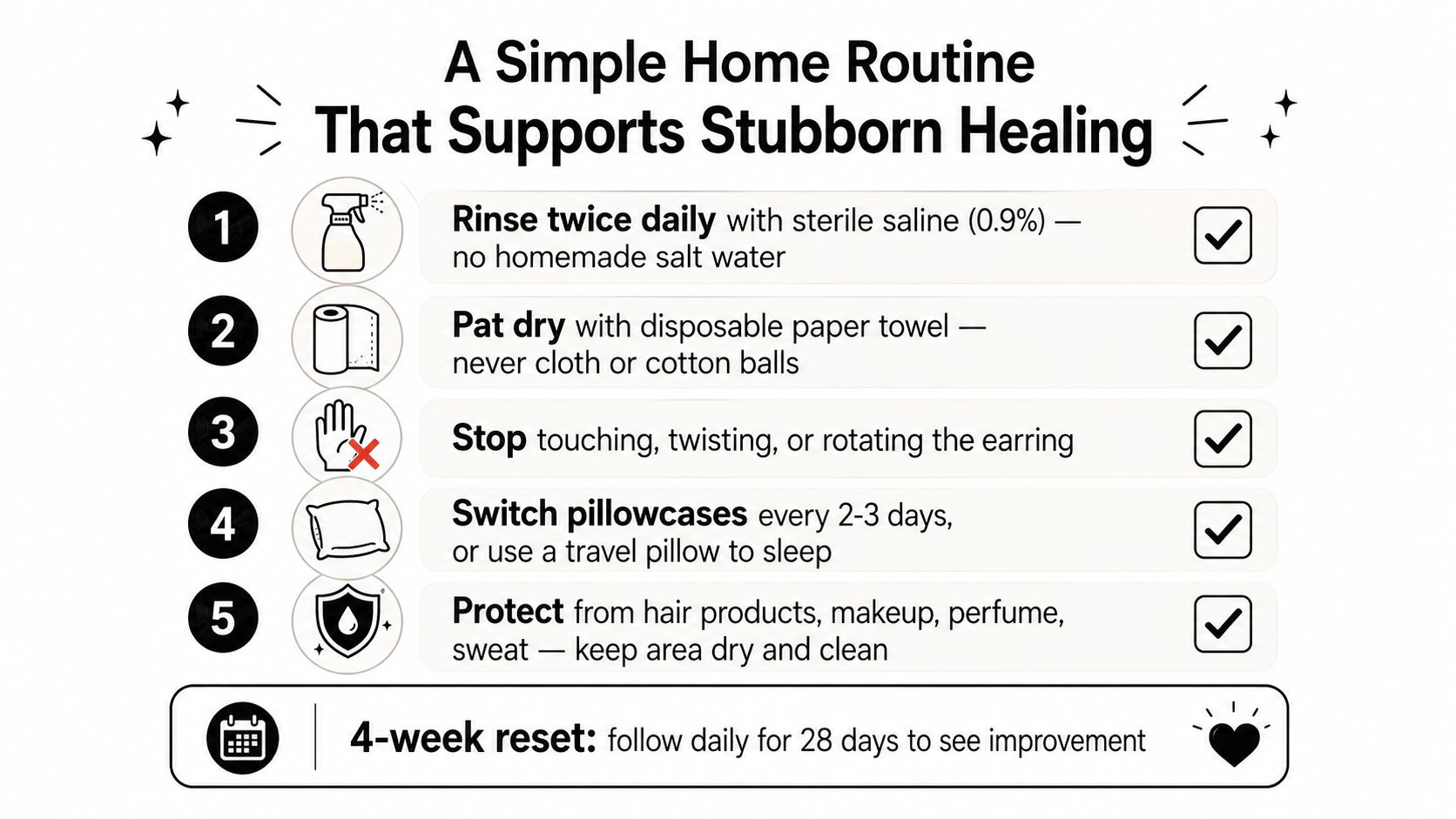
If there are no urgent warning signs, simplify your care rather than adding more products. Think of the reset as reducing disturbance while giving the tissue a consistent, gentle environment.
Use less force, not more
Clean with sterile saline labelled 0.9% sodium chloride, following the product directions. A gentle rinse twice daily is enough for routine care. Afterward, pat the area dry with a clean disposable paper towel. Don't scrub, pick crusts, or rotate the jewellery to “work” the solution into the channel.
The UK has previously issued a warning about infection linked to a piercing aftercare spray, which illustrates why a product's safety and handling matter. The government warning about an aftercare spray also reinforces a wider point: contaminated or unsuitable cleansing products can become part of the problem.
Avoid alcohol swabs, hydrogen peroxide, tea tree oil, and unprescribed antibiotic creams. They may feel active because they sting or dry the skin, but that sensation doesn't prove they're helping the wound.
Remove the daily pressure
Keep your hands off except during cleaning. Change pillowcases regularly, keep hair away while sleeping, and consider a travel pillow so the ear rests in the opening rather than against the fabric. Clean your phone and keep headphones, hats, and helmet straps from pressing directly on the jewellery.
During hair washing, rinse shampoo and conditioner away from the piercing and dry the ear gently afterwards. After exercise, remove sweat and keep the area dry, but don't respond with repeated washing. The same principle applies to cosmetics, perfume, hairspray, and styling products. Prevent contact rather than trying to strip the skin afterwards.
Use the first part of your reset to observe the trend. Is swelling easing? Is the piercing less tender when you wake? Are crusts becoming less frequent? If symptoms are unchanged or worsening, especially in cartilage, arrange an assessment instead of extending home care indefinitely.
For a practical cleaning overview, follow this guide to cleaning a new piercing and keep the routine consistent.
Why Cartilage Piercings Are Slower and Riskier Than Lobes
A lobe piercing passes through soft tissue with a better blood supply. Cartilage is firmer tissue with poorer circulation, so the body has fewer direct resources available at the site while the channel matures.
That difference explains why a lobe can appear settled sooner while a helix, tragus, conch, or industrial piercing remains vulnerable for much longer. UK pharmacy guidance places uncomplicated lobe healing at about six to eight weeks, while infected cartilage piercings may require antibiotic treatment, a clear sign that cartilage problems aren't a more annoying version of a sore lobe. UK hygiene guidance for piercing businesses specifically warns about Pseudomonas aeruginosa perichondritis associated with ear piercing.
Cartilage versus lobe piercing healing risk compared
| Factor | Earlobe | Cartilage, helix, tragus, conch, industrial |
|---|---|---|
| Tissue | Soft tissue | Firm cartilage |
| Blood supply | Better circulation | Poorer circulation |
| Pressure tolerance | Usually more forgiving | More sensitive to sleep and jewellery pressure |
| Main concern | Local irritation or infection | Irritation plus possible perichondritis |
| Response to worsening symptoms | Monitor carefully | Seek medical advice sooner |
Non-lobe ear sites also show a markedly higher complication rate in English survey evidence. The study reported 5.0% complications at non-lobe ear sites versus 1.2% in the comparison group, with an overall odds ratio of 4.15, a 95% confidence interval of 3.08 to 5.61, and p<0.0005, as reported in this English study of piercing complications.
The practical difference is speed of response. A mildly tender lobe after sleeping awkwardly may settle when pressure stops. A hot, increasingly swollen, painful outer ear needs quicker medical attention because infection around cartilage can progress beyond a surface irritation.
Don't remove jewellery from a suspected infected cartilage piercing without professional advice. A clinician or experienced piercer can decide how to manage the jewellery and the swelling safely.
Warning Signs That Mean You Need Professional Help Now
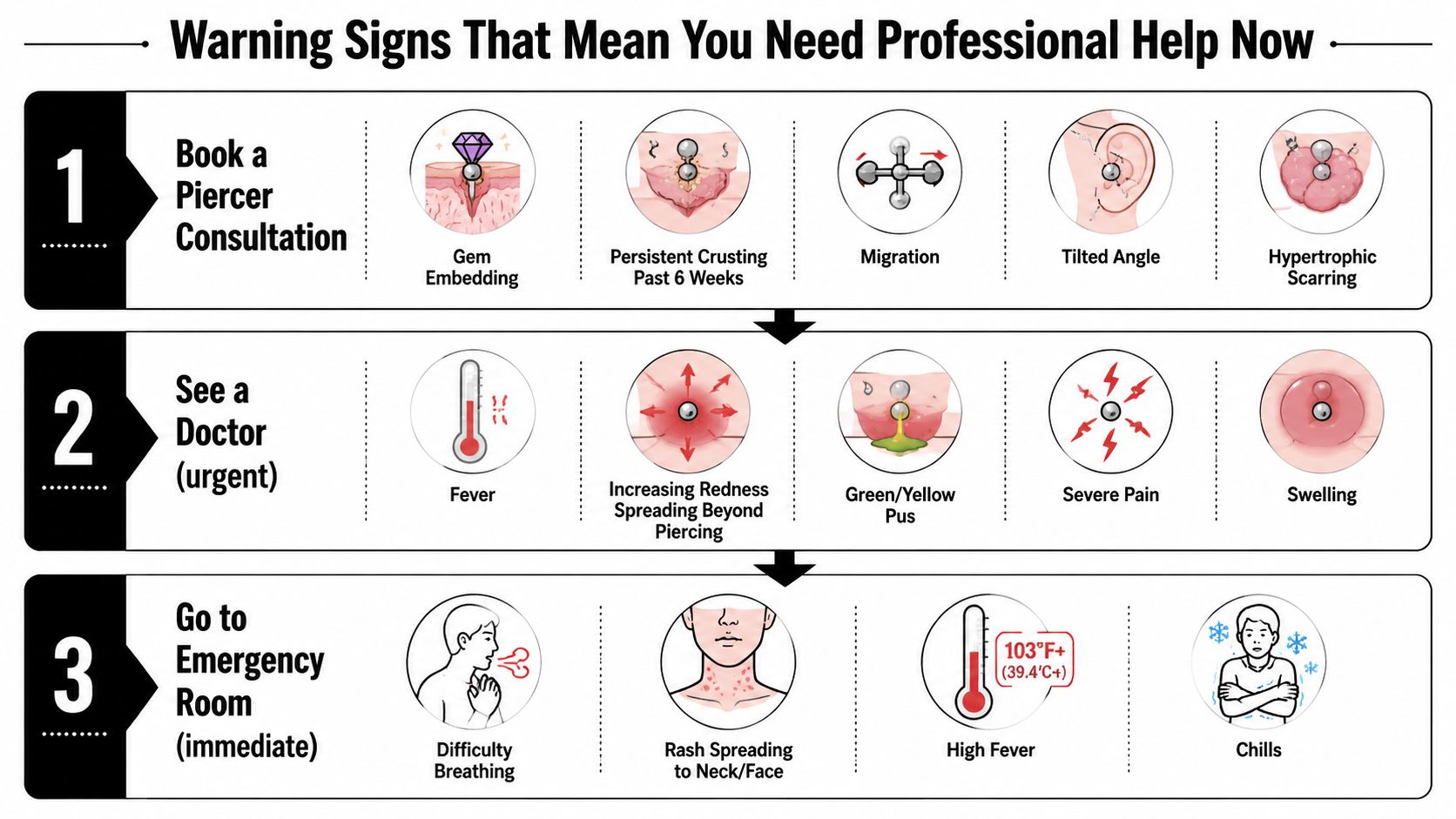
Choose the professional based on the symptom, not on who happens to reply first. A piercer can assess jewellery fit, angle, pressure, migration, and material. A GP, pharmacist, NHS 111, or minor injuries service is the right route for suspected infection, especially when symptoms are spreading or accompanied by fever.
Book a piercer consultation
Arrange a jewellery and placement review if the piece is becoming embedded, the angle looks tilted, the piercing is migrating, or crusting continues beyond the expected healing stage. A piercer can check whether the post is too short, whether the jewellery is putting pressure on one side, and whether a safer replacement is appropriate.
Hypertrophic scarring and irritation bumps can also benefit from an in-person assessment, but don't assume every lump is a scar. The appearance, firmness, drainage, and rate of change all matter.
Contact a healthcare professional urgently
Seek medical advice for increasing redness, heat, swelling, yellow or green discharge, worsening throbbing pain, or fever. The NHS advice on recognising an infected piercing recommends urgent assessment when swelling, worsening pain, pus, fever, or embedded jewellery is present.
A suspected cartilage infection deserves particular caution. Contact your GP, NHS 111, or a walk-in or minor injuries unit promptly if symptoms are progressing. Don't wait for a home routine to prove itself when the pain or redness is moving outward.
Use same-day emergency care
Go to A&E or seek immediate help if the ear is severely painful, very hot, rapidly swelling, becoming distorted, or the jewellery is fully embedded. Chills, confusion, or feeling severely unwell require urgent medical attention rather than a piercing consultation.
Use this simple decision path:
- Where is it? Lobe symptoms may be less concerning than comparable symptoms in cartilage.
- How severe is it? Mild tenderness differs from throbbing pain, heat, pus, or fever.
- How fast is it changing? Stable irritation can be reviewed, while rapid spreading redness needs urgent escalation.
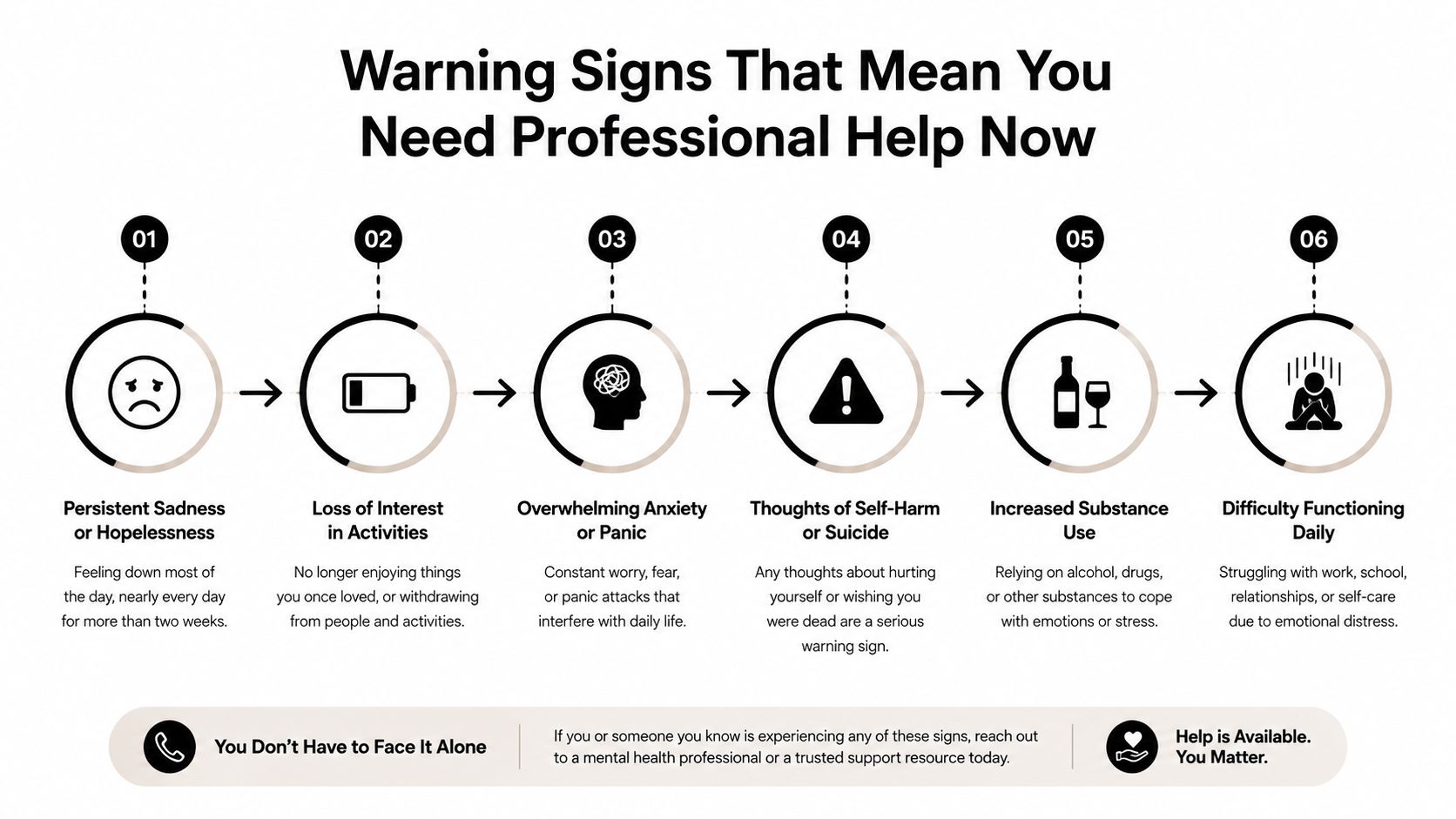
Use this piercing infection symptom guide to prepare what you'll tell the healthcare professional. Note when the problem began, whether it's spreading, what products you've used, and whether the jewellery has moved or tightened.
Bringing It All Together and Booking a Professional Review
The useful question isn't, “Why is my ear piercing not healing?” Ask instead, which factor is keeping it unsettled? Infection needs healthcare input. Irritation needs less friction and gentler care. Jewellery problems need an assessment of material, length, shape, and angle. Repeated trauma needs practical protection, while an aftercare mistake often improves when the routine becomes simpler.
Don't treat persistent symptoms by repeatedly adding products. A professional may recommend changing unsuitable jewellery to an appropriate implant-grade titanium or solid gold piece, but that change should be assessed and fitted rather than carried out casually at home. Salt-water care alone can't correct a post that's too tight, a rough edge, a damaging angle, or jewellery that keeps catching.
Before an appointment, bring or photograph the jewellery currently in place. Write a short timeline of the symptoms, list every cleaning product used, and note pressure from sleep, headphones, helmets, hair, or work equipment. If you have already spoken to a healthcare professional, share that advice with the piercer so the plan doesn't conflict.
A reputable studio should explain the jewellery choice, sterile process, placement, and aftercare clearly. For UK readers, the UK body-piercing infection-prevention guidance provides useful context on why hygiene and sterile technique matter before the needle ever touches the skin.
For appointment questions, you can call 01202 9000 50 or message WhatsApp on 07752913846.
If your ear piercing is sore, swollen, repeatedly crusting, or struggling after a jewellery change, Piercing Near Me can help you find consultation and booking options connected with professional piercing services in Croydon and Bournemouth. Book a review with your current jewellery and aftercare details ready, especially if you need help checking fit, material, pressure, or the next safe step.