
A rook piercing is an inner-ear cartilage piercing through the antihelix ridge between the conch and outer rim, with a typical healing window of 6 to 12 months and initial jewellery that should be implant-grade. It's a more advanced piercing than a standard lobe piercing, so anatomy, placement and aftercare all matter.
You may be standing in front of the mirror, turning your head from side to side and wondering whether the small fold inside your ear is suitable. Perhaps you like the neat, tucked-away look of a rook, but you're also nervous because it sits in thick cartilage and seems harder to care for than a lobe.
That hesitation is sensible. A rook can be an elegant, low-profile addition to an ear curation, but it isn't a piercing to choose solely from a photo. A professional needs to assess the shape and depth of your antihelix, select jewellery that leaves room for early swelling, and explain what normal healing looks like.
This guide covers the rook's anatomy, jewellery, pain, healing, daily care and warning signs. By the end, you should be able to decide whether the placement suits your ear and lifestyle, and recognise when a concern needs a piercer, GP or NHS 111 rather than more waiting.
Introduction to the Rook Piercing
You are looking at the small fold inside your ear, wondering whether it can hold jewellery comfortably. A rook can look neat and understated, but it is an advanced cartilage piercing, not a lobe piercing placed higher up. The tissue is denser, the healing period is longer, and the way your ear is shaped affects whether the placement is suitable.
The rook passes through the antihelix, a raised cartilage fold inside the upper ear. UK guidance describes it as a fold-of-cartilage piercing. Medical sources group it with ear-cartilage piercings, where complications can be more serious than with soft lobe tissue. Professional safety knowledge has not always been consistent across the market, as shown in The London study of ear-cartilage piercing practice.
For a first piercing, the sensation usually feels like a sharp pinch or firm pressure. Tenderness and some throbbing may follow. Everyone experiences it differently, but cartilage often feels more intense than a lobe because it is denser and settles more slowly.
Healing takes patience. UK guidance commonly gives a 6 to 12 months timeframe, while some advice allows 6 to 18 months, depending on anatomy and aftercare. UK rook-piercing guidance explains why cartilage needs longer than softer, better-supplied lobe tissue.
A calm starting point: A rook piercing should not be a rushed decision. Use the consultation to ask about placement, jewellery, sleeping, headphones and warning signs before the needle comes out.
Normal early irritation can include tenderness, mild swelling or occasional sensitivity after pressure. Worsening heat, spreading redness, severe swelling, pus or feeling unwell needs prompt medical advice rather than watchful waiting. Gentle saline, clean hands and avoiding pressure give the piercing its best chance to settle.
Where the Rook Sits and Why Cartilage Matters
Think of the ear as a small area of ridges and valleys. The antihelix is the inner raised ridge that runs roughly parallel to the outer rim. The rook sits through a fold in that ridge, above the tragus and near the daith, in the space between the conch and the outer edge of the ear.
The fold needs enough depth to hold jewellery without pressing harshly into surrounding tissue. Some ears have a prominent, well-defined shelf. Others have a flatter or narrower fold, and a rook may be unsuitable, uncomfortable or better positioned at a slightly different angle.
Finding the correct fold
You can locate the area by gently tracing the outer rim of your ear, then moving inward towards the raised cartilage ridge. The rook isn't on the rim itself, so it isn't the same as a helix. It also isn't in the open bowl of the ear, where a conch piercing sits.
The daith is lower and closer to the ear canal. The conch occupies the broad central bowl. The helix follows the outer border. These placements can look close together in photographs, especially when an ear has several piercings, but they pass through different cartilage structures.
A piercer checks more than whether you can see a fold in the mirror. They assess the tissue thickness, the available space, the jewellery angle and how the jewellery will sit when your ear is relaxed. A position that looks attractive from the front may create pressure from behind if the fold is shallow.
Why cartilage needs patience
A lobe is soft, flexible tissue. The rook passes through dense cartilage, which has a more limited blood supply and doesn't compress or recover in the same way. That difference helps explain why a rook can look settled on the outside while deeper tissue is still healing.
The UK government briefing on upper-ear piercing records numerous published case reports of auricular perichondritis following upper-ear piercing and states that infection risk is higher in cartilage than in the ear lobe. The location itself isn't a reason to panic, but it is a reason to choose an experienced professional and take symptoms seriously.
Anatomy is individual. Don't force a rook into an ear fold that can't comfortably support it. A consultation should end with one of three clear outcomes: suitable as planned, suitable with a different jewellery or angle choice, or not appropriate for your anatomy.
Jewellery Choices and Placement Considerations
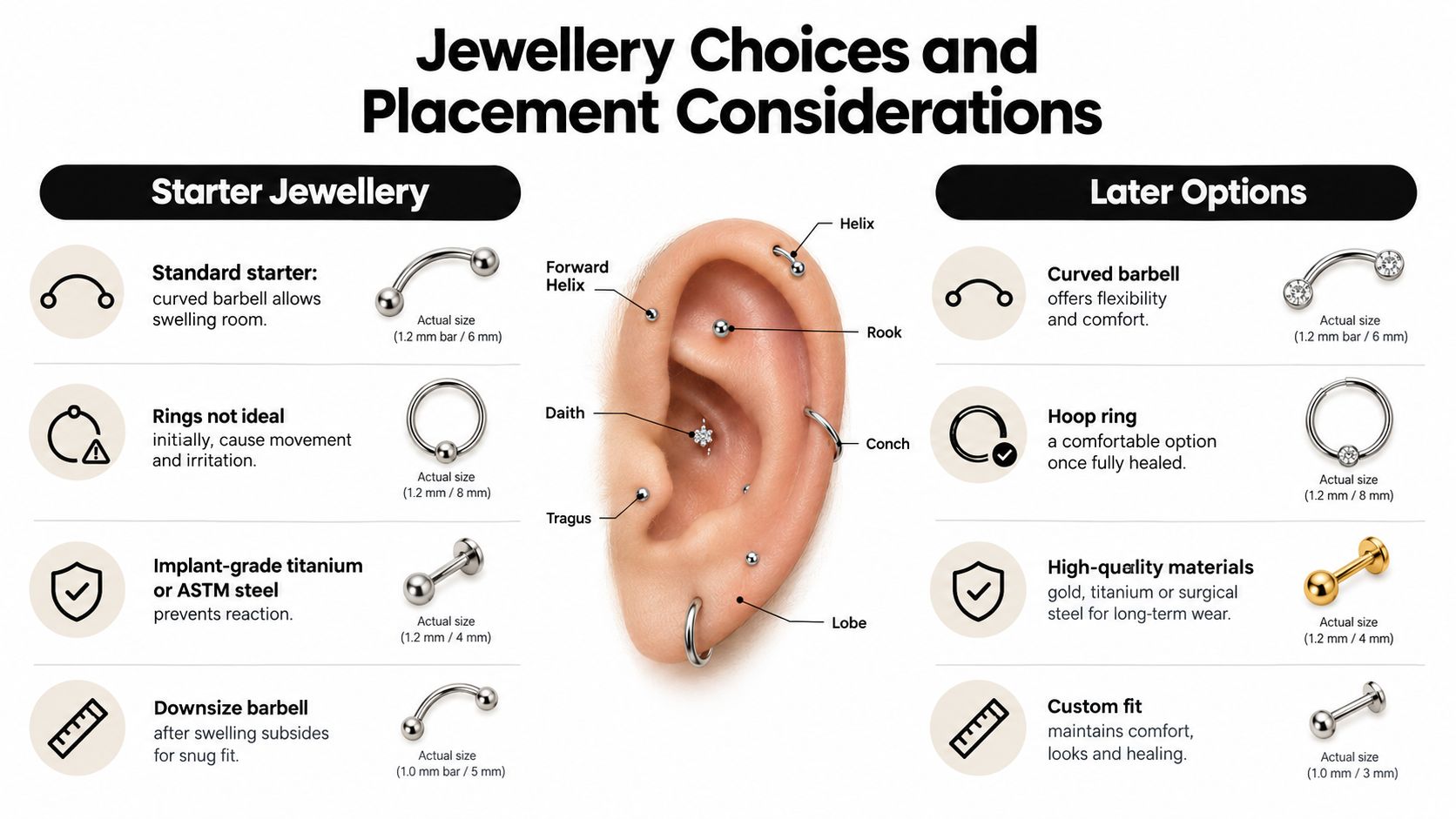
Initial jewellery needs to accommodate the early healing phase, not just look neat in a photograph. A curved barbell is commonly used because its shape follows the rook's fold and can leave practical room for swelling. A ring can move more freely, catch on hair and introduce repeated friction, which makes it a less forgiving starting choice for many clients.
| Jewellery option | Main consideration |
|---|---|
| Curved barbell | Follows the fold and can allow space for early swelling |
| Ring | Moves more readily and may increase irritation during initial healing |
| Later curved barbell | Can be fitted more closely once swelling has settled |
| Later ring | May be considered after healing, subject to anatomy and professional assessment |
Downsizing is a fit adjustment, not a sign that healing has finished. Once the initial swelling subsides, a piercer may assess whether the bar is longer than necessary. A snugger fit can reduce snagging, but changing jewellery too early can disturb the channel.
Material matters just as much as shape. The UK Association of Professional Piercers jewellery verification guidance identifies implant-grade titanium as titanium meeting ASTM F136 or ASTM F1295, or implant-grade steel meeting ASTM F138. Valid mill certificates provide evidence that the material meets the stated standard.
Ask to see what material is being used and whether the studio can verify it. “Titanium-coloured” isn't the same as implant-grade titanium, and a decorative finish doesn't prove the underlying metal is suitable for a fresh piercing.
Placement and bar length should be decided together. A piercer considers the fold's depth, the direction of the tissue, expected swelling and whether your hair, glasses, headphones or sleeping position could press on the jewellery. If you're interested in different finishes or a more decorative later piece, you can review gold rook piercing jewellery options while keeping the initial material and fit suitable for healing.
Pain Healing Timeline and What to Expect
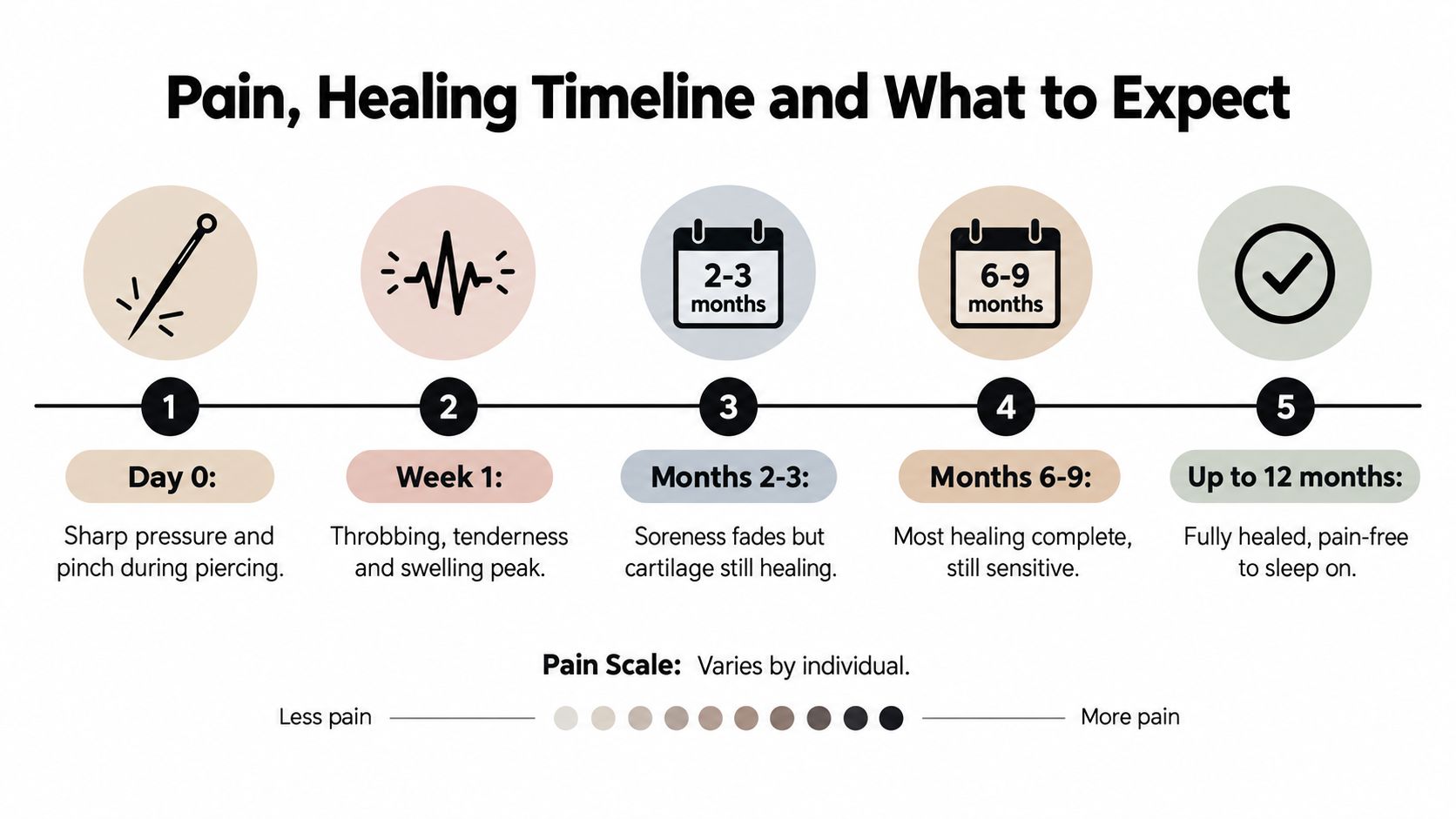
A rook piercing is usually a brief procedure, but the ear may continue to remind you it's there afterwards. The needle sensation can feel like sharp pressure and a pinch. Later, you may notice warmth, tenderness or a gentle throbbing as the area responds to the piercing.
Pain is personal, so no honest piercer can promise an identical experience for everyone. Cartilage also behaves differently from a lobe. It's firmer, less flexible and slower to settle, which means a small bump from hair or a pillow can make the area feel irritated again.
The healing arc
The typical UK healing window is 6 to 12 months, although some guidance allows for 6 to 18 months depending on anatomy and aftercare. UK cartilage-piercing healing guidance reflects the important practical point: improvement can happen well before the piercing is fully healed.
Early on, mild swelling, soreness and sensitivity are common. During the middle of the process, the outside may look calm while the channel remains vulnerable. Later, the rook may feel more comfortable day to day, but pressure from sleeping, helmets, headphones or accidental knocks can still cause a flare-up.
A rook can look healed before it is ready for careless handling. Comfort is encouraging, but it isn't the only measure of recovery.
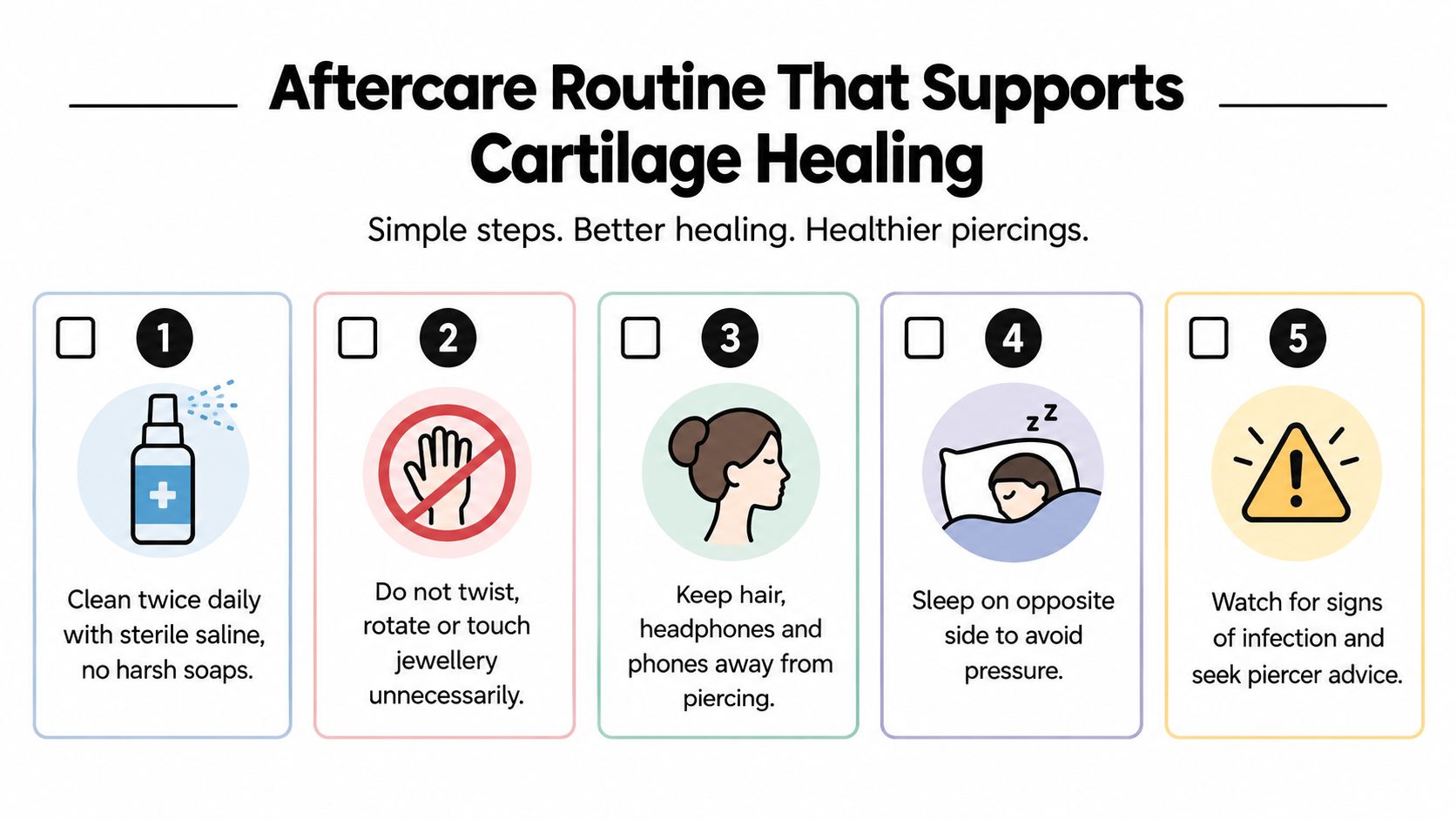
Plan around the piercing rather than expecting your routine to remain unchanged. If you sleep on that side, use the opposite side where possible. Keep headphones, phones and hair from rubbing the area, and be especially careful with jumpers, towels and hairbrushes.
A slow improvement pattern is usually more reassuring than a perfect-looking ear from the start. Healing can be uneven, with quiet periods followed by irritation after pressure or a knock. What matters is whether the overall direction is settling, rather than whether every day feels identical.
Aftercare Routine That Supports Cartilage Healing
Rook aftercare works best when it's boring, consistent and gentle. The aim is to remove surface build-up without stripping or repeatedly disturbing the healing channel.
A simple daily routine
Clean with sterile saline twice daily. Let the saline reach the area, then allow loosened residue to soften naturally. UK aftercare guidance recommends this low-intervention approach rather than vigorous scrubbing.
Leave the jewellery alone. Don't twist, rotate, spin or repeatedly check the barbell. Movement can irritate delicate tissue and create tiny injuries inside the channel.
Dry without rubbing. If moisture remains after cleaning, pat around the area with a clean disposable product. Avoid dragging fabric across the jewellery.
Reduce contact. Keep hair, phones, headphones and hands away from the rook as much as possible. Clean hair products can still irritate a fresh piercing if they collect around the fold.
Avoid submersion until healed. UK guidance advises avoiding pools, hot tubs, rivers and the sea during cartilage healing because water can introduce contamination and prolonged moisture can aggravate the area. NHS guidance says not to go swimming for the first 24 hours after a piercing, while local UK body-piercing guidance advises keeping the site dry for at least 3 days. The relevant UK aftercare toolkit supports taking extra care around water immediately after piercing.
Crusting can be part of normal healing. Don't pick it off while it's dry, and don't pull jewellery through a crust. Saline can soften surface residue, after which it should come away without force.
A bump isn't automatically an infection either. Friction, pressure and over-handling can cause irritation, so first remove the trigger and return to a gentle routine. Avoid harsh antiseptics, strong soaps and repeated cleaning, which can leave the skin more inflamed.
If you're choosing a saline product, use a reputable sterile option such as the guidance discussed in this UK saline spray guide. Don't mix a home solution that is overly concentrated, and don't treat persistent symptoms with stronger products without appropriate advice.
Common Complications and When to Seek Medical Help
If your rook feels tender after catching it on a towel, sleeping on that side or pressing it with headphones, irritation is a likely explanation. Mild swelling, warmth and clear or pale fluid that dries into light crusting can occur during normal cartilage healing. These signs should gradually settle once the trigger stops and gentle aftercare resumes.
A problem needs medical assessment when the pattern changes from settling to worsening. Seek prompt advice if you notice:
- Redness that spreads: A small flush around the piercing can be expected. Redness extending into the surrounding ear is more concerning.
- Pain that increases: Escalating, severe or disproportionate pain needs assessment.
- Thick yellow-green discharge: Coloured discharge, particularly with an unpleasant smell, should not be treated as ordinary crusting.
- Fever or feeling unwell: These wider symptoms need prompt medical advice.
- Rapid swelling: Fast-changing swelling can make the jewellery too tight and may signal a more serious cartilage problem.
Upper-ear piercings deserve extra caution because infection can involve the tissue around the cartilage. UK infection-prevention guidance recognises infection risks from body piercing, including bloodborne-virus transmission where hygiene is poor. Education also matters: The study's findings showed gaps in practitioners' knowledge about infection and scarring risks, including cauliflower ear. Clean jewellery and good aftercare reduce avoidable risks, but they cannot replace medical assessment when red flags appear.
Contact your GP or NHS 111 if symptoms suggest infection, are getting worse or leave you uncertain. Do not remove the jewellery yourself unless a healthcare professional or experienced piercer advises it. Closing the channel can sometimes interfere with drainage. A piercer can check jewellery fit, pressure and irritation, while suspected infection should be assessed by medical services.
Is a Rook Piercing Right for You and Next Steps
A rook may suit you if you like a discreet inner-ear detail and can accept a long, patient healing period. It's less suitable if you regularly sleep on that ear, need constant in-ear headphones, play contact sports without reliable protection or can't avoid repeated pressure during work and travel.
The decision should begin with an anatomy check, not a jewellery screenshot. An experienced piercer can explain whether your antihelix has enough depth, suggest an appropriate initial curved barbell and discuss how your routine could affect healing. Ask about implant-grade materials, sterile single-use needles, jewellery sizing, downsizing and written aftercare.
A reputable UK studio should also make medical escalation clear. You should know which changes are expected, which symptoms need a piercer's review and when to contact a GP or NHS 111. That conversation is particularly important for cartilage, where irritation can persist and infection can be harder to monitor than in a lobe.
For clients considering Timebomb studios in Croydon or Bournemouth through Piercing Near Me, consultations, walk-ins and appointments are available. You can call 01202 9000 50 or message on WhatsApp at 07752913846 to ask about rook suitability, jewellery and booking.
Keep these points in mind:
- Choose placement first: Your ear's anatomy determines whether a rook is appropriate.
- Start with suitable jewellery: Implant-grade materials and a correctly sized curved barbell support a safer beginning.
- Expect patience: Healing commonly takes 6 to 12 months, not a quick changeover.
- Use low-intervention care: Saline, dry handling and reduced pressure are more helpful than constant cleaning.
- Act on red flags: Worsening pain, spreading redness, coloured discharge, fever or rapid swelling needs professional advice.
If you're considering a rook piercing, Piercing Near Me can help you find Timebomb Tattoo & Piercing studios in Croydon and Bournemouth, with consultations, walk-ins and appointments. Contact the team to discuss your anatomy, implant-grade jewellery and a realistic aftercare plan before booking.