
You've had a helix piercing for a while, the swelling has settled, and now the original stud feels a little too plain. A delicate cartilage earring hoop looks like the obvious next step, until you wonder whether it will press against the ear, catch in your hair, or start an irritation bump.
Cartilage needs a more considered approach than a soft lobe. The tissue is firmer, movement around the upper ear is constant, and a hoop can rotate or pull on the piercing channel. The right choice depends on more than colour or sparkle. Material, healing stage, internal diameter, gauge, closure and placement all need to work together.
Introduction to Cartilage Earring Hoops
A first hoop often starts with a simple styling idea. You've seen a small silver ring on someone's upper ear and want the same neat, finished look. But the hoop that looks perfect in a photograph may be too tight for your anatomy, too heavy for a sensitive piercing, or unsuitable if the channel hasn't healed internally.
A cartilage hoop is a ring designed for placements such as the helix, conch, tragus, daith or rook. Unlike a straight flat-back stud, it follows a curve and can move whenever you touch your ear, brush your hair, wear headphones or sleep on that side. That movement isn't automatically harmful in a healed piercing, but it can be disruptive while cartilage is still repairing itself.
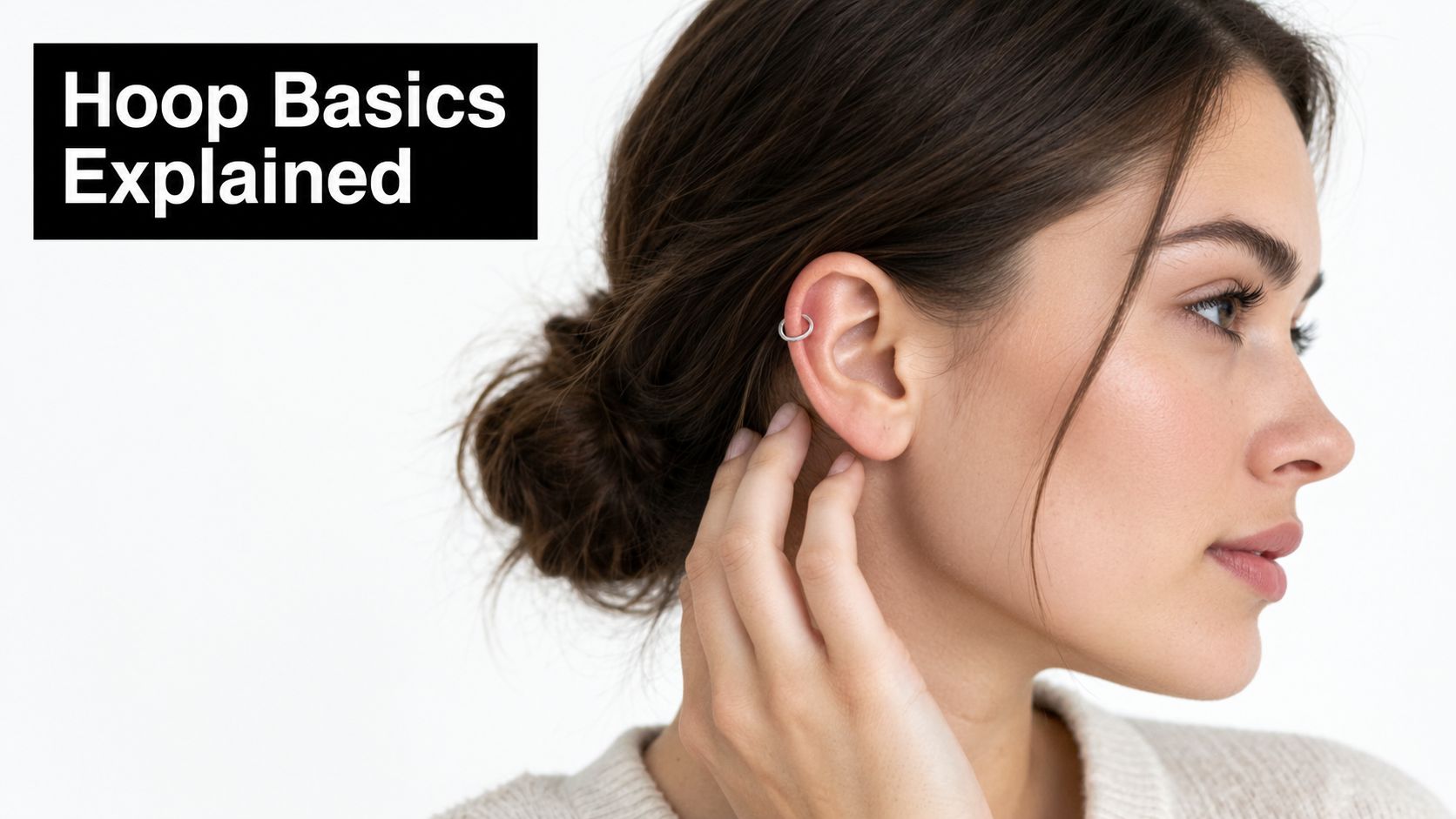
Why the healing timeline comes first
UK clinical guidance places helix healing at 3 to 6 months, while daith and tragus piercings can take up to 12 months, according to Patient.info's UK piercing guidance. Other UK advice summarises cartilage healing as a period of several months to a year, so a piercing that looks calm on the outside may still be delicate deeper inside.
That's why the original jewellery and a later fashion hoop serve different purposes. Initial jewellery gives swelling room and keeps the channel stable. A later hoop introduces movement and needs enough space to sit naturally without compressing the ear.
What this guide will help you decide
You'll learn how to compare implant-grade titanium, steel and plated metals, how internal diameter differs from gauge, and why closure design affects daily comfort. You'll also see how a helix hoop differs from one chosen for a conch or tragus.
If you're unsure, a professional fitting can remove much of the guesswork. A piercer in Croydon or Bournemouth can assess the placement, check the channel and help you choose a hoop that looks stylish without asking healing tissue to tolerate unnecessary pressure.
What Makes a Cartilage Hoop Different
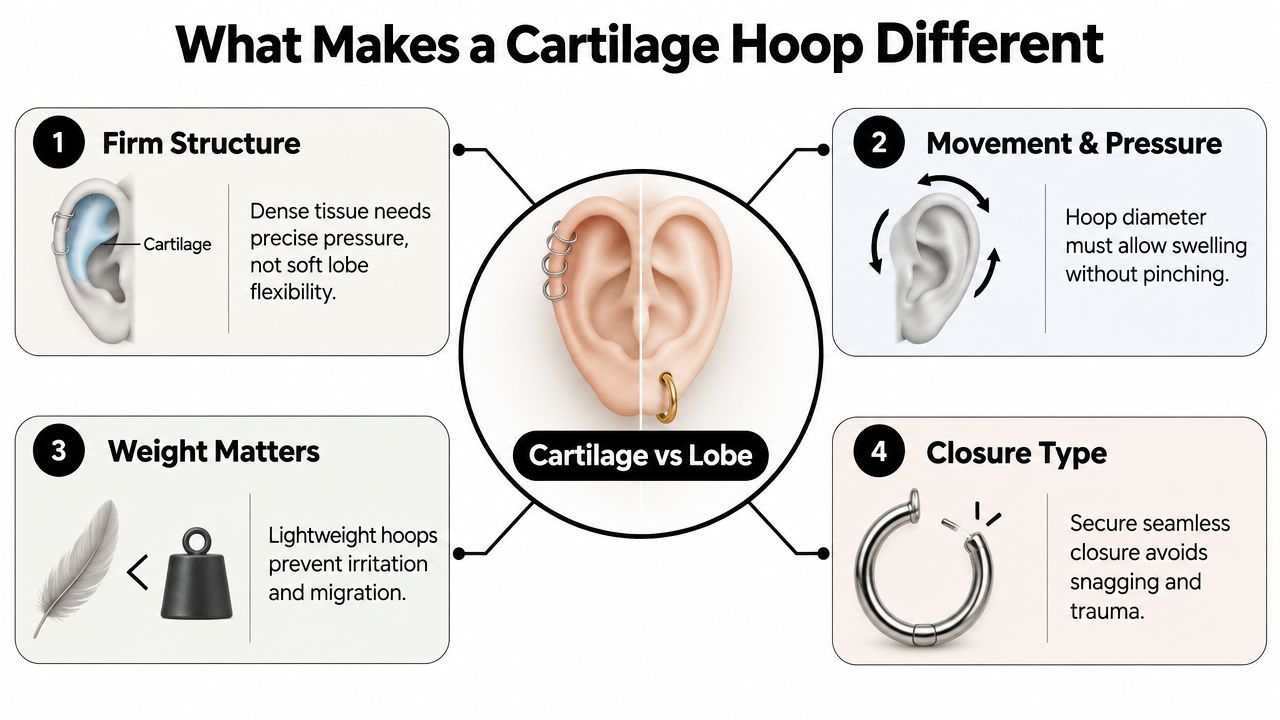
A lobe is soft and flexible, rather like a cushion that can accommodate a little movement. Cartilage is more like a firm curved frame. It doesn't give in the same way, so a ring that's slightly too small or heavy can place pressure directly on the piercing rather than settling comfortably around it.
A cartilage hoop must fit the ear's shape, not just the jewellery photo. Diameter controls the space inside the ring, while gauge describes the thickness of the metal. These measurements solve different problems.
Start with the space inside the hoop
Internal diameter is measured from one inner edge of the ring to the other. A smaller internal diameter creates a close huggie-style appearance. A larger one leaves more room for the ear's curve and any natural sensitivity.
Don't measure the outside edge when you're comparing jewellery. The metal thickness would make the ring appear larger than the usable space inside it. If a hoop sits tight against the rim, pulls the piercing hole upwards or leaves a pressure mark, the problem is usually insufficient internal diameter.
Then consider the metal thickness
Gauge is the thickness of the post or ring. A hoop with a fine gauge may look delicate, but it still needs to match the channel. A thicker ring can feel substantial and stable, yet forcing an unsuitable gauge through a settled piercing can cause trauma.
The piercing channel is not a universal tunnel. It has its own direction, size and shape, which is why an experienced piercer should check the gauge before you change to a different thickness.
Movement changes the fit
A hoop isn't fixed in place like a flat-back stud. It can rotate as you sleep, catch on a jumper or shift when you put on glasses. A little movement in a fully healed piercing may be manageable. In a tender or swollen piercing, repeated movement can maintain irritation.
Practical rule: A cartilage hoop should have enough room to follow the ear without pinching, but not so much extra space that it swings, snags and repeatedly tugs on the channel.
Lightweight metal, a smooth finish and a secure closure all help. The attractive choice is the one that behaves during ordinary activities.
Implant Grade Materials and Sensitive Skin Choices
The word hypoallergenic sounds reassuring, but it isn't a complete material specification. It doesn't tell you the exact metal, the grade, the coating or how the jewellery was finished. For a cartilage piercing that may need months of stable wear, you'll want clearer information.
Nickel allergy commonly develops after ear piercing, according to Allergy UK's nickel allergy guidance. Highly sensitive people can also react to jewellery described as nickel-safe or compliant with general directives, so the label alone shouldn't decide your purchase.
Implant-grade titanium
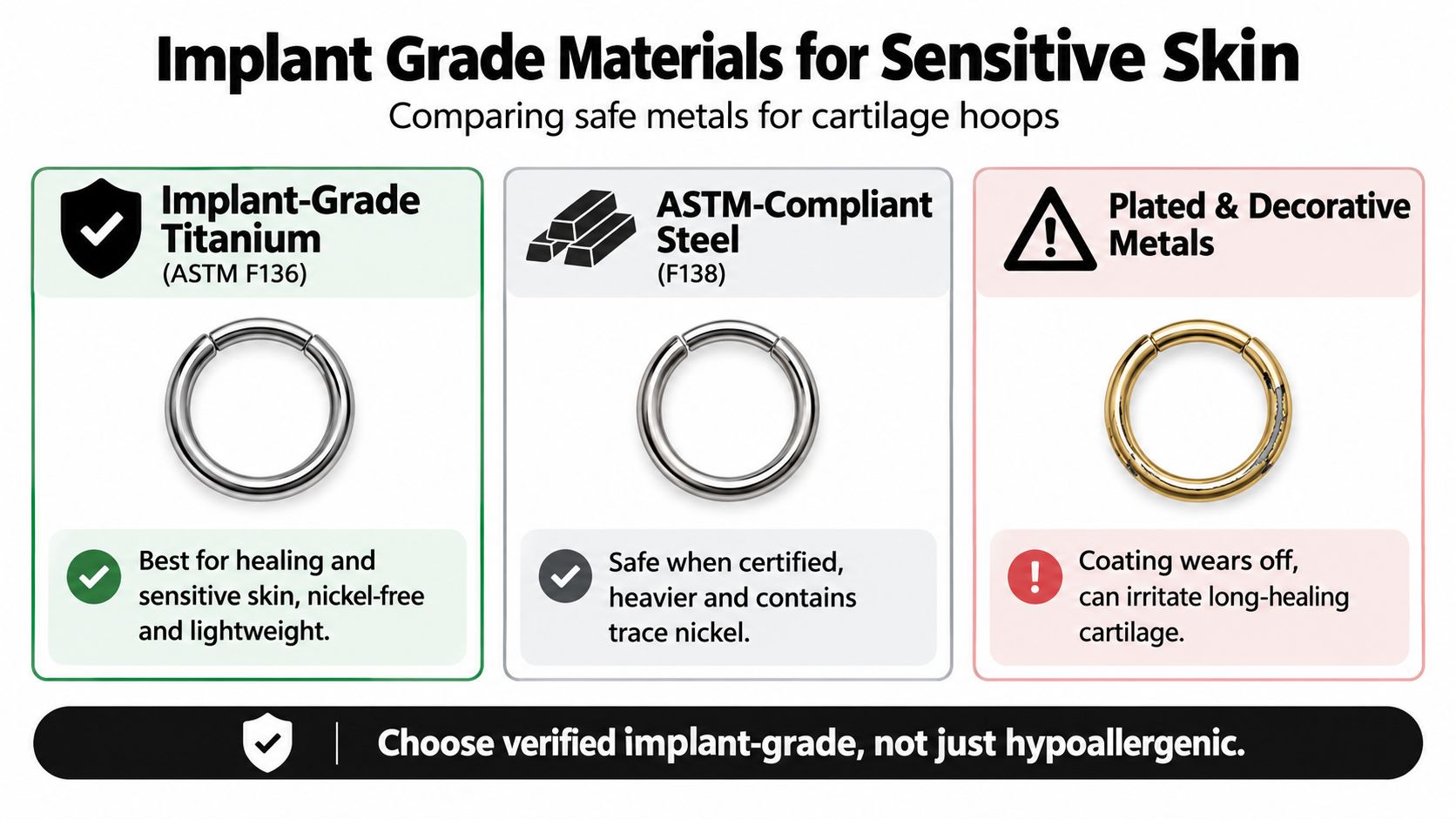
Implant-grade titanium, commonly identified by the specification ASTM F136, is a strong shortlist for healing or sensitive cartilage. It's lightweight and generally chosen because it avoids the nickel concerns associated with many other alloys.
Ask the seller or piercer to confirm the grade rather than accepting “titanium colour” or “titanium coated” as equivalent. A coated base metal isn't the same as a solid, verified implant-grade piece.
For a clearer explanation of why this material is often selected for cartilage, see this guide to titanium piercing jewellery.
ASTM-compliant steel
ASTM F138 steel can be suitable when the grade is verified and the wearer tolerates it. Steel is usually heavier than titanium and contains trace nickel, so it may not be the first choice for someone with known nickel sensitivity.
The important distinction is between certified steel and a product described only as “surgical steel”. Without a recognised specification, you can't reliably judge what the piece contains or how consistently it was made.
Plated and decorative metals
Gold plating and other decorative finishes can look beautiful, but the outer layer may wear, especially where the hoop rubs against the piercing or moves through the channel. Once the coating becomes damaged, the underlying metal can contact the tissue.
Sterling silver, gold and decorative alloys may have a place in a fully healed piercing for some wearers. They're a less cautious choice when the channel remains reactive, tender or prone to bumps. For long-healing cartilage, prioritise verified material, smooth construction and a finish that won't shed into the channel.
A practical buying check
Before ordering, look for:
- Named specifications: Check for a recognised implant or jewellery grade, not just “hypoallergenic”.
- Complete product details: Ask what metal sits beneath any plating.
- A smooth surface: Rough seams and damaged coatings can scrape the channel.
- Piercer verification: Take unfamiliar jewellery to a studio before fitting it if you're sensitive or still healing.
Material choice can't compensate for a hoop that's too tight. The metal and the fit need to be assessed together.
Finding Your Perfect Diameter Gauge and Closure
Three decisions control how a cartilage hoop behaves: internal diameter, gauge and closure. Think of them as the frame, the thickness and the fastening. Changing one can alter the whole feel of the piece.
Diameter is the room inside
A close-fitting hoop may create a tidy huggie look, but it needs enough internal space to clear the ear without pressing on the front or back of the channel. A larger hoop may be more forgiving, although it can move more and catch in hair.
Measure a well-fitting ring from its inner edge to its opposite inner edge. Don't force a rigid ruler into the ear, and don't push jewellery through a channel that feels tight. A piercer can measure the placement and account for the angle, rim thickness and any history of swelling.
Gauge must match the channel
Gauge refers to metal thickness, not ring width or overall diameter. A hoop that's thinner or thicker than the jewellery your piercing was fitted with may not sit correctly. If you're changing gauge, have a piercer assess it rather than stretching or compressing the channel at home.
You can use this millimetre to gauge conversion guide to understand product listings, but a conversion chart can't determine the correct size for your individual ear.
Closure affects everyday security
A hinged clicker is convenient and often sits smoothly when the hinge is positioned carefully. A segment ring creates a continuous appearance and can be secure when fitted correctly. A ring has a minimal look, but inserting it requires control because the opening and alignment must be handled without scraping the channel. A captive bead closure can be stable, although the bead may catch if it sits where hair or clothing rubs.
| Feature | Option | Best For | Watch Out For |
|---|---|---|---|
| Internal diameter | Snug | A close huggie appearance on suitable anatomy | Pinching, pressure marks and restricted swelling room |
| Internal diameter | More open | Extra clearance or a relaxed style | Increased movement and snagging |
| Gauge | Matched to existing jewellery | Stable, predictable fit | Forcing a different thickness |
| Closure | Hinged or segment | Regular wear and a neat finish | Hinge or seam rubbing the channel |
| Closure | Seamless or captive bead | Minimal or traditional styling | Difficult home insertion or a catching bead |
A hoop should rest around the piercing, not pull the piercing into position.
Remove or replace the piece if it causes persistent pressure, swelling, heat, discharge or increasing soreness. Those signs need professional advice rather than a tighter ring.
Matching Hoops to Helix Conch and Tragus Placements
A hoop that looks comfortable in a helix may press uncomfortably in a conch or catch on a tragus. The helix follows the outer rim, the conch sits in the ear's central bowl, and the tragus occupies the small fold beside the ear canal. Placement changes both the clearance a ring needs and how much movement it receives.
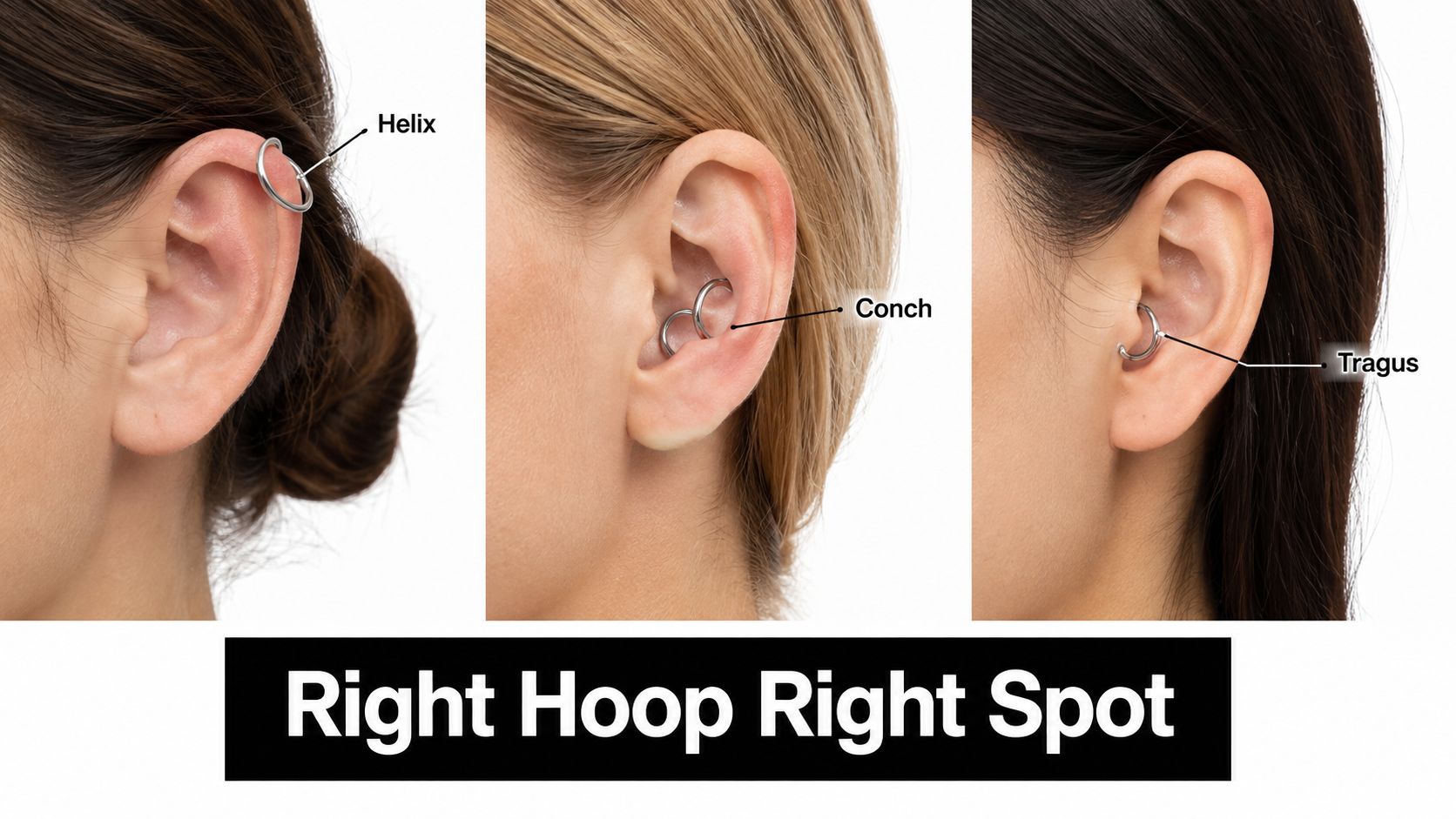
Helix
A helix hoop follows the outer edge, so a small internal diameter can give a neat, close-fitting look. The piercing's exact position matters more than its name. A channel near the rim may suit a snug ring, while one set farther inward needs more diameter to prevent the hoop from pulling the ear's edge.
Outer-rim jewellery also meets more obstacles. Hair, masks, glasses and headphones can catch on it, particularly while the piercing is healing. For regular wear, a lightweight hoop with a smooth surface and secure closure is usually easier to live with than textured or dangling jewellery.
Conch
A conch hoop travels through the ear's central shell. The ring should clear the surrounding bowl rather than press into it, even if a close fit looks attractive from the front. A piercer checks the channel angle and its distance from the outer edge before choosing the internal diameter.
A larger statement hoop can suit a fully settled conch with enough room around it. A smaller hoop may work when the channel sits nearer the inner ear, but reducing the diameter does not automatically make the fit safer. Pressure and restricted movement can irritate the tissue.
Tragus
The tragus provides limited space beside the ear canal. A low-profile closure helps because a bulky hinge or bead may catch on earbuds, hair or fingers. A flat-back stud often remains more practical while this placement settles, with a hoop better treated as a later styling choice.
UK cartilage guidance places daith and tragus healing at potentially up to 12 months, as noted earlier in the article. A professional check before introducing a moving hoop helps confirm that the channel can tolerate its rotation and contact. Patient.info explains why symptoms of infection need appropriate care rather than a tighter ring.
Safe Switching Fitting and Aftercare Essentials
A hoop swap should happen because the piercing is ready, not because the surface looks normal. UK guidance varies, with some advice referring to 12 weeks and other sources placing complete cartilage healing at 6 to 12 months, as discussed in H Samuel's ear-piercing aftercare guidance. The sensible distinction is between an early surface calm and full internal stability.
Initial jewellery is fitted to support healing and accommodate changes in swelling. A later hoop is a styling change that adds rotation, contact and snag risk. If the piercing remains tender, swollen, crusty or prone to discharge, ask a piercer to assess it before changing anything.
A gentle fitting sequence
- Ask for a professional check. Have the piercer confirm that the channel is stable, then choose diameter and gauge from the actual anatomy.
- Wash your hands and prepare clean jewellery. The hoop should have a smooth finish and a closure that aligns without force.
- Never push through resistance. If the channel doesn't accept the hoop easily, stop. Forcing it can tear fragile tissue.
- Position the closure away from pressure. A hinge, seam or bead shouldn't sit where it rubs against the piercing.
- Monitor the fit. The ring shouldn't pinch, embed, pull or swing heavily during normal movement.
For daily care, follow cartilage piercing aftercare guidance and keep the area stable. UK advice commonly supports saline care, avoiding sleeping pressure and avoiding alcohol or hydrogen peroxide because these products can irritate healing tissue.
Handling bumps and irritation
Cartilage can develop a lump or granuloma. Torbay Council's ear and face piercing aftercare guidance notes that cartilage may form granulomas and may respond to a warm compress once daily. Braintree Council also describes lumps as often linked to trapped fluid and advises a warm water compress, while warning against dry twisting and cotton wool fibres in its ear and face piercing advice.
Don't pick, twist dry jewellery or remove a problematic hoop without advice. Increasing pain, spreading redness, heat, significant swelling or discharge calls for prompt medical or professional assessment.
Your Next Steps to a Comfortable Stylish Hoop
Choosing a cartilage earring hoop becomes clearer when you use this order:
- Start with the material. Choose verified implant-grade titanium if sensitivity or ongoing healing is a concern, and treat vague “hypoallergenic” claims cautiously.
- Confirm the fit. Check internal diameter, match the gauge to the channel and choose a closure that won't catch.
- Match the placement. Helix, conch and tragus piercings need different clearances because they sit on different parts of the ear.
- Respect the timeline. A calm surface doesn't prove that the deeper channel has finished healing.
A comfortable hoop should feel almost uneventful. It shouldn't pinch when you move your ear, snag whenever you brush your hair or leave a pressure mark after sleep. If the fit feels uncertain, professional measurement is safer than repeatedly buying rings and hoping one works.
Piercing Near Me connects clients with consultation, walk-in and appointment options at studios serving Croydon and Bournemouth. You can ask about jewellery materials, placement, sizing and aftercare before committing to a change, which is particularly helpful for a first hoop or a piercing that has been sensitive.
You can also call 01202 9000 50 or message Whatsapp on 07752913846 for personalised advice about choosing and fitting a cartilage hoop.
Visit Piercing Near Me to arrange a consultation or explore piercing support in Croydon and Bournemouth. Bring your questions about material, diameter, gauge and closure, and let a professional help you choose a cartilage earring hoop that suits both your style and your healing stage.
Trackbacks/Pingbacks