
You've found a beautiful ring for your nostril, a curved bar for your navel or a discreet retainer for work. The problem is that jewellery can look right in a product photo and still be wrong for a fresh piercing, an established channel, a stretched lobe or a surface placement. Shape, material, gauge, length, diameter and closure all affect whether a piece is comfortable and suitable.
This guide compares 10 types of piercing jewellery by how each construction works, where it commonly fits, which material decisions matter and when a professional should handle the change. You'll find practical examples for cartilage, facial and body piercings, along with the trade-offs that aren't always obvious from a catalogue image.
For a consultation, fitting or purchase, Piercing Near Me connects clients with Timebomb Tattoo & Piercing studios in Croydon and Bournemouth. You can call 01202 900050 (Bournemouth) / 020 8686 7730 (Croydon) or message WhatsApp on 07752 913846 (Bournemouth) / 07902 490584 (Croydon) when you're unsure which piece matches your anatomy or healing stage.
1. Barbells
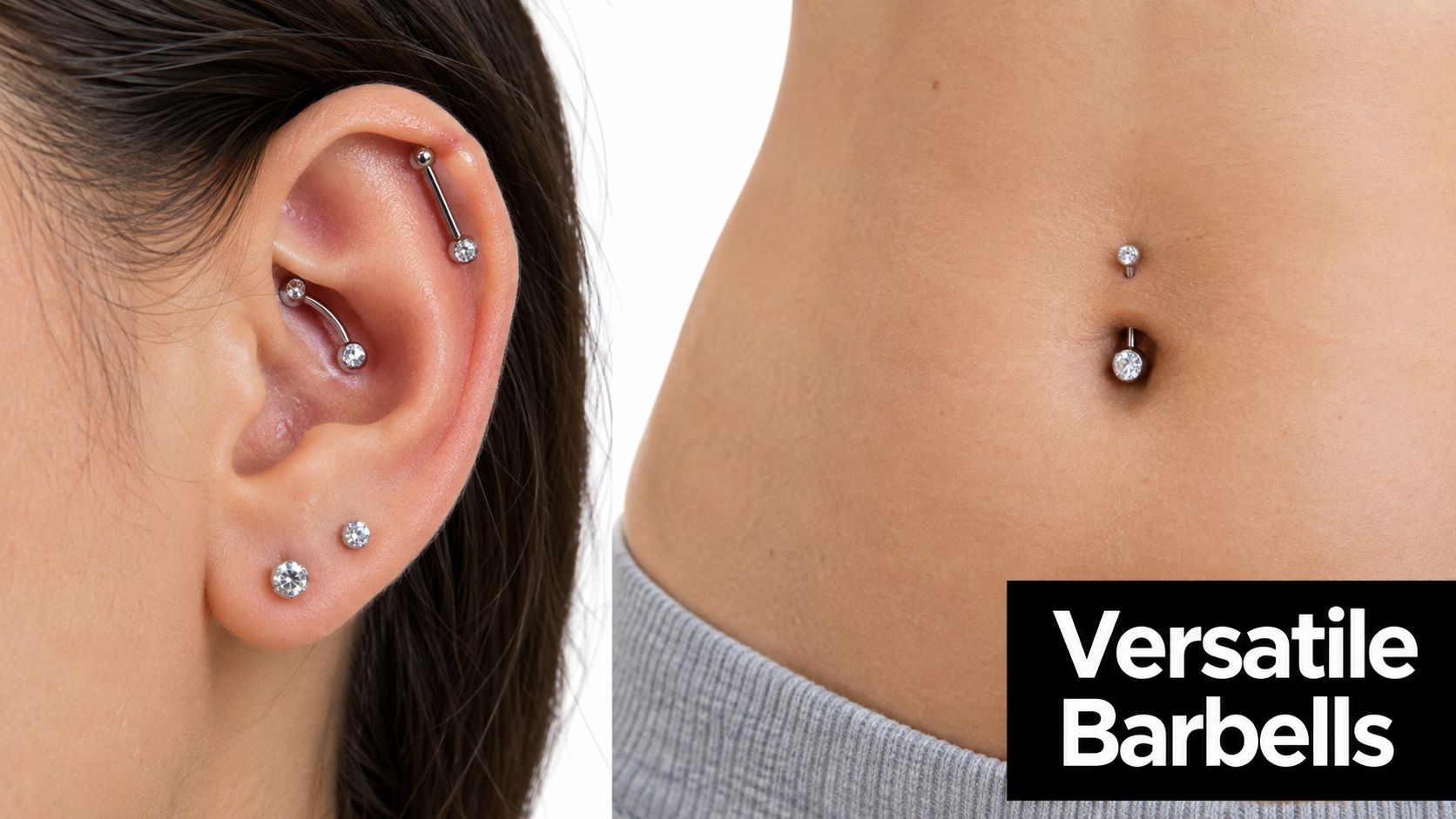
A barbell has a central post with an end on each side. The post may be straight or curved, while the ends can be threaded or attached through a threadless system. One end is often fixed, and the other screws or pushes into place. That simple construction makes barbells adaptable across ear, facial and body placements.
A straight barbell is a strong choice where the piercing channel runs in a relatively direct line. Industrial piercings commonly use a longer straight bar, while a tragus may suit a short post with a small decorative end. A navel can take a curved construction with a gemstone end, and an eyebrow piercing often needs a curve that follows the tissue rather than pressing against it.
What to check before buying
Material comes first. For a fresh piercing, UKAPP requires initial jewellery to be implant-grade titanium meeting ASTM F136 or ASTM F1295, or implant-grade steel meeting ASTM F138, with mill certificates proving compliance. It also accepts solid 14 or 18 karat gold, niobium and glass. UKAPP's jewellery verification guidance explains why a visual label such as “surgical steel” isn't enough.
Length must match the channel. A post that's too short can compress swelling, while excess length catches on clothing and moves unnecessarily. Have a piercer measure the channel instead of guessing from another piercing.
Practical rule: For initial wear, choose verified material and correct dimensions before choosing a decorative end.
Internal threading keeps the section passing through the tissue smooth, because the threaded portion remains inside the end rather than scraping through the channel. Don't rotate the barbell to clean it. A professional studio should pierce with sterile, single-use needles and fit the jewellery to the anatomy.
2. Septum Clickers
A septum clicker is a ring with a hinged section that opens and closes with a firm snap. The closure avoids the twisting or threading needed with some other circular designs, which makes changing a healed septum more convenient. The visible front can be plain, geometric, floral, gemstone-set or made as a custom symbol.
An ornate clicker can turn a septum into the main feature of the face. A small geometric design is more discreet for daily wear, while a gold-coloured or gemstone piece can suit formal styling. The important distinction is between a clicker intended for a healed piercing and jewellery suitable for a fresh wound.
The hinge is part of the fit
A hinge that catches, sits unevenly or leaves a sharp edge can irritate the channel. Open and close the mechanism before buying, and inspect the join under good light. The hinge should operate smoothly, with no rough movement that could drag across tissue.
Septum piercings are often changed to clickers after healing, but healing time varies by placement and individual response. Don't rely on a calendar alone. A piercer should assess whether the channel is calm, stable and ready for a closure that may be more substantial than the original jewellery.
Clean the whole construction. Saline care should reach the visible ring and the hinge area, where residue can collect. Don't force the clicker through resistance. If the closure won't align, have a professional open, clean or refit it rather than twisting the jewellery against the piercing.
For first-time wearers, a specialist at Timebomb Tattoo & Piercing can check the clicker's diameter, gauge and hinge position. A decorative ring may need more internal space than a plain one, particularly if the septum sits higher or the nostril shape is narrow.
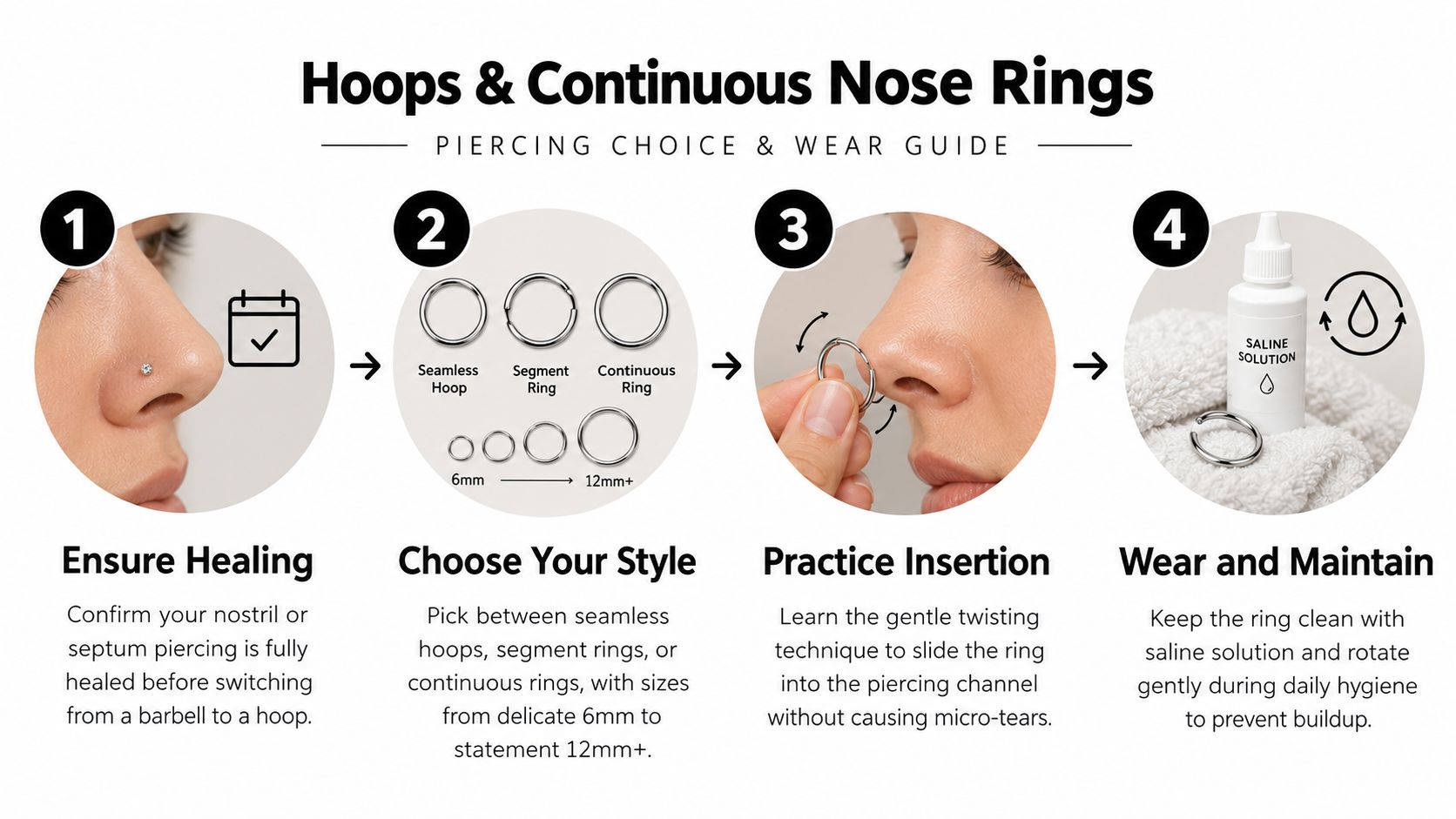
3. Hoops and Continuous Nose Rings
Hoops and continuous nose rings, often called CNRs, form a circular loop through the piercing. The ring may be solid, segmented or joined with a closure. In a nostril, the result is a clean circular outline. In a septum, the diameter determines whether the piece looks discreet or creates a stronger visual frame.
A delicate hoop can suit a healed nostril for a minimal look. A segment ring gives a similar uninterrupted appearance while offering a defined section that can be opened with the correct technique. Titanium is a sensible choice for clients who need a verified, lower-reactivity material, while a compliant solid gold piece can provide a different finish for healed wear.
Why hoops need patience
A hoop moves differently from a stud. It can rotate, catch on towels and place changing pressure on the channel. That makes it a poor automatic replacement for starter jewellery, even if the ring is the right diameter on paper. The piercing must be sufficiently healed, and the ring must sit without pressing into either side of the tissue.
A snug hoop should follow the anatomy without pinching it. “Snug” doesn't mean tight.
Insertion also varies by closure. Seamless rings need controlled twisting rather than pulling the ends apart, because opening them sideways can distort the circle. Segment and hinged rings may be easier to handle, but the join still needs to sit away from pressure points.
For detailed guidance on selecting an appropriate cartilage earring hoop, speak with a professional before changing a cartilage piercing. Clean the ring with suitable saline care, and don't practise insertion on a healing channel. If the jewellery won't pass smoothly, stop and book a fitting rather than forcing it.
4. Earplugs and Gauges
Earplugs and gauges are designed for stretched piercings, particularly enlarged lobe channels. A plug fills the opening with a solid or tunnel-like body, while a gauge is often used informally for the jewellery or the size of the stretched piercing. Designs include wood, stone, glass, metal and custom-made pieces.
The visible style can be striking. Wooden plugs may have carved patterns, stone pieces may feature turquoise or obsidian, and a double-flared plug can sit securely once the lobe has reached the required size. The construction and material still matter more than the design, especially while the tissue is adapting.
Stretching is a process, not a jewellery swap
A lobe should be enlarged gradually, with enough recovery time between size changes. There is no safe shortcut for forcing a larger plug into tissue that isn't ready. Pain, bleeding, pronounced swelling or a split at the back of the lobe are warning signs, not evidence that the jewellery is working.
During stretching, a professional can assess whether the channel is healthy and whether the next piece has an appropriate profile. Smooth, verified materials are easier to clean and less likely to introduce rough surfaces into the channel. Organic materials such as wood need particular care because their texture and porosity can make them unsuitable for a fresh stretch.
Use a professional for the decision points.
- Check the tissue: A piercer can identify thinning, irritation or uneven expansion before you size up.
- Choose smooth jewellery: Avoid chipped stone, rough wood, sharp edges and finishes that shed into the channel.
- Allow recovery: Don't treat a calendar reminder as proof that the lobe is ready.
- Consider permanence: Stretching can affect future appearance and may have work or social consequences.
A plug that fits comfortably should not need force to insert or removal tools to prevent it falling out. Fit depends on the lobe, jewellery profile and flare, so buy by measurement rather than by a label alone.
5. Shields and Ear Weights
Shields are flat decorative pieces that sit against the ear, usually supported by a stretched lobe or a compatible jewellery system. Ear weights hang below the lobe and place downward tension through the piercing. Both can create a bold silhouette, but they don't behave like ordinary lightweight earrings.
A bronze shield with a Celtic-inspired pattern gives a very different effect from a smooth titanium weight or a stone design with amber. The visual appeal comes partly from scale and movement, yet those same features can create pressure on the tissue. A piece that looks balanced in the hand may pull unevenly once worn.
Weight changes the risk
Healthy, stable stretched lobes may tolerate carefully selected weights for limited wear, but heavier jewellery shouldn't become a permanent substitute for supportive plugs. Repeated downward force can thin the lower lobe, enlarge the opening unevenly or create tears. A professional should inspect the tissue before recommending a weight, particularly if the lobe already looks narrow at the bottom.
Start with a light design and monitor comfort rather than waiting for obvious damage. Remove the piece if you feel throbbing, pinching, heat or increasing tenderness. Rotating between supportive jewellery and decorative pieces can reduce continuous strain, but it doesn't make an unsuitable weight safe.
Construction matters as much as mass. A broad shield may distribute contact differently from a narrow hanging bar. Smooth edges, balanced weight and a stable attachment point are preferable to a piece that swings sharply or catches on hair.
Don't wear ear weights in a healing piercing. They're for established tissue, and even then, a piercer should help you choose the design, duration and fit. If the lobe changes shape or develops a split, stop wearing the weight and seek professional advice.
6. Labret Studs and Threadless Push-Fit Systems
A labret stud has a straight post with a flat back and a decorative front. That flat base sits against the skin, which makes the construction useful for lips, nostrils and many ear placements. In cartilage, a well-fitted flat back is less likely to snag on bedding than a protruding butterfly-style backing.
Threadless, or push-fit, jewellery removes the need for a threaded connection between the post and decorative end. A small pin on the end bends inside the post, creating tension that holds the piece securely. The front can be changed without removing the post, although the technique still needs care.
Why professionals use flat backs
A labret's success depends on post length and the shape of the end. A post that's too long moves and catches. One that's too short presses into swelling. In a lip piercing, the back also needs to sit comfortably against the inside of the mouth without rubbing the teeth or gum.
Initial material should be verifiable. Implant-grade titanium is a common first choice for sensitive skin and fresh piercings. UKAPP's material guidance also recognises compliant implant-grade steel, niobium, glass and suitable solid gold, provided the piece meets the relevant requirements. Flat-back earring studs can be discussed with a studio when you're comparing decorative ends and post styles.
Fit before finish: A tiny gemstone on the wrong-length post is still the wrong jewellery.
Threadless ends can be convenient, but they shouldn't be yanked out or over-bent. Ask the piercer to show you how the end releases and how much tension is appropriate. Keep a spare decorative end if you rely on the style daily, and use saline care without rotating the post.
7. Hinged Segment Rings
Hinged segment rings combine the circular appearance of a hoop with an opening mechanism. One section may swing on a hinge, or a segment may detach from the ring body. The closure makes them easier to insert than a solid ring for many users, but it doesn't remove the need for accurate sizing.
These rings work across several healed placements. A small clicker can suit a septum, a plain segmented ring can sit in a helix, and a decorative segment can add detail to a navel. The ring should follow the piercing without pressing into the surrounding skin, and the closure should rest in a position that doesn't rub.
Look closely at the join
The main weak point is the hinge or segment interface. A poorly aligned closure can create a small ridge, catch on clothing or scrape the channel during insertion. Run a clean fingertip over the closed ring and check that the join sits flush. If the ring has a decorative plate, inspect the reverse side too.
Clean around the hinge rather than assuming the smooth outer surface is self-maintaining. Residue can build up in small gaps, and forcing a stiff mechanism can damage both the jewellery and the tissue. Don't repeatedly open and close a ring while it's in the piercing.
For a cartilage placement, the ring's internal diameter needs enough clearance for the ear's anatomy. A ring chosen solely because it looks snug in a photograph may press against the helix or migrate the jewellery through the channel. A piercer can test the fit and recommend whether a segment, clicker or labret is the more practical construction.
8. Dermal Anchors and Surface Bars
Dermal anchors and surface bars sit in tissue that doesn't pass through a conventional lobe or cartilage ridge. A dermal anchor has a base beneath the skin and a visible decorative top. A surface bar has two ends connected by a bar that rests under the skin's surface, allowing both ends to appear externally.
Placement changes the fitting problem. Collarbone, chest, cheekbone and forehead placements experience different pressure from clothing, sleep, hair and facial movement. The jewellery must suit the depth and direction of the tissue, not just the visual location.
These changes belong in a studio
A dermal anchor requires professional application, and a surface piercing needs an assessment of whether the anatomy can support the construction. Rejection and migration can occur when tissue pushes the jewellery towards the surface. Redness, persistent swelling, increasing tenderness or visible movement should be assessed promptly.
The safest buying decision is to choose the piercer before choosing an elaborate top. A specialist can explain the base, top, material and likely maintenance, then select jewellery that won't catch unnecessarily. During healing, keep hands, hair, clothing and accessories away from the site as much as possible.
Microdermal anchor piercing consultations can help you understand placement, jewellery choice and aftercare before committing. Use sterile saline as advised, don't twist the top and don't attempt removal at home. If the anchor starts migrating, early professional removal may prevent more tissue damage, although the final outcome depends on the individual placement and healing response.
9. Curved Barbells and Banana Bars
Curved barbells, often called banana bars, follow an arc instead of a straight line. That shape can reduce pressure where tissue bends, so studios commonly use them for navels, eyebrows and some nipple piercings. Ends may be plain discs, balls, spikes or gemstones, but decoration must not compromise fit or add unnecessary snagging.
A navel barbell often combines a smaller top end with a larger decorative lower end. Eyebrow jewellery usually uses two compact ends for a neater profile. Nipple jewellery needs particularly careful sizing because excess movement and pressure can prolong irritation. The curve should follow the anatomy, with the openings sitting naturally rather than being pulled towards each other.
Curvature doesn't replace measurement
Barbell length depends on the piercing depth and the space required for normal swelling or tissue changes. A curve that is too tight presses into the channel. A shallow curve may sit awkwardly and move more than intended.
For a fresh piercing, ask for implant-grade titanium or another material meeting recognised UK requirements. UKAPP's jewellery verification guidance identifies implant-grade titanium, compliant steel, suitable solid gold, niobium and glass as accepted initial options. It is more useful than relying on a retail description such as “hypoallergenic”.
Fit the curve to the placement. A banana bar made for a navel is not automatically suitable for an eyebrow, even when the gauge looks similar. The curve, ends and post length each affect pressure and stability. During healing, have a professional insert or change the jewellery. Do not rotate the barbell to loosen buildup. Use gentle saline care and avoid picking around the ends.
10. Septum Retainers and Clear Retainer Jewellery
Retainers are designed to make a piercing less visible, often through a clear, neutral or flesh-toned appearance. Septum retainers may flip up inside the nose, while other retainers use a simple post or curved profile. Materials sold for this purpose include PTFE, bioplast and acrylic, but they aren't interchangeable in quality or suitability.
PTFE is described in UK skin-piercing guidance as a flexible, inert, implantable thermoplastic. The same guidance names titanium, niobium, compliant steel and suitable gold among materials that may be used when they meet the required nickel controls. East Suffolk's skin-piercing guidance sets out the material and compliance considerations.
Discreet doesn't mean maintenance-free
A clear retainer can help with a workplace dress code, but it may be softer, more flexible or less durable than metal. Acrylic can scratch or develop surface damage, and any retainer can collect residue if it isn't cleaned and replaced appropriately. A piercer should decide whether the piercing is healed enough for the specific material and design.
Don't assume a retainer is automatically suitable for initial healing. A fresh channel needs stable, verified jewellery, and changing it early can cause swelling or closure. If you need to conceal a new piercing for work, discuss that requirement before the piercing so the studio can plan the jewellery and placement.
Clean the retainer according to professional advice, store it safely and avoid bending it sharply. When discretion is no longer needed, returning to appropriate implant-grade metal can provide a more durable long-term option.
10 Types of Piercing Jewellery Compared
| Item | 🔄 Complexity | ⚡ Resources & Aftercare | 📊 Expected Outcomes | 💡 Ideal Use Cases | ⭐ Key Advantages |
|---|---|---|---|---|---|
| Barbells | Low, straightforward straight/curved designs; suitable for starters | Implant-grade titanium/steel; routine saline cleaning; accurate sizing needed | Reliable healing and versatile fit when sized correctly | Initial piercings, industrial, navel, eyebrow, nipple, cartilage | Extremely versatile, easy to change, affordable; internal threading reduces irritation |
| Septum Clickers | Moderate, hinge mechanism; best for healed septums | Titanium/gold options; clean hinge area; avoid during early healing | High comfort and fast changes if piercing is healed | Healed septum wearers wanting decorative, tool-free swaps | Tool-free insertion, flush fit, decorative front plates |
| Hoops & Continuous Nose Rings (CNRs) | High, insertion/removal requires skill (especially seamless) | Titanium/gold/steel; precise sizing; saline care to avoid micro-tears | Elegant continuous look; low catch risk once healed | Healed nostril/septum piercings, subtle/professional aesthetics | Seamless circular appearance; understated and polished look |
| Earplugs & Gauges | Very high, long-term gradual stretching over months/years | Wide material choices; strict stretching schedule and hygiene | Dramatic, potentially irreversible aesthetic change; high commitment | Alternative fashion, body-mod communities, committed wearers | Bold visual impact; wide artistic/material options |
| Shields & Ear Weights | High, needs stable stretched lobes and careful fitting | Heavy materials (stone/metal); monitor tissue health; intermittent wear | Distinctive statement look but risk of permanent stretching/damage | Advanced modification enthusiasts wanting ornamental pieces | Highly decorative, customisable statement pieces |
| Labret Studs & Threadless Systems | Low, push-fit simplifies insertion; professional technique advised | Implant-grade titanium; minimal irritation; simple cleaning | Secure, low‑trauma healing; reduced micro-tears | Lip, facial, and many initial piercings; clients wanting easy swaps | Reduced tissue trauma, secure fit, strong professional preference |
| Hinged Segment Rings (Clickers/Segments) | Moderate, hinge/segment eases insertion vs seamless hoops | Implant-grade metals; clean hinge/segment; test mechanism | Hoop aesthetic with easier handling; good healing if well fitted | Septum, ear cartilage, navel when hoop look is desired | Tool-free insertion, maintains continuous ring appearance |
| Dermal Anchors & Surface Bars | Very high, specialist placement and complex aftercare | Titanium bases; intensive saline care; higher rejection risk | Unique 3D effects; unpredictable healing and possible scarring | Advanced body-mod placements (cheekbone, chest, collarbone) | Enables novel placements and interchangeable tops |
| Curved Barbells & Banana Bars | Low–Moderate, shaped to anatomy; sizing critical | Titanium/steel/gold; threadless options preferred; daily cleaning | Improved comfort on curved areas; suitable for many long-term uses | Navel, eyebrow, nipple, select ear placements; fresh piercings | Better comfort on curves, reduces pressure and irritation |
| Septum Retainers & Clear Retainers | Low, simple insertion once healed; discreet use | PTFE/bioplast/acrylic; replace regularly; clean to limit bacteria | Virtually invisible appearance; preserves healing while hidden | Professional or conservative settings requiring concealment | Near‑invisible, flexible and affordable solution for temporary concealment |
Match the Piece to the Piercing
The best jewellery choice starts with the piercing itself, not the product photograph. A straight barbell, curved barbell and labret may all look simple, but they place pressure differently. A hoop follows a circular path, a clicker adds a hinge, a retainer prioritises discretion, and a dermal anchor depends on a base beneath the skin. Stretching jewellery and ear weights create a separate set of tissue demands.
First, identify the healing stage. Fresh piercings need stable jewellery made from a verified suitable material. UKAPP requires initial jewellery to meet specific implant-grade standards, including ASTM specifications for titanium and steel, and it accepts selected solid gold, niobium and glass options. UKAPP's jewellery verification information also highlights the importance of mill certificates, which let a studio verify what the material is.
UK local authority guidance distinguishes jewellery inserted into a piercing from ordinary jewellery worn against intact skin. Inserted assemblies must release less than 0.2 micrograms of nickel per square centimetre per week, while other prolonged skin-contact jewellery is permitted up to 0.5 micrograms per square centimetre per week, as explained in Bromley's body-piercing guidance. The inserted jewellery must also contain less than 0.05% nickel by weight, with lead at or below 0.05% by weight, according to UKAPP's verification guidance. These are practical reasons to avoid vague descriptions and mixed-metal fashion pieces for a fresh piercing.
Make the decision by construction
Choose a labret for many ear cartilage, nostril and lip placements when a flat back and controlled post are appropriate. Choose a barbell when the channel and anatomy suit two visible ends, such as an industrial or some body placements. Choose a curved barbell where the tissue follows a contour, but have the curve and length measured rather than guessed.
Choose a hoop or clicker for a healed placement that can tolerate circular movement and the closure's position. A ring that's too small pinches, while one that's too large catches. Choose a retainer only after discussing material, healing stage and the reason for concealment. Choose plugs or weights only for established stretched tissue, with the weight and profile assessed separately.
Sizing is not limited to gauge. The professional also needs to consider post length, internal diameter, curvature, end size, hinge placement and the amount of space required for normal swelling. Jewellery should pass through smoothly. If you need force, twisting or repeated attempts, stop.
Know when to book the change
A professional should handle changes during healing, first-time hoop fittings, dermal jewellery, surface bars, stretching steps and any change where the jewellery has become tight or embedded. A studio can also check whether redness reflects ordinary irritation, pressure from poor sizing or a more serious problem that needs medical attention.
Keep care simple. Wash hands before touching the area, use the aftercare recommended by your piercer, avoid unnecessary rotation and don't pick at residue. Hoops, clickers, retainers, weights and dermal tops each have different cleaning and handling needs, so one routine shouldn't be copied across every placement.
Piercing Near Me helps clients arrange consultations, fitting and purchasing support through Timebomb Tattoo & Piercing in Croydon and Bournemouth. For advice about material, sizing or a safe change, call 01202 900050 (Bournemouth) / 020 8686 7730 (Croydon) or message 07752 913846 (Bournemouth) / 07902 490584 (Croydon) on WhatsApp.
Piercing Near Me can help you compare jewellery constructions, book a professional fitting and plan personalised aftercare at Timebomb Tattoo & Piercing studios in Croydon and Bournemouth. Visit Piercing Near Me to find suitable piercing services and take the next step with jewellery chosen for your anatomy and healing stage.