
If you’ve ever been woken up by the sharp jab of an earring post digging into your neck, you already know the biggest flaw of traditional butterfly backs. It's a universal, and painful, experience. This is exactly why professional piercers have moved on to a much smarter, more comfortable alternative: flat back earring studs.
These studs replace the clunky butterfly clasp and pointy post with a smooth, flat disc that sits flush against your skin. The difference is night and day. No more painful pokes, no snagging on clothes or hair, and a much safer environment for your piercing to heal.
Why Flat Backs Are a Piercing Game Changer
Think of it like this: a traditional earring is like having a tiny, sharp pebble stuck behind your ear. A flat back stud, on the other hand, is like a smooth, polished stone. The design is brilliantly simple—a low-profile disc that sits comfortably behind your earlobe or even inside your lip.
This one change solves all the most common complaints we hear about standard earrings. You can finally answer your phone, wear over-ear headphones, or get a good night's sleep without that constant, irritating pressure. But this isn't just a small luxury; it’s a crucial part of a happy, healthy piercing journey.
Unmatched Comfort and Stability
It’s not just about comfort, though. Flat back studs bring a level of stability that is essential for healing. A fresh piercing is a delicate wound, and the less it moves, the better. The secure, snug fit of a flat back minimises any wiggling or twisting, which drastically reduces irritation and prevents the piercing from healing at an awkward angle.
This stability is precisely why you'll see them used in almost any professional studio. They are the go-to for initial piercings, especially in tricky cartilage spots like the helix, conch, and tragus. The industry data backs this up, too. Most professional studios now fit new cartilage piercings with flat-back studs. It's a clear trend in body jewellery, and you can learn more about it by exploring the evolution of modern earrings.
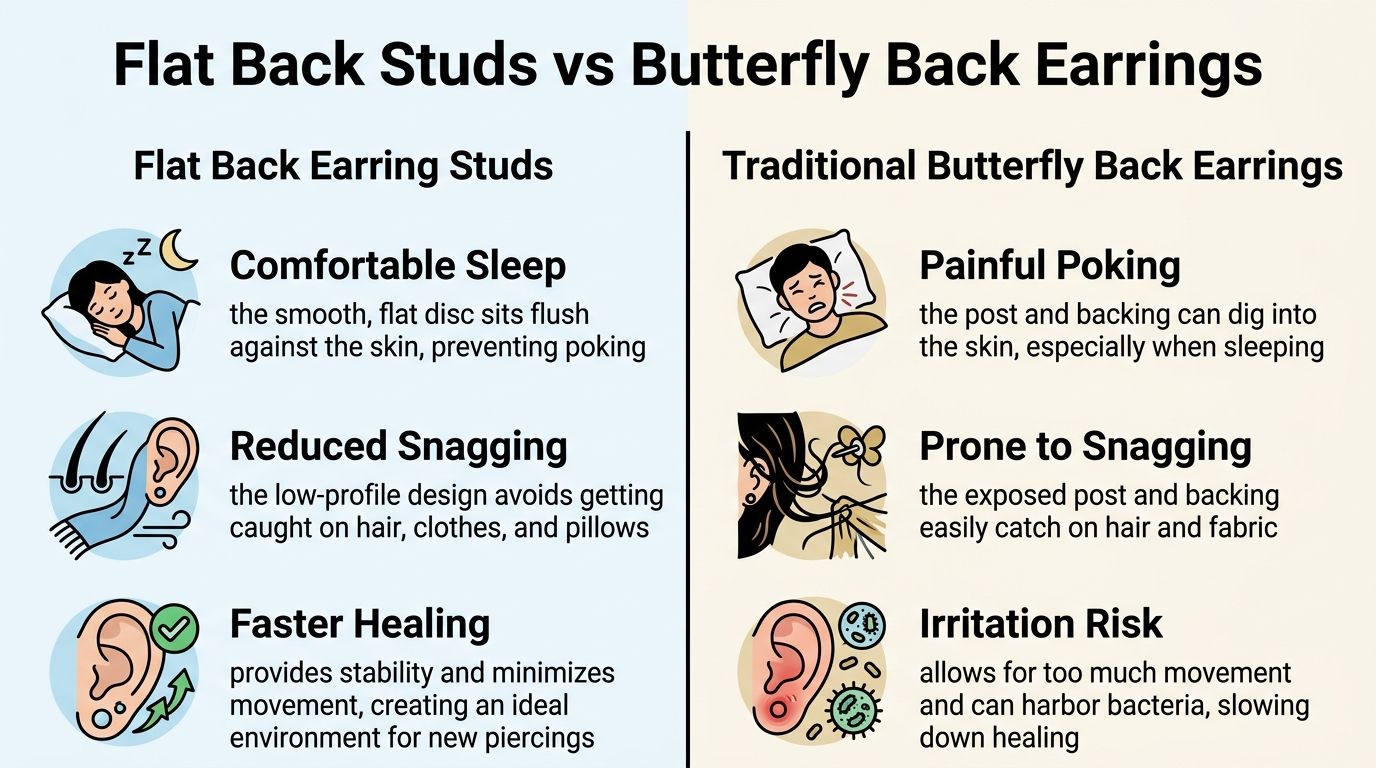
To make the choice even clearer, here’s a quick head-to-head comparison.
Flat Back Studs vs Butterfly Back Earrings
| Feature | Flat Back Earring Studs | Traditional Butterfly Back Earrings |
|---|---|---|
| Comfort | Smooth, flat disc sits flush. Ideal for sleeping and daily wear. | Protruding post can poke the skin behind the ear. |
| Healing | Secure fit minimises movement, reducing irritation for new piercings. | Can trap bacteria and debris; movement can slow healing. |
| Safety | Less likely to snag on hair, clothing, or bedding. | Easily catches, which can cause trauma to the piercing. |
| Hygiene | Easy to clean around the front and back of the piercing. | Butterfly backs are notorious for trapping dirt and dead skin. |
| Security | Threaded or threadless designs are very secure and unlikely to fall out. | Can loosen over time and easily get lost. |
| Best For | New piercings (especially cartilage), active lifestyles, and 24/7 wear. | Healed lobe piercings and short-term wear. |
As you can see, the advantages of flat backs really stack up, especially when it comes to the health and comfort of your piercing.
Ultimately, flat backs are designed from the ground up for optimal healing, long-term comfort, and safety. If you're tired of the hassle and discomfort of butterfly backs, making the switch is one of the best things you can do for your piercings.
Have questions about what style or size is right for you? Our expert team is always here to guide you. Just give us a call on 01202 900050 (Bournemouth) / 020 8686 7730 (Croydon) or drop a message on WhatsApp to 07752 913846 (Bournemouth) / 07902 490584 (Croydon).
Understanding the Anatomy of a Flat Back Stud
Getting to know your jewellery is the first step to choosing pieces you'll love with confidence. Think of a flat back stud not as a single object, but as a clever two-part system built for comfort and security. On the surface, most studs look pretty similar, but the real difference lies in how they connect.
Every flat back earring consists of two key components: the decorative top (the pretty part you see on the front) and the labret post (the bar with a flat disc that rests discreetly against the back of your piercing). The magic happens in how these two pieces join together. In any professional studio, you'll come across two main types of connection.
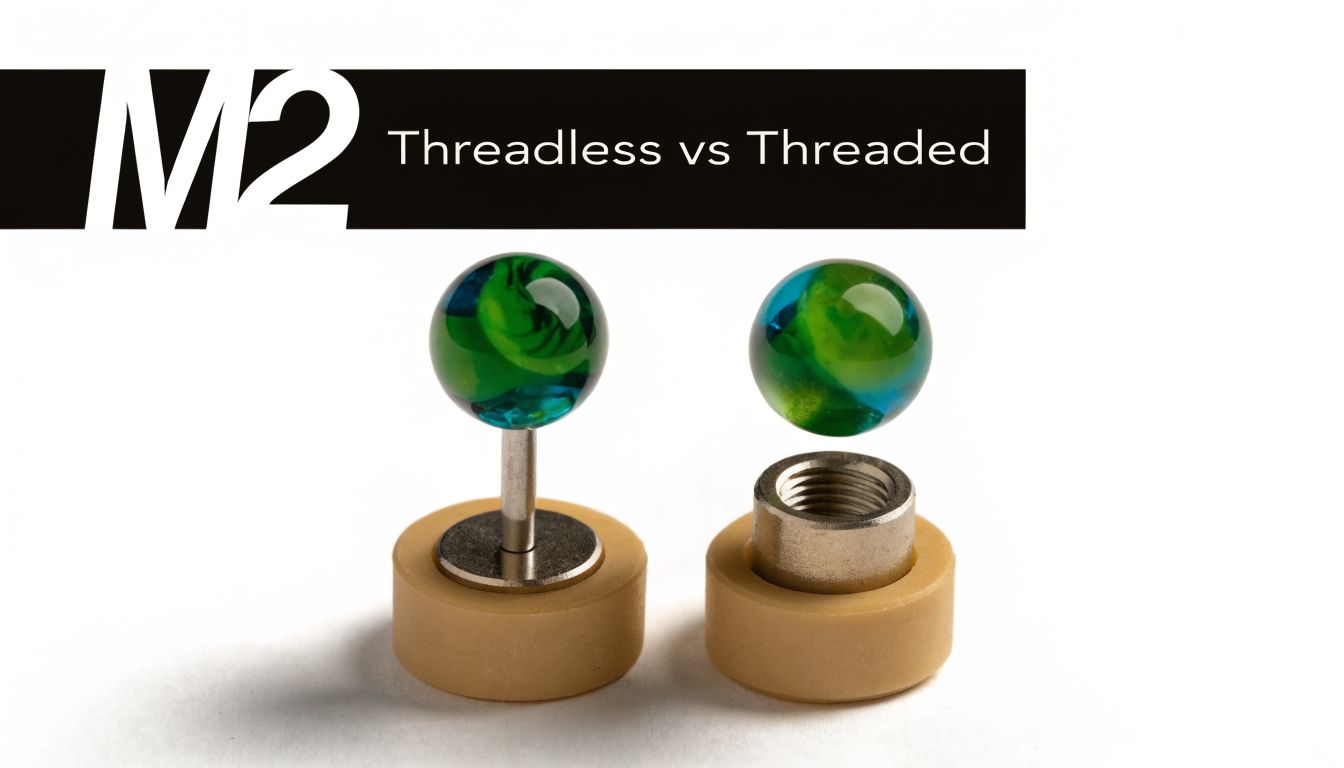
Threadless or Push-Pin Studs
This design is a massive favourite among both piercers and clients for its sheer simplicity. A threadless stud does away with screws entirely. Instead, the decorative top has a tiny, straight pin attached to it.
That little pin isn't perfectly straight—it has a very subtle, intentional bend. When you push the pin into the hollow labret post, that bend creates tension, locking the two pieces together with a secure press-fit. It's an elegant and surprisingly robust system.
Changing your jewellery is as simple as holding both ends, giving a slight twist as you pull, and popping the top out. It's perfect for anyone who loves to change their look often. If you have any questions about how they work, our team is always happy to show you; just give us a call on 01202 900050 (Bournemouth) / 020 8686 7730 (Croydon) or send a message to our WhatsApp at 07752 913846 (Bournemouth) / 07902 490584 (Croydon).
Internally Threaded Studs
The other high-quality option is the internally threaded stud. As the name implies, it uses a screw mechanism. The crucial detail here is the word internally.
With this style, the decorative top features a tiny screw that extends from its base. This screw then fits inside the hollow labret post, which has matching threads on its interior. You just gently screw the top into the post until it's snug.
This brings us to one of the most important safety standards in piercing. Reputable piercers will only ever use internally threaded or threadless jewellery. You must always avoid externally threaded jewellery—the kind where the screw threads are on the outside of the post itself.
Here’s exactly why that’s a hard-and-fast rule:
- Damage on Insertion: The sharp, coarse threads on an external post will drag and tear at the delicate tissue inside your piercing. It’s like pulling a cheese grater through a healing wound, causing unnecessary pain and trauma.
- Healing Setbacks: For any piercing, old or new, that kind of damage can trigger a major flare-up. For a healing piercing, it can set your progress back weeks, causing swelling, soreness, and a much higher infection risk.
- Poor Hygiene: Those external grooves are a perfect breeding ground for bacteria and dead skin cells, making the jewellery incredibly difficult to clean properly.
In contrast, an internally threaded or threadless post is perfectly smooth from end to end. It glides through the piercing channel without catching or causing any harm. This ensures the entire process is safer, far more comfortable, and supports a clean, quick heal. It’s a non-negotiable part of professional body piercing.
Choosing Materials for a Safe and Happy Piercing
When you get a new piercing, the jewellery you put in it is far more than just a style statement—it’s a crucial part of the healing process. Getting the material right means a smooth, happy heal. Getting it wrong can lead to irritation, allergic reactions, and even infection. This is exactly why professional piercers are so particular about using only body-safe, implant-grade metals.
Think of it this way: a surgeon wouldn't use just any old metal for a hip replacement. They use materials like titanium specifically because the body accepts them without putting up a fight. The very same logic applies to your flat back earring studs. "Implant-grade" isn't some fancy marketing buzzword; it’s a verifiable standard that guarantees a metal is biocompatible and safe to live inside your body long-term.
The Gold Standard Materials
For a piercing to heal without any drama, we exclusively recommend and use two key types of materials. These have a proven track record for being safe, durable, and perfect for brand new and fully healed piercings alike.
Implant-Grade Titanium (ASTM F-136): Honestly, this is the undisputed champion in the piercing world. It’s completely nickel-free, incredibly lightweight, and boasts the same level of biocompatibility as the metals used in medical surgery. It's the go-to choice for absolutely everyone, especially if you have sensitive skin or known metal allergies.
14k or 18k Solid Gold: If you love the timeless look of gold, solid gold (and we mean solid, not plated!) is a beautiful and safe alternative. The key is to make sure it’s 14k or higher and certified nickel-free. Lower-karat gold often contains other metal alloys that can easily upset a healing piercing.
Choosing these high-quality materials makes a real-world difference. In fact, UK safety figures show just how much flat back earring studs have improved piercing outcomes. Flat backs are generally more comfortable and easier to keep clean than traditional butterfly backs, and professional studs are made from body-safe materials. You can discover more insights about earring safety standards.
Materials to Strictly Avoid
Knowing what not to use is just as important, particularly when a piercing is fresh and vulnerable. Those cheap "mystery metals" you find in high-street fashion jewellery are a massive gamble. More often than not, they’re packed with irritants like nickel and lead.
Plated jewellery, sterling silver, and even "surgical steel" can all cause real problems. The plating on cheap jewellery can flake off, exposing the poor-quality metal underneath and creating a rough surface that harbours bacteria. Sterling silver tarnishes, which can permanently stain your skin (a condition called argyria), while most grades of "surgical steel" still contain enough nickel to trigger a nasty reaction in sensitive people.
Your body deserves the best possible start for a new piercing. If you're ever feeling unsure about what materials are safe, our experts are always here to guide you. Give us a call on 01202 900050 (Bournemouth) / 020 8686 7730 (Croydon) or drop a message to our WhatsApp at 07752 913846 (Bournemouth) / 07902 490584 (Croydon) for some friendly advice.
For a deeper dive into our favourite metal, you can also check out our guide on titanium piercing jewellery.
A Practical Guide to Sizing and Placement
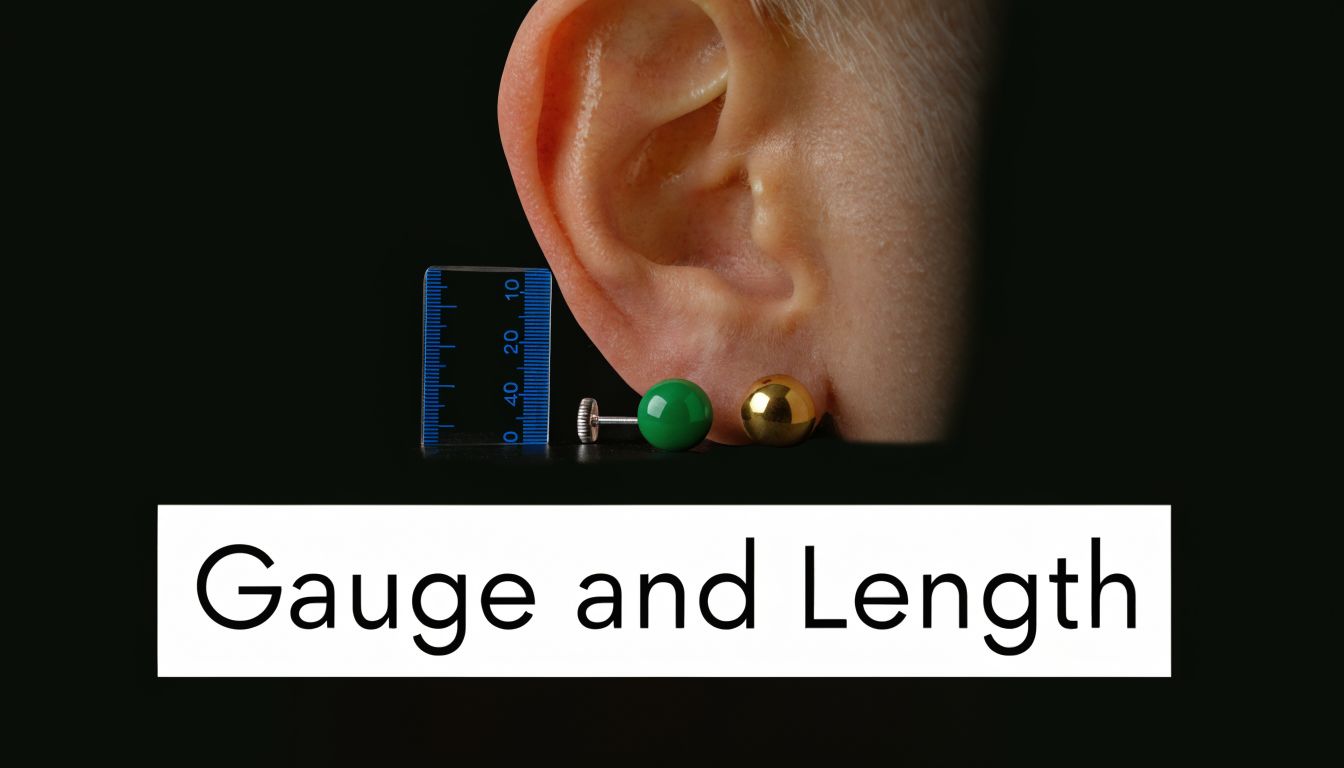
When it comes to getting the perfect fit for your flat back studs, everything boils down to two simple measurements: gauge and length. Getting these right is the secret to a comfortable, healthy piercing that looks fantastic. Let's break down what they mean.
The gauge is simply the thickness of the earring post. It’s measured in a slightly backward way, where a smaller number means a thicker post. Most ear piercings we perform use either a 16g (1.2mm) or 18g (1.0mm) post. This isn't something you should ever have to guess; your piercer will select the perfect gauge for your piercing and your unique anatomy.
Finding the Right Length
Now, let's talk about length. This is the wearable part of the post, measured from the back of the decorative top to the flat disc. While common sizes are 6mm and 8mm, the posts can range anywhere from a tiny 4mm up to 12mm or more.
The ideal length is completely unique to you and where your piercing is located. For instance, a healed helix on very thin cartilage might sit perfectly with a 6mm post. A fleshier part of the ear, like a conch or a thick lobe, might need an 8mm or even 10mm post to avoid any pressure.
This is where a professional piercer is absolutely essential. For any new piercing, we will always fit you with a post that’s intentionally a bit too long. This is non-negotiable, as it leaves crucial room for the initial swelling that occurs in the first few weeks of healing.
Without that extra space, the swelling can cause the jewellery to tighten and even become embedded in your skin, which is painful and can lead to serious complications.
The Importance of Downsizing
After the first 4-8 weeks, once that initial swelling has gone down, it's vital you come back to the studio for a downsize. This is when we swap out the initial long post for a shorter one that fits your ear snugly and perfectly.
Skipping this appointment is one of the most common mistakes we see, and it can cause a whole host of problems. A post that’s too long can:
- Snag easily: It will constantly catch on your hair, clothing, and pillows, causing irritation and trauma to the healing piercing.
- Alter the angle: All that catching and pulling can force the piercing to heal at an awkward, slanted angle—and this is often permanent.
- Cause irritation bumps: The constant movement is a leading cause of those frustrating little bumps that can appear around a healing piercing.
Ultimately, your piercer is the best person to guarantee a perfect fit, both at the start and after healing. If you're unsure about what size you need or think it's time for a downsize, just get in touch! You can call us on 01202 900050 (Bournemouth) / 020 8686 7730 (Croydon) or send a message on WhatsApp to 07752 913846 (Bournemouth) / 07902 490584 (Croydon) to book a consultation. For more placement ideas, you can also explore our comprehensive guide to ear piercings.
Where to Use Flat Back Studs for Best Results
You might be surprised at just how versatile flat back studs really are. Once you get a feel for them, you’ll realise why experienced piercers consider them the workhorse of modern piercing. While they're absolutely brilliant for ears, their comfortable and secure design makes them a top-tier choice for a whole range of placements.
Their popularity isn't just hype. Flat backs have completely reshaped the UK piercing scene. Why the boom? It goes hand-in-hand with the explosion of curated ear projects. Their ‘sleep-friendly’ design is a lifesaver for healing cartilage, which notoriously takes its time. Discover more about these piercing trends to see just how popular they've become.
Perfect for Curated Ears
If you're dreaming of a 'curated ear' – a personalised collection of piercings styled together – then flat back studs are non-negotiable. They are the foundation of any well-planned ear project. The slimline disc at the back means you can pack piercings closely together without them bumping, twisting, or getting tangled.
They’re the perfect fit for pretty much any cartilage piercing you can think of:
- Helix: The flat back keeps the jewellery sitting snugly against the outer curve of your ear, which means fewer snags on hair and clothes.
- Conch: It sits comfortably in the inner ‘bowl’ of the ear, so there's no post digging into the cartilage behind it.
- Tragus: That little flat disc is a game-changer, preventing the irritation inside your ear canal that a clunky butterfly back would cause.
- Flat: As the name suggests, this piercing needs jewellery that lies perfectly flush, and a flat back stud does exactly that, letting the decorative top be the star.
- Lobe: Honestly, they are a massive comfort upgrade for any lobe piercing, whether it's brand new or decades old.
Thinking about adding to your collection? You should learn more about the benefits of a stud helix piercing and see how it can become a cornerstone of your unique style.
A Safer Choice for Facial Piercings
It’s not just about ears. The same safety and comfort features make flat backs the best option for many popular facial piercings, especially around the mouth.
For piercings like the philtrum (often called a Medusa) or a labret (below the bottom lip), that smooth, flat disc rests gently against the inside of your lip and gums. This is crucial because it massively reduces the risk of gum erosion and damage to your tooth enamel – a serious and all-too-common issue with jewellery that isn't designed for oral placements.
Even for a nostril piercing, many people find a flat back labret is far more secure and comfortable than a traditional screw or L-shaped stud that can easily get knocked out.
If you're planning your next piercing and want to make sure it's as comfortable, safe, and easy to heal as possible, our team is here to help. We can guide you to the perfect flat back stud for your anatomy and desired look. Give us a call on 01202 900050 (Bournemouth) / 020 8686 7730 (Croydon) or send a message to our WhatsApp at 07752 913846 (Bournemouth) / 07902 490584 (Croydon) to chat with an expert.
So, Where Should You Get Your Piercing?
You’re now up to speed on why flat back studs are the gold standard for so many piercings. But knowing what you want is only half the battle. The other, arguably more important half, is choosing who does the piercing.
Finding a piercer you trust is the single most important decision you'll make. It’s the difference between a beautiful, well-healed piercing and a whole lot of trouble. A great piercer isn't just someone who makes a hole; they’re a skilled professional dedicated to your safety and the long-term health of your new addition.
Forget everything you’ve seen about piercing guns. A true professional will only ever use a brand new, single-use, sterilised needle. It’s cleaner, far more accurate, and much gentler on your body, causing less trauma to the tissue. This isn't just a preference—it’s a fundamental standard of care.
What Makes a Studio Stand Out?
A top-tier studio is about more than just a clean room. Your piercer should be your partner in this, guiding you through the whole process. They’ll help you choose the right jewellery for your anatomy from a wide selection of implant-grade metals and give you aftercare advice that’s specifically for you and your piercing, not just a generic leaflet.
This is exactly the level of care and expertise we champion. It's also how our own teams at Timebomb in Croydon and Bournemouth work. (Piercing Near Me is run by Timebomb.)
At both studios, you’ll find highly experienced piercers working in spotless, welcoming spaces. They are absolutely committed to using only the best implant-grade flat back jewellery, giving your piercing the perfect start for a smooth and happy heal.
Ready to Take the Plunge?
Getting started is simple. Whether you’re just exploring ideas, have a few questions, or you’re ready to book in for a new piercing with some top-quality flat back studs, we're here to point you in the right direction.
You can reach out for a chat or to get booked in.
- By Phone: Give the team a call on 01202 900050 (Bournemouth) / 020 8686 7730 (Croydon).
- By WhatsApp: Pop a message over to 07752 913846 (Bournemouth) / 07902 490584 (Croydon).
Let’s connect you with a brilliant piercer who can turn your ideas into reality, safely and beautifully.
Got Questions About Flat Back Earrings? We’ve Got Answers
Even after covering the basics, you probably have a few practical questions buzzing around. It's totally normal. Think of this section as a chat with your piercer, where we tackle the most common queries we get from clients every day.
If there’s something on your mind that we don’t cover here, please don't hesitate to get in touch. Our team of friendly experts is always here to help. Just give us a call on 01202 900050 (Bournemouth) / 020 8686 7730 (Croydon) or drop a message on WhatsApp to 07752 913846 (Bournemouth) / 07902 490584 (Croydon).
How Do I Change a Flat Back Stud?
Taking out your jewellery for the first time can feel a bit fiddly, but you’ll get the hang of it quickly. The golden rule is to always start with squeaky-clean hands.
First, get a firm but gentle grip on the flat disc at the back of the piercing. For a threadless (or push-pin) stud, you'll need to hold the back steady while you twist and pull the decorative top straight out. If you have an internally threaded stud, hold the back and simply unscrew the top by turning it to the left (anti-clockwise).
For your very first jewellery change-down, we always recommend booking in with your piercer. They can do it for you, ensuring it’s done safely and showing you the technique up close.
Can I Use a Flat Back for My First Piercing?
Not only can you, but you absolutely should. In fact, any professional piercer will insist on it. Flat back studs are the gold standard for almost any new piercing, whether it's a simple lobe or a more complex cartilage project like a helix or conch.
Why? Because traditional butterfly backs are notorious for causing problems. They poke you when you sleep, trap bacteria, and can be pushed on too tight. A flat back, on the other hand, sits flush against your skin, providing stability and comfort. This minimises irritation and movement, creating the perfect conditions for a smooth, fast healing process.
Think of a new piercing like a tiny, delicate wound. A flat back stud acts like a medical-grade cast for it—it keeps everything stable, clean, and protected from the bumps, snags, and pressure that can make healing a nightmare. It’s the safest start you can give your new piercing.
What Is the Best Way to Clean My Piercing?
Keeping your new piercing clean is non-negotiable for happy healing. The best and simplest way to do this is with a sterile saline solution. You can buy pre-made sprays (which are super convenient) or mix your own by dissolving a quarter teaspoon of non-iodised sea salt into 250ml of boiled, cooled water.
- First, soak a piece of non-woven gauze or a clean paper towel in the saline solution.
- Next, gently press the soaked gauze against the piercing for a couple of minutes. This will soften up any "crusties" (which are just dried lymph fluid—a normal part of healing).
- Then, with a fresh piece of gauze or a clean cotton bud, carefully wipe away the softened debris from around the front of the stud and the back disc.
- Finally, pat the area completely dry with a fresh paper towel. This is a crucial step, as leaving the area damp can encourage bacteria to grow.
Stick to this routine twice a day. And remember, don't twist or turn the jewellery! That's old, outdated advice that only irritates the healing tissue.
Where Can I Buy High-Quality Flat Back Studs in the UK?
The only place you should trust for high-quality flat back studs is a professional piercing studio. This is your guarantee that the jewellery is made from body-safe, implant-grade materials like ASTM F-136 titanium or solid, nickel-free gold.
Be very wary of big online marketplaces, high street fashion stores, or any seller who can't provide mill certificates to prove the quality of their metals. Your body can tell the difference between cheap, mystery metal and professionally certified jewellery. A reputable piercer is your best and safest source, every time.
Ready to experience the comfort and style of a piercing done right? You can explore our work and book your own appointment with Piercing Near Me by visiting us at https://piercingnearme.co.uk today.
Trackbacks/Pingbacks