
You’re probably here because you like the look of a helix piercing, but you’re also wondering if it’s going to hurt, how long it takes to heal, and whether you should start with a hoop or a stud.
That’s exactly the right place to start.
A stud helix piercing can look simple from the outside, but the difference between a smooth heal and months of irritation usually comes down to a few practical choices made on day one. Placement matters. Jewellery quality matters. Aftercare matters even more. If you’re booking in Croydon or Bournemouth, local conditions matter too, especially if you live near the South Coast and your ear never seems to stay fully dry for long.
At Timebomb Tattoo & Piercing, we talk first-time clients through this every day. The goal isn’t just to get the piercing done. It’s to help you heal it well, keep it comfortable, and end up with something that still looks great months later.
What Is a Stud Helix Piercing
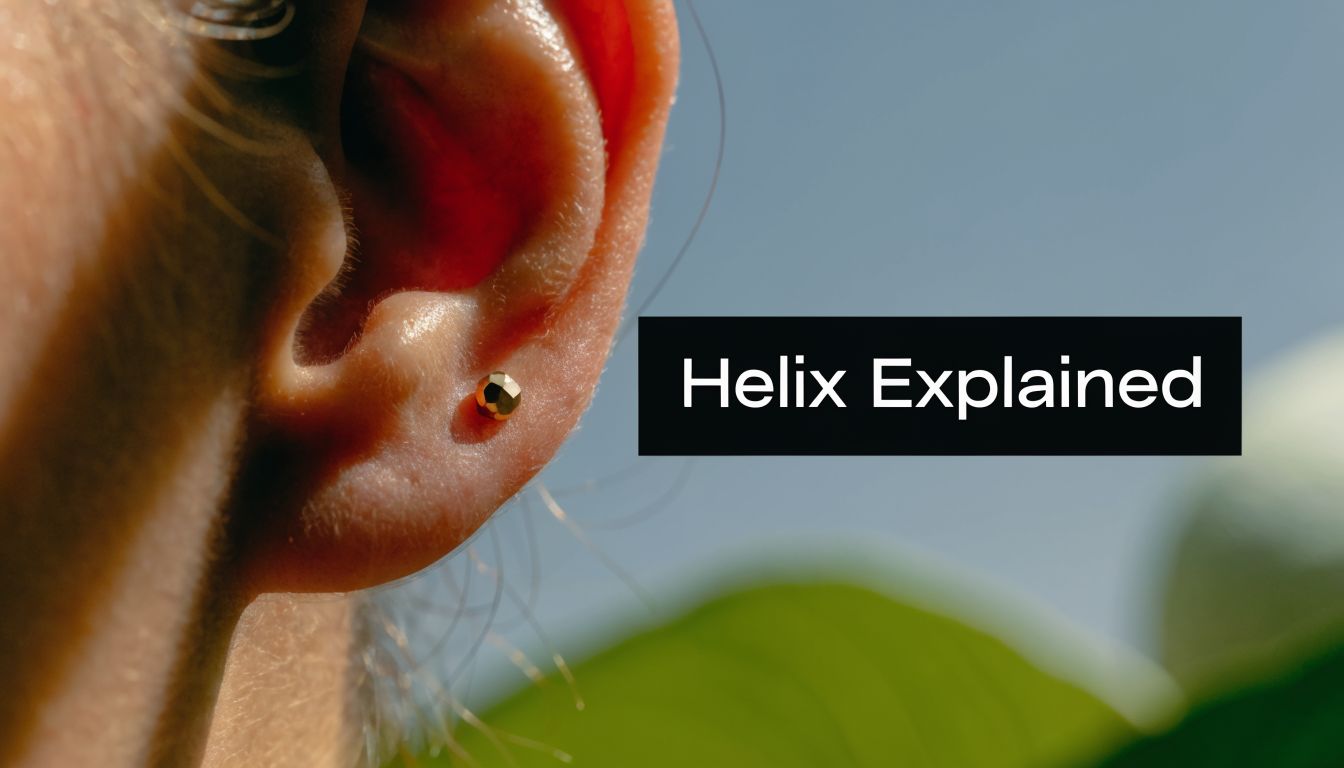
A helix piercing sits on the outer rim of the ear cartilage. If you trace your finger around the curved upper edge of your ear, that ridge is the helix. It’s different from the soft lobe because cartilage is firmer and less forgiving, which is why jewellery choice and aftercare matter so much more here.
A stud helix piercing means that the piercing is fitted with a stud, usually a flatback labret, rather than a ring. For a fresh piercing, that’s the standard we recommend because it stays put more easily and gives the area a calmer environment to settle.
Helix piercings have become much more common. Ear cartilage piercings account for six of the top ten piercings performed, and some cartilage placements have tripled in popularity over four years, according to 2019 piercing statistics published by Infinite Body. That growth is easy to understand. A helix looks neat, works well on its own, and stacks beautifully with lobes or other ear piercings.
Where people get confused
Clients often use “helix” to describe any upper-ear piercing, but there are a few different placements:
- Standard helix sits on the outer upper rim.
- Forward helix sits further forward, near where the ear meets the side of the head.
- Flat sits on the flatter cartilage area inside the upper ear, not on the rim.
That distinction matters when you’re booking. If you show up saying “I want a helix” but you mean a forward helix, the jewellery and angle may be different.
A good way to think about it is this. The helix is the ear’s outer frame. The forward helix is the front corner of that frame.
Why the word “stud” matters
Some people think “helix piercing” and “stud helix piercing” mean the same thing. They don’t. The placement is the helix. The stud describes the jewellery style used in it.
That sounds like a small detail, but it changes how the piercing behaves. A fresh cartilage piercing needs stability. A well-fitted stud gives you that. It’s less about fashion in the first weeks and more about giving your body the best chance to heal cleanly.
Why a Stud is Best for Your First Helix Piercing
You book your helix, pick a lovely ring online, and then hear your piercer say, “Start with a stud.” For a lot of first-time clients in Croydon and Bournemouth, that is the moment the questions start.
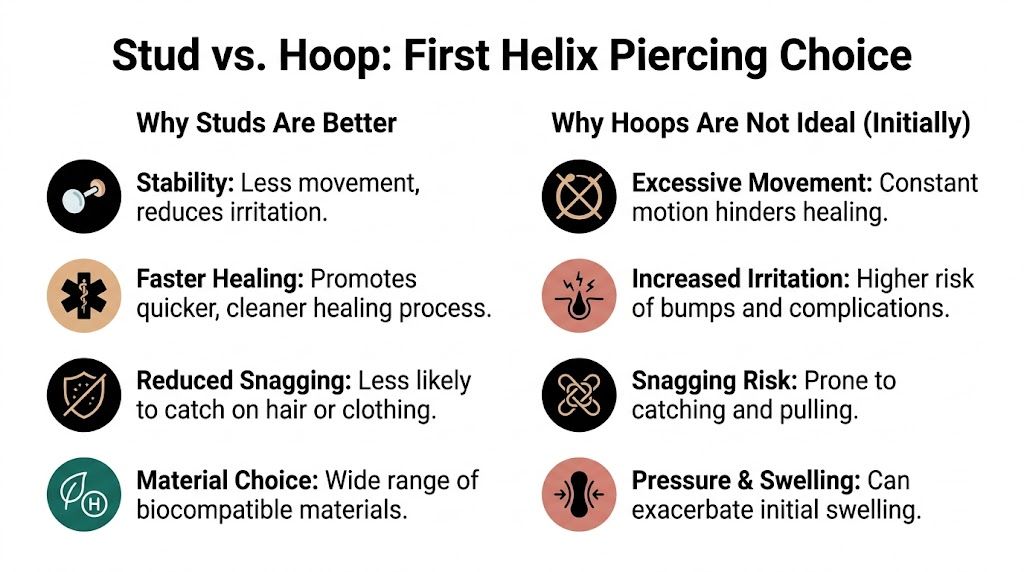
The short answer is simple. A fresh helix heals more calmly with jewellery that stays put. A hoop moves every time you brush your hair back, pull on a jumper, use over-ear headphones, or roll onto that side in your sleep. A flatback labret stud keeps the area steadier while the piercing settles.
What a fresh helix needs
A new helix heals best when it is protected from repeated movement.
Cartilage is less forgiving than a lobe piercing. If the jewellery twists, swings, or gets knocked several times a day, the channel can become irritated and stay sore for longer. That is why experienced piercers usually start with a stud rather than a ring.
In day-to-day life, that added stability makes a real difference:
- Hair brushing usually causes less pulling with a stud.
- Jumpers, scarves, and hoodies are less likely to snag.
- Sleep pressure is easier to manage when the jewellery sits close to the ear.
- Cleaning is more straightforward because the jewellery is not constantly rotating.
That matters even more in everyday UK weather. In Bournemouth, sea air, sweat, and sunscreen can all add extra irritation if the piercing is already being disturbed. In Croydon, commuters often find that collars, hair, and headphones create enough friction on their own without adding a moving hoop to the mix.
Stud vs hoop at a glance
| Factor | Labret Stud (Recommended) | Hoop / Ring (Not Recommended) |
|---|---|---|
| Movement | Stays more stable | Moves and rotates more |
| Early healing | Supports a calmer healing environment | Can disturb the channel repeatedly |
| Snagging | Lower risk with a flatback | Catches more easily on hair and fabric |
| Pressure | Sits neatly against the ear | Curved shape can create awkward pressure |
| Cleaning | Easier to keep consistent | Harder if the ring keeps shifting |
| Styling | More limited at first | Looks decorative earlier, but healing is tougher |
Why piercers start with labret studs
For first jewellery, a flatback labret gives the piercing a controlled, practical start. The back sits flat against the head instead of pressing in like a butterfly-back earring, which is one reason proper piercing jewellery feels very different from high street ear studs.
A butterfly back also traps more debris and gives swelling less room. In cartilage, that can turn a manageable piercing into an irritated one very quickly.
If you have been browsing options already, it helps to compare them with a proper guide to UK body jewellery for cartilage piercings before buying anything for a healing helix.
Practical rule: Start with the jewellery that gives your piercing the best chance to heal neatly.
But I really want a hoop
That is completely normal. Plenty of clients come into Timebomb with inspiration photos showing a slim ring in the helix, and it can look brilliant once the piercing is ready for it.
The timing is the part that matters.
Wearing a hoop too early asks a healing piercing to cope with constant motion. It is similar to trying to keep a scab intact on a bendy part of the body while brushing against it all day. Some people do get through it, but the healing is often bumpier, slower, and more frustrating than it needed to be.
Start with a stud. Once the piercing has healed well and your piercer has checked the angle, spacing, and condition of the tissue, you can usually change to a hoop safely and get the look you wanted in the first place.
Choosing Your Implant-Grade Jewellery
A fresh helix can look small from the outside, but your body treats it like a precise little wound in firm cartilage. The jewellery you start with becomes the frame that healing tissue builds around, so the right choice helps the piercing settle neatly instead of fighting it.
For that reason, we fit fresh helix piercings with jewellery made for body piercing, not standard earrings. The usual starting point is implant-grade titanium, often listed as ASTM F-136, or solid gold that is suitable for fresh piercings. For thickness, 16g is a common starting size for a helix. For length, your piercer chooses a post with enough room for early swelling without leaving it so long that it snags every time you brush your hair or pull on a jumper.
What those terms actually mean
The wording can sound technical at first, so here is the plain-English version.
- Implant-grade titanium is a body-safe metal chosen because it is stable and widely tolerated.
- 16g refers to the thickness of the post, not the size of the decorative end.
- Post length is the distance from the flat back to the front attachment.
- Flatback labret means the back of the jewellery sits flat against the head, which is much more suitable for a healing helix than a traditional earring back.
The post works like the scaffold around wet plaster. If the scaffold is poor quality or the wrong size, the shape sets badly. If it is well chosen, the tissue has a steadier path to heal around.
Why fit matters so much
Material gets a lot of attention, but fit causes just as many problems.
A post that is too short can squeeze swollen cartilage and make the area feel hot, tight, or buried. A post that is too long has the opposite problem. It moves more, catches more, and can tilt the angle of the piercing while it is still trying to settle. In Croydon and Bournemouth, we see this often with jewellery bought online because the measurements sounded right on paper but did not match the client’s anatomy in real life.
That is why a fresh helix may look slightly longer than you expected during the first few weeks. That extra room is often deliberate. Later, once swelling has gone down and the piercing is calmer, your piercer can assess whether it is time for a shorter post.
What to avoid
A healing helix does best with simple, well-made jewellery. These are the common problems we warn first-time clients about at Timebomb:
- Unclear metal descriptions. If a seller cannot tell you exactly what the jewellery is made from, leave it out of a fresh piercing.
- Plated jewellery. Surface coatings can wear away and expose the base metal underneath.
- Butterfly-back earrings. They are made for standard lobe wear, not a healing cartilage piercing.
- Very thin fashion studs. They can be unstable in cartilage and are often sold without useful sizing information.
If you want to get familiar with the names and styles before your appointment, browse these UK body jewellery options for cartilage piercings. It helps many first-time clients ask better questions when they come into the studio.
South Coast weather can play a part too. In Bournemouth, warm days, sea air, sun cream, and sweat can all make a fresh piercing feel more irritated if jewellery is already too tight or poorly fitted. In Croydon, the issue is often friction from hair, scarves, headphones, and commuting. Different routines, same rule. Start with jewellery that gives the piercing space, stability, and a clean surface to heal around.
Your Piercing Appointment at Timebomb Tattoo & Piercing
Most first-time clients expect the piercing itself to be the hardest part. In reality, the unknown is usually what makes people nervous.
At Timebomb, the appointment is straightforward and calm. You come in, talk through placement, choose suitable jewellery, and get marked up before anything happens. You’ll know where the stud is going and what it will look like before the needle comes anywhere near your ear.

What happens when you arrive
The first part is a consultation. During this, we inquire about your desired aesthetic, examine your ear shape, and discuss what will heal well. Some ears suit a certain spot beautifully. Others need a slight adjustment so the jewellery sits better and avoids unnecessary pressure.
If you’re still deciding where on the rim you want it, it’s worth looking at a guide on where to get a helix piercing before your visit so you can describe the placement more clearly.
The actual piercing process
Once placement is agreed, the ear is cleaned and marked. You’ll get to check the mark in a mirror. If you want it slightly higher, lower, or further back, that’s the moment to say so.
Then the piercer sets up sterile equipment and opens a single-use needle. The jewellery is prepared, and the piercing is carried out in one smooth motion. It is described as a quick sharp pinch followed by warmth and pressure.
After that, the stud is inserted and checked. The whole piercing part is fast. The preparation takes longer than the actual moment of piercing.
What you leave with
Before you go, you’ll get aftercare instructions specific to your piercing. That includes cleaning advice, what to avoid, and when to come back if the post needs checking or downsizing.
A good appointment should feel organised, not rushed. You should walk out knowing:
- What jewellery you’re wearing
- How to clean it
- What swelling is normal
- When to contact the studio
- When not to change it yourself
That last one matters. A fresh helix can look settled before it’s healed.
Helix Piercing Pain Healing and Aftercare Guide
Helix pain is generally manageable. The bigger challenge isn’t the few seconds of piercing. It’s the patience required afterwards.
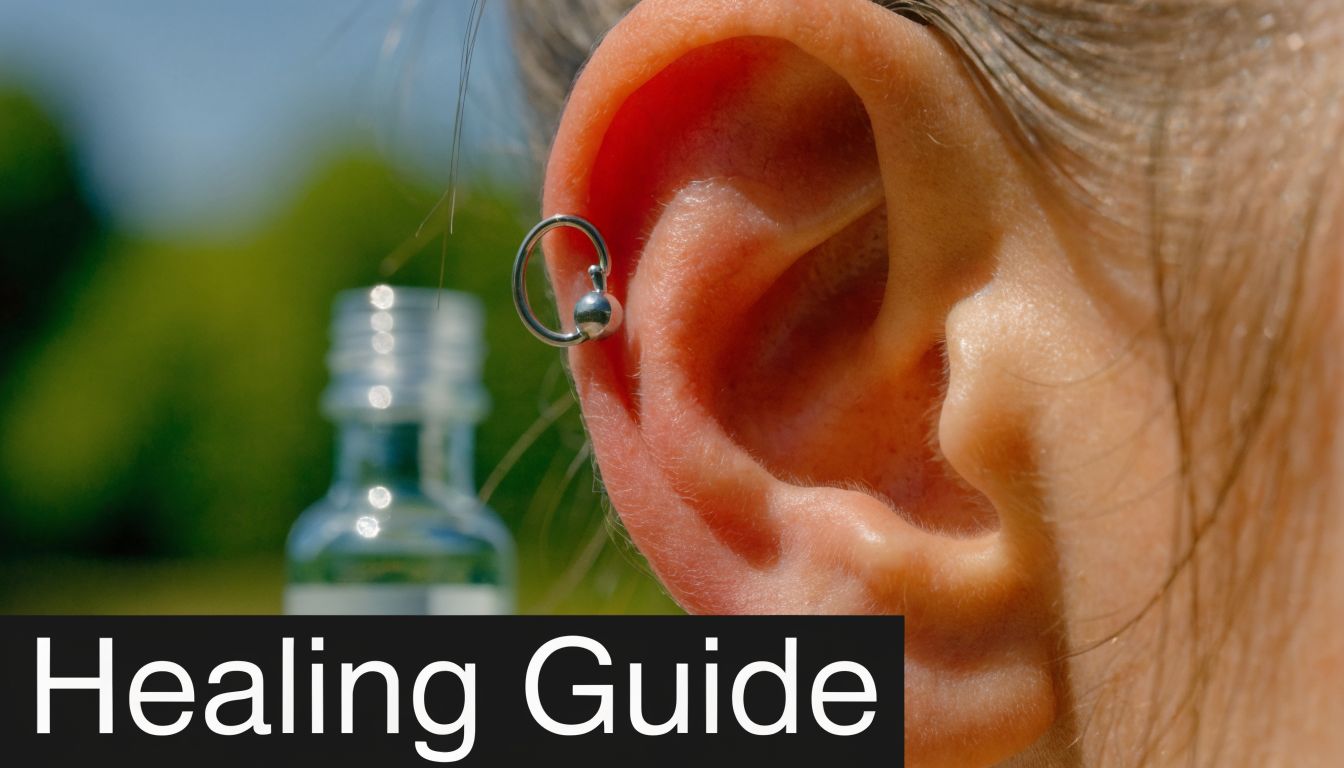
Clinical guidance indicates that helix piercings need 3-6 months for initial healing, and many piercers advise 6-9 months for full recovery, with diligent aftercare including twice-daily cleansing with sterile saline solution, as summarised in Cosmopolitan’s clinical helix piercing guidance. In plain terms, your ear may look decent well before the inside is ready.
What pain feels like
Most clients say the piercing itself is short and sharp. Afterwards, the ear often feels hot, a bit throbbing, and slightly swollen. That’s expected.
What catches people off guard is how tender a helix can be if it gets knocked. A bump from a hairbrush can hurt far more than the piercing did.
A simple healing timeline
Here’s the practical version of what usually happens.
Early stage
The first weeks are the “leave it alone” stage. You may notice redness, warmth, mild swelling, and some dried discharge. The jewellery can feel more obvious than you expected, especially when washing your hair or getting dressed.
Your piercer may fit a slightly longer post at first to allow for swelling. Don’t panic if it feels roomier than a normal earring.
Middle stage
At this point, people get overconfident. The piercing often feels calmer, but it can still be fragile. If you start twisting it, sleeping on it, or swapping jewellery too early, irritation bumps often show up here.
This is also when consistent cleaning matters most. If you need a suitable product, use a proper saline spray for piercing aftercare rather than homemade mixes or random antiseptics.
Late stage
At this point, the piercing usually looks settled from the outside. Even so, cartilage can still be finishing off internally. If it still hurts when pressed, crusts often, or flares up after minor knocks, it probably isn’t ready for a jewellery change yet.
Daily aftercare that actually helps
Keep it simple. Over-cleaning causes almost as many problems as under-cleaning.
- Wash your hands first. If your hands aren’t clean, don’t touch the piercing.
- Clean twice daily with sterile saline. A gentle spray is enough.
- Let warm water run over it in the shower. That helps soften build-up.
- Dry it carefully. Don’t leave the area damp.
- Keep hair, headphones, hats, and phone pressure to a minimum.
Don’t twist the jewellery to “stop it sticking”. That old advice causes needless trauma in cartilage.
What to avoid
- Sleeping on that side
- Alcohol or hydrogen peroxide
- Changing the stud yourself
- Picking off crust
- Butterfly-back earrings
- Swimming if the piercing is still angry
Bournemouth and South Coast aftercare
UK-specific advice matters.
In Bournemouth especially, moisture can linger around the ear after showers, sea air, exercise, or damp weather. That doesn’t mean your helix can’t heal well. It means you need to be more deliberate about drying it gently and not trapping moisture behind the ear with wet hair.
When to get a follow-up
Book back in if the piercing becomes increasingly sore, swollen, or keeps flaring after the first settling period. If something feels off, don’t wait and hope. Cartilage usually rewards quick, sensible adjustments.
Book Your Stud Helix Piercing in Croydon or Bournemouth
A good stud helix piercing starts long before the needle. It starts with choosing a studio that uses safe jewellery, sterile technique, and clear aftercare.
That matters because aftercare and jewellery quality change outcomes. Sterile saline, clean hands and a well-fitted implant-grade flat-back stud give a helix the best chance of healing without problems, as the helix size and healing guide at Crystal Heaven Jewellery.
If you’re ready to book, contact Timebomb Tattoo & Piercing directly:
- Phone: 01202 900050 (Bournemouth) / 020 8686 7730 (Croydon)
- WhatsApp: 07752 913846 (Bournemouth) / 07902 490584 (Croydon)
If you’re choosing between the two studios, the best option is usually the one that makes your follow-up easiest. Cartilage piercings sometimes need a check-in, so convenience helps.
Why clients book with confidence
- Single-use sterile needles
- Implant-grade jewellery for fresh piercings
- Experienced piercers
- Clear, personalised aftercare
- Stud-first approach for safer healing
If you’re unsure whether your ear anatomy suits the exact placement you want, message first. It’s much better to ask questions before the appointment than to guess.
Frequently Asked Questions About Helix Piercings
How do I stop myself sleeping on it
The simplest fix is a travel pillow or doughnut pillow. Your ear sits in the middle gap, so the cartilage is not being pressed all night.
If you know you roll onto that side in your sleep, tie long hair back and keep your pillowcase smooth and clean to reduce snagging. If the area starts looking swollen or sore after a few nights, ask your piercer to check the fit of the stud. That is especially helpful if you are travelling between Croydon and the South Coast, where long car journeys and awkward sleep can irritate a fresh helix more than people expect.
When can I change my stud to a hoop
Wait until the piercing is fully healed and stable, then have a piercer assess it in person. A helix can look settled on the outside while the inside is still delicate, a bit like paint that feels dry on top but marks easily underneath.
If you switch too soon, the curve of a hoop can add movement and pressure. That is one of the quickest ways to turn a calm piercing into an irritated one.
What if I get a bump
Leave it alone. Do not squeeze it, do not put tea tree oil on it, and do not change the jewellery yourself.
A bump usually means the piercing is being irritated, often by pressure, moisture, sleeping on it, or catching it with hair or clothing. The right next step is to book a check with a professional piercer at Timebomb in Croydon or Bournemouth, so they can look at the angle, jewellery fit, and healing pattern. In coastal areas like Bournemouth, damp air and sweat can also keep the area irritated if the ear stays moist for too long.
Is redness always a sign of infection
No. Mild redness can be part of normal healing, especially after the ear has been knocked or slept on.
What matters is the pattern. If the redness keeps increasing, the area feels hotter, pain is getting worse instead of better, or you notice unusual discharge, get it checked promptly.
Can I wear headphones
Yes, but be careful with anything that presses on the helix. Over-ear headphones can trap heat and push the stud into the cartilage, while some on-ear styles rub the area every time you move.
If you need to wear them for work, calls, or commuting, keep sessions short and check that nothing is pressing directly on the piercing. Many first-time clients find one earbud on the opposite side is the easier option during early healing.
How do I know it’s fully healed
A healed helix feels quiet. It is comfortable, stable, and does not keep producing crust, soreness, or flare-ups after light contact.
If you are still wondering whether it is ready, that usually means it is worth getting checked before changing jewellery. A quick in-person assessment is much safer than guessing at home.
If you’re looking for a safe place to start, Piercing Near Me helps you find trusted piercing information and connect with professional studios, including Timebomb Tattoo & Piercing in Croydon and Bournemouth. It’s a simple way to compare options, learn what good practice looks like, and book your stud helix piercing with confidence.