
You're probably doing what nearly everyone does before booking an eyebrow piercing. Standing in front of the mirror, lifting your brow slightly, tilting your head, and trying to work out where that little flash of jewellery would look best. Maybe you've saved a few photos. Maybe you already know you like the classic look. Maybe you're torn between subtle and bold.
That instinct is completely normal. Style matters. But with eyebrow piercing placement, the safest and most flattering result doesn't start with “Which look do I want?” It starts with “What will my anatomy support well?”
A good piercer doesn't just copy a photo onto your face. They look at your brow shape, the tissue available, your symmetry, how much movement there is in the area, and how the jewellery will sit once swelling settles. That's what turns a nice idea into a piercing that looks balanced and has the best chance of healing cleanly.
If you're new to facial piercings, that can feel a bit disappointing at first. People sometimes worry that “anatomy-led” means less choice. In practice, it usually means better choices. You're not being told no for the sake of it. You're being guided towards a placement that suits your face and is less likely to become irritated, crooked-looking, or unstable.
Your First Step to the Perfect Eyebrow Piercing
A client once described the decision perfectly. She said, “I know the look I want, but I don't know where it should go.” That's the point where a piercing appointment becomes useful. The mirror gives you inspiration. A trained piercer gives you a plan.
Placement is often initially considered mainly in terms of left side or right side, closer to the centre or closer to the tail. Those are real style choices, but they come after the safety choices. The first question is whether the brow has enough suitable tissue to hold jewellery in a stable way.
What people often get wrong
The biggest misunderstanding is assuming the eyebrow itself is what gets pierced. It isn't really about the hair. It's about the tissue beneath and around the brow line.
Another common mistake is choosing placement based only on a favourite photo. A placement that looks clean on one person can sit awkwardly on someone else if their brow ridge is flatter, more mobile, or less pronounced. Faces aren't templates.
A successful eyebrow piercing should look intentional on your face, not identical to someone else's.
What a good placement should do
A well-chosen placement usually does three things at once:
- Suit your features by following the natural line of your brow and eye area
- Protect healing by sitting in tissue that can support the jewellery
- Age well visually so it still looks balanced after the initial swelling has gone down
That's why the perfect placement isn't always the one you first imagined. It's the one that looks right, heals sensibly, and works with your anatomy rather than against it.
Why Anatomy Is the Most Important Factor
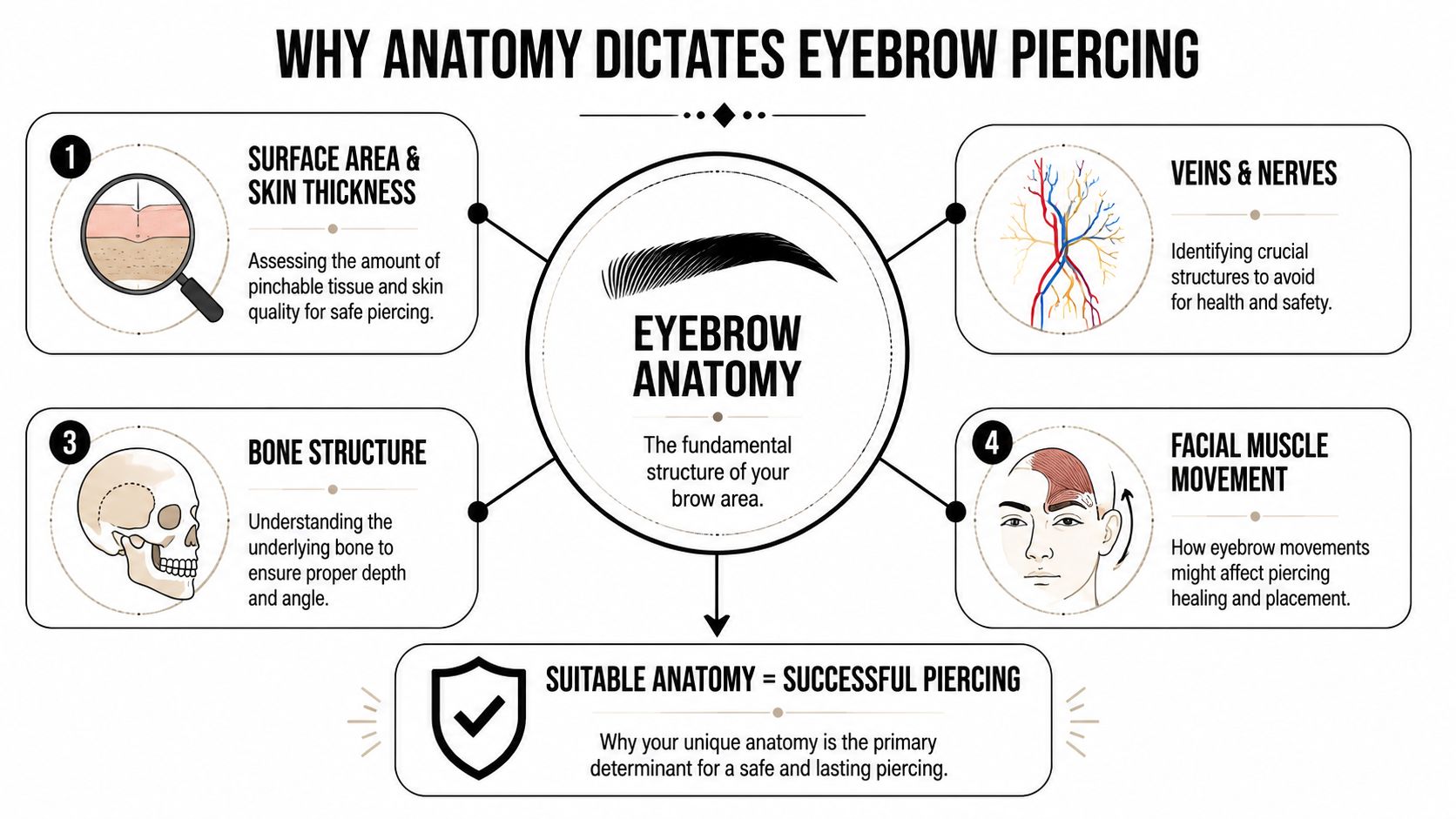
Most online inspiration treats eyebrow piercing placement like picking eyeliner. Just choose a look and go for it. In reality, expert guidance says placement is highly dependent on tissue shape, with the standard spot usually toward the outer third, and the real question is whether your brow has enough protruding tissue to hold jewellery safely. That's something a professional piercer needs to assess in person, as noted in Urban Body Jewelry's guide to choosing eyebrow piercing placement.
Think of the brow like a ridge
The easiest way to picture it is to think of the eyebrow area like a small ridge. Some brows have a clear raised area with enough soft, pinchable tissue. Others are flatter. Some taper sharply near the tail. Some have lovely shape visually but very little tissue that can safely hold jewellery.
A piercer is looking for a “just right” area. Not too shallow. Not too flat. Not so tight that the jewellery sits under pressure.
If that sounds picky, it should. Facial piercings deserve that level of care.
What your piercer is checking
During a consultation, a piercer usually evaluates several things at once:
- Tissue support. Is there enough stable tissue for the entry and exit points?
- Brow shape. Does the natural arch create a better visual and structural placement?
- Movement. Does that part of your face crease or shift a lot when you talk and emote?
- Balance. Will the jewellery line up well with your eye, brow tail, and facial symmetry?
This is why one person can wear a beautiful outer-brow piercing while another is better suited to a different angle, a different side, or sometimes a different piercing altogether.
Why “just copy this photo” doesn't work
People get confused because eyebrows look similar from a distance. Up close, they vary a lot. Hair pattern, muscle movement, skin tension, brow prominence, and tissue depth all change the outcome.
Practical rule: If a placement only works when you force your expression in the mirror, it probably isn't your natural best placement.
A strong consultation should feel collaborative. You can absolutely bring reference images. Just be ready for your piercer to translate the vibe rather than duplicate the exact map.
A Visual Guide to Eyebrow Piercing Placements
The modern eyebrow piercing entered piercing culture in the 1970s through punk, then the classic vertical style was widely re-popularised in the 1990s through fashion and celebrity influence. Contemporary guidance also notes that standard eyebrow piercings are typically done at 16 gauge (1.2 mm), with some piercers using 14 or 12 gauge depending on anatomy and jewellery choice, as described in Urban Body Jewelry's overview of eyebrow piercing history and sizing.
Vertical eyebrow piercing
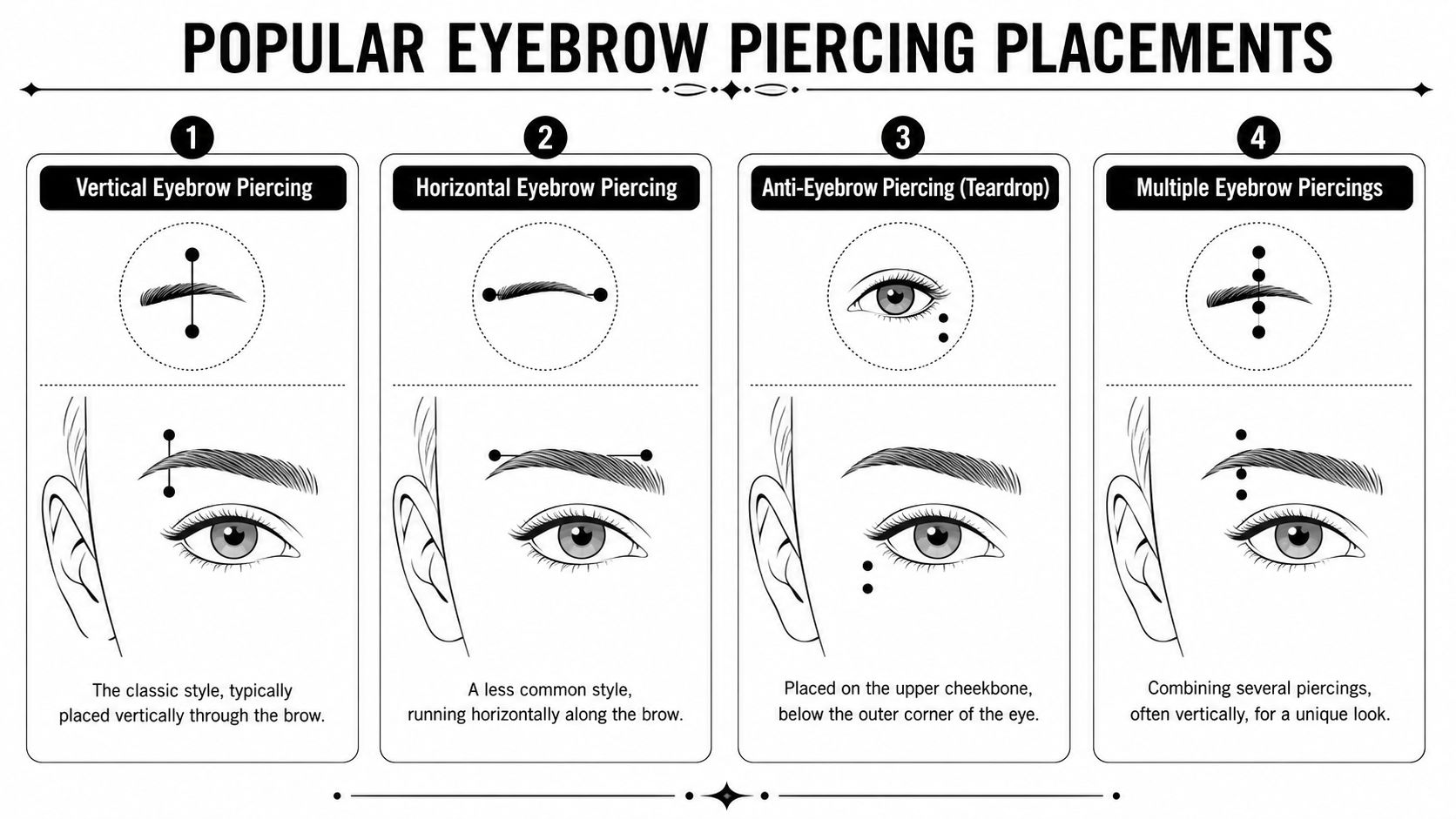
This is the look primarily associated with the term “eyebrow piercing”. It usually sits vertically through the brow area, often around the arch or outer third. Visually, it catches the curve of the brow nicely and tends to look balanced on a wide range of faces.
For many clients, this is the cleanest starting point because it reads immediately as an eyebrow piercing without overpowering the eye area. It can feel edgy or refined depending on the jewellery end you choose.
Horizontal eyebrow piercing
A horizontal placement runs along the brow line rather than crossing it vertically. The effect is more unusual and more graphic. It can look striking, especially on clients with strong brow shape and the right tissue.
It's not automatically the better choice just because it looks distinctive in photos. The area still has to support the jewellery well, and that decision is always anatomy-led.
Multiple eyebrow piercings
Some clients love a stacked or curated look. Multiple placements can be beautiful, but they need planning. A face can easily look cluttered if the spacing is off or if the piercings compete with each other rather than working together.
A good design takes into account:
- Spacing so each piece has room to sit cleanly
- Flow so the placements follow the brow and eye line
- Healing practicality because more jewellery means more chances to snag or irritate the area
Anti-eyebrow and related looks
This one causes confusion all the time. An anti-eyebrow is not placed in the eyebrow itself. It sits below the outer eye area on the upper cheekbone. People often group it with eyebrow styles because it creates a similar visual accent on the face.
That doesn't mean it's interchangeable with a standard brow piercing. It's a different placement with different anatomy considerations and different jewellery needs.
Eyebrow Piercing Placement Comparison
| Placement Style | Visual Effect | Best For | Typical Jewellery |
|---|---|---|---|
| Vertical eyebrow | Classic, balanced, frames the arch | Clients with suitable tissue near the arch or outer brow | Curved barbell |
| Horizontal eyebrow | More unusual, sleek, directional | Clients whose anatomy supports a stable horizontal sit | Surface-style jewellery chosen by the piercer |
| Multiple eyebrow piercings | Layered, styled, statement look | Clients with enough space and anatomy for more than one placement | Usually coordinated barbells |
| Anti-eyebrow | Accent below the outer eye, separate from the brow | Clients better suited to cheekbone placement than brow tissue | Surface bar |
The best-looking placement is usually the one that makes your features look more balanced, not the one that is most dramatic on paper.
How Jewellery Choice Impacts Your Piercing
Jewellery isn't the finishing touch. It's part of the piercing design from the start. If the wrong jewellery goes into the right placement, healing can still become awkward.
Shape matters as much as style
For a standard vertical eyebrow piercing, a curved barbell is commonly the most suitable starting jewellery. That curve follows the shape of the tissue more naturally than a straight piece would. The result is less awkward pressure on the channel while the piercing settles.
For more specialised placements, your piercer may recommend other options that better suit the angle and anatomy. This is one reason consultations matter so much. Jewellery should support the placement, not fight it.
Why initial jewellery often looks a little longer
People sometimes worry that the bar looks too long on day one. Usually, there's a reason. Fresh piercings need room for early swelling. Starting too snug can create pressure and make a new piercing far more uncomfortable.
Later, once the piercing has calmed and your piercer is happy with healing, you may be advised to downsize. That shorter fit often looks neater and moves less in daily life.
Material makes a difference
High-quality materials matter most when a piercing is fresh and reactive. If your skin is already dealing with a new wound, it doesn't need extra irritation from poor-quality metal.
If you want to understand why so many experienced piercers favour titanium for fresh piercings, this guide to titanium piercing jewellery is a helpful starting point.
A few sensible questions to ask your piercer:
- What material is this starter jewellery made from?
- Why have you chosen this shape for my placement?
- Will I need a downsize appointment later?
Jewellery should fit your anatomy first. Decorative details come second.
The Piercing Process Pain Healing and Aftercare
Eyebrow piercing is treated as a surface piercing, which means it's more prone to rejection than a traditional through-and-through piercing. Practical guidance recommends placement around the arch or just beyond it into the tail, where there's enough tissue to support it, and the full healing timeline is commonly 3 to 6 months, according to Lynn Loheide's eyebrow piercing guidance.
What the appointment feels like
The appointment itself is usually calm and straightforward. First comes the assessment and marking. Your piercer checks the tissue, maps the angle, and lets you see the proposed placement before anything happens.
The piercing moment is brief. Most clients describe it as a sharp pinch followed by pressure. Then the jewellery goes in, the area is cleaned, and you'll usually be shown the result straight away.
What healing really looks like
Fresh eyebrow piercings can be a little misleading because they may look decent before they're fully healed. That doesn't mean the channel is mature or stable yet.
During healing, it's normal to be mindful of the area in ways you don't expect at first. Washing your face, pulling on jumpers, drying with a towel, sleeping on one side, taking off a hoodie, brushing your fringe back. All of those little moments matter.
Daily habits that make the biggest difference
Lifestyle has a real effect on this piercing. Snagging and repeated movement can increase irritation and make the piercing harder to settle.
Common trouble spots include:
- Sleep position if you tend to press that side of your face into the pillow
- Face washing when flannels, cotton pads, or quick movements catch the jewellery
- Makeup and skincare if products sit too close to the piercing
- Exercise and work routines if sweat, helmets, visors, towels, or uniform changes create repeated friction
If your piercer recommends a sterile saline product, use it as directed and keep the routine simple. This overview of saline spray for piercing care can help you understand why less handling is usually better.
Healing goes more smoothly when your routine is boring. Clean hands, gentle cleaning, and no fiddling.
When to check back in
If the jewellery starts catching constantly, the area stays irritated, or the placement seems to be changing, go back to your piercer sooner rather than later. Small issues are much easier to assess in person than through guesswork at home.
Your Consultation Checklist Booking with Confidence
A consultation shouldn't feel like a sales conversation. It should feel like a proper safety check and design session. You bring your ideas. The piercer brings anatomy knowledge, placement judgment, and practical advice about healing.
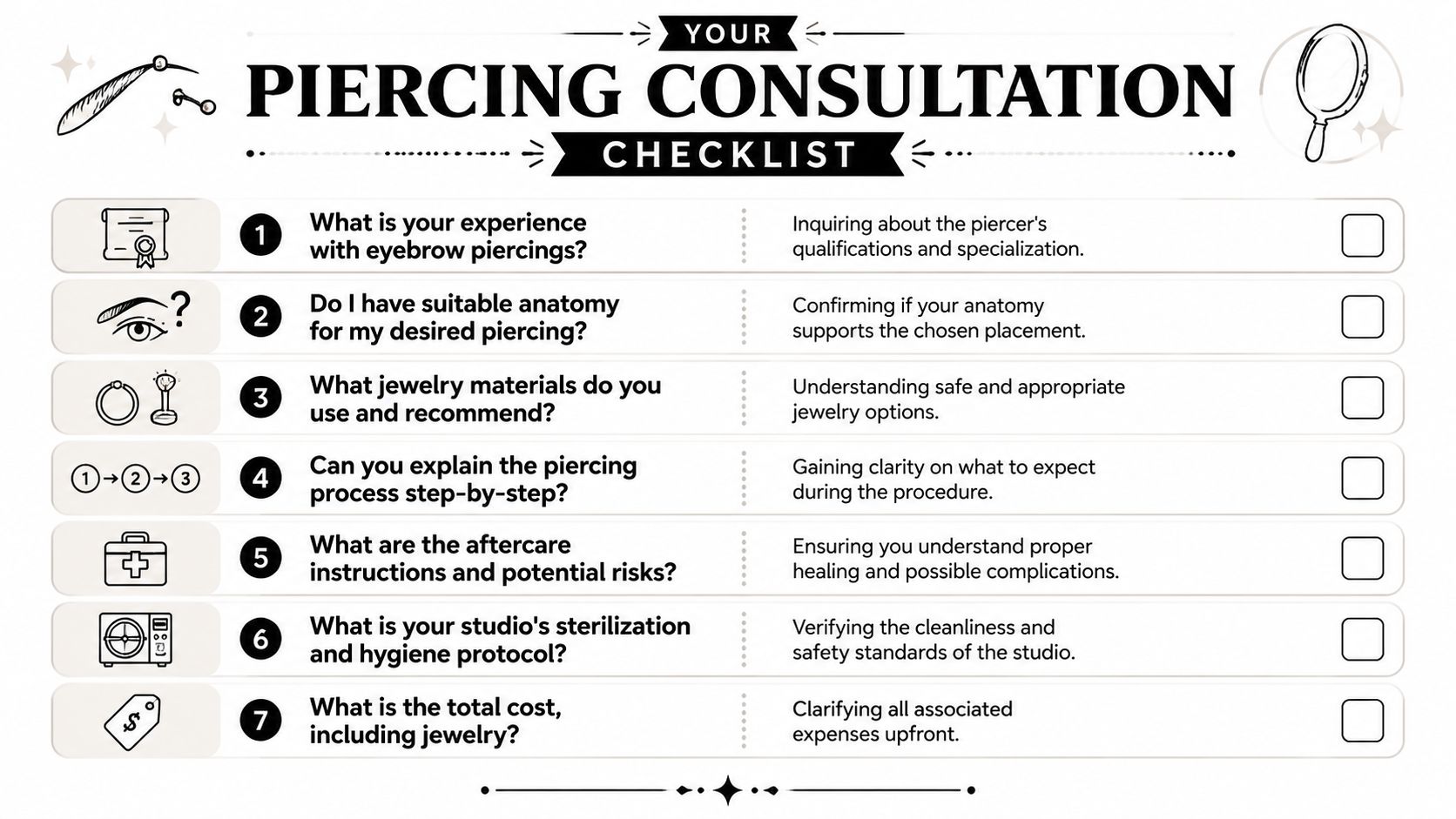
A lot of hesitation disappears once clients realise they're allowed to ask direct questions. In fact, you should. Eyebrow piercings are especially worth discussing in detail because daily habits can affect healing. Guidance for clients often highlights snagging during face-washing, sleep, or makeup application, along with practical concerns such as whether your job will interfere or how to avoid makeup contamination, as discussed in this video guidance on eyebrow piercing healing and lifestyle.
Questions worth asking in the studio
Bring your inspiration, but also bring these questions:
- Am I suitable for the placement I want? Ask your piercer to explain why a spot does or doesn't suit your anatomy.
- What jewellery will you start with? You want to know both the material and the shape.
- How will this placement fit my routine? Mention glasses, makeup, sport, helmets, beauty treatments, and how you sleep.
- What signs mean normal irritation, and what signs mean I should come back in?
- Will I need a downsize appointment? If so, roughly when should you return for a check?
Signs you're in good hands
A strong consultation usually includes marking, discussion, and honesty. A good piercer won't rush you, won't promise a placement your anatomy can't support, and won't act irritated when you ask practical questions.
Look for someone who explains the “why”, not just the “what”.
If a piercer can't explain why they chose a placement, that's a reason to pause.
Booking with confidence
If you also want a clear idea of pricing before you book, this page on how much an eyebrow piercing is can help you prepare your questions.
For bookings or consultation enquiries, call 01202 9000 50 or message WhatsApp 07752913846. If you're deciding between Croydon or Bournemouth, ask for a placement consultation first and take your reference photos with you.
Frequently Asked Questions About Eyebrow Piercings
Can I get an eyebrow piercing if I wear glasses
Usually, yes. The key issue is whether your frames press near the chosen placement or catch during removal. Bring your everyday glasses or sunglasses to the consultation so your piercer can check properly.
How soon can I wax or thread my brows
Avoid brow treatments near a fresh piercing until your piercer is happy that it's fully healed. During healing, waxing, threading, and close tweezing can irritate the area or introduce contamination.
What's the difference between irritation infection and rejection
Irritation often follows friction, snagging, pressure, or product contact. The area may look angry but the cause is usually mechanical. Infection needs proper medical assessment. Rejection means the body is no longer tolerating the piercing well and the jewellery may start sitting more shallowly over time. If you're unsure, don't self-diagnose. See your piercer promptly, and seek medical advice when appropriate.
Can I wear makeup with a new eyebrow piercing
Keep makeup away from the piercing while it heals. The closer product gets to the entry and exit points, the more likely you are to cause irritation or contamination. Once healed, apply carefully around it and remove product gently.
Which side should I choose
The side that suits your anatomy and your day-to-day life best. If you always sleep on one side, wear certain frames, or part your hair in a way that catches one brow more than the other, mention that. Placement should work with your habits, not just your mirror selfie.
If you're ready to move from inspiration to a well-planned appointment, Piercing Near Me makes it easier to find safe, professional support for your eyebrow piercing placement. For help booking in Croydon or Bournemouth, call 01202 9000 50 or message 07752913846 on WhatsApp.