
You've probably done this already. You saved a few ear photos, zoomed in on tiny studs along the lobe or helix, and thought, “I love that, but where would I even start?” That's the point where a lot of people stall. The look feels delicate and effortless online, but in real life it raises practical questions about pain, placement, healing, and whether your own ear shape will suit it.
That uncertainty is normal. Constellation ear piercings sit in the sweet spot between style and planning. They can look soft, minimal, bold, celestial, tidy, asymmetrical, or highly polished, but they only work well when the design is mapped to your anatomy and carried out safely.
From Pinterest Inspiration to Piercing Reality
A first-time client often walks in with a phone full of screenshots and one big worry. They don't want a random collection of holes. They want that curated look where each stud seems to belong, even if the arrangement is tiny and understated.
That's exactly why constellation styling appeals to so many people. It feels personal. One person might want a subtle cluster tucked around the upper lobe. Someone else might prefer a more spaced-out arrangement that travels toward the helix. The goal isn't to copy a celebrity ear exactly. The goal is to create something that fits your ear.
In the UK, that interest in multiple ear placements isn't niche. Ear piercings account for 71% of all procedures, and the highest prevalence of body piercing is among 16–24-year-old females, with rates as high as 50%, according to UK piercing prevalence research published on PMC. That helps explain why curated ears have become such a familiar reference point in studio consultations.
Why the look feels confusing at first
Online inspiration rarely shows the full journey. You see the finished jewellery, not the mapping, spacing, swelling, or healing choices behind it.
Common first-timer questions usually sound like this:
- How many piercings count as a constellation rather than just a second or third lobe?
- Can I get the full look in one go, or should I build it over time?
- Will my ear anatomy suit it, especially if I want cartilage included?
- Does it hurt more because several placements are involved?
- How long before it looks settled rather than fresh and tender?
Practical rule: Bring inspiration photos for style, not for exact copying. A good piercer uses them as a reference, then adjusts the plan to your ear.
What makes the process easier
The easiest way to calm first-time nerves is to treat the appointment like a design consultation, not a leap into the unknown. You don't need to arrive knowing every placement name. You just need a rough sense of the mood you like. Tiny stars, clean studs, mixed textures, a balanced lobe stack, or a more sculptural cartilage look all give your piercer something to work from.
Once you stop thinking of it as “I need loads of piercings right now” and start thinking “I'm building an ear that suits me,” the whole idea becomes much more manageable.
What Are Constellation Ear Piercings
A constellation piercing is a curated group of three or more piercings designed to mimic a star pattern, and the trend became widely popular around 2016, as noted in Stretch It Body Jewellery's guide to ear piercing types.
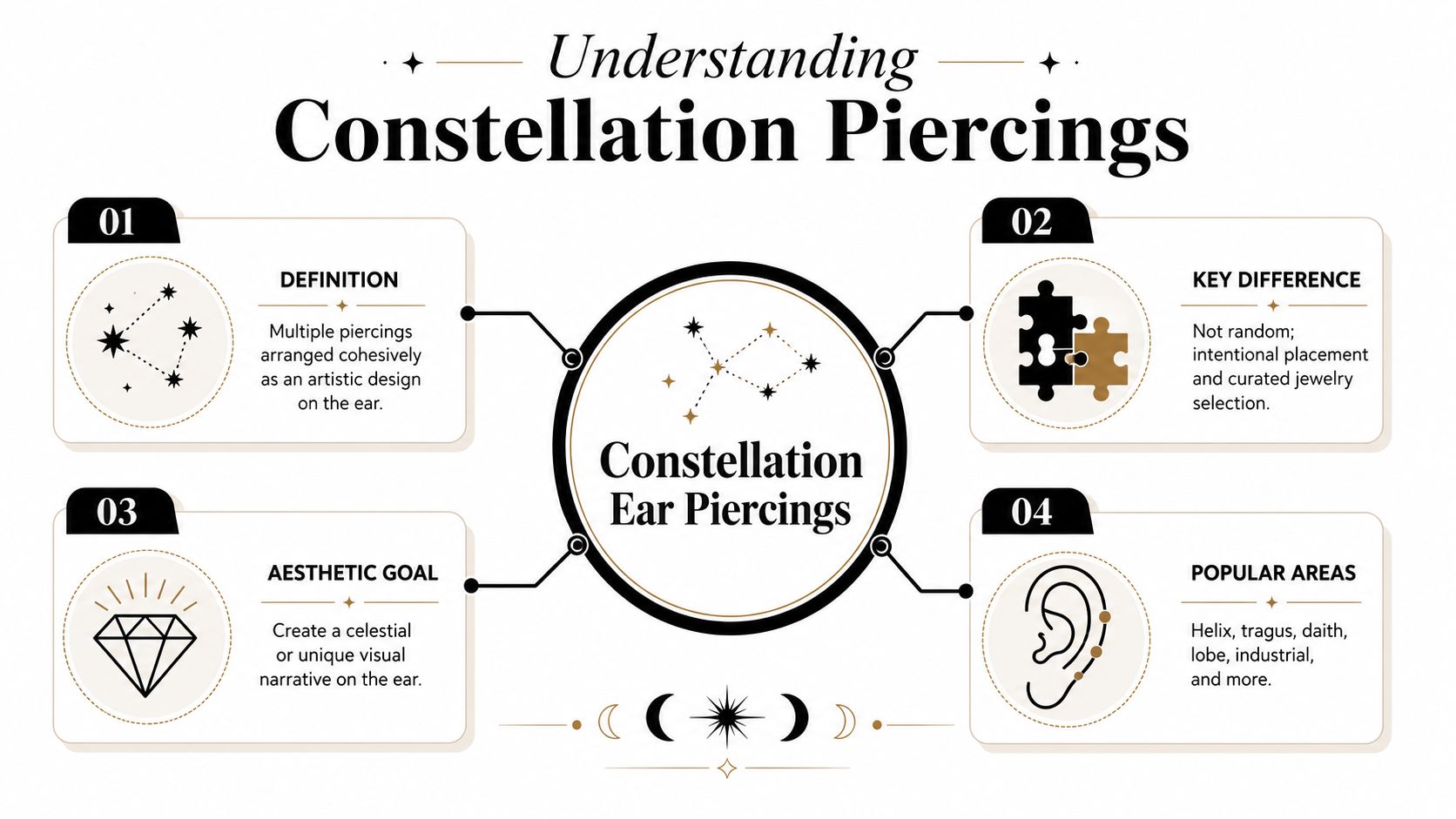
That definition matters because people often use the term for any ear with several studs. A real constellation layout isn't just “more piercings.” It's intentional placement. Each piece should relate to the others the way stars relate in a pattern. The spacing, angle, jewellery size, and visual balance all matter.
Constellation versus random stacking
A random stack can still look nice, but it usually grows by accident. A constellation is planned.
Here's the difference in a simple comparison:
| Style | How it feels visually | How it's planned |
|---|---|---|
| Multiple piercings | Added over time without a single visual idea | Individual decisions |
| Curated ear stack | Balanced and styled | Planned around jewellery and spacing |
| Constellation ear piercings | Star-like, artistic, intentionally scattered | Designed as one composition |
If you've ever seen an ear where three tiny studs on the lobe lead the eye upward to a helix piece, that's the effect. The piercings don't need to match perfectly. They need to belong together.
Where they can sit on the ear
The lobe is often the starting point, as it provides the clearest visual foundation. From there, some designs stay soft and simple, while others expand into cartilage.
Popular areas can include:
- Lobe placements for the main “star field”
- Upper lobe for a tighter cluster
- Helix for lift and height
- Tragus or conch for contrast and depth
- Daith or other cartilage features when anatomy allows
A good constellation looks natural on the ear it's built for. It shouldn't feel pasted on from someone else's photo.
The artistic part people miss
The best designs use negative space well. That means not filling every available area just because you can. Sometimes one tiny stud placed slightly off-centre creates more impact than adding several more pieces.
Jewellery choice shapes the result too. If every piece is the same size, the ear can look flat. If one stud is slightly brighter or larger, it gives the eye somewhere to land. That's why a curated constellation often feels more polished than a basic “ear party”. It has rhythm.
Designing Your Unique Ear Constellation
Before any needle comes out, the design work starts. Here, your ideas become something wearable instead of just aspirational. A strong constellation doesn't begin with “What's trending?” It begins with the shape of your ear, how you wear your hair, whether you use headphones often, and how subtle or dramatic you want the result to feel.
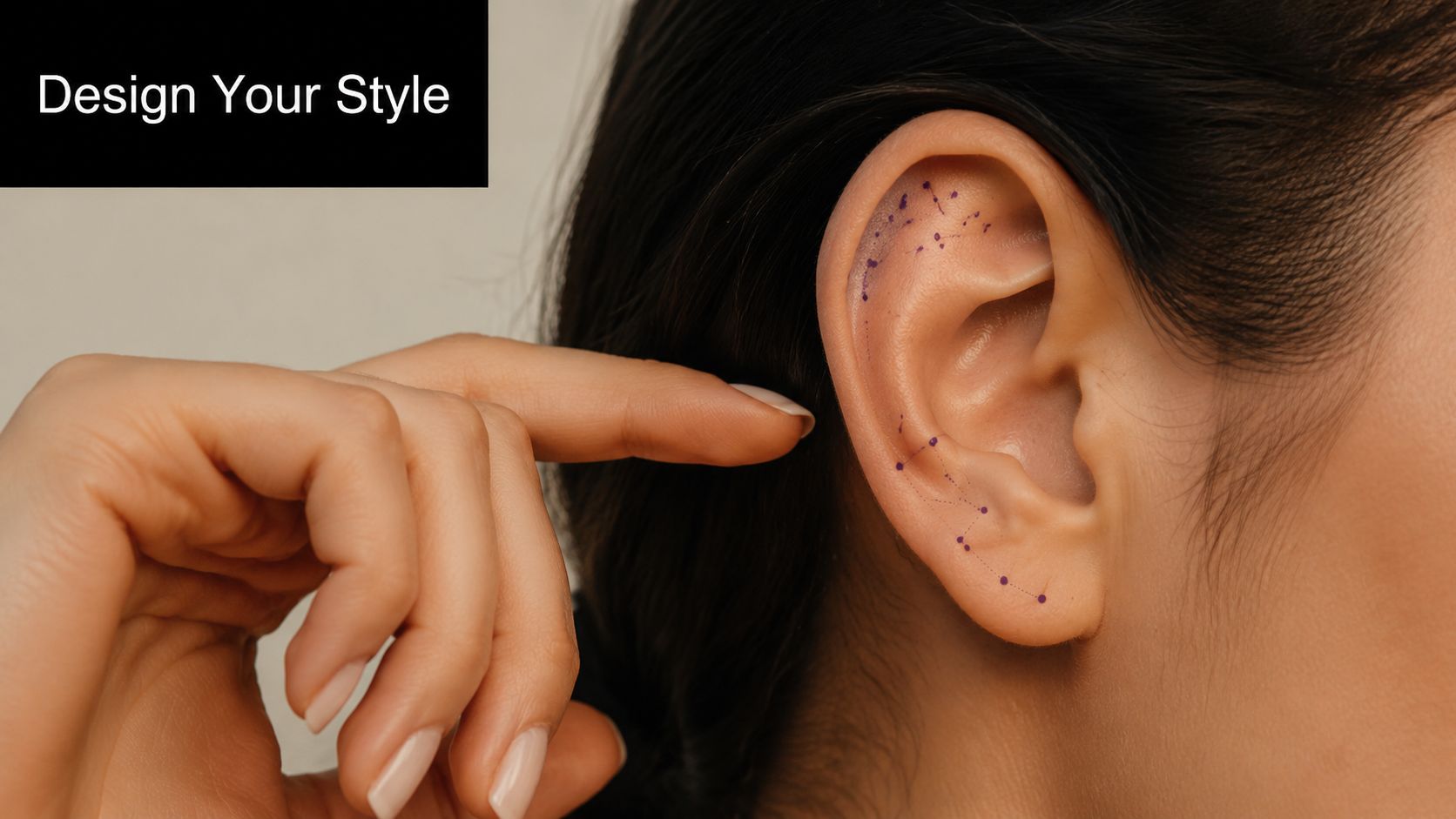
If you want to browse different layout ideas before booking, a full ear piercings guide with placement inspiration can help you work out what catches your eye.
Start with shape, not jewellery
A lot of first-timers do the reverse. They fall in love with a specific stud, then try to force a layout around it. That can work, but it's usually better to map the ear first.
A piercer will look at things like:
- Lobe space. Some ears suit a triangular cluster. Others look better with a gentle diagonal line.
- Cartilage definition. A crisp helix edge can support a lifted design, while a softer shape may suit the lobe better.
- Balance from front to side. Some piercings show best head-on, while others reveal themselves in profile.
- Lifestyle friction. Hair snagging, helmets, over-ear headphones, and sleep habits all affect the plan.
A few layout ideas that work well
Not every constellation needs to be elaborate. Some of the best ones are simple.
Soft lobe cluster
Three or more small studs grouped closely, often with one slightly higher than the others. This gives a clean star-scatter effect and stays wearable day to day.Diagonal ear line
A visual path starting at the first or second lobe and rising toward the upper lobe or helix. This can make the ear look longer and more sculpted.Mixed-focus arrangement
Tiny lobe studs paired with one feature placement such as a helix or tragus. This keeps the overall look delicate while adding structure.Asymmetrical styling
One ear carries the fuller constellation while the other stays simpler. That's useful if you want impact without both ears healing at once.
The ear doesn't need to be crowded to look curated. Placement does more work than quantity.
Choose jewellery that supports healing and style
Initial jewellery should be practical first and pretty second. Once the piercing has healed well, you can refine the look further.
When planning your style, think about:
| Jewellery choice | Effect on the overall look |
|---|---|
| Tiny matching studs | Clean, minimal, star-like |
| Graduated sizes | More movement and visual depth |
| Mixed shapes | Slightly more editorial or playful |
| A single accent piece | Gives the design a focal point |
For first placements, many people gravitate toward plain polished ends, bezel-set stones, or very small gold details. That keeps the ear from feeling too busy while it heals.
The key is collaboration. You bring the taste. The piercer brings spacing, anatomy knowledge, and restraint. That combination is what turns a mood board into an ear you'll still love long after the initial excitement wears off.
The Professional Piercing Process Explained
Walking into a professional studio for your first constellation appointment should feel organised, calm, and clear. You shouldn't feel rushed into placements you don't understand, and you shouldn't be left guessing what happens next.
The consultation usually starts with a conversation rather than a tool tray. You'll talk through your inspiration, point out any side you sleep on, mention any previous piercings, and discuss whether you want a delicate start or something more developed. Then the piercer studies the ear itself. They're looking for safe angles, enough spacing, and whether certain placements will heal happily on your anatomy.
What happens during the appointment
Most curated appointments follow a sensible flow:
Placement mapping
The piercer marks the ear with a sterile marker so you can see the design before anything is pierced.Jewellery selection
You choose suitable starter pieces that fit the plan and leave room for swelling.Sterile setup
Tools are prepared, the skin is cleaned, and everything is arranged before the first piercing begins.Piercing with a needle
A professional uses a single-use sterile needle, not a gun. That gives far more control over angle and tissue handling.Final check
The jewellery is fitted, the area is cleaned again, and you're talked through aftercare.
Why gauge and material matter
For cartilage placements often used in curated ears, professional piercers commonly use a 16 gauge (1.2mm) needle. That standard helps prevent the “cheese-cutter effect”, where jewellery can migrate through tissue if it's too thin. Starter jewellery should be made from titanium, gold, or surgical stainless steel to support biocompatibility and minimise irritation, as outlined in this guide to piercing gauge and jewellery materials.
That sounds technical, but it matters in very practical ways. If the jewellery is poor quality or the fit is wrong, healing often becomes far more frustrating than the piercing itself.
Studio standard: If a placement is being done with a gun, or the jewellery material isn't clearly explained, walk away.
What it feels like
Most first-timers are surprised by how fast each piercing is. The sensation is usually a quick sharp pinch followed by heat, pressure, and then awareness of the jewellery being there. The more helpful thing to prepare for isn't the second of piercing. It's the tenderness afterwards.
If you're getting several placements, the ear can feel increasingly sensitive as the appointment goes on. That's normal. A good piercer will pace the session, keep checking in with you, and advise you if it's smarter to stop and continue another day.
Some clients want the whole constellation immediately. Sometimes that's viable. Sometimes the better result comes from building the design in stages so the ear can heal more comfortably and the layout can evolve with intention.
The Reality of Healing and Aftercare
The success of your constellation is determined by its healing. Fresh piercings can look beautiful on day one, but healing is what determines whether they still look good months later.
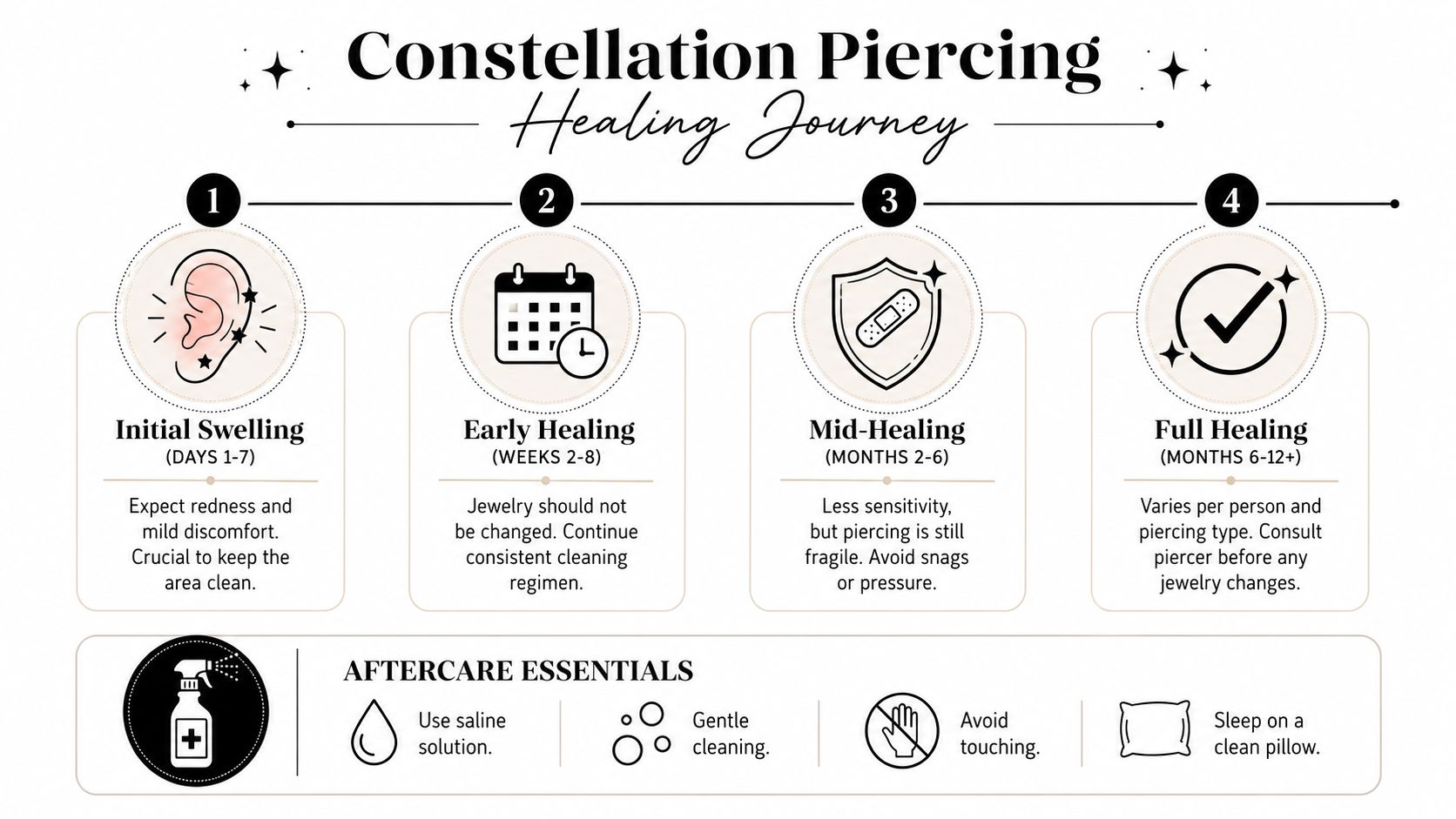
Many people still assume ear piercings settle quickly. For a curated set involving multiple lobe and cartilage sites, that expectation is too optimistic. Multi-site cartilage and lobe constellations often require 9–12 months to fully heal, and rushing jewellery changes is a major cause of irritation and complications, according to expert guidance on curated constellation healing.
If you want a broader overview of what different ear placements tend to do during recovery, this ear piercing healing times guide is useful for setting expectations.
What normal healing actually looks like
Healing rarely moves in a straight line. The first week may bring warmth, swelling, and tenderness. Later on, things often seem calmer, then suddenly become grumpy after being snagged by hair, slept on awkwardly, or caught by clothing.
A typical healing pattern may include:
- Early swelling and redness around the fresh sites
- Dry discharge or crusting, especially after cleaning
- Tenderness when bumped
- Good weeks and bad weeks, particularly with cartilage
- A piercing that looks fine outside before it's healed inside
Don't judge healing by appearance alone. A piercing can look settled well before the channel is actually stable.
Aftercare habits that help
Good aftercare is repetitive and a bit boring. That's a good sign. You're trying to avoid drama, not create it.
Keep it simple:
- Use sterile saline to clean the area gently.
- Leave the jewellery alone unless your piercer tells you otherwise.
- Sleep carefully, especially if the fresh ear is your usual side.
- Watch for friction from hairbrushes, hats, phones, and headphones.
- Keep products away. Hairspray, heavy skincare, and makeup can irritate healing sites.
A few things tend to cause trouble fast. Twisting jewellery, changing ends too early, using harsh homemade solutions, and treating every bump as something to “fix” at home usually make matters worse.
When to be extra cautious
Constellation layouts often place jewellery across parts of the ear that catch more daily contact than people realise. If you wear over-ear headphones, use a helmet, or have a job where hair and clothing brush the ear constantly, tell your piercer before the appointment. That can influence placement choices.
Medical imaging is another practical consideration. The Association of Professional Piercers notes that jewellery can blur CT scans, and guidance on piercing considerations during imaging appears in the APP piercing FAQ. If you ever need an MRI or CT scan, tell the imaging team you have ear jewellery and ask what their protocol is before removing anything yourself.
Patience is part of the style. The people with the best-healed curated ears usually aren't the ones who heal fastest. They're the ones who protect the work long enough for it to settle properly.
Book Your Consultation in Croydon or Bournemouth
You have a folder full of saved ear photos, but booking still feels like a big jump. That is normal. A good consultation turns scattered inspiration into a clear, realistic plan, especially if this is your first cartilage work and you are not sure what your ear can comfortably heal.
At Timebomb Tattoo & Piercing in Croydon or Bournemouth, the goal is not to copy a picture exactly. The goal is to build a constellation that suits your anatomy, your routine, and your patience for healing. Some ears can start with two or three well-spaced placements. Others are better as a staged project, a bit like decorating a wall one frame at a time so the final arrangement works.
If you want to compare professional ear piercing services near you before choosing a studio, do that first. Then bring your shortlist and your inspiration into the consultation so the conversation stays practical.
What to do before you book
A little prep helps the appointment feel less overwhelming.
- Save a few reference photos that show the mood, spacing, or jewellery shape you like
- Choose your priority ear if you want to begin with one side
- Consider your daily habits such as your sleep side, headphones, helmets, hair routine, or work dress code
- Write down your questions so you do not forget them once you are in the studio
- Stay open to edits if your piercer recommends a safer placement or a slower rollout
Contact details for bookings
For bookings and consultations at Timebomb Tattoo & Piercing, call 01202 9000 50 or message WhatsApp 07752913846.
Nerves are common. A consultation does not lock you into every piercing you have ever liked online. It gives you a chance to sit down with an experienced piercer, look at your ear in real life, talk through timing, and leave knowing what comes first, what can wait, and how to build toward the finished look safely.
The best constellation ears usually come together through good planning, steady healing, and small smart choices at the start. That first conversation is where the design becomes something you can wear and heal well.