
Thinking about a new piercing is always exciting, but it’s totally normal if a few nerves are mixed in with that excitement. That Google search for "professional ear piercing near me" is the single most important thing you can do to make sure you have a safe, clean, and all-around great experience.
Let's walk you through how to find a skilled, hygienic piercer you can truly trust.
Why Your Piercer Matters So Much
Choosing the right studio isn't just about picking out some new jewellery—it's a decision about your health and safety. The difference between a true professional and a cheap, quick option can make or break your healing journey and the final look of your piercing.
We want you to feel confident in your choice. So, we'll show you exactly what to look for, what to avoid (like those outdated piercing guns), and what the highest standards in the industry look like. We hold our own team at Timebomb Tattoo & Piercing in Croydon and Bournemouth to these exact standards, so we'll use them as our benchmark.
The goal is simple: find a piercer who treats this as the skilled, sterile procedure it is. They should prioritise your unique anatomy, flawless sterilisation, and high-quality materials above everything else. That's what separates a risky choice from a safe and successful piercing.
What This Guide Covers
We’ve put this guide together to give you complete peace of mind. We'll cover all the essentials so you feel totally prepared, know what to expect, and can spot a great studio from a mile off.
Here’s what we’ll break down:
- The tell-tale signs of a professional, hygienic studio.
- The crucial differences between a piercing needle and a piercing gun (and why it matters).
- A step-by-step look at what happens during a professional piercing appointment.
- The absolute essentials of aftercare for smooth, easy healing.
By the end, you'll see why being picky about your piercer is so important. If you’re ready to book with a team that puts your safety and comfort first, you can call us on 01202 900050 (Bournemouth) / 020 8686 7730 (Croydon) or drop a message to our studio WhatsApp at 07752 913846 (Bournemouth) / 07902 490584 (Croydon).
Spotting the Difference: What Makes a Piercing Studio Genuinely Professional?
So, you've searched for "professional ear piercing near me." What you'll find is a mix of dedicated studios and high street shops, and telling them apart is crucial. It’s not just about getting a piercing that looks good; it’s about making a choice that prioritises your health and safety above all else.
Think of it this way: a professional piercer is a specialist, much like a dental hygienist or a surgeon. They have an intimate understanding of anatomy, follow rigorous hygiene protocols, and possess the technical skill to perform a precise, sterile procedure. Their entire focus is on giving you a beautiful piercing that will heal safely for the long term.
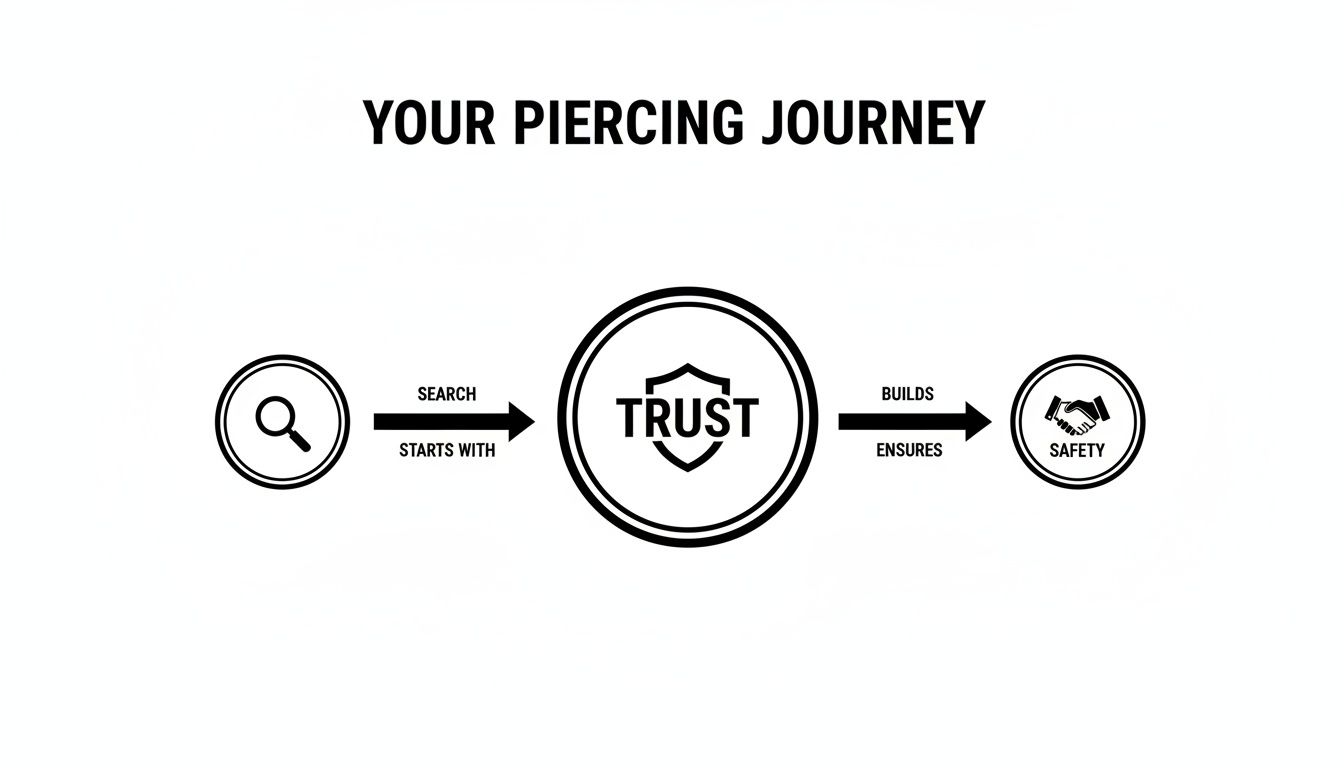
The Needle vs. The Gun: A Non-Negotiable Difference
The single most telling difference between a pro and a retail clerk is the tool they use. A true professional piercer will only ever use a single-use, pre-sterilised, hollow needle. It’s designed to cleanly part the tissue, creating a smooth channel for the jewellery to sit in. This is the gold standard for a reason—it’s precise and minimises trauma.
A piercing gun, on the other hand, is a completely different story. It uses blunt force to ram a stud through your ear, which can shatter cartilage and cause significant, unnecessary trauma to the surrounding tissue. This crude method dramatically increases the risk of infection, scarring, and healing complications.
To help you understand just how important this is, we've put together a quick comparison.
Professional Needle vs Piercing Gun Quick Comparison
| Feature | Professional Piercer (Needle) | High Street Retailer (Gun) |
|---|---|---|
| Tool | Single-use, sterile hollow needle. | Reusable piercing gun. |
| Process | Creates a clean, precise channel by parting tissue. | Uses blunt force to push a stud through tissue. |
| Tissue Damage | Minimal, promoting faster and cleaner healing. | High trauma, can shatter cartilage and cause scarring. |
| Sterilisation | Tool is 100% sterile and disposed of after one use. | Gun cannot be properly sterilised; plastic parts can harbour bacteria. |
| Jewellery | Implant-grade, body-safe materials. | Often low-quality, plated metals with unknown alloys. |
| Outcome | Higher chance of a healthy, straight, well-healed piercing. | Increased risk of infection, rejection, and misplaced piercings. |
As you can see, the choice is clear. The piercing gun is an outdated and unsafe method that has no place in a modern, professional studio. For a much deeper look at this, we've broken down all the details in our guide to the piercing gun vs needle debate.
The Quality of Your First Piece of Jewellery Matters
The next sign of a trustworthy studio is the jewellery they use for your initial piercing. A professional piercer will only use implant-grade materials that are specifically designed to live inside the human body. Anything less is a gamble with your health.
Here’s what you should be looking for:
- Implant-Grade Titanium: This is the industry standard. It's completely hypoallergenic, nickel-free, and incredibly biocompatible, which is exactly what you want for a fresh piercing.
- 14k or 18k Solid Gold: It's essential that this is solid gold (not plated) and from a reputable supplier who can guarantee it's nickel-free and alloyed for body compatibility.
- Niobium: Another fantastic hypoallergenic material that's safe for new and fully healed piercings.
The cheap, mystery-metal jewellery you find in malls and accessory shops is a huge red flag. It often contains high levels of nickel and other irritating alloys that can trigger nasty allergic reactions, painful irritation, and even cause your body to reject the piercing entirely.
Choosing a studio that is professionally regulated and inspected is non-negotiable. Regulations via the UK's Local Government Act ensure that licensed premises are fully inspectable, dramatically reducing infection risks.
This professional oversight is why hygiene is the number one priority for so many clients when picking a piercer. Professional, registered studios see far fewer infections than unregulated piercers.
If you ever have any questions about our own uncompromising standards, please give us a call at 01202 900050 (Bournemouth) / 020 8686 7730 (Croydon) or send a message to our WhatsApp at 07752 913846 (Bournemouth) / 07902 490584 (Croydon). We're always happy to talk you through our process.
Exploring Popular Ear Piercing Styles
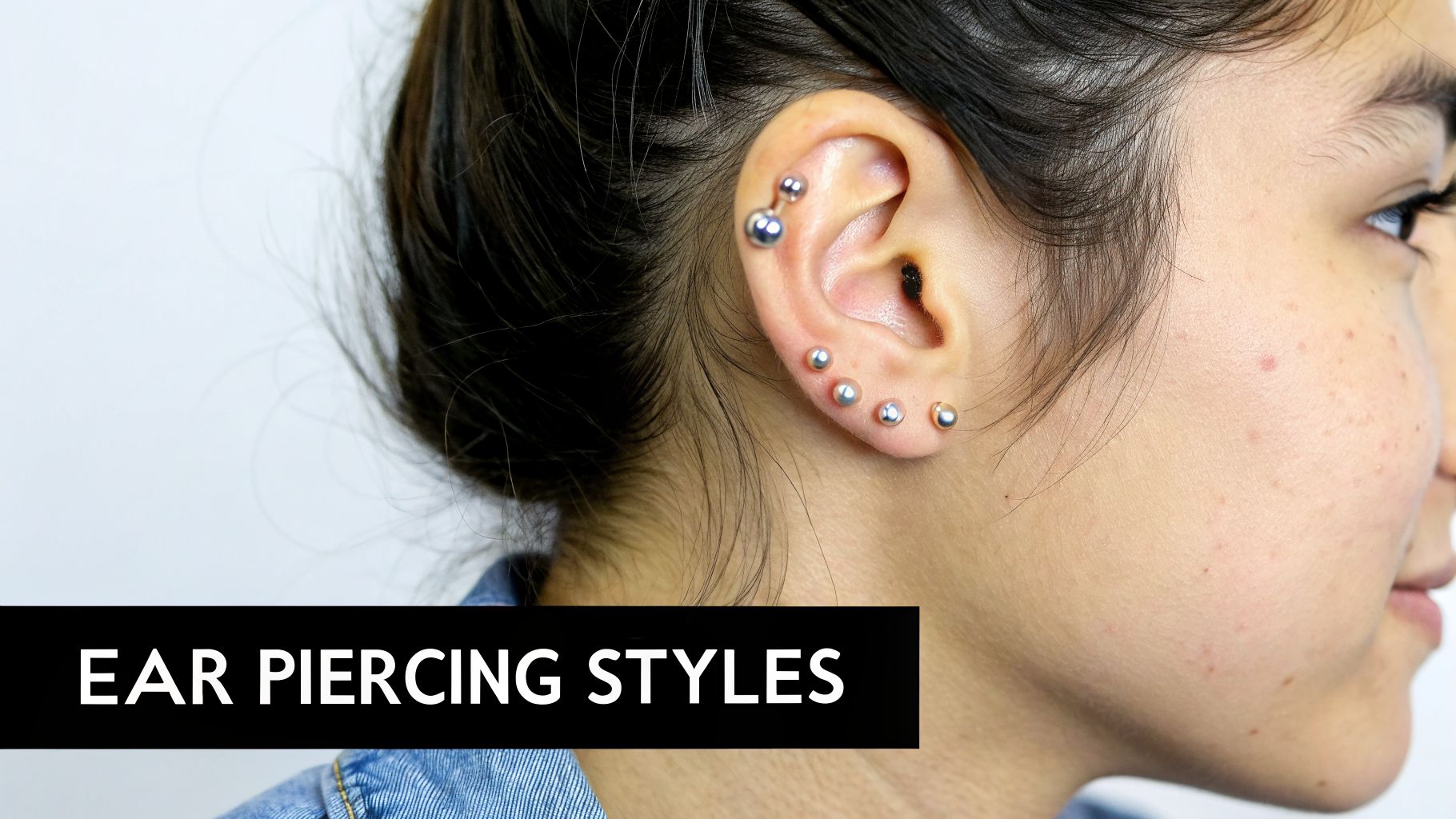
Right, let's get to the exciting bit: deciding where to get your new piercing. It's so much more than just a standard lobe these days. The world of professional ear piercing has opened up, giving you a huge canvas of cartilage options to create a look that's completely yours—what we call a 'curated ear'.
To help you get a feel for what’s possible, let's walk through some of the most popular styles. Think of this as a starting point. It’ll give you the language and ideas you need to have a really productive chat with your piercer about what you envision. We'll touch on what each one feels like, how long it takes to heal, and the best ways to show it off.
Classic and Cartilage Piercings
Every placement, from a subtle stud to a bold hoop, brings its own personality. Getting to grips with the basics is the first step in choosing the perfect piercing for your anatomy and style.
Lobe Piercings
This is the one everyone knows. It’s that soft, fleshy bit at the bottom of your ear, and it’s where most of us start our piercing journey. Why? It's known for being one of the easiest piercings to get and heal.
- Pain Level: 1/5. Honestly, it's just a quick, sharp pinch that's over in a second.
- Healing Time: You’re looking at a pretty speedy 6-8 weeks for healing.
- Styling: The possibilities are endless. It's the perfect spot for studs, hoops, or even a 'stacked lobe' with multiple piercings climbing up.
Helix Piercings
That upper cartilage rim of your ear? That’s the helix. It has become a modern classic and for good reason—it looks fantastic. You can have a single stud or create a cascade of them running along the curve of your ear.
- Pain Level: 2-3/5. A definite sharp pinch here, as we're going through cartilage, not soft tissue.
- Healing Time: Patience is key. Healing averages 6-12 months because cartilage has less blood flow than the lobe.
- Styling: Delicate studs and hoops that 'hug' the rim of the ear are hugely popular and look incredible.
The trend isn't just anecdotal. Ear piercings are the most common procedures in professional studios. This has been matched by a welcome shift towards safer materials. Using high-quality, implant-grade titanium for initial jewellery makes allergic reactions much less likely than lower-grade metals.
More Advanced Cartilage Styles
Once you venture beyond the outer rim of the ear, you discover some truly unique placements that can become the centrepiece of your curated ear. These absolutely require a piercer with a deep, practical understanding of ear anatomy.
Conch Piercings
The conch is located in the inner ‘cup’ part of your ear—the large area of cartilage in the centre. It’s a beautifully bold choice that can be styled with a simple stud or, once fully healed, a statement hoop that wraps around the ear's outer edge.
- Pain Level: 3/5. You'll feel a firm, noticeable pressure during the procedure.
- Healing Time: It's a commitment. Healing can take 6-12 months, sometimes longer.
- Styling: A sparkly stud looks elegant and classic, while a well-fitted ring makes for a dramatic and eye-catching look.
Here's a crucial piece of advice from years of experience: cartilage piercings demand patience. They are far more sensitive to being knocked, snagged, or slept on than lobe piercings. Following your aftercare instructions to the letter is the single most important thing you can do for a happy, healthy piercing.
Daith and Tragus Piercings
These are two very distinct piercings, both located in the inner cartilage folds close to the ear canal. They add intricate detail to any ear project.
- Daith: This one goes through the innermost fold of cartilage at the very front of the ear. It’s become famous for its unique look and is often fitted with a decorative hoop. Pain is around 3/5, with a healing time of 9-12 months.
- Tragus: The tragus is that small, thick flap of cartilage that sits just in front of your ear canal. It’s the perfect home for a single, subtle stud. The pain is similar to a daith at 3/5, and healing takes 6-12 months.
Feeling the inspiration? You can dive deeper and see more real-world examples in our complete ear piercings guide.
Remember, the 'best' piercing is the one that fits your unique anatomy and makes you feel great. When you're ready to take the next step, our expert piercers in Croydon and Bournemouth are here to help you choose the perfect placement. Just give us a call on 01202 900050 (Bournemouth) / 020 8686 7730 (Croydon) or send a message to our WhatsApp on 07752 913846 (Bournemouth) / 07902 490584 (Croydon) to book a consultation.
What to Expect at Your Piercing Appointment
It’s completely normal to feel a few butterflies before your appointment. But knowing exactly what to expect can help turn those nerves into pure excitement. When you've been searching for a "professional ear piercing near me," what you’re really looking for is a calm, clean, and confident experience. So, let's pull back the curtain and walk you through the process at a pro studio like Timebomb, so you know what’s coming every step of the way.
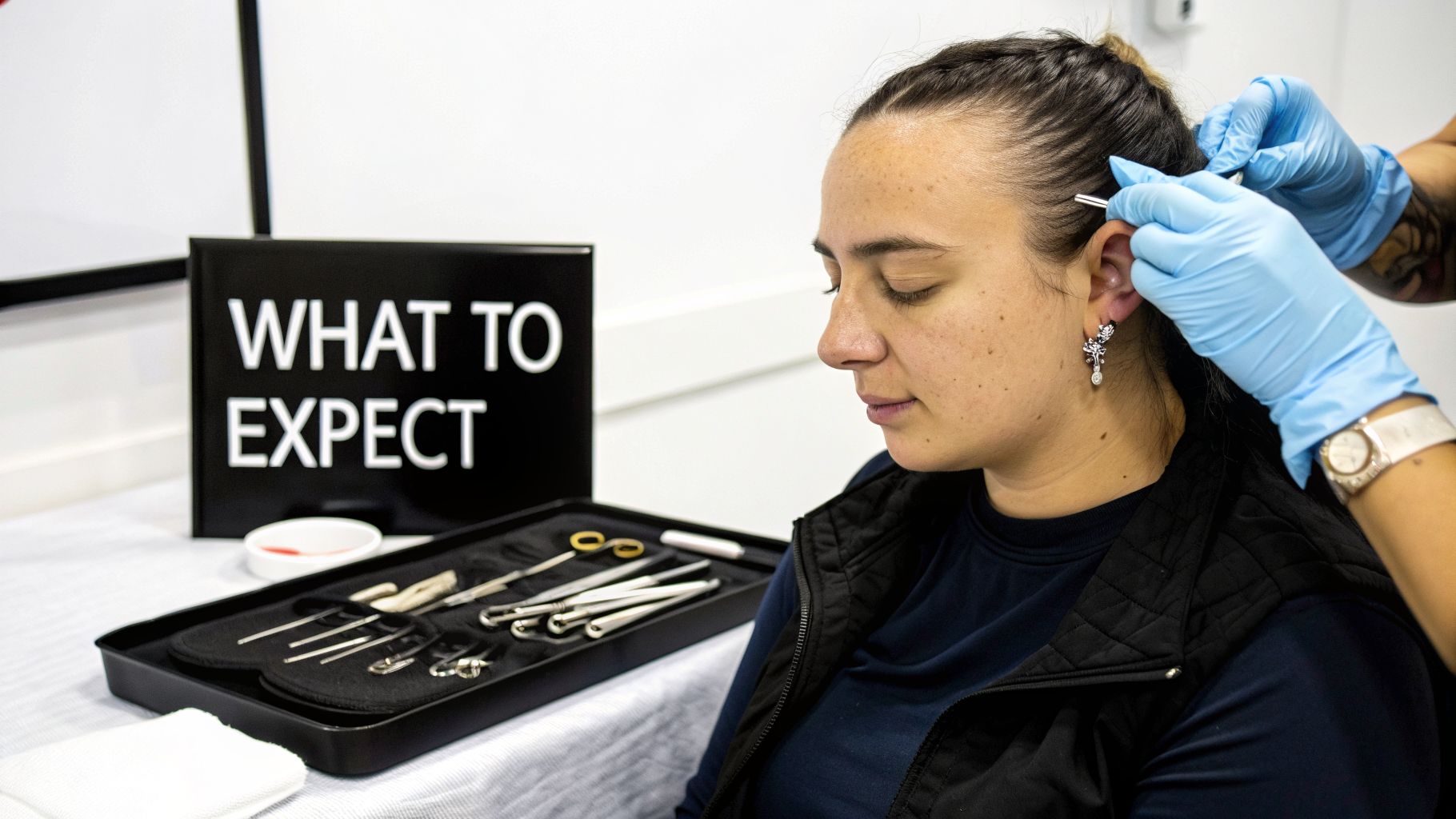
The whole experience is built around your safety and comfort. A great piercer isn't just there to do the piercing; they're there to guide you, making sure you feel informed and in control from the moment you walk in. If you have any last-minute wobbles or questions, don't hesitate to give us a call on 01202 900050 (Bournemouth) / 020 8686 7730 (Croydon) or ping a message to our WhatsApp on 07752 913846 (Bournemouth) / 07902 490584 (Croydon).
Step 1: The Chat and Choosing Your Jewellery
Every appointment kicks off with a friendly, informal chat. This is where you and your piercer talk about what you have in mind. They’ll take a look at your ear's unique anatomy to figure out the perfect placement that will not only look amazing but also heal well. Think of it as a collaboration—your idea, their expertise.
Then for the really fun part: picking out your starter jewellery. You’ll get to see a curated selection of beautiful, sterile, implant-grade pieces. We’re talking high-quality materials like implant-grade titanium or solid 14k/18k gold. Your piercer will explain the pros of each, helping you find something that's not just your style, but also perfect for a happy, healing piercing.
Step 2: Sterile Setup and Precision Marking
Once you’ve found the one, you'll head to a private, immaculately clean piercing room. Your piercer will put on fresh gloves and start setting up. Everything is single-use, and they will open the sterile needle from its sealed packaging right in front of you. This isn't just for show; it's a critical part of the process and a non-negotiable sign of a true professional.
Next, the area will be cleaned thoroughly with a medical-grade antiseptic. Using a sterile, single-use marker, your piercer will then place a small dot on your ear. You get the mirror to check it from all angles and give the final thumbs-up. It has to be exactly where you want it before anything else happens.
This marking step is absolutely crucial. It ensures pinpoint accuracy and, most importantly, puts you in the driver's seat. It's a simple check that guarantees you'll love the placement of your new piercing.
Step 3: The Piercing and Aftercare Run-Down
With your final approval, it's go-time. Your piercer will coach you to take a nice deep breath in and then breathe out slowly. The piercing happens on the exhale—it’s a swift, smooth motion with a hollow needle that creates a clean channel for the jewellery. Honestly, the sensation is over in a second.
Your chosen jewellery is then immediately inserted and secured. The piercer will give the area one final clean and have a good look to make sure everything is perfect. Before you leave, they’ll go through the aftercare instructions in detail, explaining exactly how to clean and look after your piercing for a smooth, trouble-free healing journey. You’ll usually get this both verbally and in writing, so you have everything you need.
Mastering Your Piercing Aftercare Routine
A piercer’s job ends when you walk out the door. After that, a successful heal is down to you. Think of it this way: we create the piercing, but you create the perfect environment for it to heal beautifully.
Your body is already kicking off its amazing natural healing process. All you need to do is keep things simple, clean, and irritation-free to help it along. Getting this right is the secret to a happy, healthy piercing.
The Essential Dos and Don'ts
Good aftercare is all about gentle consistency, not aggressive cleaning. In fact, doing too much or using the wrong stuff is one of the biggest reasons piercings get irritated. So, let’s keep it simple.
The Golden Rules of Aftercare (The 'Dos'):
- Clean Twice Daily: Grab a sterile saline wound wash spray. A couple of quick sprays, twice a day, is all you need. It’s sterile, pH-balanced, and you don’t even have to touch your piercing.
- Wash Your Hands: If you absolutely must touch the area around your piercing, make sure your hands are spotlessly clean first. Wash them thoroughly with antibacterial soap.
- Be Patient: Healing is a marathon, not a sprint. Earlobes might feel fine in weeks, but cartilage can take up to a year to settle completely. Stick with your routine.
Common Mistakes to Avoid (The 'Don'ts'):
- No Twisting or Turning: That old myth about twisting your jewellery needs to go! It just drags in bacteria and tears up all the delicate new tissue your body is trying to build. Leave it still!
- Avoid Harsh Chemicals: Steer clear of alcohol, peroxide, antiseptic creams, and DIY salt solutions. They are far too harsh, kill off good healing cells, and will only make things worse.
- Keep it Dry: Don’t let moisture hang around after a shower or cleaning. Gently pat the area completely dry with a fresh piece of kitchen roll or a non-fluffy disposable. A damp piercing is a breeding ground for bacteria.
We go into much more detail on the best methods in our complete guide, where you can learn more about how to clean a new piercing.
Understanding the Healing Stages
It helps to know what’s normal so you don’t panic over every little thing. For the first few days, expect some tenderness, a bit of swelling, and maybe even a tiny spot of bleeding. This is all part of the initial response.
You'll also likely see some clear or whitish-yellow fluid that dries into a 'crust'. This isn't pus! It’s lymph fluid, a totally normal and healthy part of the healing process.
If you start seeing thick green or dark yellow discharge, notice a bad smell, or the area feels hot to the touch with a throbbing pain that won't quit, it's time to get in touch. Don't sit on it and hope for the best.
When you searched for a "professional ear piercing near me" and chose a reputable studio, you also chose their expertise and support. We're your first port of call for any worries. If you have any questions at all, big or small, call us on 01202 900050 (Bournemouth) / 020 8686 7730 (Croydon) or send a picture and a message to our WhatsApp at 07752 913846 (Bournemouth) / 07902 490584 (Croydon).
Alright, you’ve done the hard part—learning what separates a truly professional piercing from a risky one. Now, let's talk about finding a studio that lives and breathes those standards.
We’d love to welcome you to Timebomb Tattoo & Piercing. With studios in both Croydon and Bournemouth, we've built our reputation on exceptional hygiene, years of expertise, and creating a space where you feel completely comfortable and looked after.
Timebomb Tattoo & Piercing Bournemouth
Our Bournemouth studio is a trusted spot on the South Coast for anyone seeking a high-quality piercing. We’ve designed it to be modern, spotlessly clean, and genuinely welcoming.
- Address: 109 Old Christchurch Road, Bournemouth, BH1 1EP
- Opening Hours: Monday – Saturday, 11am – 6pm (closed Sunday)
- Book Online: Schedule Your Bournemouth Piercing Appointment
- Get in Touch: Give us a call on 01202 900050 (Bournemouth) / 020 8686 7730 (Croydon) or drop a message to our WhatsApp at 07752 913846 (Bournemouth) / 07902 490584 (Croydon) if you have any questions.
"So friendly and professional. I was a bit nervous but they made me feel completely at ease. The studio is spotlessly clean, and they talked me through everything. Absolutely recommend!" - Verified Google Review
Timebomb Tattoo & Piercing Croydon
For those in and around Greater London, our Croydon studio is your local hub for piercing artistry. We hold ourselves to the exact same high standards of safety and care, ensuring you get the perfect result.
- Address: 22 George Street, Croydon, CR0 1PA
- Opening Hours: Monday – Saturday, 11am – 6pm (closed Sunday)
- Book Online: Schedule Your Croydon Piercing Appointment
- Get in Touch: For any enquiries, please call 020 8686 7730 or reach out via WhatsApp on 07902 490584.
This isn't just about us, though; it's about a shift in what people expect. In our experience, many clients choose a studio based on Google reviews that mention hygiene.
This is especially true for parents bringing in their teens for a first piercing. They really value our detailed, personalised aftercare advice. Trust and transparency matter more than ever. You can discover more insights about the UK body piercing industry on researchandmarkets.com.
Your Piercing Questions, Answered
It's totally normal to still have a few questions buzzing around your head, even after reading through a guide like this. We get it!
So, we've gathered some of the most common things people ask us every day in our Croydon and Bournemouth studios. Here are some quick, straightforward answers to help you feel 100% ready.
How Much Will My Ear Piercing Cost?
The total price is made up of two things: the piercing service fee itself, and the cost of the beautiful jewellery you pick out. We're all about being upfront, so we'll give you a full breakdown during your consultation before any needles are involved.
The final figure really depends on where you get the piercing and which piece of jewellery you fall in love with. If you want a specific quote, just give our team a shout on 01202 900050 (Bournemouth) / 020 8686 7730 (Croydon) to chat about our current selection and pricing.
Can I Get More Than One Piercing at a Time?
Absolutely! Getting a few piercings done in one sitting is definitely an option. That said, we usually suggest sticking to a maximum of three or four at once. This gives your body a much better chance to focus its energy on healing them properly.
Here's a pro tip from our piercers: Try to get new piercings on one ear at a time. It makes a huge difference being able to sleep on your other side without irritating the new additions!
When you come in, our piercers will take a look at your anatomy and chat with you about your ideas, then give you their expert advice on the best plan for you.
What's the Minimum Age for an Ear Piercing?
For most cartilage piercings, you need to be at least 16 years old. Lobe piercings can sometimes be done for younger clients, but this always requires a parent or legal guardian to be present and give their consent.
No matter your age, you'll need to bring a valid photo ID. For anyone under the age requirement, we also have legal consent forms that need to be completed by a parent. Because the rules can vary slightly between different piercing types, it's always a good idea to call us on 01202 900050 (Bournemouth) / 020 8686 7730 (Croydon) or drop a message on WhatsApp at 07752 913846 (Bournemouth) / 07902 490584 (Croydon) just to double-check before your visit.
Feeling ready to take the next step with a team that puts your safety first? Piercing Near Me is your direct link to the brilliant piercers at Timebomb Tattoo & Piercing for an experience that's clean, professional, and all about you.
Trackbacks/Pingbacks