
You’ve probably done the same thing most first-time cartilage clients do. You save a few photos, zoom in on someone’s neat little helix hoop, maybe send one to a friend, then immediately hit the practical questions. Does it hurt? Can I get a ring straight away? Will it suit my ear? What if it heals badly?
That hesitation is sensible. An ear cartilage piercing ring can look delicate and effortless, but getting there takes a bit of planning. Cartilage isn’t like the soft lobe. It needs the right placement, the right jewellery, and a realistic healing plan if you want the finished look to be comfortable as well as stylish.
I’ve guided plenty of people through this exact decision, including nervous first-timers, parents booking for teens, and people who thought they wanted one type of ring until they understood their anatomy. The good news is that cartilage piercing doesn’t have to feel confusing. Once you know the difference between healing jewellery and style jewellery, most of the uncertainty disappears.
From Pinterest Dream to Piercing Reality
A common scenario goes like this. Someone falls in love with a clean, stacked ear with a helix hoop, a daith clicker, or a conch ring that hugs the ear just right. They assume they’ll walk into a studio, choose a ring, and leave looking exactly like the photo.
Then the important questions begin.
The photo shows the destination, not the process
The polished look you admire online is usually the end result of a healed piercing, not the starting point. That’s where many people get caught out. They ask for a ring because the ring is the style they want, but the best jewellery for a fresh cartilage piercing is often different from the jewellery you’ll wear long term.
Cartilage also varies from person to person. A ring that sits neatly on one person’s helix may press, rotate awkwardly, or look oversized on another ear. A good piercer reads your anatomy first, then matches the jewellery to the placement.
A beautiful cartilage piercing doesn’t start with copying someone else’s ear. It starts with choosing jewellery that fits your own ear safely.
Why people feel unsure
Most first-time clients aren’t worried about style alone. They’re worried about getting it wrong. They’ve heard stories about bumps, soreness that drags on, or cheap metal causing irritation.
Those concerns are valid. Cartilage takes patience, and because it has limited blood supply, healing is slower than with lobes. That’s one reason safe studios are so particular about jewellery quality, aftercare, and not rushing into a ring just because it looks good on day one.
A long-running interest in cartilage piercing isn’t new either. In a 2006 survey in England, 46% of women aged 16 to 24 had piercings beyond the earlobe, showing how mainstream cartilage placements had already become among younger clients in the UK, according to Body Candy’s summary of youth piercing statistics.
What helps most on your first visit
If you’re deciding on your first ear cartilage piercing ring, focus on these three things before style:
- Placement: Helix, conch, tragus, daith, and rook all behave differently.
- Healing jewellery: What works for a fresh piercing is chosen for stability, not just appearance.
- Material and fit: Implant-grade options and correct sizing matter more than decorative detail at the start.
Once those are right, the ring you want becomes much easier to wear later.
The Great Debate Studs Versus Rings for New Piercings
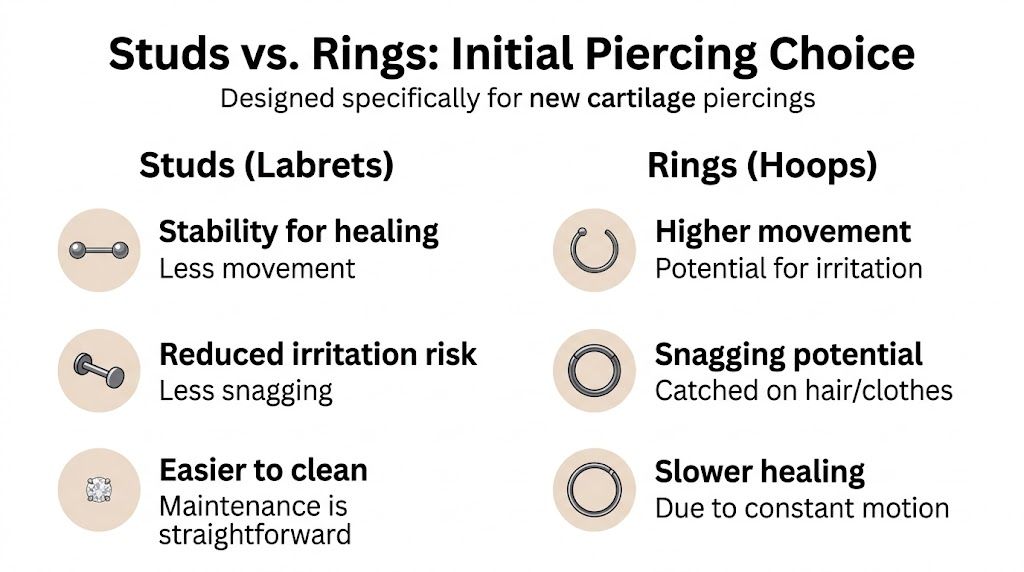
If you ask a professional piercer whether you should start a fresh cartilage piercing with a stud or a ring, the answer is usually simple. Start with a stud.
That can feel disappointing if your dream look is a hoop. But the logic is solid. Fresh cartilage needs calm, stable conditions. A ring moves more, turns more, catches more easily, and puts more changing pressure on the channel while the tissue is trying to settle.
Why a stud usually wins
Building a house illustrates the point. You don’t start with the decorative balcony, but with the foundation. A labret stud gives cartilage that stable foundation.
A flat-back labret stays relatively still. It doesn’t swing when you brush your hair. It doesn’t rotate through the piercing every time you pull a jumper over your head. It also gives your piercer room to allow for swelling without the jewellery cutting in.
APP-based guidance used by many professional studios in the UK recommends implant-grade titanium (ASTM F136) or 14k+ solid gold for initial jewellery, with an 8mm post to allow for swelling and internally threaded or threadless jewellery to reduce tissue damage. The same guidance notes that studios following these standards see far fewer infections than those using lower-quality materials, as outlined in Lark & Berry’s cartilage earring guide.
What makes rings harder during healing
Rings aren’t bad jewellery. They’re just demanding jewellery for a fresh piercing.
Here’s where people struggle with them most:
- More movement: A ring shifts as you talk on the phone, sleep, wash your hair, or get dressed.
- More snagging: Hair, towels, hoodies, and headphones can all pull a ring.
- More irritation: Constant motion can keep the channel unsettled.
- More pressure issues: If the diameter isn’t perfect, the ring can sit too tightly or at an awkward angle.
This is why clients sometimes think their body is “rejecting” the piercing when what’s really happening is repeated irritation from jewellery movement.
The good news if you want a ring
Starting with a stud doesn’t mean giving up on your ring. It means earning it properly. Once the piercing has healed well and your piercer is happy with the tissue, you can move into the hoop, clicker, or decorative ring style you wanted from the beginning.
If you’re still weighing up jewellery options for a fresh ear piercing, this guide to the best earrings for newly pierced ears helps explain why simple, secure pieces usually heal best.
Practical rule: Choose your first jewellery for healing. Choose your second jewellery for styling.
For a free, no-obligation consultation to discuss your piercing goals, call us on 01202 900050 (Bournemouth) / 020 8686 7730 (Croydon) or send a message on WhatsApp to 07752 913846 (Bournemouth) / 07902 490584 (Croydon).
A Catalogue of Cartilage Piercing Rings
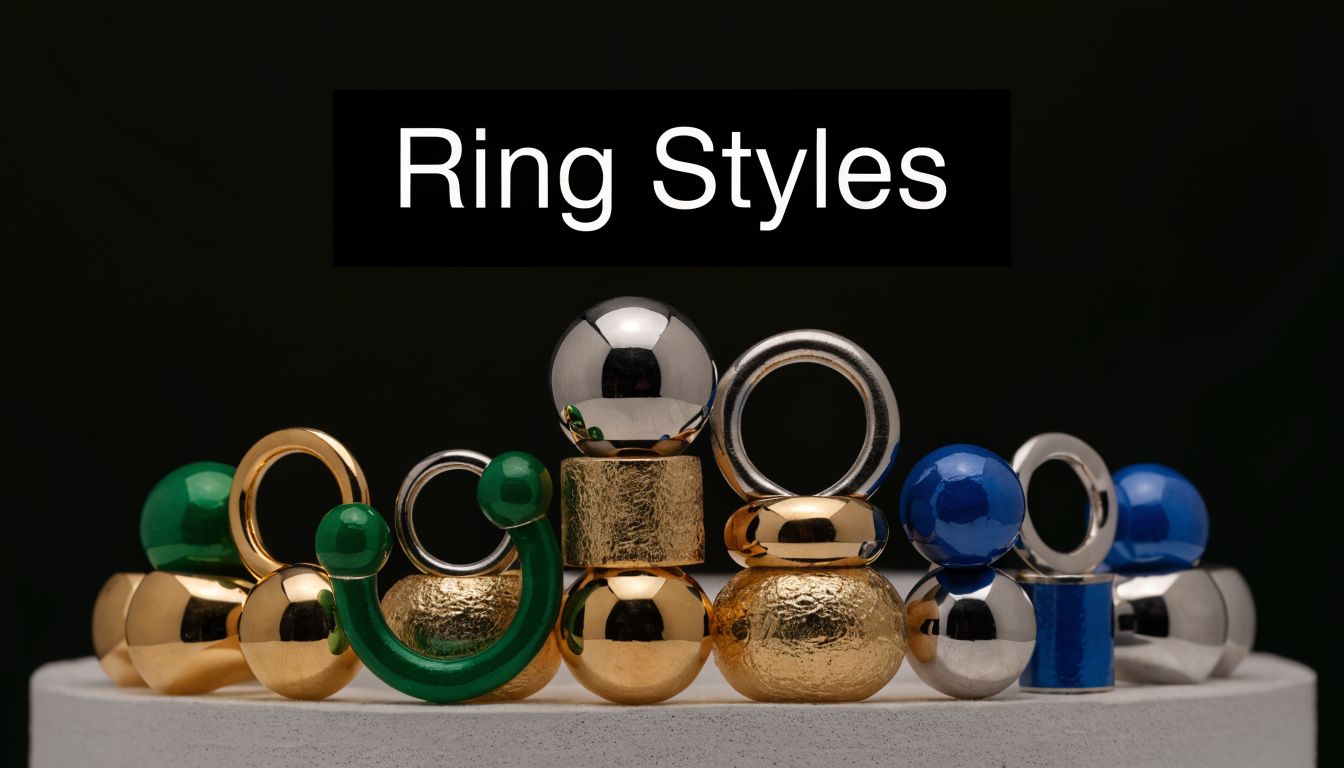
Once your piercing is fully healed, the fun begins. The phrase ear cartilage piercing ring covers several very different jewellery styles, and each one behaves differently in the ear.
Some give a smooth, minimal finish. Others are easier to open and close. Some are best left to a piercer to change. Knowing the names makes it much easier to ask for what you want.
Seamless and segment rings
These are the rings clients often describe as “the really clean ones with no obvious ball”. The appeal is obvious. They create a continuous circle with a neat, refined finish.
A twist-open ring opens by twisting the ring sideways rather than pulling it apart. A segment ring has a removable section that clicks or presses into place. Both can look excellent in healed helix, tragus, and some conch placements where you want the jewellery to disappear into the overall ear styling.
They’re stylish, but they’re not always the easiest for home changes. If someone forces the seam the wrong way, they can distort the shape and end up with a ring that never sits quite right again.
Captive bead rings
The captivе bead ring, often shortened to CBR, is a classic. The ring holds a small bead in place with tension, so the bead completes the circle.
Clients often like CBRs because they look traditional and feel secure once fitted correctly. They suit placements where a simple ring shape works well, including helix and daith. Some people also like the bead as a tiny feature rather than wanting a completely plain hoop.
A few practical points matter here:
- They’re secure: Good for people who don’t want a hinge mechanism.
- They can be fiddly: The bead can be awkward to remove without the right tools.
- They work well in plain metal styles: Especially if you want a straightforward look rather than ornate detail.
Clickers
If you like the idea of changing jewellery more easily once healed, clickers are often the favourite. They open on a small hinge and close with a very satisfying click.
That makes them popular for daiths, septums, and some helix or conch placements, depending on the piece. Decorative clickers also allow for lots of styling options, from simple polished rings to pieces with stones or shaped fronts.
People often assume a clicker is always better because it’s easier. It can be, but only if the wearable size and diameter are right for your anatomy. A beautiful clicker that’s slightly too tight will never feel luxurious.
If a ring looks perfect in the tray but presses when fitted, it isn’t the right ring for that piercing.
Hoops and decorative ring styles
“Hoop” is often used as a catch-all term, but it can mean several things. Some hoops are fixed bead styles. Some are plain polished circles. Others have charms, stones, clusters, or shaped fronts.
These tend to shine once your piercing is stable and you know what suits your ear. A slim helix hoop can look understated. A conch hoop can frame the centre of the ear beautifully. A decorative daith ring can become the focal point of the whole ear.
Here’s a simple matching guide:
| Ring style | Best known for | Common healed placements |
|---|---|---|
| Seamless ring | Clean continuous look | Helix, tragus, conch |
| Segment ring | Smooth finish with removable section | Helix, conch, daith |
| Captive bead ring | Secure classic design | Helix, daith |
| Clicker | Easy opening and closing | Daith, helix, conch |
| Decorative hoop | Statement styling | Helix, conch, orbital |
The best ring isn’t the one with the fanciest name. It’s the one that fits the placement, sits comfortably, and matches how much fuss you want when changing it.
Choosing the Right Material and Size for Your Ring
When clients say, “I just want a simple hoop,” I usually slow the conversation down at this point. Simple-looking jewellery can still go wrong if the material is poor or the size is off.
Those two details decide whether your ear cartilage piercing ring feels smooth and comfortable or constantly annoying.
Material comes first
For initial cartilage piercings, professional standards favour implant-grade titanium and 14k+ solid gold. Titanium is widely chosen because it’s lightweight and suitable for many people who react badly to mixed metals. Solid gold can also work beautifully when it’s appropriate quality and composition.
Lower-quality options cause a lot of confusion. Clients often assume “silver-coloured” means safe, or that a pretty finish matters more than what the metal is. It doesn’t. Plated jewellery can wear down. Mystery alloys can irritate the skin. Jewellery that looks fine in a packet may not be suitable for a healing piercing.
A quick comparison
| Material | Best For | Pros | Cons |
|---|---|---|---|
| Implant-grade titanium | Fresh piercings and long-term wear | Lightweight, widely trusted for sensitive ears, professional standard | More clinical look if you prefer warm-toned jewellery |
| 14k+ solid gold | Healed piercings and suitable initial jewellery | Attractive finish, premium feel, safe when properly made | Higher cost, quality varies if you don’t buy carefully |
| Sterling silver | Very limited use, not ideal for cartilage piercing | Familiar and often easy to find | Poor choice for initial cartilage jewellery, can tarnish and irritate |
| Unspecified mixed metal | Best avoided | Cheap upfront | Unpredictable wear, higher chance of irritation |
Understanding gauge and diameter
Sizing sounds technical until you put it into plain language.
Gauge is the thickness of the jewellery. Diameter is the width of the ring. When buying shoes, one number indicates the general size category, while the other determines if the fit works for your foot shape. Similarly, with rings, both measurements are important.
For cartilage, 16g to 18g is standard for many placements, according to APP-style guidance reflected in the earlier material standards source. If the ring is too thin, it may feel flimsy or not suit the piercing channel. If it’s too thick, it may not fit comfortably.
Diameter changes the look more than many people expect:
- Too small: The ring can pinch or sit tightly against the ear.
- Too large: It can stick out, catch easily, and lose that neat fitted appearance.
- Just right: It follows the ear naturally without pressure.
Why professional sizing matters
Cartilage placements have become extremely popular. In Infinite Body’s piercing statistics summary, six cartilage types, including helix, conch, and tragus, appeared in the top ten most popular piercings, and ear piercings accounted for 71% of all procedures post-lockdown in 2020. That popularity is one reason clients see so many ring styles online. But popularity doesn’t remove the need for custom fitting.
A helix ring on one ear may need a different diameter from the same placement on another person. Conch rings vary even more because ear depth and angle differ so much. This is why a piercer measures your ear rather than guessing from a photo.
The ring should suit your anatomy, not force your anatomy to suit the ring.
If you want the jewellery to feel good all day, sizing is not a small detail. It’s the detail.
Your Cartilage Ring Healing and Aftercare Guide
Cartilage healing is slow enough that people often think something has gone wrong when it’s just taking its time. That’s normal. What matters is keeping the piercing calm and avoiding the little habits that keep setting it back.
What healing usually feels like
A fresh cartilage piercing can be tender, warm, and a bit swollen early on. It can settle, then flare up again if you sleep on it, catch it with a brush, or keep moving the jewellery to “check it”.
Cartilage has limited blood supply, which is why healing commonly takes 4 to 12 months. That’s a broad range because placement, aftercare, and jewellery choice all affect how smoothly things go.
The routine that keeps it simple
You do not need a cupboard full of products. Optimal results are often achieved by maintaining a simple, consistent routine.
Use this approach:
- Clean with sterile saline: Spray gently twice a day.
- Leave the jewellery alone: No twisting, no turning, no checking if it moves.
- Keep pressure off it: Avoid sleeping on that side if you can.
- Watch hair and clothing: Towels, hoodies, and headphones can all irritate cartilage.
If you want a closer look at what counts as suitable cleaning, this guide to saline spray for piercing care explains what to use and what to skip.
The bump that scares everyone
A lot of clients panic when they see a small irritation bump near a cartilage piercing. Most of the time, that bump is not a sign that the piercing has failed. It’s your ear complaining about pressure, movement, snagging, or unsuitable jewellery.
Common triggers include:
- Sleeping on the piercing
- Changing jewellery too early
- Using harsh products
- Starting with a ring that moves too much
- Knocking it repeatedly
The answer usually isn’t stronger cleaning. It’s removing the source of irritation.
When to ask for help
You don’t need to panic over every bit of crusting or tenderness, but you also shouldn’t ignore a piercing that’s getting steadily worse. If the area becomes increasingly angry, more painful, or you’re worried about the jewellery fit, let a professional piercer assess it.
A calm review early on can prevent weeks of frustration later.
Healing improves when you stop trying to “fix” the piercing every day.
Find Your Piercer in Croydon and Bournemouth
Choosing the right studio matters just as much as choosing the right jewellery. A well-placed cartilage piercing with suitable implant-grade jewellery gives you a much better shot at the neat, wearable result you want.
That matters in busy areas where cartilage demand has been strong for years. In the UK, interest in cartilage isn’t a passing fad. As noted in Impuria’s cartilage piercing guide, an English survey found 46% of women aged 16 to 24 had piercings beyond the earlobe, and there is ongoing confusion around age rules for teens, especially 16 to 17-year-olds.

What a reputable studio should do
A proper cartilage appointment should never feel rushed or casual about hygiene. Look for a studio that uses single-use sterile needles, offers implant-grade jewellery, talks you through placement and healing, and gives you clear aftercare rather than vague reassurance.
You also want a piercer who’ll tell you when a ring isn’t the right starting jewellery, even if that isn’t what you hoped to hear. Good advice protects the piercing. It doesn’t just close the sale.
A helpful local starting point is this page for professional ear piercing near me, especially if you’re comparing studios and want to know what standards to look for.
The teen and parent question
Online, many families encounter conflicting information. For cartilage piercings in England, the minimum age is 16, and reputable studios will ask for ID. The verified brief also notes that many reputable studios often require parental consent for under-18s.
If you’re a parent booking for a teen, or you’re 16 or 17 yourself, don’t rely on hearsay from social media or what a friend says another studio did. Ask directly what ID is required, whether a parent or guardian needs to attend, and what paperwork the studio uses.
That conversation is a good sign, not an inconvenience. It shows the studio takes both safety and compliance seriously.
Contact details for advice and booking
For clients in Croydon and Bournemouth, it’s worth speaking to a professional before deciding on placement or jewellery type, especially if your aim is a future ring.
Use these details for direct advice:
- Phone: 01202 900050 (Bournemouth) / 020 8686 7730 (Croydon)
- WhatsApp: 07752 913846 (Bournemouth) / 07902 490584 (Croydon)
A quick consultation can save you from choosing a placement that won’t sit the way you want once healed.
Your Cartilage Ring Questions Answered
Can I ever start with a ring instead of a stud?
Sometimes a piercer may approve a ring for a specific placement and anatomy, but for most first-time cartilage piercings, a stud is the safer starting point. If your heart is set on a ring, the best move is to ask whether your chosen placement is suitable for that journey rather than insisting on the ring on day one.
When can I change to my first proper ear cartilage piercing ring?
Not when the piercing merely looks better. It needs to be settled. Cartilage often behaves well on the surface before the inside is fully healed, so changing too early can undo progress fast. If you’re unsure, get a piercer to assess it in person.
How do I clean around a ring without spinning it?
Let the saline do the work. Spray the area, soften any dried matter gently, and rinse in the shower if advised by your piercer. You don’t need to rotate the jewellery to clean “under” it. In fact, repeated movement often causes the very irritation people are trying to prevent.
Why does my ring suddenly feel tight?
This usually happens because the ear is swollen or irritated, not because the ring shrank. Sleeping on it, changing jewellery too soon, or wearing a diameter that’s too snug can all make the ring feel restrictive. If the jewellery starts pressing into tissue, get it checked promptly.
Are clickers safe for healed cartilage piercings?
Yes, if they’re well made and correctly sized. The hinge should close securely and the seam shouldn’t sit awkwardly in the piercing channel. Cheap clickers can look polished at first glance but feel rough in wear, so quality still matters after healing.
What’s the easiest ring style for everyday wear?
For many people, a well-fitted clicker is the easiest once healed because it’s simpler to open and close. If you want the smoothest visual finish, continuous or segment rings often look cleaner, though they can be fussier to handle at home.
Why does one ring style suit my friend’s ear but not mine?
Because ear anatomy varies far more than people expect. The fold of the helix, the depth of the conch, and the angle of the piercing all change how a ring sits. This is why copying the exact jewellery from a photo doesn’t always produce the same result.
Is a cartilage ring supposed to sit tightly against the ear?
Not tightly. Neatly, yes. Pressing, no. A good ring should follow the ear without digging in or leaving the area feeling trapped. If it only looks good when it’s uncomfortably close to the tissue, the diameter is probably wrong.
I’m 16 or 17. What should I bring to a UK studio?
Bring valid ID and check the studio’s policy before you travel. Many reputable studios in England ask for parental consent for under-18s, and they should be clear about their requirements in advance.
If you’re ready to find a safe studio, compare jewellery options, or get help choosing the right ear cartilage piercing ring for your anatomy, Piercing Near Me makes that process much easier. You can explore trusted guidance, learn what to expect, and connect with experienced professionals for clear advice before you book.
Trackbacks/Pingbacks