
You've probably done the fun part already. You've picked the placement, saved jewellery ideas, maybe asked friends for recommendations, and now you're close to booking.
Then the nerves kick in. Not just “will it hurt?” nerves, but the more important question. Is this studio safe?
That question matters more than the style of the room, the number of followers a studio has, or how nice the jewellery looks in the cabinet. A beautiful piercing done with poor hygiene can turn into a serious problem very quickly. A professional piercing should never ask you to trade safety for convenience.
Your Piercing Journey Starts with Safety
A first-time client often notices the obvious things first. The reception area looks tidy. The piercer seems friendly. The jewellery looks polished and well displayed. All of that helps, but none of it tells you what's happening behind the scenes with infection control.
A safety test often begins when you ask simple questions. Where are the tools sterilised? Are the instruments sealed until use? What kind of machine does the studio use? A good studio won't act annoyed or defensive. They'll answer clearly because safe practice isn't a secret.
In piercing, the single most important process for reusable instruments is autoclave sterilization. That's the step that takes an item from “cleaned” to “sterile”. Those aren't the same thing. Something can look spotless and still not be safe for a piercing procedure.
Practical rule: If a studio can explain how it sterilises instruments in plain language, that's a good sign. If the answer is vague, rushed, or evasive, walk away.
Clients sometimes feel awkward asking about hygiene because they don't want to sound difficult. You're not being difficult. You're checking the standard of care for a procedure that breaks the skin. That's sensible.
What makes this easier is that you don't need a microbiology background to spot good practice. You only need to know what an autoclave does, what evidence a studio should have, and what you should be able to see with your own eyes on the day.
What Is Autoclave Sterilization
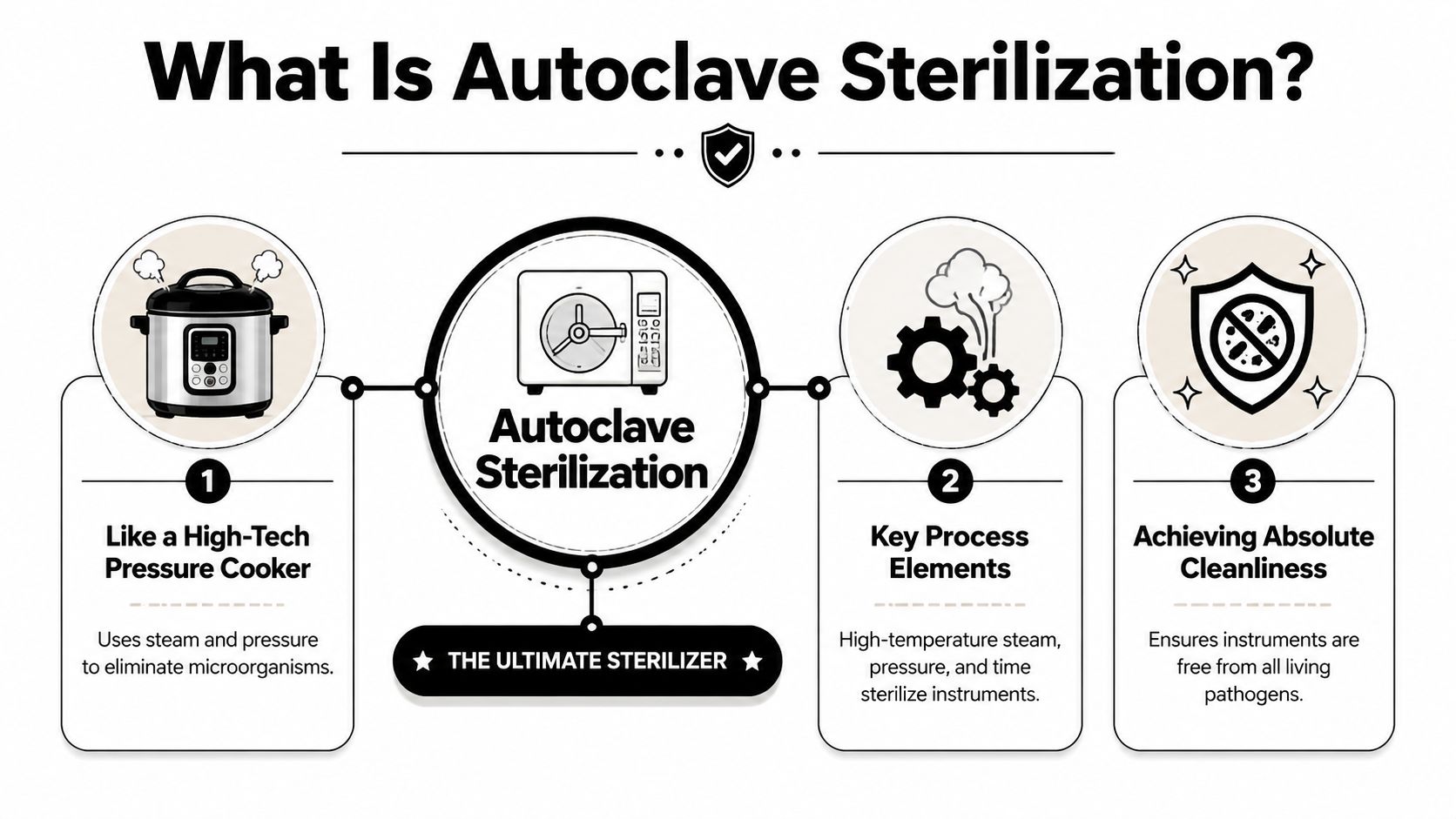
An autoclave is easiest to understand if you think of it as a high-tech pressure cooker for sterile instruments. It doesn't just heat items. It uses pressurised saturated steam to reach the conditions needed to destroy microorganisms on properly prepared tools.
Clean isn't the same as sterile
Understanding the differences can be a source of confusion. Cleaning removes visible dirt, residue, and debris. Disinfecting reduces some harmful microorganisms on surfaces. Sterilisation is the higher bar. It means the process is designed to eliminate all microbial life on the instrument.
That distinction matters in piercing because instruments can have hinges, grooves, and tiny hard-to-reach areas. Wiping a tool or soaking it in liquid doesn't give the same level of assurance as a validated steam sterilisation cycle.
In the UK, archived but foundational Scottish Health Technical Memorandum guidance states that 134°C using saturated steam under pressure is the preferred sterilisation point for clinical instruments, and the same reference also notes the need for records of each cycle and weekly biological indicator testing in relevant settings such as piercing studios, as set out in the Scottish Health Technical Memorandum SHTM 2010 Part 1.
Why steam matters so much
Boiling water sounds strong because it's hot, but autoclave sterilization goes further. The machine controls steam, pressure, temperature, and time so the sterilising conditions reach instrument surfaces properly and consistently.
That's why professionals rely on autoclaves rather than improvised methods. A proper autoclave cycle is repeatable. It can be monitored. It can be tested. It can be documented.
A simple way to think about it is this:
- Boiling cleans poorly for clinical use and doesn't provide the same validated outcome.
- Disinfectant is useful for surfaces, not as a substitute for instrument sterilisation.
- Autoclave sterilization is the medical-grade process used when sterility matters.
A piercing client doesn't need to know every machine setting. You do need to know that “we sanitise everything” isn't the same as “we sterilise instruments in an autoclave”.
The Four Pillars of Sterilization
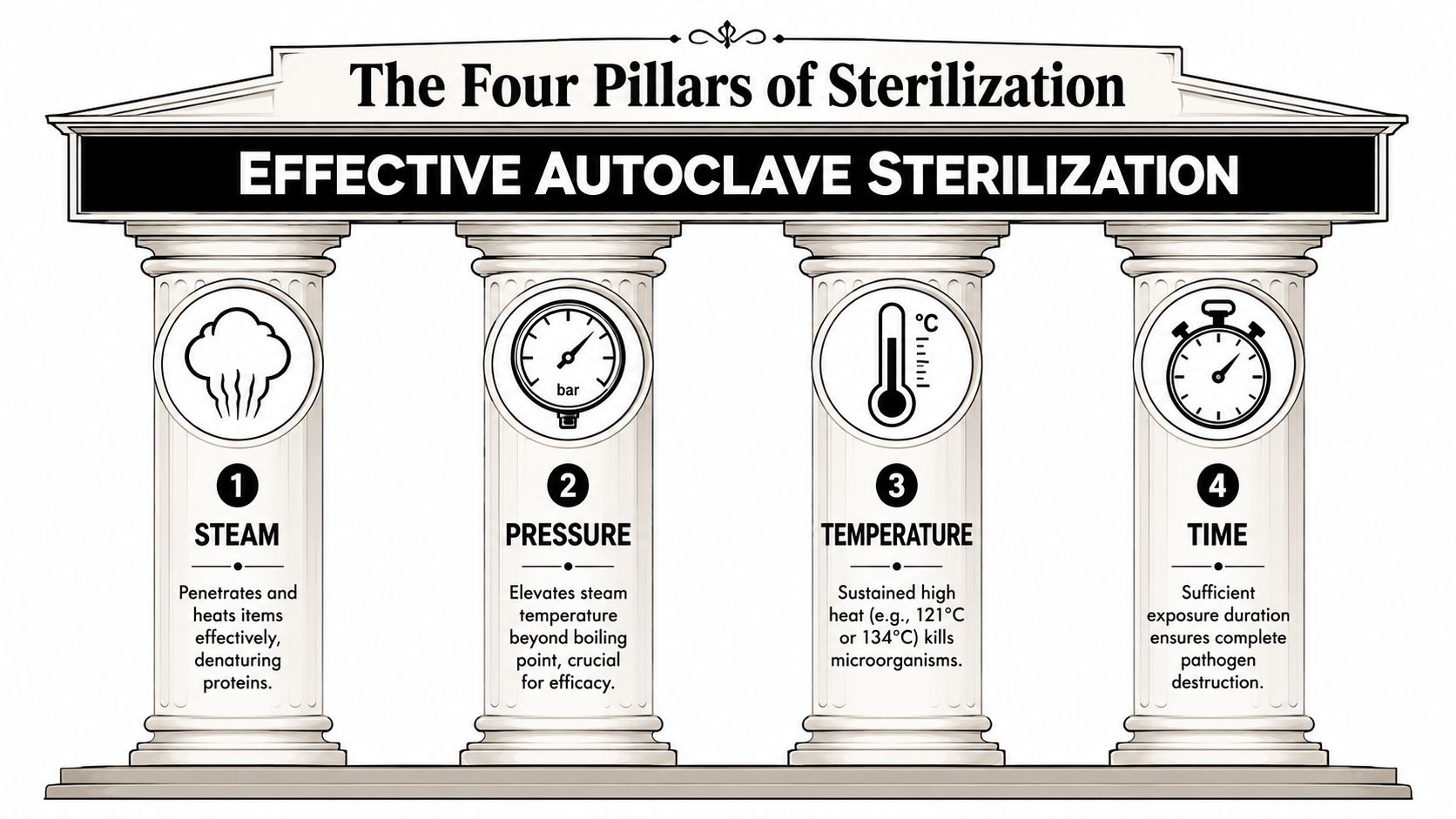
Autoclave sterilization only works when four things come together properly. If one fails, the whole cycle is questionable. That's why experienced piercers treat sterilisation as a controlled system, not a rough routine.
Steam
Steam is the working part of the process. It carries heat into the surfaces of the instrument, including awkward shapes that matter in clinical tools. Dry air doesn't transfer heat the same way, which is why air removal and steam penetration are so important in a proper cycle.
If a tool is packaged badly, overloaded, or positioned incorrectly, steam may not reach every surface as intended. That's one reason operator training matters so much.
Pressure
Pressure isn't there for show. It allows the steam environment inside the chamber to reach sterilising conditions above normal boiling point. Without the right pressure, the machine can't create the conditions needed for reliable sterilisation.
For a client, this means the machine itself has to be designed for the job. A random heated box or countertop gadget is not an autoclave just because it gets hot.
Temperature
This is one of the clearest areas where standards matter. In UK guidance for dental and medical practice, Type B autoclaves are required for hollow instruments and complex loads, and sterilisation is specified at 134–137°C with a minimum holding time of 3 minutes under pressurised steam in HTM 01-05 guidance summarised here.
That tells you something important. The temperature isn't guessed. It's set, measured, and tied to the type of load.
Time
Heat has to be maintained for long enough to do the job. A short burst of high heat isn't the same as a validated sterilisation cycle. Time is part of the science, not an optional extra.
Different materials and loads can require different cycle parameters. That's one reason professional studios separate what must be single-use from what can be safely reprocessed. If you want to understand why studios rely so heavily on disposable sharps, this guide to single-use needles in piercing is worth reading.
Why all four have to work together
A useful way to see it is as a chain:
| Pillar | What it does | What goes wrong if it fails |
|---|---|---|
| Steam | Reaches and heats instrument surfaces | Some areas may not be effectively sterilised |
| Pressure | Creates the right steam conditions | The cycle may never reach proper sterilising performance |
| Temperature | Delivers lethal heat to microorganisms | The process may be too weak |
| Time | Holds conditions long enough | Microorganisms may survive |
If a studio talks only about “high heat” but never about packaging, loading, testing, or cycle control, that's an incomplete picture.
How Studios Prove Sterilization Works
A machine isn't safe because it exists in the room. It's safe because the studio can prove it's working. Good infection control always comes down to evidence.
What you can see straight away
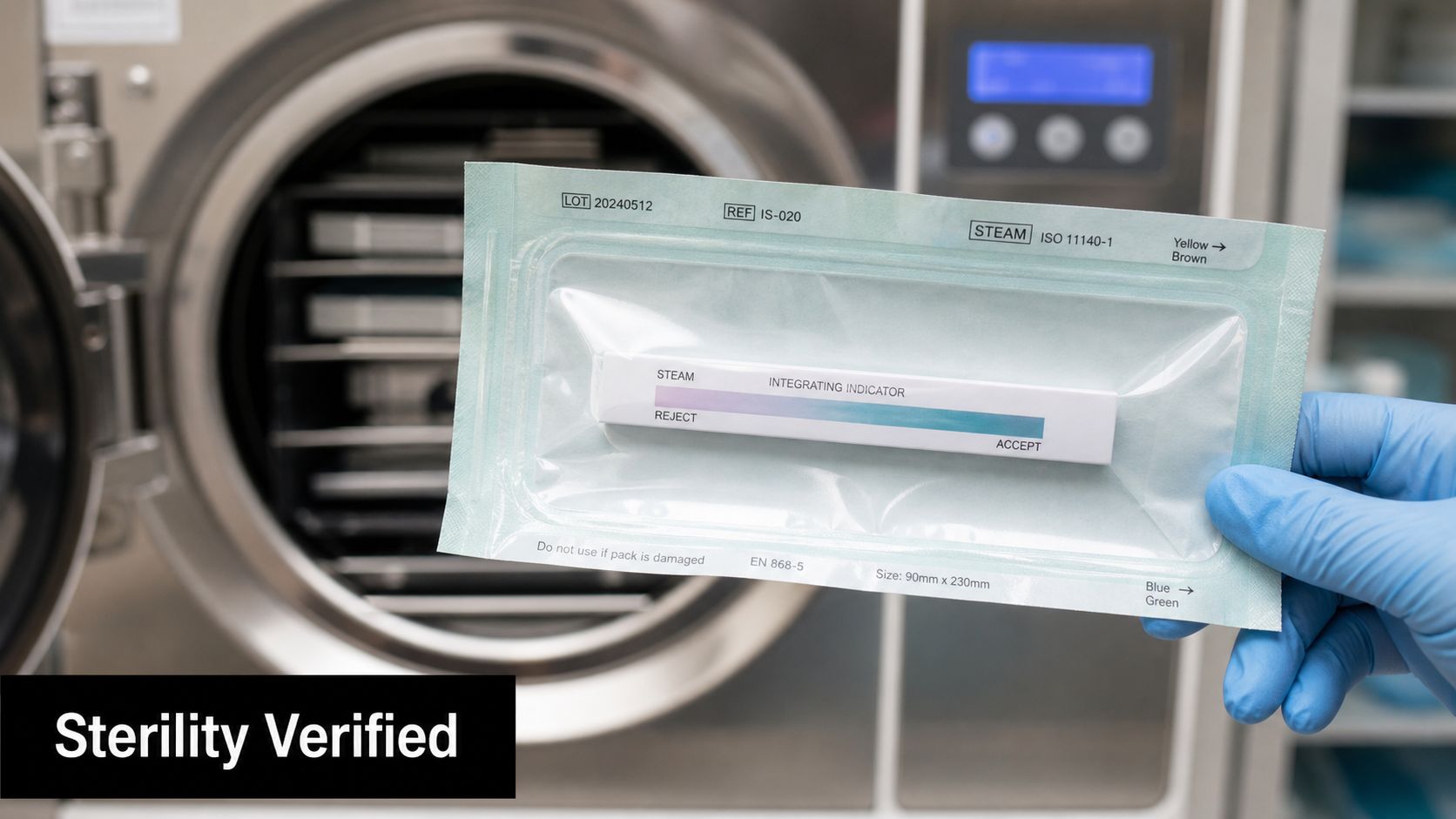
The easiest sign for a client to spot is the sterile pouch. Instruments that have been processed are typically sealed in pouches before use. Those pouches often carry a chemical indicator, which changes appearance after exposure to the cycle.
That indicator matters, but it has limits. It shows the pouch has gone through a process. It doesn't, by itself, prove the entire load achieved sterility inside every package.
Here's the practical difference:
- Chemical indicators help confirm exposure to the cycle.
- Cycle records show what machine run took place.
- Biological testing gives the strongest proof that the sterilisation conditions worked.
The test that matters most
The strongest routine proof is the biological indicator, often called a spore test. It uses highly resistant spores to check whether the autoclave cycle was effective. If the spores don't survive, that's powerful evidence the cycle did what it was supposed to do.
UK guidance highlighted in the legal and regulatory summary requires autoclaves to follow Installation Qualification, Operational Qualification, and Performance Qualification under ISO 17665-1:2006, and this validation framework is used to achieve a Sterility Assurance Level of 10⁻⁶, meaning a one-in-a-million probability of a single viable microorganism surviving the cycle, as described in the UK legal and regulatory summary for sterilisation equipment.
That sounds technical, but the meaning is simple. A proper sterilisation system isn't based on hope. It's based on validated performance.
The machine itself also needs checking
Vacuum steam autoclaves also need tests that check the machine's function, not just the outcome on a pouch. You may hear a piercer mention a Bowie-Dick test. That's used to check whether air removal and steam penetration are working properly in vacuum-type units.
A well-run studio also keeps records. Operators should be able to show that cycles are logged and that servicing, testing, and maintenance are part of normal practice rather than something they do only when an inspector is due.
Ask a simple question: “How do you know your autoclave is working properly?” A strong answer will mention testing, records, and routine checks. A weak answer will just say, “It always works.”
Your Safety Checklist in a Piercing Studio
When you walk into a studio, you don't need to inspect it like a regulator. You only need a practical checklist that helps you tell the difference between reassuring talk and professional standards.
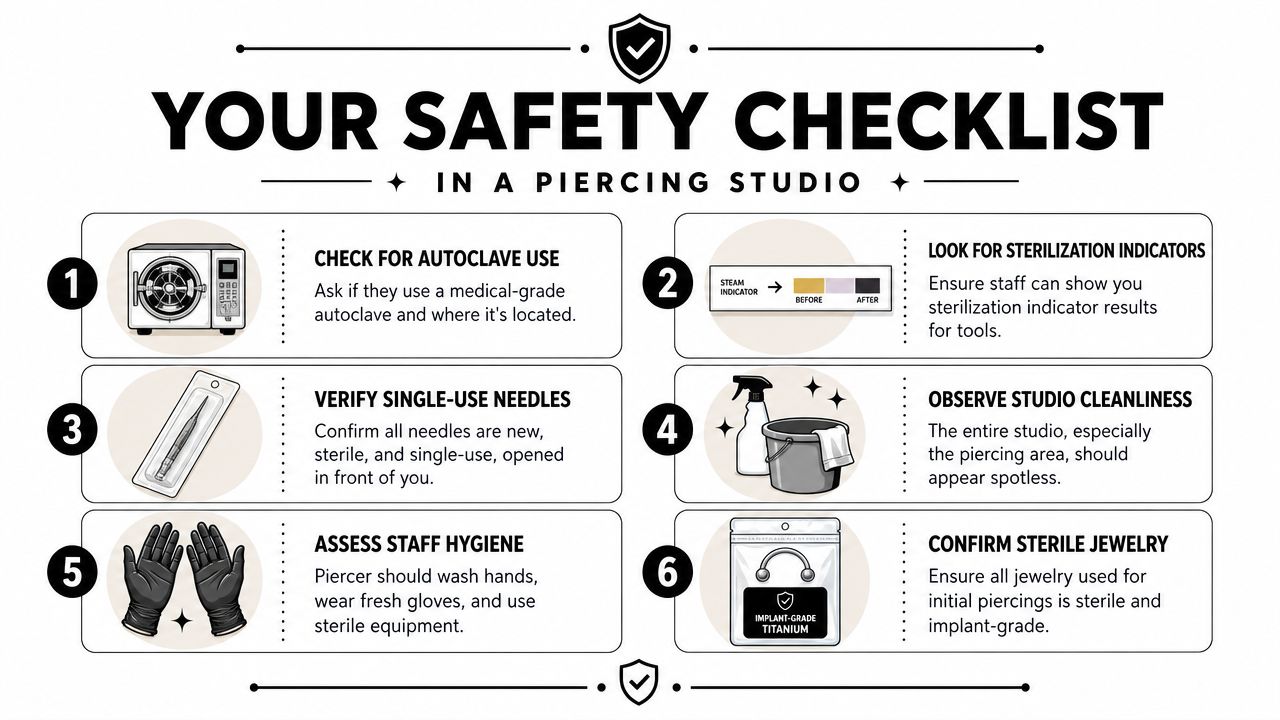
What to look for before you sit down
Start with what's visible. The room should look organised, the work area should be clean, and the piercer should set up methodically rather than rushing. Fresh gloves, a tidy tray, and sealed items opened in front of you are all good signs.
For equipment, UK law matters too. Under the UK Medical Devices Regulations 2002, autoclaves in professional studios must legally bear the UKCA mark and comply with BS EN 13060:2014+A1:2018 for small steam sterilizers, as stated in the summary of legal requirements for UK autoclaves.
Questions worth asking
A professional studio should be comfortable with questions like these:
- Do you use an autoclave on site? A clear yes should come with a straightforward explanation.
- Are instruments opened from sealed sterilisation pouches in front of me? You should be able to see this happen.
- Do you use single-use needles? The answer should also be yes, with the package opened in front of you.
- Do you carry out spore testing and keep records? They don't need to give you a lecture, but they should answer confidently.
- Can you explain your hygiene process? A professional piercer should be able to explain it in plain English.
If you're comparing studios, this directory of professional piercers near you can help you narrow your options before you book.
A simple client checklist
Use this when you arrive:
| Check | What you want to see |
|---|---|
| Needles | New, sterile, single-use, opened in front of you |
| Jewellery | Sterile for the procedure and suitable for initial piercing |
| Pouches | Sealed until use, with an indicator visible |
| Work area | Clean, uncluttered, prepared before the procedure |
| Piercer hygiene | Hand hygiene, fresh gloves, controlled setup |
| Answers | Calm, informed, transparent responses to your questions |
A good studio won't try to make you feel silly for asking. Safe practice stands up well to scrutiny.
If you want to ask questions before choosing a studio, call 01202 9000 50 or message 07752913846 on WhatsApp.
Common Myths About Sterilization Debunked
Unsafe advice often sounds confident. That's why it helps to know the difference between a method that sounds clean and one that actually meets the standard expected for piercing instruments.
Myth one boiling water makes tools sterile
Boiling is not the same as autoclave sterilization. Heat alone isn't enough unless it's delivered under the right controlled conditions for the right load. UK guidance for different materials shows this clearly. For example, solid biohazardous waste has a mandatory cycle of 121°C for 20 minutes, with a total autoclave processing time between 60 to 120 minutes, according to the Loughborough University autoclave operating procedure.
That doesn't mean piercing tools use that same waste cycle. It proves something simpler. One cycle does not fit all, and sterilisation isn't just “get it hot somehow”.
Myth two disinfectant wipes are enough for needles or tools
Disinfectant wipes have an important role on environmental surfaces. They do not replace a validated instrument sterilisation process. A wiped tool may look immaculate while still falling short of the standard needed for something that will enter freshly pierced tissue.
That's one reason professional studios also rely on disposable sharps. If you're weighing up studio methods, this guide on piercing gun vs needle helps explain why the tool choice matters as much as the hygiene process.
Myth three UV boxes sterilise jewellery and equipment
UV devices can sound scientific, but they don't replace autoclave sterilization for piercing instruments. Light only works where it directly reaches. Jewellery settings, threaded areas, hinges, and shaded surfaces create obvious limitations.
If a studio presents a UV box as its main sterilising method for instruments, that should raise concerns.
Myth four if the studio looks clean the process must be safe
A clean-looking room is good. It isn't proof of sterilisation. Infection control depends on systems, not appearance alone. A minimalist studio with spotless counters can still have poor instrument handling. A less flashy studio can run excellent documented procedures.
Cleanliness is what you notice first. Sterility is what protects you.
Book Your Piercing with Confidence
The safest clients aren't the ones who know loads of technical jargon. They're the ones who know what standard to expect.
If a studio uses proper autoclave sterilization, opens sterile items in front of you, answers questions clearly, and treats hygiene as essential, you can sit down with far more confidence. That's what professional piercing should feel like. Calm, organised, and transparent.
Don't settle for vague promises like “everything's sanitised”. Ask how instruments are sterilised. Ask what testing is done. Ask to see sealed pouches opened in front of you. Those are normal questions, and a good studio will respect them.
If you're looking for a safe and professional piercing experience in Bournemouth or Croydon, call 01202 9000 50 or send a WhatsApp message to 07752913846.
If you're ready to choose a studio with safety in mind, Piercing Near Me helps you find trusted professional piercing services with a focus on clean practice, experienced piercers, sterile single-use needles, and supportive aftercare.
Trackbacks/Pingbacks