
You've just had your belly button pierced, gone home, and now every little thing feels important. Is that small bit of redness normal? Can your waistband touch it? Do you need to clean it more because it's cold, damp, and you're layered up in a hoodie and high-waisted joggers?
That uncertainty is normal. A fresh navel piercing looks simple from the outside, but healing one well takes patience, a steady routine, and a bit of restraint. Belly button piercing aftercare isn't about doing more. It's about doing the right things consistently and avoiding the habits that cause irritation.
At Timebomb Tattoo & Piercing, the clients who heal best aren't always the ones who fuss over it most. They're the ones who understand what a navel piercing needs in a UK setting: breathable clothing, gentle cleaning, no unnecessary touching, and realistic expectations through a long healing window.
Your New Piercing Journey Begins
Congratulations on the new piercing. It's one of those placements that can look settled quite quickly, while still being very much in the healing phase underneath. That mismatch is what catches people out.
A navel piercing sits in a part of the body that bends, twists, rubs against clothing, and traps moisture more easily than many other piercings. That's why belly button piercings have a minimum healing time of 6 to 9 months, with full recovery sometimes taking 12 months, as noted in NeilMed's navel piercing aftercare guidance. It's also why this piercing needs more patience than an ear piercing.
What healing really asks of you
The first job is simple. Keep it clean, keep pressure off it, and don't interfere with the jewellery. Most healing problems start when people assume “it looks fine” means “it's healed.”
For first-timers, one of the most useful things you can do is learn the difference between healing time and feeling time. It may feel calmer long before the tissue channel is mature.
Practical rule: Treat your new navel piercing like a healing wound with jewellery in it, not like a finished accessory.
Why UK clients need a slightly different mindset
Generic aftercare advice often skips the reality of living in the UK. In Croydon or Bournemouth, your piercing isn't healing in beachwear all year. It's healing under knitwear, waistbands, shapewear, winter layers, and damp-weather clothing that can hold heat and moisture against the area.
That matters. Friction and trapped moisture don't always create immediate drama, but they can keep a piercing stuck in a cycle of low-grade irritation. If you're still deciding whether this placement suits your age and situation, the UK guidance on belly button piercing age considerations is worth a look.
The right expectation from day one
A smooth heal doesn't mean a perfectly pretty piercing every day. Some tenderness, light crusting, and occasional flare-ups after a knock can happen during the journey. What matters is the overall direction. Calm, steady, and slowly improving is what you want.
If you start with that expectation, you're far less likely to panic, over-clean, or change the jewellery too soon.
The Essential Daily Cleaning Routine
Good aftercare is repetitive on purpose. The best routine is the one you can stick to morning and night without improvising.
For a new navel piercing, sterile saline (0.9% sodium chloride) is the main aftercare product most UK piercers recommend, and the NHS advises keeping a new piercing clean and avoiding unnecessary handling. That's why I keep belly button piercing aftercare very plain: sterile saline, clean hands, and minimal disturbance.
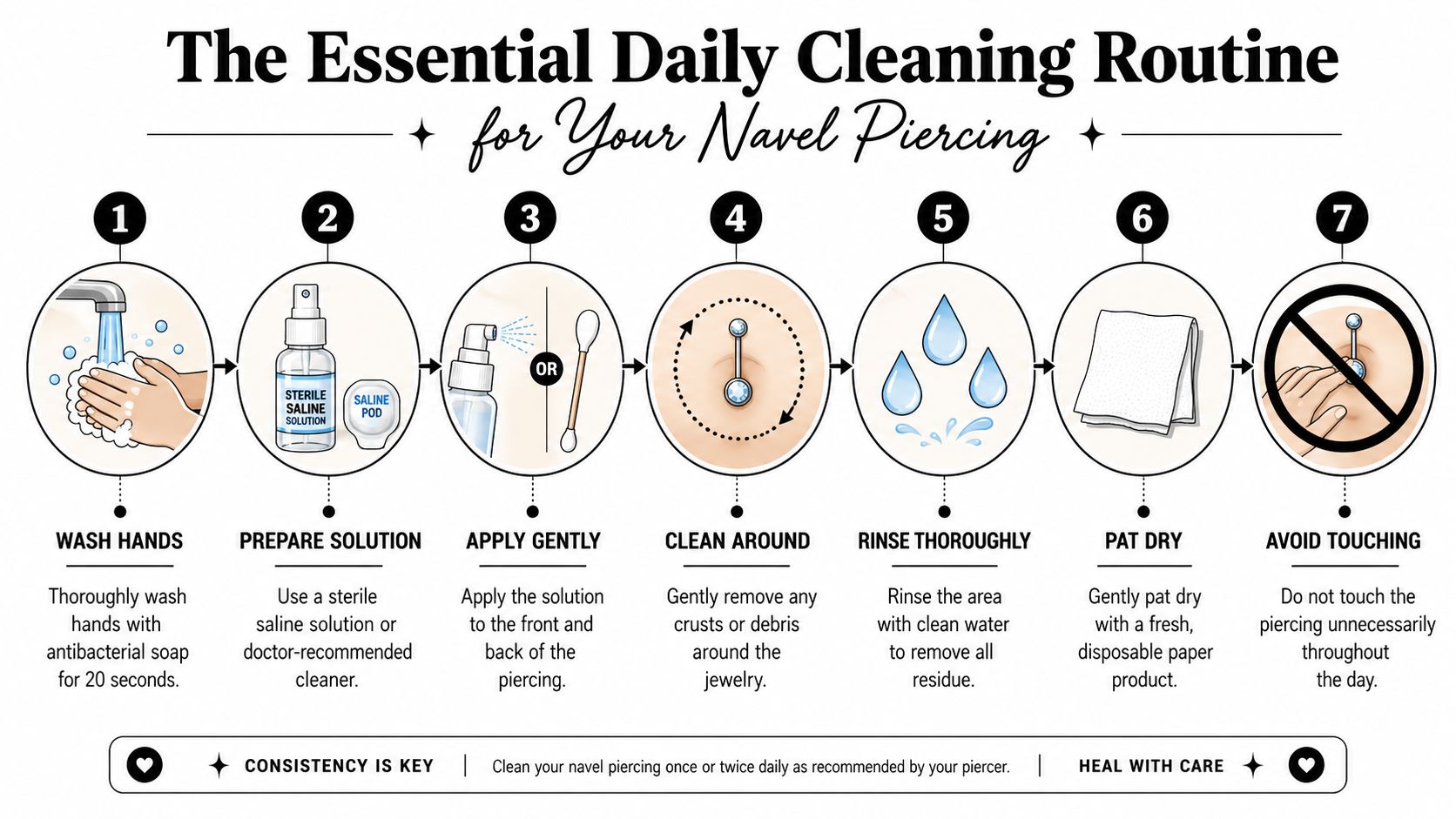
The routine that works
Follow this sequence twice a day.
Wash your hands first. Use antibacterial soap and wash for 20 seconds before you touch the area. Dirty hands undo good aftercare fast.
Rinse away any residue. If there's shower product, sweat, or dried discharge around the area, let warm water run over it gently.
Use the right saline. Choose a sterile wound-wash saline labelled 0.09% sodium chloride with no added antibacterials, moisturisers, perfumes, iodine, or preservatives.
Spray, don't scrub. Apply the saline to the piercing and let it sit. Don't rub the jewellery back and forth.
Leave softened debris alone unless it lifts easily. If crust has loosened, you can remove it gently. If it's stuck, don't pick at it.
Let it air-dry. That's the preferred finish. If you need to dry the area, use a fresh disposable paper product very gently.
Hands off again. Once it's clean, leave it alone.
For a fuller walkthrough of safe technique, this guide on how to clean a new piercing is a useful companion.
What not to use
Most of the trouble comes from people adding products that feel “stronger” but heal worse.
- Avoid alcohol-based antiseptics: They're too harsh for a healing piercing.
- Skip hydrogen peroxide: It can irritate healing tissue.
- Don't use ointments: They smother the area.
- Avoid scented soaps and skincare: Fragrance and additives often trigger irritation.
Leave the jewellery still. A navel piercing doesn't heal better because you “work the saline in” by twisting it.
Over-cleaning is still irritation
Twice daily is enough. More is not better. Over-cleaning can slow healing, because repeated disturbance affects the natural barrier the skin is trying to rebuild.
If you've had a sweaty day or the area feels grubby, rinse it in the shower. Don't turn that into a full extra cleaning routine every time.
One detail most people miss
The goal isn't to make the piercing look dry and spotless all day. The goal is to keep the site clean without stripping it. A small amount of dried lymph can be part of normal healing. Aggressively chasing every speck of crust is one of the quickest ways to keep a navel piercing angry.
Adapting Your Lifestyle for Safe Healing
Daily life is where most navel piercings get irritated. Not during cleaning. Not in the studio. At home, at the gym, in the car, and under clothes that looked harmless until they pressed on the bar all day.

A common UK scenario goes like this: the piercing was fine in a loose top, then winter arrived. Suddenly it's under thermal layers, tights, fitted jeans, and waistbands that sit right on the jewellery. The area stays warm, slightly damp, and under pressure. It doesn't always look infected. It just never gets the quiet conditions it needs.
Tight waistbands and high-waisted winter clothing can rub a healing navel piercing, so loose, breathable clothing helps, especially in colder months. That's why “clean and dry” on its own isn't enough advice for UK clients.
What to wear in real life
Loose, breathable fabrics help. Tight synthetic waistbands, shapewear, and high-friction sportswear don't.
A few practical swaps make a real difference:
- Choose softer waistlines: Low-pressure joggers, loose pyjama bottoms, and breathable cotton tend to behave better than stiff denim.
- Watch winter layering: If you're wearing multiple fitted layers, check whether the piercing is being compressed for hours.
- Be careful with high-waisted outfits: If they press directly on the top bead, expect irritation.
- Change out of damp clothing quickly: Sweat and trapped moisture can keep the area unsettled.
Showering, movement, and exercise
Showers are fine. Long baths and soaking aren't what you want during healing.
Core-heavy training can also be a nuisance with this placement. Repeated bending, sit-ups, tight waistbands, and anything that drags or catches the jewellery can keep the channel irritated. If exercise is part of your routine, think less about “can I train?” and more about “what will rub, bend, or trap sweat against it?”
A navel piercing usually prefers a boring routine. Predictable clothing, gentle showers, and fewer knocks heal better than bursts of intense activity followed by lots of fussing.
The non-negotiable rule on swimming
This one catches people out because holidays, spas, and beach days don't wait for piercing timelines. Your piercing still does.
Clients need to avoid swimming in pools, hot tubs, Jacuzzis, beaches, ponds, and lakes for the full healing period of 6 to 12 months, as set out in Urban Body Jewelry's navel aftercare guidance.
Sleeping and the small habits that matter
Stomach sleeping, absent-minded picking, and repeatedly checking the jewellery in the mirror all count as irritation. None of them look dramatic in the moment. Together, they slow things down.
If you want the simplest lifestyle rule, it's this: reduce pressure, reduce moisture, and reduce movement.
Understanding the Healing Timeline and Jewellery
Patience matters more with a navel piercing than commonly expected. A lot of clients judge healing by the skin they can see. The tissue under that surface follows its own schedule.
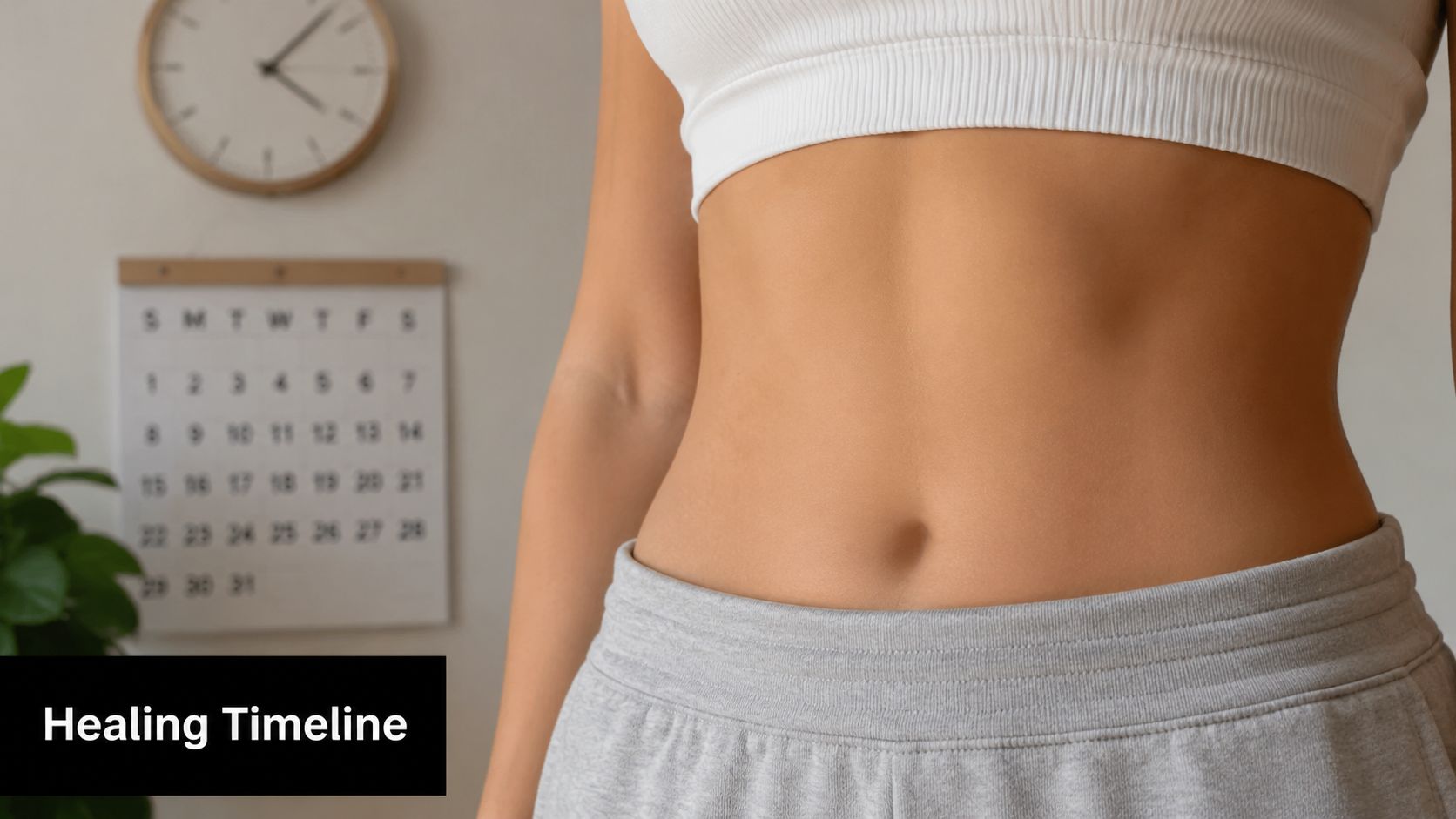
A belly button piercing typically takes 6 to 12 months to fully heal, and minor inflammation or crusting at the 6-month mark is common. That should reassure you if yours still has occasional crusting or mild irritation months in. It may be frustrating, but it isn't unusual.
If you want a more focused breakdown, this guide to navel piercing healing time is worth reading alongside your aftercare routine.
What early healing looks like
At the start, tenderness, local redness, and light crusting can all happen. Then the piercing often calms down enough to fool people into thinking they're done.
That's where false healing becomes a problem. The outside can look settled while the inside remains delicate. The jewellery may move more easily, the skin can appear smooth, and you might think a shorter bar or prettier jewellery would be fine. That assumption causes a lot of setbacks.
Why changing jewellery too soon causes trouble
Changing jewellery too early is one of the most common causes of irritation and migration. Unless your piercer advises a downsize, waiting until at least 6 months before changing jewellery yourself is the safer approach.
That's why a professional reassessment matters. Surface appearance is not enough.
Don't judge readiness by “it looks healed.” Judge it by time, stability, absence of irritation, and an in-person check if you're unsure.
Start with the right jewellery and leave it alone
Initial jewellery quality matters. In UK practice, implant-grade titanium or 316L surgical stainless steel is the standard you want for a fresh navel piercing, alongside sterile single-use equipment and proper studio hygiene.
There's also a very simple mechanical reason to leave jewellery alone: repeated movement irritates the healing channel and can lead to migration or raised scarring. A navel piercing doesn't benefit from routine twisting, testing, or “just checking if it's stuck.”
What healed actually looks like
A healed navel piercing is quiet. No regular crusting, no active redness, no tenderness, and no pain during normal movement. The jewellery sits naturally without the skin looking shiny, stretched, or thinned.
If the surface looks smooth but the area still flares after clothing pressure, catches easily, or feels sore after a jewellery nudge, assume it's still healing. That mindset saves a lot of revision appointments.
Troubleshooting Common Piercing Problems
Most problems aren't true infections. They're irritation, pressure, friction, over-cleaning, or jewellery that's being moved around more than the wearer realises. That's good news, because irritation can often settle when the cause is removed.
It's also why guessing with home remedies causes more damage than it fixes.
Normal healing versus a problem
A healing navel piercing can produce light crust, look slightly pink, and feel a bit sore if it's knocked. That can be normal. What deserves attention is a change in pattern. Increasing redness, worsening pain, spreading heat, thicker coloured discharge, or a piercing that starts to look shallow should never be brushed off.
If you're worried, don't try to self-diagnose with internet hacks. Get it checked.
The biggest mistakes I see
Avoid smothering the piercing with ointments or creams, which can trap bacteria against the wound. Keep movement to a minimum, too, because constant knocking and twisting irritates the channel.
Those two mistakes explain a huge amount of what looks like “random” trouble.
What works: saline, patience, breathable clothing, and reducing friction.
What doesn't: tea tree oil, thick creams, alcohol wipes, twisting the bar, and changing jewellery because the top hole looks neat.
Belly Piercing Aftercare Do's and Don'ts
| Do | Don't |
|---|---|
| Wash hands before cleaning | Touch it absent-mindedly during the day |
| Use sterile saline with 0.09% sodium chloride | Use alcohol, peroxide, or scented products |
| Let the jewellery stay still | Rotate, twist, or slide the bar |
| Wear loose, breathable clothing | Keep it under tight waistbands or shapewear |
| Shower and rinse gently | Soak it in baths, pools, or hot tubs |
| Ask a piercer if healing seems off | Apply ointments to “help it along” |
When to stop waiting and get help
If the area looks progressively worse rather than slowly calmer, get in touch. If the skin appears to be thinning over the bar, if the top bead sits differently, or if the piercing suddenly becomes much more reactive, it's time for a proper assessment.
For non-urgent checks, you can WhatsApp a clear photo to 07752 913846 (Bournemouth) / 07902 490584 (Croydon). For immediate concerns, call 01202 900050 (Bournemouth) / 020 8686 7730 (Croydon). If you're local to Bournemouth or Croydon, getting an experienced piercer to look at it in person is always safer than trying random products at home.
Frequently Asked Aftercare Questions
I knocked it. Have I ruined it
Usually, no. A snag or knock can make it sore, red, or slightly swollen for a bit. Go back to calm aftercare: saline, no touching, and looser clothing for the next few days. If the jewellery looks displaced or the skin starts thinning, get it checked.
Is a little bleeding normal at the start
A small amount can happen early on, especially if the area catches or gets bumped. What matters is whether it settles. Ongoing bleeding or bleeding with visible trauma needs a proper look.
Can I cover it with a plaster for sport
Only if you've had direct advice to protect it for a specific reason, and even then you need to be careful. Covering a healing navel piercing can trap moisture and friction against the site. In day-to-day life, breathable clothing is usually the better option.
It looks healed on the outside. Can I change it now
Not based on appearance alone. Navel piercings often look calmer before the internal tissue is ready. If you're tempted to change it because the outside seems smooth, that's exactly when many people set themselves back.
What if there are crusties after months
That can still happen during a long navel healing cycle. Don't pick at them. Keep the routine gentle and pay attention to whether things are gradually improving overall.
Should I clean it more in winter
Not automatically. The bigger winter issue is often clothing pressure and trapped moisture, not a need for extra product. Keep the routine consistent, and put your effort into choosing softer waistbands and changing out of damp layers quickly.
If you're looking for trusted UK guidance and a safe place to book with experienced piercers, Piercing Near Me helps you find professional studios, clear aftercare advice, and support for every stage of healing. If you need help with a navel piercing, jewellery questions, or choosing a reputable studio in Croydon or Bournemouth, it's a strong place to start.
Trackbacks/Pingbacks