
You've chosen a placement, saved a few photos, and started comparing tiny discs, gems, and gold-tone tops. The part that deserves the most attention, though, is easy to overlook: the dermal piercing jewellery sitting in your skin. A beautiful top can't compensate for an unsuitable alloy, rough finish, poor fit, or inadequate sterility.
A dermal anchor isn't like an earring that passes through a soft lobe and can be removed casually. Its base sits beneath the skin, so material quality, sizing, placement, and aftercare all work together. This guide translates UK jewellery-safety rules into practical questions you can ask before booking in Croydon, Bournemouth, or elsewhere.
Why Your Dermal Jewellery Choice Matters More Than You Think
A client might arrive at a studio focused on whether a small star or a flat gem will look best against the collarbone. An experienced piercer will also consider the base beneath that decoration, the attachment's height, the metal's documented composition, and how clothing or hair will move across the site. The visible top creates the style, but the hidden anchor has a much larger influence on comfort and longevity.
The first piece remains in a fresh wound while the surrounding tissue settles. That means the jewellery needs to be sterile, appropriately sized, smooth, and made from a suitable material. A rough join can rub. A tight top can create pressure. An unknown alloy can irritate sensitive skin. A base that doesn't suit the available tissue or movement around the placement may contribute to migration.
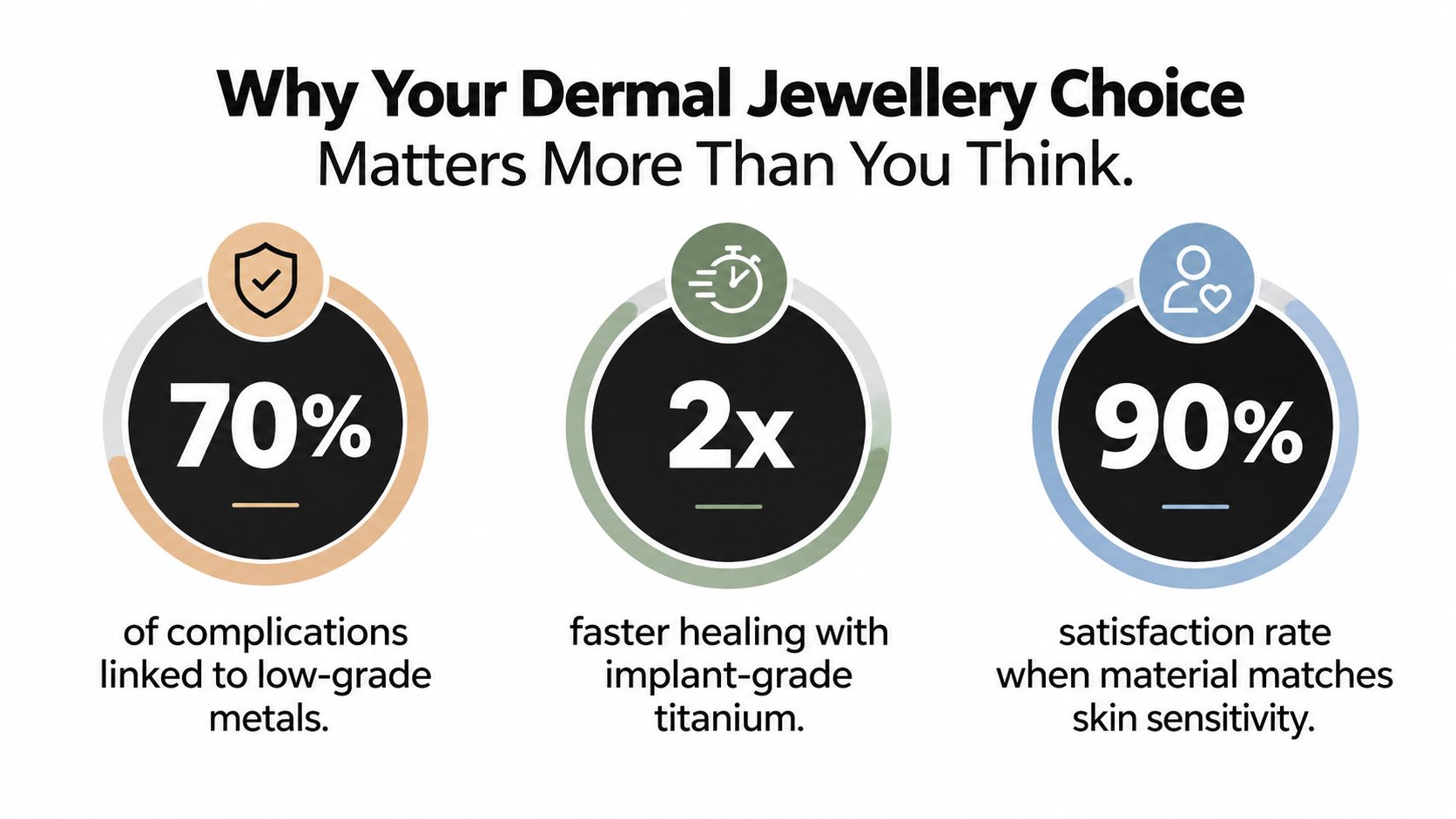
The available England-wide evidence isn't specific to dermal anchors, but it shows why careful selection matters. Among 754 non-earlobe piercings reported by people aged 16–24, 233 involved a complication, representing 31.0%, with a 95% confidence interval of 26.8% to 35.5%. Professional medical help was sought for 115 piercings, or 15.2%, and seven cases, or 0.9%, required hospital admission. The figures come from a major England-wide study of non-earlobe piercing outcomes, and they must not be treated as a dermal-specific complication rate.
| Outcome | Reported cases | Share of sample |
|---|---|---|
| Complication | 233 | 31.0% |
| Professional medical help | 115 | 15.2% |
| Hospital admission | 7 | 0.9% |
Practical rule: Treat the first dermal piece as medical-contact jewellery with a decorative function, not as an accessory added at the end.
The safest decision therefore starts before colour, gemstone shape, or matching with your other piercings. Ask what the anchor is made from, how the studio verifies sterility, whether the footprint suits your anatomy, and what follow-up support is available if healing changes.
How a Dermal Anchor Actually Works Under the Skin
Think of a dermal anchor as a small hook beneath a surface rather than a ring passing through a tunnel. The base plate sits under the skin, a short post reaches the surface, and the visible top attaches to that post. These parts perform different jobs, so choosing the top doesn't replace the need to assess the anchor.
A conventional piercing has an entrance and an exit. A dermal has one visible opening, with the base held beneath the skin by its shape and the tissue that grows around it. Some anchors use a compact single-hole foot, while others use a broader plate with more than one opening. The piercer chooses between these designs according to the placement, available tissue, movement, and the amount of stability required.
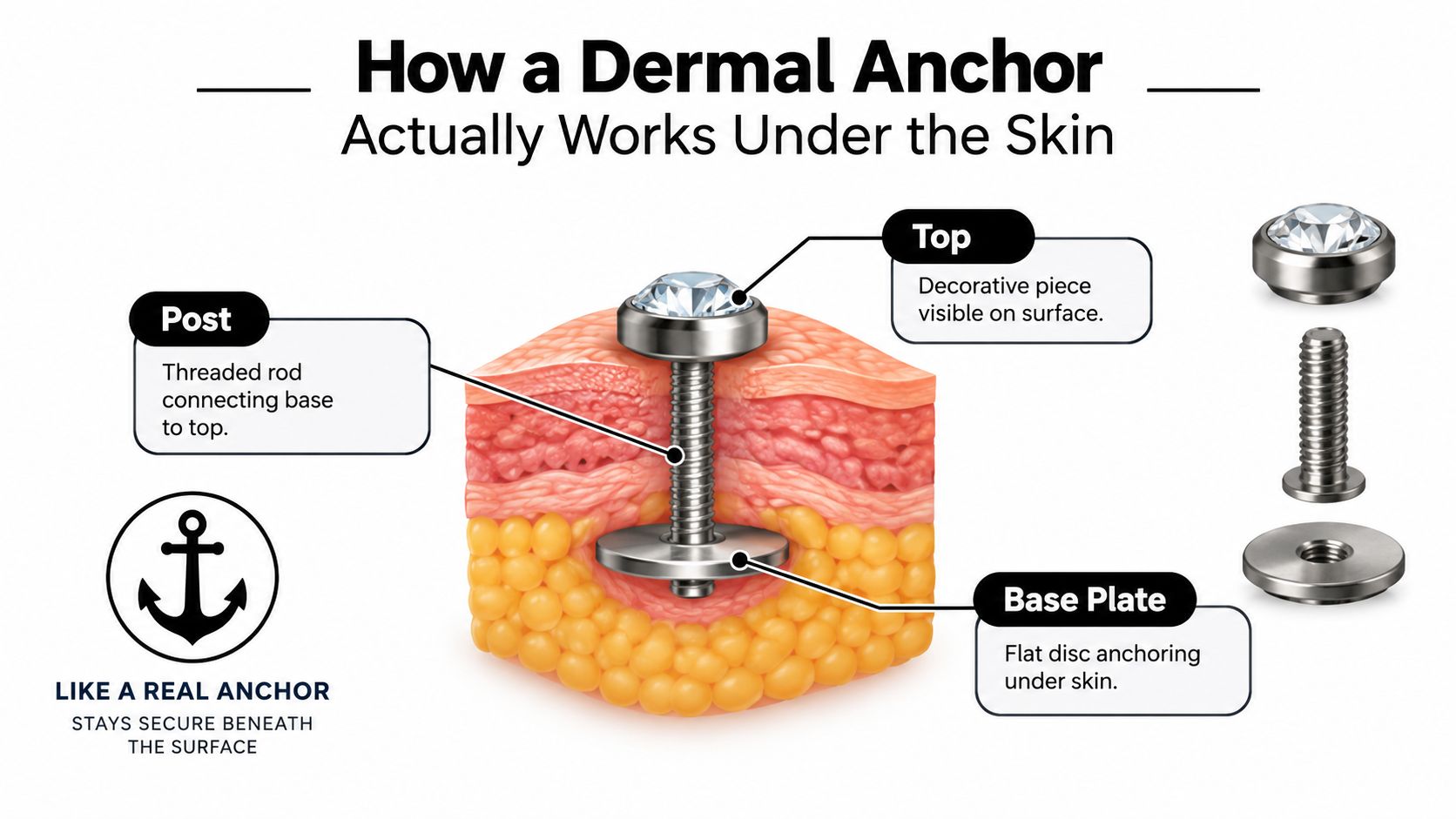
The three parts to understand
Base plate: This is the section beneath the skin. Its shape and footprint affect how it distributes pressure and how securely it sits.
Post: This connects the buried base to the top. Its diameter needs to work with the channel created during insertion, and its threading must match the top.
Top: This is the visible, removable decoration on many dermals. It can be a disc, ball, gem, or another low-profile design, but it still needs a suitable finish and secure attachment.
A top that looks small may still sit high if its threaded connection or underside is bulky. Conversely, a broad, flat top can spread contact across the skin but may be inconvenient if it catches on clothing. The piercer should assess the complete assembly, not only the part visible in a photograph.
For a more detailed introduction to the buried base and surface attachment, see this guide to microdermal anchor piercing. Don't try to swap a top while the anchor is unsettled, and don't force a thread that doesn't engage smoothly. A tiny component can still create substantial mechanical irritation when it sits against healing tissue.
Top Styles and How They Behave in Real Life
A dermal top should suit the life of the placement. A raised claw-set gem may look striking in a studio mirror, but it can become a snag point behind the ear or beneath a strap. A flat disc may appear understated, yet its low profile often makes daily contact easier to manage.
| Top style | Snag risk | Profile on skin | Best suited to |
|---|---|---|---|
| Flat disc | Low | Flush or low | Areas beneath clothing, straps, or frequent contact |
| Small ball | Low to moderate | Rounded and compact | Exposed placements with limited rubbing |
| Single claw-set gem | Moderate | Raised at the stone | Low-friction areas where sparkle is the priority |
| Flat gemmed disc | Low to moderate | Low with surface sparkle | Chest, collarbone, or careful everyday wear |
| Cluster or sculpted shape | Moderate to high | Raised or irregular | Stable, visible placements with little snagging |
Behind the ear, hair, masks, collars, and glasses can all brush the top. A compact disc or smooth ball is usually easier to live with than a pointed shape. On the chest, a low-profile gemmed disc may provide shine without creating a prominent edge beneath a shirt.
The lower back presents a different problem. Waistbands, belts, furniture, and sleeping positions can apply repeated pressure. A decorative top with several raised points gives those forces more surfaces to catch. The final choice still depends on anatomy and the piercer's assessment, but a smoother profile is often the sensible starting point where pressure is unavoidable.
Match the top to movement
A top shouldn't be judged only while standing still. Bend, sit, dress, sleep, exercise, and consider whether hair or clothing will repeatedly cross it. A threaded join should sit securely without a visible gap that traps debris, while the underside should be smooth enough not to scrape the surrounding skin.
You can change the visual style later once the anchor has healed and a piercer confirms that a replacement is appropriate. Start with the piece that reduces unnecessary contact, then treat decorative changes as a later styling decision rather than a healing shortcut.
Implant Grade Materials and What UK Rules Actually Require
“Implant-grade titanium” sounds reassuring, but the phrase alone doesn't prove that a particular dermal piece is suitable. You need to know the documented alloy, the surface quality, the dimensions, and whether the jewellery was sterile before insertion.
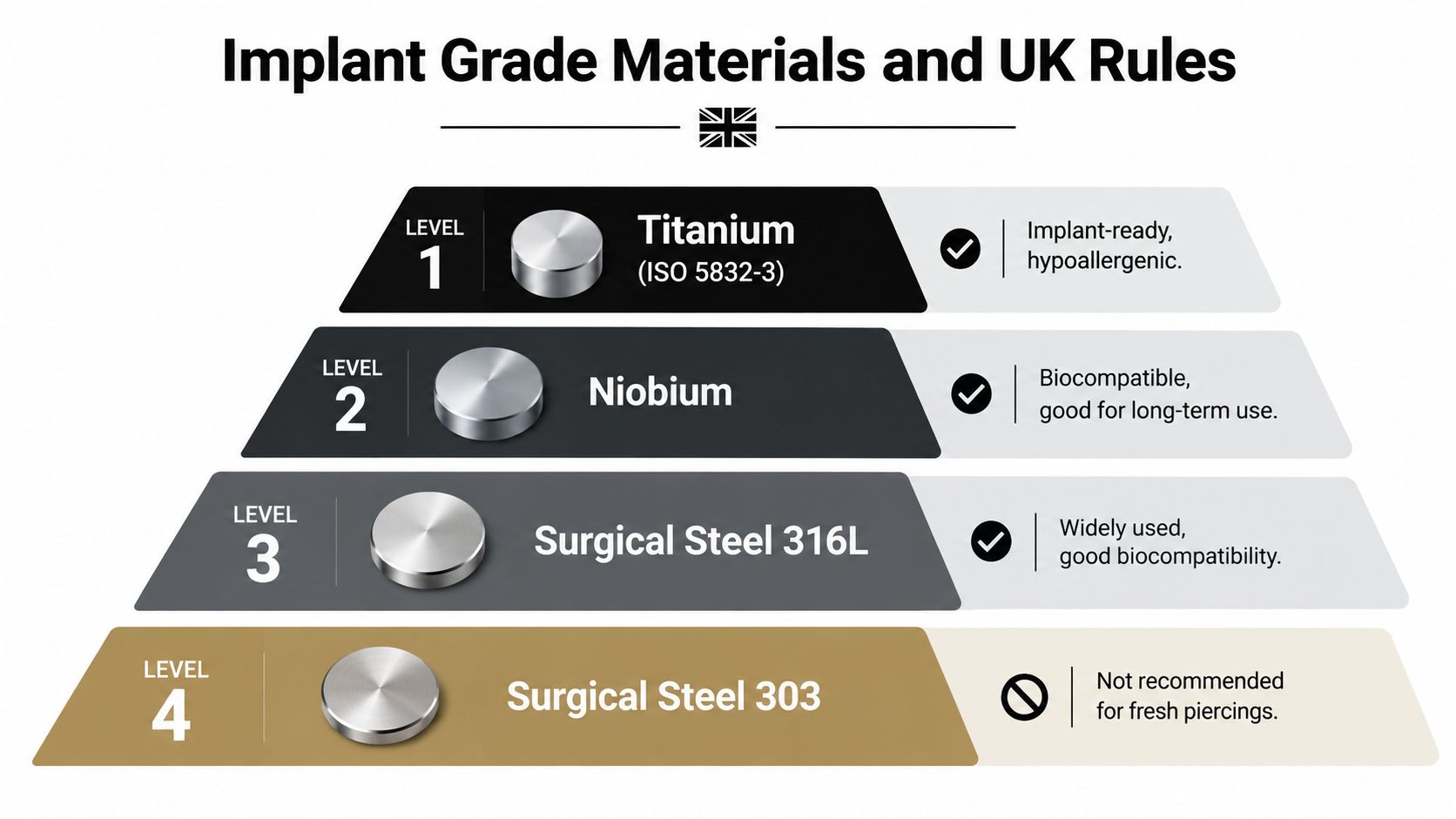
UK local-authority guidance states that jewellery contacting broken skin or mucous membranes must be sterile and appropriately sized and graded. It lists solid 14- or 18-carat gold, niobium, titanium, and platinum among acceptable materials. The same guidance sets nickel-release limits of less than 0.2 micrograms per square centimetre per week for post assemblies used in fresh piercings and less than 0.5 micrograms per square centimetre per week for other articles in prolonged skin contact, as detailed in the UK body-piercing code of practice.
What the main material choices mean
Titanium is commonly considered for fresh dermals and clients with metal sensitivity, but ask for the specific alloy documentation rather than accepting the label alone. A smooth, well-finished surface matters just as much as the broad material category.
Niobium and platinum also appear in UK guidance as acceptable options. Their suitability still depends on the individual piece's construction, finish, sterility, and fit.
Solid 14- or 18-carat gold is listed as acceptable. Gold above 18 carat is discouraged in body-piercing guidance because its relative softness can increase scratching and pitting. Gold-coloured plating isn't equivalent to a solid gold specification, so ask exactly what lies beneath the finish.
Stainless steel requires more detail than “surgical steel”. British Stainless Steel Association guidance discusses 316 and 316L grades in skin-contact applications, while grade 303 may cause reactions in some people and is considered unsuitable for prolonged close skin contact. The relevant question isn't whether steel sounds professional. It's which grade the piece uses and whether its nickel release meets the applicable limit.
Ask the studio, “What is the exact alloy, what evidence supports its nickel-release compliance, and how do you verify the finish and sterility before insertion?”
A useful consultation checklist includes:
- Composition: Request the alloy specification, not only “hypoallergenic”.
- Nickel release: Ask which limit applies to the anchor and top, and whether conformity is documented.
- Surface finish: Check that the base, post, joins, and top have no burrs, pits, or sharp edges.
- Gold carat: Confirm whether gold is solid and whether it is 14 or 18 carat.
- Sterility: Ask how the sealed jewellery is sterilised and opened for your procedure.
You can compare material options and terminology in this UK guide to body jewellery, but the piercer's assessment remains essential. A material name is one part of the decision, not a guarantee by itself.
Sizing, Gauge, and Getting the Fit Right First Time
Sizing affects both comfort and mechanics. Gauge describes the thickness of the post and the needle channel, while the anchor footprint describes the area of the base beneath the skin. Thread type determines whether the chosen top can attach securely to that post.
UK piercing-control guidance requires the jewellery diameter to match the needle diameter, so the piercer isn't forcing a wider implant through a narrower channel. The same guidance requires needles to be sterile, single-use, and disposable, and jewellery to be sterile before use, as set out in this UK piercing-control guidance.
A client may ask for the smallest possible anchor because it seems discreet. That isn't always the safest choice. A small base on an active area may have less surface to distribute movement and pressure, while an oversized base may be unsuitable for the available tissue. The correct size comes from anatomy and placement, not from a universal chart.
Use dimensions as conversation starters
| Placement | Typical gauge | Anchor footprint | Thread type |
|---|---|---|---|
| Collarbone | To be assessed by piercer | Compact to medium, based on tissue | Matching threaded top |
| Chest | To be assessed by piercer | Medium where tissue allows | Matching threaded top |
| Lower back | To be assessed by piercer | Chosen for pressure and tissue | Matching threaded top |
| Behind the ear | To be assessed by piercer | Compact where anatomy allows | Matching threaded top |
The table is deliberately a consultation reference rather than a prescription. There isn't a safe one-size-fits-all measurement for every body. A piercer should check skin thickness, movement, pressure from clothing, and the angle at which the top will sit.
Before booking, ask to see the proposed anchor and top together. Confirm that the thread matches, the top sits neatly without excessive pressure, and the base has a footprint appropriate to the placement. If the recommendation differs from your expectation, ask what anatomical reason supports it.
Healing Well and Knowing When Something Is Wrong
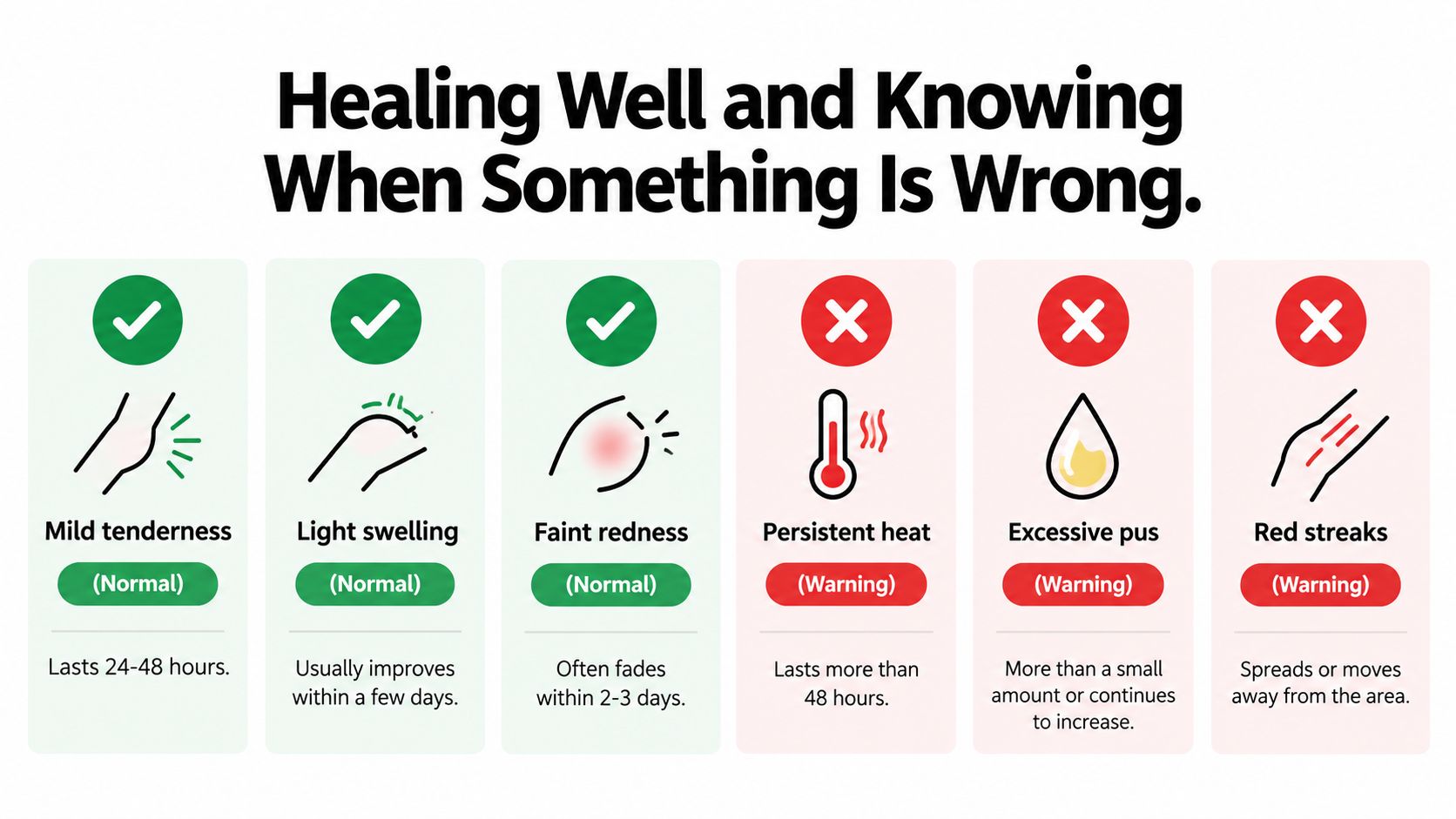
Early healing can involve mild tenderness, light swelling, and faint local redness. Those signs should gradually settle rather than become more intense or spread. Dermal jewellery also needs protection from twisting, lifting, snagging, and repeated pressure, because mechanical irritation can contribute to inflammation and migration.
The wider UK evidence shows why worsening symptoms deserve attention. A 2008 England survey of 1,940 piercings found complications in 27.5% of cases, 12.9% serious enough to need professional help, and 0.9% requiring hospital admission. A Welsh look-back in the same source reported 36.3% of respondents developing a skin infection after piercing in premises with poor hygiene. These figures aren't dermal-specific or current dermal-anchor rates, but they support prompt escalation rather than automatic reassurance.
A simple daily check
- Clean gently: Follow the studio's aftercare instructions and avoid aggressive scrubbing.
- Leave it still: Don't twist, lift, or pick at the top.
- Reduce friction: Keep hair, waistbands, straps, and rough fabric from catching it.
- Observe the direction: Note whether redness, swelling, or discomfort is settling.
- Check the position: Report visible movement, sinking, or skin growing over the jewellery.
Mild discomfort that eases is different from persistent heat, increasing pain, pus, spreading redness, darkening skin, fever, or feeling generally unwell. Embedding and visible migration also need professional assessment. The NHS guidance on infected piercings advises prompt medical attention for possible infection, and jewellery shouldn't be removed without clinical advice because closing the surface can trap infection.
Escalate without panic
Contact the original piercer for placement, fit, snagging, or migration concerns. Contact NHS 111, a GP, or another clinician if you notice signs suggesting infection or systemic illness. If symptoms are severe or rapidly worsening, seek urgent medical help.
Don't apply harsh household products, force an embedded top, or keep changing jewellery to test different metals. A calm description of when the change started, what it looks like, and whether pain or heat is increasing will help the piercer or clinician decide what should happen next. For visual guidance on movement and rejection, see this resource on piercing rejection signs.
Your Pre Booking Consultation Checklist
Take this list into a Croydon or Bournemouth consultation, whether you're booking your first dermal or replacing an existing top.
- Material: What exact alloy is the anchor and top made from?
- Compliance: Is nickel-release conformity documented against the relevant UK limits?
- Finish: Are the base, post, joins, and top smooth, polished, and free from burrs or pits?
- Sterility: Will the jewellery be sterile before insertion, and will the needle be sterile, single-use, and disposable?
- Sizing: Does the jewellery diameter match the needle diameter?
- Footprint: Why does this anchor base suit the tissue, movement, and pressure at the chosen placement?
- Threading: Which thread type does the top use, and will future tops match it?
- Aftercare: Will you receive clear written advice about cleaning, snagging, swimming, sleeping, and top changes?
- Follow-up: Who should you contact if the anchor migrates, becomes embedded, or develops increasing redness, heat, pain, or discharge?
A professional should be comfortable answering these questions without dismissing your concerns. UK guidance supports sterile jewellery, sterile single-use needles, appropriate sizing, and diameter matching, but your anatomy still determines the final selection.
If healing becomes concerning, contact the original piercer first for jewellery and placement questions, then NHS 111 or a GP when infection or systemic symptoms may be involved. Keep the jewellery in place unless a clinician advises removal.
Piercing Near Me helps clients compare professional piercing services, arrange consultations, and find guidance on dermal placements, jewellery selection, and aftercare. Visit Piercing Near Me to explore booking options, or contact the team on 01202 900050 (Bournemouth) / 020 8686 7730 (Croydon) or WhatsApp 07752 913846 (Bournemouth) / 07902 490584 (Croydon) before choosing your dermal jewellery.