
You're probably here because you've seen a look you like, typed double eye piercing into Google, and ended up with a mix of eyebrow photos, surface piercing advice, and content that doesn't quite answer the practical questions. That's common.
In UK studio terms, a request for a double eye piercing typically refers to a paired eyebrow piercing style. The look can be bold, clean, and very wearable, but it also needs proper planning. Good placement matters. Jewellery choice matters. Your daily habits matter more than most inspiration posts admit.
At our studios in Croydon and Bournemouth, the conversation usually starts with the same few questions. What does this piercing mean? Will it suit my face? Will both piercings heal evenly? And what happens if one settles differently from the other? Those are the right questions to ask.
What Is a Double Eye Piercing
The first thing to clear up is simple. A double eye piercing does not mean piercing the eye itself. In normal UK piercing language, it almost always means two eyebrow piercings placed as a pair.
That matters because once you understand the term properly, the rest of the decision becomes much easier. You're not looking at some obscure or undefined procedure. You're looking at a variation of a familiar modern facial piercing.
The style behind the name
Eyebrow piercing first appeared in the 1970s in punk subculture and was re-popularised in the 1990s, which is why it's often treated as a fashion-led modern piercing rather than a traditional body modification, as noted in this eyebrow piercing history overview. A standard eyebrow piercing is a vertical surface piercing, usually done with a 12–18 gauge cannula needle, and the same basic anatomical logic applies to a double placement.
In practice, a double version usually means one of two things:
- Two piercings on one eyebrow for a stacked or paired look
- One piercing on each eyebrow for a more balanced face-framing effect
Neither option is automatically better. The right choice depends on your anatomy, your style, and how much aftercare load you're realistically prepared to take on.
Practical rule: If you like the look in a photo, don't assume the same map will suit your face. Eyebrow work is always anatomy-led.
Why there isn't much official data on it
One reason the term feels confusing is that official datasets don't seem to track demand at the level of double eyebrow placements. That means most useful guidance comes from working studios and piercing education rather than a national register.
That's normal in piercing. Many of the decisions that matter most aren't about broad public data. They're about tissue depth, brow shape, movement, glasses, sleeping habits, and whether the jewellery will sit stably during healing.
A lot of online content stops at the aesthetic. The more useful question is whether the style is suitable for you. Some clients have enough tissue and a stable enough area for a paired look. Others are better served by a single placement first, then a review once that piercing has settled.
What clients often misunderstand
The biggest misconception is that a double eye piercing is just “twice the style” with no real trade-off. It isn't. It's two separate piercings, two separate channels, and a setup that requires more discipline than a single brow piercing.
If you go ahead, the aim shouldn't be to copy a photo exactly. The aim is to create a placement that looks strong on day one and still looks right once swelling drops and the tissue relaxes.
Placement Options for Double Eyebrow Piercings
Placement is where a good result is made or lost. Two piercings can look sharp in the mirror on the day, but if they're too close, too shallow, or mapped against the wrong facial reference points, healing gets harder very quickly.
The most common layouts
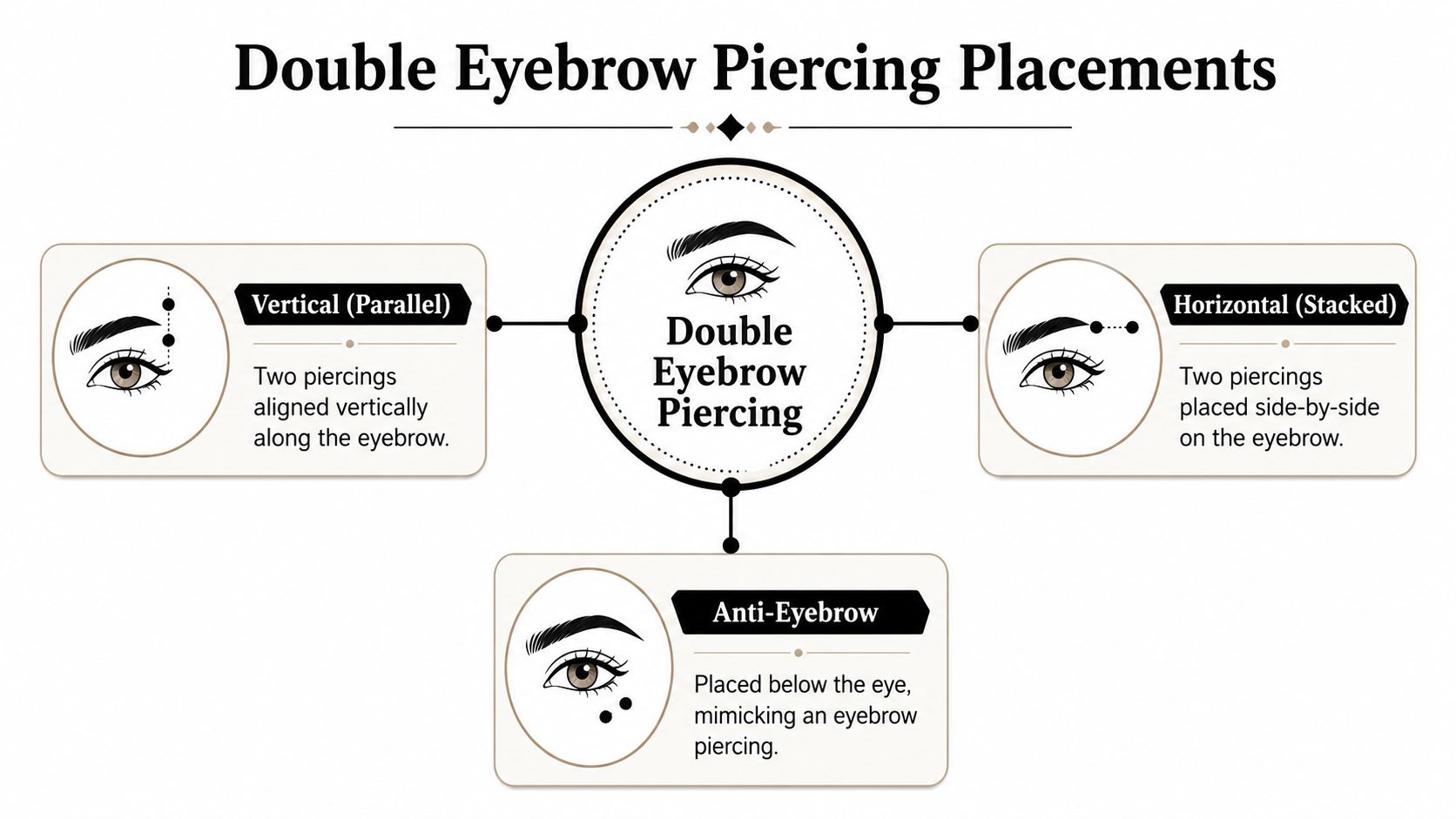
Most clients choose from a small number of workable arrangements:
Double on one brow
This creates a stronger, more directional look. It suits clients who want one side of the face to carry more visual weight.One on each brow
This tends to read as cleaner and more symmetrical from a distance, although actual symmetry is more complicated than people think.A more customised pairing
Sometimes the better answer is not a mirrored setup at all. A piercer may adjust spacing or angle to suit the way your features sit.
The key point is that placement should follow anatomy, not just trend photos.
Spacing is not a minor detail
For double eyebrow piercing placement, the two entry points need enough separation to prevent jewellery contact. A commonly cited benchmark is at least 8 mm between the centres of the two holes, which helps allow for swelling and reduces irritation, as outlined in this placement guide discussing double piercing spacing.
That spacing matters because jewellery that knocks together during healing creates friction. Friction leads to irritation. Irritation makes swelling linger and increases the chance that a fresh piercing starts behaving like an angry one.
If the jewellery touches when your face moves, the design isn't finished yet.
What a piercer is really assessing
When mapping a double eyebrow setup, the brow itself is only part of the picture. A professional piercer is also looking at:
- Tissue thickness so the piercing has enough support
- Natural brow line so the jewellery sits with the face rather than against it
- Facial movement because some placements get stressed every time you smile or raise your brows
- Lifestyle details such as glasses, helmets, fringe, and sleep position
A useful way to think about it is tailoring. Two people can ask for the same style, but the final fit has to be adjusted to the body in front of you.
What doesn't work
Some choices look good only for the stencil photo. Common problems include:
| Placement issue | What usually happens |
|---|---|
| Too close together | Jewellery rubs, catches swelling, and stays irritated |
| Too shallow | The piercing may migrate or sit poorly |
| Forced symmetry against uneven features | One side often looks “off” once healed |
| Ignoring daily habits | Snagging and pressure keep the area unsettled |
The best placement is the one that still makes sense after the first few weeks, not just the one that looks neat with pen marks on untouched skin.
Your Piercing Appointment Step by Step
Most first-time clients relax once they know how the appointment works. Facial piercings are already a well-established part of modern piercing demand. One studio report from 2019 recorded 3,335 facial piercings, accounting for over a quarter of all services, as shown in this 2019 piercing statistics breakdown. So while eyebrow work feels bold when it's your own face, it's a familiar appointment in a professional studio.
When you first come in
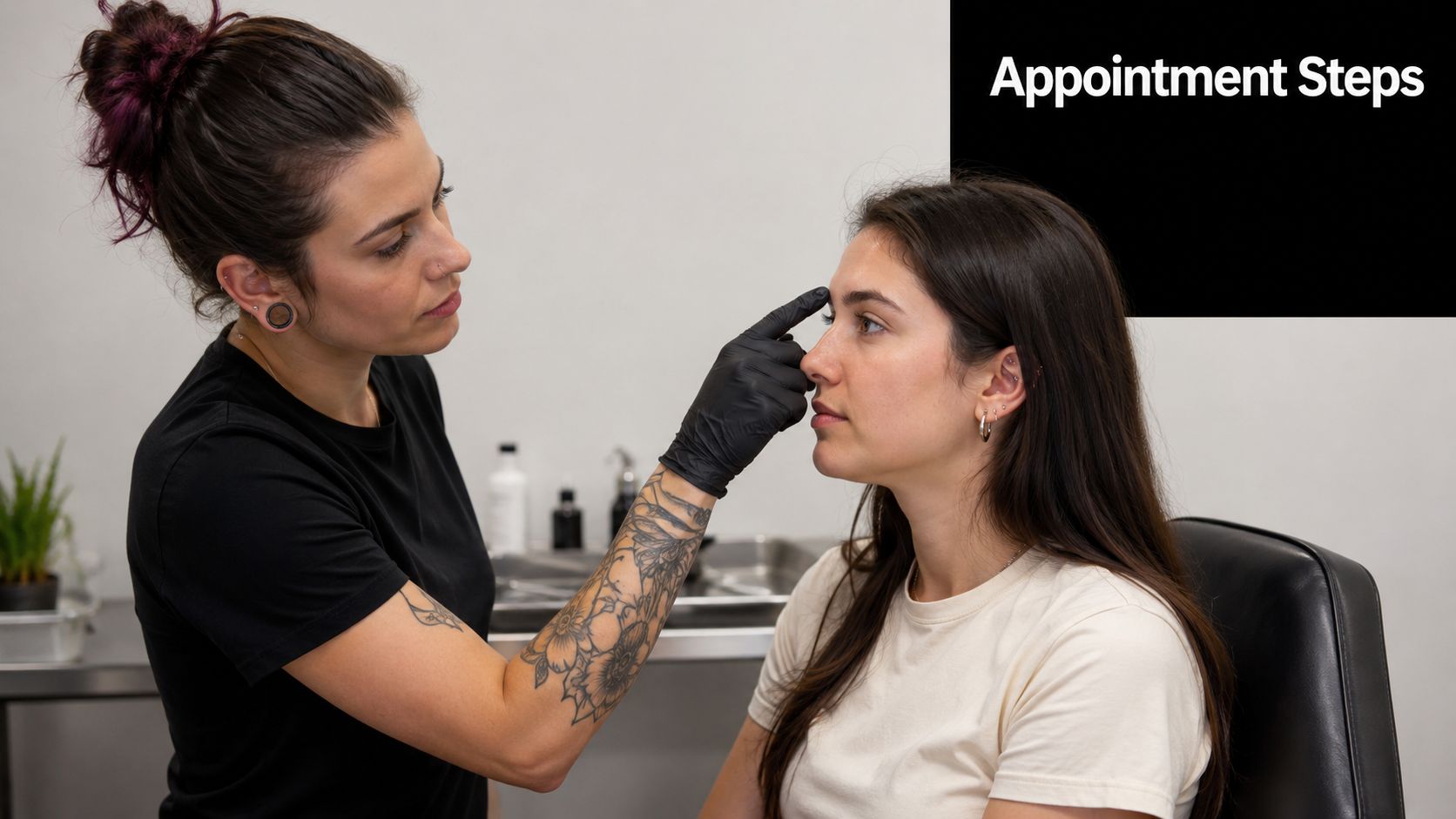
At our Croydon and Bournemouth studios, the appointment starts with a conversation, not a needle. We'll ask what look you want, whether this is your first facial piercing, and how you usually heal. If you wear glasses, play sport, use brow products daily, or sleep heavily on one side, say so. Those details affect the plan.
Then comes consent, ID checks where needed, and jewellery selection. Initial jewellery should be safe, simple, and stable. This isn't the moment to choose something fiddly because it looked good in a filtered close-up online.
Marking and checking placement
This part takes longer than the piercing itself, and that's how it should be.
The area is assessed, cleaned, and marked. You'll be shown the placement in the mirror, and good piercers expect feedback. Sometimes the first mark is right. Sometimes it needs adjusting because one brow sits higher, one eye opens wider, or the angle looks different when your face is relaxed.
A precise mark is never wasted time. It's often the difference between a piercing that settles well and one that keeps being questioned.
The piercing itself
Once the map is agreed, the setup is prepared using sterile, single-use equipment and appropriate jewellery. The piercing is then performed cleanly and efficiently. For most clients, the actual procedure is quick. The slower part is the careful part before it.
After insertion, the jewellery is checked for fit and spacing. With a paired eyebrow placement, we're looking for a result that sits cleanly now but also leaves room for early swelling without excess pressure.
Before you leave
You'll get aftercare instructions and a chance to ask practical questions. Ask them. It's better to leave with a clear plan than go home and start guessing.
Good questions include:
- Can I wear makeup nearby
- What if I catch it while changing
- When should I message if one side swells more
- When do I come back for a check
That last part matters. A good studio doesn't vanish after the jewellery goes in.
Healing Times and Aftercare for Double Piercings
Double eyebrow piercing aftercare is where clients either protect their result or slowly work against it. Healing can be straightforward, but only if you respect the fact that you're caring for two separate wounds, not one.
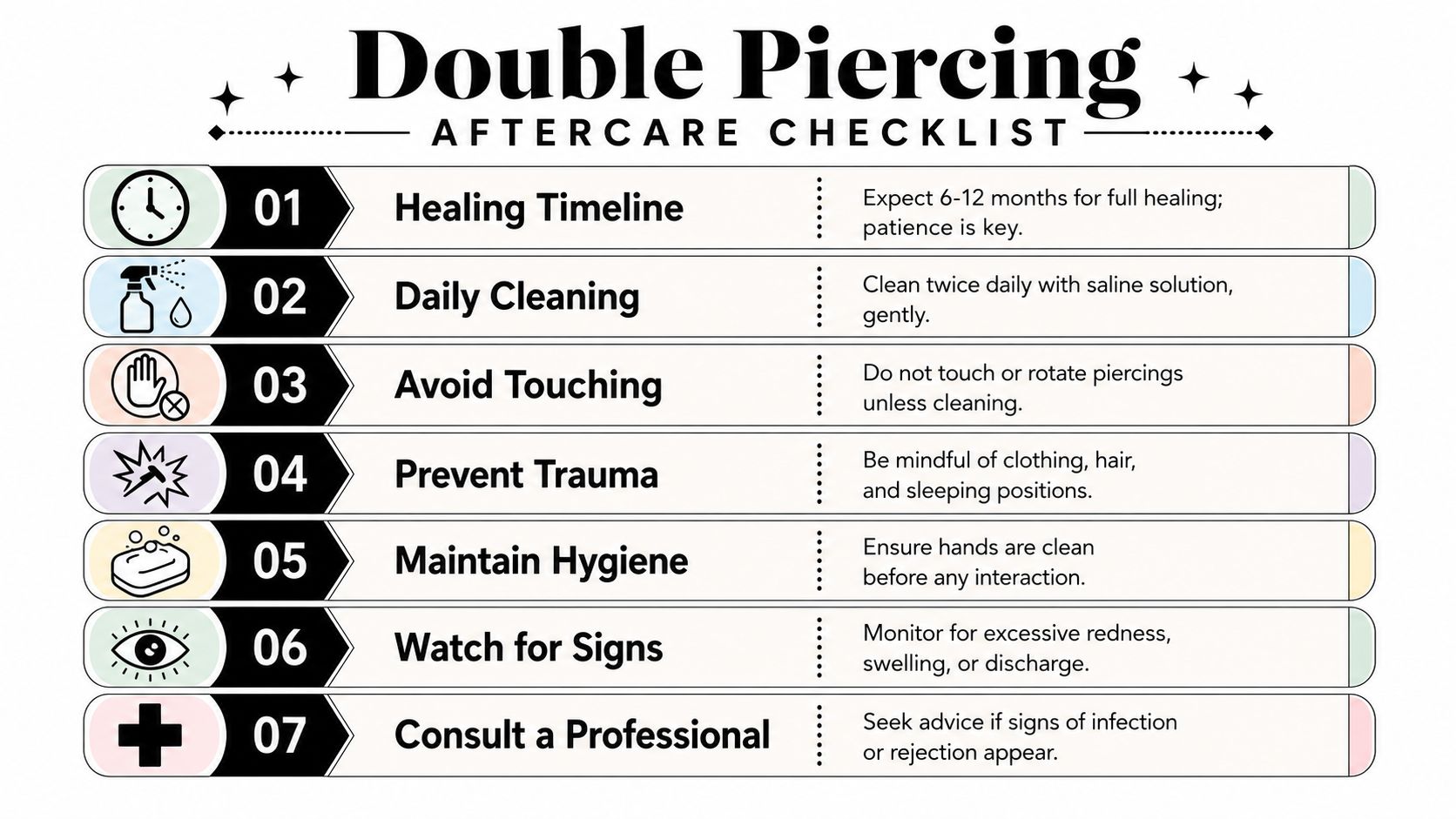
Uncomplicated healing for closely placed eyebrow piercings is often in the 2–3 month range when aftercare is followed, according to this practitioner-led note on double facial piercing healing. The practical issue is that each channel needs cleaning and protection, which effectively doubles the healing surface.
What proper aftercare looks like
You do not need a complicated routine. You need a consistent one.
- Clean gently with sterile saline and keep the process simple. If you need a suitable product, this guide to saline spray for piercing aftercare covers what to look for.
- Keep hands off unless you're actively cleaning. Most irritation is home-made.
- Watch transfer points such as makeup, skincare, hair products, hats, and pillowcases.
- Avoid snagging from towels, jumpers, helmets, and brushes.
- Leave jewellery alone unless your piercer tells you otherwise.
What usually slows healing down
The most common problems aren't mysterious. They're repetitive.
Touching to “check” them. Cleaning too aggressively. Using harsh solutions. Sleeping on them before they're stable. Letting brow makeup sit in the area. Repeatedly catching one side with clothing or hair.
Here's the pattern I see most often in studio follow-ups. Clients think they're being careful because they clean regularly, but they're also overhandling the piercing between cleans. The tissue doesn't get a calm day.
Aftercare load: A double setup asks for more restraint than a single piercing. If your routine is chaotic or hands-on, that's worth admitting before you get it done.
A simple healing checklist
| Early healing goal | What helps |
|---|---|
| Keep swelling manageable | Avoid pressure, rubbing, and jewellery contact |
| Protect both channels | Clean consistently and reduce touching |
| Minimise irritation bumps | Cut out makeup transfer and snagging |
| Let the tissue settle | Be patient and don't rush jewellery changes |
Jewellery and healing behaviour
Initial jewellery should support healing, not compete with it. In studio, the aim is usually a secure fit in a material suited to fresh piercings, with enough room to accommodate the normal early stage without creating unnecessary movement.
If one side seems to be lagging behind the other, that isn't automatically a disaster. One brow can get more pressure from your sleep, your fringe, your glasses, or even the way you move your face. The important thing is not to self-diagnose too quickly or start changing products every few days.
Managing Risks Like Rejection and Asymmetry
The hardest truth about a double eye piercing is that “perfect” isn't a reliable goal. Balanced is the better goal.
A common concern is whether both eyebrow piercings will stay symmetrical over time. Placement should be judged against stable facial landmarks such as the pupils, because brows themselves are often asymmetrical, as explained in this eyebrow placement guide focused on facial landmarks. That's why a pair that looks perfectly matched to the brows on day one can look slightly different once healing settles.
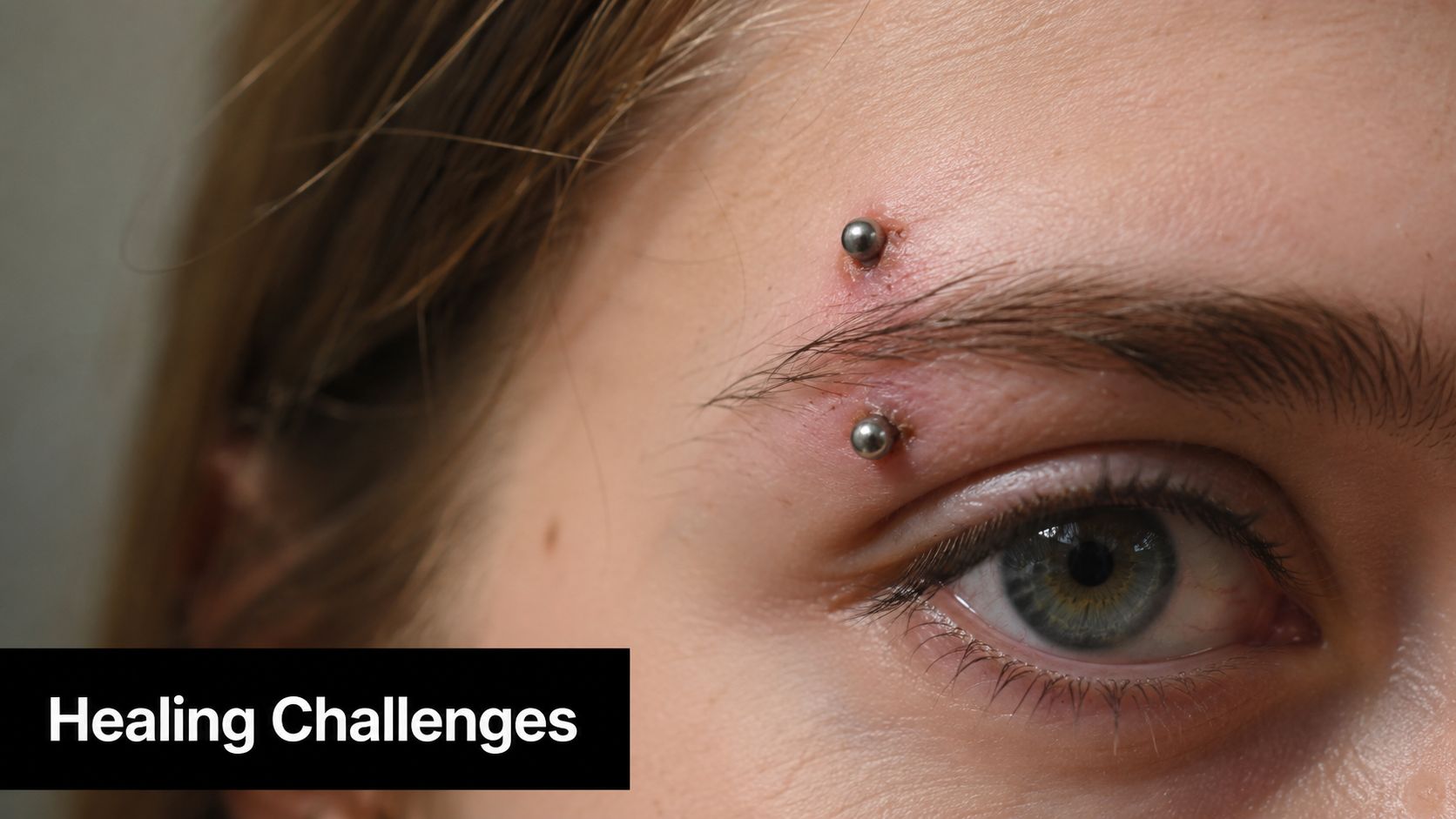
Why asymmetry happens
Your face is not a ruler. Very few brows sit identically, and even fewer move identically. Add swelling into the mix, and a fresh pair can look uneven before it has had time to settle.
That doesn't always mean anything is wrong. It may mean one side is holding more swelling, getting more pressure at night, or healing at a slightly different pace.
What matters is whether the jewellery remains well supported, comfortable, and properly angled as the tissue calms down.
Rejection versus ordinary irritation
Surface-style eyebrow work always needs honest discussion about migration and rejection risk. That risk doesn't mean the piercing is doomed. It means you need to watch the piercing with a clear head.
Ordinary irritation often improves once the cause is removed. Rejection tends to look more directional. The tissue may appear to thin, the jewellery may seem more exposed, and the piercing may stop looking as well-seated as it did at the start. If you're unsure, compare what you're seeing with these common piercing rejection signs explained in practical terms.
What usually helps and what doesn't
Helps
Better sleep positioning, less touching, removing sources of friction, and coming back to the studio for an assessmentDoesn't help
Twisting jewellery, changing it too early, covering the area with makeup, or trying internet remedies because the piercing “looks a bit off”
If one side heals more slowly, treat that as useful information, not a reason to panic. The body doesn't heal in mirrored halves.
A strong result isn't always the one that looked most identical at the start. It's the one that remains healthy, stable, and flattering once the healing period has done its work.
Book Your Piercing in Croydon or Bournemouth
If you're considering a double eye piercing, the best next step is a proper in-person consultation. That gives you a realistic answer on placement, anatomy, jewellery, and whether a paired setup is the right choice now or better approached in stages.
We welcome clients at our Croydon and Bournemouth studios. If you want to ask about availability, jewellery options, healing concerns, or whether your brow anatomy is suitable, call 01202 900050 (Bournemouth) / 020 8686 7730 (Croydon) or message us on WhatsApp 07752 913846 (Bournemouth) / 07902 490584 (Croydon).
Quick questions clients ask
Do I need an appointment
Walk-ins may be available, but it's always best to contact the studio first if you want a specific piercing or time slot.
How old do I need to be
Age suitability depends on the piercing and the studio's consent requirements. Ask before travelling so you know what applies to your situation.
What ID should I bring
Bring valid photo ID, and if a parent or guardian is required, make sure they bring their ID as well. If you're unsure, ask us before your visit.
If you're comparing options first, this guide on how much an eyebrow piercing costs may help you plan before booking. And if you want to speak to the studio directly, the numbers are 01202 900050 (Bournemouth) / 020 8686 7730 (Croydon) and 07752 913846 (Bournemouth) / 07902 490584 (Croydon) on WhatsApp.
Ready to book with a studio that takes placement, hygiene, and aftercare seriously? Visit Piercing Near Me to find trusted piercing information and book with experienced professionals in Croydon or Bournemouth.