
You’re probably here because the conversation has already started at home.
A teenager wants a nose stud, a first pair of lobes, or maybe a helix. A parent wants to know the same things every careful parent asks. Is it legal? How old do you need to be? Do I need to come in? What ID do we bring? And how do we make sure it’s done properly?
Those are exactly the right questions. In the UK, piercing rules aren’t as simple as often assumed, and that’s where individuals can be caught out. The legal position, studio policy, and good safety practice aren’t always the same thing. If you understand the difference, you’re much more likely to have a calm appointment, a smoother heal, and fewer surprises on the day.
Thinking About a Piercing Your First Questions Answered
A common version of this starts like this. A teen has saved screenshots for weeks, finally asks about getting pierced, and the parent says, “Maybe, but I need to know the rules first.”
That hesitation is sensible. A piercing is a small procedure, but it still involves skin, healing, hygiene, and responsibility afterwards. The piercing itself only takes a moment. The main job is looking after it properly in the weeks and months that follow.
The two people who usually need reassurance
If you’re the person getting pierced, you probably want a clear answer on age, consent, and whether you can get the placement you want right now.
If you’re the parent, you’re usually checking different things. You want to know whether the studio is clean, whether the policy is sensible, and whether your child is ready for aftercare.
Practical rule: The best first question isn’t “Can they do it?” It’s “Should this piercing be done at this age, by this studio, with this level of aftercare?”
That’s why piercing age uk searches can feel confusing. The law might allow more than a reputable studio is willing to do. That’s not the studio being difficult. It’s often a sign they take safety seriously.
For families thinking specifically about first lobes, this guide on the best age for ear piercing can help frame the decision in a practical way.
What usually matters most on the day
Most first-timers feel calmer once they know four things:
- Age rules matter, but they vary depending on where you are in the UK.
- Studio policy matters too, especially for cartilage, facial, and body piercings.
- Consent is a real process, not a quick signature at the desk.
- Good studios look for readiness, not just whether someone technically meets the minimum.
That’s the difference between getting pierced quickly and getting pierced well.
Understanding UK Piercing Age Laws
The easiest way to think about UK piercing law is as a patchwork quilt. There isn’t one neat national rule covering every piercing in every part of the country.
What the law looks like across the UK
In England, Wales, and Northern Ireland, there is no set minimum age for most piercings. Scotland is different, because under-16s require parental presence. Public opinion has leaned towards tighter rules for some time. A 2011 YouGov poll of 1,739 adults in Great Britain found that 52% supported a minimum age of 16 for ear piercings without consent, and 41% supported 18+ for other body piercings, as summarised in this overview of body piercing regulation in the UK.
Many people often get confused. They assume “no national minimum age” means “anything goes”. It doesn’t.
Some piercings are treated much more strictly. Intimate piercings are not in the same category as lobes or nostrils. The legal and safeguarding approach is far firmer there, and professional studios reflect that in their policies.
Why local rules and studio rules both matter
In practice, age decisions often sit across three layers:
- The law
- Local council conditions
- The studio’s own policy
That means two studios in different towns may handle the same piercing differently, even when the client is the same age. Croydon and Bournemouth clients often expect one simple UK-wide answer, but it is more local than that.
A good studio doesn’t work to the loosest possible interpretation of the rules. It works to the safest one it can justify.
The regional differences people ask about most
Here’s the short version people usually need:
| UK area | General position |
|---|---|
| England | No national minimum age for most piercings such as ears |
| Scotland | Under-16s need a parent or guardian present |
| Wales | Stricter rules apply for certain piercings, especially tongue, nipple, and genital piercings for under-18s |
| Northern Ireland | Similar to England for most non-intimate piercings |
The key point isn’t just legal compliance. It’s that the UK remains unevenly regulated for piercing. That’s why professional judgement matters so much.
If a studio asks more questions than you expected, that’s usually reassuring. They’re checking age, maturity, anatomy, and whether the chosen piercing makes sense for that person now, not just whether they can get away with doing it.
Piercing Age and Consent A Breakdown by Type
The same age does not fit every piercing. In a good studio, the decision changes with the body area, the healing time, and how much day to day care that piercing needs.
A simple way to picture it is this. A lobe piercing is often like caring for a small scrape on soft tissue. A tongue, navel, or cartilage piercing asks for much more. The jewellery sits in an area that swells more, gets knocked more easily, or takes longer to settle. That is why studios in places like Croydon and Bournemouth often sort age policies by piercing type rather than giving one blanket answer.
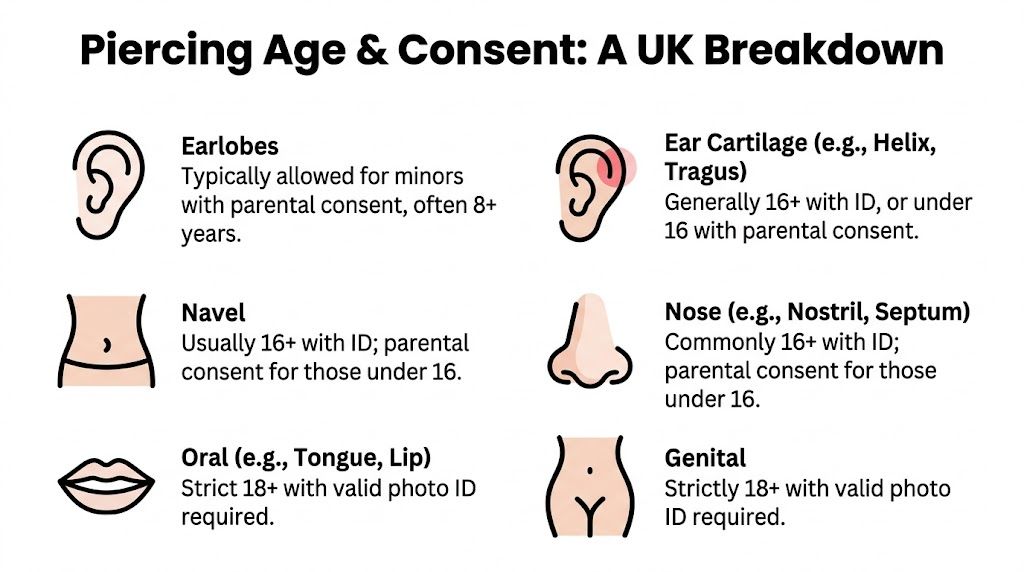
Typical studio expectations by piercing type
This is a realistic guide to what many professional UK studios do in practice. Individual studios may be stricter, especially if the client is very young, plays contact sports, or seems unsure about aftercare.
| Piercing Type | Typical Age with Parental Consent | Typical Age without Parental Consent |
|---|---|---|
| Earlobes | Often available for younger minors, depending on studio policy | Usually older teens or adults, depending on studio policy |
| Ear cartilage | Often restricted or handled case by case for younger clients | Commonly offered to teens with ID |
| Nose | Sometimes allowed for minors with a parent or guardian | Commonly offered from the mid-teen years with ID |
| Navel | Often assessed carefully for age and anatomy | Commonly offered to older teens or adults |
| Oral piercings | Usually much stricter | Commonly adults only |
| Genital piercings | Not offered to minors | Adults only |
Earlobes are often the starting point
Lobes are usually the easiest first piercing because the tissue is softer and healing is usually more straightforward than cartilage or oral placements. Even so, a responsible piercer is still checking for readiness, not just permission.
For a younger child, that often means simple practical questions. Can they sit still? Do they understand that healing care matters every day, not only on the appointment? Are they asking for the piercing themselves, or are they only agreeing because someone else wants it?
If the child is frightened, tearful, or clearly saying no, the appointment should stop. Good consent is not a formality.
Cartilage and facial piercings need more maturity
Cartilage can catch people out because it is still on the ear. Parents often assume it will be much the same as a lobe. In practice, it is closer to the difference between a short local journey and a long trip with changes along the way. Both get you somewhere, but one takes far more patience and planning.
Helix, tragus, and similar placements can stay tender for months. They are easier to irritate with headphones, hair brushing, helmets, school uniforms, and sleeping on that side. That is one reason many studios are cautious with younger teens, even where the law leaves room for discretion.
Facial piercings raise similar questions. A nostril piercing may be straightforward for a prepared older teen, but a studio still has to think about school rules, sports, healing discipline, and whether the parent and teen both understand the commitment. If you are comparing options, this guide to nose piercing age in the UK explains the usual expectations in more detail.
The piercings that are usually treated much more strictly
Navel, oral, nipple, and genital piercings are where policies usually tighten. The reason is not only age. It is also anatomy, swelling, privacy, safeguarding, infection risk, and whether the client can realistically manage healing without cutting corners.
Oral piercings are a good example. They can look quick to do, but the aftercare sits in the middle of eating, drinking, dental hygiene, and swelling control. That is a lot to handle for a younger client. Intimate piercings bring another level of safeguarding, so reputable studios keep very firm boundaries.
If a studio says yes to every piercing a minor asks for, that is not flexibility. It is poor judgement.
A quick way to judge whether a policy sounds sensible
Parents and teens often feel confused when one studio says yes and another says no. The easiest test is to ask three plain questions:
- How demanding is this piercing to heal in real life?
- Can the client manage the care without constant reminders?
- Would the decision still feel sensible after the excitement of the appointment has worn off?
If those answers are uncertain, waiting is usually the safer choice. A few extra months can make the experience calmer, the healing easier, and the final result better.
Why Reputable Studios Have Their Own Policies
A parent rings the studio from Croydon or Bournemouth and says, “Another place said yes, so why are you saying no, or not yet?” That question comes up often, and it has a sensible answer. A good studio policy is there to lower the chance of problems during healing, not to make the booking harder.
The legal minimum is only one part of the decision. Studio rules usually go further because real life goes further. A piercing has to survive school, PE, football, hair brushing, sleeping on one side, headphones, forgotten cleaning, and the first week when the excitement is high but the routine has not settled yet.
Safety starts before the needle
A careful piercer looks at the whole picture. Age matters, but so do anatomy, maturity, daily habits, and whether the client understands what healing will ask of them.
That is why two teenagers of the same age may be treated differently. One may be ready for a straightforward lobe piercing with good support at home. Another may be constantly in contact sports, touching the area, or choosing a piercing that is much harder to heal well.
A studio with standards will say so clearly. If you are comparing options, it often helps to look for professional piercers near you and read how they explain their age and consent policies, not just whether they have a free slot.
Why age on its own does not answer the question
Ear piercing is a good example. In England, the law around ear lobes is often less restrictive than people expect, but that does not mean every child is ready at every age. Many experienced studios prefer to wait until a child can sit still, understand what is happening, and leave the jewellery alone while it heals.
That last part is where parents sometimes get caught out. Wanting the piercing and caring for the piercing are two different skills. A young child may be brave for the appointment and still struggle with cleaning, sleeping carefully, or not twisting the jewellery afterwards. Piercers see that difference every week.
A stricter house policy usually protects healing time, comfort, and the final result.
What thoughtful studio policies usually include
Strong studio rules tend to look at several practical points at once:
- Healing difficulty. Earlobes are usually simpler than cartilage, navels, or oral piercings.
- Day-to-day friction. School uniforms, helmets, sports, hair, and earbuds can all irritate a fresh piercing.
- Understanding and consent. The client should be able to explain what they want and show that they understand basic aftercare.
- Support at home. Younger clients usually heal better when a parent knows what normal swelling and cleaning look like.
- Safeguarding and privacy. Some piercings need firmer boundaries because the appointment and healing process are more sensitive.
That is why reputable studios sometimes set an age above the bare legal minimum, or refuse a piercing they could technically perform. The policy works like a seatbelt. It can feel restrictive in the moment, but it is there because experienced people know where things usually go wrong.
Good policies do not stop good piercings. They help the right piercing happen at the right time, with a calmer appointment and a better chance of smooth healing.
Navigating Consent and ID Requirements
The easiest appointment is the one you prepare for properly. Most problems at reception happen because someone has brought the wrong ID, the wrong adult, or no proof of age at all.
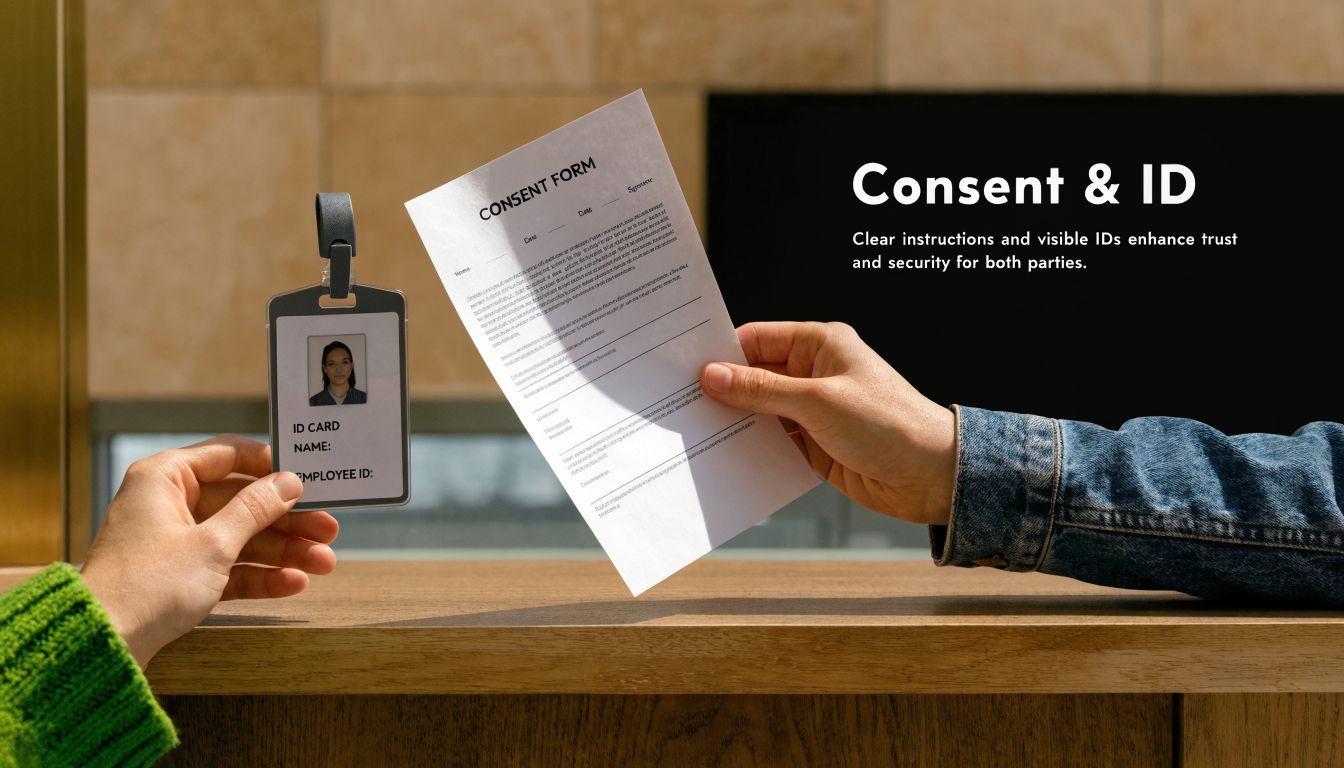
What to bring to the studio
If the client is under the studio’s age for independent consent, a parent or legal guardian usually needs to attend in person.
A smooth check-in usually means bringing:
- The young client’s photo ID if they have it
- The parent or guardian’s government-issued photo ID
- Any supporting documents the studio asks for in advance
- Time to read the consent form properly, not rush through it
If you’re unsure what counts, call first. That saves a wasted trip. For direct advice, you can phone 01202 900050 (Bournemouth) / 020 8686 7730 (Croydon) or message 07752 913846 (Bournemouth) / 07902 490584 (Croydon) on WhatsApp.
Why studios are so firm about this
Some clients think ID checks are just admin. They aren’t. They protect the client, the parent, and the studio.
UK studios use strict ID verification to comply with the Health and Safety at Work Act 1974 and local bylaws. Good studios also start piercings in implant-grade titanium (ASTM F136), which is nickel-free and far less likely to cause a reaction than surgical steel.
That combination matters. The paperwork isn’t separate from the safety side. Good identification, clear consent, and appropriate jewellery all support a safer outcome.
Bring more identification than you think you’ll need. It’s much easier to leave unused documents in your bag than to be turned away at the desk.
What the consent process usually looks like
In a well-run studio, the process is simple and calm:
- Reception checks age and documents
- The consent form is read and signed
- The piercer confirms the chosen placement is suitable
- Jewellery options are discussed
- Aftercare is explained before the procedure starts
The part people often miss is number three. Consent doesn’t guarantee approval for every piercing requested. The piercer still needs to be satisfied that the anatomy, age, and practical healing situation make sense.
Questions worth asking before you travel
If you’re booking for a teen or younger client, ask these in advance:
- Does a parent need to be physically present for the whole appointment?
- What ID does the studio accept for both people?
- Are there any piercings the studio won’t perform below a certain age?
- Does the studio require a consultation first for younger clients?
Those questions usually tell you a lot about how organised the studio is.
Your Guide to a Safe Piercing Experience
A safe piercing experience is easy to spot once you know what to look for. It isn’t about fancy decor or a trendy social feed. It’s about method, hygiene, materials, and whether the piercer works with care.
Needles matter more than people realise
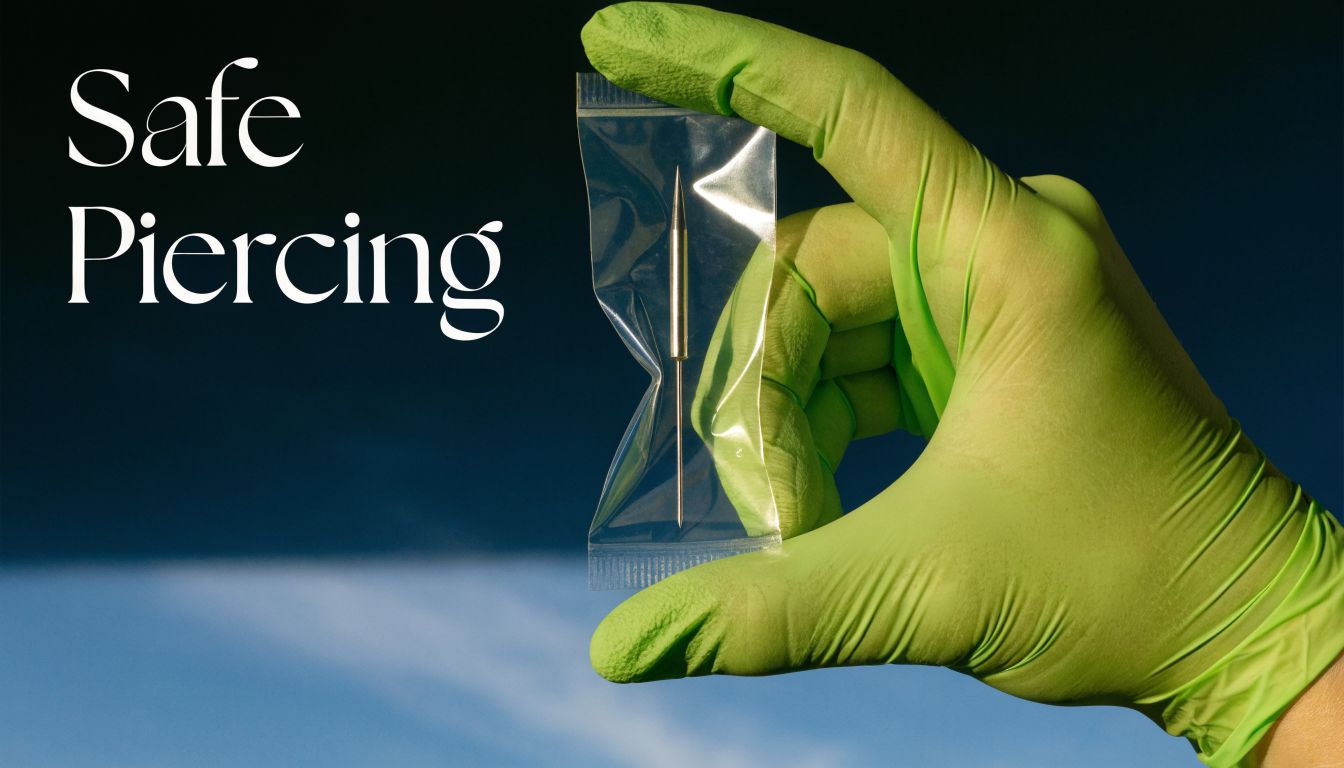
Professional UK piercing standards favour single-use sterile needles over guns. Piercing guns cause more blunt-force trauma to the tissue than a sharp, hollow needle. Professional studios also use autoclave sterilisation at 134°C and high-grade materials. Even with good technique, a helix usually takes 3 to 9 months to heal fully.
That’s why reputable piercers are so firm on this point. A piercing gun may seem quick, but speed isn’t the same as precision or gentle tissue handling.
What a clean, professional setup usually includes
When you walk in, look for visible basics done properly:
- Fresh sterile equipment opened for the appointment
- Clean gloves and a tidy procedure area
- Appropriate jewellery, ideally implant-grade and suitable for initial healing
- Careful marking and placement checks before anything is pierced
You should also feel that the piercer is paying attention to you, not processing you. A good appointment never feels rushed.
Jewellery choice is part of safety
People often focus on the needle and forget the jewellery. The jewellery sits in the piercing while it heals, so material and fit matter.
Implant-grade titanium is widely preferred because it is suitable for fresh piercings and supports cleaner healing. Threadless or well-finished jewellery also helps reduce avoidable irritation from poor construction or rough edges.
A well-placed piercing with poor jewellery can still become an annoying heal. Technique and material work together.
Aftercare should be explained clearly
A proper appointment ends with useful aftercare, not a vague “clean it and don’t touch it”.
You should leave knowing:
- How to clean it
- What normal healing looks like
- What signs mean you should contact the studio
- When to return for a check or jewellery change
That final part matters for first-timers. Reassurance and follow-up are part of good practice, especially with cartilage and body piercings that can be fussy during healing.
Ready for Your New Piercing Get Started Today
If you’ve made it this far, you already know more than most first-time clients. That matters.
The big takeaway on piercing age uk is that the answer isn’t just about one law. It’s about the law, the local setting, the studio’s policy, the piercing you want, and whether you can heal it well. Once people understand that, the whole process feels much less confusing.
For parents and teens, the best approach is simple. Check the studio’s policy before booking. Bring the right ID. Choose a studio that uses sterile single-use needles and quality jewellery. And don’t treat a stricter policy as a bad sign. In most cases, it’s exactly the opposite.
If you want help before booking, speak to someone first. You can call 01202 900050 (Bournemouth) / 020 8686 7730 (Croydon) or send a WhatsApp message to 07752 913846 (Bournemouth) / 07902 490584 (Croydon) and ask what to bring, what age policy applies, and whether the piercing you want is a good fit right now.
If you’re ready to find a trusted studio, Piercing Near Me makes it easy to explore professional options in Croydon and Bournemouth, compare placements, and book with more confidence.