
Scrolling through a dermal piercing on someone's chest or wrist can leave you with the same question every first-timer asks, how does a single gem stay there with no bar showing? The answer is simpler than it looks, but the mechanics matter because dermals heal differently, fail differently, and need a different kind of aftercare than a standard ear or facial piercing. If you're trying to decide whether the look is worth the commitment, start with how the jewellery sits under the skin.
Understanding What a Dermal Piercing Really Is
A dermal piercing looks like a tiny stud sitting directly on the skin, but that visible top is only half the story. Underneath sits a small anchor tucked into the dermis, the layer beneath the surface, which is why the jewellery appears to float without a visible bar. That's the key difference from a traditional piercing, which passes through the tissue and has two ends.
A wall plug is a useful comparison. The shiny top is the screw head you can see, but the part that holds everything in place is hidden inside the wall, and the skin has to accept that hidden piece for the piercing to stay secure. In dermal work, the anchor has to sit at the right depth so the body doesn't slowly push it out or bury it too far in.
The medical literature describes a dermal piercing as a single-point surface piercing placed into the dermis with an anchor beneath the skin, unlike standard piercings that have two exit points, with common anchor gauges of 14G to 18G and base diameters of roughly 3 to 7 mm (PMC review). That makes the design mechanically different before you even think about style.
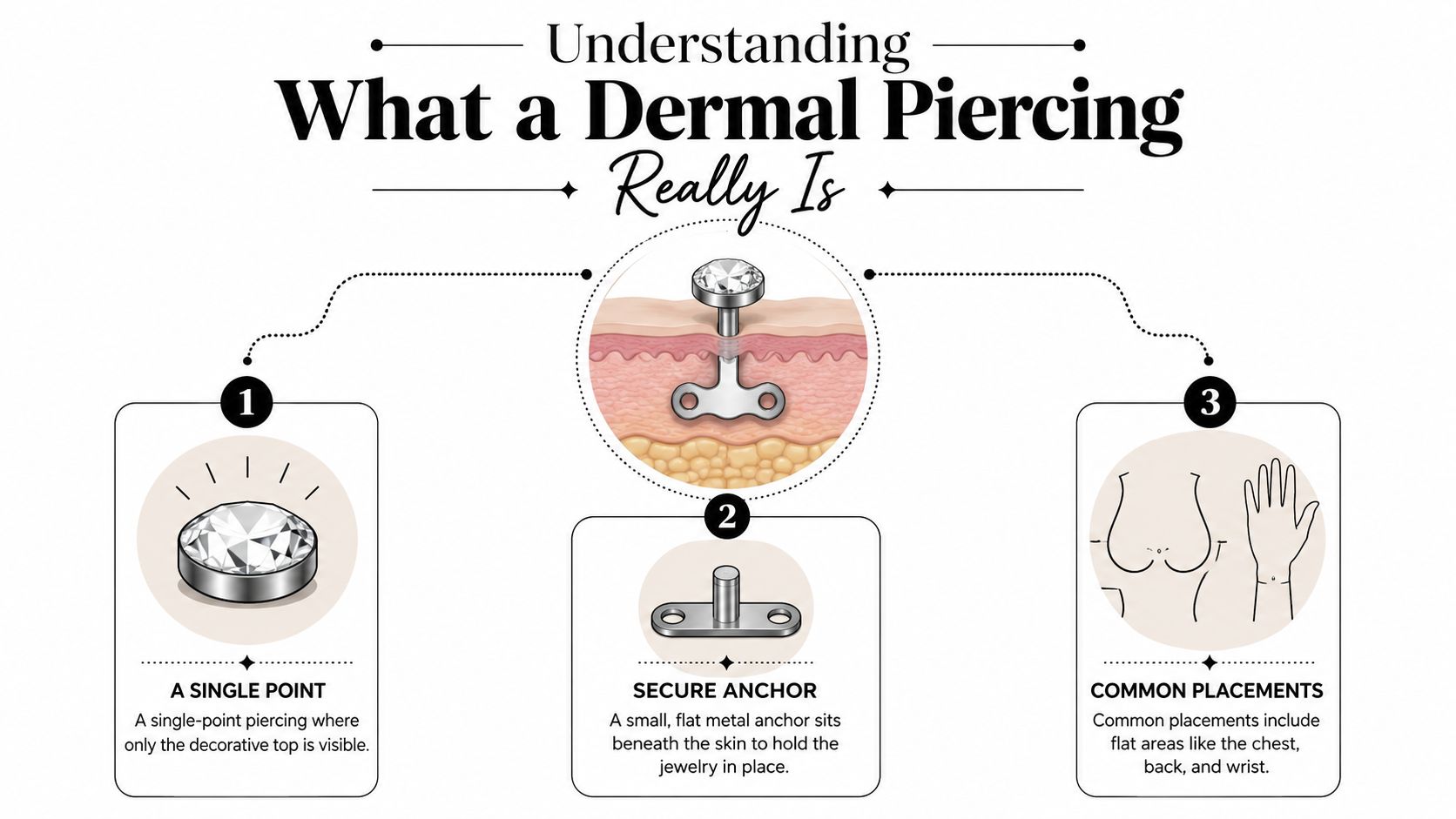
Practical rule: if you can picture the jewellery as a two-part system, you're already thinking about it the right way. The visible top is for appearance, the anchor is what makes the piercing function.
How Dermals Differ From Traditional Surface Piercings
A dermal piercing can look like a surface piercing at first glance, especially once the top is fitted and sitting flat against the skin. The structure is different, though. A surface piercing uses jewellery that travels under the skin with two visible ends, while a dermal relies on a single visible top held by a hidden anchor beneath the surface.
That hidden-anchor design changes how the piercing behaves day to day. Dermals depend heavily on how well the anchor matches the tissue depth and how much movement the area gets, so thin skin, high-friction spots, and places that bend a lot are more likely to cause trouble. The jewellery is also kept compact, with UK piercing retail channels commonly using a 1.2 mm internal thread, a 1.6 mm gauge anchor, and tops in the 3 mm to 4 mm range, which helps balance stability with less tissue trauma.
| Feature | Surface Piercing | Dermal Piercing |
|---|---|---|
| Structure | Two visible exit points | One visible top, one hidden anchor |
| Body path | Jewellery passes through tissue | Jewellery sits in a small pocket under the skin |
| Healing behaviour | Usually more linear and familiar | More dependent on anchor depth and placement stability |
| Rejection tendency | Can still reject, especially at tension points | Often more sensitive to movement and pressure |
| Removal process | Usually removed like other through-and-through piercings | Typically removed by freeing the anchor from beneath the skin |
A lot of people call dermals “microdermals”, and in practice that usually means the same thing, just with small hardware. The name matters less than the mechanics. The piercing lives or fails based on how well the anchor sits in the tissue, and that is where first-timers often get surprised.
A dermal is a bit like a wall plug inside skin. You only see the decorative screw head on top, but the part doing the holding is hidden underneath. That is also why some placements hold up better than others. Areas that move less and get brushed less tend to last longer, while spots that catch on clothing, bend often, or sit under pressure are more likely to reject.
For a closer look at the hardware side of microdermal anchor piercing, see the microdermal anchor piercing guide.
The visible gem gets the attention, but the hidden base does the work.
The Dermal Piercing Procedure Step by Step
A proper dermal appointment starts before any tool touches the skin. The piercer should talk through the placement, check the area for movement and thickness, and mark the exact spot so the anchor lands where the skin can support it. That part matters because the wrong site can look great in the chair and fail in real life.
The anchor is then seated into a tiny pocket made with a needle or skin punch, which creates room beneath the skin for the base to sit. That pocket has to match the anchor depth closely, because a pocket that's too shallow makes the jewellery unstable and a pocket that's too deep can raise the risk of embedding or irritation to deeper structures. The medical guidance on dermal hardware is clear that the pocket and anchor need to fit together properly to reduce migration or rejection (PMC review).
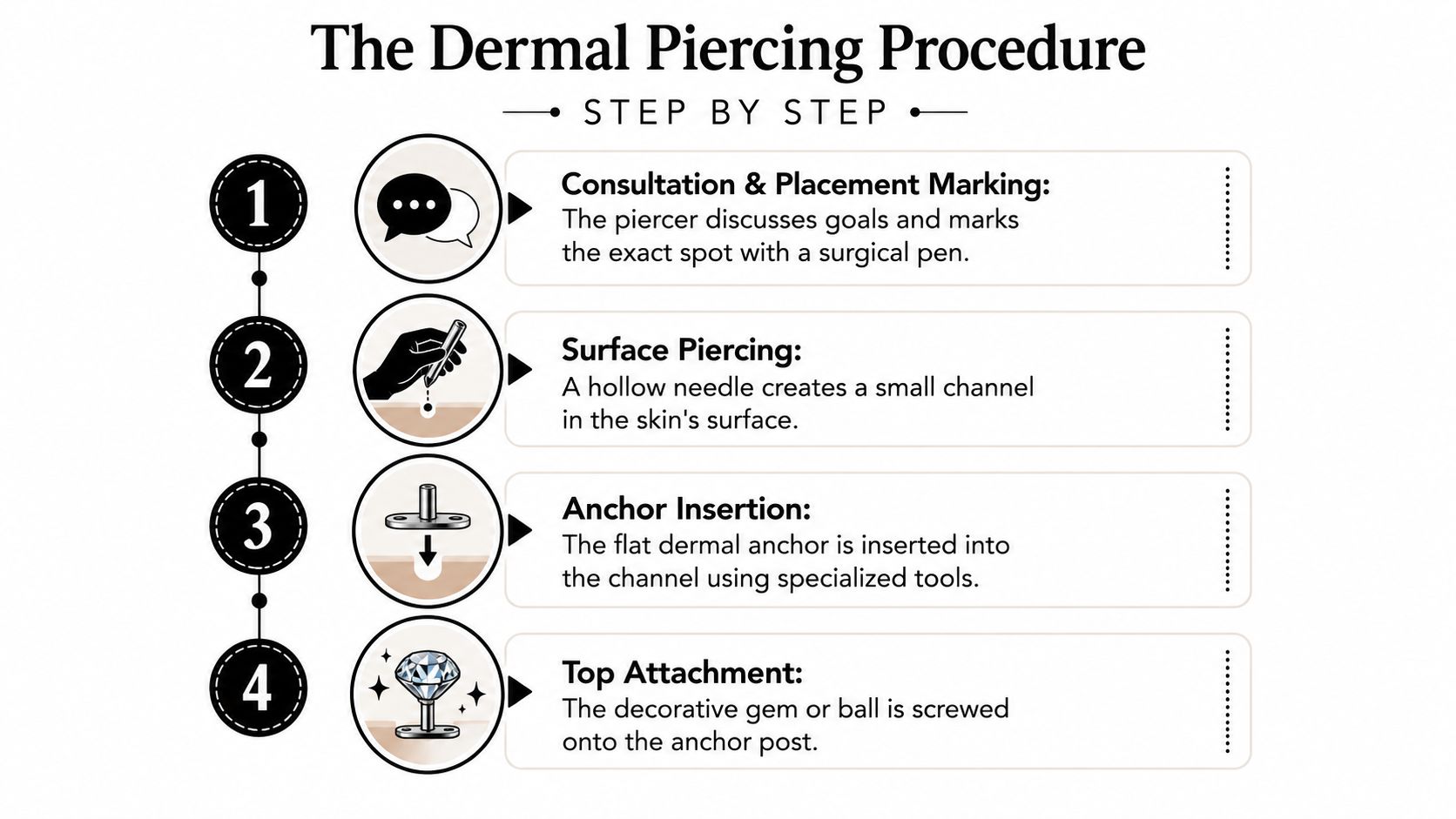
A clean way to picture it is as fitting a small post into a prepared socket. The post has to sit straight, flush, and stable, otherwise the decorative top never has a fair chance of healing comfortably. That's why the procedure isn't just about precision, it's about matching the jewellery to the body in front of the piercer.
The visible top is screwed on only after the anchor sits correctly. For first-timers, implant-grade titanium is the sensible starting point because it's widely used in professional piercing jewellery and keeps the focus on compatibility rather than guesswork. If you're comparing styles, the internal guide on microdermal anchor piercing helps make sense of the hardware side without turning the choice into a jargon test.
Common Placements and Jewellery Choices
A dermal usually works best on skin that does not move around too much and has enough tissue to hold the anchor in place. Flat areas, or areas with only a gentle curve, are usually the first places a piercer considers, because constant bending, rubbing, or pressure makes the jewellery work harder than it should. A careful piercer looks at the site first, then the style of the jewellery.
What placement really means
A chest dermal or upper-back dermal often behaves differently from one placed where clothing or straps rub all day. The design may stay the same, but the skin under it does not. Skin thickness, movement, and contact with clothing all affect whether the anchor stays seated, so some placements are offered more readily than others. A piercer may turn down a site that looks good on paper but does not have the right tissue support in real life.
Jewellery choice is usually straightforward at the start. Gem tops, bezel-set discs, and simple titanium ends are common because they sit neatly and do not add extra drag. The anchor design matters too, and expert guidance on fenestrated base guidance explains why a fenestrated base can help the tissue hold the anchor more securely in the dermis.
Good fit beats bold placement. If the tissue cannot support the anchor well, the prettiest spot is still the wrong one.
A sensible studio will also ask how your daily routine fits the placement. Tight waistbands, heavy bags, sports gear, and repeated movement all affect how a dermal settles and how long it is likely to stay comfortable. That is why a careful piercer may steer you toward one area and away from another, even if you arrived with a specific look in mind.
Healing Timelines and Daily Aftercare
Dermals can look calm on the surface long before they're settled underneath, and that trips a lot of people up. Early quiet doesn't mean the tissue has finished adjusting around the anchor. The safest assumption is that the outside may look fine while the deeper healing is still ongoing.
Peer-reviewed piercing literature reports 10 to 30 percent of body piercing cases presenting with infection or bleeding at the insertion site, which is why early warning signs matter so much (medRxiv review). A simple routine gives the piercing the best chance of staying stable instead of getting irritated by daily habits.
A routine you can actually follow
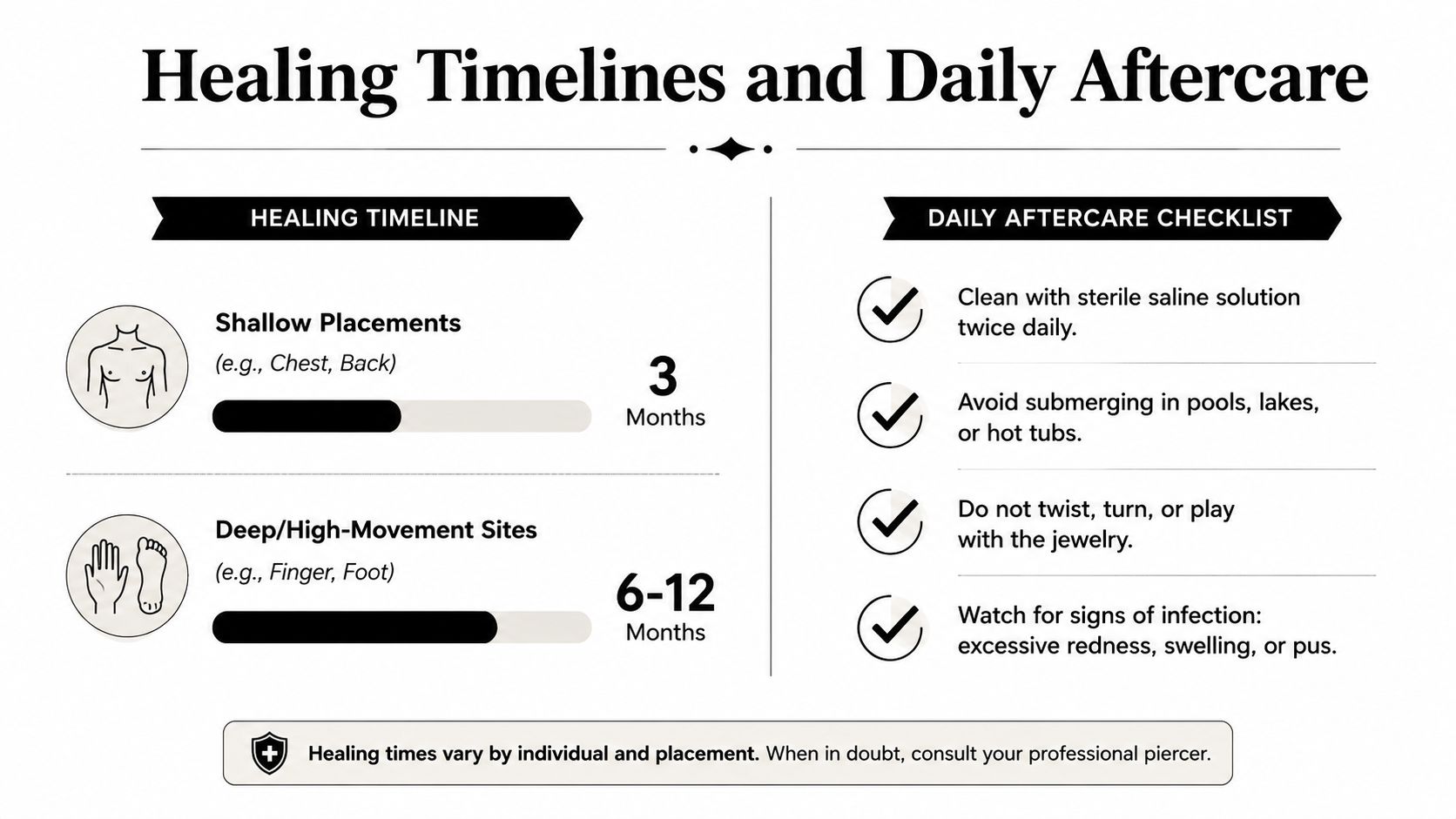
Daily checklist
- Clean gently with sterile saline.
- Leave it alone. Don't twist, turn, or play with the top.
- Avoid pressure from bras, waistbands, seatbelts, or sleeping on it.
- Keep it out of pools, hot tubs, and saunas while it's fresh.
- Watch the area for redness that keeps spreading, heat, swelling, pus, or a top that starts sitting differently.
The routine is boring on purpose. Dermals do better when they're not being bumped, soaked, or over-cleaned, and they really don't like hands that keep checking them “just to see”. If the jewellery feels tender for a bit, that's not unusual, but increasing pain, hot swelling, or discharge means the piercing needs a proper look.
A good rule is simple, if the surface looks angry, or the top starts moving more than it did before, contact the piercer instead of waiting it out. Catching irritation early is much easier than dealing with a failing anchor later.
Risks, Rejection, and How Often Dermals Really Last
This is the question that usually decides whether someone books a dermal or keeps scrolling. A dermal can last a long time, but it is not permanent, and the body can reject it if the anchor never settles well in the tissue. That is not the piercing “going wrong” in a moral sense, it is the body reacting to something it treats as foreign.
The early signs usually start. The anchor may shift a little, the top may stop sitting flush, and more of the jewellery becomes visible than before. Rejection is the final stage of that process, where the body keeps pushing the anchor closer to the surface until it can no longer hold. Embedding is the other side of the problem, where the anchor sits too deep and becomes difficult to manage, which is why careful placement matters from the start.
A dermal is a bit like a button sewn onto cloth. If the thread sits well, it stays put. If the fabric is thin, stretched, or pulled again and again, the button starts to loosen. Skin behaves the same way under pressure, friction, and repeated movement.
UK context helps make the picture more realistic. A UK-based survey found 10% of adults in England aged 16 and over had at least one body piercing, and nearly 50% of women aged 16 to 24 had a piercing at a site other than the earlobe (UK body-piercing survey). That does not tell us how every dermal will behave, but it does show how common piercing decisions are, often at a young age, and why people want a clearer answer about risk before they commit.
For a plain-English check on warning signs, the guide to piercing rejection signs is useful to keep nearby. In practice, dermals placed on low-movement areas can last for years, while placements that sit under tension or constant rubbing tend to fail sooner. The main trade-off is not just how the piercing looks on day one, but whether the site can keep supporting it once normal daily movement starts pressing on the anchor.
Removing a Dermal and Choosing a Safe Studio
A dermal can be removed in a controlled way when it is time to come out. The piercer usually lifts the skin just enough to free the anchor and let the small pocket close. It sounds dramatic, but in skilled hands it is a straightforward process, and early removal usually gives the skin a better chance to settle neatly than waiting for the jewellery to push its way out on its own. Some mark or flat scar can remain, especially if the piercing has been irritated, rejected, or snagged often.
The larger question is how to choose a studio that can show you its hygiene standards before the piercing even begins. Look for single-use sterile needles, properly autoclaved equipment, implant-grade titanium jewellery, and an aftercare explanation that is clear and specific, not recycled from a template.
The setting matters more than many first-timers expect. Analysts in a Wales-based look-back study of a poorly hygienic premises found 36% of clients reported a skin infection associated with their piercing (Wales hygiene study). That does not mean every studio is unsafe. It shows how much the conditions around the piercing can shape what happens afterwards.
A safe studio should be able to explain sterilisation, jewellery choice, and removal in plain language without getting defensive.
If a piercer cannot tell you what they are using, how it is being cleaned, or what they would do if a dermal starts failing, keep walking. Placement skill helps, but sterile technique and honest guidance separate a pretty result from a problem waiting to happen. If you are comparing costs as part of that decision, the dermal piercing cost guide is a useful place to start, but price only makes sense alongside hygiene, skill, and follow-up.
Booking a Dermal Piercing at Timebomb Studios
A good first dermal appointment should feel calm, specific, and unhurried. The piercer should check the placement, explain why the site makes sense for your skin, show you jewellery options, and talk through aftercare before anything is done. If you're comparing costs as part of the decision, the dermal piercing cost guide is a useful place to start, but the value is in the skill, hygiene, and follow-up you get with the appointment.
That matters even more for dermals because the hidden anchor makes the placement less forgiving than a simple through-and-through piercing. A good studio will tell you when a location looks promising and when it doesn't, because refusing a bad fit is part of good service. That kind of honesty is exactly what first-time clients need.
Piercing Near Me works with Timebomb Tattoo & Piercing studios in Croydon and Bournemouth, where clients can expect sterile needles, implant-grade jewellery, experienced piercers, and clear personalised aftercare. If you want a dermal and you want it done properly, the safest next step is to ask questions before you book, not after the jewellery is in.
Please call 01202 900050 (Bournemouth) / 020 8686 7730 (Croydon) or message 07752 913846 (Bournemouth) / 07902 490584 (Croydon) on WhatsApp to ask about your placement, check suitability, or arrange a consultation.
If you want a studio-led, UK-specific piercings guide with clear advice on safety, healing, and booking, visit Piercing Near Me. It's a practical place to compare services, understand the process, and take the next step with confidence.