
You're probably here because you typed 8mm nose studs into a shop search, saw dozens of options, and realised none of them seemed to explain the one thing you needed to know. Will it fit? Will it heal well? Is it safe, or is it just labelled nicely?
That confusion is normal. Jewellery listings often throw around one measurement as if it tells you everything, when in piercing jewellery it rarely does. With nose studs, 8mm can mean different things, and if you buy the wrong piece, the problem isn't only how it looks. It can affect comfort, healing, and whether the jewellery is even suitable for your piercing in the first place.
The 8mm Nose Stud Mystery
A lot of first-time clients have the same story. They see a simple little stud online, the listing says 8mm, and they assume that must be a standard nostril size. Then the jewellery arrives and one of three things happens. The post is too long and sticks out inside the nostril, the top looks far bigger than expected, or the piece isn't the right style for the channel at all.
The awkward bit is that shops aren't always lying. They're often just being incomplete.
In England, nose piercings are firmly part of mainstream piercing culture. Nose piercings are the third most common piercing site in England, with 3.0% of the population having one, according to survey data published on PMC. That popularity means there's a huge amount of jewellery on the market, but it also means a lot of generic retail listings are aimed at quick sales rather than clear education.
Why the label causes so much confusion
“8mm” sounds precise, but it's a bit like buying jeans marked only “medium”. It tells you something, just not enough to know whether they'll fit your body.
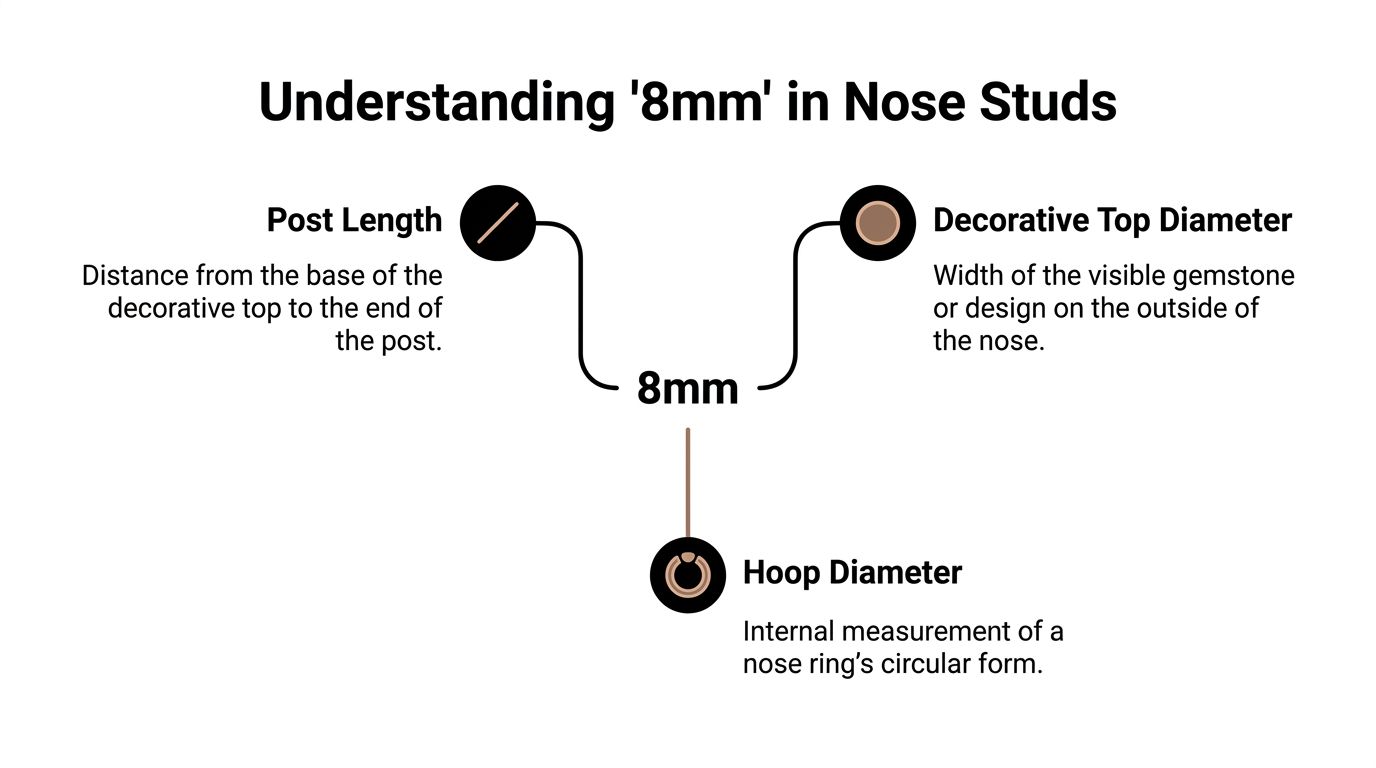
With nose jewellery, that single number might refer to:
- The length of the post
- The size of the decorative top
- The diameter of a hoop
If you're buying a stud, you need to know which one the seller means. If they don't say, you're guessing.
Practical rule: If a product listing says only “8mm” and nothing about gauge, threading, or whether the measurement is length or diameter, treat it as incomplete information.
Why this matters for more than style
A nose stud that's too long can move around and catch. One that's too short can press into tissue. One that's too thin can create a different problem altogether, which we'll get to shortly.
That's why experienced piercers don't size jewellery by trend labels alone. They look at your anatomy, the age of the piercing, the jewellery style, and how the piece sits when you breathe, smile, and clean around it.
Decoding What 8mm Really Means
The easiest way to understand 8mm nose studs is to split the term into separate measurements. Don't think of “8mm” as the size. Think of it as one possible size among several parts.
Post length
For a stud, post length is the distance from the underside of the decorative top to the end of the wearable post. This is the part that passes through the piercing channel.
Professional sizing information commonly used in UK piercing explains that the average length of a nose ring is about 6 millimetres, while 5mm and 7mm lengths are also available for different anatomy, and 8mm remains a common baseline size in retail sizing language, especially around nostril jewellery, as outlined in this nose ring sizing guide from Body Candy.
For many healed nostril piercings, a shorter post often sits neater. An 8mm post is more likely to make sense when someone has thicker tissue, a particular placement, or extra room is needed.
Decorative top diameter
Sometimes the 8mm refers to the visible end, not the wearable part. That means the gem, disc, cluster, or design on the outside measures 8mm across.
For a nostril stud, that's a very different look from a tiny subtle crystal. An 8mm top can read as bold, obvious jewellery rather than a delicate everyday stud.
If you've ever opened a parcel and thought, “That's much bigger than I expected,” this is often why.
Hoop diameter
This aspect is a frequent source of misunderstanding. 8mm is also a standard way to describe the internal diameter of a hoop.
For nostril hoops in the UK, 5/16 inch (8mm) is one of the two most common diameter sizes, alongside 10mm, which is why the number appears so often in product listings. But that doesn't make every 8mm piece suitable for every nostril.
A simple way to read a listing
When you check a product page, look for these three questions:
| What to check | What it means |
|---|---|
| Is 8mm the post length? | How much wearable bar sits through the piercing |
| Is 8mm the top size? | How large the visible decoration looks |
| Is 8mm the hoop diameter? | The internal width of a ring |
If you're unsure about the thickness as well, it helps to learn the basics of nostril piercing gauge sizing.
A good jewellery listing should tell you more than one measurement. One number on its own isn't enough to buy confidently.
Gauge Size The Critical Dimension for Safety
This is the part many online listings hide in small print, if they mention it at all. Gauge means the thickness of the post.
It's like the thickness of an earring wire. Two pieces can both be called 8mm, yet one can be much thinner than the other. That difference matters.
Many retail listings for 8mm nose studs sell 20G (0.8mm) jewellery with external threading, while professional UK piercers recommend 18G (1.0mm) with internal or threadless systems to reduce tissue damage and the cheese-cutter effect, as noted by Trendhim's nose piercing jewellery information.
Why thinner isn't always better
First-time clients often assume thinner jewellery will feel gentler. It sounds logical. Smaller must mean easier, right?
Not always. A very thin post can put more concentrated pressure on tissue. Over time, that can encourage movement, irritation, and that slicing effect piercers describe as cheese-cutter behaviour. The jewellery doesn't literally cut like a blade, but it can place narrow pressure through soft tissue in a way that isn't stable.
The real issue with online 8mm studs
A lot of online pieces are sold as if the only thing that matters is the visible measurement. They might say 8mm titanium nose stud in large text, while the important details sit buried below, or aren't listed properly at all.
Watch for these common problems:
- 20G posts sold as standard. They're common online, but that doesn't mean they're the best choice for a stable nostril piercing.
- External threading. The screw ridges pass through the channel during insertion and removal.
- Vague sizing language. “Universal fit” and “standard nose stud” don't tell you enough.
A better way to think about gauge
If length is how the jewellery sits, gauge is how the jewellery behaves.
A slightly thicker, properly fitted piece tends to feel more secure and more predictable. That's one reason reputable studios pay close attention to thickness instead of treating it as an afterthought.
If a seller highlights the gemstone, colour, and finish but glosses over gauge and threading, they're focusing on appearance first. A piercer should do the opposite.
Choosing Safe Materials and Threading
The material label on a jewellery listing can sound reassuring without providing much detail. “Titanium”. “Steel”. “Surgical”. Those words look safe, but the safer question is which grade, exactly?
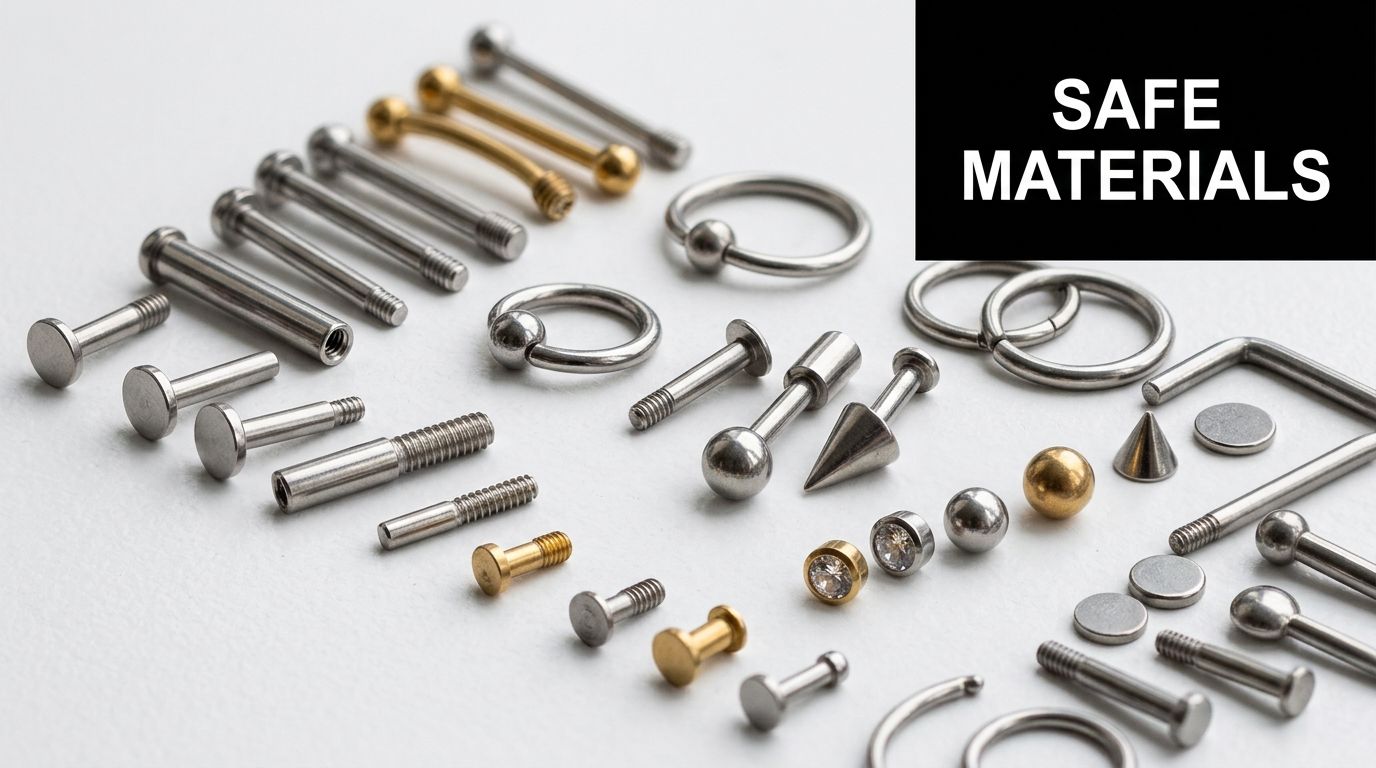
To meet UK hygiene expectations, nose jewellery should be made from certified materials such as ASTM F136 titanium, and many online listings for 8mm nose studs fail to publish those certification codes, which leaves buyers unable to confirm whether the jewellery is implant-grade or free from unsafe nickel alloys, as discussed in this piece on titanium piercing jewellery and supported by Pierce Body's discussion of nose and septum piercing trends.
Material words that need proof
A proper jewellery description should tell you the certification standard, not just the marketing term.
Here's the difference:
| Listing term | What you still need to know |
|---|---|
| Titanium | Is it ASTM F136? |
| Steel | Is it ISO 5832-3 compliant? |
| Surgical steel | What grade is it, specifically? |
If that information isn't listed, you can't verify the material standard yourself.
Why threading matters so much
Threading is how the decorative top connects to the post.
There are three broad possibilities you'll see in nose jewellery:
- Externally threaded. The post has screw ridges on the outside.
- Internally threaded. The post is smooth, and the top screws into it.
- Threadless. A smooth post holds a pin-fit top.
For nostril jewellery, internal threading and threadless systems are the safer professional standard. They keep the wearable surface smooth during insertion and removal.
External threading is the one I'd be cautious about. Those ridges can drag through the channel, and they also create extra little areas where debris can collect.
What to ask before you buy
If you're bringing in pre-bought jewellery, ask the seller or your piercer these exact questions:
- What is the gauge?
- Is it internally threaded or threadless?
- Is the titanium ASTM F136 certified?
- If it's steel, is it ISO 5832-3 compliant?
- Which part of the jewellery is 8mm?
Jewellery that looks polished on a website can still be poor quality. Smooth finish, certified material, and safe threading matter more than a pretty product photo.
How to Measure for Your Perfect Nose Stud Fit
Only do this with a fully healed piercing that feels calm and stable. If it's new, sore, crusty, swollen, or recently irritated, stop there and let a piercer size it in person.
For healed piercings, home measuring can help you understand what already works for you. The key is not to measure in a rush.
Start with the jewellery you already wear comfortably
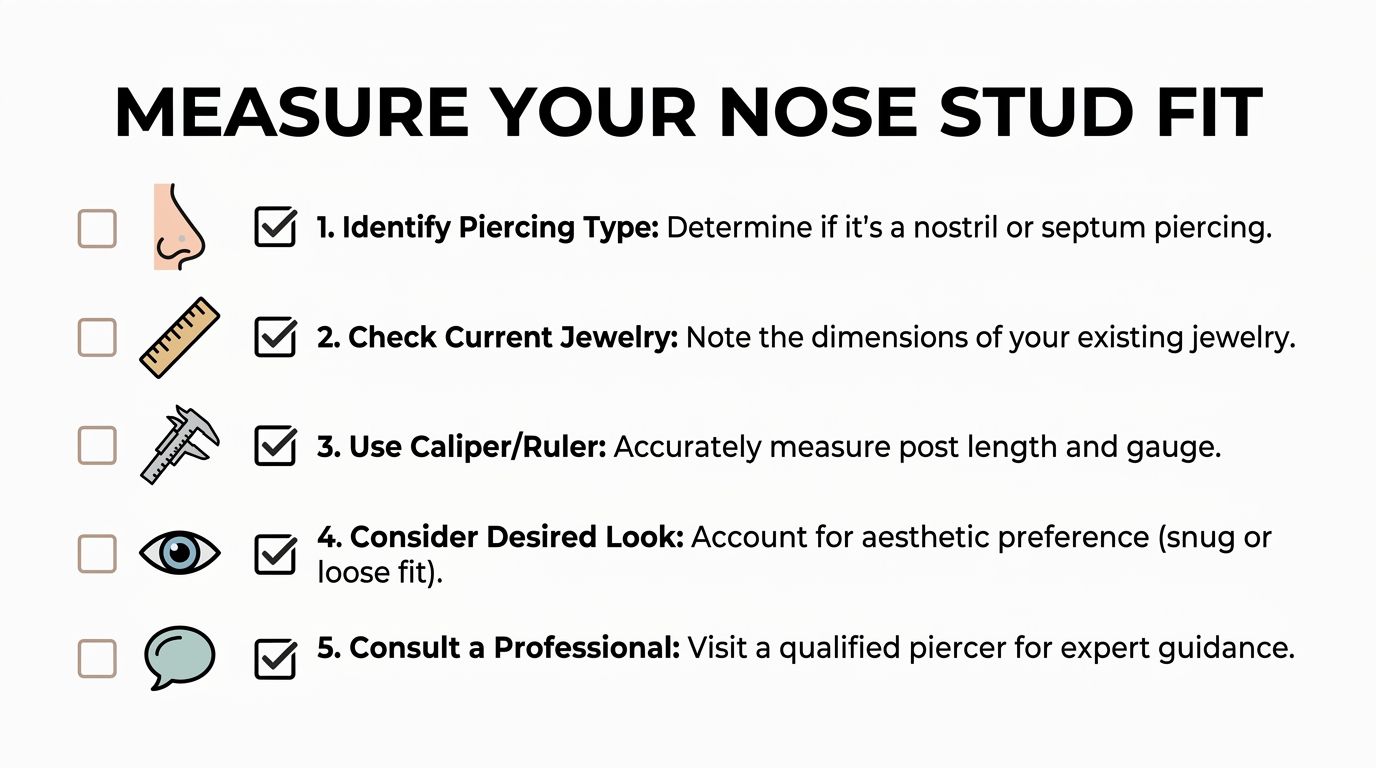
The easiest reference point is a stud you know feels right. Remove it carefully on a clean day, then check these parts:
The wearable length
Measure the post from the underside of the top to the end of the bar.The top size
Measure the visible decoration across its widest point.The thickness
Gauge is harder to measure accurately without proper tools, so if you're unsure, don't guess.
A caliper is more reliable than a basic ruler for small jewellery parts.
Check how the fit behaves, not just the number
A stud can technically fit and still not be ideal. Ask yourself what happens during normal wear.
- If it lifts forward, the post may be too long.
- If the top presses in, the post may be too short.
- If it catches easily, the style may not suit your placement.
- If the inside feels sharp or scratchy, the threading or finish may be poor.
Match the jewellery to your piercing placement
Not every nostril sits the same way. A lower, classic nostril placement may suit a very small top. A higher placement might need a different look and fit balance so the jewellery doesn't appear crowded or awkward against the curve of the nose.
That's why copied sizing from a friend rarely works well. Their anatomy isn't yours.
Keep your measuring realistic
Home measuring is useful for replacement jewellery, not for setting up a fresh piercing or solving a problem piece.
Use this approach for:
- A healed piercing you've worn happily for a while
- Replacing like-for-like jewellery
- Checking whether “8mm” on a product page matches your current piece
Don't use it for:
- A new piercing
- An irritated or swollen nostril
- Jewellery you suspect is poor quality
- Forcing a different gauge without advice
Measure the jewellery that fits well, not the nostril itself. The jewellery gives you a far more practical reference point.
When You Must Consult a Professional Piercer
Some situations are fine for careful home checking. Others aren't. If any of the points below sound familiar, it's better to stop guessing.
New piercings and first jewellery changes
Fresh nostril piercings need room for healing, and that initial fit is anatomy-specific. The first jewellery change can also be fiddly, especially if the piece uses a flat back, internal thread, or threadless pin.
If it's your first swap, a piercer can change it with less irritation and confirm that the replacement is suitable.
Pain, bumps, pressure, or repeated snagging
These usually mean something is off. It might be the length. It might be the gauge. It might be the material or threading. It can also be a combination.
Trying random jewellery until one seems better often drags the problem out.
Jewellery bought elsewhere
Pre-bought jewellery is one of the most common reasons people end up in the studio for a check. The piece may be labelled for a nose piercing, but that doesn't mean it meets professional standards or matches your channel.
A piercer can inspect:
- Material quality
- Threading style
- Gauge compatibility
- Whether the finish feels smooth
- Whether the length suits your anatomy
When your measurements still leave you unsure
That last bit matters. Good measuring should make you clearer, not more confused. If you're still second-guessing the listing, the safest choice is to bring the jewellery and let a professional look at it before you wear it.
If you need to persuade yourself that a piece is “probably fine”, it usually isn't the right piece to insert without a proper check.
Book Your Expert Fitting in Croydon or Bournemouth
If you're looking at 8mm nose studs and feeling torn between convenience and safety, get them checked in person. A proper fitting solves the problems online listings can't. You get the right length for your anatomy, the right gauge for stability, and confirmation that the material and threading are suitable before anything goes near your piercing.
Timebomb Tattoo & Piercing helps clients in Croydon and Bournemouth with new nostril piercings, jewellery changes, fit checks, and assessments of jewellery bought elsewhere. If you've ordered something online and you're not sure whether it's implant-grade, internally threaded, threadless, or even the correct thickness, that's exactly the kind of thing worth bringing into the studio.
What an expert fitting helps with
An in-person appointment is useful if you want to:
- Check a mystery “8mm” listing before buying the wrong thing again
- Replace low-quality jewellery with safer implant-grade options
- Confirm whether your current stud is too long, too short, or too thin
- Bring in online jewellery for inspection before wearing it
- Book a nostril piercing properly rather than guessing your starter size
You can also explore local studio information through nose piercing options near you.
Contact details
For bookings or questions, call 01202 900050 (Bournemouth) / 020 8686 7730 (Croydon).
For quick messages and jewellery checks, WhatsApp 07752 913846 (Bournemouth) / 07902 490584 (Croydon).
If you're nearby, Croydon and Bournemouth both give you access to professional help when a product page just isn't telling you enough. That's often the difference between jewellery that merely goes in, and jewellery that fits, heals, and feels right.
If you want a safer, simpler route to the right nose jewellery, book through Piercing Near Me and get connected with experienced professionals for fittings, consultations, and piercing appointments in Croydon or Bournemouth.