
Most advice on how to clean piercing jewelry gets one thing wrong. It treats every piece like it needs to be stripped, scrubbed, and disinfected as if it had just come out of a clinical tray, when the core job is usually much simpler, and much gentler. For a healing piercing, the priority is clean skin, low irritation, and no residue. For a healed piece, the goal is visible debris removal and complete drying, not home sterilisation.
That distinction matters because the aftercare window is long enough for cleaning to become routine, and the wrong products can make the whole situation worse. UK guidance for new piercings keeps the focus on mild soap and warm water or saline, while avoiding alcohol, hydrogen peroxide, and other strong cleaners that can irritate tissue and damage finishes on some metals (NHS-aligned body piercing guidance). If you're cleaning jewellery in a fully healed piercing, the method changes again, because the jewellery can usually be handled, disassembled, and washed directly without disturbing a healing tract.
Why Most People Clean Piercing Jewelry the Wrong Way
The biggest mistake is treating piercing jewellery like it should come out of a home wash looking hospital-sterile. That sounds careful, but it misses the core job. If the piece is going back near skin, the question is whether it is clean, free of residue, and not carrying anything that will irritate a healing channel or cloud a polished finish.
Sterile is not the same as suitable
For a new piercing, the cleaning approach is different from the one used on jewellery that has already healed. Keep the focus on saline or mild soap and water, leave the jewellery in place, and avoid turning a fresh site into a project every time it feels tender. If you need a refresher on the practical side of that routine, the advice in new piercing aftercare keeps the emphasis where it should be, on the piercing itself rather than on aggressive treatment. For a healing piercing, that means no harsh disinfectants, no constant twisting, and no overhandling that keeps the tissue irritated for longer than it needs to be.
Healing time still depends on the placement. Lobes are usually 6 to 8 weeks, and cartilage can take up to 12 weeks or more (body piercing aftercare guidance). That window is long enough for people to get impatient and start using stronger cleaners or scrubbing too hard. The result is often dry skin, a crankier tract, and jewellery that keeps moving against tissue that has not settled yet.
Practical rule: if the jewellery is going back into a healing piercing, cleaning should support the tissue, not challenge it.
For healed, removable jewellery, the standard shifts. You can clean the piece more directly because the skin is no longer recovering around it, but the finish still matters. Alcohol and hydrogen peroxide come up a lot in household advice, yet they are poor choices for routine jewellery care because they are harsh on some finishes and unnecessary for everyday hygiene. A gentler wash removes oils, skin film, and grime without leaving behind a chemical trace that can sit on the metal or plastic.
The confusion usually comes from treating jewellery as if it is separate from the piercing. In practice, the contact point decides the method. A piece that can be washed thoroughly on a counter may be the wrong thing to put through a fresh lobe or cartilage site, especially if it has threads, settings, or decorative parts that trap residue. Cleaning should follow the healing stage, then the material, then the way the piece is built. That order keeps you from using the wrong method just because the jewellery itself looks sturdy.
The Two-Stage Method for Cleaning Healed Piercing Jewelry
Healed jewellery cleans best when you separate the process into two jobs, loosening debris and removing residue. That sounds basic, but it's where many individuals go wrong. They either rush the soak and leave grime in the threads, or they overwork the piece with cloth towels and end up putting lint and bacteria straight back onto it.
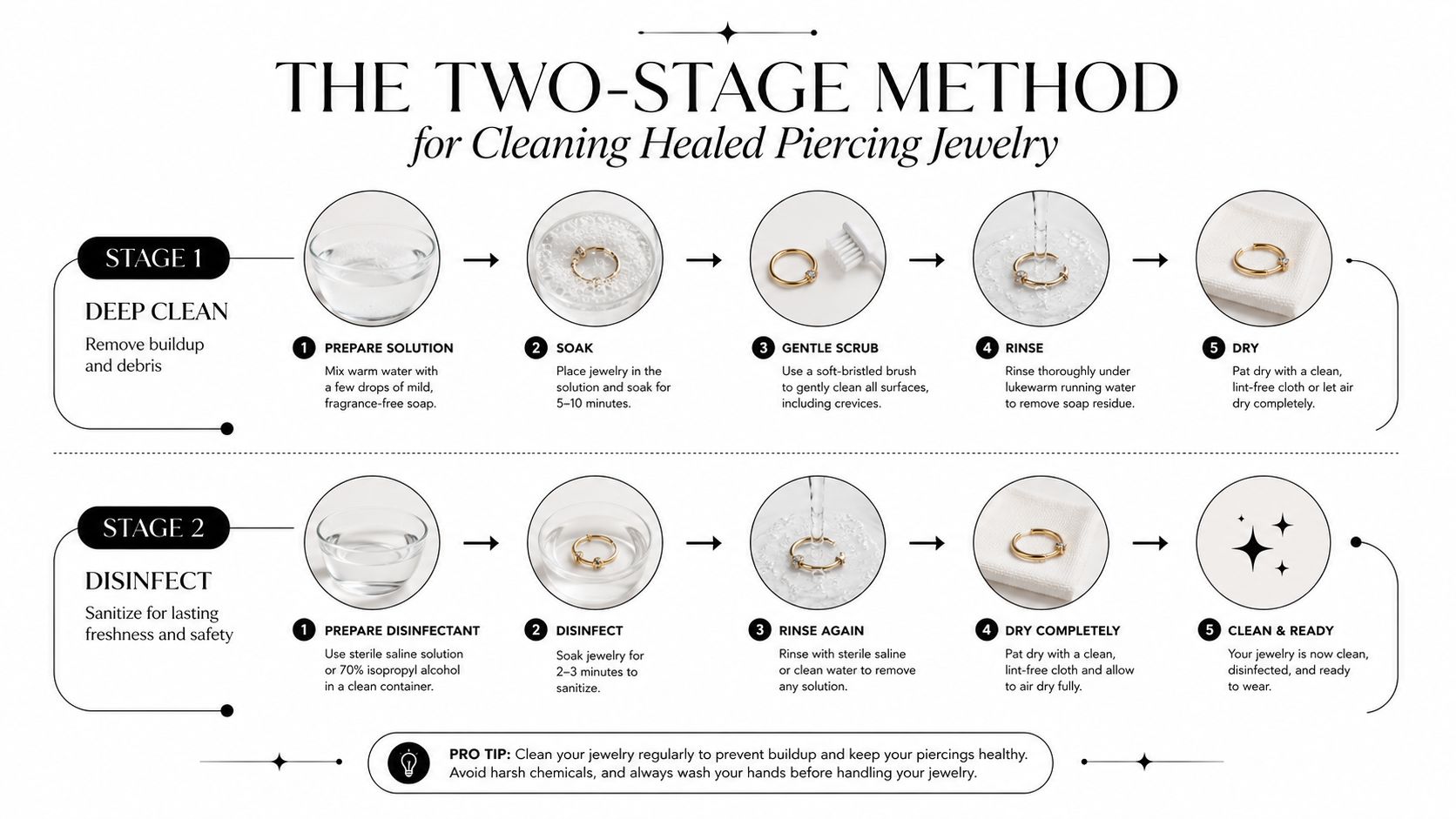
Stage one, wash and disassemble
Start with clean hands. If the piece comes apart, separate it before it goes into water. That matters on threadless ends, internally threaded pieces, and anything with decorative components that trap skin oil around the join. A lot of grime hides where the eye can't see it.
Use warm water and a small amount of mild, fragrance-free soap. Soak the jewellery for about 5 to 10 minutes, then use a soft brush only on threads and crevices where residue sticks. That's enough for most healed pieces, and it's less likely to damage a finish than abrasive scrubbing. A dedicated soft brush is far better than a kitchen sponge, which can hold old grease and grit.
Stage two, rinse and dry properly
Rinse thoroughly. Soap residue is one of the most common reasons a piece looks clean but still irritates skin later. Dry it with a lint-free paper towel, not a cloth towel. Fabric towels can reintroduce bacteria and leave fibres in hinges, settings, or tiny decorative grooves.
A good benchmark is simple, the piece should look clean, feel smooth, and be completely dry before it goes back into storage or into a healed piercing. That's more useful than chasing sterility at home. It also aligns with the practical advice in ear piercing cleaning guidance, where residue control and dryness matter more than harsh cleansing.
Don't twist or rotate components just to “help” them clean. Unnecessary movement is how people end up making a clean piece harder to wear.
If the design has lots of tiny settings, the brush is doing the heavy lifting, not chemicals. If it still looks dirty after that, the problem is often the design, not your technique.
Material-Specific Cleaning for Implant-Grade Metals Gold and Bioplastics
Material choice changes what you should clean with, and what you should avoid. A method that works on implant-grade titanium can be too aggressive for solid gold, and it can be wrong for bioplastic or acrylic. The safe answer is not one-size-fits-all. Match the cleaner to the finish, the construction, and how much the piece can handle.
The table below is the quickest way to judge what belongs in the cleaning bowl.
| Material | Safe Cleaners | Avoid |
|---|---|---|
| Implant-grade titanium | Warm water, mild fragrance-free soap, gentle brush on threads | Alcohol, hydrogen peroxide, harsh disinfectants |
| Surgical steel | Warm water, mild fragrance-free soap, thorough drying | Prolonged exposure to alcohol or peroxide |
| Solid gold | Mild soap, warm water, soft cloth or lint-free towel | Abrasive scrubbing, strong chemicals, rough drying cloths |
| Bioplastic | Mild soap, lukewarm water, very light handling | Hot water, alcohol, peroxide, aggressive brushing |
| Acrylic | Mild soap, lukewarm water, gentle rinse | Alcohol, peroxide, heat, long soaking |
Implant-grade titanium and surgical steel tolerate routine soap cleaning well, but they do not need a chemical bath to be usable. Alcohol and peroxide add risk without giving you anything useful back, and repeated use can shorten the life of the finish. Solid gold needs a softer touch because polished surfaces show wear quickly, and I would rather preserve the finish than chase a harsh clean that is not necessary. If you are choosing gold for a healed piece, solid gold piercing jewellery guidance is the right standard to keep in mind.
Bioplastics and acrylic get damaged most often by overconfidence. They are more likely to cloud, warp, or look tired if you treat them like metal. If a client brings me a decorative acrylic item that has gone dull, the cleaning habit is usually the problem, not the jewellery itself.
Hard water is the other practical issue in the UK. In some areas, limescale leaves a faint film after rinsing, and that film can make jewellery look dirty even when the soap has done its job. A final rinse helps, and in a healed context a sterile saline rinse can be a practical finishing step for pieces that will go straight back into wear. That is one reason solid gold jewellery tends to benefit from gentler handling, and the same caution shows up in solid gold piercing jewellery guidance.
The key is simple. If the material scratches, clouds, or reacts badly, stop forcing a universal method onto it.
Cleaning Jewelry in a Healing Piercing Without Causing Irritation
When the piercing is still healing, the wrong move is to treat the jewellery like a removable object that needs a deep clean every time you notice a bit of crust. The jewellery is part of the healing environment. Pulling it out, rotating it, or scrubbing it hard can irritate the tissue and make the tract angrier than it needs to be.
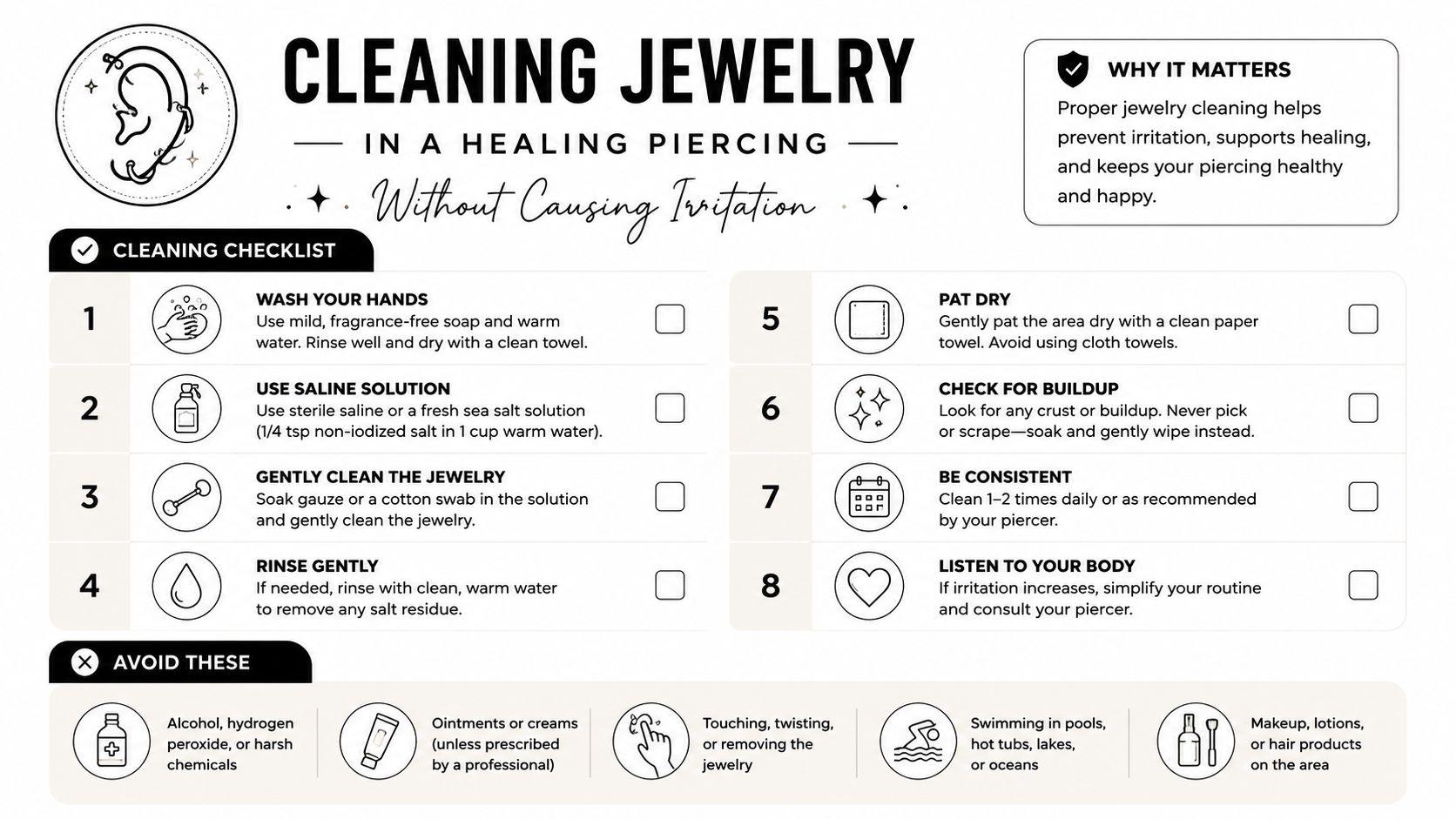
Keep the jewellery in place
UK aftercare guidance is clear on the practical point that matters most, do not remove the jewellery until the piercing is fully healed. That's the part many people miss when they ask how to clean piercing jewelry during the healing stage. You are usually cleaning around the piercing, not performing jewellery maintenance in the usual sense.
For the piercing site itself, sterile saline is the preferred option. It's typically sprayed or soaked on for 30 to 60 seconds, then patted dry. That gives you a low-irritation clean without the sting, residue, or finish damage that can come from stronger household products. It also keeps the focus where it belongs, on the skin and tract rather than the metal finish.
Avoid movement that slows settling
Twisting, rotating, or repeatedly checking the backing does more harm than people expect. The tissue is trying to settle around the jewellery, and extra movement makes that job harder. Even when the piece looks loose enough to “just clean properly”, overhandling can delay the stabilisation of the piercing tract.
Clean the area gently, dry it carefully, and leave the jewellery alone unless a professional has told you otherwise.
If you're seeing crust, the answer is usually not to scrub the jewellery harder. It's to soften the area with saline, remove what releases easily, and leave anything stubborn alone until the next clean. That approach aligns with body piercing aftercare guidance, which emphasises cleaning around the piercing rather than overhandling healing tissue.
If a fresh piercing is sore, swollen, or producing more irritation after each clean, the issue is often the method, not the jewellery. Back off, simplify the routine, and keep the products mild.
Storage Transport and Daily Maintenance Habits
Clean jewellery doesn't stay that way by accident. Most contamination happens between wears, in handbags, toiletry bags, bathroom shelves, and the bottom of drawers where pieces rub against each other. Storage is part of cleaning because a scratched, tangled, or dusty piece is harder to keep clean.
Store each piece so it stays separate
Individual compartments are better than one open pile. They stop chains knotting, prevent post ends from knocking against gemstone settings, and reduce the chances of dust collecting in tiny crevices. If you don't have a jewellery box with dividers, a simple lint-free pouch is better than loose storage, especially for backup pieces that travel to the gym or sit in a wash bag.
Keep jewellery away from hair products, perfume, and makeup. Those products leave residue that looks harmless at first, then builds into a dull film. If you're wearing or carrying spare jewellery, wash your hands before handling it. That one habit does more for daily hygiene than many realise.
Match the clean to the situation
A quick wipe-down is fine if a piece has only been handled briefly and stayed visibly clean. A full soak is better if it's picked up skin oil, trapped dust, or residue from storage. If the item has been near swimming pool water, humidity, or hard-water splashes, dry it promptly and inspect the joints for residue before it goes away again.
The less time jewellery spends damp or exposed, the less likely it is to pick up grime that's hard to shift later.
For UK readers, hard water can leave tiny mineral marks that make jewellery look neglected even when it isn't. The answer isn't stronger soap every time, it's better drying and a cleaner rinse. If you already know the piece is metal-heavy and removable, the two-stage clean from earlier in the article is still the safest routine.
Daily maintenance should feel boring. That's a good sign. Jewellery care works best when it becomes a habit instead of a rescue mission.
When to Seek Professional Help at Your Local Piercing Studio
Some jewellery problems don't respond to home cleaning, and trying harder at home only wastes time. I see this most often with pieces that have damaged threads, settings that trap debris, or finishes that have already started to degrade. The piece may look clean after a soak, but the fault is in the construction, not the surface dirt.
A common example is a decorative end that keeps catching residue around a loose gemstone. Another is a threaded piece that feels gritty every time it's reassembled. If soap and brushing don't solve it, the item may need professional ultrasonic cleaning, or it may need replacing entirely. If the jewellery itself is irritating the piercing, the piercing needs attention too.
Signs that need a studio assessment include persistent discolouration, loosening stones, damaged threads, and any redness, swelling, or discharge around the piercing site that doesn't settle with gentle aftercare. A piercer can tell the difference between cosmetic grime and a structural problem very quickly. That matters more than trying to guess from the bathroom mirror.
For people near Croydon or Bournemouth, Timebomb Tattoo & Piercing studios can look at both the jewellery condition and the piercing health, then advise whether the piece is worth saving or should be replaced. If you want to book or ask a question, call 01202 9000 50 or message 07752913846 on WhatsApp.
Piercing Near Me helps you find trusted piercing advice and professional studios when cleaning at home stops being enough. If your jewellery needs a second look, or you want guidance on aftercare for a fresh or healed piercing, visit Piercing Near Me to find the right support and take the guesswork out of it.