
You've found a beautiful gold stud online. It says “solid gold”, the photos look perfect, and you're already picturing it in your helix, nostril, or lobe. Then the doubt starts. Is it safe for a fresh piercing? Is 9k good enough? What does implant-grade even mean? And if you're in the UK, where do you buy solid gold without guessing?
That uncertainty is sensible. Jewellery for a piercing sits inside your body, not just on top of your skin. The wrong piece can irritate a healing channel, catch on tissue, or expose metals you never intended to wear. The right piece can feel comfortable, heal cleanly, and still look polished years later.
A lot of the confusion comes from labels that sound reassuring but don't tell you enough. “Gold” could mean solid gold, plated gold, or jewellery made for fashion wear rather than body wear. “High quality” might refer to appearance, but not to threading, surface finish, or whether the alloy is appropriate for a healing piercing.
This guide is for people who want clear answers. If you're choosing your first gold piercing, upgrading old jewellery, or trying to find a trustworthy studio in Croydon or Bournemouth, you need practical information, not sales talk. Safe gold jewellery should look good, fit correctly, and support healing. All three matter.
Your Guide to Choosing Safe and Stylish Gold Piercings
Individuals often begin by considering style. They see a tiny gold stud, a neat hoop, or a curated ear with mixed textures and think, that's exactly what I want. Then they hear terms like 14k, 18k, threadless, internally threaded, and implant-grade, and the whole thing suddenly feels more technical than expected.
That's normal. Piercing jewellery sits in a space between adornment and medical-grade material. You want something elegant, but you also need something your body can tolerate. A piece can be beautiful and still be wrong for a new piercing if the metal mix, finish, or construction isn't suitable.
What usually confuses people first
A few questions come up again and again:
- “Is all solid gold safe?” No. Karat matters, and so does how the jewellery is made.
- “Is 9k fine if it's cheaper?” For fashion wear, many people wear it without issue. For fresh or healing piercings, the answer is more cautious.
- “Does plated gold count?” It may look similar at first, but the surface can wear down.
- “Why do piercers talk about titanium and gold together?” Because the post and decorative end both need to be safe for long wear.
Practical rule: For a piercing, always judge jewellery by the material, the construction, and the maker. Appearance comes after that.
What a safe choice should do
Good jewellery should do four jobs well. It should sit smoothly, avoid irritating the tissue, stay secure, and still suit your style. If even one of those is missing, the piece can become annoying very quickly.
That's why professional piercers pay so much attention to the details clients don't always see at first glance. The finish should be smooth. The connection should be gentle on tissue. The gold should be a suitable karat. And the jewellery should be made for body wear, not adapted from fashion jewellery.
Understanding Gold Karats What 14k vs 18k Really Means
When people hear solid gold piercing jewelry, they often assume more gold must always mean better. In practice, it's about balance. Gold has to be pure enough to be appropriate for body wear, but strong enough to survive daily life in a piercing.
A simple way to think about it is baking. Pure flour on its own won't become a sturdy cake. You need other ingredients to give it structure. Gold works in a similar way. Pure gold is soft, so jewellery makers add other metals to create an alloy that's strong enough to wear.
What karat actually means
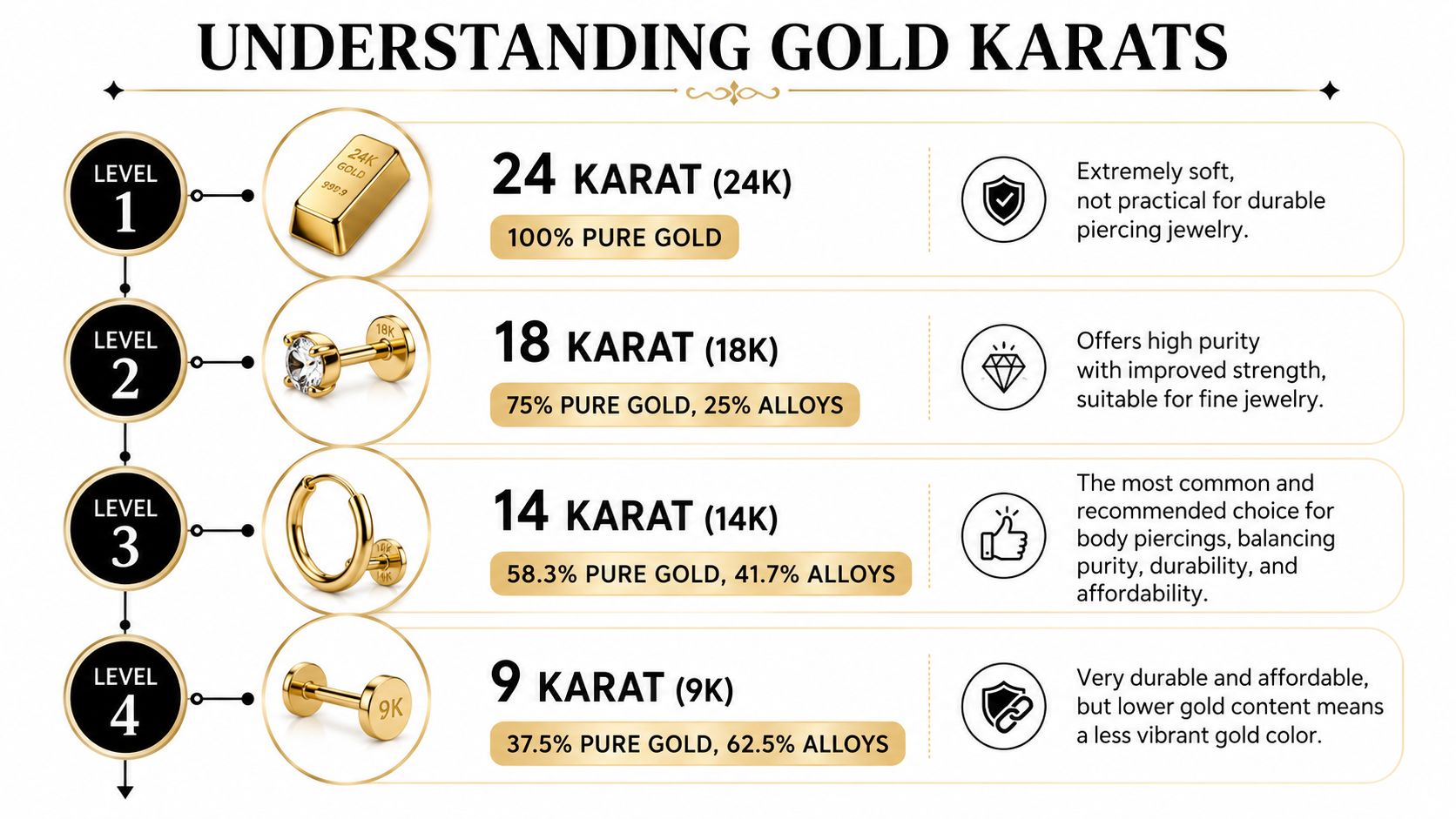
Gold purity is measured in 24 parts.
- 24k gold means all 24 parts are gold. It's very pure, but too soft for practical piercing wear.
- 18k gold means 18 parts gold and 6 parts alloy.
- 14k gold means 14 parts gold and 10 parts alloy.
- 9k gold contains less gold and more alloying metals than 14k or 18k.
UK piercing professionals predominantly manufacture and recommend 14k or 18k solid gold for piercing jewellery because pure 24k bends and dents too easily, while 14k and 18k give the durability needed for wear in the body, as outlined in this explanation of why piercing jewellery material matters.
Why 14k and 18k are the sweet spot
There's a reason experienced piercers return to the same range again and again. According to the Association of Professional Piercers jewellery guidance, gold for initial piercings should be 14k or higher, nickel- and cadmium-free, and alloyed specifically for biocompatibility. The same guidance says gold above 18k is too soft for initial or healing piercings, while gold below 14k often contains nickel or cadmium that can trigger allergic reactions.
That leaves 14k to 18k as the practical zone for healing piercings.
14k is often chosen because it balances durability, appearance, and cost.
18k gives a richer gold content, but it's softer than 14k and should still be made specifically for body wear.
If a piece is described only as “gold” with no karat, no alloy details, and no body jewellery specifications, that's a warning sign.
The UK confusion around 9k gold
Many UK clients get mixed messages. 9k gold is common in British jewellery shops, and it's legally sold as gold. That leads many people to assume it must also be suitable for fresh piercings.
The problem is the alloy content. UK-specific guidance around piercing education highlights that clients often ask whether 9k is safe for fresh piercings, while 14k to 18k solid gold is identified as nickel-free and hypoallergenic for piercing wear, and lower-karat gold can contain more alloyed metals that may irritate healing tissue, as discussed in this post addressing the 9k versus 14k safety issue.
For healed piercings, some people choose lower-karat gold without obvious problems. For a fresh piercing, it makes sense to be stricter. Healing tissue is less forgiving than a fully settled lobe that's been stable for years.
A simple way to decide
If your piercing is new, tender, or still healing, choose 14k or 18k solid gold made for body wear. If the seller can't confirm that, don't treat it as suitable just because it looks expensive or comes in a nice box.
Solid Gold vs Gold Plated Why the Difference Matters
Gold-plated jewellery confuses people because it can look excellent at first. In photos, it may be impossible to tell apart from solid gold. The difference appears with time, friction, cleaning, and wear.
A plated piece has a base metal underneath and only a thin layer of gold on the outside. Once that outer layer starts wearing away, your piercing is no longer in contact with gold. It's in contact with whatever metal sits beneath it.
Jewellery Type Comparison Solid Gold vs Plated and Filled
| Feature | Solid Gold (14k/18k) | Gold Plated | Gold Filled / Vermeil |
|---|---|---|---|
| What it is | Gold throughout the piece or the wearable gold component | Base metal with a thin gold surface layer | Base metal with a thicker gold layer than plating |
| Surface over time | Remains gold at the surface | Can wear, chip, or peel | Lasts longer than plating, but still has a surface layer |
| Suitability for healing piercings | Best option when made for body wear | Poor choice for healing tissue | Better than plating for fashion wear, but still not the same as solid gold |
| Risk if surface fails | No hidden plating to flake away | Underlying metal may contact the piercing | Underlying metal may eventually contact the piercing |
| Long-term value | Stable for long wear | Often cheaper upfront, less reliable over time | Midpoint, but not a substitute for body-safe solid gold |
For piercing wear, the failure point matters. Jewellery doesn't need to break to cause trouble. It only needs to lose that smooth, stable outer layer.
The concern with plated jewellery is simple. As the finish wears, it can expose a base metal that your body doesn't tolerate well. Guidance for gold body jewellery stresses that solid 14k gold should show zero surface peeling, unlike gold-plated jewellery, which can degrade and expose nickel-rich substrates over time, as noted in this discussion of 14k gold safety for body piercings.
Why style buyers still need to think about construction
Fashion jewellery descriptions often focus on colour, shine, and trend. Piercing jewellery needs more than that. The surface has to stay stable because it's sitting in a channel of tissue, not hanging from fabric or resting on your wrist.
If you like combining tones, shapes, and textures, you can still build a polished look with body-safe pieces. This guide to mixing silver and gold jewellery styles shows how to think about aesthetics without giving up on material quality.
A piercing doesn't care what a piece looked like on day one. It responds to the surface it touches every day after that.
Implant Grade Gold and Your Piercing's Health
Solid gold is only part of the safety picture. A piece can be the right karat and still be badly designed for a healing piercing. That's why professional piercers also look at finish, threading, certification, and maker.
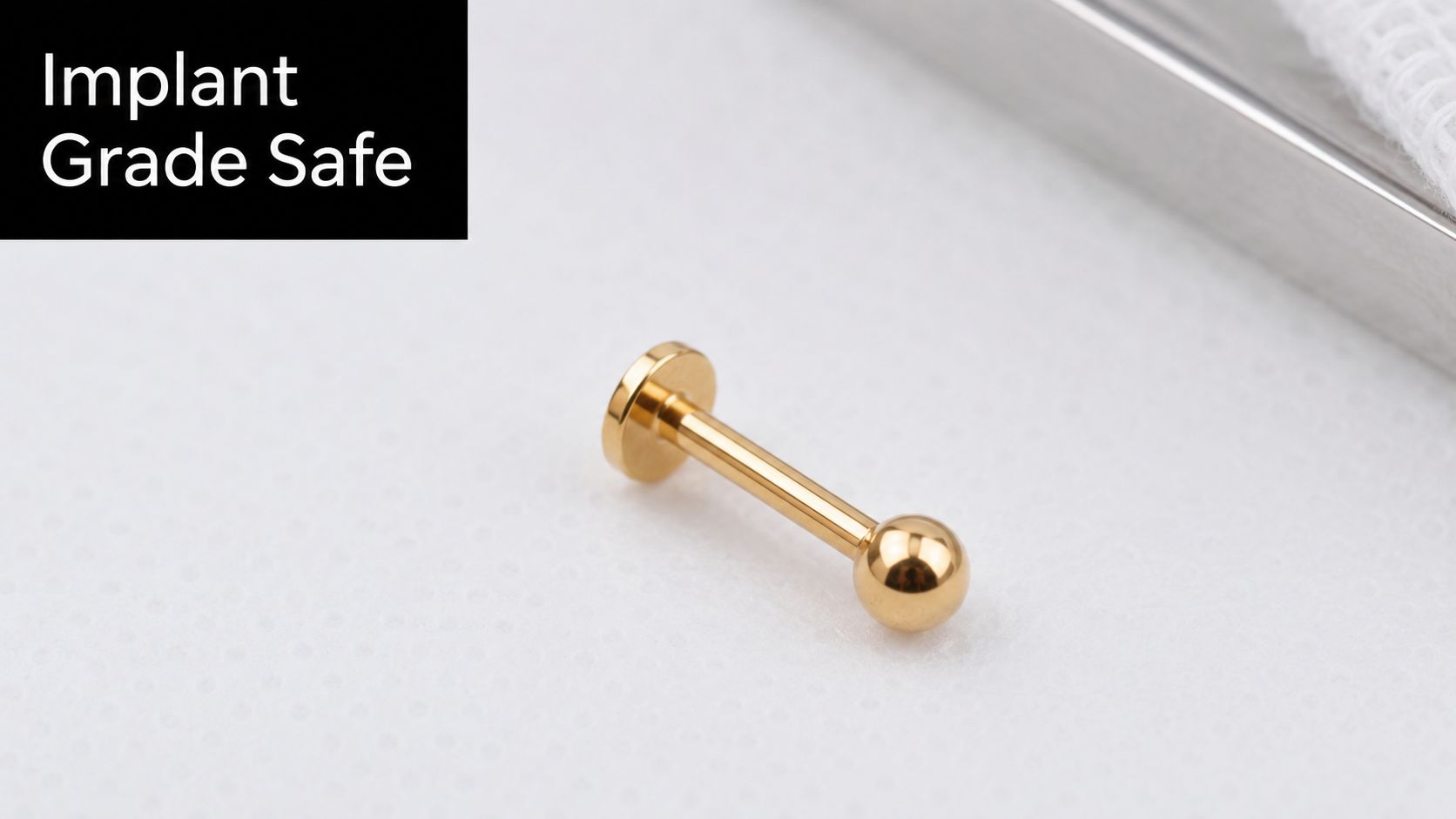
Many people first hear the term implant-grade in relation to titanium. The same standard of thinking applies to gold body jewellery. The jewellery needs to be made specifically for body wear, with biocompatible alloys, a smooth finish, and construction that won't scrape the piercing channel.
Why the finish matters
Under magnification, a rough piece of jewellery isn't harmless. Tiny imperfections can drag through tissue during insertion or movement. Healing piercings are especially vulnerable because the channel is still settling and can become irritated quickly.
Professional guidance for body-wear gold in the UK points to specialist makers such as Anatometal, BVLA, Body Gems, and LeRoi, because they alloy gold for biocompatibility and produce mirror-smooth body jewellery rather than general fashion pieces, as explained in this materials guide for piercing jewellery.
Internal threading and threadless posts
This detail gets missed all the time. The connection style affects how gently jewellery moves through the piercing.
For solid gold piercing jewellery in the UK, expert standards favour internally threaded or threadless push-fit designs over externally threaded ones because external threads on gold can create microscopic irregularities that abrade tissue and raise infection risk during healing. That standard is outlined in the earlier safety discussion of gold body jewellery.
A simple breakdown helps:
- Internally threaded means the post is smooth on the outside, and the decorative end screws into it.
- Threadless means the decorative end uses tension to fit into the post.
- Externally threaded means the rough threaded part passes through the piercing itself.
The professional preference is obvious once you picture the jewellery moving through tender tissue. You want the wearable section to be as smooth as possible.
Smooth posts and gentle connections reduce trauma. That matters more than decorative detail during healing.
Hallmarks, certificates, and the legal side
A stamp such as 14K helps confirm the gold content, but it isn't the whole story. For piercing jewellery, you also want confidence in the alloy and the maker. European and UK consumer rules set strict limits for materials used in piercing assemblies, including a nickel release rate below 0.2 micrograms per square centimetre per week and cadmium below 0.01% by weight, as summarised in this article on European piercing jewellery regulations.
That's why buying from a professional studio or a specialist body jewellery source matters. A fashion retailer may tell you the karat. A body jewellery specialist should also be able to tell you who made the piece, whether it's meant for body wear, and whether the post is internally threaded or threadless.
If you want to get familiar with the kinds of jewellery used in reputable studios, this overview of UK body jewellery options and standards is a useful reference point.
How to Select the Perfect Solid Gold Jewellery Style
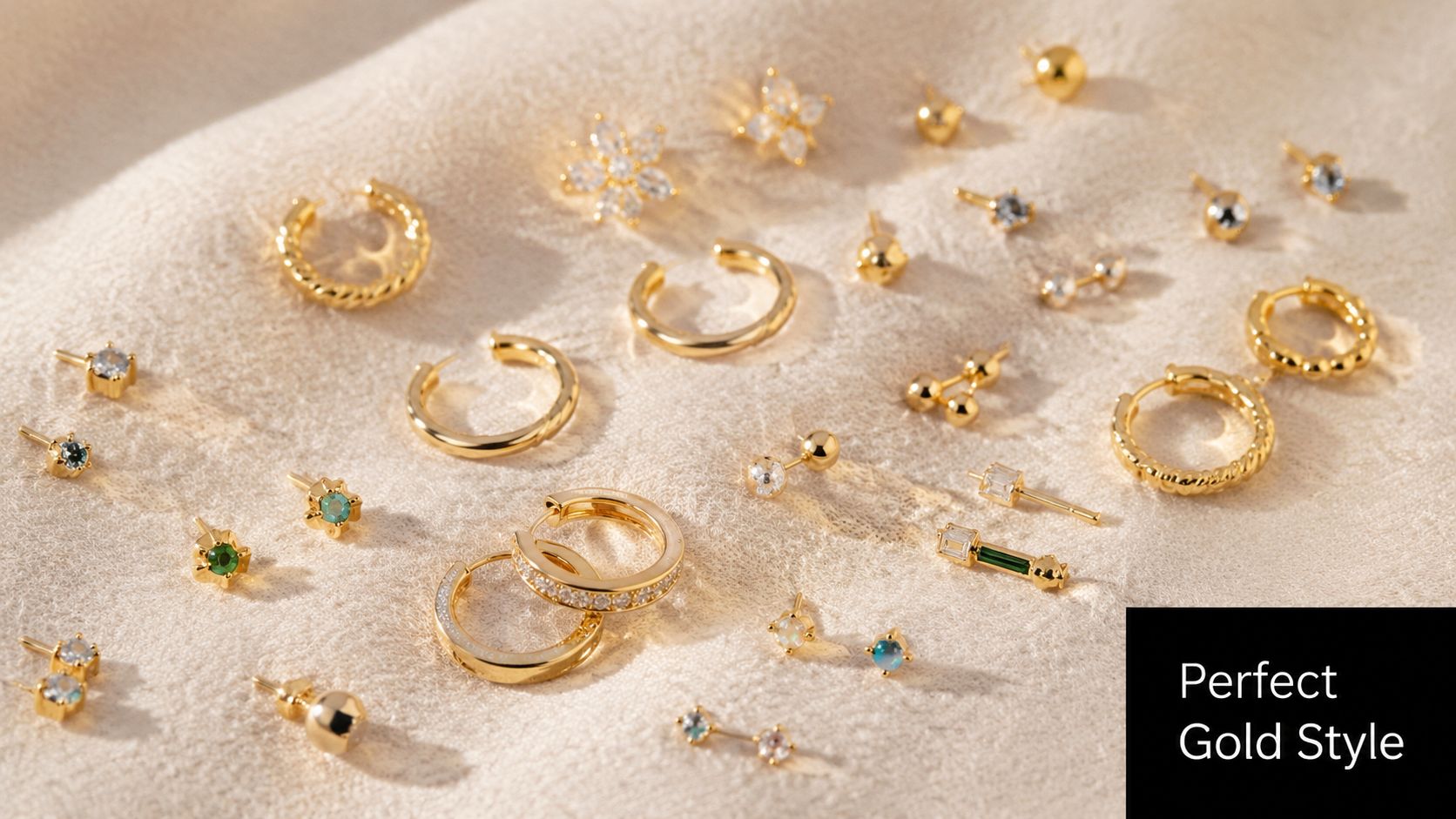
Once safety is sorted, style becomes the fun part. Solid gold body jewellery isn't limited to one look. You can keep it minimal with a tiny bead or claw-set gem, or build a fuller ear with mixed shapes, chains, and stacked placements.
UK demand for gold piercing jewellery has grown sharply. Reporting highlighted by West London Living notes that major UK-based retailers such as Astrid & Miyu grew revenue from £12.7 million in 2021 to £34 million in 2023, which is about 168% growth in two years, and retailers such as Tish Lyon list 154 studs and 243 rings & hoops, showing how broad the available range has become in the UK market, according to this feature on why solid gold is taking over the jewellery box.
Match the style to the placement
Different piercings behave differently. A piece that works beautifully in one placement can be awkward in another.
- Lobes often suit studs, small hoops, and decorative ends because the area usually deals well with a wider range of styles.
- Helix piercings often do best with a low-profile labret while healing because hair, glasses, and clothing can catch on raised pieces.
- Nostrils usually need neat, secure jewellery that won't spin excessively or snag during washing.
- Conch piercings can look great with a stud first, then a ring later once the piercing is fully stable.
Choose the closure carefully
A style isn't only about the front you can see. The closure changes how practical the jewellery feels.
A threadless stud is a favourite for many fresh piercings because it's secure and sleek. An internally threaded end also works well when properly fitted. A clicker ring can be convenient for certain healed piercings, but it isn't automatically the best first choice for every placement.
Build a look that still feels wearable
The best curated ear isn't always the most crowded one. Good styling leaves room for comfort. If you sleep on one side, wear headphones often, or keep your hair down most days, low-profile pieces may suit you better than larger decorative ends.
If you're browsing ideas, this collection of gold huggie earring styles in the UK can help you think about proportion and pairing, especially for healed placements.
Start with jewellery that heals well. Add bolder shapes once the piercing has settled and you know how that placement behaves on you.
Cleaning and Long Term Care for Your Gold Jewellery
High-quality gold is easy to live with, but easy doesn't mean careless. The aim is to keep the piercing calm and the jewellery clean without overdoing it.
For a new or healing piercing, your routine should stay simple.
A sensible cleaning routine
- Use sterile saline for the piercing site. Let it soften any dried matter, then rinse gently if needed.
- Leave the jewellery in place. Twisting or turning it usually causes more irritation, not less.
- Dry carefully. Pat around the area with clean disposable gauze or let it air dry.
- Keep soaps, make-up, and hair products off the piercing as much as possible.
- Let warm water run over it in the shower. That helps remove residue without harsh scrubbing.
What to avoid
Some habits cause more trouble than people expect:
- Alcohol and peroxide can dry and irritate healing tissue.
- Harsh chemical cleaners may dull the finish on jewellery and upset the piercing.
- Cotton fibres can catch on posts and ends.
- Over-cleaning can leave a piercing angry and dry.
For healed solid gold jewellery, occasional gentle cleaning is usually enough. If you remove it, wash it with mild soap and water, rinse thoroughly, and dry it completely before putting it back in. If the piece contains stones or a more delicate setting, ask your piercer how to clean it safely.
When to get help
If a piece feels rough, loose, or difficult to secure, don't force it. A professional can check the threading, fit, and condition of the jewellery. The goal is long-term comfort, not managing around a piece that doesn't sit properly.
Book Your Safe Gold Piercing in Croydon or Bournemouth
Finding verified solid gold piercing jewellery in the UK can be harder than people expect. Community discussions show that UK clients often struggle to identify reputable local shops selling 14k+ gold segment rings and threadless studs, especially compared with the US market, which leaves a real need for better local guidance in places such as Croydon and Bournemouth, as described in this UK discussion about shops selling 14k gold jewellery.
That gap matters because “gold” on its own isn't enough information. You need to know whether the piece is body-safe, whether the post is appropriate, and whether the studio can explain what you're being pierced with.
What to ask before you book
A good studio should answer clear questions without getting defensive.
- Ask about karat. For a fresh piercing, you want to hear 14k or 18k, not vague wording.
- Ask about the post style. Internally threaded or threadless is the standard you're looking for.
- Ask who made the jewellery. Specialist body jewellery makers matter.
- Ask whether the piece is meant for initial piercings. Not all gold jewellery is.
- Ask about aftercare support. A trustworthy studio doesn't disappear after the appointment.
What a reassuring studio experience looks like
You should feel informed, not rushed. Your piercer should check placement carefully, explain suitable jewellery options for your anatomy, and tell you if your preferred style would be better as a later change rather than your starting piece.
That matters for first-timers, for parents booking for teens, and for experienced clients adding more advanced cartilage or facial placements. Gold jewellery should feel like an upgrade in comfort and finish, not a gamble.
If you'd like to speak to a studio team about safe gold options in Croydon or Bournemouth, call 01202 900050 (Bournemouth) / 020 8686 7730 (Croydon) or send a WhatsApp message to 07752 913846 (Bournemouth) / 07902 490584 (Croydon). If you prefer to ask questions before booking, that's a sensible place to start.
If you're ready to find safe, stylish gold options with professional guidance, Piercing Near Me helps you explore trusted studios, understand your jewellery choices, and book with confidence. For help with appointments in Croydon or Bournemouth, call 01202 900050 (Bournemouth) / 020 8686 7730 (Croydon) or message 07752 913846 (Bournemouth) / 07902 490584 (Croydon) on WhatsApp.
Trackbacks/Pingbacks