
You're probably here because you like the look of huggies, but the moment you start shopping for gold huggie earrings UK listings, everything gets muddy. One pair says solid gold. Another says vermeil. Another looks identical but costs far less. Then you notice the sizes are in millimetres, and suddenly you're wondering whether a tiny difference will make them sit beautifully or pinch all day.
That confusion is normal. Huggies are small, close-fitting earrings, so the details matter more than they do with bigger hoops. Material affects comfort. Sizing affects whether they close around your ear. And if you're wearing jewellery in a piercing, safety matters just as much as style.
I'm going to walk you through this the same way I'd explain it to a first-time client in the studio. Keep it simple. Buy for your anatomy, not just the photo. Choose quality you can trust. And if you want personal advice, you can always call 01202 900050 (Bournemouth) / 020 8686 7730 (Croydon) or message 07752 913846 (Bournemouth) / 07902 490584 (Croydon) on WhatsApp for guidance.
What Exactly Are Gold Huggie Earrings
Many recognize a huggie on sight, but distinguishing it from a standard hoop isn't always clear. The short version is this. A huggie earring is a small hoop designed to sit close to the ear, rather than hanging lower like a traditional hoop.
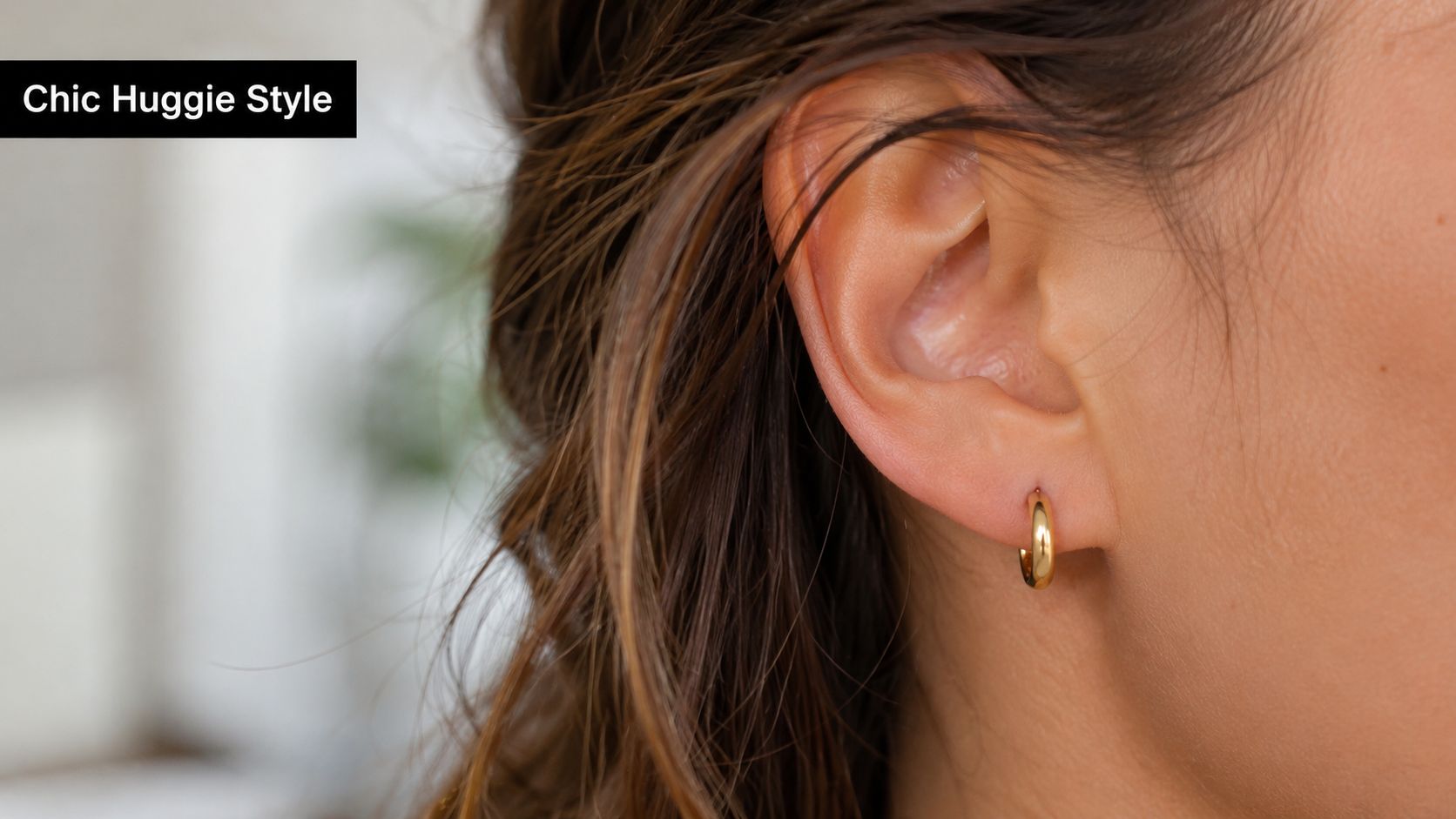
That close fit is the whole point. A standard hoop creates movement and space. A huggie creates a neat, snug line around the lobe or cartilage. If you want a clean everyday look, or you like the layered “curated ear” style, huggies usually become a foundation piece.
How huggies differ from regular hoops
With regular hoops, you can often get away with guessing. They're bigger, more forgiving, and less dependent on exact anatomy. Huggies are different because they sit so close to the piercing.
That means a pair that looks perfect online can feel completely wrong on your ear if the diameter doesn't match your placement. This is why so many first-time buyers end up with jewellery they love in theory but never wear in practice.
If you want a simple visual explanation of the style itself, this guide on what huggie earrings are is a helpful starting point.
Practical rule: If the earring is meant to sit close to your ear, don't shop by appearance alone. Fit is part of the design.
Why people love them
Huggies work because they solve a few everyday problems at once:
- They look polished without trying too hard. A plain gold huggie can work with workwear, casual clothes, or evening jewellery.
- They stack well. If you have second lobes, helix piercings, or a mix of placements, huggies layer neatly.
- They feel more secure than larger hoops. Many people prefer that close fit for day-to-day wear.
The catch is that this same close-fitting design is also why buyers need to pay more attention to material quality and sizing than they might with fashion jewellery.
Decoding Gold Quality and UK Hallmarks
Shoppers are often misled. A listing says “gold”, but that word can mean very different things. In the UK market, shoppers often see gold-plated, gold-filled, vermeil, and solid gold grouped together, even though they're not the same in wear, value, or suitability for piercings. The British Association of Dermatologists advises that even trace nickel in lower-quality jewellery can trigger reactions, which is why the choice between solid 9ct or 14ct gold and plated options matters for allergy risk and long-term wear, as noted in this UK market summary on gold jewellery confusion and nickel sensitivity.
What each gold term actually means
A lot of disappointment starts with one assumption. If it looks gold, people assume it will behave like gold. It won't.
Solid gold means the piece itself is made from a gold alloy throughout. For piercings, this is usually the safest long-term option if the alloy quality is good and the finish is suitable for body jewellery.
Gold-plated jewellery has a base metal underneath with a thin gold layer on top. It can look lovely at first, but that outer layer can wear away over time.
Gold-filled uses a thicker bonded outer gold layer than standard plating. It's generally more substantial than plated jewellery, but it still isn't the same as solid gold.
Vermeil is gold over sterling silver. It can be a better fashion-jewellery option than basic plating, but it still has a surface layer rather than being solid gold through the piece.
Why this matters for piercings
A piercing isn't just wearing jewellery on the skin. The post and wearable part sit in the body. That's why I always tell first-time buyers to think beyond colour and price.
If you have reactive skin, a lower-quality alloy or plated base metal can cause trouble. Even when a pair looks identical in a product photo, the wear experience can be completely different.
For many clients, the safest mindset is simple:
- Prioritise material honesty. You want clear wording, not vague marketing language.
- Treat “tarnish-free” with caution. That phrase doesn't tell you enough on its own.
- Look for solid gold or professional-grade body jewellery materials if you want something for regular wear in healed piercings.
If you're comparing precious-metal piercing jewellery more broadly, this overview of solid gold nose rings helps show the same quality principles in another piercing category.
Gold Jewellery Type Comparison
| Type | Gold Content | Best For | Piercing Suitability |
|---|---|---|---|
| Solid gold | Gold alloy throughout the piece | Long-term wear and buyers who want durability | Usually the strongest option for healed piercings when quality is appropriate |
| Gold-plated | Thin gold layer over a base metal | Occasional fashion wear | Often not the best choice for regular piercing wear |
| Gold-filled | Thicker bonded gold layer over base metal | Buyers wanting a mid-point between plating and solid gold | Better than thin plating, but still not the same as solid gold |
| Vermeil | Gold layer over sterling silver | Fashion jewellery with a precious-metal base | Can suit some wearers, but isn't the same as solid gold for long-term piercing use |
Hallmarks are your reality check
In the UK, hallmarking gives you something far more useful than a polished product description. It gives you an official clue about what the metal is.
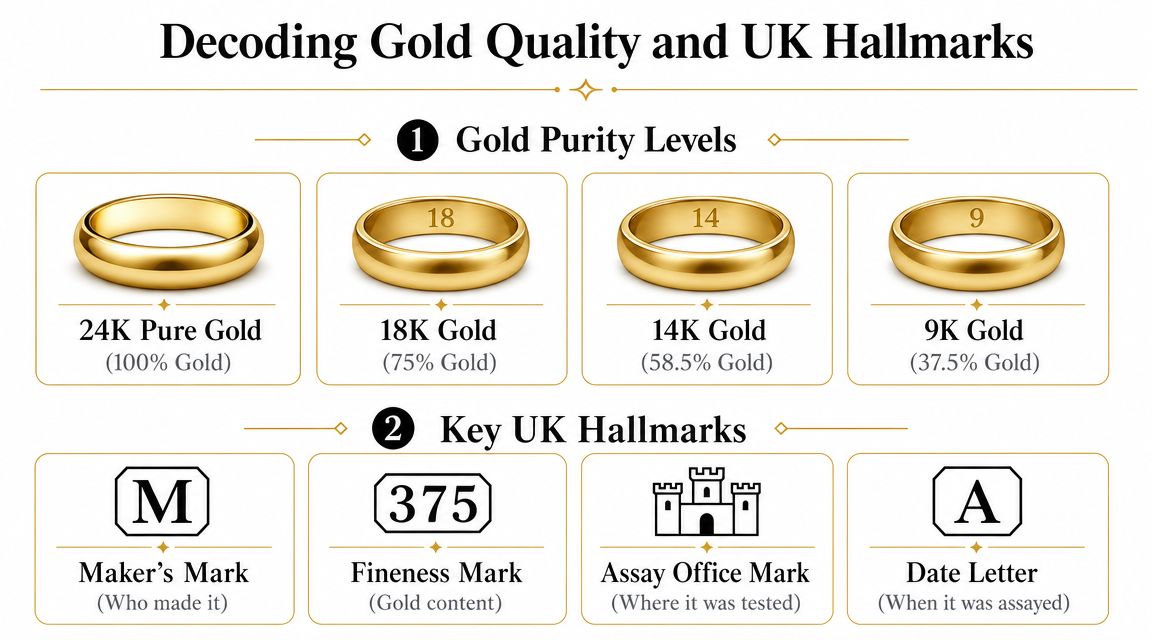
The infographic below highlights common hallmark elements buyers should recognise.
A proper hallmark helps answer practical questions such as who made the item, what gold standard it claims, and where it was assayed. For a first-time buyer, that matters because the safest purchase is usually the one with the clearest, verifiable description.
Jewellery descriptions should tell you what the piece is, not just how it looks.
If a seller leans heavily on words like “luxury”, “premium”, or “tarnish-free” but stays vague about metal content and hallmarking, slow down. That's usually a sign to ask more questions before you buy.
Finding Your Perfect Fit A Sizing Guide
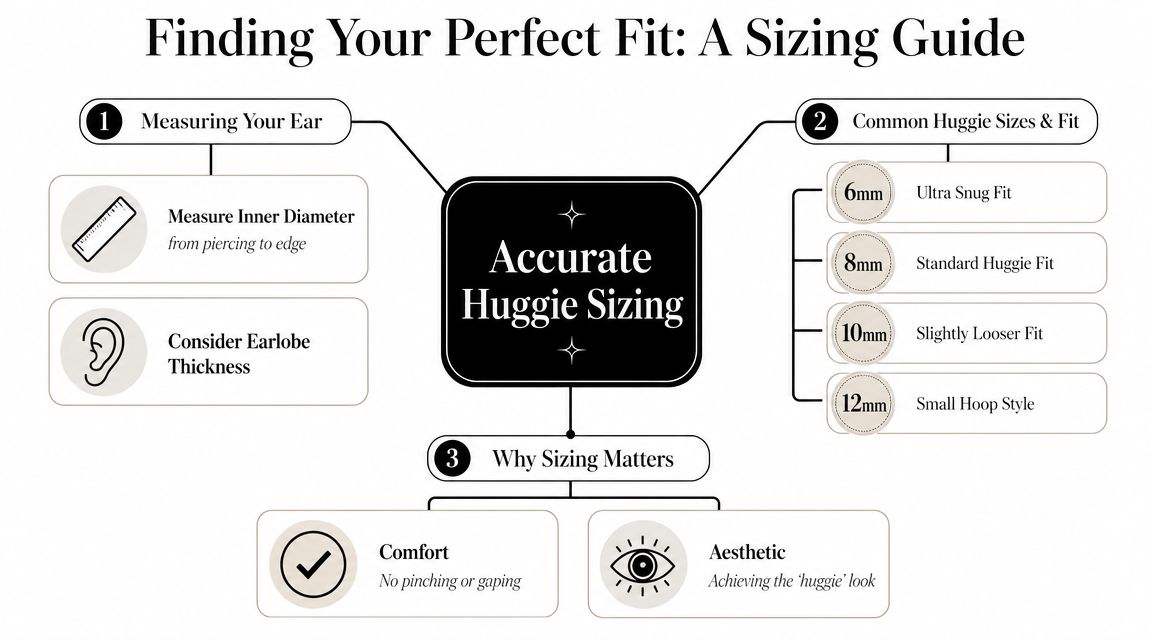
Sizing is where huggies stop being a fashion accessory and start becoming an anatomy choice. A tiny measurement difference can change whether a pair looks sleek and comfortable or feels tight and awkward.
In the UK, some solid gold huggies are sold in precise outer diameters of 9 mm, 11 mm, and 14 mm, and one retailer advises measuring from the piercing to the ear's edge, then adding 1 mm for a snug fit or 2 mm+ for a looser fit, which shows how much millimetre-level sizing affects comfort and appearance in close-fitting hoops, especially around cartilage, according to this UK huggie sizing guide.
The measurement that matters
When people shop for huggies, they often focus on the outside of the hoop because that's what the listing shows. What your ear cares about is the space available for your tissue and piercing placement.
Think about these two parts:
- Outer diameter is the full size of the hoop from edge to edge.
- Inner diameter is the space inside the hoop, which affects whether it will fit your ear comfortably.
If your piercing sits low in the lobe, you may be able to wear a snugger hoop. If it sits higher, or if your lobe is thicker, you'll need more room.
A simple way to measure
You don't need to overcomplicate this. For a first estimate, measure from the piercing hole to the edge of the ear where you want the hoop to sit.
Then use the retailer's practical rule:
- Add 1 mm if you want a close, classic huggie fit.
- Add 2 mm or more if you want the hoop to look a bit looser.
- Check your lobe thickness too. Thickness changes how tight a hoop feels once closed.
This is one of the few jewellery categories where being “roughly right” often isn't enough.
If a huggie only just closes, it isn't the right fit. It shouldn't press, pinch, or pull the piercing angle.
Lobe and cartilage don't size the same way
A first lobe piercing is usually the easiest place to wear huggies because the tissue is softer and placement is often straightforward. Cartilage is less forgiving.
For placements like helix, conch, or other close-fitting ear piercings, the wrong size can create pressure and irritation. A hoop that's too small can pull at the channel. One that's too large may rotate strangely or lose that neat “hugging” look.
A few things often confuse first-time buyers:
- Higher piercings usually need more thought. The higher the placement, the less likely a tiny hoop will fit the way you expect.
- Sleep comfort depends on fit and anatomy. A clicker that feels fine during the day may still bother you at night if it sits at an awkward angle.
- Photos can mislead. The same hoop can look snug on one ear and roomy on another.
What to do if you're between sizes
If you're unsure, don't automatically choose the smallest option because it looks closest to the “huggie” aesthetic. That's how people end up with hoops they can't comfortably close.
Instead, ask yourself which matters more right now. Do you want the tightest possible look, or do you want easy daily comfort? Most first-time buyers are happier when they leave a little room rather than forcing a very tight fit.
A well-sized huggie should sit neatly, close securely, and feel calm on the ear after the first few minutes of wear.
Styling Gold Huggies for a Curated Ear
Once fit and material are sorted, the fun part starts. Gold huggies are one of the easiest pieces to build around because they can be quiet or expressive depending on where you place them.
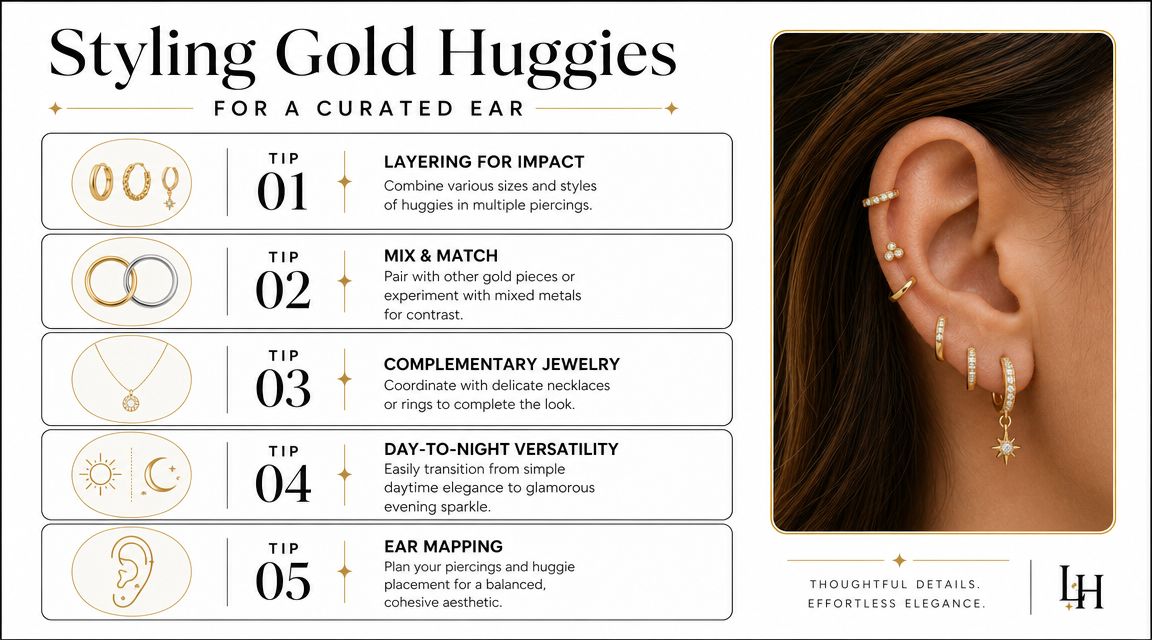
A simple example is the person who starts with one plain gold huggie in the first lobe. It feels clean, easy, and wearable every day. Then they add a smaller stud in the second lobe. Later, maybe a tiny huggie or discreet ring goes into a healed helix. Suddenly the whole ear looks intentional, even though each piece is understated on its own.
That's why huggies work so well in a curated ear. They don't demand all the attention. They create shape and rhythm.
Easy combinations that usually work
You don't need lots of piercings to make huggies look good. A few balanced combinations do most of the work.
- Single pair on first lobes gives you a polished everyday look.
- First lobe huggie plus second lobe stud keeps things minimal but layered.
- Graduated lobe stack uses slightly different hoop sizes for a neat progression.
- One cartilage huggie with plain lobes draws the eye upward without looking busy.
If you want inspiration for placements and combinations, this guide to full ear piercings shows how different ear areas can work together.
Keep the ear balanced
People often think styling means adding more. Usually, it means editing better.
If your first lobe huggie is thicker or more detailed, pair it with simpler pieces above it. If your cartilage jewellery already catches the eye, keep the lower ear softer. That balance is what makes a stack feel organised rather than crowded.
A good ear stack doesn't need matching pieces. It needs pieces that make sense together.
You can also decide what role gold huggies play in your look. For some people, they're the everyday anchor and everything else changes around them. For others, they're the subtle filler that ties a few stronger pieces together.
The best curated ears usually grow slowly. You wear one piece, learn what feels good on your anatomy, then build from there.
How to Buy Gold Huggie Earrings Safely in the UK
A polished online photo can't tell you whether a hoop will suit your anatomy, whether the closure will feel secure, or whether the material description is suitable for piercing wear. That's the biggest reason I steer people towards professional advice when they're buying their first proper huggies.
Fast-fashion listings tend to sell the look. Professional piercers sell the fit, the material, and the wear experience. That difference matters because jewellery sits inside a piercing channel, not just on the surface of your skin.
What a professional can help you check
Buying from a studio or with studio guidance gives you a chance to ask better questions. Not vague ones like “Is this good quality?” but practical ones about your actual ear.
A professional can help assess:
- Whether your piercing is positioned well for a snug hoop
- Whether your anatomy suits the size you're considering
- Whether the closure is likely to feel comfortable for regular wear
- Whether the metal quality sounds appropriate for a healed piercing
That's especially useful if you've got a helix, a higher lobe, or any piercing that sits at a less standard angle.
What to ask before you buy
If you're comparing sellers, ask direct questions and notice how clearly they answer.
- What exactly is the metal? You want a clear answer, not just “gold”.
- Is the item described by inner or outer diameter? This affects fit.
- Is it suitable for healed piercings? A seller should understand the difference.
- Can someone advise on size based on placement? If not, you're mostly guessing.
When jewellery is going in your body, expert fitting has real value. If you want personal fitting advice from experienced piercers in Bournemouth or Croydon, call 01202 900050 (Bournemouth) / 020 8686 7730 (Croydon). For quick messages and photo checks, WhatsApp 07752 913846 (Bournemouth) / 07902 490584 (Croydon).
Long-Term Care and Maintenance
A good pair of gold huggies should stay in great condition for years if you treat them well. That doesn't mean complicated care. It means consistent, gentle care.
How to clean them simply
For routine cleaning at home, keep it basic:
- Use mild soap and warm water to remove everyday build-up
- Dry with a soft cloth so moisture doesn't sit around the hinge or closure
- Check the clasp gently to make sure it still closes smoothly
Avoid aggressive scrubbing and harsh household cleaners. Gold can handle daily life well, but the finish and moving parts still deserve care.
Daily wear habits that help
Many people wear huggies often because they're compact and convenient. That's fine, as long as they still feel comfortable and the piercing is healthy.
A few sensible habits make a difference:
- Take them out if they start feeling tight or irritating
- Store them separately when you're not wearing them, so they don't scratch against harder pieces
- Pay attention after hair products, skincare, or heavy sweating, then clean them if they've picked up residue
If you shower in them occasionally, that's not usually the end of the world, but regular exposure to product build-up can dull how clean they feel. The goal is simple. Keep both the jewellery and the piercing area fresh.
Frequently Asked Questions
Can I get pierced with a huggie?
Usually, no. A snug huggie is generally better for a healed piercing, while an initial piercing often needs a stud to allow for swelling and easier cleaning, as explained in this guidance on huggies and post-healing wear.
That's why many people treat huggies as a milestone jewellery change rather than starter jewellery.
Is solid gold hypoallergenic?
No material suits absolutely everyone, so I wouldn't promise that any metal is universally reaction-proof. What I can say is that higher-quality solid gold is usually a much better choice than vague plated jewellery if you want better long-term wear and fewer surprises.
If you have very sensitive skin, ask exactly what alloy you're buying and get advice before wearing it in a piercing.
How do I know if my piercing is ready for a huggie?
Look for a piercing that feels settled, not tender, not crusty, and not irritated during jewellery changes. If the area still feels reactive, wait.
Cartilage especially needs patience. Even if the outside looks calm, the channel may still not be ready for a snug hoop.
Why won't my new huggie close comfortably?
That usually points to sizing, placement, or tissue thickness. It doesn't always mean the jewellery is faulty. A hoop can be beautifully made and still be wrong for your ear.
If you have to force it, stop. The right huggie should close without creating pressure.
Are huggies good for sleeping in?
Some people find them comfortable, especially once they're used to the fit. Others notice the hinge or closure more at night, particularly in cartilage placements.
That's very anatomy-dependent. If sleep comfort matters to you, choose your closure style carefully and don't buy the tightest fit possible.
What's the safest way to choose my first pair?
Keep your checklist short and strict:
- Buy for a healed piercing
- Choose clear, honest material descriptions
- Measure properly instead of guessing
- Ask for fitting help if your placement is unusual
If you're unsure whether your piercing is ready, it's best to ask a pro. For quick advice, message our piercing experts on WhatsApp at 07752 913846 (Bournemouth) / 07902 490584 (Croydon).
If you want help finding safe, professional piercing advice and trusted studios, visit Piercing Near Me. It's a straightforward way to explore jewellery guidance, learn about placements, and connect with experienced piercers in Bournemouth and Croydon who can help you choose huggies that fit properly, feel comfortable, and work for long-term wear.
Trackbacks/Pingbacks