

You've just had your ears pierced, you've checked them in the mirror about six times already, and now the nerves are kicking in. Is that tiny bit of redness normal? Should you turn the jewellery? Can you clean it with salt water at home? If you're a parent, you're probably asking the same questions, just with a more suspicious look at Google.
Good. A little caution is healthy.
Most piercing problems don't start in the studio. They start at home, when someone gives old advice, uses the wrong products, or fusses with the jewellery too much. Proper ear piercing cleaning is simple, but it has to be done properly and consistently. No shortcuts. No “my friend said this worked”. No random lotions from the bathroom cupboard.
The good news is that safe aftercare isn't complicated. UK guidance is quite clear when you strip away the nonsense. Clean it properly, leave it alone, dry it correctly, and don't try to force healing along. That's how you get a piercing that settles cleanly instead of turning into weeks of avoidable irritation.
Your New Piercing Journey Starts Here
A fresh ear piercing usually comes with two feelings at once. First, excitement. You like how it looks, you've already thought about future jewellery, and it feels like a small but brilliant upgrade. Then comes the second feeling. Responsibility.
That second part matters more than commonly realised.
I've seen plenty of first-time clients do everything right on piercing day, then run into trouble because of bad aftercare advice from a friend, a family member, or a social media video. Someone tells them to twist the stud. Someone else says sea salt and hot water in a mug is “basically the same” as sterile saline. Another person says to use peroxide because it “keeps it clean”. That's how a calm, normal healing piercing gets angry.
What a normal start usually looks like
For many people, the first few days are uneventful. The area may feel tender. It might look a bit pink. You may notice a little dried fluid around the jewellery. None of that is automatically a problem.
What matters is your response. The right approach is boring, gentle, and disciplined.
- Clean it properly: Use the correct product and the correct method.
- Keep your hands off: Touching and fiddling are the fastest ways to irritate a new piercing.
- Don't improvise: Fresh piercings are not the place for skincare experiments or home remedies.
A healing piercing doesn't need “help” from strong products. It needs calm conditions.
What good aftercare actually does
Good aftercare isn't about obsessing over your ear. It's about reducing irritation so your body can do its job. That means keeping the area clean without over-cleaning, avoiding contamination, and not damaging the fragile tissue that's trying to form around the jewellery.
If you're slightly nervous, that's fine. If you're a parent trying to keep a teenager from poking at their new lobe every hour, that's also fine. The answer is the same for both of you. Follow a proper UK-style routine and keep it simple.
Your Essential Piercing Aftercare Toolkit
A fresh ear piercing needs a small, boring kit. That is good news. The simpler your setup, the less chance you have of irritating it with the wrong product.
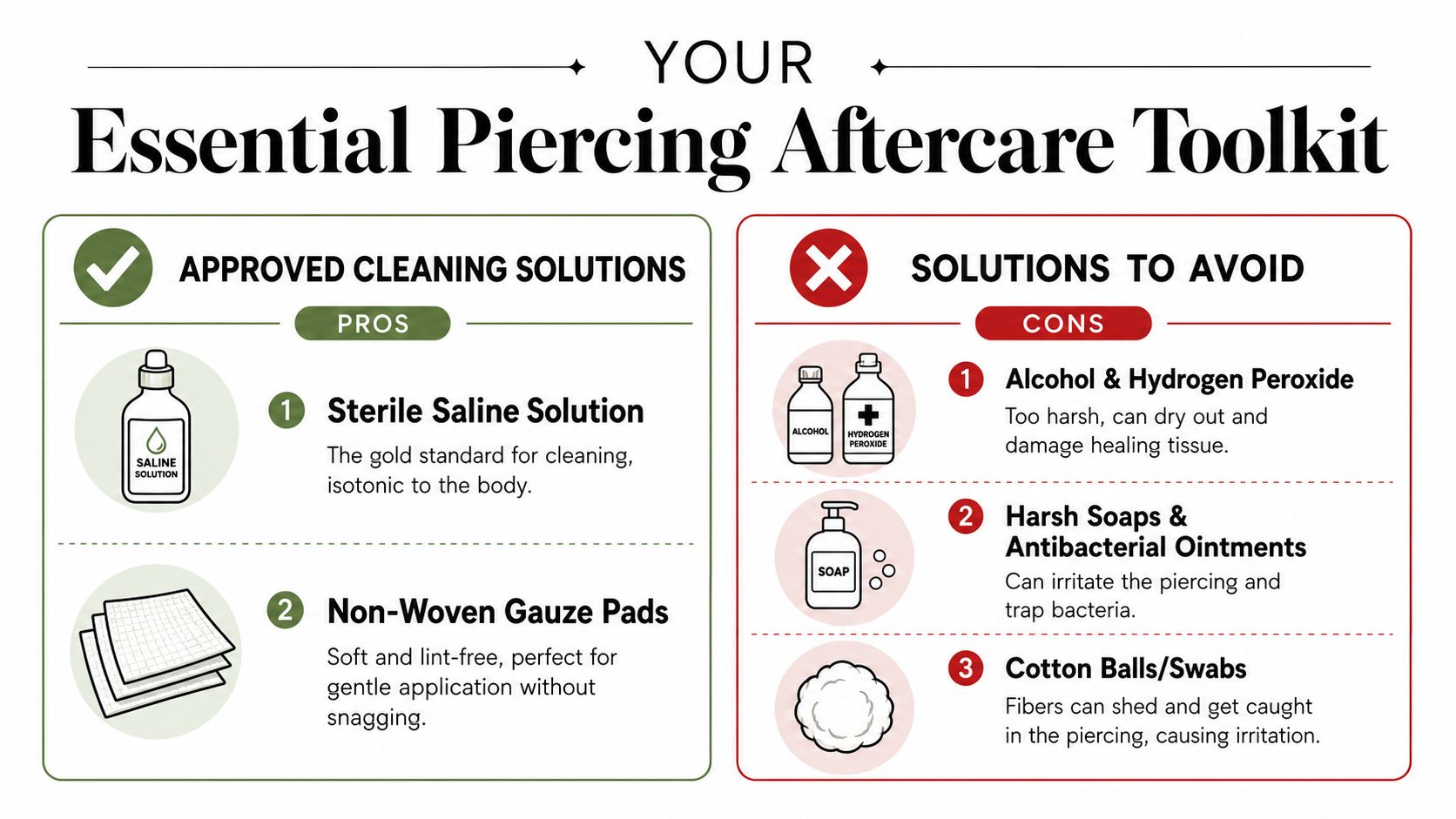
The one item I tell UK clients to buy first is sterile saline solution, 0.9% sodium chloride. It is made for wound care, it is properly balanced, and it helps soften and lift away dried discharge without damaging fragile healing skin. If you want help choosing one, use this guide to sterile saline spray for piercing aftercare.
Keep this kit simple
If you came back into my studio asking what to keep at home, I would tell you to get four things and stop there:
- Sterile saline spray: Choose 0.9% sodium chloride with no added tea tree, perfumes, or antiseptics.
- Non-woven gauze: Better than cotton pads or cotton wool because it is less likely to leave fibres behind.
- Plain disposable paper towel: Use it to dry the area after cleaning or after a shower.
- Clean hands: Your aftercare fails fast if you touch the piercing with dirty fingers.
I would also tell you what to bin or leave in the cupboard.
- Alcohol-based products: They sting for a reason. They dry out the tissue and slow healing.
- Hydrogen peroxide: Too harsh for routine aftercare.
- Creams and ointments: They trap moisture and grime around the jewellery.
- Harsh soaps: They irritate skin that is already trying to recover.
- Cloth towels: They can hold bacteria and catch on jewellery.
This lines up with standard UK aftercare advice. Cloth towels are a poor choice for drying, while disposable paper products and non-woven gauze are safer. Alcohol and peroxide are not routine piercing aftercare products either, as explained in this UK ear piercing aftercare guidance.
Skip homemade salt water if you can
I know why people do it. Someone at home says, “just mix salt and warm water.” It sounds cheap and harmless. It is also one of the most common mistakes I see in UK clients with sore, over-irritated piercings.
The problem is consistency. People use too much salt, too little salt, table salt with additives, water that is not clean enough, or a batch they keep sitting around. Then they blame the piercing, when the issue is the solution itself.
UK public health advice supports a clean, straightforward approach to wound care. The NHS backs pharmacy advice that saline products made for wound washing are a safer option than guesswork in the kitchen, and the NHS also advises against antiseptics for routine cleaning in this NHS guidance on piercing aftercare and infection signs. If sterile saline is available, buy it from a pharmacy and use that.
Best advice: Use sterile saline and keep the rest of your routine plain. Fresh piercings heal better when you stop trying to “treat” them.
The Correct Daily Ear Piercing Cleaning Routine
You've cleaned it, then looked in the mirror an hour later and wondered if you should clean it again. That is how a lot of UK clients end up with angry ears. The best routine is boring, gentle, and the same every day.
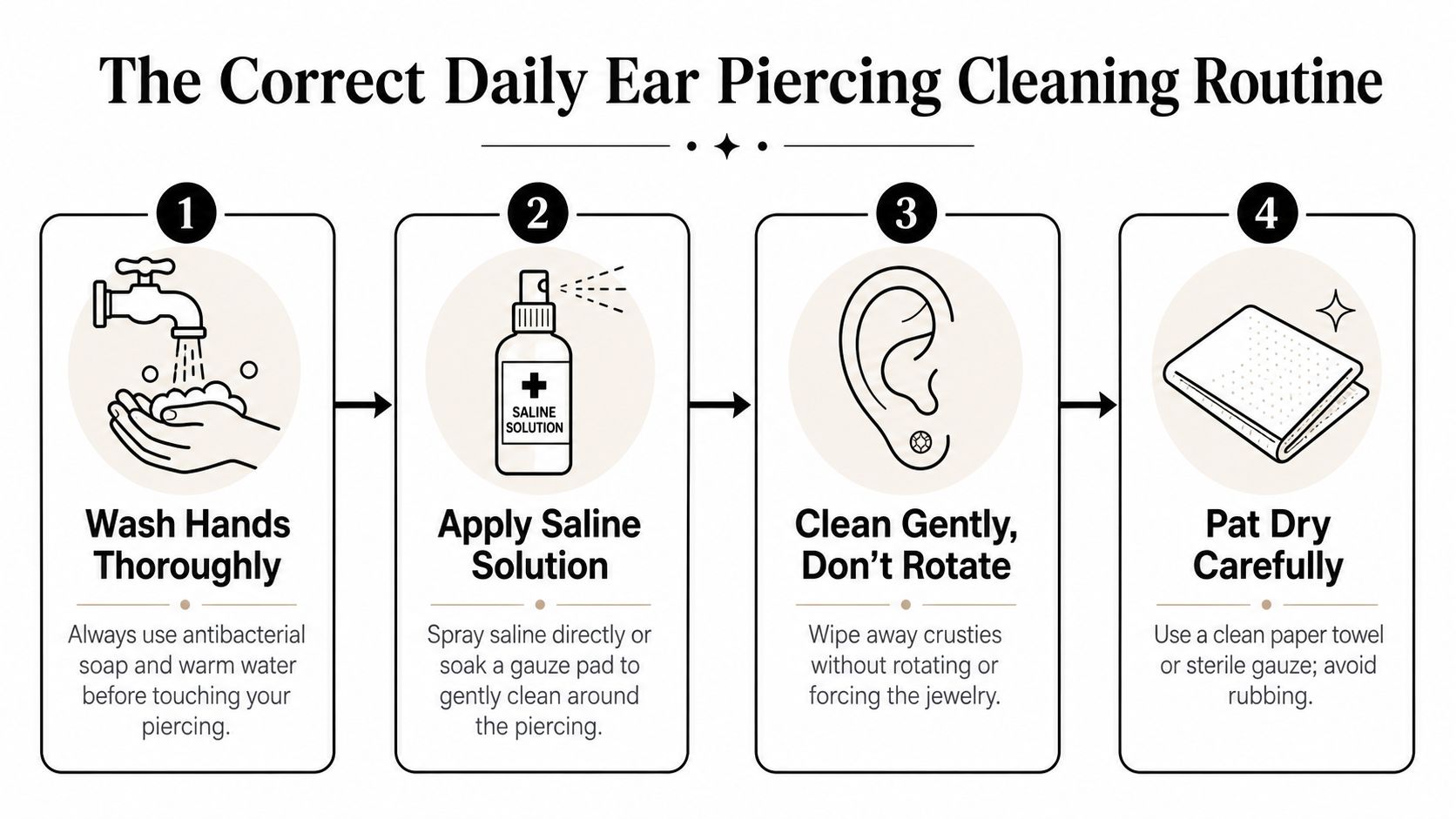
For a fresh ear piercing, clean it twice a day. Keep your hands off it the rest of the time. If you start adding extra wipes, tea tree oil, antiseptic, or a bit of twisting because someone told you it helps, you create the irritation yourself.
The routine I want you to follow
UK aftercare advice is clear on the basics. Wash your hands first, clean with sterile saline, dry with clean disposable paper, and leave the jewellery alone. The NHS-backed pharmacy guidance from Boots also advises keeping the area clean and dry, avoiding unnecessary handling, and using a gentle saline approach rather than harsh products, as set out in this Boots guide to looking after a new piercing.
Do it like this:
Wash your hands properly
Soap and water. Full wash, not a quick rinse. If your hands are not clean, do not touch the piercing.Spray sterile saline on the front and back
Let it sit for a moment so any dried discharge softens. For cartilage piercings that are feeling tender, this guide to cartilage piercing healing and aftercare will help you avoid the usual setbacks.Wipe away only what lifts easily
Use non-woven gauze if you need to remove softened crust. If it is stuck, leave it. Picking dry build-up tears the skin and sets healing back.Pat the area dry
Use clean paper towel or gauze. Be gentle. Damp skin stays irritated more easily, especially behind the ear.
That is the whole job.
Two rules people keep breaking
First, do not over-clean. Twice daily is enough. More than that usually means dry, sore skin and a piercing that never seems to settle.
Second, do not twist or rotate the jewellery. Old advice said to turn it. Current professional aftercare does not. Rotating jewellery drags dried matter and bacteria through the channel and scrapes tissue that is trying to repair itself. UK studio guidance also warns against movement for exactly that reason, as explained in this UK ear piercing aftercare guide from Ink Spot Carlisle.
If the jewellery feels “stuck”, that usually means dried discharge around it, not that your skin is growing over it. Clean it with saline, dry it, and leave it alone.
Keep morning and evening identical
A simple routine works best because you are more likely to stick to it.
| Time | What to do | What to avoid |
|---|---|---|
| Morning | Wash hands, spray saline, pat dry | Don't touch, twist, or pick at dry crust |
| Evening | Repeat the same clean | Don't add creams, oils, or antiseptic |
Consistency beats fussing. If your piercing is clean, dry, and left alone between cleans, you are doing it right.
Adapting Your Cleaning for Lobe and Cartilage Piercings
You get your ears pierced on Saturday. By Tuesday, the lobe piercing looks fairly calm, but the helix is throbbing because you slept on it, caught it with a hoodie, and wore your AirPods for three hours. That difference matters. Lobes and cartilage do not behave the same, so your aftercare needs a bit of common sense to match.
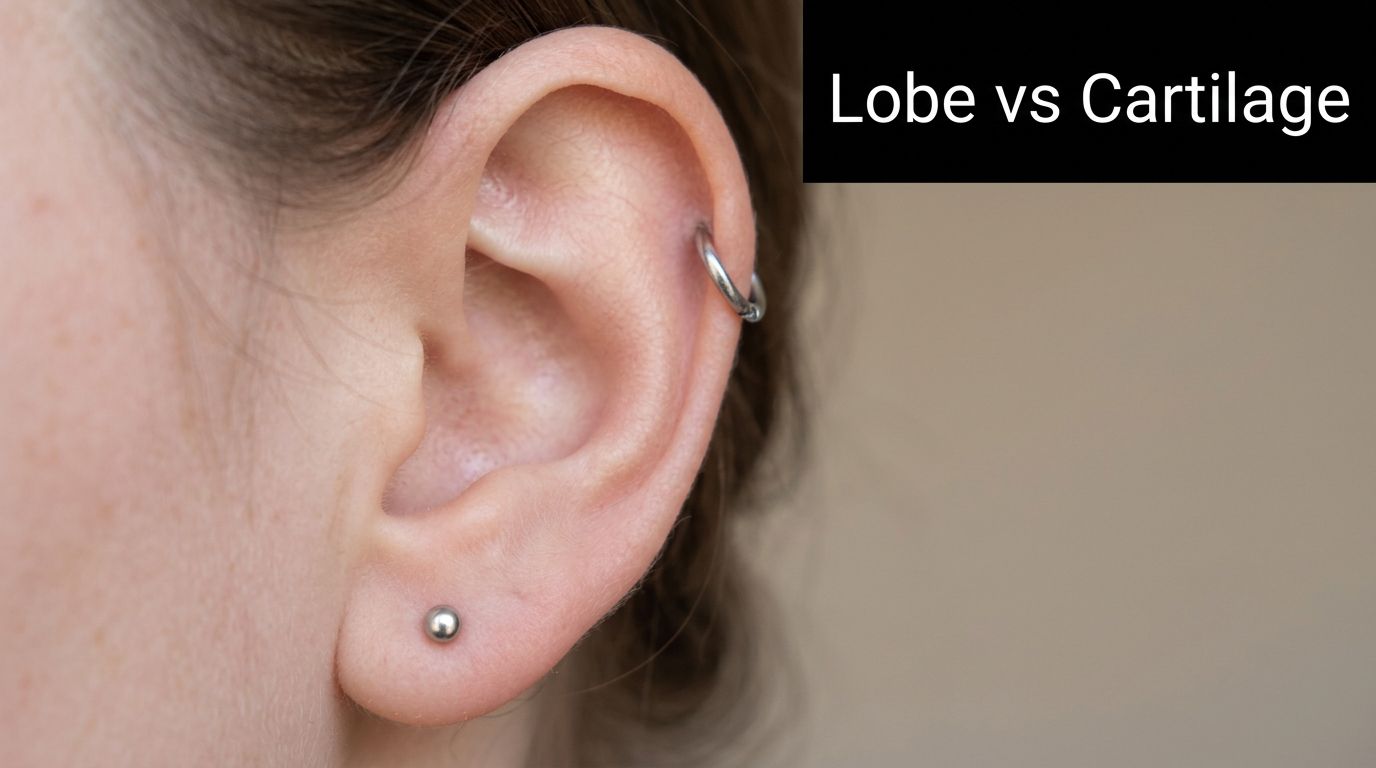
The cleaning steps stay the same. Sterile saline, gentle drying, and no fiddling. What changes is how much protection the piercing needs during the day.
Lobes usually settle more predictably because they are soft tissue with better blood flow. Cartilage is slower, touchier, and more likely to flare up after pressure or friction. That is why UK clients often get caught out. They assume a cartilage piercing should behave like a lobe, then panic when it stays tender for longer.
If you are healing a helix, conch, or similar placement, read our guide to cartilage piercing healing and what slows it down.
Lobe piercings need consistency
Lobes are the easier healers, but people still make them harder than they need to be. The usual mistakes are changing jewellery too early, touching them because they "seem fine", or cleaning with whatever is in the bathroom cupboard.
For lobe piercings, stick to these rules:
- Keep the routine boring: Clean exactly as advised, morning and evening.
- Leave the jewellery in place: Do not remove it to "let it breathe".
- Keep hands and hair off it: Repeated touching causes irritation fast.
- Be careful with phones and headphones: Anything pressing on the area can make it sore.
A calm lobe piercing usually rewards simple, repetitive care.
Cartilage piercings need protection
Cartilage needs the same cleaning, but much stricter day-to-day care. With such strict care, poor habits quickly become apparent. Sleeping on it, wearing over-ear headphones, catching it with a towel, or letting wet hair sit against it can keep it angry for weeks.
For cartilage piercings, be stricter about the following:
- Avoid pressure: Use a travel pillow or sleep on the other side.
- Stop the snags: Watch hats, jumpers, hairbrushes, towels, and hoodie necks.
- Keep hair products away: Spray, dry shampoo, and conditioner can all irritate it.
- Expect a slower settle: Cartilage often improves, then gets grumpy again after a knock.
If a cartilage piercing is sore after being bumped, go back to the basic routine and reduce pressure. Do not start mixing up homemade salt water, tea tree oil, antiseptic cream, or random TikTok fixes. In UK practice, that is one of the biggest reasons a piercing stays irritated.
Quick comparison
| Piercing type | Usual healing behaviour | What causes trouble most often |
|---|---|---|
| Lobe | More predictable, usually less reactive | Touching, early jewellery changes, general fiddling |
| Cartilage | Slower, more sensitive, can flare after minor knocks | Sleeping on it, friction, headphones, snagging |
If your lobe seems ahead of your cartilage, that is normal. Treating them the same is the mistake. Clean both gently, but protect cartilage far more carefully.
Troubleshooting Common Healing Worries
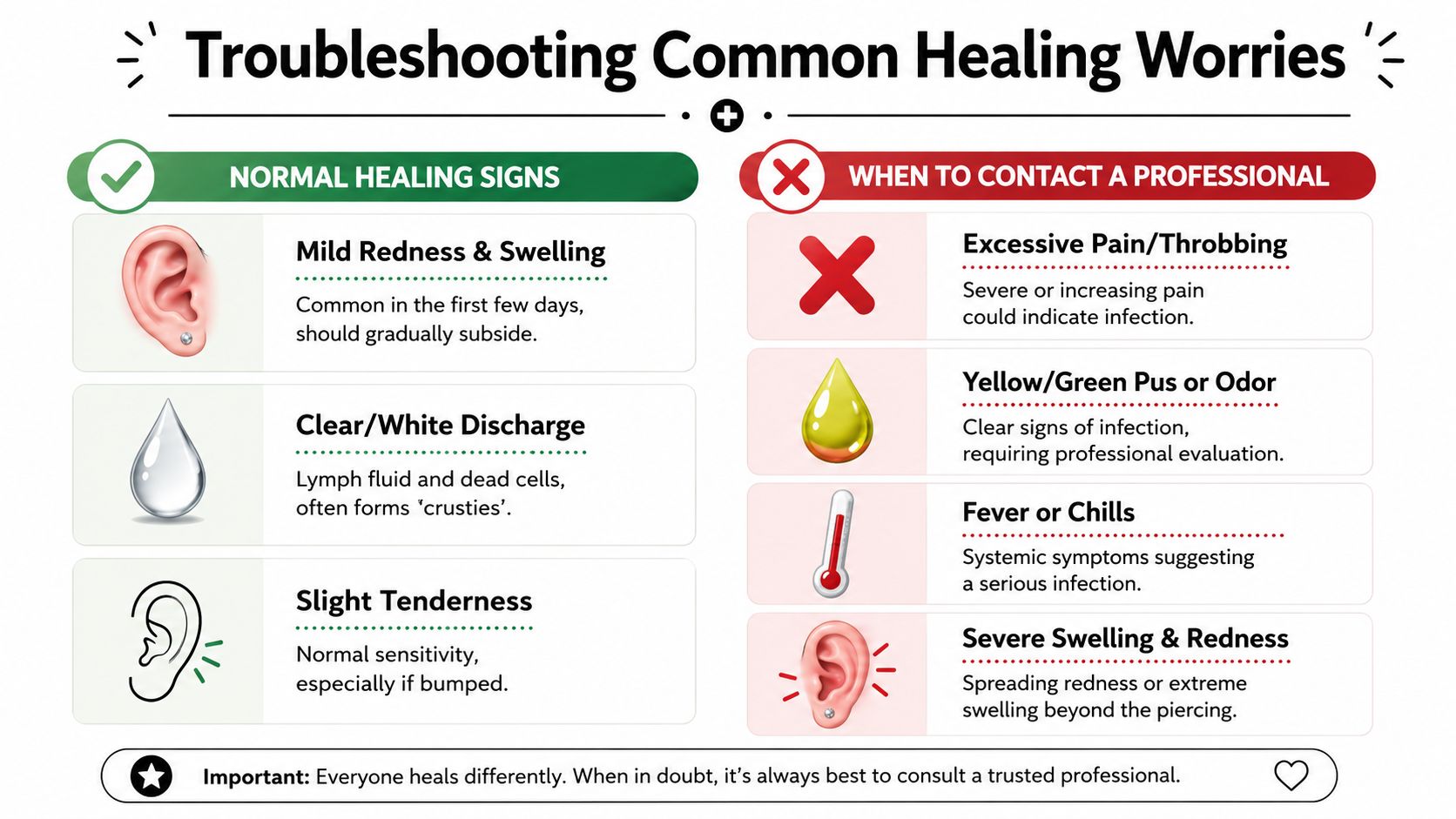
Most healing worries fall into two camps. Normal healing that looks unfamiliar, and genuine trouble that needs attention. Knowing the difference stops people from panicking over harmless crusting, and it also stops them from ignoring signs they shouldn't ignore.
If you want a fuller breakdown of warning signs, read this guide on how to tell if a piercing is infected.
What's usually normal
A new piercing can produce a bit of dried discharge. People call them “crusties”. That's often just dried lymph and healing debris. Mild redness, slight tenderness, or a bit of swelling after a knock can also happen.
Normal healing tends to look like this:
- Light crusting: Usually pale or clear when fresh, then dried.
- Minor redness: Especially early on or after irritation.
- Tenderness: More noticeable if it gets bumped.
If that's all you're seeing, go back to the basics. Gentle saline. No twisting. No picking.
What's more concerning
A piercing that becomes more painful instead of less comfortable deserves attention. So does discharge that looks thick, yellow or green, bad smell, spreading redness, or severe swelling.
Here, you stop guessing.
- Increasing pain or throbbing: Not the same as mild tenderness.
- Hot, angry skin: Especially if the redness spreads.
- Yellow or green discharge: That's not the same as ordinary crusting.
- Feeling unwell: Fever or chills need medical attention.
A practical point from UK aftercare advice matters here too. If infection is present, removing jewellery can trap bacteria inside. Leave it in unless a medical professional tells you otherwise. That same guidance also warns against alcohol, peroxide, and harsh chemicals for healing tissue, as explained in the earlier UK aftercare reference.
If the area looks worse each day instead of calmer, get it checked.
When to ask for help
If you're unsure, ask sooner rather than later. Good advice early on can prevent a small irritation from turning into a bigger problem.
For professional help, call 01202 900050 (Bournemouth) / 020 8686 7730 (Croydon) or message 07752 913846 (Bournemouth) / 07902 490584 (Croydon) on WhatsApp.
Keep those numbers handy if you're dealing with:
- Jewellery that's embedding or feels too tight
- Persistent swelling that isn't settling
- A piercing you've caught badly
- Any symptoms that look more like infection than irritation
Parents, this is the point where it helps to step in. Teens often wait too long because they don't want to make a fuss. Fresh piercings are much easier to troubleshoot early.
Your UK Piercing Aftercare Questions Answered
Can my teenager go swimming after getting their ears pierced
It's Friday night, the piercing is fresh, and someone remembers there's a swimming lesson in the morning. Leave the pool out of the plan for now.
Fresh piercings do better when you keep them away from pool water, hot tubs, lakes, and the sea in the early stage of healing. Chlorine does not make pool water sterile, and open water is even less predictable. If your child has to swim soon after being pierced, rinse the area afterwards with sterile saline, dry it with clean gauze or kitchen roll, and watch closely for irritation over the next day or two.
My advice is simple. The longer you can keep a new ear piercing out of the water, the easier healing tends to be.
How long until I can change the earrings
Wait until it is properly healed, not just less sore.
Lobes usually settle faster than cartilage, but both can look better on the outside before the channel inside is ready. Changing jewellery too early is one of the most common mistakes we see in UK studios. It leads to swelling, tearing, and piercings that suddenly start playing up after seeming fine.
If you are not sure whether it is ready, ask your piercer to check it first. For teenagers especially, I'd rather you wait a bit longer than force a jewellery change and undo weeks of healing.
What if my piercing gets caught on clothes or a towel
Treat it straight away.
Wash your hands. Check that the jewellery is still sitting in the right position and has not been pulled tight into the skin. Then clean the area with sterile saline and leave it alone. A snag can make it sore, puffy, or slightly crusty for a day or so.
Get help if the angle looks different, the jewellery is pressing in, or the area keeps getting more swollen instead of settling. Cartilage piercings are particularly unforgiving after a knock.
Can I sleep on it
Avoid it.
Pressure is a huge cause of bumps, soreness, and prolonged healing, especially with cartilage. If it is a lobe piercing, sleeping on it may still irritate it. If it is cartilage, regular pressure can keep it angry for months. Use a travel pillow or sleep on the other side so the ear sits in the hole instead of being crushed against the mattress.
This one makes a real difference.
Should I take the earring out if it looks irritated
No.
Leave the jewellery in place unless a clinician tells you to remove it. If you take it out during swelling or suspected infection, the hole can start closing and trap the problem inside. Clean it properly, reduce pressure, stop touching it, and get it checked if it is getting worse rather than calmer.
My child has crusting. Is that normal?
Usually, yes.
A bit of pale crusting is common while a piercing heals. It is dried lymph, not proof that something is wrong. Don't pick it off dry, and do not scrub at it with cotton buds. Soften it with sterile saline during cleaning, then gently wipe away what comes off easily.
Thick yellow or green discharge, a strong smell, or heat and spreading redness are different. Those need proper advice.
Do we need to rotate the earrings while cleaning?
No. Don't twist them. Don't spin them. Don't move them “to stop them sticking”.
That old advice causes trouble. Rotation drags bacteria and dried debris into the channel and irritates tissue that is trying to heal. Modern UK aftercare is much simpler. Clean the piercing, keep hands off, and let it settle.
If you want calm, sensible advice and help finding safe, professional studios, Piercing Near Me makes it easy to book with experienced piercers in Croydon and Bournemouth. If you're unsure about healing, placement, or aftercare, speak to a professional before small irritation turns into a bigger problem.
Trackbacks/Pingbacks