
You're standing in front of the mirror with two tiny studs balanced against the front of your ear, checking whether a double tragus piercing would give you the neat, stacked look you've saved online. From the front, it looks simple. From the side, you're already wondering whether your tragus is large enough, whether your earbuds will become unusable, and whether sleeping on that ear will turn a stylish idea into months of irritation.
That's the honest starting point. A double tragus piercing isn't just a single tragus piercing repeated twice. It's two nearby cartilage wounds sharing one small, pressure-prone area, so placement, jewellery length, device use and aftercare all need more planning than most short online guides suggest.
Why a Double Tragus Piercing Deserves Extra Thought
Two studs can look balanced, graphic and polished, but both punctures occupy one small, pressure-prone area. Swelling from one can reduce the space available to the other, so you are managing two connected cartilage wounds rather than two independent holes. The second channel often makes the first harder to settle as well.
Judge the idea against your routine and the healing timeline. Sleeping on that side, wearing in-ear headphones for work, or placing a motorcycle helmet strap against the ear can create repeated pressure that a single tragus piercing might avoid. Earbuds and headphones may need to stay out during the early healing period. Jewellery also needs room for initial swelling without leaving posts long enough to catch on hair, clothing or equipment.
UK public-health guidance treats ear-cartilage piercing as a meaningful infection-control concern. National advice specifically warns cosmetic piercing businesses about Pseudomonas aeruginosa perichondritis, an infection affecting ear cartilage, and local guidance controls which cartilage placements may be offered through cosmetic-piercing rules (UK cosmetic piercing code of practice). A double tragus is not automatically unsafe, but two nearby wounds leave less margin for poor sterile technique, unsuitable jewellery or inconsistent aftercare.
Practical rule: If you cannot comfortably pause pressure from earbuds, headphones and side-sleeping, reconsider the timing before reconsidering your anatomy.
The second hole is often the harder healer because it has less spare space around it, and swelling can make both sites difficult to clean or inspect. Before booking, a proper consultation should establish:
- Is the tragus broad enough? The piercer must assess whether both channels can sit with healthy separation.
- Can your routine adapt? Earbuds, helmet straps and sleep position may need to change.
- Will the jewellery remain accessible? Swelling can make cleaning and later adjustments awkward.
- Are you prepared for a long healing window? Cartilage can look settled before deeper tissue has matured.
A careful design accounts for both holes together, including their spacing, jewellery fit and likely pressure points. That planning is what makes the polished result more realistic to maintain.
Tragus Anatomy and What a Double Tragus Really Means
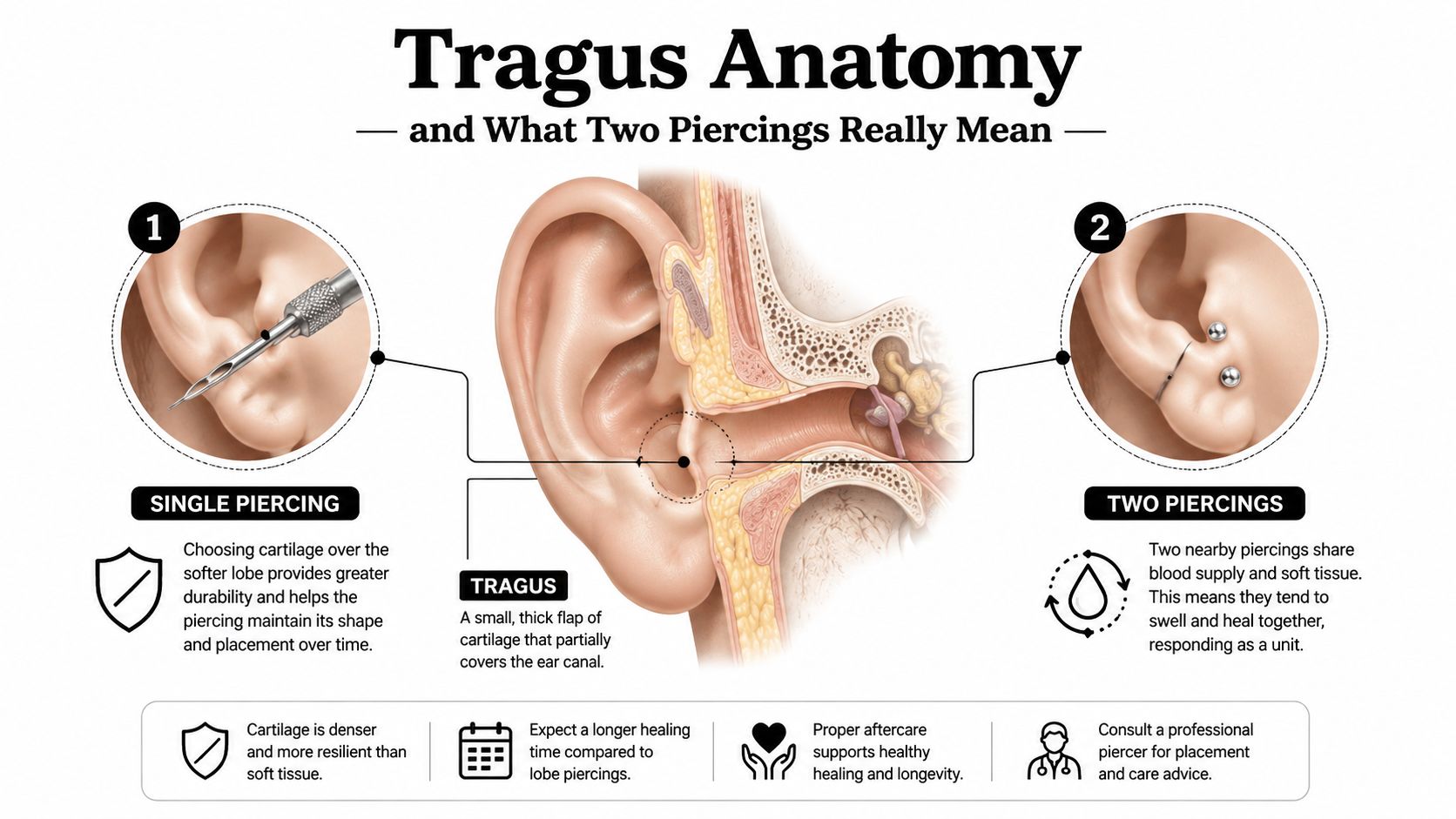
The tragus is the small cartilage flap at the front of the ear canal. It partly shields the canal and has limited working space, so a standard tragus piercing usually uses a small, flat-backed stud rather than a large decorative hoop. Its cartilage is denser and has a more limited blood supply than the fleshy earlobe, which makes careful placement and aftercare important.
Cartilage heals slowly because fewer blood vessels reach it. A needle creates a channel through that dense tissue, and the body must settle inflammation around jewellery positioned beside the ear canal. Movement, moisture and debris can be difficult to control there, especially if an earbud or headphone repeatedly contacts the area.
The shared swelling problem
A double tragus piercing uses one small cartilage zone for two channels. Swelling, tenderness and pressure can therefore overlap, leaving less room for each site to settle. The nearer stud may press against the other if the posts are too short or the marks do not account for the jewellery ends.
The piercer should assess the ear from the front and side. A tragus can look broad enough in a mirror yet become noticeably narrower from an angle. Available tissue also depends on the natural fold and the position of the antihelix behind it.
A UK investigation into cartilage-piercing infections recorded 10 cases of perichondritis. 7 people required hospital admission and 3 required surgery. The outbreak was traced to a contaminated water-heating system in the studio, demonstrating why studio environmental controls matter alongside personal aftercare (UKHSA outbreak investigation).
Use this working model: two punctures create one connected recovery zone. Their proximity affects marking, initial post length, sleeping pressure and how easily both channels can be kept clean. A second hole can increase the practical burden even when each mark appears suitable on its own. During healing, treat the pair as one irritated area and reduce pressure before swelling turns into a jewellery-fit problem.
Your Consultation and Placement Conversation
A responsible consultation starts before the consent form. The piercer should examine the tragus under strong light, feel the available cartilage and check the ear from several angles. They'll also consider existing jewellery, scars, skin conditions and any history of problematic healing.
Tell the piercer about keloid formation, significant skin reactions and medication that affects bleeding, including blood-thinning medication. Don't stop prescribed medication for a piercing appointment without medical advice. The aim is to identify avoidable risk and decide whether the placement is sensible for your ear, not to force the design you arrived with.
Your routine determines the design
Bring your normal habits into the conversation. A tragus that looks suitable on a quiet day may be a poor choice if your work headset presses directly over it or your earbuds sit tightly against the jewellery.
Discuss:
- Earbuds: In-ear devices can rub both posts and transfer debris into a healing area.
- Headphones: Over-ear headphones may be preferable, but only if the ear cup doesn't compress the tragus.
- Helmet equipment: Motorcycle straps and protective headgear can catch protruding ends.
- Sleep position: Side-sleeping creates sustained pressure, not just occasional contact.
- Work requirements: Repeated removal of hearing protection can knock fresh jewellery.
The piercer should mark both positions with a single-use surgical pen, then let you inspect the marks from the front and side. Use your own mirror if that helps you judge the spacing. Symmetry matters, but healthy tissue and a comfortable angle matter more than making the studs appear perfectly parallel.
The best mark is the one your anatomy can heal, not the one that looks perfect for a few seconds in a mirror.
Before committing, ask these questions plainly:
- How are your instruments sterilised?
- Are the needles sterile and single-use?
- Where did the jewellery come from, and what material standard does it meet?
- How will you allow for swelling between the two holes?
- What written aftercare will I receive?
- Who should I contact if one post starts embedding or the swelling changes?
A studio that answers clearly should also be comfortable declining the placement if your tragus is too narrow or the jewellery would overlap. That refusal is professional judgement, not lost enthusiasm.
Choosing Implant-Grade Jewellery for Both Holes
Jewellery is part of the healing setup, not a finishing touch. For a double tragus piercing, choose a smooth, biocompatible material with a surface that won't scrape the channel or trap unnecessary debris.
The UK framework lists suitable jewellery materials including surgical stainless steel, 14K or 18K gold, niobium, titanium, platinum and dense low-porosity plastic when jewellery touches broken skin (UK jewellery and aftercare guidance). It also gives a nickel-release threshold of no more than 0.5 micrograms per square centimetre per week for direct and prolonged skin contact, so vague claims such as “hypoallergenic metal” aren't enough.
Metal comparison
| Metal | Standard or alloy note | Nickel release risk | Best use for double tragus |
|---|---|---|---|
| Implant-grade titanium | Look for a recognised implant standard such as ASTM F136 | Very low when correctly specified | A strong first choice for sensitive or swelling-prone cartilage |
| Niobium | Solid niobium is valued for biocompatibility and can be anodised | Low when solid and suitable for body jewellery | Useful when you want a coloured finish without a surface coating |
| Solid gold | Choose solid 14K or 18K gold, with a nickel-free alloy | Depends on the alloy, so confirm composition | Suitable when the studio can verify the alloy and finish |
| Surgical stainless steel | Use a recognised grade such as ISO 7153 steel | Can vary with alloy and nickel release | Consider only when the studio confirms the grade and suitability |
A polished, machine-finished surface is preferable to rough plating or decorative coating. Coatings can wear, chip or create an uneven surface as the jewellery moves, while a smooth finish gives the healing channel less to fight against. A flat-back labret usually sits more securely than a protruding butterfly-backed fashion stud.
For sizing, the piercer must measure your anatomy rather than apply a universal fit. Many studios use a 1.2 mm, or 16 gauge, post for cartilage work, while initial length needs to account for swelling. The longer post should provide clearance without leaving an unnecessary lever that catches on hair or headphones. The decorative end also needs to sit clear of the antihelix.
A straight labret is often easier to stabilise and clean. A short curved barbell may suit a particular angle, but it can create uneven pressure if the curve doesn't match the tragus. Two adjacent posts need deliberate vertical separation so the ends don't press into one another as either channel swells. Your piercer should determine that spacing during marking, not after the jewellery has been inserted.
For material guidance and examples of titanium options, review titanium piercing jewellery before your appointment, then confirm the exact specification with the studio.
What Happens During the Piercing Appointment
You'll usually begin with paperwork, identification and consent. The appointment should feel organised rather than rushed, with time to discuss anatomy, jewellery and the marks before any needle touches your skin.
Under a bright examination light, the piercer checks the tragus and marks the entry points. They'll look from the front, side and mirror view, then ask you to approve the placement. This is the moment to question spacing, angle or height. Once the needle goes through, changing the plan isn't a realistic option.
The skin is prepared with a suitable single-use wipe, such as alcohol or chlorhexidine where appropriate, and the jewellery is handled within a sterile setup. A professional uses a sterile, disposable hollow needle or catheter, never a piercing gun, because a gun delivers blunt force and isn't appropriate for dense tragus cartilage.
Expect pressure, a brief sharp sensation and possibly an audible pop as the needle passes through the cartilage. The sound can feel more dramatic than the sensation because the tragus sits close to the ear canal. A calm piercer will explain each stage instead of leaving you to interpret every noise.
The jewellery is transferred through the channel, then the piercer checks that both posts have room for swelling and that the ends sit comfortably. They should clean away marking residue, show you the finished placement and explain what normal early tenderness can look like.
Before you leave, you need written aftercare and a clear contact route. A professional appointment doesn't end when the studs are fitted. It ends when you understand how to handle the area, what to avoid and when a symptom needs clinical attention.
Aftercare and the Realistic Healing Timeline
Treat the two piercings as one healing area. Wash your hands before and after any necessary contact, keep the jewellery still and use sterile saline rather than experimenting with creams, oils or harsh household products. UK infection-prevention guidance stresses hand hygiene around blood and body fluids and points body-piercing businesses towards consistent safety procedures (CIEH tattooing and skin-piercing toolkit).
The first day
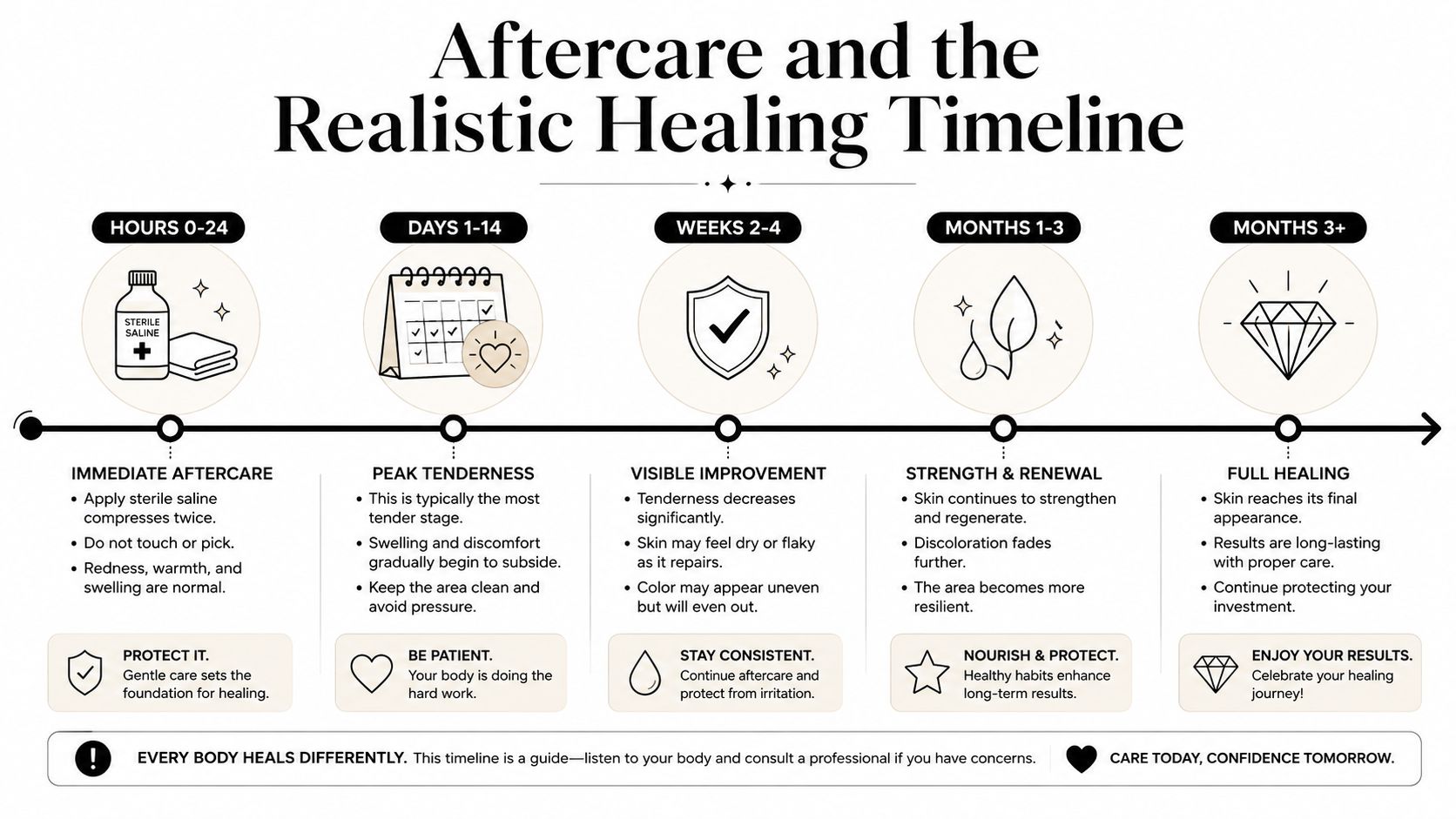
During the first hours, mild localised redness, throbbing, tenderness or a small amount of bleeding can occur. Use sterile saline as your piercer advises, avoid touching the studs and dry the area gently with a clean paper towel rather than a fluffy bath towel.
NHS guidance advises cleaning an infected piercing twice a day, drying with a clean paper towel and avoiding swimming for the first 24 hours (NHS infected piercings advice). If you suspect infection, follow clinical advice rather than treating the wound as a routine cosmetic piercing.
From tenderness to tissue maturation
Tenderness often feels more noticeable during the early days, and swelling can make the second hole feel tighter than the first. Sleep on the opposite side, keep pillowcases clean and pause earbuds. If you need audio, over-ear headphones are only sensible if they don't press on the tragus.
Use sterile saline consistently, but don't over-clean. Avoid twisting jewellery when dry, picking crusts or applying creams. UK outbreak evidence associated one aftercare solution with illness, with an adjusted odds ratio of 4.60, and associated cream use with illness, with an adjusted odds ratio of 5.89 (NHS infection guidance and outbreak evidence). Saline-based care is the safer default unless a clinician or your piercer gives a specific alternative.
The outside can look calm while the inner fistula remains fragile. UK guidance commonly places cartilage healing over several months, and tragus healing can take up to 12 months (NHS infected piercings advice). Don't change jewellery because the surface looks neat.
For a practical overview of tragus piercing healing time, use the expected window as a planning tool rather than a deadline. A piercer should assess whether both channels have matured before downsizing or changing the jewellery.
Spotting Complications and When to Seek Help
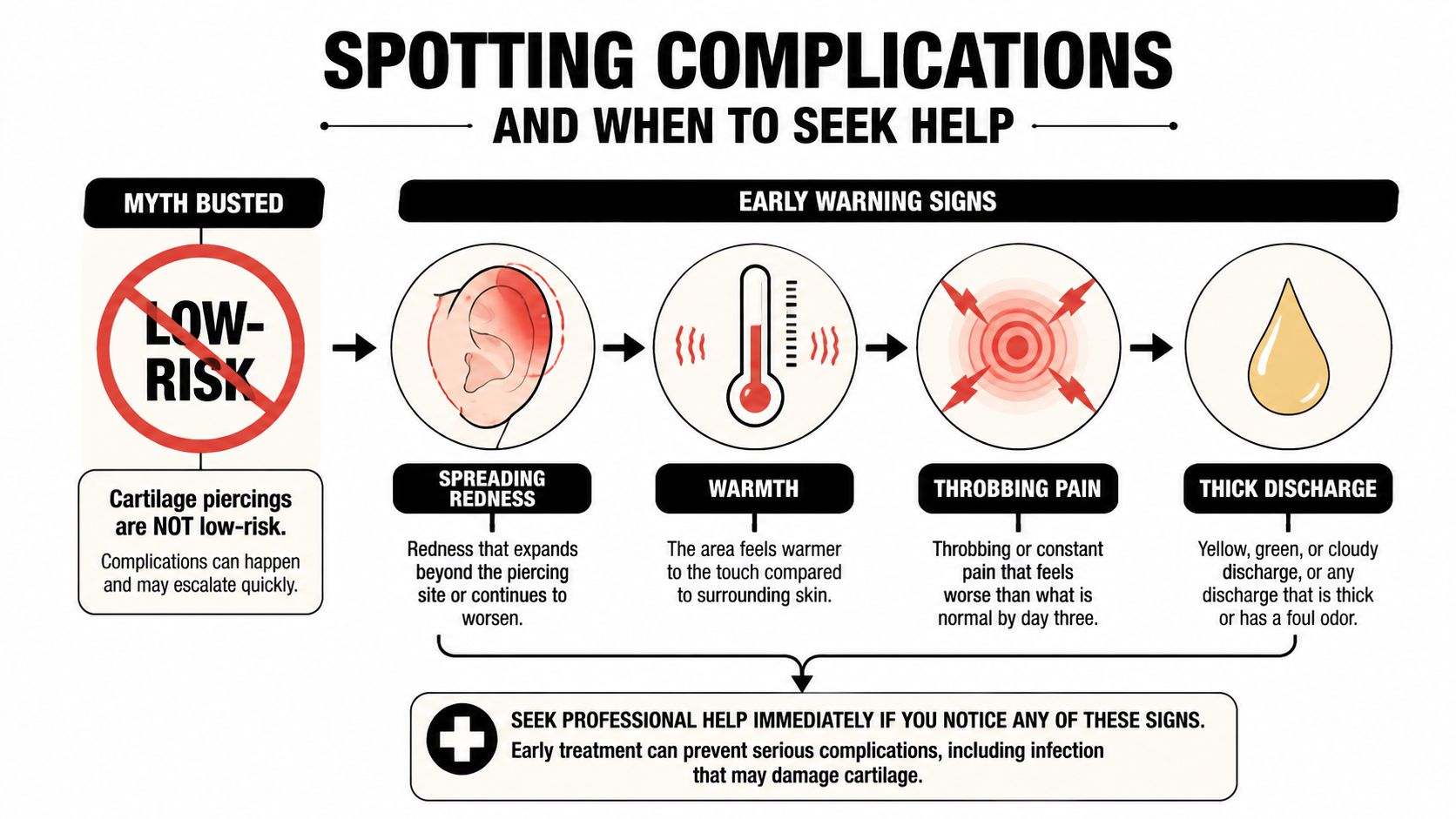
You notice the second tragus becoming hotter and tighter while the first still looks settled. Treat the area as two connected cartilage wounds. Their proximity means swelling can affect both channels, and pressure from earbuds or headphones can keep irritating the newer hole. A UK public-health notice highlights Pseudomonas aeruginosa perichondritis as a complication associated with ear piercings, and severe cartilage infections can damage tissue. Early action gives you a better chance of preventing a manageable problem from becoming a serious one.
Symptoms that need attention
Normal early irritation should gradually settle. With a double tragus, compare both holes and take note when one begins to influence the other. A small amount of tenderness or clear fluid can occur during healing, but a worsening pattern needs attention.
- Spreading redness: Redness extending beyond the immediate piercing area deserves prompt assessment. Do not cover it with concealer or trap pressure against it beneath headphones.
- Increasing warmth: A hot ear with worsening swelling is more concerning than mild warmth immediately after the appointment.
- Disproportionate throbbing pain: Pain that keeps intensifying, especially after the early settling period, should be assessed rather than dismissed as ordinary cartilage tenderness.
- Thick yellow or green discharge: Clear or pale fluid can dry around a healing piercing. Thick coloured discharge, particularly with odour or increasing swelling, needs medical advice.
- Embedding jewellery: If the front or back of a post is disappearing into swollen tissue, do not force it out. Do not wait to see whether the jewellery becomes visible again.
If you suspect infection, follow clinical advice rather than treating the wound as a routine cosmetic piercing. Read our guide on how to tell if your piercing is infected for warning signs and next steps.
Continue gentle sterile saline care while arranging advice, but avoid creams, alcohol, tea tree oil and unverified antiseptics. Reduce pressure from masks, earbuds and headphones. Photograph the ear each day in similar lighting, so you can judge whether redness or swelling is spreading instead of relying on memory.
The escalation route
Contact your GP or an urgent care service when swelling, warmth, pain or discharge is worsening rather than settling. Ask a clinician how to manage the jewellery. Removing it without advice may allow the channel to close around infection, while leaving an embedded post in place can create a separate tissue problem.
Seek urgent medical help if you develop fever, chills, feel generally unwell or see rapidly expanding redness. The UK investigation described earlier involved hospital care and surgery in some patients. Severe symptoms call for medical assessment, not trial-and-error aftercare.
Local authority standards also make the studio's conduct relevant. Piercing businesses should use sterile jewellery for broken skin, follow hygiene controls and provide clear aftercare. Ask how instruments are sterilised and whether the piercer can explain the autoclave process. Registration paperwork or visible hygiene information does not replace sound technique, and evasive answers are a reason to leave.
Screenshot this readiness check
- Anatomy: Is the tragus large enough for two punctures without overlap?
- Jewellery: Have you confirmed implant-grade titanium or verified solid 14K or 18K gold, with posts long enough for swelling?
- Supplies: Do you have sterile saline wound wash and a travel pillow ready?
- Routine: Can you pause earbuds and avoid sleeping on that side for at least four weeks?
- Studio: Have you saved a photo of the studio's autoclave log or local authority registration?
- Red flags: Do you know which symptoms mean GP, urgent care or A&E rather than more home cleaning?
- Timing: Have you left an extra week of margin before a holiday, sports event or MRI?
The second hole can react later, after the first has started to look calm. Plan the double tragus around your routine, including travel, sleep and headphone use, rather than around a single photograph.
For an anatomy and jewellery consultation, Piercing Near Me can help you explore suitable services through Piercing Near Me, including booking support connected with studios in Croydon and Bournemouth. Contact the team on 01202 900050 (Bournemouth) / 020 8686 7730 (Croydon) or WhatsApp 07752 913846 (Bournemouth) / 07902 490584 (Croydon) to discuss placement, implant-grade jewellery and aftercare before you commit.