
You're scrolling through social media when a tiny ring tucked into the innermost fold of someone's ear catches your attention. The caption promises a stylish piercing, perhaps even relief from migraines, and suddenly you're wondering whether this discreet piece of jewellery could suit your ear too.
So, what is a daith piercing? It's a cartilage piercing through the thick fold immediately above the ear canal, known anatomically as the crus helix. It's a distinctive placement, but it isn't a simple lobe piercing. The location affects the needle sensation, jewellery choices, healing time and aftercare. The migraine claim also needs careful handling, because personal reports aren't the same as medical evidence.
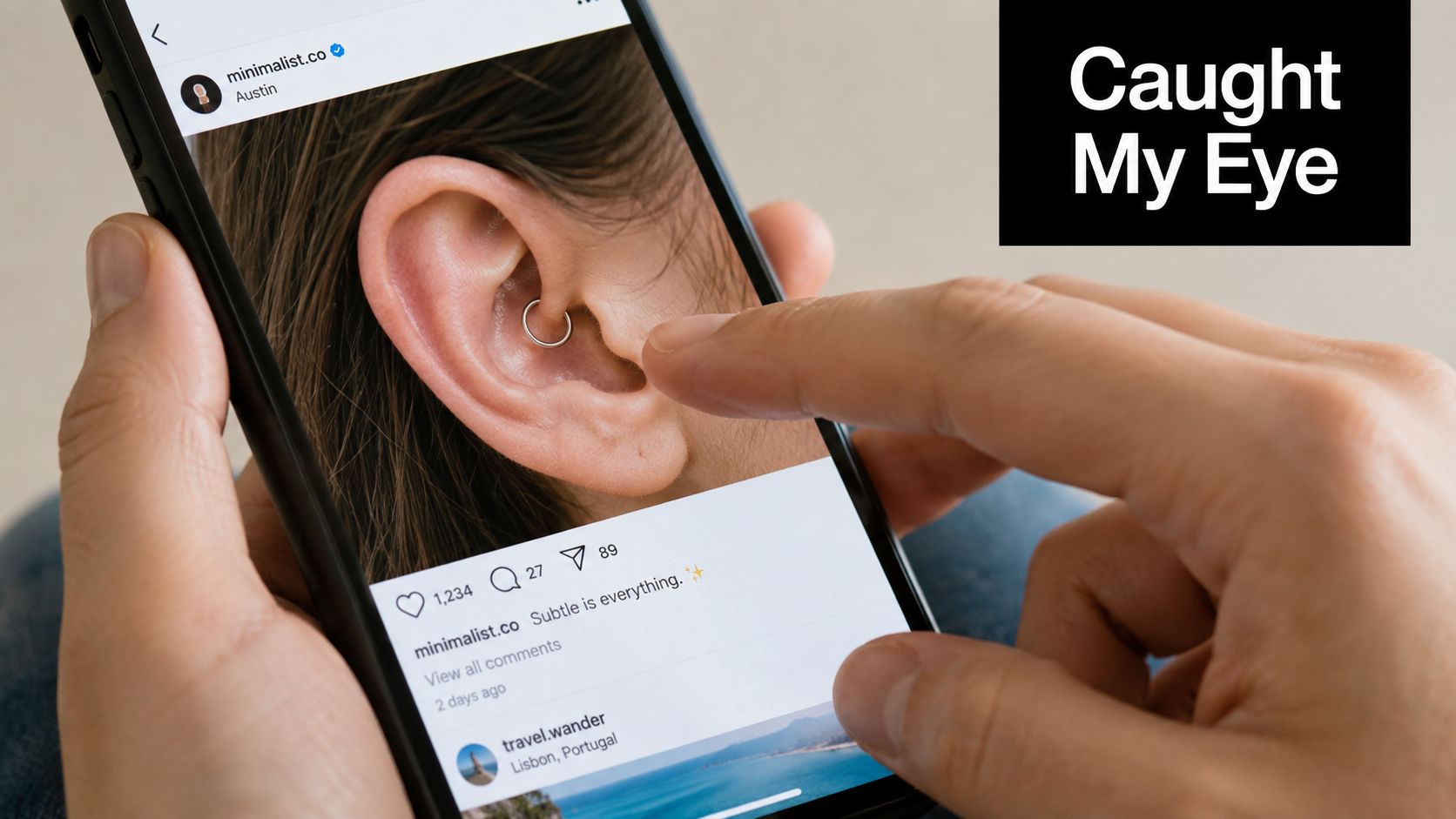
This guide walks through the placement, history, jewellery, pain, healing and UK aftercare expectations. By the end, you should have enough information to decide whether you want the daith for its appearance, rather than choosing it because an online caption promises a result it can't reliably deliver.
Meeting the Daith Piercing for the First Time
A first-timer often arrives at a studio with the same image saved on their phone: a small ring, neatly hidden in the inner ear, with no obvious explanation of how it got there. They may like the understated look, but they're usually carrying two questions as well. Will it hurt, and can it really help migraines?
The first answer depends on your anatomy and sensitivity. A daith passes through firm cartilage, so the sensation is usually sharper and more pressurised than a soft-lobe piercing. The actual needle movement is brief, but the ear can feel tender afterwards because the tissue has less flexibility than the lobe.
The second answer is more cautious. Some people report that their migraines improved after getting a daith, but medical reviews continue to describe the evidence as lacking. A piercing can be a perfectly valid style choice without being a proven treatment.
A daith should make sense as jewellery first. Treat any possible migraine benefit as uncertain, not as a reason to ignore medical care.
The placement also makes the daith a commitment. Your piercer needs to check whether the fold is deep and accessible enough, select jewellery that allows for swelling, and explain how to avoid pressure from sleeping, headphones, hair and towels. Healing commonly takes 6 to 12 months according to UK practitioner guidance from The Newdorp's daith aftercare guide, and irritation can appear even when the piercing looks settled from the outside.
Where the Daith Sits in the Ear
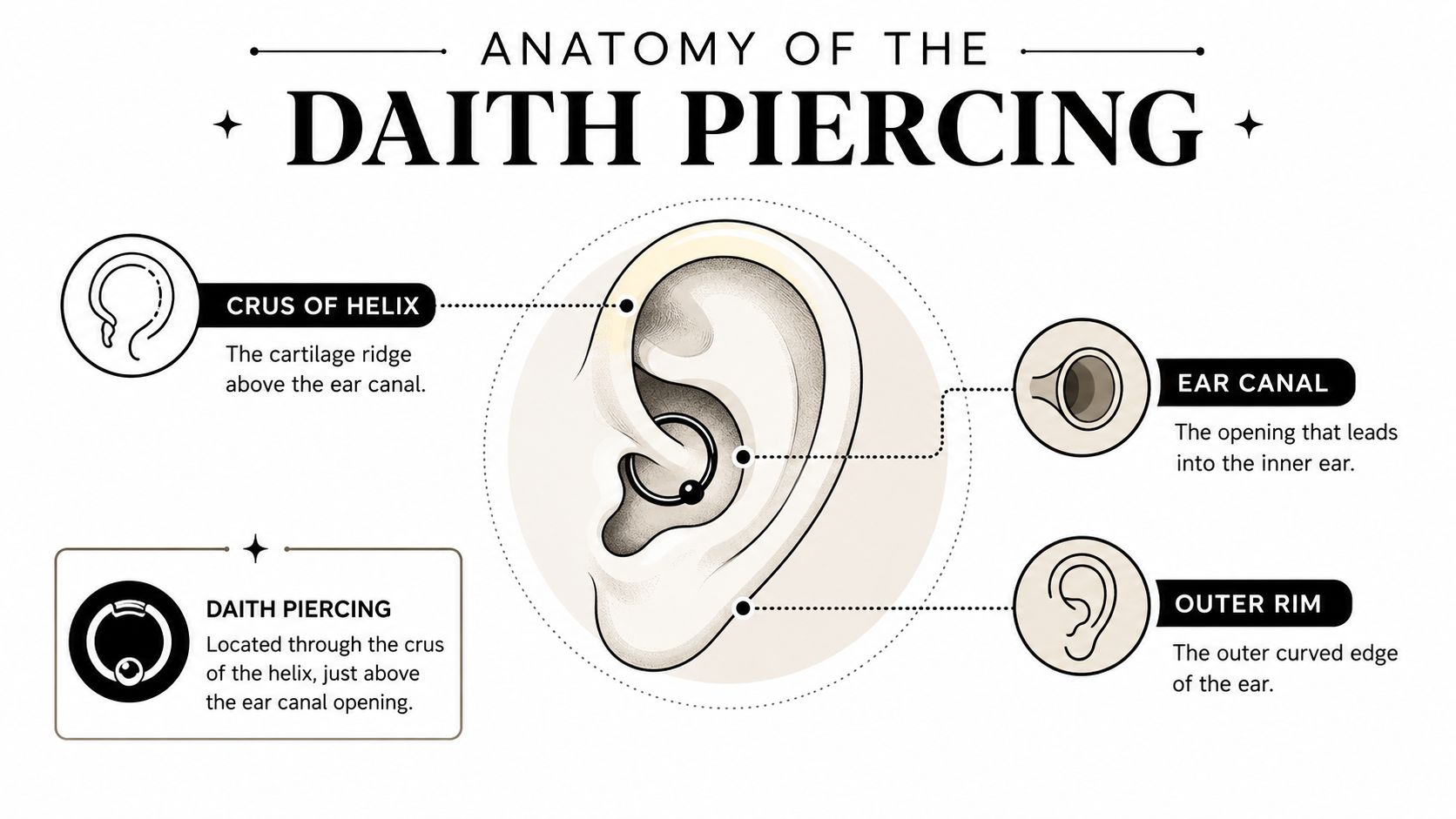
Begin at the front of the ear, beside the canal opening. The small flap partly covering that opening is the tragus. From there, follow the rounded hollow of the concha and look upwards towards the inner ridge curving above the canal. This ridge is the crus helix, near the fold where a daith piercing is placed.
The daith passes through neither the outer rim, where a helix piercing sits, nor the centre of the concha bowl. The jewellery rests in the compact fold between these landmarks, usually close to the ear canal. Limited space and visibility mean the piercer needs to assess the angle and work carefully.
Why the inner fold affects healing
The earlobe is soft tissue with comparatively good circulation. A daith sits in thicker cartilage with more limited circulation, so the body repairs the needle channel more slowly. It needs more patience than a lobe piercing, even if the finished jewellery looks small and discreet.
Ear anatomy varies. One person may have a broad, defined fold, while another may have a shallow ridge that cannot safely support suitable jewellery. An experienced piercer should assess the ear while it is relaxed rather than force a placement to match a saved photo. They can mark the proposed entry and exit points, then explain whether there is enough room for swelling.
The position also creates practical demands:
- Pressure matters: Headphones, earbuds and sleeping on that side can press against the fresh channel.
- Access is restricted: Cleaning and future jewellery changes need extra care because the area is difficult to see.
- The fit must be precise: Jewellery that is too tight can press into swollen tissue. Jewellery that moves too freely can keep the channel irritated.
A good consultation should leave you understanding both the appearance and the trade-offs of this cartilage placement.
A Short History from 1992 to the Migraine Trend
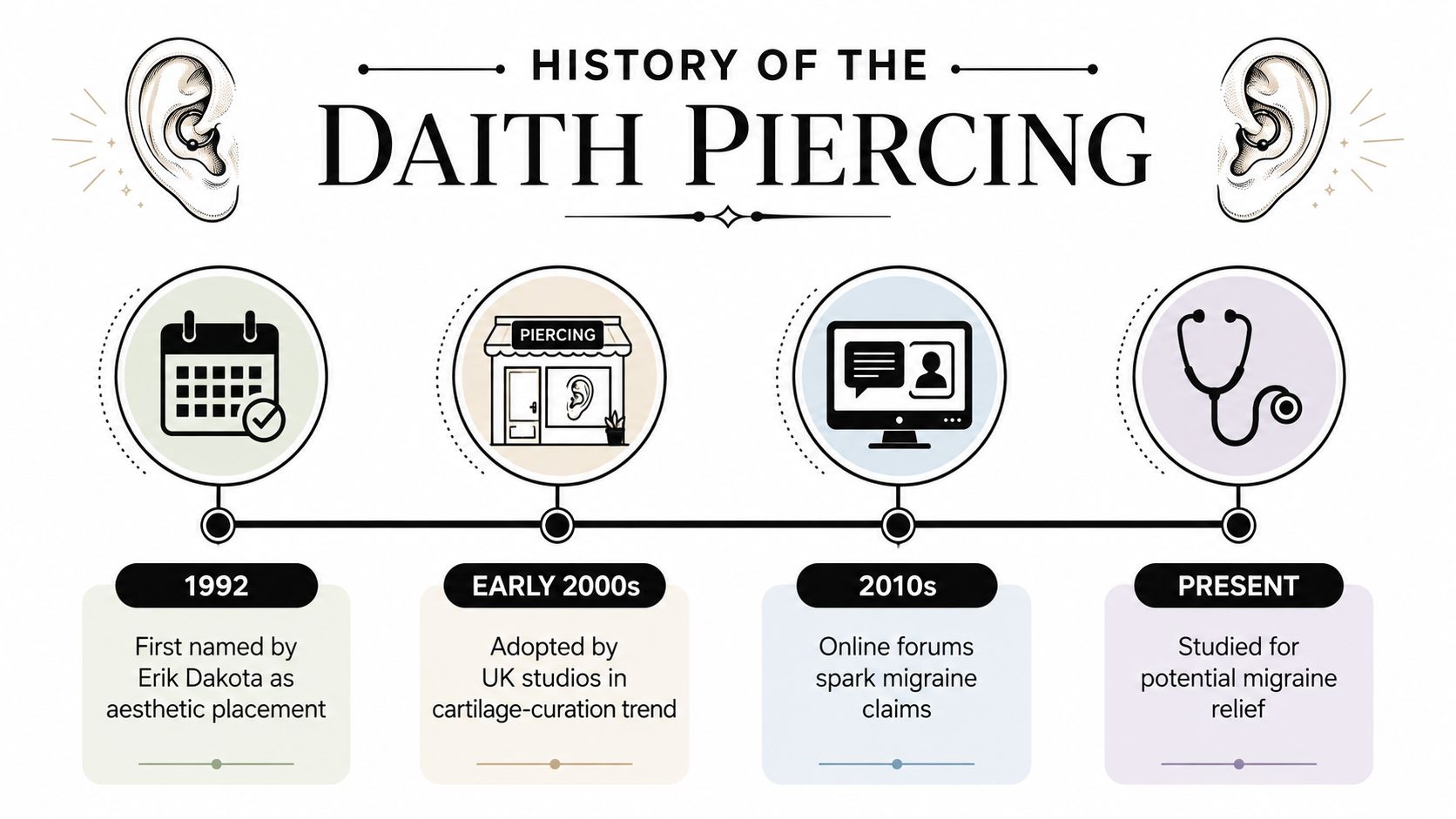
The daith started as a style choice rather than a medical procedure. UK health-research material identifies New York piercer Erik Dakota as its creator in 1992, as documented in the UK Health Research Authority summary of daith research.
Its appeal came from the placement itself. The inner cartilage fold was less commonly pierced than the lobe or helix, giving curated-ear designs a discreet detail. Jewellery could show from the front while remaining contained within the ear.
How the migraine association developed
The migraine association grew through online communities, where people described feeling better after getting pierced. Supporters often connect the daith with acupuncture points in the ear, although an acupuncture needle and a permanent cartilage piercing are different interventions. The jewellery is also not placed according to a medically validated migraine-treatment protocol.
The trend became widespread enough to attract research attention. The Health Research Authority notes that, since 2015, uptake among migraine sufferers in the UK has been significant, with many tens of thousands trying the procedure. Its summary also records continued scientific scepticism.
A UK survey dataset included 508 patients, with 296 responses collected three months after piercing. The London Migraine Clinic survey report states that, among respondents who had kept the piercing for over a year, 70% said their migraines were greatly improved or had stopped completely. These were self-selected survey responses, not results from a controlled clinical trial.
That distinction matters. Some people may have experienced genuine relief, but expectation, natural changes in migraine patterns and selection bias can also influence self-reported outcomes. The history explains how the claim gained momentum, not proof that the piercing caused the improvement.
Jewellery Options for a Daith Piercing
A daith needs jewellery that follows the fold without creating unnecessary pressure. Your piercer should choose the material, gauge, diameter and closure after examining your anatomy, rather than selecting a piece solely because it looks attractive in a product photograph.
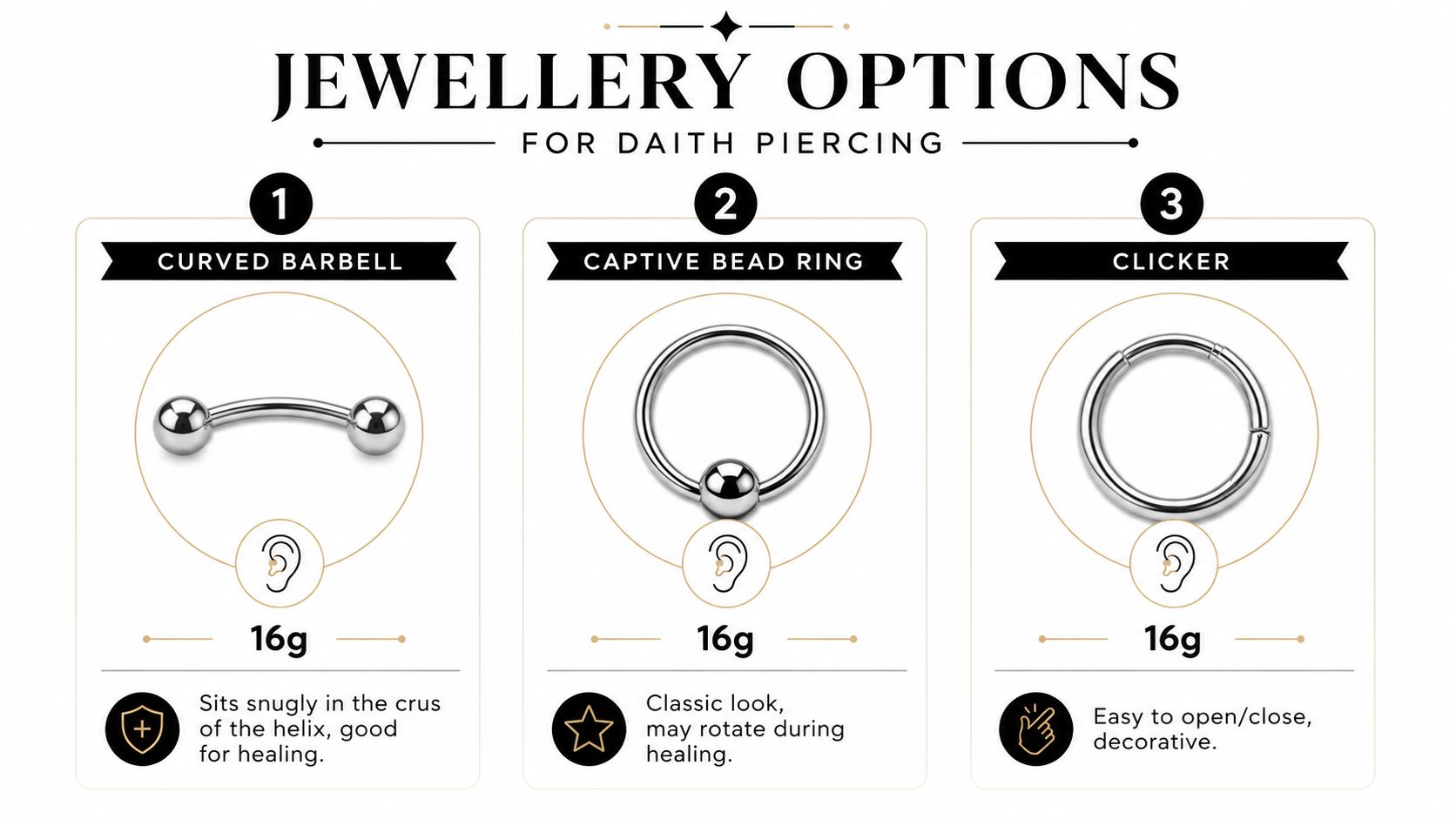
Curved barbells can sit closely within the crus helix and may offer a relatively contained shape during early healing. They have less circular movement than many rings, although the exact suitability depends on the fold and the jewellery's curve. A reputable piercer will ensure the ends aren't pressing into the surrounding cartilage.
Captive bead rings create the classic daith appearance. The bead holds the ring closed, but the circular jewellery can rotate as you move, sleep or dry your hair. That movement may catch on towels or hair and can make cleaning the inner fold less straightforward.
Clickers use a hinged segment that opens and closes. They're convenient once the piercing has healed, but the hinge must be smooth, secure and correctly positioned. A poorly fitted mechanism can rub the tissue or create pressure at one point in the channel.
Material and fit matter more than decoration
Look for implant-grade titanium or suitable nickel-free gold with a polished surface. Rough finishes, poor closures and unsuitable alloys can create avoidable irritation. The jewellery shouldn't be so tight that swelling has nowhere to go, but an oversized piece can move, snag and disturb the healing channel.
Initial jewellery is usually kept simple. Once the tissue has fully settled, your piercer can assess whether a decorative ring, clicker or different finish is appropriate. Don't change it casually during recovery, even if the outside appears normal. For style ideas, you can browse gold daith jewellery options, then take the preferred design to a professional for a fit and material check.
The Migraine Claim and What the Evidence Says
If someone books a daith piercing after months of migraine attacks, the appointment can feel like a possible treatment as well as a style choice. The honest answer is that a daith piercing isn't an established migraine treatment. Some people report fewer or less intense attacks afterwards, but their experience cannot show that the jewellery caused the change or that the same result will happen for someone else.
Medical reviews describe the available research as limited, with evidence consisting mainly of case reports and small, uncontrolled surveys. One review discusses limited case reports, an unquantified failure rate and possible complications such as infection and persistent pain in its examination of daith piercing and migraine evidence. Its conclusion is that the evidence is insufficient to recommend daith piercing as migraine treatment.
Separate a personal experience from clinical proof
Migraine symptoms can change naturally. Medication, sleep, stress, hydration and diet may also change around the time of a piercing. Expectations can affect how someone interprets later symptoms. That does not make the account dishonest. It means the account cannot separate coincidence from cause and effect.
The suggested connection with stimulation of the vagus or trigeminal nerves remains a hypothesis, not a confirmed mechanism. No standard piercing method has been established as a medical intervention, and reliable evidence has not shown that a daith works better than appropriate migraine diagnosis and care.
| Source or approach | What it suggests | What it cannot establish |
|---|---|---|
| Personal accounts | Some people feel their migraines improve after piercing | That the piercing caused the improvement |
| Self-selected survey responses | Some respondents reported improvement | That the result applies to all migraine sufferers or beats placebo and selection effects |
| Medical reviews | Evidence remains limited and formal proof is lacking | A reliable treatment effect or a standard clinical method |
| Established healthcare | Diagnosis and personalised migraine management remain important | That jewellery can replace prescribed care or specialist advice |
Survey findings need careful context. People who believe a piercing helped may be more likely to respond, while those who saw no change may be less likely to take part. The survey format also cannot control other changes in a participant's health or treatment. As noted earlier, the reported result should be read as an account of experience, not proof of a predictable effect.
If you are considering a daith specifically for frequent attacks, speak with a GP or headache specialist first. A piercing still carries ordinary cartilage risks, including infection, bleeding, allergy, scarring and ongoing irritation. The daith piercing benefits and limitations overview can help you weigh the idea, but keep the distinction clear: anecdote can describe an experience, while clinical evidence tests whether an effect is predictable.
Pain and Healing Expectations You Should Plan For
The needle sensation was covered earlier, so the more useful question here is what happens after you leave the studio. A daith is a cartilage piercing in a tight inner fold, and the appointment is brief compared with the months needed for the channel to settle.
Eat beforehand, arrive rested, breathe steadily and avoid alcohol before the appointment. If you take prescribed medication that affects bleeding, ask your doctor before changing anything. Your piercer can explain the procedure, but cannot advise you to stop prescribed treatment.
The healing curve is the bigger decision
A daith commonly takes 6 to 12 months to fully settle. Cartilage has limited circulation, and the inner placement can be difficult to protect from pressure and accidental contact. Irritation and tenderness are more likely early on if the jewellery is moved or the site becomes contaminated, as described in UK daith guidance from The Newdrop.
Mild tenderness, modest swelling and redness can occur during the first stage. The piercing may then look calm before flaring after pressure from sleeping, headphones, hair, exercise or an accidental knock. That pattern does not automatically mean it has failed, although repeated disturbance can extend the healing period.
Plan your routine around the piercing, not only around the appointment. If you sleep heavily on one side or wear tight headphones every day, discuss those habits with your piercer before choosing the placement.
Leave the jewellery in place during healing unless a qualified piercer or clinician advises otherwise. If swelling makes a bar or ring look too tight, arrange a professional check rather than trying to correct it at home. Down-sizing and decorative jewellery changes should wait until the channel is ready.
Healing is rarely a straight line. A quiet-looking piercing can still be fragile beneath the surface, so avoid judging readiness by appearance alone.
Persistent or worsening pain should not be dismissed as normal. Spreading redness, marked heat, substantial discharge, fever or jewellery becoming embedded needs prompt medical attention.
UK Aftercare and Knowing When to See a GP
A daith needs a simple routine that you can repeat without disturbing it. Wash your hands before contact, follow your piercer's written instructions, and clean gently. Dried crust should soften with saline rather than being scraped away.
The NHS guidance on infected piercings advises seeking medical advice through a GP or NHS 111 if infection is suspected. It also says to leave the jewellery in place unless a doctor tells you to remove it, avoid cotton wool during cleaning and avoid swimming for the first 24 hours.
A practical cleaning routine
Use sterile saline or the mild, fragrance-free cleanser recommended by your studio. Patient.info advises cleaning 2 to 3 times a day with saltwater and avoiding alcohol or hydrogen peroxide, since these can irritate the skin and slow recovery, as explained in Patient.info's infected-piercing guidance.
- Wash your hands: Clean your fingers before they go near the jewellery.
- Apply the recommended solution: Let saline loosen dried fluid instead of picking at the area.
- Rinse if advised: Remove residue gently, without forcing water into the piercing channel.
- Pat dry: Use clean disposable paper. Cotton wool can leave fibres behind.
- Leave it alone: Do not twist, spin or repeatedly inspect the jewellery.
Keep swimming pools, hot tubs and open water out of your routine while the piercing is vulnerable. Protect the ear from direct pressure during sleep, and take care with headphones, helmets, hairbrushes and towels. Strong chemicals can disrupt the skin barrier, making irritation harder to settle.
A little redness, swelling, tenderness or clear lymph fluid can occur during early healing. Cartilage may also develop an irritation bump after pressure or a knock. Symptoms should gradually become less disruptive, although healing can fluctuate rather than improve every day.
Normal healing versus a warning sign
Contact a GP or NHS 111 if you notice:
- Spreading redness: Redness extending beyond the immediate piercing area.
- Increasing heat and throbbing: Skin that feels hot while pain becomes stronger.
- Yellow-green discharge: Particularly alongside worsening swelling or an unpleasant odour.
- Systemic symptoms: Fever, chills or feeling generally unwell.
- Embedding jewellery: The ring or bar pressing into tissue, disappearing beneath it or becoming trapped.
UK public-health guidance on Pseudomonas aeruginosa perichondritis associated with ear piercings says businesses should provide verbal and written aftercare and advise clients to see a doctor if infection symptoms appear, as set out in the UK government business guidance. A piercer can assess irritation and jewellery fit, but suspected infection requires clinical care.
Choosing a Studio and Putting It All Together
You have found a studio, shown the piercer your preferred jewellery, and are ready to book. Before the needle touches your ear, check that the studio is registered with the relevant local authority, ask who will perform the piercing, and look for clear sterilisation procedures. A single-use needle should be opened in front of you, reusable equipment should be sterilised in an autoclave, and jewellery materials should be named precisely rather than described as “surgical metal”.
Ask about implant-grade titanium or suitable solid gold with a smooth, polished finish. The piercer should examine your anatomy and explain where the jewellery can sit. A reputable studio will also discuss age requirements and consent procedures, particularly if a parent or guardian is arranging the piercing for a younger client.
Your studio appointment checklist
Before booking, make sure you can answer these questions:
- Placement: Has the piercer examined your crus helix and explained the planned position?
- Initial jewellery: Is the material appropriate, and does the fit leave room for swelling without excessive movement?
- Sterility: Is the needle single-use, and are reusable instruments sterilised in an autoclave?
- Aftercare: Will you receive written instructions, including what to do if infection is suspected?
- Healing plan: Can you avoid pressure, swimming and unnecessary jewellery changes during recovery?
- Migraine expectations: Are you choosing the piercing for its appearance, with migraine relief treated as unproven?
A studio should give you time to ask questions. It should not guarantee that every ear can accommodate a daith, promise a quick healing process, or present migraine relief as an established result.
Cartilage placements deserve careful planning because they generally heal more slowly than lobe piercings and can react badly to pressure, knocks or unsuitable jewellery. Follow the aftercare instructions provided, keep the area free from avoidable pressure, and seek medical advice if symptoms become concerning, as noted earlier. A piercer can discuss irritation and jewellery fit, but suspected infection requires clinical care.
Use a local search and booking guide such as daith piercing services near you to compare studios. Then contact the chosen piercer directly about anatomy, jewellery, consent and aftercare. The balanced verdict is straightforward: a daith is an attractive cartilage placement with a longer healing curve and real risks. Choose it for the look and placement, not because anyone can guarantee migraine relief.
For a daith consultation, Piercing Near Me lists professional piercing services connected with studios in Croydon and Bournemouth, with information about placement, jewellery and aftercare. Visit Piercing Near Me to review the options, then call 01202 9000 50 or message WhatsApp on 07752913846 to discuss your appointment.