
You've probably landed here the same way many clients do. You saw a neatly placed ring tucked into the inner ear, searched for Daith piercing near me, and started wondering whether it's just a great-looking cartilage piercing or whether the migraine rumours might be true as well.
That's a sensible place to start. A daith can look brilliant when it's done properly, but it's also one of those piercings that gets talked about far more online than it gets explained properly in person. The result is that people often turn up with half the story. They know they like the look. They've heard it might help headaches. They aren't sure what the actual procedure involves, how long it takes to heal, or what makes one studio safer than another.
At Timebomb, we'd rather give you a straight answer than sell you a fantasy. If you're considering a daith in Croydon or Bournemouth, what matters most is accurate placement, sterile technique, suitable jewellery, and realistic aftercare.
Thinking About a Daith Piercing in the UK
A lot of people who ask for a daith aren't coming in with the same reason. Some want a more distinctive ear curation. Some have run out of outer-ear options and want something with a bit more character. Others mention migraines with some hesitation, as if they're hoping the piercing might do two jobs at once.
That's exactly why this piercing needs honest guidance.
In the studio, the first useful conversation usually isn't about jewellery. It's about expectation. A daith can be a beautiful, well-balanced addition to your ear, but it also sits in a demanding part of the cartilage and it needs proper planning. Not every ear is suited to the same look, and not every client is prepared for the patience a cartilage piercing asks of them.
What works: choosing a daith because you like the placement, you understand the healing commitment, and you're ready to follow aftercare properly.
What doesn't: booking it as a quick trend piercing, touching it constantly, or expecting it to function like medical treatment.
For clients in Croydon and Bournemouth, the practical questions are usually the right ones. Is the studio clean? Does the piercer assess anatomy first? Will someone explain aftercare clearly? Can you come back if it becomes irritated or if the jewellery needs adjusting?
Those are the questions that protect your ear and your result. If you start there, you're already making a better decision than someone chasing hype.
What Exactly Is a Daith Piercing
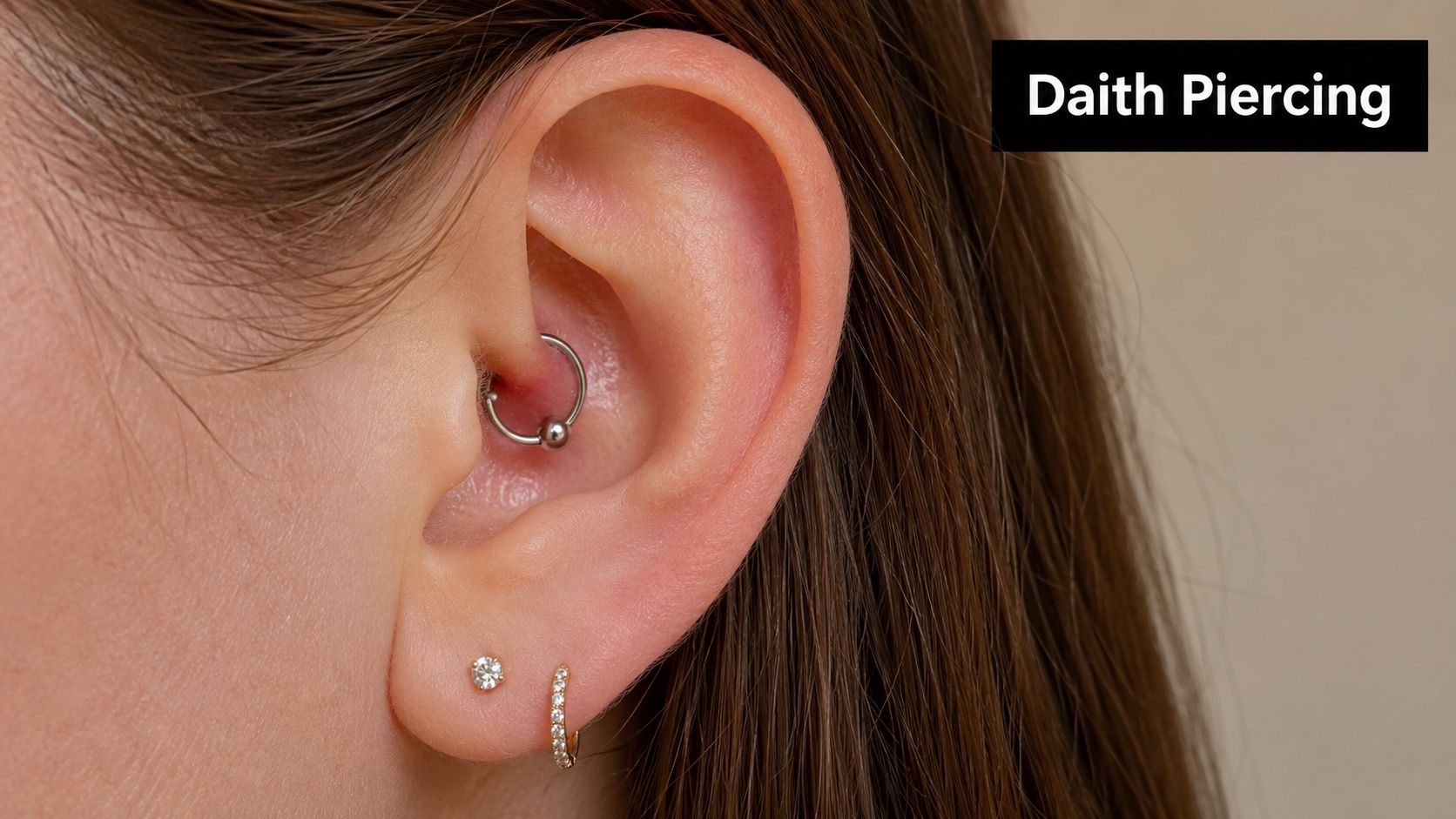
A daith piercing is a cartilage piercing placed in the innermost fold of the ear. More specifically, it goes through the crus of the helix, which is the ridge of cartilage sitting just above the ear canal. If you imagine the ear as a series of curved shelves and folds, the daith sits tucked into one of the deepest inner folds rather than along the outer rim.
That hidden position is part of why people like it. It's noticeable without being loud.
Why placement matters so much
A daith isn't a piercing to leave to guesswork. The piercer has to align the needle through the ear's crus of the helix while taking your individual anatomy into account. Gamma Piercing describes it as requiring “expert placement and attention to anatomy” in its guidance on daith piercings and migraines.
That's the part many search results skip over. They show you the finished ring, but not the decision-making behind it.
A strong daith placement should suit the natural fold of your ear, sit cleanly, and leave enough room for the jewellery to heal without putting poor pressure on the tissue. If the angle is wrong, if the fold is too shallow for the jewellery chosen, or if the piercing is forced because someone wants the look regardless of anatomy, healing becomes harder than it needs to be.
What to look for in a proper consultation
When someone asks for a daith, a good piercer should look at more than the spot itself.
A proper consultation usually includes:
- Anatomy check: not every inner ear fold has enough shape or depth for a safe, attractive daith.
- Jewellery discussion: the initial piece needs to suit both the anatomy and the healing stage.
- Position approval: you should understand where the piercing will sit before anything starts.
- Practical lifestyle talk: earbuds, phone use, sleeping habits, and hair all matter with this placement.
A daith looks subtle when it's healed well. It looks troublesome when it's been placed without enough care.
That's why “near me” shouldn't mean “closest available”. For a daith, it should mean a studio where the piercer knows exactly what they're looking at.
The Migraine Question Straight Answers from Professionals
This is the part many studios soften. We don't.
If you're asking whether a daith piercing is a proven treatment for migraines, the honest answer is no.
The modern daith piercing is traced to 1992, when piercer Erik Dakota is credited with co-creating it in Santa Cruz, California. Published commentary also states that evidence does not support therapeutic use for migraines, and any reported relief is likely anecdotal or placebo-based, as noted in this daith piercing history and migraine discussion.
Why the myth keeps spreading
The migraine claim sounds believable because it gets tied to pressure points and acupuncture-style explanations. That gives it a medical tone, even when the evidence isn't there. Then people repeat personal stories online, and the claim starts sounding stronger than it is.
That doesn't mean anyone is lying about what they felt. It means a personal experience is not the same thing as reliable proof.
Clients often appreciate directness here. If somebody lives with frequent headaches, they deserve better than a piercer nodding along to a claim that hasn't been properly established. A responsible studio shouldn't blur the line between body art and treatment.
What a trustworthy studio should say
A trustworthy piercer should tell you three things clearly:
- It's an aesthetic piercing: choose it because you want the look.
- Relief claims are unproven: don't treat it as a substitute for proper medical advice.
- Health concerns belong with healthcare professionals: if migraines are affecting your life, NHS pathways and medical assessment matter more than a piercing appointment.
The same bluntness applies in consultation. We won't present a daith as a cure, a therapy, or a workaround for ongoing headache issues. If you still want the piercing because you like the style, that's completely fair. We're happy to help with that.
If you want a daith because it suits your ear and your style, that's a solid reason. If you want it because you're desperate for migraine relief, it's better to separate the piercing decision from the medical one.
That honesty matters. It protects clients from disappointment, and it keeps the piercing conversation where it belongs. On safety, suitability, and long-term healing.
Your Daith Piercing Journey From Consultation to Finish
You arrive with a clean ear, a few nerves, and usually one big question. How is this going to go?
For a good studio, the answer should be straightforward. A daith appointment is careful, methodical work. There is nothing theatrical about it, and there should be no sales pitch about migraines, miracle pressure points, or pushing ahead if your ear is not suited to the placement.
What happens on the day
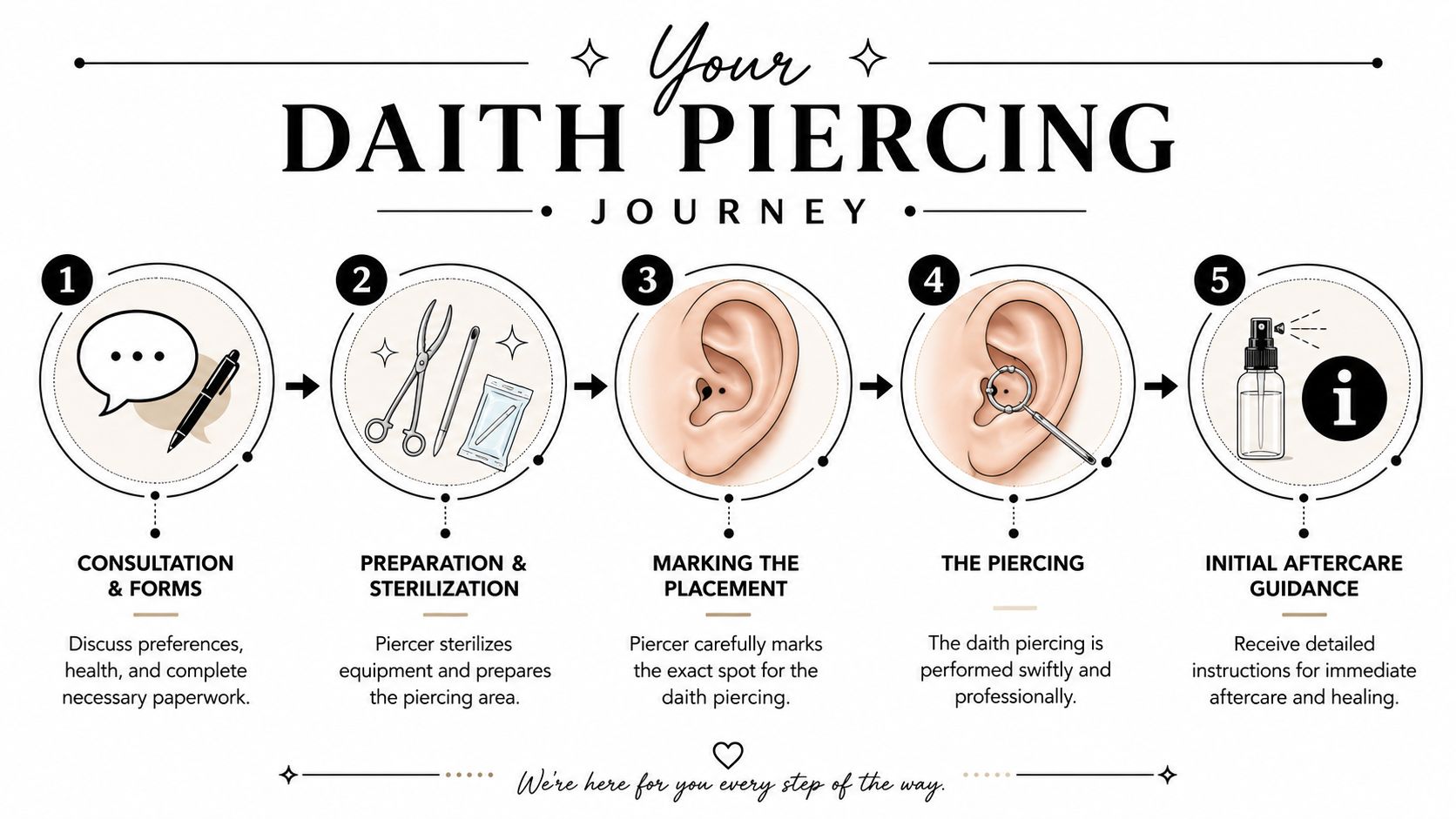
The appointment starts with consultation and anatomy assessment. I look at the fold itself, the depth of the ridge, access for safe placement, and whether suitable jewellery will sit comfortably without excess pressure. Some ears are ideal for a daith. Some are marginal. Some should not be pierced there at all.
Jewellery choice matters early, not later. Initial pieces need enough room for swelling and the right shape for stable healing, which is why the most decorative option is not always the smartest starting point. If you want to compare healed looks before you choose, it helps to browse gold daith jewellery styles for healed piercings so you can separate day-one practicality from long-term style.
Once the plan is clear, the area is cleaned, the placement is marked, and you check the position. Take that check seriously. A daith sits inside the ear, so small placement changes can affect both the look and how the jewellery rests.
The piercing itself is brief. Industry guidance from the Association of Professional Piercers procedure page describes a standard process built around single-use sterile needles, careful jewellery insertion, and immediate review of the finished placement. In practice, the needle pass is over quickly. The appointment takes longer because the careful parts happen before and after that moment.
What it feels like and what matters most
A daith usually feels like a sharp pinch with strong pressure through thick cartilage. Then comes warmth, a bit of throbbing, and heightened awareness of that ear for the rest of the day.
Pain scores are not very useful here. Technique, anatomy, stress levels, and how well the jewellery fits all change the experience. What clients remember most is whether the appointment felt controlled and whether they left confident about what happens next.
| Stage | What you should expect |
|---|---|
| Before piercing | A proper anatomy check, clear jewellery advice, and honest discussion about suitability |
| During piercing | Calm instruction, sterile technique, and a precise needle pass |
| Immediately after | Jewellery fitted correctly, light bleeding or tenderness explained, and the area checked |
| Before you leave | Simple aftercare guidance and clear advice on what is normal versus what needs review |
A strong appointment is not the fastest one. It is the one done cleanly, accurately, and with enough experience to stop the process if your ear is not right for it.
That last point protects people from poor results. A responsible piercer will turn down a daith rather than force one through unsuitable anatomy and leave you with months of irritation.
Healing and Aftercare A Nine Month Timeline
Two weeks after a daith, clients often tell me the same thing. “It felt fine at first, and now it's grumpy.” That does not usually mean anything has gone wrong. It usually means cartilage is behaving like cartilage. It heals slowly, reacts to pressure, and settles in stages rather than in a straight line.
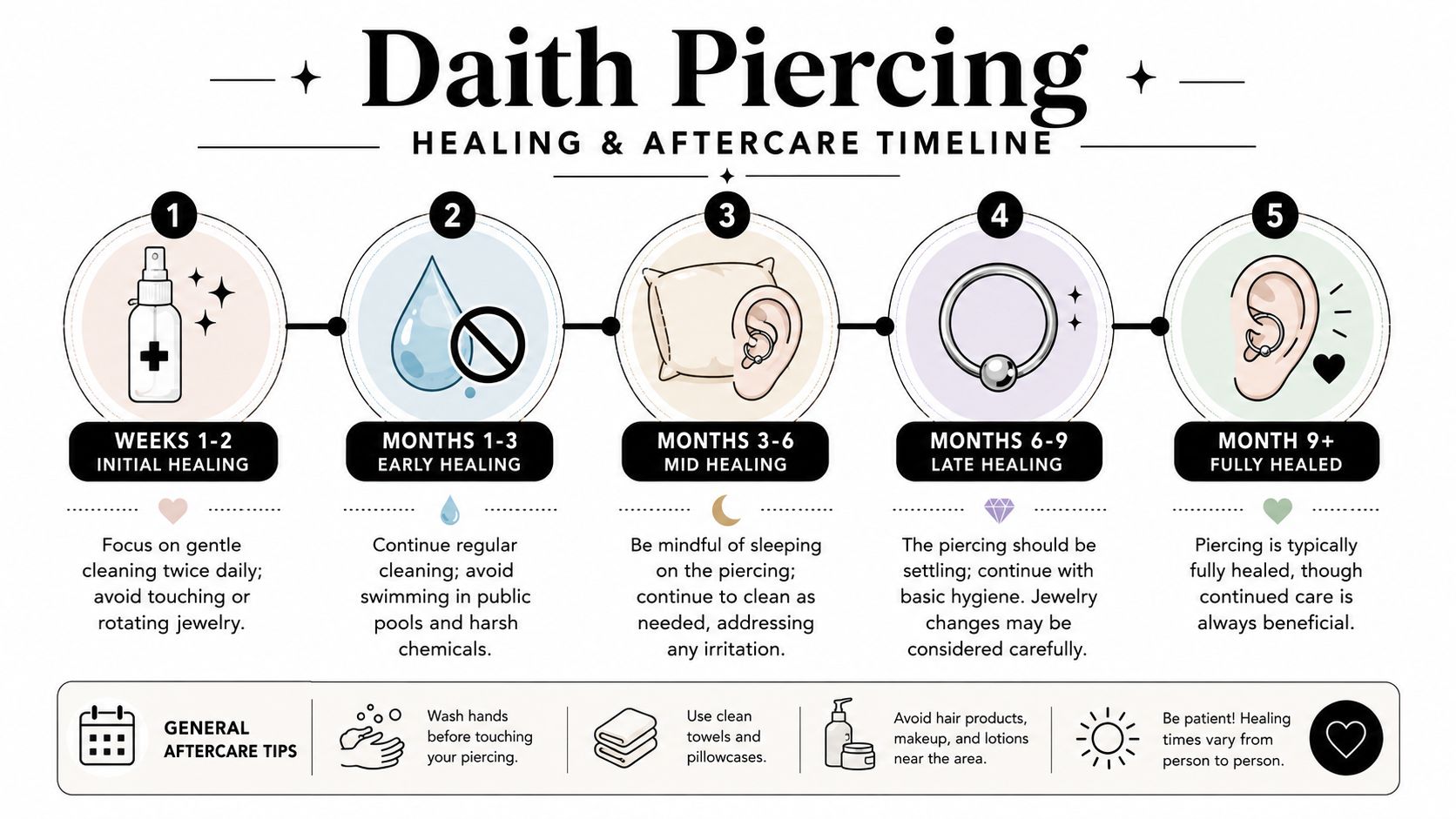
A daith is a long-healing piercing. Full healing often takes many months, and nine months is a reasonable expectation for plenty of clients. Some settle sooner. Some take longer, especially if the area gets knocked, slept on, or irritated by earbuds and constant handling. The piercing itself is quick. The result depends on what happens over the months after it.
What healing usually looks like
The first few weeks are about swelling, tenderness, and getting used to protecting the area. After that, many people assume it is nearly healed because it looks calmer from the outside. That is where impatience causes trouble. Cartilage can look settled well before the channel is actually stable.
A rough timeline helps:
- First month: tenderness, warmth, light swelling, and occasional crusting are common.
- Months two to four: the piercing often looks better but still reacts easily to bumps and pressure.
- Months five to nine: irritation should be less frequent, but the piercing still benefits from a hands-off routine and correctly fitted jewellery.
- Later healing: some daiths continue settling beyond that, particularly if healing has been interrupted.
If you want broader guidance on healing cartilage piercings properly, read that alongside the aftercare sheet from your studio.
Aftercare that actually helps
Good aftercare is boring. That is usually a good sign.
- Use sterile saline sparingly: clean away build-up without soaking the piercing or scrubbing it.
- Keep hands off: no twisting, rotating, or checking it in the mirror with your fingers.
- Reduce pressure: avoid sleeping on that side and be careful with over-ear headphones, phones, towels, and hair.
- Leave the jewellery in place: changing it early creates fresh trauma in tissue that is still forming.
Clients sometimes ask whether extra cleaning will speed things up. It usually does the opposite. Over-cleaning dries the area out and keeps it irritated.
What slows a daith down
The biggest problem is irritation. Not infection. Not mystery. Irritation.
For daiths, the common causes are very predictable. Sleeping on the piercing, using in-ear headphones, catching it while drying your hair, and trying to swap jewellery before the channel is ready all keep the tissue inflamed. Stress, illness, and poor-quality jewellery can also drag healing out.
This is also where the migraine myth causes problems. If someone gets a daith hoping for medical relief, they can miss the practical part that determines the outcome. A daith is not a treatment for migraines. From a piercing point of view, the job is to place it correctly, use suitable jewellery, and help it heal cleanly.
Why reviews matter during the healing period
A proper check-up can save months of hassle. Swelling drops, angles settle, and jewellery that was right on the day may need reassessing later for comfort and healing. That is normal studio care, not a sales tactic.
If the area becomes hot, increasingly painful, very swollen, starts producing thick discharge, or the jewellery feels too tight, get it assessed by your piercer promptly. Do not rely on random online comments, and do not try to fix it at home by removing or changing the jewellery yourself. A calm in-person review usually tells us whether you are dealing with normal irritation, pressure, or something that needs medical advice.
Healing goes best when the piercing is done for the right reason and looked after with patience. Style is a fair reason. Trend is a fair reason. Hoping it will cure migraines is not something any responsible piercer should promise.
Book Your Daith Piercing in Croydon or Bournemouth
If you're ready for a daith, choose the studio for the right reasons. You want an experienced piercer, an anatomy-first consultation, sterile single-use needles, suitable jewellery, and proper aftercare support once the appointment is over.
That's what makes the difference between a piercing you enjoy wearing and one that becomes a long irritation project.
At Timebomb Tattoo & Piercing, clients in Croydon and Bournemouth come in for daiths because they want a careful, well-explained service. Some are first-timers and need reassurance. Some already have several ear piercings and want a more advanced placement done cleanly. In both cases, the standard should be the same. No hype, no pressure, and no pretending a daith is something it isn't.
When to book with confidence
You're in a good position to book when:
- You want the look for the right reason: style first, not medical hope.
- You're happy to commit to healing: cartilage needs patience.
- You want proper assessment: not every daith should be pierced.
- You know where to go if you need support: local aftercare matters as much as the initial appointment.
If you're based on the South Coast, you can also browse body piercing in Bournemouth to see more local service information before you choose your appointment.
For bookings or questions, contact the team directly.
Call us on 01202 900050 (Bournemouth) / 020 8686 7730 (Croydon)
Send a WhatsApp message to 07752 913846 (Bournemouth) / 07902 490584 (Croydon)
If you're comparing studios, browsing jewellery ideas, or trying to book safely with a reputable local piercer, Piercing Near Me helps you explore professional options and connect with Timebomb Tattoo & Piercing in Croydon and Bournemouth.
Trackbacks/Pingbacks