
The popular advice on daith piercing benefits is too neat. Either it's sold as a migraine fix, or it's dismissed as nonsense, and both versions miss the main point, which is that this is first and foremost a cartilage piercing with a cosmetic payoff, a messy evidence base, and some very real healing demands. If you want the honest answer, start here, not on a forum thread or a glossy Instagram caption.
What a Daith Piercing Actually Is
A daith piercing goes through the small inner fold of cartilage just above the ear canal. That makes it very different from a helix piercing on the outer rim or a tragus piercing on the little flap at the ear opening. It sits in a tight, awkward piece of anatomy, which is why the placement looks distinctive and why the healing can be more demanding than a simple lobe piercing.
Think of it less like putting a stud through soft earlobe tissue and more like threading a small hoop through a tiny ridge of tough gristle. That's the right mental model for first-timers. The tissue is denser, the angle matters more, and the jewellery choice has to suit the shape of the fold rather than your favourite aesthetic on Pinterest.
A good piercer should talk you through the exact placement before anything happens. If the daith is marked badly, the jewellery can sit wrong, rub, or never look balanced. That's why this piercing is one of those cases where anatomy comes first and trends come second.
For a style reference, some clients look at gold options before booking, including pieces featured in this gold daith jewellery guide. The material and shape matter because the piercing has to heal around the jewellery, not just sit prettily in the ear.
Practical rule: if the placement conversation is rushed, walk away. A daith should be marked on your ear, not guessed from a photo.
The Benefits People Actually Claim
The daith piercing benefits people talk about usually fall into three buckets, and they're not equal.
Migraine and headache relief
This is the big one. People often say the piercing helped their migraines, eased head pain, or reduced how often attacks came on. That claim has been circulating for years, and the London Migraine Clinic says it's been discussed as an alternative migraine treatment for over 20 years in UK-facing conversations about migraine care, with retrospective surveys involving over 3,000 respondents and about 500 people who had migraines for more than 10 years and had been pierced for more than 12 months (London Migraine Clinic research summary).
That sounds impressive until you separate reported benefit from proof. It's survey-based history, not controlled clinical evidence.
Anxiety and stress
Some clients say the piercing made them feel calmer or helped with stress. That's a reported experience, not a proven treatment. The plausible story people tell is stimulation of pressure points or the vagus nerve, but that idea hasn't turned into reliable clinical evidence. In plain English, some people feel better, but that doesn't make it a therapy.
Aesthetic appeal
This is the strongest benefit by far. A daith can anchor an ear stack, add shape to the inner ear, and give you a focal point without looking overdone. If you already like cartilage jewellery, the visual case is real. If you don't care about the look, the other claimed benefits need to do a lot of heavy lifting, and they usually can't.
What the Evidence Really Shows
The best survey data in the materials is mixed, which is exactly what you'd expect from an anecdotal trend that became a beauty talking point.
In one self-selected survey of 380 patients, 47.2% reported reduced migraine frequency, 49.9% reported less severe attacks, and 4.7% said their symptoms got worse (PMC survey review). Those figures are interesting, but they're not a green light. People who choose to answer piercing surveys are already biased towards having an opinion, and often towards having a strong one.
A newer review indexed in PubMed is blunt about the state of play. It says the available literature and reported recurrence of pain mean current evidence does not support daith piercing for migraine, tension-type headache, or other headache disorders (PubMed review, 2024). The 2017 review in PMC says there were no standard recommendations supporting it because data were limited, and that the American Migraine Foundation does not recommend it because of risks such as infection and pain (PMC review).
That's the split in one sentence. Some people report feeling better, but the medical literature doesn't support treating the piercing as a migraine intervention. A temporary benefit, a placebo response, or a short-lived change in pain perception is not the same thing as a validated treatment.
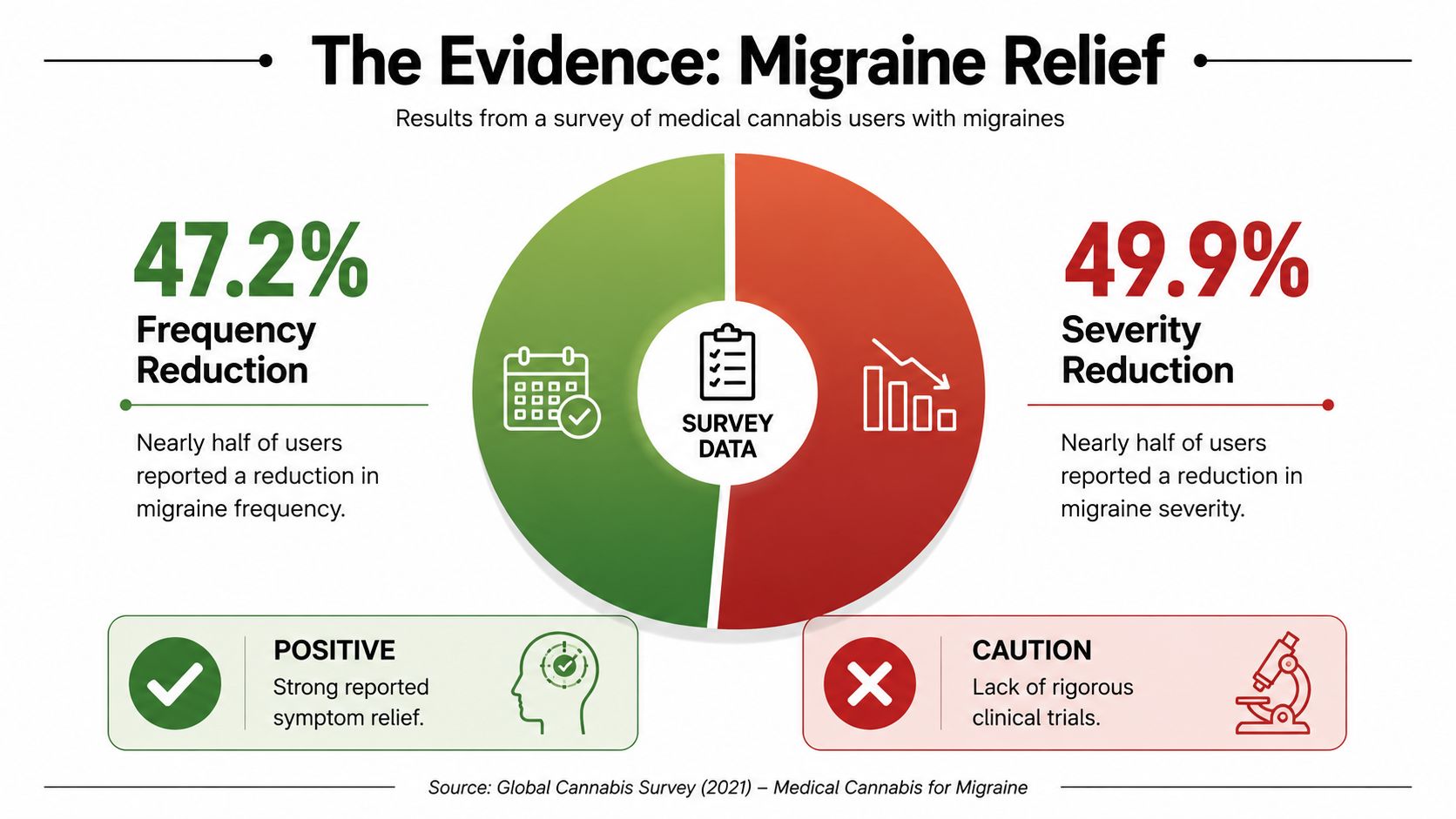
Bottom line: reported relief is real as a personal experience, but it isn't proof of medical effectiveness.
The same logic applies to any claim that the piercing “activates” a special point in the ear. Maybe that helps some people feel something. It still doesn't create the kind of consistent result you'd want before calling it treatment.
Risks, Healing Time and Real-World Aftercare
A daith piercing is not the kind of thing you get and forget about. It's a cartilage piercing, and cartilage is fussier than soft tissue. That means more chance of pain, more chance of irritation, and a longer period where you have to think before you lie down, put on headphones, or brush your hair.
What daily life actually feels like
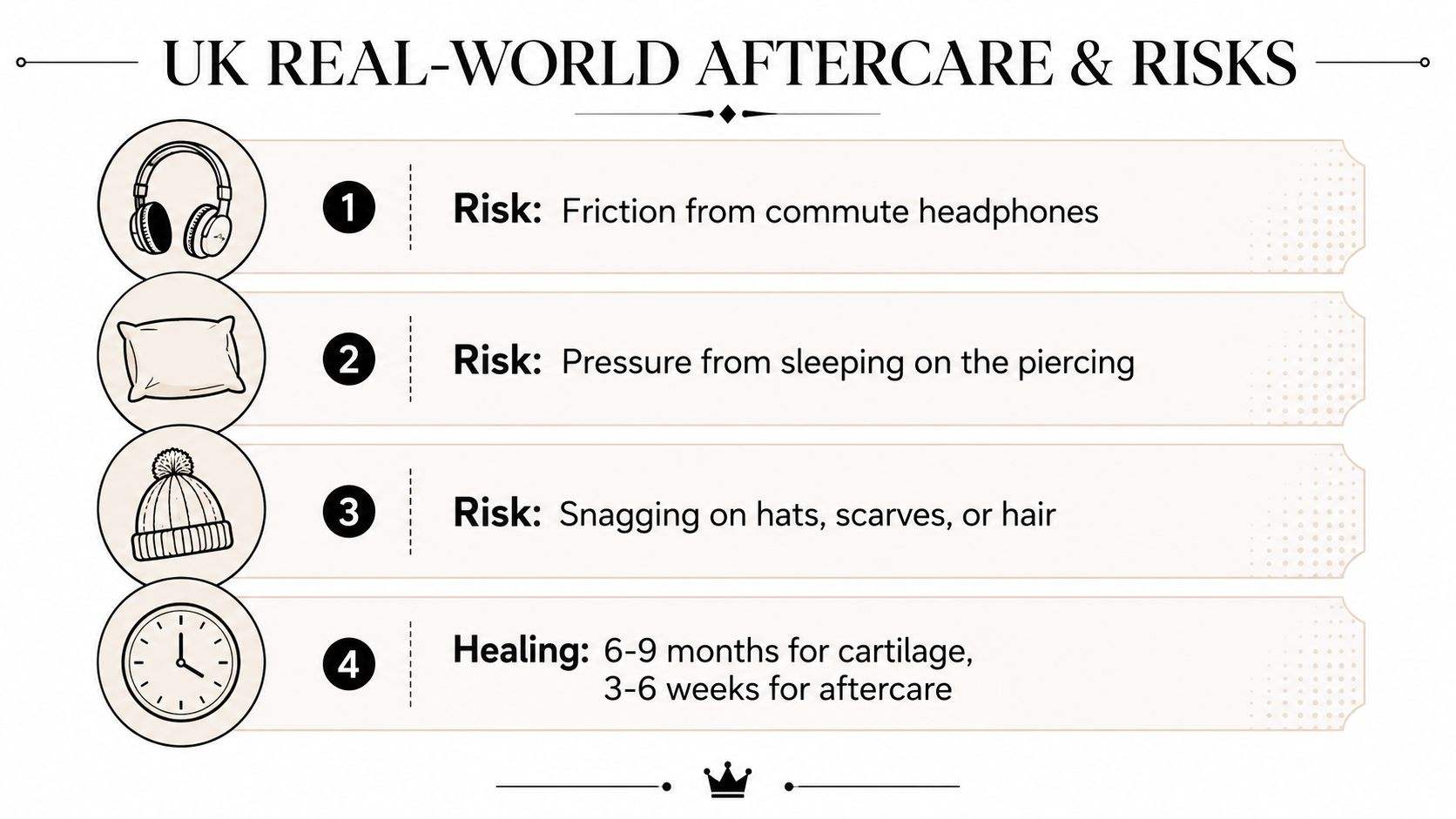
If you commute on the Tube with over-ear headphones, you'll need to notice pressure points fast. If you sleep on that side, you'll annoy the piercing, and a fresh daith does not forgive that kindly. Hats, scarves, and loose hair can all snag it during colder months, and that's when a lot of clients realise healing is not just a studio problem, it's a life-admin problem too.
A realistic healing expectation for cartilage is 6 to 9 months for proper healing, with the early aftercare period often framed as 3 to 6 weeks of especially careful management (American Migraine Foundation aftercare guidance). That's the window where people most often bump it, sleep on it, or get cocky and test earbuds too early.
What to watch for
A sore daith can be normal. A piercing that gets hotter, more swollen, increasingly angry, or starts behaving like it's infected is not something to “wait out”. Cartilage infections are one of the reasons daiths get a bad reputation in the first place.
Here's the blunt aftercare version:
- Don't sleep on it: pressure is one of the fastest ways to prolong irritation.
- Avoid constant twisting: movement doesn't speed healing, it usually annoys the tissue.
- Keep headphones off it early on: friction is a common source of trouble.
- Treat bumps seriously: if a bump appears, don't keep poking at it and hoping it disappears.
If you want a straight answer on discomfort, see this practical guide to daith piercing pain. The important part isn't the number on a pain scale, it's whether you're willing to look after a cartilage piercing properly while it settles.
Choosing a Safe Piercer in the UK
Safety is where a good daith either starts or falls apart. The piercing itself is only half the job. The other half is whether the studio treats cartilage work as precision work, not a quick add-on between ear lobe appointments.
What a competent piercer should show you
Ask for single-use sterile needles, not reusable nonsense. Ask what jewellery they use, and expect implant-grade titanium or solid gold for initial wear, not mystery metal. Ask how their instruments are sterilised, and don't be shy about wanting proof that the autoclave is maintained and tested properly.
A good piercer also shows healed examples, not just fresh, shiny work. Fresh piercings always look neat. Healed placements tell you whether the angle, depth, and jewellery choice worked.
If a piercer is irritated by basic hygiene questions, that's your answer.
What to ask before booking
Use a simple script. Ask whether they've pierced daiths before, whether they'll check your anatomy first, and whether they'll talk you out of a bad fit if your ear shape isn't suitable. The best piercers don't sell every piercing to every ear. They protect the ear first.
If you're comparing local options, find a daith piercer near you and check whether the studio explains aftercare in plain language, not jargon. That matters more than a flashy social feed.
A worked example of good practice
At a serious studio, the booking process should be straightforward. You should be able to ask about placement, jewellery, and aftercare before you turn up. You should leave with clear written guidance, not a vague “just spray it and don't touch it” routine.
For direct enquiries, use 01202 900050 (Bournemouth) / 020 8686 7730 (Croydon) or WhatsApp 07752 913846 (Bournemouth) / 07902 490584 (Croydon) to verify hygiene standards, ask about available jewellery, and check whether a consultation makes sense before you book. If you're near Croydon or Bournemouth, that kind of direct contact saves time and filters out the casual operators.
How Daith Piercing Compares to Alternatives
If you want headache relief, a daith piercing is not the first thing I'd point you to. If you want the look, it might still be the right piercing. That's the difference.
| Option | Mechanism | Evidence | Typical Cost | Healing Time |
|---|---|---|---|---|
| Daith piercing | Claimed pressure-point effect, unproven | Mixed surveys, reviews do not support it as treatment | Varies by studio | Cartilage healing is slow |
| Acupuncture | Needle-based stimulation | Used more widely in migraine care than daith piercing, but response still varies | Varies by practitioner | No piercing wound |
| Common migraine medication | Medical treatment aimed at symptoms or prevention | Established clinical use | Prescription-dependent | No piercing wound |
| Tragus, rook or conch piercing | Cosmetic cartilage placement | Aesthetic only | Varies by studio | Cartilage healing is slow |
A migraine sufferer who wants to test the “pressure point” theory is better off discussing acupuncture or conventional migraine care first. That gives you a reversible, medically supervised route before you commit to a permanent cartilage piercing. A style-led client, on the other hand, may prefer a daith because the placement is bolder and visually distinctive than many other inner-ear options.
What daiths are not is a magic shortcut. They sit in the same cosmetic category as other cartilage piercings, even if people attach extra meaning to them.
Who a Daith Piercing Is Actually For
Get a daith piercing if you want the look and you're ready for cartilage healing. That's the cleanest recommendation. The style case is strong, the placement is distinctive, and if you love curated ear jewellery, the result can be excellent.
Be cautious if you're chasing migraine relief and you've run out of patience with everything else. The reports of benefit exist, but the evidence doesn't justify calling it treatment. If you still want to try it, treat it as a personal experiment with uncertain payoff, not a medical plan.
Don't get one if you're looking for a guaranteed fix. That mindset leads to disappointment, and disappointment makes people mistreat the piercing when it doesn't perform like a miracle.
My advice is simple. Research the piercer, book a consultation, plan your aftercare around sleep, headphones, and cold-weather snagging, then look at the piercing again at the six-month mark. If you still love the look and the healing has gone well, you made a good choice. If you were only in it for the promise of relief, the evidence hasn't earned that decision.
If you're ready to talk through whether a daith is right for your ear, your lifestyle, and your expectations, contact Piercing Near Me today and book a proper consultation.
Trackbacks/Pingbacks