
You've woken up with a tender nose, a little dried fluid around the jewellery, and the sudden worry that every ordinary habit might ruin the piercing. You're not alone. Most first-time clients expect a short cleaning routine, but a healing nose piercing is better understood as a contamination-control job lasting several months, not a chore that ends after a fortnight.
Good aftercare is deliberately uneventful. You clean it consistently, reduce friction, keep products and questionable water away, and resist the urge to adjust jewellery that looks slightly untidy. Current UK nose-piercing saline guidance commonly places nostril healing at three to six months, while septum piercings are often given a shorter healing window of four to six weeks. Your routine should match the placement, not a generic social-media checklist.
What the First Six Months Aftercare Actually Involves
On the first day, your nose may feel warm, tight, or bruised. A small amount of dried plasma around the jewellery is expected while the fresh channel begins to settle. The mistake is treating that residue as dirt that must be scrubbed away. Aggressive cleaning can create more swelling and tenderness than the original piercing.
During the first week, the useful routine is simple: clean with sterile saline in the morning and evening, soften any crust before removing it, and keep your hands away at other times. The jewellery doesn't need constant inspection. It needs a calm environment while the channel forms around it.
Practical rule: A clean piercing that's repeatedly knocked, twisted, or covered in cosmetics can struggle more than one that's gently cleaned and then left alone.
Why healing feels uneven
Nostril tissue often settles unevenly. One day the area can look calm, then a pillow seam, towel, face covering, or accidental touch can cause renewed crusting. That doesn't automatically mean infection. It usually means the piercing has been irritated and needs less friction, not stronger products.
The longer window matters because the outside can look healed before the inside has finished strengthening. UK professional advice commonly treats nostrils as slower-healing than many ear piercings, often allowing three to six months for healing, as described in UK nostril aftercare guidance. Septum care can become lower intervention sooner, particularly when the jewellery sits comfortably in the soft tissue and there's no visible build-up.
From around the six-week point, a professional may assess whether a nostril post needs downsizing after swelling has reduced. Current UK aftercare advice has moved away from routine jewellery rotation and towards saline cleansing with minimal handling. Your job isn't to monitor the piercing every hour. It's to maintain a consistent routine and remove the everyday causes of contamination and snagging.
The Twice-Daily Saline Cleaning Routine
Use a sterile 0.9% sodium chloride wound wash, ideally in a pressurised can, rather than a fragranced antiseptic or homemade mixture of uncertain strength. If sterile saline isn't available, a traditional option is one quarter of a teaspoon of non-iodised sea salt dissolved in 250 ml of warm, previously boiled water, but a properly made sterile product is easier to keep consistent.
You'll also need clean non-woven gauze or fresh kitchen roll. Cotton wool is a poor choice because loose fibres can cling to the jewellery and healing tissue.
A calm morning and evening method
- Wash your hands thoroughly. Don't touch the jewellery with unwashed hands, even if you're only planning to move it slightly.
- Apply the saline. Spray the front and back of the piercing, or soak clean gauze with the solution.
- Soften the crust. Hold the damp gauze gently against the area for sixty to ninety seconds. This loosens dried material without scraping the channel.
- Remove only what has lifted naturally. Wipe around the piercing lightly. Don't drag the jewellery through the tissue or pull attached crust away.
- Rinse with fresh saline. This clears softened residue from the skin and jewellery.
- Pat completely dry. Use fresh disposable paper towel or gauze. Dampness trapped around the site can encourage irritation.
Repeat the routine morning and evening, particularly during the early healing period. UK public-health guidance for body piercing supports cleaning the implant twice each day, and this UK body-piercing toolkit gives the same frequency.
For a ready-made option, you can compare a sterile saline spray for piercing aftercare and choose a product with a clear ingredient label.
Do not twist, rotate, or push the stud through the channel.
Rotation was included in some older consumer instructions, but current UK professional guidance generally advises leaving jewellery alone. Twisting can tear delicate healing tissue, transfer contaminants from the jewellery surface, and prolong irritation. Keep the jewellery in place while cleaning. Removing it during healing can allow the channel to narrow or close and may make clinical assessment more difficult.
Septum Versus Nostril How Healing Changes the Routine
A nostril piercing and a septum piercing may sit close together, but they don't present the same healing problem. A nostril usually passes through the alar tissue and remains exposed to glasses, masks, towels, pillow seams, skincare, and accidental face-touching. A correctly placed septum normally passes through the softer membrane in the natural “sweet spot” behind the columella, rather than through the thicker cartilage.
That anatomical difference changes how much intervention helps. Nostril care usually benefits from a consistent twice-daily saline routine across its longer healing window. Septum care often becomes lighter once the area is clean and comfortable. Many UK-facing recommendations say the inside of the nose is self-cleaning, so a septum can often be left alone unless visible build-up needs gentle saline removal.
The jewellery and the risk are different
Nostril piercings are commonly fitted with an L-bar or a flat-back labret, depending on anatomy, jewellery preference, and the piercer's assessment. Septums are often fitted with a circular barbell or a ring. The jewellery shape affects movement, snagging, and how easily you can clean around it, but it doesn't make twisting acceptable.
| Factor | Nostril Piercing | Septum Piercing |
|---|---|---|
| Typical UK healing guidance | Often three to six months | Often four to six weeks |
| Main exposure | Cosmetics, glasses, masks, towels, bedding, snagging | Internal nasal build-up and unnecessary handling |
| Routine | Sterile saline twice daily, with careful drying | Leave alone when clean, use saline for visible build-up |
| Jewellery examples | L-bar or flat-back labret | Circular barbell or seamless ring |
| Common error | Treating it as healed too early | Over-cleaning or repeatedly flipping and adjusting it |
The comparison is not a licence to ignore a septum. Pain, increasing swelling, heat, or unusual discharge still needs attention. It prevents a common mismatch: applying intensive nostril cleaning to a septum that doesn't need repeated handling, while giving a nostril too little care because both piercings are labelled “nose piercings”. For more context on the shorter healing pattern, see this septum piercing healing-time guide.
Everyday UK Exposures That Slow Healing
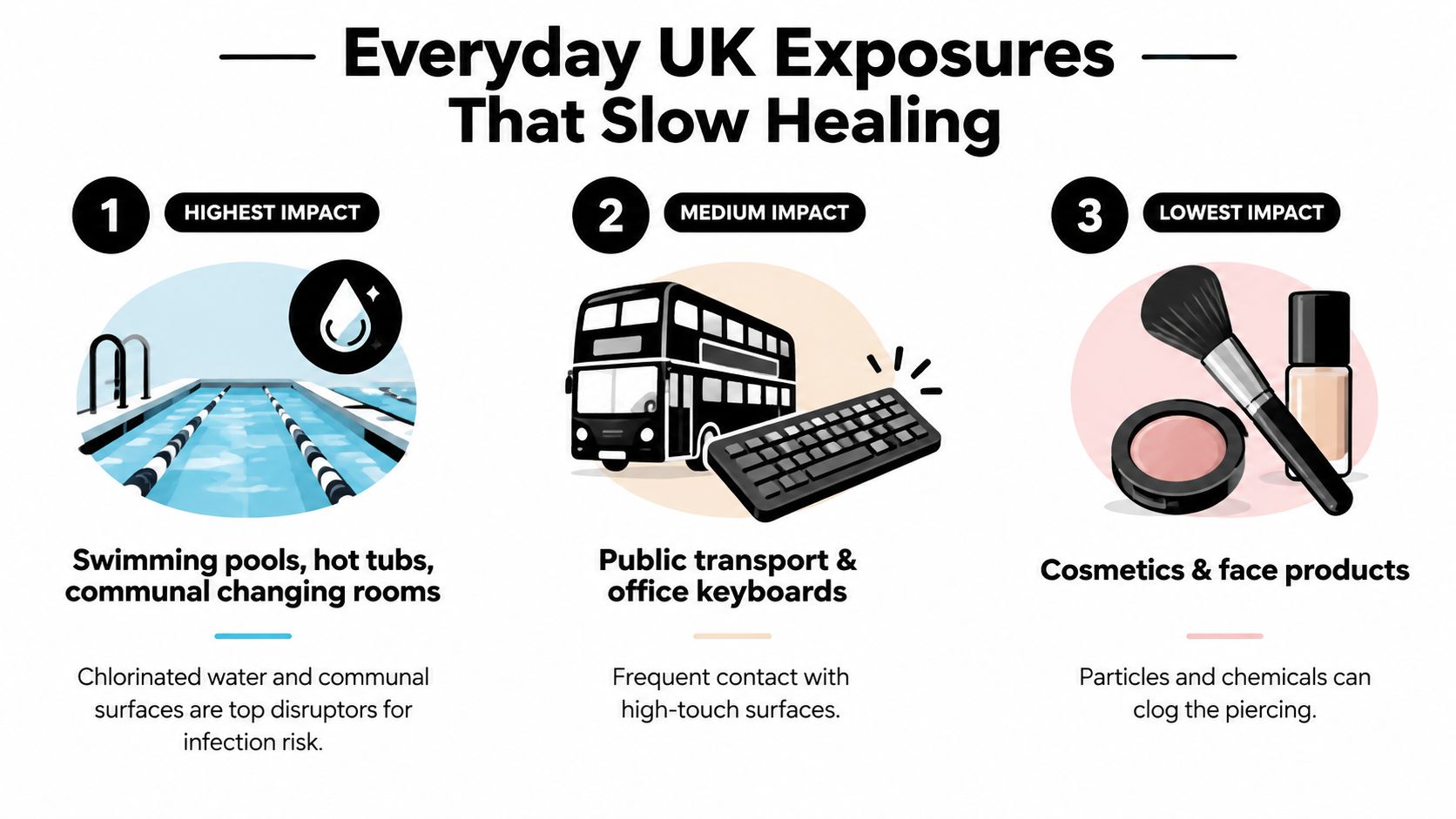
A fresh piercing can look settled while remaining vulnerable to contamination. The practical question is not whether you cleaned it this morning, but what repeatedly reaches or irritates it during the next six months. UK routines create several avoidable exposures, particularly around swimming, commuting, seasonal weather, and water quality.
Swimming and changing facilities
Pools, hot tubs, lakes, and the sea all create problems for a healing piercing. Chlorinated water is not sterile, while shared wet surfaces and natural water introduce further contamination routes. Changing rooms also leave you handling clothing and bags in a damp environment before touching your face.
Avoid swimming while the piercing is fresh, rather than relying on a waterproof covering. If swimming is part of your work, training, or family routine, plan the appointment around that interruption. The UK saline and swimming aftercare advice also recommends keeping swimming away from the early healing period.
Cosmetics, weather, and water
Foundation, concealer, SPF, retinoids, exfoliating acids, and fragranced moisturisers can enter the piercing channel. Apply skincare around the site and keep makeup away from the jewellery. Do not use cosmetics to disguise redness that is becoming more pronounced.
Cold, wet weather brings a different set of problems. Rainwater, damp scarves, and condensation around a face covering can leave the area wet for longer. In hot weather, sweat from cycling, running, or crowded public transport can sit around the jewellery. Rinse away visible residue with sterile saline, then dry carefully rather than repeatedly scrubbing.
Hard water can leave mineral residue on skin and jewellery, especially after washing. It does not automatically mean the piercing is infected, but repeated residue can encourage rubbing and over-cleaning. Let the area dry, remove only loose build-up, and avoid adding household products to compensate.
Commuting and background contamination
Phones, hands, helmets, and travel cards pass through many shared surfaces during a normal UK commute. Keep hands clean before any necessary contact, wipe phones regularly, and prevent damp clothing or equipment from pressing against the piercing. If a gym session or journey leaves the area sweaty, a saline spray can help, but it does not replace the morning and evening routine.
The aim is fewer contamination events and less irritation across the whole healing window. Avoiding every ordinary activity is unnecessary. Change the routines that repeatedly wet, contaminate, or disturb the site, and leave a calm piercing alone between scheduled care.
Signs of Infection and When to Contact a Piercer or GP
Fresh piercings can be mildly red, tender, itchy, or crusty. Clear or pale lymphatic fluid can dry around the jewellery, especially after sleeping or bathing. Those signs can fit ordinary healing when they remain limited and gradually settle.
Infection looks different because the condition worsens rather than fluctuates after a minor knock. The NHS guidance on infected piercings identifies concerning symptoms including swelling, pain, heat, marked redness or darkening, and green, smelly discharge. Treat those changes as a clinical issue, not a reason to experiment with harsh cleaning products.
| Symptom | Normal Healing | Contact GP or Piercer |
|---|---|---|
| Redness | Mild and localised | Spreading or becoming markedly red or dark |
| Fluid | Clear or pale lymphatic fluid | Thick yellow or green discharge, particularly with a foul smell |
| Pain | Tenderness that gradually eases | Hot, throbbing, or worsening pain |
| Swelling | Mild swelling that settles | Increasing swelling, jewellery embedding, or a tight bar |
| General health | You otherwise feel well | Fever or swollen lymph nodes near the jaw or neck |
| Jewellery position | Stable and comfortable | Migration, rejection, or pressure from an unsuitable fit |
Choose the right professional
Contact your piercer promptly if the jewellery feels too tight, begins embedding, shifts position, or develops an irritation bump. A piercer can inspect placement, angle, jewellery size, and mechanical pressure. They can't diagnose a spreading infection or prescribe antibiotics.
Contact a GP promptly if the site is hot, increasingly painful, markedly swollen, producing green or foul-smelling discharge, or if you feel feverish or unwell. NHS advice states that infected piercings are commonly treated with antibiotics, with creams used for minor cases and tablets for more serious infections.
Leave the jewellery in place unless a clinician tells you to remove it. Taking it out can allow the surface to close while bacteria remain inside the channel. If you're unsure whether the problem is irritation or infection, send clear photographs to your piercer while arranging medical advice rather than squeezing, draining, or rotating the jewellery. This piercing infection guide can help you organise what you're seeing before you make contact.
Healing Milestones From Day One to Six Months
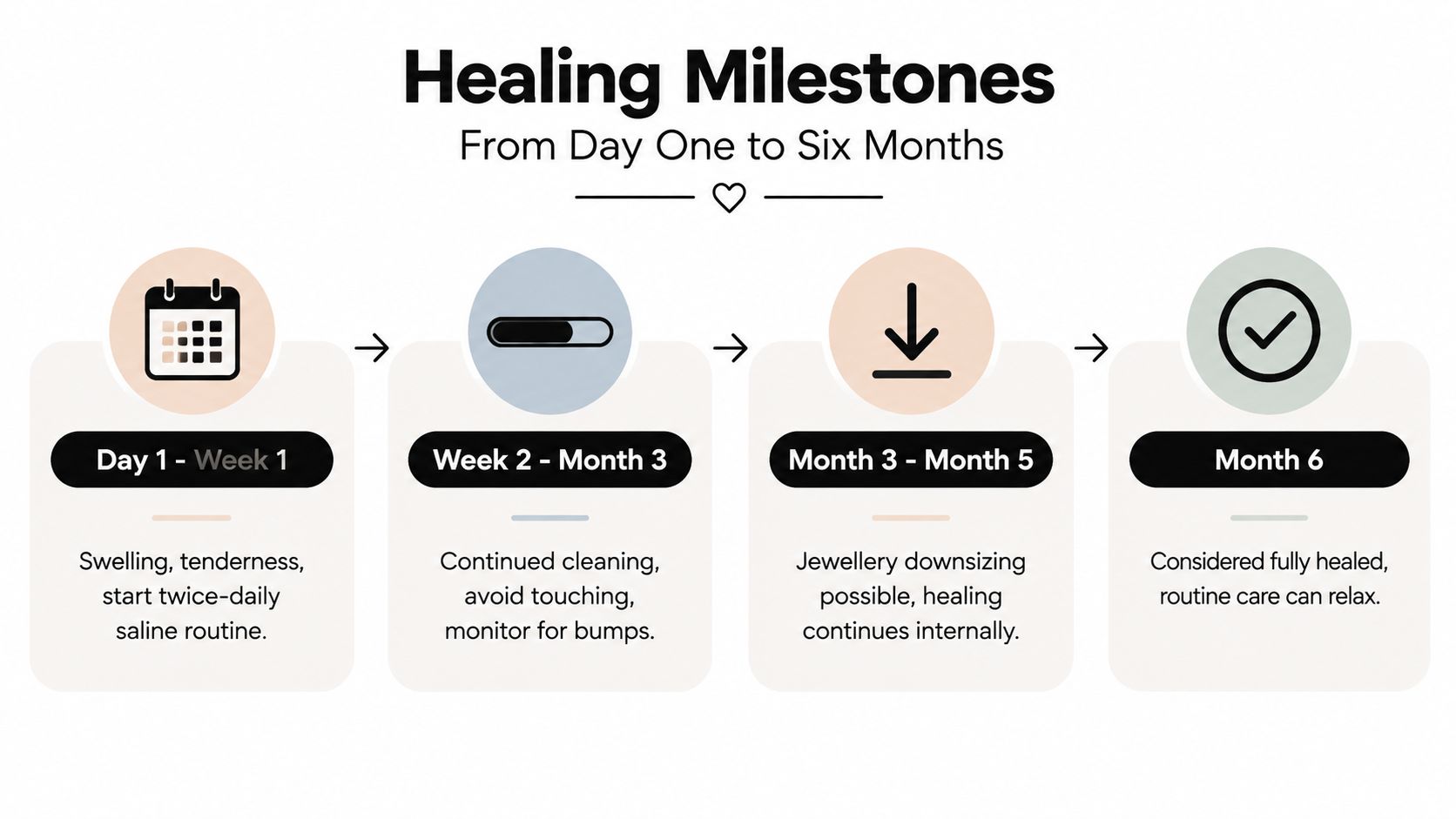
Healing is not a straight line. During the first stage, protect the fresh wound from contact and contamination. Later, the main task is reducing pressure and snags while the internal channel strengthens. A piercing may look calm externally and still flare after being caught or exposed to a product.
A realistic planning timeline
- Day one to week one: Tenderness, local swelling, and dried plasma are common. Start sterile saline care twice daily. Keep hands, cosmetics, and unnecessary jewellery movement away from the site.
- Weeks two to four: Soreness may ease while crusting continues. A quieter surface does not mean the channel has finished healing. Continue gentle cleaning and address repeated snags, pressure from sleep, or contact with towels and clothing.
- Around week six: Book a professional review, especially for a nostril. Once swelling has settled, the piercer can check the angle, jewellery fit, and whether downsizing the post would reduce pressure or snagging. This review should be based on how the piercing looks and behaves, not on the calendar alone.
- Months two to three: The piercing may feel stable but remain fragile internally. Keep contamination control consistent, and do not test it by changing jewellery or returning casually to swimming.
- Months four to six: Many nostrils become much more settled during this wider window, although bumps and repeated irritation can extend healing. A well-placed septum may feel comfortable sooner with low-intervention care, provided there is no persistent tenderness, discharge, or visible build-up.
The pace depends on anatomy, jewellery fit, placement, health, and repeated trauma. Cartilage and surrounding tissue remodel slowly, so a calm exterior cannot confirm permanent healing. Persistent symptoms, recurring irritation, or jewellery that no longer fits as it did initially justify a professional assessment. For further practical context, see this guide to professional nose-piercing aftercare.
Quick Recap and Booking Your Next Appointment
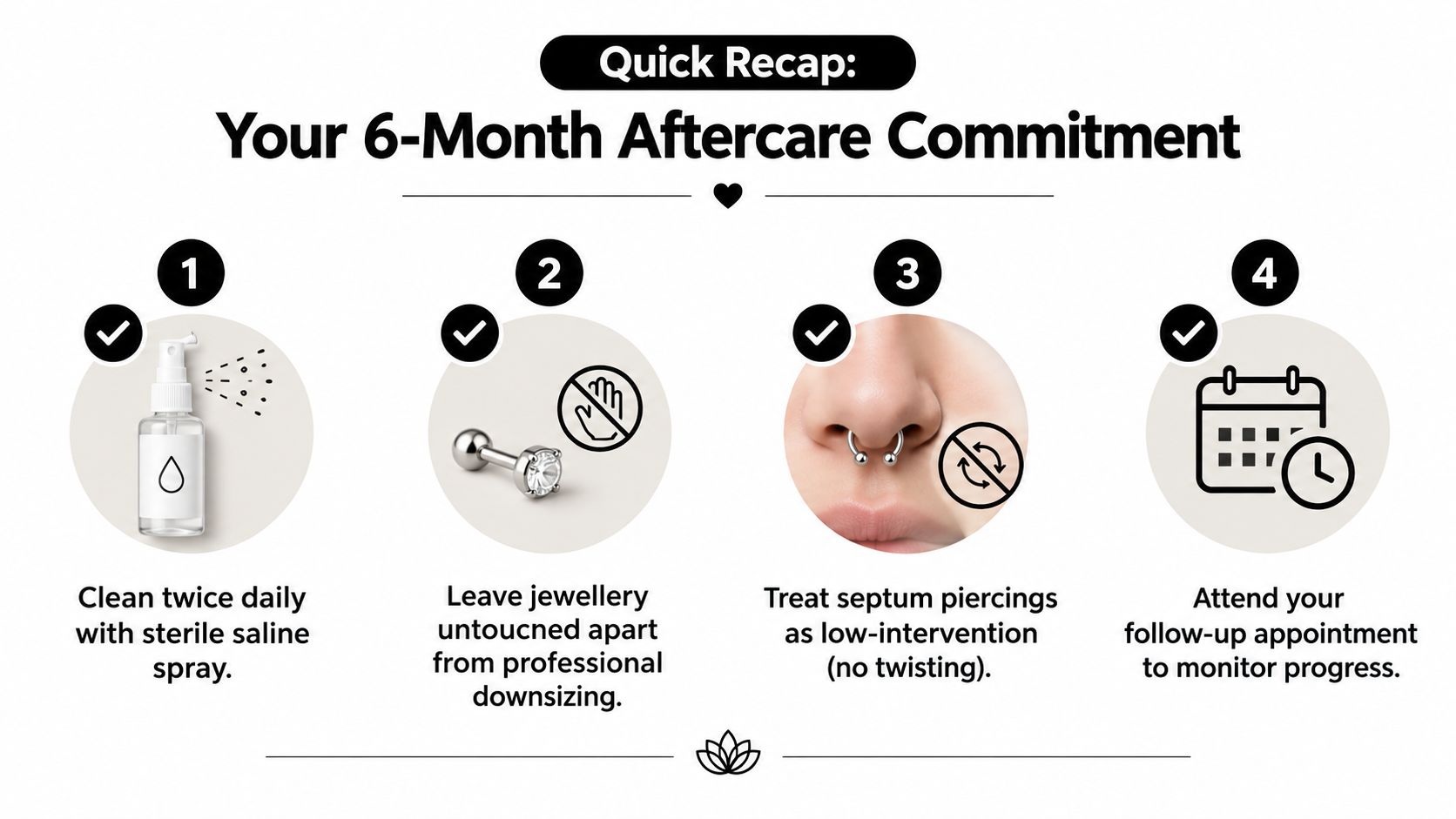
For a nostril, think in terms of six months of contamination control. Clean with sterile saline twice daily, dry it properly, leave the jewellery alone apart from professional adjustments, and keep swimming water, cosmetics, skincare, towels, masks, glasses, and bedding from creating repeated problems. For a septum, use a lower-intervention approach when there's no visible build-up, because unnecessary handling can create the irritation you're trying to prevent.
The most avoidable mistake is twisting or rotating the stud. The most underestimated one is sleeping directly on a fresh piercing, especially when a pillow seam catches the jewellery or presses it sideways. A travel pillow can create a gap around the nose and make sleep less disruptive without requiring you to change your entire routine.
Book reviews before problems become habits
Arrange a check with your original piercer around six weeks so they can assess swelling, angle, and whether a nostril post needs downsizing. If the nostril continues to flare, arrange another review around twelve weeks rather than repeatedly changing products at home. A six-month review is sensible before you treat a nostril as fully healed, especially if it has experienced bumps, snags, or recurring crusting.
A monthly photograph in consistent lighting can help you notice gradual changes in angle, swelling, or jewellery position. Keep your piercer's contact details and your local NHS service details accessible, so you aren't searching while the area is painful or changing quickly.
The wider UK hygiene context matters too. GOV.UK infection-prevention guidance for tattooing and body piercing provides a national standard-setting framework for local authorities and businesses, including hygiene and cross-contamination control. Choose a professional studio that can explain its sterile technique, jewellery materials, placement decisions, and aftercare clearly. For direct questions, our phone number is 01202 9000 50, and our WhatsApp number is 07752913846.
Piercing Near Me helps you find professional piercing services in Croydon and Bournemouth, with consultations, appointments, walk-ins, implant-grade jewellery, and personalised aftercare guidance. Visit Piercing Near Me to explore suitable studios, plan your nose piercing, and arrange support for the healing period.