
“Just clean it more” is often the worst advice for an ear piercing itchy problem. Scrubbing, twisting, and adding stronger products can keep a healing channel irritated, while the cause may be jewellery metal, pressure, trapped product, or infection. The useful question isn't only how to calm the itch. It's what pattern the itch is showing you.
A mild itch that comes and goes can be part of normal healing. Persistent itching with flaky redness may point towards nickel allergy or allergic contact dermatitis, while increasing heat, pain, swelling, or pus needs medical attention. Use the guide below as a calm decision tree, and remember that an itch is information, not proof that your piercing has failed.
When a New Piercing Will Not Stop Itching
Three weeks after a fresh helix piercing, the initial swelling has finally eased. The ear looks less dramatic, but the itch has arrived, especially at night when there's nothing else to distract you. You catch yourself reaching towards it, then worry that the constant urge to scratch means something has gone wrong.
That situation is common, and itching alone doesn't tell you which problem you're dealing with. A new piercing is repairing a small wound, so some intermittent itch can be expected. At the same time, persistent symptoms may come from irritation, contact allergy, or infection, and each one needs a different response.
Start by observing rather than reacting. Ask yourself when the itch began, whether it stays close to the piercing or spreads across the surrounding skin, and whether the ear is becoming hotter, more swollen, or more painful. Also check whether the jewellery touches the irritated area tightly, catches on hair, or presses against the ear while you sleep.
Practical rule: An itch that is mild and improving deserves gentle aftercare. An itch that is worsening, spreading, or joined by pain, heat, or coloured discharge deserves professional advice.
A new piercing can remain tender, itchy, and slightly red for a few weeks, according to Torbay Council's UK ear-piercing aftercare guidance. The important detail is the direction of travel. If the ear gradually settles, healing is more likely. If the symptoms escalate or return whenever a particular earring is worn, the jewellery may be the problem rather than a lack of cleaning.
How Ear Piercings Heal and Why They Itch
Healing happens through overlapping stages, rather than one clean switch from “fresh” to “finished”.
The three healing phases
Inflammation begins immediately. The body sends fluid and immune cells to the area, which can create mild tenderness, warmth close to the hole, and a small amount of clear or pale crust.
During proliferation, the body builds new tissue around the piercing channel, also called the fistula. New skin and connective tissue gradually line and strengthen that channel. Itching can become noticeable here because the body is actively repairing the area.
Remodelling is the slower phase. Collagen reorganises and the tissue gains strength, but the piercing can still feel sensitive when it catches, gets knocked, or experiences pressure. Itching during this stage doesn't automatically mean infection. It may mean the tissue isn't finished adapting.
Lobe and cartilage timelines are different. A lobe may look settled after several weeks, but the inside can remain vulnerable for longer. Cartilage piercings, including helix and conch placements, commonly need six to twelve months or longer to heal, as described in UK-oriented cartilage aftercare guidance from Timebomb Bournemouth.
Treat the sensation as a signal to check the surrounding conditions. A mild, occasional itch with no worsening redness or discharge is usually less concerning than an itch that becomes intense, constant, and paired with a visible rash. That baseline makes it easier to sort normal remodelling from a reaction that needs a change in jewellery or medical review.
Four Common Causes of an Itchy Ear Piercing
The same word, “itchy”, can describe four different situations. Use the pattern, not the sensation alone, to decide what deserves attention.
| Cause | Itch Character | Skin Signs | Discharge | Telltale Clue |
|---|---|---|---|---|
| Normal healing | Mild and intermittent | Slight pinkness or light crusting | None, or clear healing fluid | It gradually settles |
| Irritation | Persistent or easily re-triggered | Tenderness, dryness, or a small irritation area | Usually absent | Pressure, friction, products, or sleeping position |
| Contact allergy | Intense and persistent | Red, flaky, weeping, or crusted skin around the contact area | Usually absent, though weeping may occur | The rash follows jewellery contact |
| Infection | Itch with increasing soreness | Heat, swelling, redness, and tenderness | Yellow or green discharge, or pus | Symptoms worsen rather than settle |
Normal healing
Healing itch is usually mild, occasional, and localised. The skin may look slightly pink, and a small amount of light crust can occur as the channel repairs itself. It shouldn't steadily intensify.
Irritation
Irritation often follows a physical trigger. Sleeping on the ear, a tight backing, a hoop that moves too freely, headphones, hair, shampoo, or repeated touching can keep the area unsettled. The ear may feel tender or dry without the spreading warmth and pus associated with a more serious problem.
Contact allergy
Allergic contact dermatitis tends to be more intensely itchy. Redness, flaking, weeping, or crusting may extend beyond the piercing hole and match the area touched by the jewellery. Nickel is a common trigger, and the British Society of Cutaneous Allergy nickel advice recommends avoiding nickel-containing products on the skin in future.
Infection
Infection becomes more concerning when itch arrives with increasing pain, heat, swelling, spreading redness, or coloured discharge. Cartilage infections deserve particular care because Pseudomonas aeruginosa perichondritis is a recognised complication of cosmetic ear piercing, according to NHS guidance on infected piercings.
These causes can overlap. The most overlooked hidden culprit is often the jewellery itself.
Could Your Jewellery Be the Underlying Cause
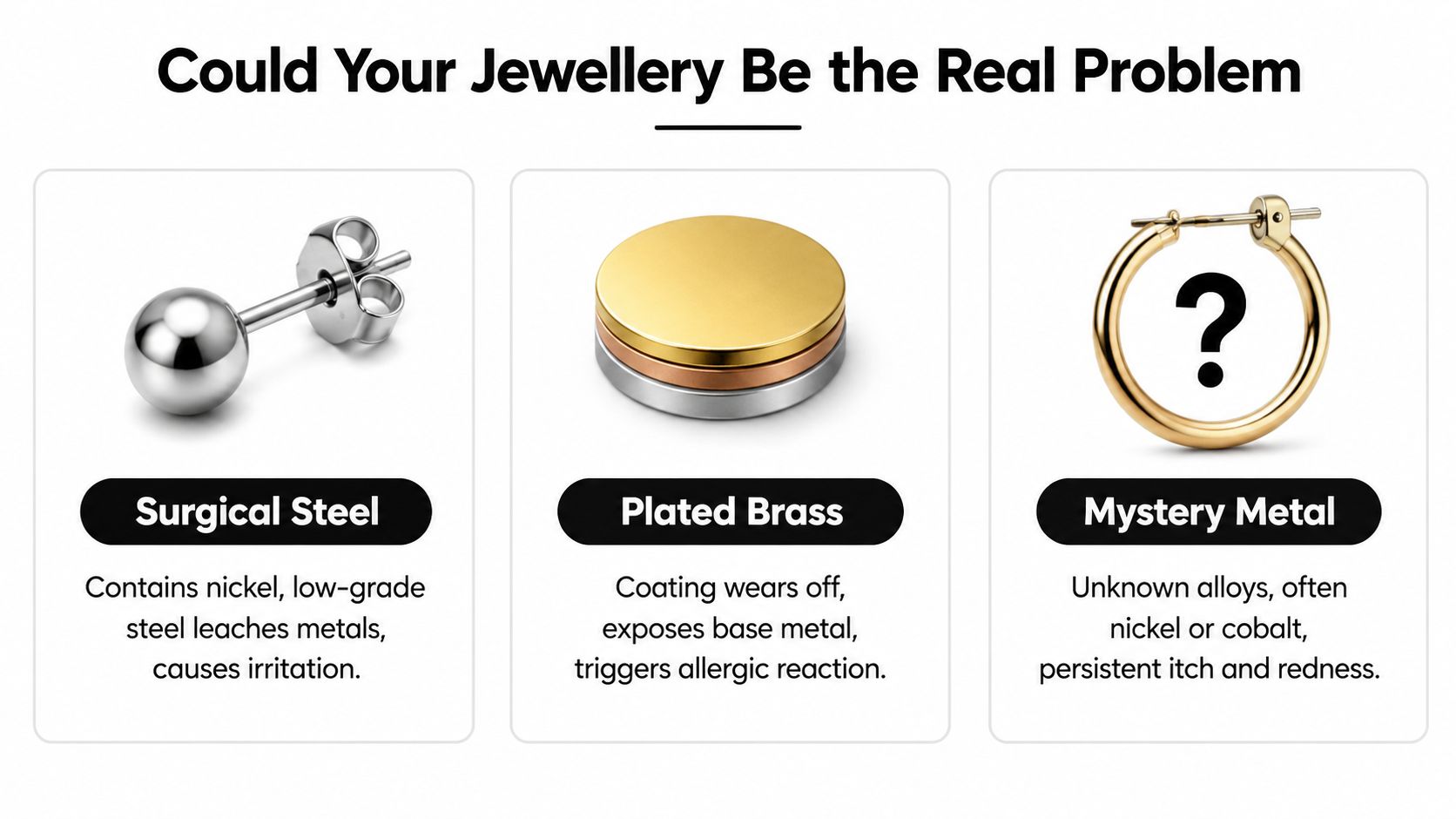
Persistent itch does not always mean you need to clean more. Extra rinsing, wiping, and rotating can keep injuring the channel while the earring continues exposing your skin to a triggering material. Treat the pattern as a decision tree: first ask whether the itch is mild and settling, then check whether the rash follows the jewellery, and finally consider whether pressure or movement is keeping the area irritated.
Nickel deserves particular attention. UK rules limit nickel release from post assemblies to below 0.2 micrograms per square centimetre per week. For sensitive ears, Allergy UK identifies 18-carat gold, solid silver, and platinum as generally safer alternatives. A metal label alone may not tell you enough, so ask what the piece is made from.
Look for signs that point away from ordinary healing:
- Persistent itch: The sensation stays intense rather than gradually easing.
- Contact-shaped rash: Red, flaky, or weeping skin appears where the jewellery touches.
- Delayed reaction: Symptoms begin after the piercing first seemed comfortable.
- Repeated flares: Heat, sweat, or the same jewellery repeatedly brings the symptoms back.
A metal reaction can resemble poor healing, especially when an earring is described only as “steel” or “hypoallergenic.” Known tolerated jewellery gives more useful information than either label. Implant-grade titanium, niobium, or suitable solid gold may be options to discuss with a trained piercer, particularly if earrings have caused problems before. The piercer can also check whether the post is too long, too short, or pressing against tissue.
Do not rotate the jewellery to spread cleaning solution through the channel, or use alcohol, peroxide, or thick ointment to overpower the itch. If you need help comparing materials, review these hypoallergenic earrings for sensitive ears with a qualified piercer before making a change.
If the ear is significantly swollen or painful, leave the jewellery in place and seek medical assessment before any change.
Safe Ways to Soothe the Itch at Home
Home care should be gentle and boring. The goal is to remove triggers without disturbing the healing channel.
Start with a simple routine
- Wash your hands before touching near the piercing.
- Use sterile saline according to the product directions, commonly as a gentle rinse or short soak. A suitable saline spray for piercings can help remove residue without the harshness of household disinfectants.
- Rinse away products after showering. Shampoo, conditioner, hairspray, and styling products shouldn't sit around the jewellery.
- Pat dry carefully with clean disposable material or allow the area to air dry. Avoid rubbing.
- Keep pressure away by using a travel pillow so the ear rests in the central opening rather than against the fabric.
Cleaning harder isn't a substitute for identifying the cause. Alcohol and hydrogen peroxide can dry and irritate the skin, while antibiotic ointments may trap moisture and create further sensitivity. Mild antibacterial solutions or soaps should only be used if needed, and Torbay Council advises stopping if they cause irritation, redness, or drying.
Remove the behaviours that keep the itch going
Don't scratch, twist, rotate, pick crust, or remove the jewellery during an itch flare. Those actions create friction and can introduce contamination from your hands. Avoid sleeping directly on a fresh cartilage piercing, and keep hair, helmets, and headphones from rubbing the area.
A cool compress held briefly against the surrounding ear can provide temporary comfort, but don't press heavily on the jewellery. If a clinician confirms an allergy-related cause, ask whether an oral antihistamine is suitable for you. Don't apply anti-itch cream or another medicated product without professional advice.
A calmer ear usually needs less interference, not more products.
Give the simplified routine a one-week check-in. If the itch hasn't improved, aftercare probably isn't the whole explanation. Arrange a jewellery assessment or medical review, depending on whether the symptoms point towards metal sensitivity or infection.
Why Cartilage Piercings Itch Differently
A cartilage piercing can look tidy while still feeling itchy. That does not automatically mean it needs stronger cleaning. Cartilage repairs more slowly than the soft lobe, and its position exposes it to pressure, friction, and product residue for longer.
| Factor | Lobe Piercing | Cartilage Piercing |
|---|---|---|
| Healing experience | Often settles sooner and is easier to protect | Stays sensitive for longer |
| Common irritation | Hair, products, touching, and earring pressure | Sleeping, headphones, helmets, hair, and product buildup |
| Jewellery during healing | Studs usually reduce movement | Flat-back labrets often create a calmer fit than hoops |
| Infection concern | Needs attention if symptoms worsen | Requires prompt medical review when heat, pain, swelling, or pus appears |
The helix is especially exposed. A pillow can press against the outer rim throughout the night, so itching may become more noticeable after sleep than during the day. An over-ear headphone can rub a conch, while a helmet strap may catch the ear each time you put it on or remove it. Hair products can also settle behind the jewellery, where they are harder to rinse away.
Use the pattern of symptoms as a simple decision tree. If the itch is mild, localised, and linked to pressure or recent contact, irritation is more likely. If it appears with a spreading rash, especially around jewellery containing nickel, discuss metal sensitivity with a qualified piercer or healthcare professional. If the ear becomes increasingly hot, painful, or swollen, treat that as a medical concern rather than a cleaning problem.
A flat-back labret may move less than a hoop during early healing, when a qualified piercer recommends it. Keep hairstyles loose, remove product residue gently, and limit over-ear headphones while the piercing is sensitive. Avoid changing jewellery repeatedly, since movement can keep the channel irritated.
Cartilage has less direct blood supply than the lobe, which helps explain why small sources of pressure can remain troublesome. Because cartilage problems can worsen quickly, the next section sets out the signs that mean waiting is no longer sensible.
Red Flags That Mean It Is Time to See a Professional
An itch becomes a medical concern when it appears alongside a worsening inflammatory pattern. You don't need to diagnose the problem at home. You do need to recognise when waiting and cleaning are no longer appropriate.
Use this decision rule
Contact a GP or urgent-care service promptly if you notice:
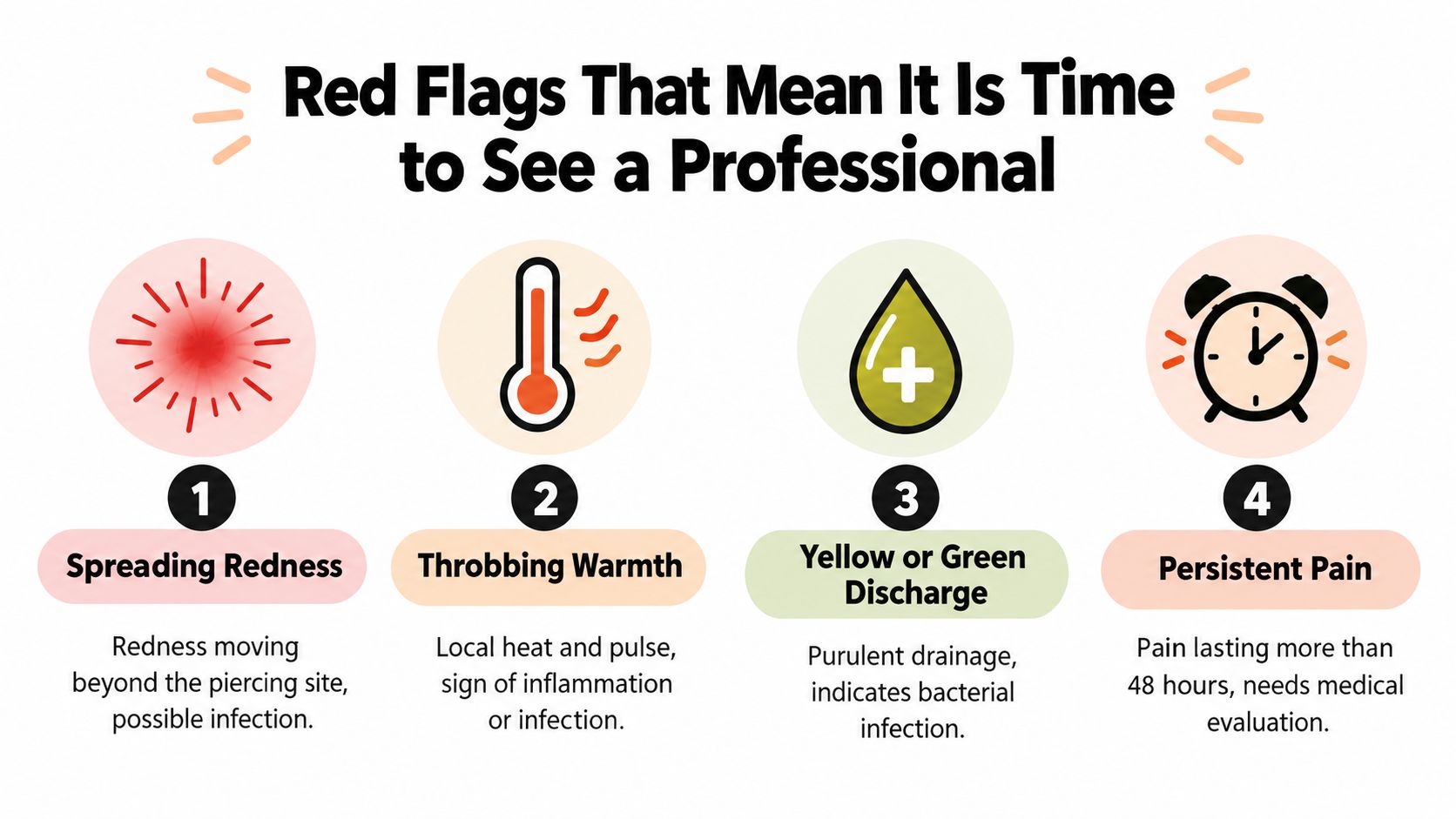
- Spreading redness: Redness moves beyond the immediate piercing site.
- Throbbing warmth: The ear feels distinctly hot and pain pulses or increases.
- Increasing swelling: The tissue becomes tighter, more distorted, or starts to engulf the jewellery.
- Yellow or green discharge: Thick or coloured fluid suggests possible infection.
- Fever or feeling unwell: General symptoms raise the urgency.
- Worsening pain: The piercing becomes more painful over time instead of gradually settling.
- Embedding jewellery: The post or backing appears to sink into swollen tissue.
The NHS advises urgent medical review when a piercing is hot, very red, painful, or producing pus. This matters even more for cartilage, where a clinician may need to assess the ear promptly rather than relying on topical care.
A small irritation bump isn't automatically an infection. A hypertrophic scar generally remains close to the original piercing area, while a keloid can grow beyond it. Neither should be squeezed or cut at home, and a piercer or dermatologist can help distinguish scar tissue from an active inflammatory problem.
Know who should see you first
A scheduled piercer appointment suits a mild but persistent itch, a possible jewellery allergy, pressure from an oversized post, or a bump without heat and pus. A medical professional is the right first contact for spreading redness, severe pain, fever, marked warmth, coloured discharge, or suspected cartilage infection.
For a practical symptom checklist, use this guide on how to tell if a piercing is infected. Don't remove jewellery from a potentially infected piercing without advice, because the channel can close around the problem.
If you're uncertain and the symptoms are changing quickly, choose medical advice rather than trying another home remedy.
Finding the Right Help for an Itchy Piercing
Match the professional to the pattern you are seeing.
A piercer can examine the jewellery material, post length, backing, and signs of pressure from sleeping or headphones. They can suggest a safer replacement when the main problem is persistent itching with dry or flaky skin, without spreading heat or coloured discharge. This helps separate a jewellery or friction issue from a problem needing medical care.
A GP, dermatologist, or urgent-care clinician should assess suspected infection, significant swelling, pus, fever, severe pain, or a hot cartilage piercing. A dermatologist may also help when allergic contact dermatitis keeps returning or affects other areas touched by metal.
Prepare before booking
Record when the piercing was done, when the itching began, and whether you changed the jewellery or aftercare products. Take the jewellery packaging if available. List saline, soaps, creams, sprays, headphones, helmets, and hair products that touch the ear.
Ask the studio:
- What exact metal is in the jewellery?
- Is the post pressing against swelling?
- Should a professional change or downsize it?
- Could the backing, hoop, or shape cause friction?
- What should stay in place while a clinician checks the ear?
A useful consultation includes examining the piercing, asking how symptoms are changing, and distinguishing healing, irritation, allergy, and infection instead of recommending more cleaning automatically. If the pattern is unclear, photograph the ear as symptoms change and arrange professional guidance.
Piercing Near Me provides professional piercing services and aftercare support connected with studios in Croydon and Bournemouth. You can contact the team on 01202 9000 50 or WhatsApp 07752913846 to discuss the itch and arrange appropriate help.
If your ear piercing is itchy, check the pattern before touching it. Mild, improving itch can fit healing. Persistent flaky redness may suggest jewellery sensitivity, while heat, worsening pain, or pus needs medical attention. For studio information and booking options, visit Piercing Near Me.