
You buy a lovely new pair of earrings, put them in, and within hours your lobes feel hot, tight, itchy, or sore. Sometimes the skin goes red. Sometimes it weeps a little. Sometimes you take them out and think, “Why does this happen to me every time?”
If that sounds familiar, you’re not fussy and you’re not imagining it. Sensitive ears are common, and the phrase hypoallergenic earrings for sensitive ears gets thrown around so often that it can start to feel meaningless.
A lot of first-time clients come in assuming they just need “better earrings”. Often that’s partly true. However, the solution is more specific than that. You need to know which materials are safest, which jewellery designs are easier to heal with, what “hypoallergenic” means in the UK, and how to spot products that sound safe but aren’t.
The Frustration of Sore Ears and the Search for a Solution
Sore ears can take the fun out of wearing jewellery very quickly. What should feel like a simple style choice turns into trial and error, wasted money, and that familiar cycle of trying another pair and hoping for a different result.
For some people, the problem starts with cheap studs from a high street shop. For others, it happens with old earrings they used to wear with no issue. That part confuses people. They think, “If these were fine before, why are they irritating me now?” Usually the answer sits somewhere between metal sensitivity, worn plating, trapped residue, and jewellery shape.
Why this feels so confusing
The biggest problem is that sensitive ears isn’t one single thing.
Sometimes it’s an allergy, most often linked to nickel. Sometimes it’s irritation from rough backs, heavy earrings, or poor-quality coatings. Sometimes a piercing is still delicate and doesn’t tolerate movement well. The symptoms can look similar, which is why people often misread what’s going on.
You don’t need to guess your way through this. If your ears keep reacting, the material and construction of the jewellery matter far more than the branding on the packet.
What people usually try first
Many individuals begin with one of these:
- Switching to “hypoallergenic” earrings without checking the actual metal
- Leaving earrings out for weeks and then putting the same problem pair back in
- Cleaning more aggressively with harsh products that make the skin angrier
- Blaming the piercing itself when the jewellery is the actual issue
That last one matters. A well-placed piercing can still become miserable if the jewellery going through it isn’t suitable.
The good news is that you can make this much simpler. Once you understand what causes reactions and what materials are worth trusting, choosing earrings gets easier and your ears usually get much happier.
Decoding the 'Hypoallergenic' Label What It Really Means
Hypoallergenic doesn’t mean allergy-proof. It means less likely to cause a reaction.
That’s the part many shoppers miss. This is similar to the “low-fat” label on food packaging. It tells you something useful, but it doesn’t tell you everything. You still need to check what’s in it. With earrings, that means looking past the label and asking what metal the post, backing, and wearable surface are made from.
The main culprit is usually nickel
Nickel turns up again and again in jewellery reactions because it’s widely used in alloys. It helps make metal harder and cheaper to produce, which is why it has been so common in costume jewellery and lower-cost pieces.
For sensitive ears, that’s often where the trouble starts. The skin’s reaction to the metal goes beyond a “dislike”. In an allergic reaction, the body treats contact with nickel as a problem and responds with inflammation. That’s why people get itching, redness, soreness, and rash-like irritation rather than simple discomfort.
In the UK, nickel allergy affects approximately 10 to 20% of the female population, and the EU Nickel Directive, fully adopted in the UK, restricted nickel release from pierced earrings to 0.5 micrograms per cm² per week. That regulation was introduced to reduce allergic reactions, according to this UK-focused overview of earrings for sensitive ears.
Why the label alone isn’t enough
A packet can say “hypoallergenic” and still leave out the detail you require.
Look for specifics such as:
- Implant-grade titanium
- Niobium
- Platinum
- 14k or higher gold, if the alloy is suitable for sensitive ears
- Detailed metal disclosure, not vague wording
If the seller can’t tell you what the post is made from, that’s a warning sign. If the item is plated, you also need to know what sits underneath that plating.
What first-time buyers often misunderstand
People often assume the decorative front is all that matters. It isn’t. The post and the part sitting inside the piercing matter most because that’s what stays in contact with the tissue.
They also assume “surgical steel” always means safe. It doesn’t always. Some steel jewellery works well for some wearers, but if your ears are reactive or newly pierced, safer options usually sit higher on the list.
Practical rule: If your ears are sensitive, shop by material specification, not by marketing language.
That one shift saves a lot of grief.
The Best Jewellery Materials for Truly Sensitive Ears
If you’ve ever stood in front of a jewellery display wondering what’s safe, start by ranking materials instead of looking at style first. Once the material is right, you can choose studs, hoops, huggies, or labrets with far more confidence.
In practice, some materials are consistently better for sensitive ears than others.
The safest starting point
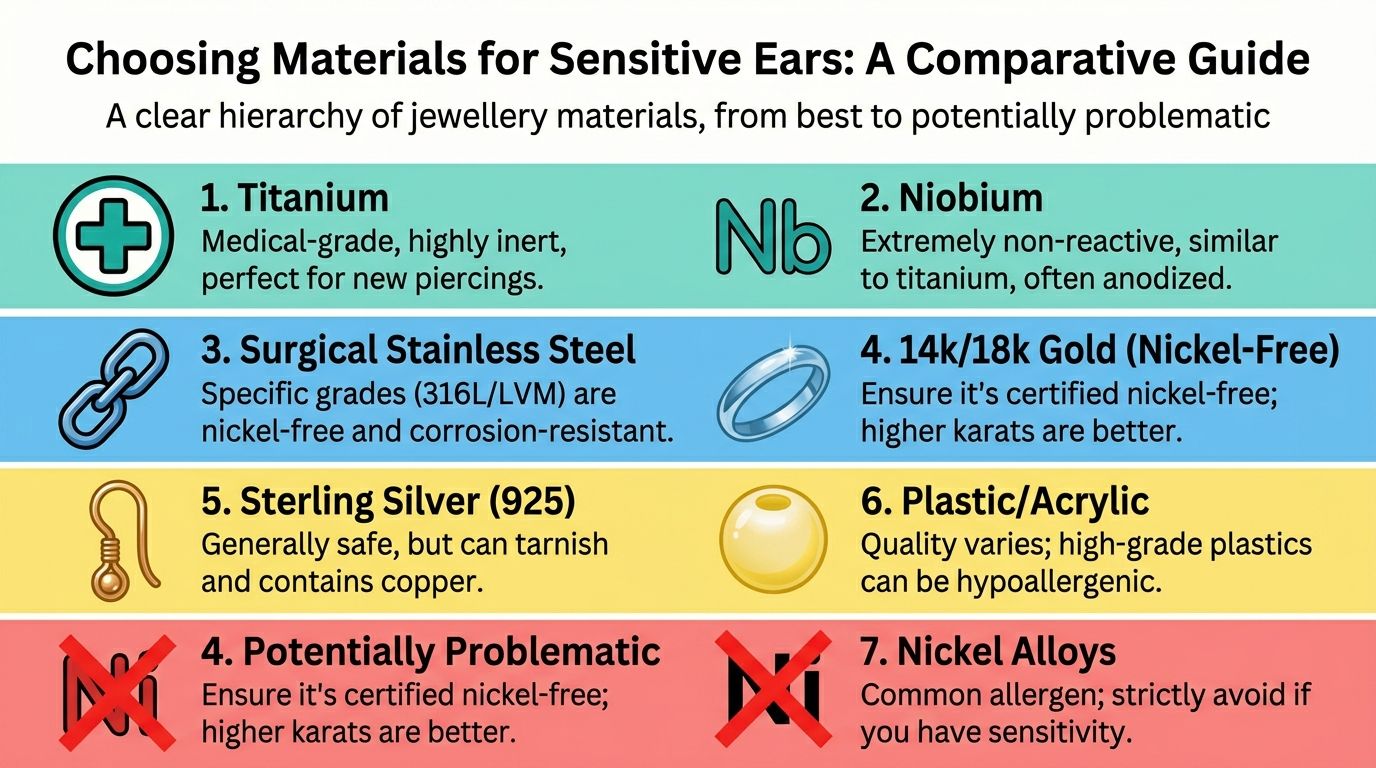
At the top of the list sits implant-grade titanium, especially ASTM F-136. That specification matters because it tells you the jewellery meets a recognised standard used for biocompatible applications. In plain terms, it’s a material chosen because the body tends to tolerate it very well.
For newly pierced ears and for clients who react easily, titanium is usually the easiest recommendation. It’s light, corrosion-resistant, and commonly chosen when the goal is calm healing rather than gambling on whether a mystery alloy will behave.
Niobium also deserves a place near the top. It’s a strong option for people who want a highly non-reactive metal, and it can also be anodised for colour without relying on questionable surface coatings.
Where gold and platinum fit
Platinum is a strong option for sensitive ears, especially for healed piercings and long-term wear. It’s often chosen by people who want something premium without moving into lower-quality mixed metals.
Gold needs more care. The key question isn’t “Is it gold?” but “What else is mixed with it?”
A simple rule helps:
- 14k and above is generally a better starting point than lower karat options
- Nickel-free alloy information matters, especially for white gold
- Gold-plated jewellery can become a problem once the outer layer wears down
Many people are surprised by this. They assume gold means safe by default. But the ear reacts to the total alloy, not just the word “gold” on the label.
The misunderstood middle ground
Surgical stainless steel causes the most confusion.
Some studio-grade steel jewellery is suitable in many cases, particularly when the grade is clearly specified. But the term itself gets used loosely in retail settings, and that’s the problem. If a client already knows they react to mixed metals, I’d rather see them in implant-grade titanium than testing their luck with steel.
UK rules have pushed studios towards implant-grade materials, because nickel in non-compliant jewellery is a common cause of reactions, and demand for hypoallergenic options like flat-back labrets has grown as a result.
Materials that need caution
Some materials aren’t always awful, but they need context.
Sterling silver can work for some healed piercings, but it isn’t my first recommendation for very sensitive ears or fresh piercings.
Acrylic and plastic vary massively in quality. Some people wear them comfortably in certain healed piercings, but I wouldn’t treat them as a top-tier choice for first-time ear piercing.
Then there are nickel alloys and unknown mixed metals. If your ears are already reactive, these are the ones to skip.
Comparison of Safe and Unsafe Earring Materials
| Material | Nickel-Free? | Biocompatibility | Best For |
|---|---|---|---|
| Implant-grade titanium (ASTM F-136) | Yes | Excellent | New piercings, very sensitive ears, everyday wear |
| Niobium | Yes | Excellent | Sensitive ears, coloured jewellery without coatings |
| Platinum | Typically yes | Very high | Healed piercings, premium long-term wear |
| 14k+ gold | Can be, depends on alloy | Good to very good | Healed piercings, classic jewellery if alloy is suitable |
| Surgical stainless steel | Not always | Variable | Some healed piercings, only when grade is clearly specified |
| Sterling silver | Not always ideal for sensitivity | Moderate | Occasional wear in healed piercings |
| Plated base metal | Unknown underneath | Low for sensitive ears | Best avoided if you react easily |
| Nickel alloy or unknown alloy | No or unclear | Poor | Avoid |
My simple ranking
If you want the short version, use this order:
- Implant-grade titanium
- Niobium
- Platinum
- 14k+ gold with suitable alloy
- Clearly specified studio-grade steel
- Everything else with caution
If you’re shopping for a fresh piercing, a flat-back titanium piece is often the easiest answer. If you want more guidance on starter jewellery, this guide to the best earrings for newly pierced ears is a helpful next step.
Jewellery should solve irritation, not create another round of it.
Recognising and Managing an Allergic Reaction
When ears react, people often ask whether it’s an infection, an allergy, or just irritation. You won’t always know immediately, but there are clues that can help you respond sensibly.
An allergic reaction often feels persistently itchy and inflamed. The skin may become red, sore, weepy, or flaky. You might also notice that the reaction returns every time you wear the same pair, even if the piercing itself seemed settled before.
Signs that point towards a reaction
Watch for these:
- Persistent itching that starts after wearing a certain pair
- Redness and warmth around the piercing hole
- Swelling that doesn’t settle quickly
- Weeping or crusting rather than normal, brief moisture
- Discolouration or dark staining on the skin
- A repeating pattern where the same earrings always cause trouble
Temporary irritation can look milder. For example, a heavy hoop may make a lobe sore by the end of the day without causing a full allergic rash.
What to do straight away
If you think the jewellery is the problem, keep your response simple.
- Remove the offending jewellery if the piercing is healed and the item is clearly triggering the reaction.
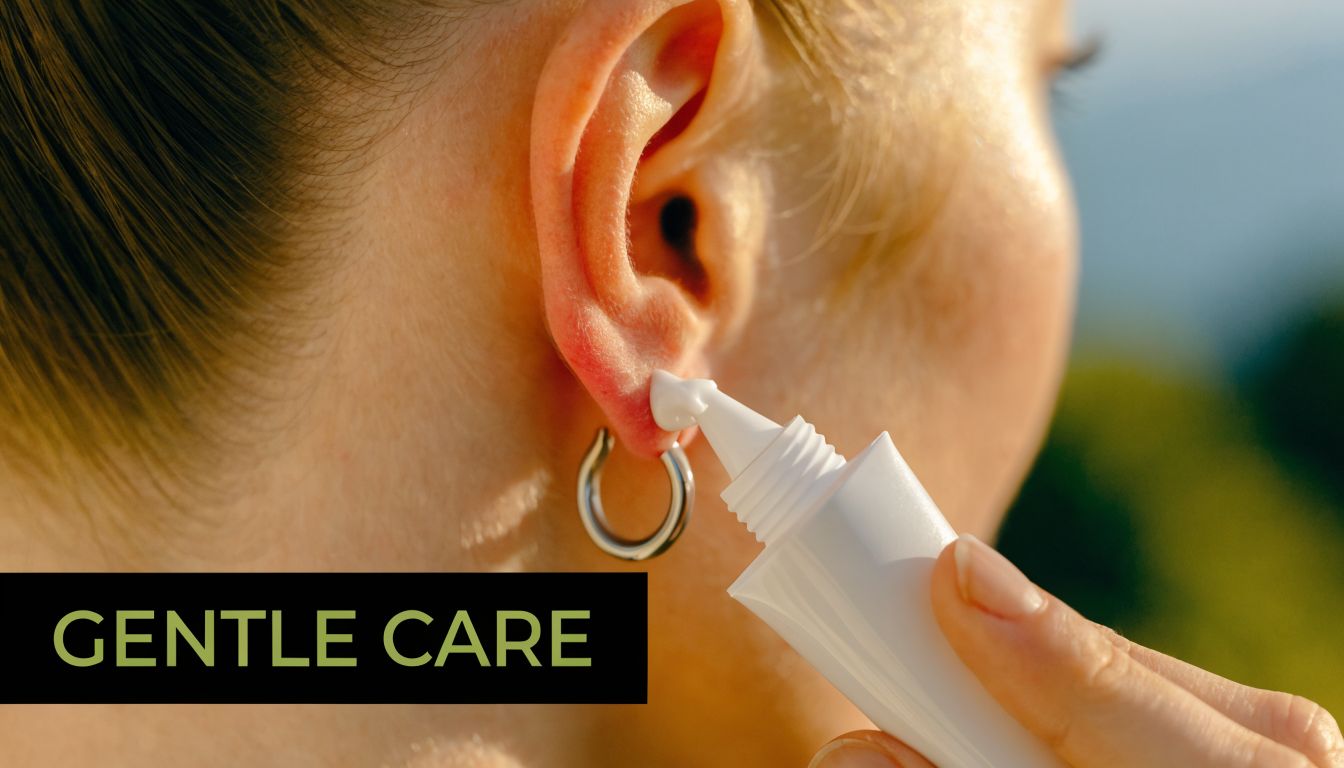
- Clean gently with sterile saline, not alcohol or harsh antiseptics.
- Use a cool compress if the ear feels hot or swollen.
- Leave the area alone as much as possible. No twisting, picking, or squeezing.
If you need help choosing an appropriate cleanser, this guide to saline spray for piercing explains what you want and what to avoid.
When to get extra help
If the skin becomes very painful, increasingly swollen, or the problem doesn’t settle, speak to a professional piercer or your GP. If you’ve had repeated reactions over time, a medical patch test can help confirm which metals you react to.
If your ears only “behave” when you wear one specific material, pay attention to that. Your skin is giving you useful information.
How to Choose Safe Earrings A Practical Shopping Guide
Most shopping mistakes happen before the earring ever touches your ear. People see a pretty finish, a reassuring label, and a low price, then assume it’s safe enough. For sensitive ears, that’s where problems begin.
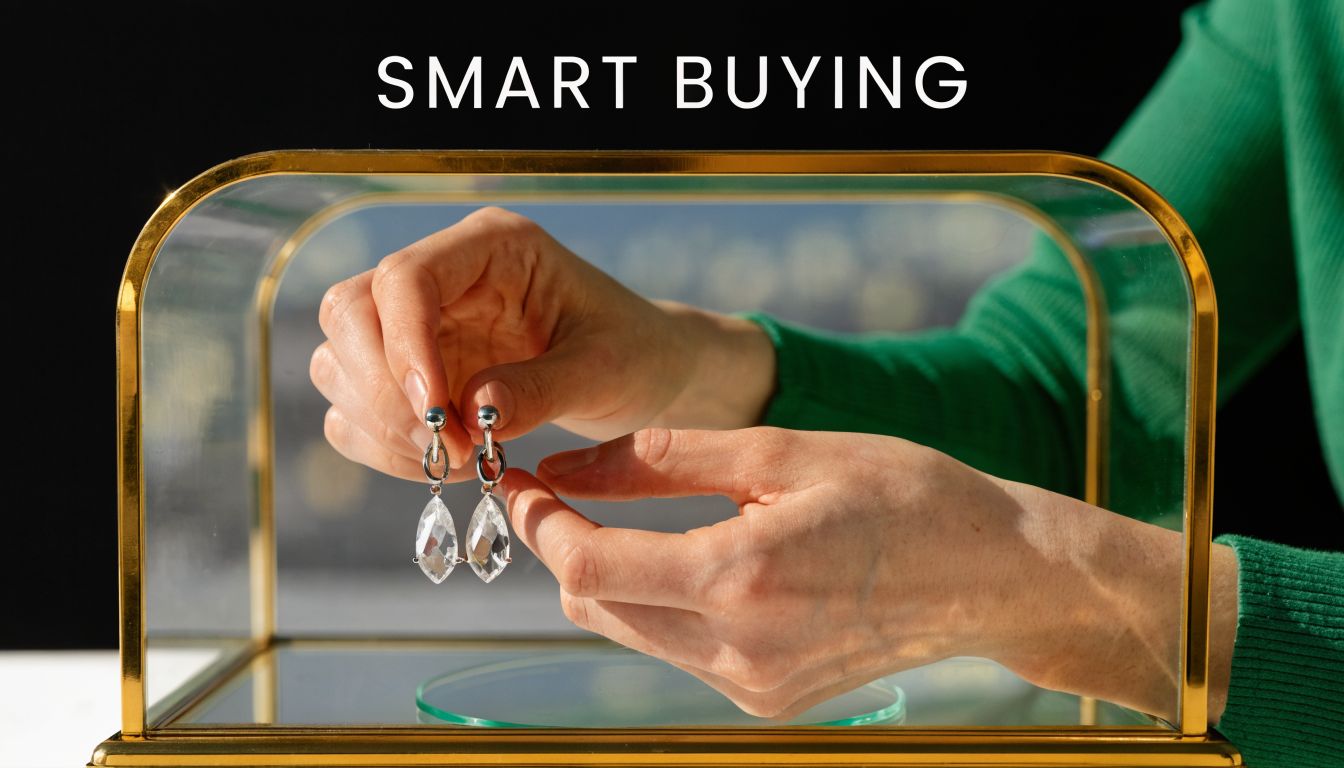
High street “hypoallergenic” claims aren’t always reliable. UK Trading Standards surveys have found that a significant percentage of jewellery sold that way does not comply with nickel-release standards, which is why buying verified implant-grade materials from reputable professional sources matters, as explained in this overview of earrings for sensitive ears.
Don’t just check the metal
Construction matters too.
A beautifully safe front with a poor-quality post still gives you a problem. The same goes for decorative pieces with rough edges, cheap butterfly backs, or flaky plating.
Here’s what I’d want a first-time client to check.
The better features to look for
Flat-back labret style
These sit more neatly against the ear than traditional butterfly backs. They’re often more comfortable for sleeping, less likely to trap grime in the same way, and less likely to jab the skin behind the ear.Smooth wearable surfaces
The post, backing, and front should all feel clean and well finished. Rough edges create friction, and friction can turn a mild issue into a constant one.Lightweight design
Heavy earrings drag on the piercing channel. Even safe metal can feel awful if the piece is too weighty for daily wear.Verified material specification
You want the exact metal named. “Sensitive”, “skin-friendly”, and “premium” don’t tell you enough.
Be wary of coatings
Colour can be safe or risky depending on how it’s achieved.
Anodisation on suitable metals such as titanium and niobium is generally very different from a cheap surface coating. It changes appearance without relying on a layer that can peel and expose whatever sits underneath. By contrast, low-quality plating often looks fine at first, then starts wearing away at the post or edges first, which is exactly where your skin is in contact.
A simple shopping checklist
Take this with you mentally whenever you buy earrings:
- Ask what the post is made from, not just the decorative front
- Ask whether the item is plated
- Choose flat backs where possible for everyday comfort
- Avoid mystery metals and vague product descriptions
- Skip rough butterfly backs if they’ve irritated you before
- Be cautious with bargain multipacks, especially if the seller doesn’t disclose composition
What I’d recommend for different people
If you’re buying for a fresh piercing, go simple. A titanium flat-back stud is hard to beat.
If you’re building an everyday collection, stick to a small set of reliable pieces instead of lots of random pairs that keep upsetting your skin.
If you’re shopping for a teen or first-time wearer, comfort matters just as much as appearance. A jewellery box full of irritating earrings is far less useful than two or three pairs they can wear all day.
Safe Piercing Practices The Foundation for Happy Ears
The safest earrings in the world can still struggle if the piercing itself starts with poor technique. Healthy ears depend on more than the jewellery. They depend on how the piercing is performed, what goes in on day one, and how the client looks after it afterwards.
That’s why the conversation shouldn’t stop at “What metal should I buy?” It should also include “Who is piercing me, with what, and under what standards?”
Needle versus gun
A professional piercing uses a single-use sterile needle. That matters because it creates a clean opening designed for piercing tissue properly.
A piercing gun works very differently. It forces blunt jewellery through the ear. That creates more trauma and gives you less control over jewellery quality and fit. It’s also not the professional standard for clients who care about hygiene, precision, and calmer healing.
Why starter jewellery matters so much
Initial jewellery has one main job. It needs to stay stable while the piercing settles.
That means:
- Suitable material, ideally implant-grade options for sensitive clients
- Correct length or fit so the ear has room without excess movement
- Secure closure that won’t loosen or scrape
- Smooth finish that won’t aggravate tender tissue
Fresh piercings don’t need novelty. They need reliability.
Aftercare that actually helps
Good aftercare is usually boring. That’s a good sign.
Keep it simple:
- Use sterile saline
- Wash your hands before touching the area
- Don’t twist the jewellery
- Don’t sleep directly on a healing piercing if you can avoid it
- Don’t swap jewellery too early
A lot of irritation comes from over-handling. People mean well. They want to “check” the piercing, rotate it, clean it too aggressively, or test different earrings too soon. That usually slows healing rather than helping it.
Healing ears prefer consistency. Calm jewellery, calm cleaning, calm hands.
Why professional standards make such a difference
A proper studio treats the jewellery, the procedure, and the aftercare as one connected system.
That means they’ll usually:
- Use sterile, single-use tools
- Offer implant-grade starter jewellery
- Explain realistic healing behaviour
- Tell you what’s normal and what isn’t
- Help you troubleshoot before a small irritation becomes a bigger issue
For first-time clients, that support matters just as much as technical skill. If you already know your ears are sensitive, tell the piercer before anything starts. That gives them the best chance to choose suitable jewellery from the beginning.
Your Partner for Safe Piercings in Bournemouth & Croydon
If you want a studio that takes sensitive ears seriously, Timebomb Tattoo & Piercing is the place to speak to. For clients in Bournemouth and Croydon, that means access to experienced piercers who understand that safe ear piercing isn’t just about making jewellery look good. It’s about choosing materials and methods that support comfortable healing.
A strong studio standard should feel obvious the moment you ask questions. You should be able to find out what jewellery is being used, why it’s appropriate, how it will be fitted, and how to care for it afterwards.
What you should expect
At Timebomb Tattoo & Piercing, clients can expect a safety-first approach built around professional practice:
- Single-use sterile needles
- Implant-grade jewellery options, including titanium
- Guidance for clients with metal sensitivities
- Clear aftercare advice
- A supportive approach for first-timers and parents
If you’re booking for a teen, replacing troublesome jewellery, or planning a cartilage piercing, it helps to speak with a professional before choosing on looks alone.
Book a consultation or ask a question
You can explore appointments and studio information through professional ear piercing near me.
For direct contact, use:
- Phone: 01202 900050 (Bournemouth) / 020 8686 7730 (Croydon)
- WhatsApp: 07752 913846 (Bournemouth) / 07902 490584 (Croydon)
If you’re unsure what jewellery would suit your ears, send a message first. That’s often the easiest way to avoid buying the wrong thing and repeating the same irritation cycle.
Best for first-time clients
A good consultation should leave you feeling clearer, not pressured.
You should be able to ask:
- What material do you recommend for my ears?
- Would a flat-back labret suit me better than a butterfly back?
- What should I wear for a fresh lobe or helix piercing?
- What signs of irritation should I watch for?
And again, if you want to speak to the studio directly, the contact details are:
01202 900050 (Bournemouth) / 020 8686 7730 (Croydon)
07752 913846 (Bournemouth) / 07902 490584 (Croydon)
Frequently Asked Questions About Hypoallergenic Earrings
Can I be allergic to gold earrings
Yes, sometimes. Often the issue isn’t the gold itself but the metals mixed into the alloy. That’s why higher-quality gold tends to be a better option than lower-karat pieces, and why vague “gold-tone” jewellery can be a problem.
Are titanium earrings the best choice for sensitive ears
For many people, yes. They’re often the easiest recommendation for both very sensitive ears and fresh piercings because they’re widely tolerated and commonly used in professional piercing jewellery.
Are butterfly backs bad
Not always, but they can be less comfortable for some people. They may press into the skin, collect residue, or catch more easily than flat-back styles. If the area behind your ear often gets sore, your backing style may be part of the problem.
What should I choose for a child or teen’s first earrings
Keep it simple and comfortable. A lightweight implant-grade titanium flat-back stud is usually a sensible starting point because it’s secure, easier to live with, and less likely to cause trouble than decorative starter jewellery.
Should I keep wearing old earrings that always irritate me
Probably not. If a pair repeatedly causes itching or redness, it’s telling you something useful. You don’t need to “get used to” painful jewellery. It’s usually better to replace problem pairs with a few safe, well-made pieces you can enjoy wearing.
Can I coat irritating earrings and make them safe
Temporary fixes exist, but they’re unreliable. If the coating wears down, the same metal touches your skin again. For sensitive ears, replacing poor-quality jewellery is usually the cleaner and safer answer.
If you’re ready to find a safer option for new piercings or troublesome jewellery, Piercing Near Me can help you connect with trusted professionals at Timebomb Tattoo & Piercing in Bournemouth and Croydon. For advice or bookings, call 01202 900050 (Bournemouth) / 020 8686 7730 (Croydon) or message 07752 913846 (Bournemouth) / 07902 490584 (Croydon) on WhatsApp.
Trackbacks/Pingbacks