
You've cleaned it carefully. You've checked it in the mirror three times today. Maybe the skin looks a bit red, maybe the bar seems more visible than it did last week, and now you're wondering if something's going wrong.
That worry is common, especially with a new piercing. A lot of people panic at the first sign of soreness or a change in how the jewellery sits. Sometimes it's normal healing. Sometimes it's irritation from sleeping on it, catching it on clothing, or cleaning it too aggressively. And sometimes the body is starting to push the jewellery out.
The hard part is telling those situations apart without making things worse. If you're feeling unsure, keep reading slowly and compare what you're seeing with what's described below. If you also need a refresher on safe aftercare, this guide on how to clean a new piercing properly is a good companion read.
Is My New Piercing Healing Wrong
A worried client often says the same thing. “It looked fine at first, but now I'm not sure.” Usually they mean one of three things. The piercing still feels tender, the jewellery seems to sit differently, or the skin around it won't settle.
That doesn't automatically mean rejection. Fresh piercings can look uneven when swelling changes. A longer initial bar can seem more obvious once the area calms down. Mild redness after being knocked, slept on, or cleaned too harshly can also happen without anything serious developing.
What most people are actually noticing
People usually spot change before they know what the change means. They notice:
- More jewellery showing: The bar or curve seems easier to see than before.
- A different angle: The piece doesn't sit the way it did when it was first pierced.
- Skin that stays annoyed: The area looks irritated long after those first very early healing days.
- A nagging feeling that it looks thinner: Especially with eyebrow, navel, and other surface-style placements.
Most problems look similar at first. The safest approach is to watch for a pattern of change, not one bad day.
The question to ask yourself
Don't ask, “Is it red today?” Ask, “Is it changing over time?”
Rejection is usually a process, not a sudden event. Infection has its own pattern. Simple irritation often improves once the cause is removed. Once you start thinking in patterns instead of snapshots, the situation gets much easier to judge.
Understanding What Piercing Rejection Is
Piercing rejection is the body gradually pushing jewellery closer to the skin's surface until it can no longer hold it securely.
A simple way to understand it is this. Your body is trying to heal around the jewellery, but in some piercings it never fully accepts that jewellery as stable. Instead of building a strong tunnel of healed tissue, it keeps shifting the jewellery outward. That process is called migration. If it continues, the piercing may eventually come out on its own.
This can worry people because it sounds dramatic. In real life, it is usually slow. You are more likely to notice small visual changes over time than one sudden, obvious problem.
As noted earlier, professional and medical guidance describes rejection as a gradual process that happens most often in piercings that sit close to the surface. That includes placements such as eyebrows, navels, and many surface piercings. These are harder for the body to keep long term because there is less tissue holding the jewellery in place.
Jewellery choice and anatomy both matter too. A piercing needs enough healthy tissue, a suitable angle, and jewellery that matches the placement. If one of those pieces is off, the body may keep treating the piercing like something it wants to move out rather than settle around.
That is why rejection should not be confused with infection or ordinary irritation.
With rejection, the main story is movement and thinning.
With infection, the main story is heat, swelling, discharge, and feeling unwell.
With irritation, the main story is inflammation after pressure, snagging, harsh cleaning, or unsuitable jewellery, and it often improves once the cause is removed.
This distinction matters because the safest response is different in each case. If you mistake irritation for rejection, you may panic unnecessarily. If you mistake rejection for simple irritation, you may leave jewellery in while the skin gets thinner and the chance of scarring goes up.
A good way to picture it is a button slowly pulling through fabric. At first the fabric still holds. Then the hole stretches, the material thins, and the button sits less securely. Rejection can look similar in skin, just much more gradually.
If a piercing is rejecting, keeping the jewellery in usually does not make it “heal stronger.” It often gives the body more time to push it further out. That is why early recognition matters. Calm observation matters just as much.
Early Piercing Rejection Signs to Watch For
Rejection is often not identified by pain, but rather by change. The key is comparing how the piercing looks now with how it looked when swelling settled and early healing became more stable.
Visible changes in the jewellery
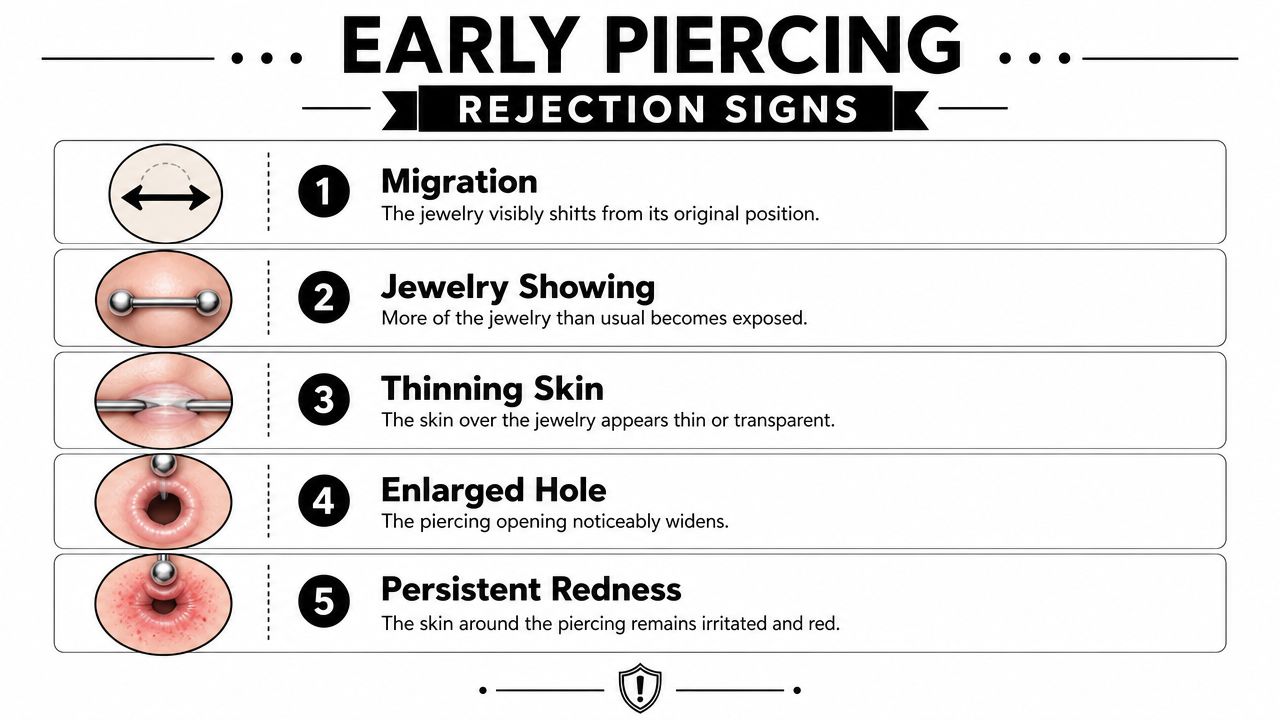
One of the clearest piercing rejection signs is migration. That means the jewellery is no longer sitting in its original position. It may look slightly higher, lower, or closer to the surface than it did before.
You might also notice more of the bar or curve showing. This can confuse people, because swelling going down can also reveal more jewellery early on. The difference is that with rejection, the area doesn't just de-puff. The tissue itself seems to get less substantial over time.
Another clue is the way the jewellery hangs. A curved bar that used to sit neatly may start to tilt. A surface bar may become more obvious under the skin and then look less securely anchored.
Changes in the skin itself
The skin often tells the story more clearly than the jewellery does. Watch for these:
- Thinning tissue: The strip of skin over the jewellery looks narrower than before.
- A larger opening: The entry or exit hole seems stretched or widened.
- A transparent look: The skin may appear shiny, delicate, or nearly see-through over the jewellery.
- Ongoing irritation: Redness, dryness, flaking, or tenderness that doesn't settle.
These signs matter most when they persist or keep progressing.
If your piercing looks more exposed each week, that isn't typical healing behaviour.
A simple self-check at home
Stand in the same lighting and look straight at the piercing, then from the side. If you have an earlier photo from when swelling had already gone down, compare it carefully.
Ask yourself:
- Does the jewellery look closer to the surface?
- Is the skin bridge thinner than it was?
- Have the holes widened or changed shape?
- Is irritation continuing without a clear trigger?
If you answer yes to more than one of those, especially on a surface-style piercing, it's worth having a professional assess it soon.
What doesn't always mean rejection
Not every odd-looking stage is a disaster. Short-lived redness after catching the jewellery. Temporary tenderness after sleeping on it. A bar looking more visible as swelling reduces. Those things can happen during normal healing.
What matters is whether the piercing settles back down, or keeps moving in the wrong direction.
Rejection vs Infection vs Normal Irritation
Panic often sets in because rejection, infection, and irritation can all involve redness and discomfort. The differences are in the pattern, the look of the tissue, and how the piercing changes over time.
If you think infection could be part of the picture, this guide on how to tell if a piercing is infected can help you compare symptoms more closely.
Rejection vs. Infection vs. Irritation Know the Difference
| Symptom | Piercing Rejection | Piercing Infection | Normal Irritation |
|---|---|---|---|
| Jewellery position | Moves from its original placement, looks more exposed, may hang differently | Usually stays in place unless swelling changes how it sits | Can look slightly off temporarily if swollen or knocked |
| Skin thickness | Tissue between holes may look thinner over time | Skin may look swollen, angry, and inflamed rather than thin | Tissue often looks puffy or tender, not progressively thinner |
| Piercing holes | Openings may appear larger | Holes may look inflamed and sore | May look a bit irritated without obvious enlargement |
| Redness | Can persist and linger | Often stronger, hotter, and more reactive | Usually mild and linked to pressure, touching, products, or snagging |
| Pain | May be sore or tender, often more visually noticeable than severely painful | Often more intense, throbbing, hot, or worsening | Usually mild, localised, and improves when the cause stops |
| Discharge | Not usually the defining feature | Thick or concerning discharge is more suggestive of infection | Clear fluid or light crust can happen during healing |
| Time pattern | Gradual progression | Can escalate more noticeably | Tends to settle when aftercare and pressure improve |
The easiest way to tell them apart
Rejection usually looks like a slow escape. Infection usually looks like an angry flare-up. Irritation often looks like a temporary protest.
A rejecting piercing often becomes more exposed and less secure. An infected piercing often feels increasingly hot, sore, and unwell. An irritated piercing often improves when you remove the cause, such as friction, pressure, or unsuitable cleaning habits.
When people get confused
People often mistake irritation for rejection after catching a piercing on clothing or sleeping on it. They also mistake rejection for infection because they assume any redness means bacteria. It doesn't.
Quick check: Rejection is mostly about migration and thinning. Infection is more about heat, worsening pain, and concerning discharge.
If you aren't sure which one you're dealing with, don't keep experimenting with creams, oils, tea tree products, or homemade fixes. That can muddy the picture and irritate the area further.
Why Rejection Happens and How to Avoid It
Rejection isn't random. It usually comes down to a mix of placement, jewellery, anatomy, and pressure. A piercing can be cared for lovingly and still struggle if one of those fundamentals isn't right.
The biggest risk factors
UK-facing aftercare guidance consistently treats shallow placement and friction as major risk factors, and notes that rejection can be triggered by poor placement, improper jewellery, anatomy, or jewellery fit. One cited benchmark is that there should be at least a quarter inch of tissue between the entrance and exit holes, with thinning tissue, enlarged holes, jewellery movement, and nearly transparent skin all listed as warning signs in this aftercare discussion of piercing rejection risks and prevention.
In plain terms, a piercing needs enough healthy tissue to support it. If it sits too shallowly, or the jewellery shape doesn't suit the area, the body has less reason and less ability to keep it stable.
What helps lower the risk
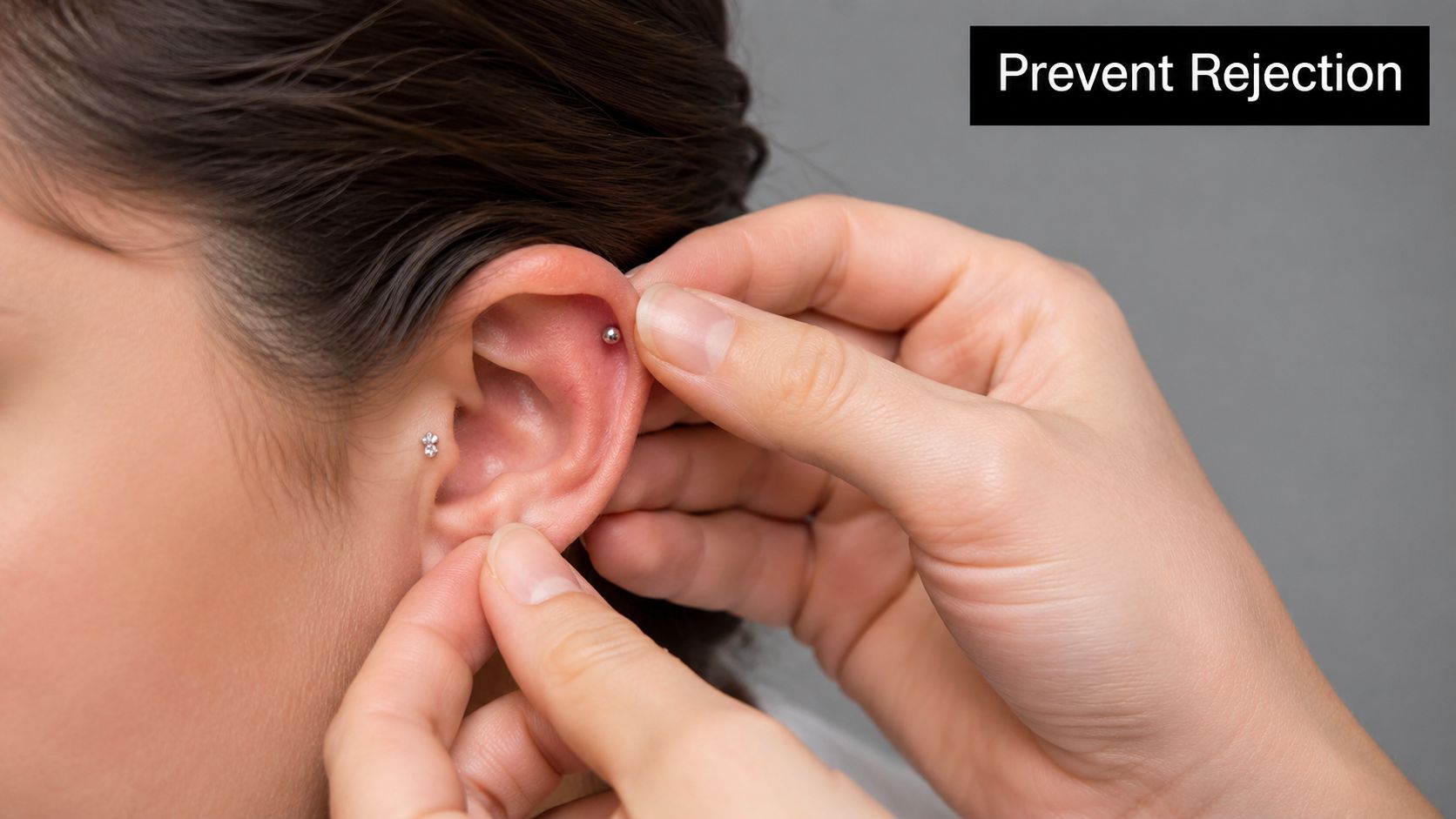
Prevention starts before the needle ever touches the skin. Good decisions early on make a major difference.
- Choose suitable jewellery: Implant-grade options matter. If you want to understand safe material choices better, read about implant-grade titanium piercing jewellery.
- Match the placement to your anatomy: Not every body suits every piercing. A responsible piercer will tell you when a placement is likely to struggle.
- Reduce friction: Waistbands, tight clothing, helmets, sleeping pressure, and constant touching can all irritate a piercing repeatedly.
- Use the right shape and fit: A technically good material still won't help much if the bar length, curve, or style is wrong for the area.
Prevention is mostly about set-up
Aftercare matters, but aftercare can't fix poor anatomy matching or a shallow piercing. The best outcomes usually come from a careful piercer, a realistic placement choice, and jewellery that suits the body rather than just the look you want.
Your Action Plan for Suspected Rejection
If you think your piercing may be rejecting, don't panic. But don't ignore it either. The sooner you get a proper assessment, the better your chances of limiting scarring.
What to do today
Start with a calm check.
- Stop irritating it further: Don't twist it, push it back into place, or keep comparing it by touching it.
- Keep aftercare simple: Use the routine your piercer recommended. Don't add harsh products or internet remedies.
- Take a clear photo: Good lighting helps you compare changes and show a professional.
- Get it assessed promptly: A professional can tell the difference between migration, pressure irritation, and something more concerning.
For urgent advice or a consultation in Bournemouth or Croydon, call us on 01202 9000 50 or send a picture to our WhatsApp at 07752913846.
When removal may be the safer choice
If the jewellery is clearly migrating, the skin is becoming thin, or the area looks close to tearing, removal is often the safer option. Leaving a rejecting piercing in place can mean the body continues pushing it out, which may leave a more obvious scar.
Don't remove jewellery casually if you think there may also be infection involved. If the area is very hot, increasingly painful, or producing concerning discharge, get professional advice quickly so you know the safest next step.
The goal isn't to “save” every piercing at any cost. The goal is to protect the tissue.
When to see a GP
See a GP if you have signs that suggest infection or your symptoms feel beyond a normal piercing problem. A piercer can assess placement and jewellery. A medical professional should assess broader health concerns, especially if the area seems severely inflamed or you feel unwell generally.
A good rule is simple. If it looks like migration, see a piercer promptly. If it looks medically unwell as well as irritated, involve a GP.
Frequently Asked Questions and Expert Advice
Common questions about rejection include what tends to reject, whether a piercing can be redone later, and how worried you should be about scarring. If you are still unsure after comparing rejection, infection, and normal irritation, that uncertainty is understandable. Piercings can look similar in a mirror, especially in the early stages.
Which piercings are most likely to reject
Some placements behave more like a splinter near the skin than a channel set safely within it. The shallower and more surface-level the jewellery sits, the easier it is for the body to push it towards the surface over time.
That is why surface bars and some navel piercings are often higher risk. Placement, jewellery shape, anatomy, and ongoing pressure all matter. Some professional educators also discuss how anatomy matching and suitable gauge can lower risk, as covered in this piercing education video on rejection risk and anatomy.
Ear piercings can still have problems, but the question is usually different. With many ear piercings, irritation or pressure is often the first thing to rule out before assuming rejection.
Can I get it re-pierced later
Sometimes you can. The deciding factor is the condition of the tissue after it heals.
Scar tissue can change the way jewellery sits, a bit like trying to place something neatly through fabric that has already been stitched and pulled once before. If the skin healed thin, uneven, or tight, repeating the same placement may create the same problem again. A good piercer will assess the area first rather than guessing.
Does rejection always leave a bad scar
No. Early recognition usually gives the skin a better chance to heal with a smaller mark.
Scarring often becomes more noticeable when jewellery keeps migrating and the tissue gets thinner for longer. That is why rejection matters even when the area does not look dramatic yet. Quiet migration can still leave a line or mark if it is ignored.
Can better jewellery fix rejection once it starts
Better jewellery can improve comfort if the problem is irritation, swelling, or pressure from an unsuitable piece. It cannot usually stop true rejection once the body is already pushing the jewellery outward.
A simple way to frame it is this. Jewellery changes can help with a bad setup. They rarely reverse a clear rejection pattern.
If the skin over the jewellery looks thinner over time, get the piercing assessed rather than waiting for it to settle on its own.
I'm still not sure what I'm looking at
That is very common. Rejection, infection, and ordinary irritation can overlap at first glance, and online photos often make things more confusing rather than clearer.
A piercer can assess angle, placement, jewellery fit, and whether the tissue looks stable. A GP is the right choice if the area seems medically unwell or you feel unwell generally. Using both when needed is often the safest approach.
If you want a professional assessment for placement, jewellery, healing, or whether an area may be suitable for re-piercing, call 01202 9000 50 or WhatsApp 07752913846.
If you want calm, professional guidance rather than guessing from mirror checks, Piercing Near Me helps you connect with trusted piercing support for Croydon and Bournemouth. Whether you need a second opinion on piercing rejection signs, help choosing implant-grade jewellery, or advice on whether a piercing should be removed or re-done later, it's a straightforward place to start.