
You've probably got a search tab open right now, half excited and half unsure. You want a new piercing. You also don't want to end up in a place that looks good on Google but cuts corners where it matters.
That instinct is right.
Searches for piercings near me often begin with reviews, photos, and distance. That's understandable, but it's not enough. A pretty feed and a five-star rating don't tell you whether the studio uses a single-use sterile needle, whether the setup is clean, or whether the piercer gives aftercare that supports good healing.
For a first piercing, or even your fifth, safety comes first. Style matters. Jewellery matters. Placement matters. But if the studio gets hygiene wrong, none of the rest counts. That's why this guide focuses on the part many local pages skip: how to judge a piercing studio properly, using official health standards as the benchmark rather than hype.
If you're in Croydon or Bournemouth, you don't need more vague advice. You need a clear way to separate a proper studio from an unsafe one, know which piercing suits your day-to-day life, and understand exactly what will happen at your appointment. That's how you walk in calm and walk out happy.
Your Search for the Perfect Piercing Starts Here
You're standing outside a studio in Croydon or Bournemouth with your phone still in your hand, comparing ratings and wondering if you're about to make a smart decision or a stupid one.
Start with a better question than “Which place looks nicest online?” Ask which studio follows the standards that protect you. Star ratings can tell you whether staff were polite. They do not tell you whether the piercer uses sterile single-use equipment, keeps a clean setup, or gives aftercare that supports proper healing.
That matters because a piercing is a controlled wound. If the studio cuts corners on hygiene, the jewellery style, the price, and the Instagram photos stop mattering very quickly. Good studios know this and make their safety standards easy to see, not hidden behind marketing.
If you want a clear starting point, use a proper guide to finding experienced professional piercers and judge each studio against real health standards, not hype.
The right studio earns your trust before your appointment starts.
That is the standard you should expect in Bournemouth, Croydon, or anywhere else. A strong studio welcomes sensible questions, explains its process clearly, and treats safety as the baseline, not a sales point. Once you know how to assess that properly, choosing where to book gets much easier.
How to Spot a Safe Professional Piercing Studio
Forget the star rating for a minute. Reviews can tell you whether staff were friendly. They can't reliably tell you whether infection control was handled correctly.
A major underserved angle in UK searches for piercings near me is how to judge safety and sterility beyond star ratings. Public health guidance in England says body piercing should use a single-use sterile needle, appropriate hygiene, and clear aftercare, but many local results focus on convenience and reviews rather than infection control or whether the studio follows professional standards, as noted in this discussion of how clients should judge safety beyond ratings.
What a proper studio should show you
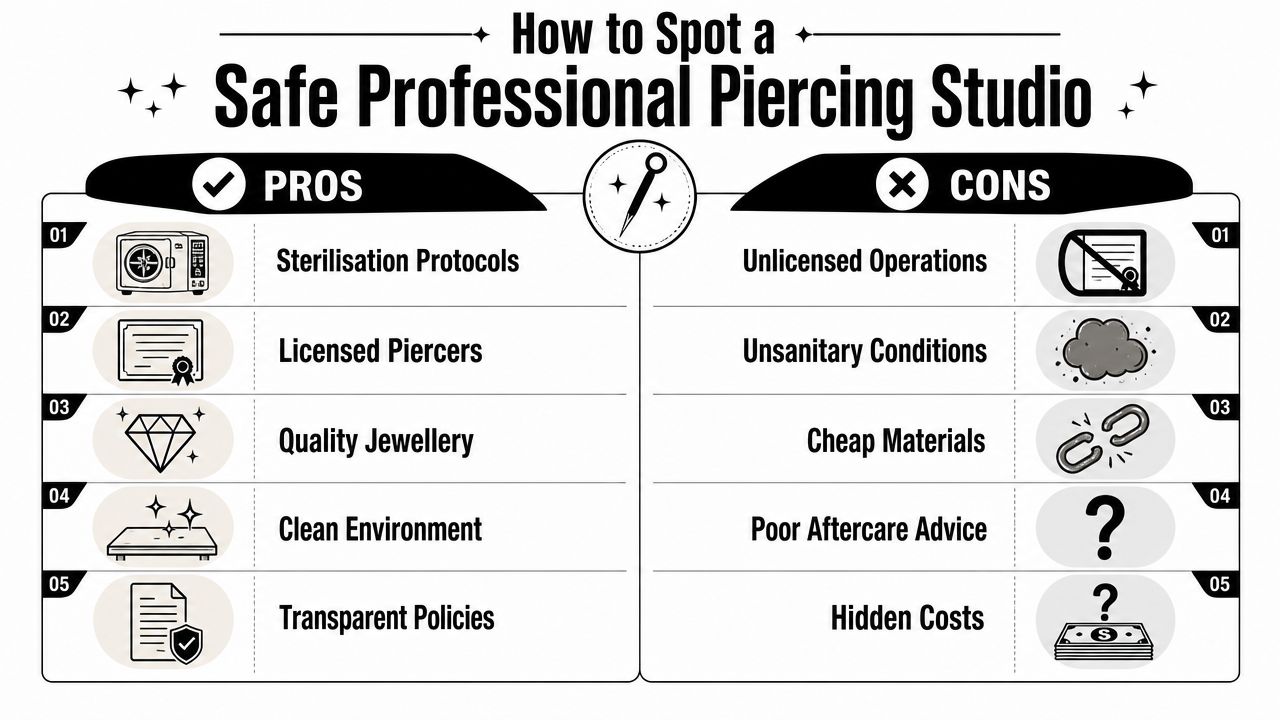
A good studio makes safety visible. You shouldn't have to drag basic answers out of them.
Look for these signs:
- Single-use sterile needles rather than vague talk about being “clean”
- Fresh gloves and a tidy station prepared in front of you
- Clear explanations about jewellery, placement, and healing
- Written aftercare instead of rushed verbal instructions
- Calm confidence when you ask direct questions
If a piercer gets defensive when you ask about sterilisation, walk out. Professional studios expect those questions.
Red flags I'd never ignore
Some warning signs are subtle. Others are immediate deal-breakers.
| Green flag | Red flag |
|---|---|
| Questions are answered plainly | Staff dodge safety questions |
| Work area looks organised | Surfaces look cluttered or dirty |
| Jewellery options are explained | Cheapest option is pushed without context |
| Consent and aftercare are taken seriously | The appointment feels rushed |
| Placement is discussed carefully | Staff mark quickly and move on |
Practical rule: If a studio wants your money more than your informed consent, it's the wrong studio.
Needle versus gun
This is one of the easiest ways to sort serious studios from weak ones. If you're unsure about the difference, read this guide on piercing gun vs needle.
Needles are the professional standard for precision and hygiene. They're designed for the job. A proper piercer will also talk you through the jewellery being fitted, how the placement sits on your anatomy, and what healing will realistically involve.
Ask these questions before booking
You don't need to sound like an expert. You just need to be direct.
What do you use for the piercing itself
You want a clear answer, not waffle.What jewellery do you recommend for healing
Good studios explain why a certain material or style suits the piercing.What aftercare do you give
If they don't have a consistent aftercare routine, that's a problem.Can you talk me through the setup
A professional won't mind. They'll usually be pleased you asked.
The bottom line is simple. Don't choose the nearest studio. Choose the studio that treats safety as standard, not as a marketing line.
Choosing a Piercing That Fits Your Lifestyle
The best piercing isn't always the one you saved on Instagram. It's the one that suits how you live.
A frequently under-answered question is whether a piercing is suitable for school, work, or sport. NHS and local authority guidance in the UK often stresses healing time, irritation from friction, and the need to avoid swimming or contact sports, but local search content often skips the practical disruption that really shapes the decision, as explained in this overview of piercings and day-to-day suitability.
If you want the easiest first step
Start simple.
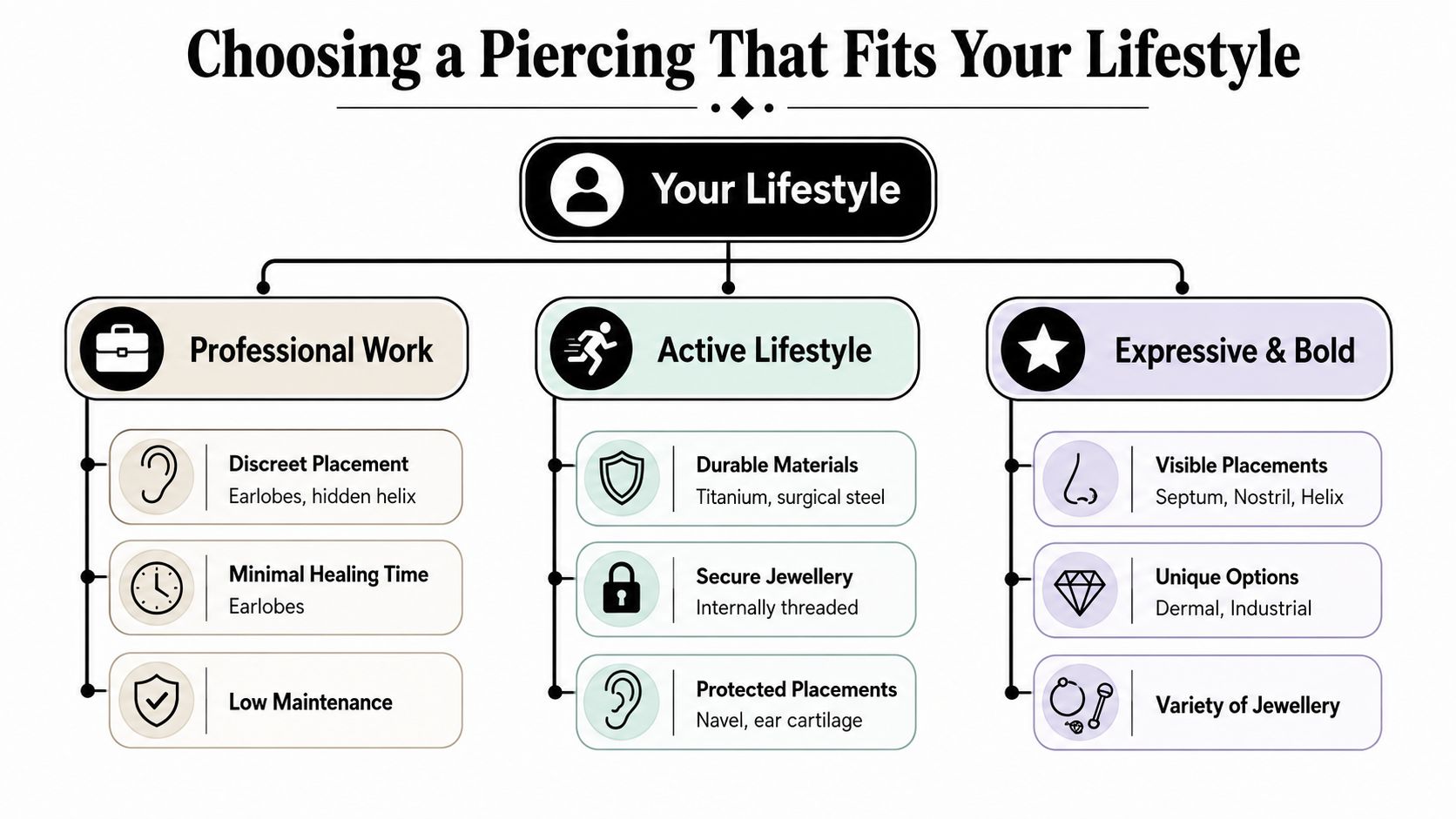
Earlobes are usually the least disruptive choice for most first-timers. They're straightforward, easy to style, and less likely to clash with glasses, headphones, or sleep. If you're nervous, a neat lobe or paired lobes is often the smartest first booking.
A nostril piercing can also work well if you want something visible but not overpowering. It gives you a bit more personality straight away, but it does need you to be sensible about touching, makeup, and snagging.
If your routine is busy or physical
Some placements look brilliant but don't fit an active schedule.
Consider these factors before you choose:
Sleep position
If you always sleep on one side, an ear cartilage piercing on that side may annoy you for a while.Headphones and helmets
Tragus, helix, and some other ear placements can become awkward if you wear over-ear gear often.Work uniform or dress code
Schools and workplaces differ. A subtle placement may save you hassle.Sport and swimming
Fresh piercings don't mix well with friction, impact, or pool time.
If your life is full of movement, pressure, sweat, and kit, choose a placement that won't fight your routine every day.
If you want something bolder
Go bold on purpose, not on impulse.
Septum, helix combinations, conch, navel, and more expressive placements can look fantastic, but they ask more from you. You'll need patience, good habits, and realistic expectations about irritation. That's fine if you're up for it. It's not fine if you want to forget about it the next morning.
A quick reality check before you choose
Ask yourself these four questions:
- Can I leave this jewellery alone while it heals?
- Will this placement catch on clothes, hair, or equipment?
- Do I need it to be discreet for school or work?
- Am I choosing this because I love it, or because it looks good on someone else?
That last one matters more than people admit. Anatomy, routine, and comfort all shape whether a piercing feels right long after the excitement of booking wears off.
What to Expect During Your Piercing Appointment
Most first appointments are far less intimidating than people imagine. In a proper studio, the process feels structured, clean, and calm.
You arrive, check in, and talk through what you want. If you're unsure about placement, the piercer should help you narrow it down without pushing you into something unsuitable. Good advice at this stage saves regret later.
The consultation and setup
This part matters more than the actual second of the piercing.
Your piercer should discuss placement, check the area, explain jewellery options, and answer your questions directly. Then they prepare the station, wash or sanitise appropriately, put on fresh gloves, and clean the skin. You may be marked first so you can confirm the position before anything happens.
In the UK, the main technical risk factor in a piercings near me search is sterility protocol. The NHS advises that piercing should be done with a single-use, sterilised needle and clean, hygienic technique because reused or inadequately sterilised equipment increases the risk of bacterial infection and blood-borne virus transmission, as summarised in this explanation of NHS guidance on sterile piercing technique.
The piercing itself
The actual piercing is quick.
You'll be asked to stay still, breathe normally, and relax the area as much as you can. Tension often arises more from anticipation than pain. A skilled piercer works efficiently, fits the jewellery, checks the placement, and gives you a moment to settle before moving on.
Breathe in. Hold still. Let the piercer do their job. The worst part is usually the build-up, not the procedure.
Before you leave
Don't rush out just because the hard bit is over.
Use those last few minutes well:
- Check the mirror and make sure you're happy with placement
- Listen to the aftercare advice even if you think you know it already
- Ask what's normal for swelling, tenderness, or light bleeding
- Ask what isn't normal so you know when to get in touch
A good appointment doesn't end with the needle. It ends when you leave knowing exactly how to look after the piercing you've just paid for.
Your Essential Piercing Aftercare Guide
You get home, look in the mirror, and your new piercing already feels like part of you. Good. Now protect it properly.
Aftercare is where good studio standards keep mattering. A studio can meet high hygiene standards on the day, but your healing still depends on what happens over the next few weeks. Treat the piercing like a clean wound with jewellery through it. That mindset stops a lot of bad decisions before they start.
The routine that works
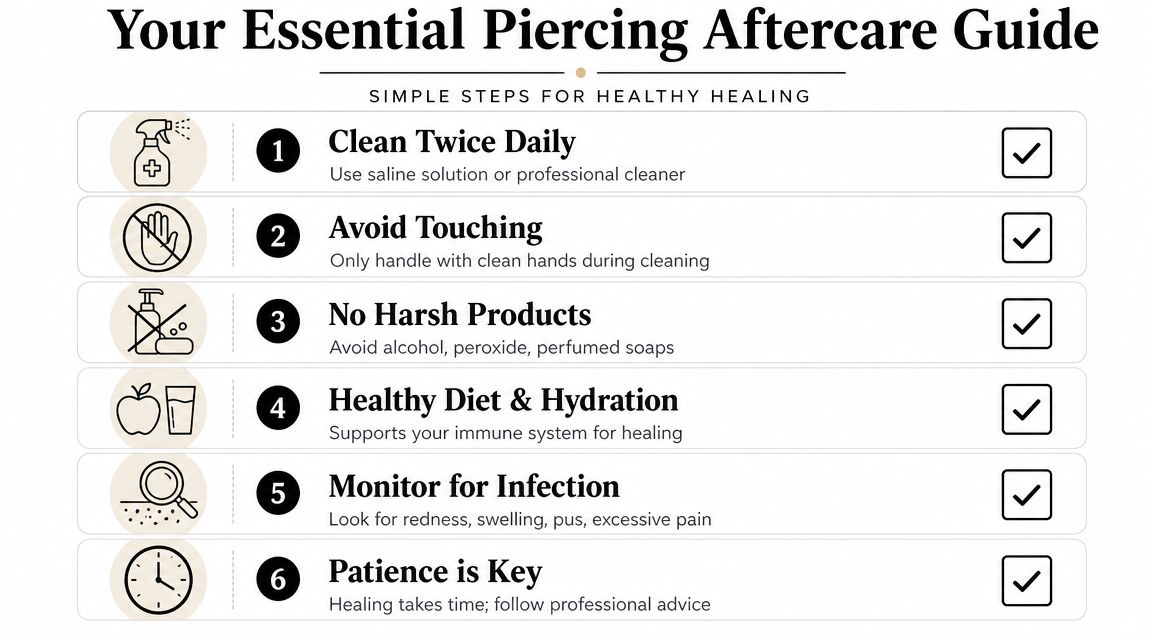
Keep your routine simple and repeatable. If a studio gave you a long shopping list of products, I'd question that.
A solid daily routine looks like this:
- Wash your hands first every time you go near the piercing
- Clean gently with sterile saline or the aftercare product your piercer recommends
- Leave the jewellery alone so the channel can settle without extra irritation
- Pat the area dry with clean tissue or gauze if needed, instead of rubbing it
If you want the step-by-step version, read this guide on how to clean a new piercing safely.
What causes trouble
Poor healing usually comes from friction, moisture, or people fiddling with the jewellery.
Watch for the habits that set clients back:
- Touching it to check it
- Twisting or rotating the jewellery
- Using alcohol, peroxide, or scented products
- Changing jewellery because it "looks healed"
- Sleeping on it or catching it on hair, clothing, headphones, or sports kit
That last point gets overlooked. A technically perfect piercing can stay angry for weeks if you keep putting pressure on it.
What is normal
Early healing can include tenderness, mild swelling, light crusting, and a bit of sensitivity when the area gets knocked. That is common.
What matters is the direction things are going. Healing should slowly settle. It should not get hotter, redder, more painful, or more swollen day after day.
When to contact your piercer
Ask your piercer for help if you notice:
- Pain that is getting worse instead of easing
- Noticeable heat spreading around the area
- Thick discharge or anything that worries you
- Jewellery embedding, sinking, or feeling too tight
- Swelling that suddenly ramps up
Do that early. A good studio in Croydon or Bournemouth would rather answer a simple aftercare question now than deal with a preventable problem later.
The best aftercare advice is still the simplest. Clean it properly, keep pressure off it, and stop messing with it.
Book Your Piercing in Croydon or Bournemouth Today
By now, the choice should feel clearer. Don't book a studio because it's close. Book because you can recognise proper standards when you see them.
If you're in Croydon or Bournemouth, choose a studio that takes consultation seriously, works cleanly, explains jewellery properly, and supports you after the appointment. That's the difference between a piercing experience you enjoy and one you spend weeks worrying about.
Keep your booking simple
If you want to ask a question before you commit, do that. A decent studio would rather answer your questions now than fix confusion later.
Use these contact details for bookings and enquiries:
- Phone 01202 9000 50
- WhatsApp 07752913846
What to do before you message or call
It helps to know three things:
| Before you book | Why it helps |
|---|---|
| The piercing you want | It makes the consultation easier |
| Whether you need discreet jewellery | Useful for work, school, or sport |
| Your rough availability | Speeds up the booking process |
If you're torn between two placements, say so. If you're nervous, say that too. First-time clients ask these questions every day, and they should. You're not supposed to know everything before booking.
My straight recommendation
Choose the studio that makes you feel informed before you arrive. Not dazzled. Informed.
That means they answer clearly, take hygiene seriously, give proper aftercare, and treat your piercing like a professional procedure rather than a quick sale. If that's what you want in Croydon or Bournemouth, get in touch on 01202 9000 50 or send a WhatsApp message to 07752913846 and ask the questions that matter.
If you're ready to stop guessing and start with a studio that puts safety first, book through Piercing Near Me. It's the simplest way to find trusted professional piercing support in Croydon or Bournemouth, compare your options, and move from “still thinking about it” to a booking you feel good about.