
You've just left the studio, caught your reflection in a shop window, and had that split-second mix of excitement and nerves. The piercing looks great. Then the questions start. Should you clean it now or later? Is it meant to feel warm? What if you bump it in the shower? That's all normal.
Good healing isn't about doing everything. It's about doing the right things, consistently, and avoiding the habits that cause underlying trouble. Most problems I see aren't from clients ignoring aftercare completely. They come from overdoing it, touching too much, cleaning too often, or throwing every product in the bathroom cabinet at a fresh piercing.
Your New Piercing Journey Starts Now
A new piercing is a small wound with jewellery placed through it. That means your body needs calm conditions to heal. Clean technique at the appointment matters, but what you do over the next days, weeks, and months matters just as much.

In England, approximately 31.0% of body piercings on individuals aged 16–24 develop complications, and those issues are significantly less likely when the piercing is done by specialists, with a 0.5% hospital admission rate, compared with 3.0% for non-specialists, according to research published on PubMed Central. That's why choosing a proper studio and following calm, sensible aftercare makes such a difference.
If you haven't been pierced yet and you're still choosing where to go, it's worth starting with professional piercers near you. A good studio gives you sterile technique, suitable jewellery, and clear aftercare that matches the piercing you've had done.
What good healing looks like
Healing rarely feels perfectly linear. Some days it settles. Some days it feels slightly tender again after you've slept on it, caught it with clothing, or had a longer shower than usual.
That doesn't automatically mean something's wrong. It means healing tissue is sensitive.
Practical rule: Treat your new piercing like healing skin, not like a dirty object that needs constant scrubbing.
The mindset that helps most
Clients do best when they keep the routine simple:
- Clean hands first before you go anywhere near the jewellery.
- Use gentle products only, ideally sterile saline.
- Leave it alone the rest of the time. No twisting, no rotating, no testing whether it's “still sore”.
- Expect patience, especially with cartilage and body piercings.
If you remember one thing from this guide, make it this. Piercings usually heal better when you stop trying to force them to heal faster.
Your Essential Aftercare Toolkit
You don't need a shelf full of products for body piercing aftercare. In fact, the more products people add, the more irritated the piercing usually becomes. A short, boring list works best.
What to keep on hand
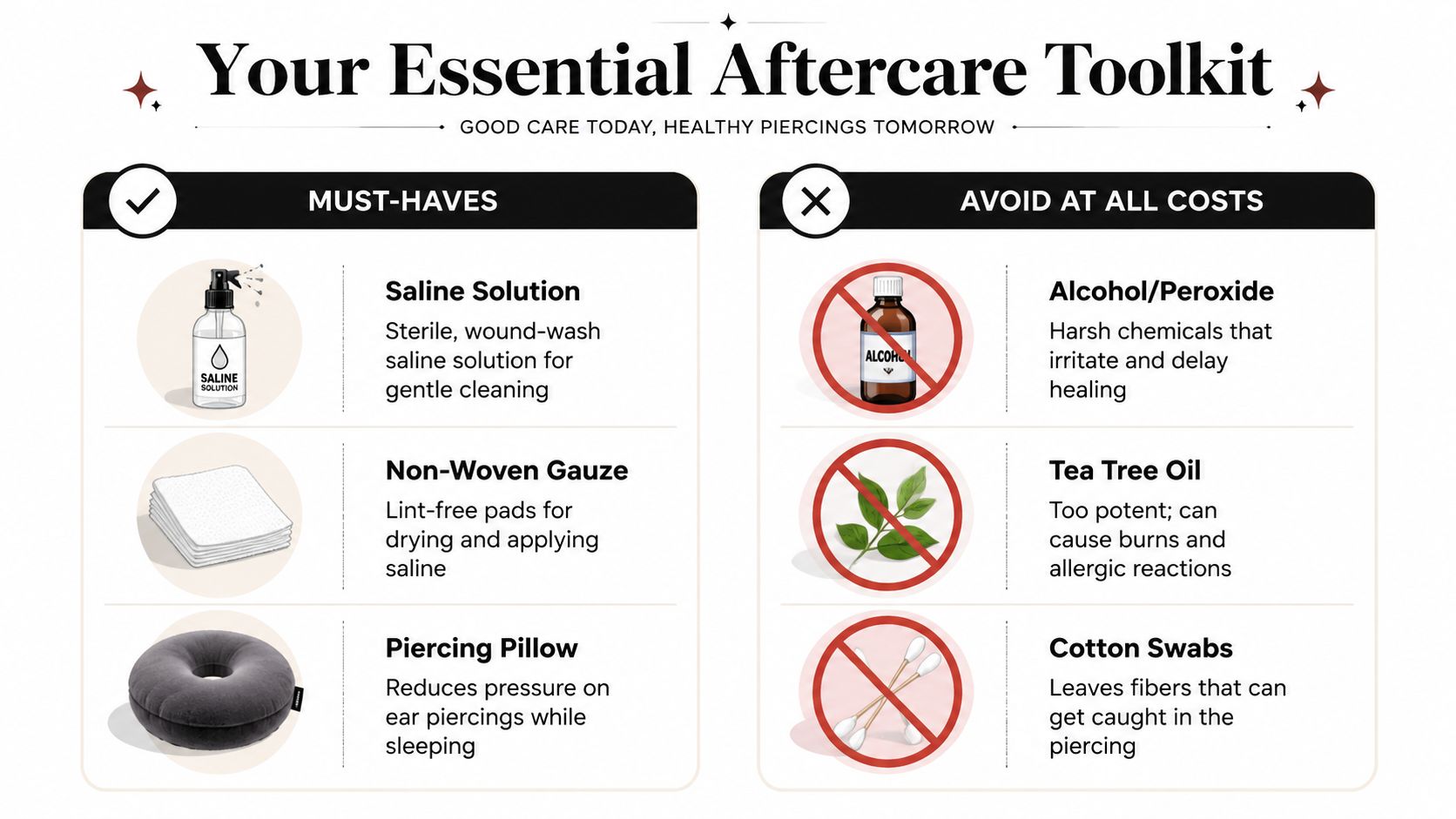
The gold standard is sterile saline wound wash containing 0.9% sodium chloride. It's gentle, predictable, and made for wound care. For jewellery itself, implant-grade options matter too, and if you want to understand the materials commonly used in fresh piercings, titanium piercing jewellery is a useful place to start.
A simple kit looks like this:
- Sterile saline spray for twice-daily cleaning.
- Fresh disposable paper towels or kitchen roll for drying the area.
- Clean running water for rinsing away residue in the shower.
- A travel pillow or piercing pillow if you've had ear work and tend to sleep on your side.
- Hair clips or ties if long hair keeps wrapping round the jewellery.
What to skip completely
A lot of bad aftercare starts with products people assume must be “stronger” and therefore better. They aren't.
Avoid:
- Alcohol and hydrogen peroxide, which can irritate and damage healing tissue.
- Harsh antibacterial soaps on the piercing itself.
- Tea tree oil, essential oils, and homemade mixes with random ingredients.
- Ointments and thick creams unless a clinician has specifically told you to use them.
- Cotton wool and cotton buds if they leave fibres behind.
Some UK clients were given a cleansing spray that later became the subject of an official infection warning. The government advice was to follow the Chartered Institute of Environmental Health aftercare guidance instead of relying on unverified commercial sprays, as noted in the UK government infection warning for piercing aftercare spray.
If you don't have sterile saline
If a sterile saline spray is unavailable, you can make a temporary solution by dissolving exactly 1/8 to 1/4 teaspoon of non-iodized, fine-grain sea salt into one cup (250ml) of warm distilled or bottled water, according to the Association of Professional Piercers aftercare guidance. Table salt and Epsom salts can contain additives that irritate the wound.
That recipe is a backup, not a licence to freestyle. More salt doesn't make it stronger in a helpful way. It usually just makes it stingier and more drying.
The Core Cleaning Routine
A common misconception about body piercing aftercare is that it involves cleaning as much as possible. It isn't. The goal is to keep the piercing clean without stripping the skin, irritating the channel, or disturbing the jewellery.
The routine that usually works
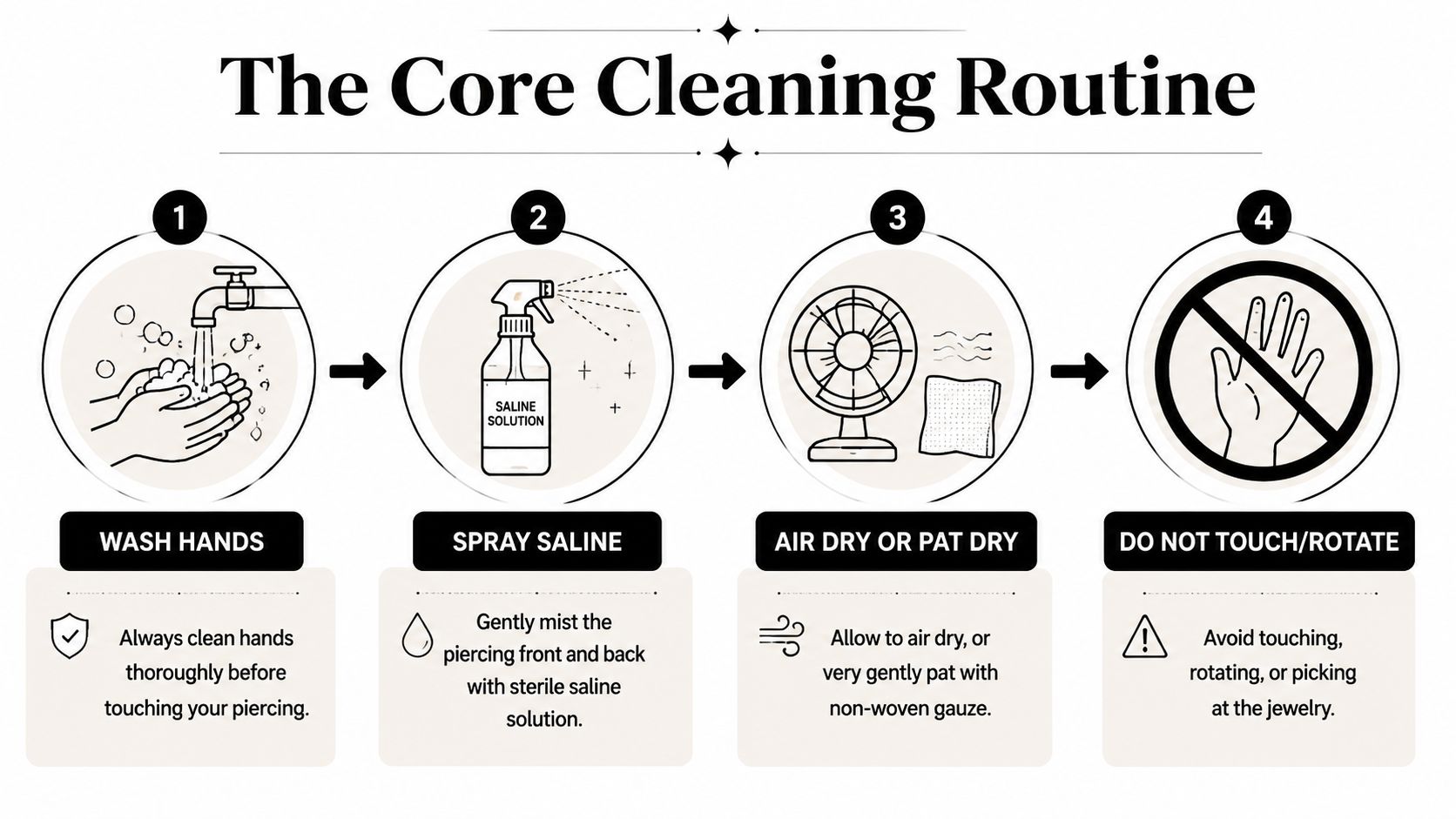
Start with your hands. Wash them properly before you touch the area at all. If you haven't washed your hands, don't move the jewellery, don't check the back, and don't pick away dried discharge.
Then spray sterile saline onto the front and back of the piercing. Let it soften any dried matter rather than scrubbing at it. If you're in the shower later, warm running water can help rinse away loosened residue.
After that, drying matters. Moisture left sitting around a piercing can add irritation. Pat dry gently with fresh disposable paper towel or kitchen roll, or let it air dry fully if you can do that without hair, clothing, or hands getting involved. If you need the right product for this step, saline spray for piercing care is one practical option among standard wound-wash products.
The mistake most people don't realise they're making
Over-cleaning causes a surprising amount of grief. Clients often think flaking, tightness, redness, or soreness means they should clean even more. In many cases, that's exactly what keeps the piercing irritated.
Recent industry data says overuse of saline disrupts the skin's natural microbiome and slows epithelialisation. In a UK study, 54% of clients in Croydon and Bournemouth reported skin flaking and irritation from cleaning more than the recommended twice-daily frequency, according to Holier Than Thou aftercare guidance.
If your piercing feels dry, papery, or increasingly touchy, don't assume it's dirty. Sometimes it's over-managed.
What twice daily actually means
Twice daily means enough to support healing, not enough to turn the area into a project. For most fresh piercings, that's:
- A morning clean with sterile saline.
- An evening clean with sterile saline.
- A warm water rinse in the shower as part of normal hygiene if needed.
- Hands off in between unless there's a genuine reason to touch it.
That last point matters more than people think. Constant checking is still irritation.
What not to do during cleaning
A clean routine is gentle. A damaging one usually has too much friction, too much force, or too many products.
Avoid these habits:
- Don't rotate the jewellery. That drags dried material and bacteria through the channel.
- Don't soak it in strong mixes. More salt or more product isn't better care.
- Don't scrub crust away dry. Soften first, then rinse gently.
- Don't use communal towels. Fresh disposable paper is safer and kinder to the area.
- Don't keep switching products. Stick to one simple routine and give it time.
A piercing heals best when the skin is left calm enough to do its job.
Piercing Healing Timelines and What to Expect
Healing takes longer than most first-time clients expect, especially if the piercing sits in cartilage or denser tissue. The reason is simple. Different areas of the body have different blood supply, and tissue with lower vascularisation heals more slowly.
That's why lobes can seem settled quite quickly while cartilage, navels, and nipples may stay delicate for far longer. Looking good and being fully healed aren't the same thing.
Estimated piercing healing times
| Piercing Type | Average Full Healing Time |
|---|---|
| Earlobe | 4 to 6 months |
| Cartilage such as helix or conch | 12 to 24 months |
| Navel | 12 to 24 months |
| Nipples | 12 to 24 months |
These healing ranges are drawn from Maria Tash aftercare guidance on tissue vascularisation and healing times, which also notes that over-cleaning with harsh soaps can kill new cells and delay healing.
What healing often feels like
A healing piercing usually has phases. Early on, you may notice warmth, tenderness, minor swelling, or a little dried lymph. Later, the area often looks much calmer, but it can still flare up if it's knocked, slept on, or compressed by clothing.
Cartilage is especially prone to this stop-start feeling. It may behave for weeks, then react after one rough night's sleep.
Looking settled is not the same as being ready for jewellery changes, pressure, swimming, or rough handling.
Important callouts for ears and oral piercings
For ear piercings, starter jewellery needs to stay in place for a minimum of six weeks so the wound doesn't close, according to the American Academy of Dermatology advice on caring for pierced ears. Taking it out too early, even briefly, can allow the channel to retract.
For mouth and lip-adjacent piercings, the first stage of healing comes with extra rules. For the first 6 weeks after a piercing in or near the mouth, there must be no oral contact of any kind, including wet kissing or oral sex, and genital piercings may need that caution extended to 6 to 10 weeks, as explained in the University Health Services Berkeley body piercing guidance.
Patience beats guesswork
If you try to judge healing by how “fine” it looked yesterday, you'll end up second-guessing yourself. Judge it by the tissue type, how often it's being irritated, and whether the overall trend is improving.
That's the trade-off with piercings. A slower, calmer healing period now usually means fewer setbacks later.
Troubleshooting Common Piercing Issues
Most healing problems sit in one of two categories. Either the piercing is doing something normal that looks alarming to a first-timer, or it's being irritated by pressure, moisture, cosmetics, snagging, or an aftercare mistake.
Knowing the difference stops panic and helps you act early when something really does need attention.
What's usually normal
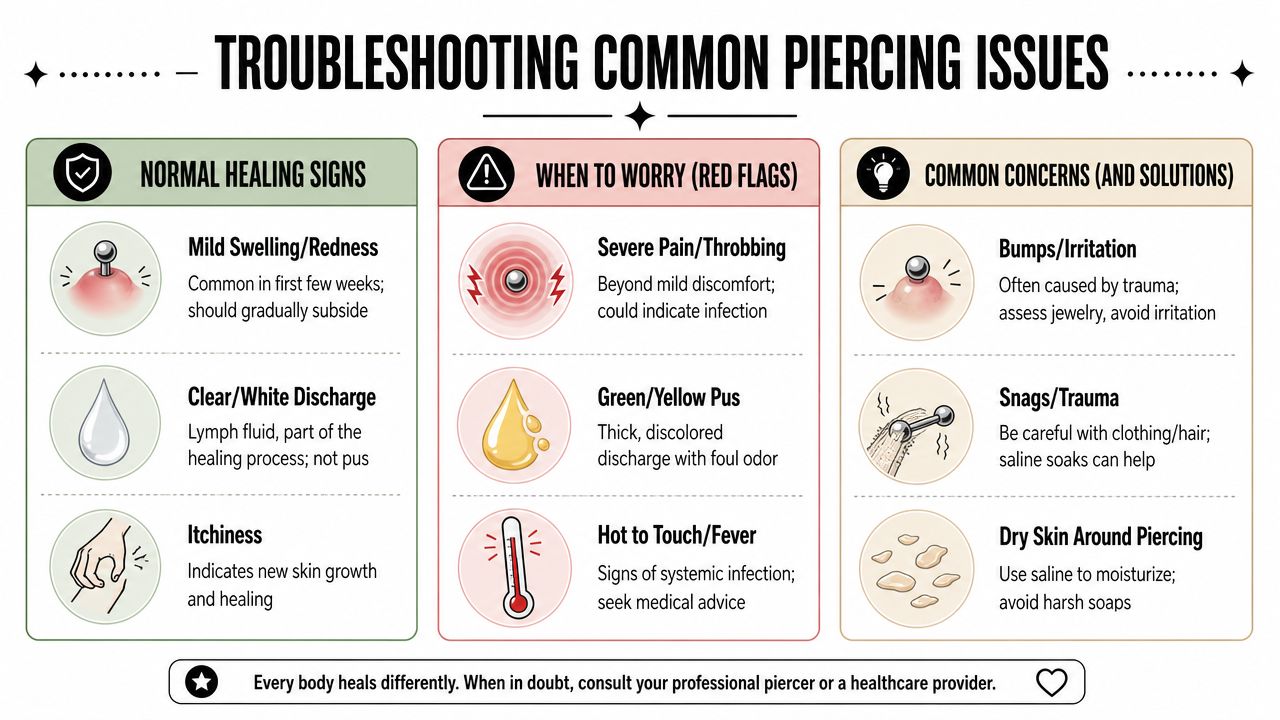
A fresh piercing can produce a small amount of clear or whitish dried discharge. Clients often call these “crusties”. That's usually dried lymph, not pus. Mild swelling, tenderness, occasional itching, and a bit of redness around a new piercing can also be part of ordinary healing.
An irritation bump is also common, especially on cartilage and nostrils. In practice, it's often linked to pressure, sleeping on the piercing, snagging it with clothing, or using too many products.
What deserves closer attention
You should be more cautious if the area becomes increasingly painful rather than gradually settling, if heat radiates outward, if swelling suddenly worsens, or if discharge becomes thick, strongly discoloured, or foul-smelling. Feeling generally unwell alongside a worsening piercing is a reason to seek medical advice promptly.
If you suspect infection, don't remove the jewellery on impulse unless a qualified clinician tells you to. Fresh piercings can close quickly, and removing jewellery can complicate drainage.
Worth remembering: irritation is common, but worsening pain, spreading heat, and feeling unwell should never be brushed off.
Common self-inflicted setbacks
A lot of clients don't do anything reckless. They just do one or two small things repeatedly that keep the piercing angry.
Common pitfalls that derail healing include premature jewellery removal, swimming in pools, which is linked with an increased infection risk of 15–20%, and applying creams or makeup near the site, which is linked to 10–15% of irritation cases, according to Tattoo Heroes piercing aftercare guidance.
That's why so many “mystery problems” turn out to be practical ones:
- Sleeping pressure from lying on the piercing.
- Hair wrapping round jewellery on ears and facial piercings.
- Moisture staying trapped after showers, workouts, or wet weather.
- Cosmetics and skincare drifting onto the site.
- Pool, hot tub, or open-water exposure too early.
What to do at home and when to get help
If the issue looks like irritation, simplify. Go back to sterile saline, reduce touching, stop sleeping on it, keep hair and clothing off it, and dry it properly after cleaning.
If the problem keeps worsening, contact your piercer. If you have signs of significant infection or you feel unwell, speak to a doctor. A good piercer can help you tell the difference between an annoyed piercing and one that needs medical assessment.
A Note for Our Croydon and Bournemouth Clients
If you're healing a new piercing locally, don't sit at home worrying over every little change. A quick check with a professional is often all it takes to sort out whether you're seeing normal healing, irritation, or something that needs extra care.
Clients in Croydon and Bournemouth often run into the same practical issues. Headphones pressing on fresh ears, hair snagging helix jewellery, gym sessions leaving moisture trapped, or beach and pool plans arriving before the piercing is ready. None of that means you've ruined it. It just means the aftercare may need tightening up for a few days.
If you've had your piercing done with us or you're unsure what you're looking at, get in touch. For any questions, big or small, give us a call on 01202 9000 50 or send a picture of your piercing to our dedicated WhatsApp support at 07752913846.
Sometimes the best aftercare advice is simple reassurance from someone who sees healing piercings every day.
Your First Piercing FAQs
When can I change my jewellery
Not when it first starts to look settled. Wait until the piercing is fully healed enough for a jewellery change, which depends on placement and how calm the tissue has been. Ear jewellery also shouldn't be removed too early, especially in the first stage of healing.
If you're unsure, get a piercer to assess it rather than guessing. A rushed jewellery change is one of the easiest ways to undo good healing.
Is a bit of bleeding or swelling normal at first
Yes, a small amount can be normal in the early days. Piercings are wounds, so some tenderness, minor swelling, and light spotting can happen depending on placement and how the tissue responds.
What matters is the direction of travel. You want gradual improvement, not steadily increasing pain, pressure, or heat.
Can I exercise with a new piercing
Usually yes, but be sensible. The risks come from friction, pressure, dirty hands, shared equipment touching the area, and leaving sweat or moisture sitting on the piercing for too long.
After a workout, rinse if needed, dry the area well, and avoid tight clothing rubbing directly over body piercings.
How should I sleep with it
If it's an ear piercing, keep pressure off it. A travel pillow or piercing pillow can make a huge difference because the ear sits in the gap rather than being crushed into the mattress.
If it's a navel or surface piercing, pay attention to waistbands, rolling over, and any sleepwear that catches the jewellery.
Should I rotate or move the jewellery while cleaning
No. That old advice causes trouble. Rotating jewellery drags debris through the channel and can tear up tissue that's trying to stabilise.
Clean around the piercing gently and leave the jewellery alone.
Is more saline better if it looks irritated
Usually not. This is one of the biggest myths in body piercing aftercare. If a piercing is flaky, dry, or touchy, extra cleaning may be the reason it's staying irritated.
Twice daily is usually enough. If you've been cleaning more often, simplify the routine and give the skin a chance to settle.
Can I swim with a new piercing
It's better to avoid it during healing. Pools, hot tubs, lakes, and the sea all create extra exposure you don't need, especially in the early phase. If water contact happens accidentally, rinse gently afterwards and keep an eye on how the piercing behaves over the next day or two.
What if I'm not sure whether it's normal
Ask. Don't crowdsource a diagnosis from strangers online who can't see the jewellery, the angle, the tissue, or your cleaning habits. A quick message to a professional can save you weeks of irritation.
If you're looking for safe, practical guidance before or after your appointment, Piercing Near Me helps you find professional studios, understand healing basics, and book with more confidence.
Trackbacks/Pingbacks