
You're probably here because you've seen a pair of Titanium Gold Earrings online or in a studio case and thought, “Great, I get the look of gold with the safety of titanium.” That's a reasonable assumption. It's also where a lot of confusion starts.
For first-time clients, the jewellery wall can feel oddly technical. One label says titanium, another says surgical steel, another says gold, and then there's “titanium gold” sitting in the middle sounding like it must be a metal blend or a solid gold piece with a titanium benefit. In most cases, that isn't what you're buying.
If you want a piercing that heals well and still looks polished, the material matters just as much as the placement. A pretty top means very little if the post going through your skin isn't suitable.
Why Your Piercing Jewellery Material Matters
Standing at the counter, it's easy to choose with your eyes first. That's normal. You notice the sparkle, the shape, the gold colour. Your skin, though, cares about something else entirely. It cares about the part of the jewellery that sits inside the piercing channel.
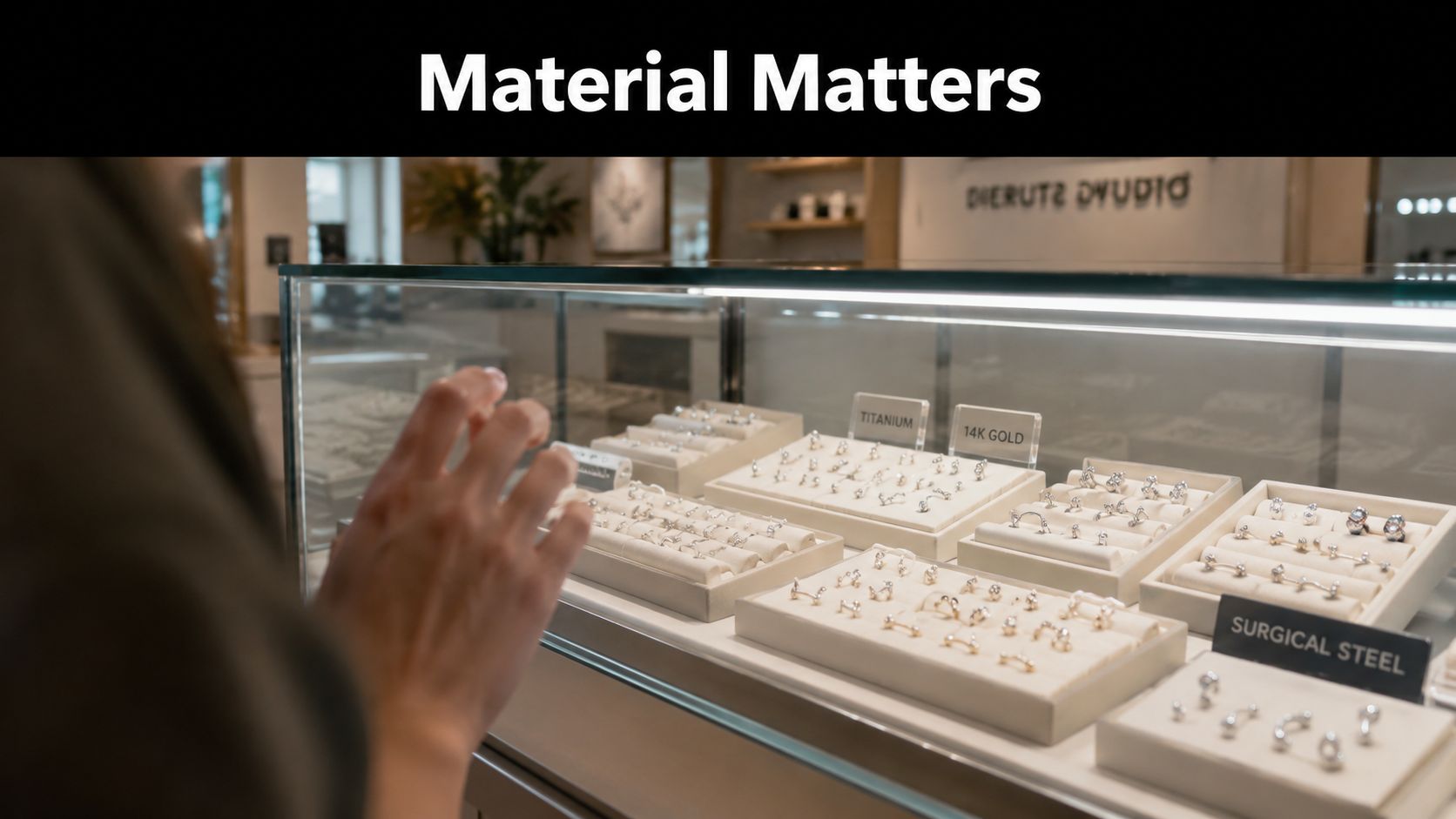
That's why material isn't a small detail. It affects healing, comfort, irritation risk, and how the piercing behaves day to day. If you've ever had earrings that left your ears hot, itchy, or sore, there's a good chance the issue wasn't your skin being “difficult”. The issue was the jewellery.
What your body reacts to
Fresh piercings are controlled wounds. They need stable, smooth, biocompatible jewellery while the tissue settles and rebuilds. Rough finishes, mystery metals, and low-quality coatings can create unnecessary friction or exposure to metals your body doesn't like.
A good piercer looks beyond the decorative front. They check:
- The base material so the post is suitable for skin contact
- The finish quality so the surface is smooth rather than scratchy
- The jewellery construction so insertion doesn't scrape the channel
- The intended use because healed-lobe jewellery isn't always suitable for a fresh cartilage piercing
Practical rule: For a new piercing, ask about the post first and the colour second.
Why implant-grade matters
When piercers talk about implant-grade titanium, they're talking about jewellery made to a higher standard than ordinary fashion jewellery. That matters because body jewellery isn't just decorative. It sits in living tissue.
The UK jewellery sector is large, with the watch and jewellery market reaching approximately $17.5 billion in 2023 according to Statista's UK jewellery industry overview. In a market that size, there's a huge range in quality. Some pieces are built for safe wear in piercings. Others are mainly built to look good in a product photo.
That's why you shouldn't treat all gold-coloured earrings as equal. Two pieces can look nearly identical in the tray and behave very differently once they're in your ear.
What Titanium Gold Earrings Really Are
The term Titanium Gold Earrings often leads to one of two assumptions: that the earrings are made of solid gold and titanium together, or that “titanium gold” is the name of a special metal. In most cases, neither is true.
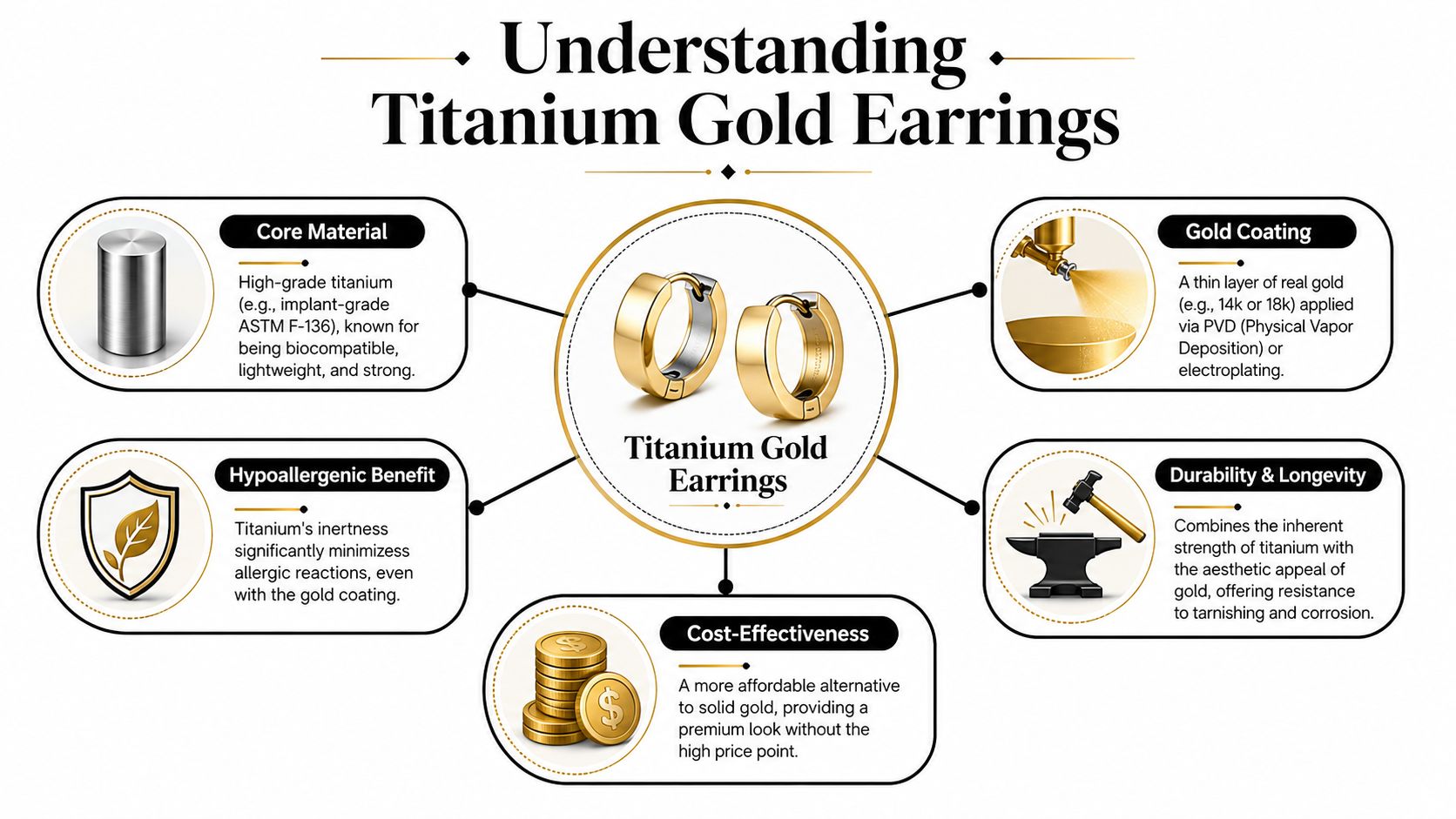
Usually, you're looking at titanium jewellery with a gold-coloured surface. The titanium is the working material. The gold appearance is the finish.
The simplest way to understand it
Imagine a high-quality waterproof jacket. The inner fabric performs the key function. It gives the jacket strength, structure, and performance. The outer finish adds the look and some surface protection.
Titanium gold earrings work in a similar way. The titanium core is what gives you the lightweight, strong, body-friendly base. The gold-tone layer is what creates the colour people want.
How the gold colour gets there
The two terms you'll usually hear are PVD coating and anodisation.
- PVD coating means a very thin layer is bonded to the surface in a controlled process.
- Anodisation changes the oxide layer on the titanium itself to produce colour.
Camden Body Jewellery states that implant-grade titanium jewellery such as ASTM F136 pieces can use Ti-6Al-4V ELI alloy with nickel content of less than 0.005%, and that the gold colour can be produced by PVD coating or electrolytic anodisation at approximately 570 to 590 nm. It also notes that this process creates a durable surface designed not to peel into the piercing channel. You can read those details in Camden's titanium earrings collection information.
That sounds reassuring, but there's an important distinction. A gold-coloured finish is not the same thing as solid gold jewellery.
Where buyers get misled
This is the part many shops gloss over. According to Rhokea's UK titanium earrings market page, 95% of products marketed this way are PVD or plated titanium with gold-tone fronts, and only 2% of UK retailers explicitly disclose that plating process. The same source says fading can happen after 6 to 12 months of wear.
That doesn't make titanium gold earrings bad. It just means you should buy them with the right expectation. You're choosing a titanium piece with a gold look, not a forever-solid-gold surface.
If you're browsing different styles, it helps to compare options sold specifically as titanium piercing jewellery so you can separate body-safe materials from fashion-led descriptions.
If a listing says “gold titanium” but doesn't explain whether the gold colour is coated or anodised, pause before you buy.
The Hypoallergenic and Durable Choice
The reason piercers keep coming back to titanium isn't hype. It's because the base material solves several problems at once.
For initial body piercings, Tribu Piercings' guide to APP-approved titanium standards says implant-grade titanium (ASTM F-136 or ISO 5832-3) is the gold standard because it is inert, lightweight, and ideal for individuals with nickel sensitivity. The same guide notes that gold jewellery must be 14k or higher, nickel-free, cadmium-free, and alloyed for biocompatibility to be considered safe.
Why titanium suits sensitive skin
Titanium has a strong reputation because it's biocompatible. In plain language, your body is far less likely to object to it. That's why clients with reactive skin often do better in implant-grade titanium than in mixed-metal fashion earrings.
Its low reactivity is especially useful when:
- You're getting your first piercing and don't yet know how your skin responds
- You've reacted to earrings before and suspect nickel may be the issue
- You're healing cartilage piercings where irritation tends to be more stubborn
Why the finish still matters
Titanium's safety isn't only about the metal formula. It's also about surface quality and construction. The Association of Professional Piercers jewellery standards page explains that titanium body jewellery should meet ASTM F86 surface finish standards and have a mirror-smooth, electro-polished surface. It also notes that internal threading is preferred because it avoids scraping the piercing channel during insertion.
That's a practical detail many clients never hear. A beautiful decorative top doesn't compensate for a rough post or poor threading.
Studio habit worth keeping: Ask whether the jewellery is implant-grade and internally threaded before it goes anywhere near a fresh piercing.
Everyday wear benefits
Even once healed, titanium remains easy to live with. It's light, so larger ends feel less heavy on the ear. It resists corrosion, so normal exposure to sweat and water is less of a problem than with lower-quality metals. And because it's strong, it holds up well as a long-term staple in cartilage, lobes, and many body placements.
That's why titanium gold earrings appeal to so many people. You get a polished gold appearance with a base material that piercers trust.
Comparing Your Piercing Jewellery Options
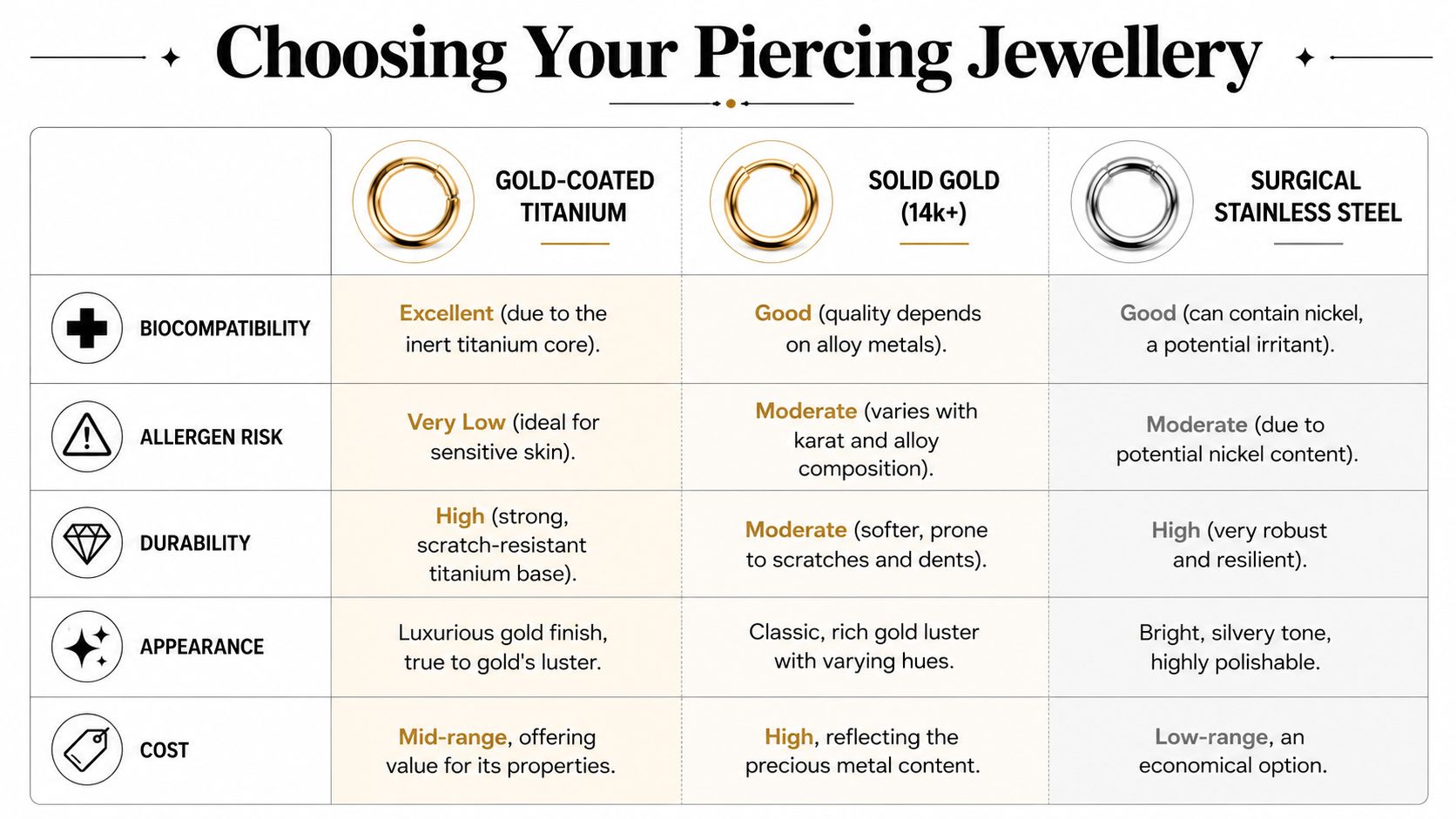
If you're deciding between gold-coated titanium, solid 14k+ gold, and surgical steel, the right choice depends on what matters most to you. Healing safety, appearance, long-term wear, and budget don't always point to the same answer.
A quick side-by-side view
| Material | Best for | Watch out for |
|---|---|---|
| Gold-coated titanium | Clients who want the gold look with a titanium base | The gold finish may wear over time |
| Solid gold 14k+ | Clients who want precious metal jewellery and can verify the alloy | Softer metal, higher cost, quality depends on composition |
| Surgical steel | Healed piercings for people who tolerate it well | Can contain nickel, so it isn't ideal for everyone |
Gold-coated titanium
This option gives many people the look they want at a more approachable price than solid gold. The titanium underneath is the main advantage. It's lightweight and generally well accepted by the body.
The limitation is simple. The gold colour is a surface treatment, so appearance can change with time and wear. That matters most if you expect the finish to stay exactly the same for years.
Solid gold 14k and above
Solid gold can be an excellent piercing option when it is properly made. For body jewellery, the alloy matters a lot. Gold isn't automatically safe just because it's gold. It needs to be suitable for piercings, not just for occasional jewellery wear.
There's also a practical wear issue. Gold is softer than titanium and can pick up scratches or dents more easily. Some people love that trade-off because they want solid precious metal. Others would rather have a tougher everyday piece.
Surgical steel
Surgical steel is common and often affordable. Some clients wear it with no trouble at all. But it's not the easiest choice for someone with sensitive skin or for anyone trying to reduce uncertainty in a fresh piercing.
Under European piercing jewellery regulations summarised by Trinity Body Jewellery, jewellery parts that sit in the skin must release nickel at less than 0.2 micrograms per square centimetre per week, while lead must be at or below 0.05% by weight and cadmium at or below 0.01% by weight. Regulations help, but many clients still prefer implant-grade titanium when healing is the priority.
What about fresh piercings
The choice becomes much less flexible. Tinilux's discussion of fresh piercing safety notes that worn PVD-plated jewellery can create risk at the post interface if the surface thins, and it says UK piercing guidance for 2024 to 2025 requires 100% solid implant-grade titanium or 14k+ solid gold for new piercings.
So if you're booking a new cartilage or lobe piercing and you like a gold look, ask whether the piece is suitable for an initial piercing or whether it's better as a later change once the piercing is stable. If you're comparing styles, it can help to look through examples such as gold huggie earrings in the UK and then confirm which ones are for healed wear versus fresh piercings.
Fresh piercing jewellery should be chosen like medical equipment first and jewellery second.
How to Choose and Care For Your Jewellery
Once you know what Titanium Gold Earrings are, buying gets easier. You don't need to memorise technical language. You just need a short list of smart questions and a few care habits that protect both your piercing and the finish.
Questions to ask before you buy
At the studio, don't be shy about asking direct questions. A good piercer expects them.
Use this checklist:
Is the post implant-grade titanium?
Ask whether it's ASTM F-136 or another recognised implant-grade specification.Is the gold colour anodised or PVD coated?
This tells you whether you're buying a coloured titanium finish or a plated surface.Is this suitable for a fresh piercing or only for a healed one?
That answer matters more than the style name.Is the jewellery internally threaded or threadless?
You want insertion to be as smooth as possible.What part of the piece sits inside the piercing?
Decorative fronts get attention, but the post is what your body lives with.
How to read product wording
Some descriptions sound impressive while saying almost nothing. Be cautious with phrases like “hypoallergenic”, “surgical”, or “gold titanium” if the listing doesn't explain the exact material.
Look for wording that clearly identifies:
- The base metal
- The coating or colour process
- Whether it's for initial piercings
- The threading style
- Aftercare guidance
If the wording is vague, ask before you commit.
Caring for the jewellery and the finish
For healing piercings, keep aftercare simple. Sterile saline and clean hands do most of the work. Avoid harsh cleansers, alcohol-based products, and scrubbing around the jewellery.
For gold-coloured titanium pieces in particular:
- Use sterile saline rather than homemade mixes or chemical-heavy cleaners
- Avoid abrasive cloths that can wear the gold-coloured surface
- Keep cosmetics off the area where possible, especially sprays and creams
- Don't twist the jewellery just to “check” it, because movement irritates healing tissue
If a healed piece starts looking dull or patchy, that doesn't always mean the jewellery is unsafe. It may mean the surface colour is wearing. That's an appearance issue first, though any irritation means it's time to have a piercer inspect it.
Find Your Perfect Piercing in Croydon and Bournemouth
The best studio experience feels clear from the start. You can ask basic questions without feeling awkward. The piercer explains what the jewellery is made from, tells you whether it suits a fresh piercing, and doesn't hide behind vague sales language.
That matters even more with Titanium Gold Earrings, because the gold look can distract from the central question. What is the post made from, and is it appropriate for your piercing today?
For clients in South London and on the South Coast, professional support makes that choice much easier. Timebomb Tattoo & Piercing in Croydon and Bournemouth focuses on safe, professional piercing with clear jewellery guidance, single-use sterile needles, and quality options suitable for real healing, not just display-case appeal.
Why local support helps
An experienced studio can check placement, explain whether a gold-coloured option is suitable now or better later, and help you choose jewellery that fits both your anatomy and your style. That's especially helpful if this is your first cartilage, nostril, conch, or lobe piercing.
You can also speak to someone before booking through professional ear piercing near me if you want to compare options and understand what's best for a fresh piercing.
If you'd like to contact the studio directly, the phone number is 01202 9000 50 and the WhatsApp number is 07752913846.
If you want a safer, clearer route to your next piercing, Piercing Near Me helps you explore trusted studios, understand your jewellery options, and book with more confidence.