
You're probably reading this with a mix of excitement and nerves. Maybe you've wanted your first lobe piercing for ages, maybe you're thinking about a helix after years of wearing earrings, or maybe you're a parent trying to make sure your teen's appointment is done properly.
Getting ear pierced should feel straightforward, calm, and safe. The problem is that a lot of advice in the UK still blurs together two very different experiences: a professional needle piercing in a proper studio, and a quick gun piercing in a retail setting. They are not the same thing. If you understand that difference before you book, you'll avoid most of the mistakes first-time clients make.
Before You Book Choosing Your Piercing and Studio
The most important choice happens before anyone touches your ear. It's not the jewellery colour. It's not whether you want a stud or a hoop later on. It's where you go and how they pierce.
In the UK, ear piercing is already part of everyday life for many people. 84% of female respondents in the United Kingdom reported having their earlobe pierced, according to Statista's piercing survey data. That tells you something useful as a first-time client. Most studios aren't dealing only with first lobes. They're also helping people add second lobes, helix piercings, conch piercings, and other placements that need more precision and better technique.
Choose the placement with healing in mind
A lobe piercing goes through soft tissue. That usually makes it simpler to heal than cartilage.
A helix, tragus, conch, or rook goes through firmer tissue, and that changes everything. Cartilage is less forgiving. It swells more easily, gets irritated more easily, and takes longer to settle. If you sleep on that side, wear tight headphones, or catch it with a hairbrush, you'll notice it quickly.
A good piercer will talk through:
- Your anatomy: Not every ear suits every placement.
- Your routine: Side sleepers and headphone users need honest advice.
- Your jewellery start point: A flat-back stud is often a safer starter option than a ring.
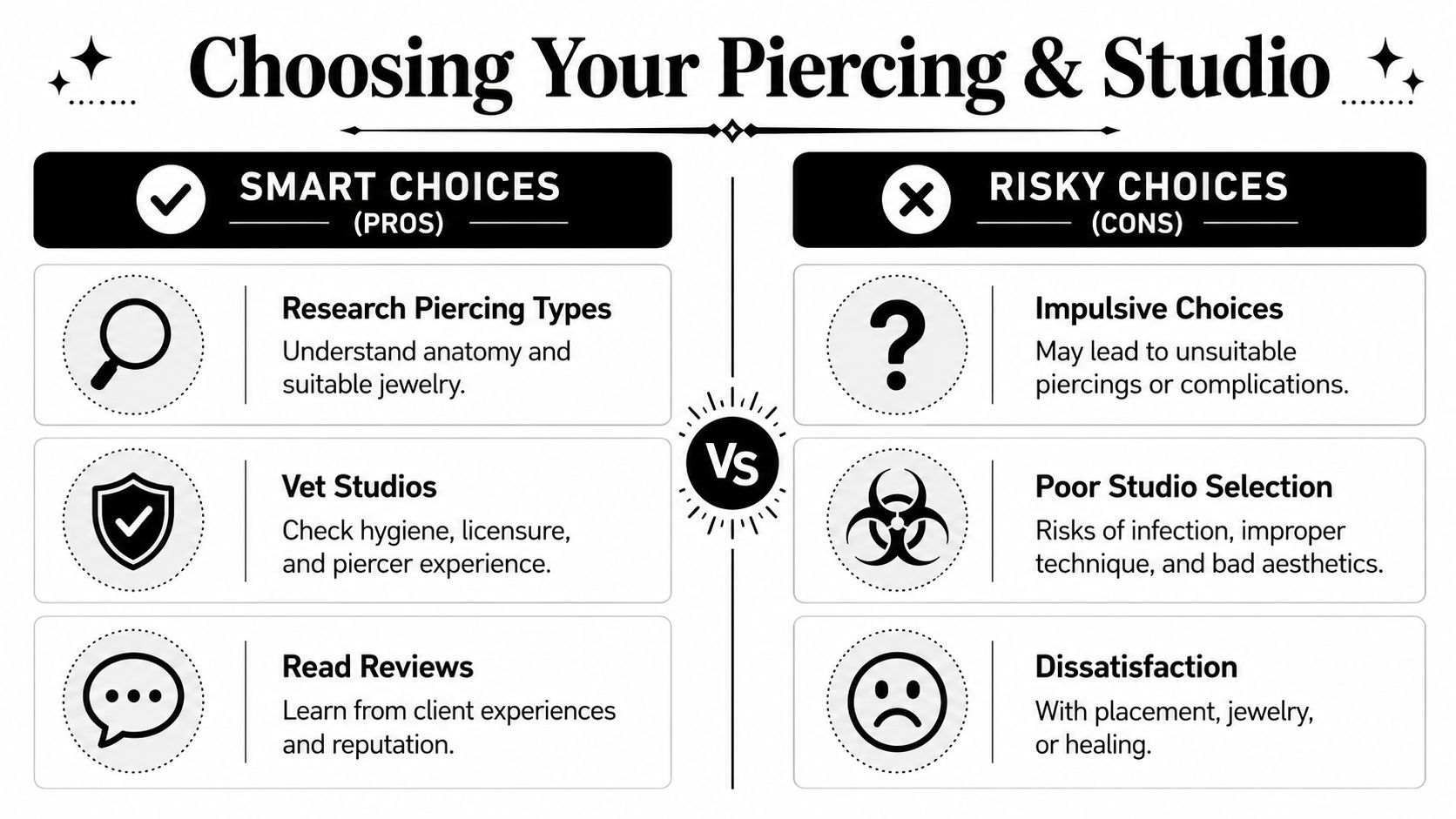
This visual helps sort the smart choices from the risky ones.
Needle versus gun isn't a style preference
This is the safety issue that matters most.
The Mayo Clinic explicitly warns that “Reusable guns also may damage ear tissue” and recommends choosing a piercer who uses “a fresh, sterile, disposable needle” instead, in its guide to piercing safety and aftercare from the Mayo Clinic. The same verified guidance notes that needle-only studios in the UK have significantly lower complication rates, based on BAPP data referenced there.
That matters for lobes, but it matters even more for cartilage. A piercing needle is sharp and designed to create a clean channel. A gun uses force. In soft tissue that's already less ideal. In cartilage, it's poor practice.
Practical rule: If a studio offers cartilage piercing with a gun, walk away.
If you want to browse a professional option before booking, this guide to professional ear piercing near me is a useful starting point.
What a reputable studio should show you
You shouldn't have to guess whether a studio is safe. The signs are visible.
Hygiene you can actually see
The room should look clinical, organised, and easy to clean. Your piercer should wash their hands, use fresh gloves, and open sterile items in front of you where appropriate. Jewellery for initial piercings should be suitable for fresh wounds, not mystery metal from a display rack.
A piercer who explains the why
A good consultation doesn't feel rushed. They should explain placement, angle, jewellery size, likely swelling, and healing expectations in plain English. If you ask, “Can I sleep on this?” or “Can I start with a hoop?”, you should get a clear answer, not a sales line.
Jewellery quality
For a fresh piercing, implant-grade titanium is a strong standard because it's widely trusted for initial wear. It's plain, practical, and kind to healing tissue.
Portfolio and consistency
Look at healed work, not just fresh, filtered photos. You want neat placement, balanced angles, and evidence that the studio pierces the kind of ear you have.
Preparation and Legal Requirements in the UK
A good piercing appointment starts before you leave home. Clients faint less often and feel steadier when they've eaten, had water, and arrived without rushing. You don't need a complicated ritual. You just need to give your body a fair chance to cope well with stress.
Bring patience too. If your piercer checks your ID carefully, asks health questions, and takes time marking placement, that's a good sign.
What to do before you arrive
A simple routine works best:
- Eat a proper meal: Don't turn up on an empty stomach.
- Drink water: Feeling dehydrated can make nerves feel worse.
- Avoid alcohol: It's a poor idea before any piercing appointment.
- Wear practical clothing: Especially if you're getting cartilage pierced and need easy access around the ear.
- Tie back long hair: It makes marking, piercing, and cleaning easier.
Turn up as if you're going to a careful appointment, not popping into a shop for an impulse buy.
ID rules for younger clients
The UK rules can catch people out, especially families who assume a bank card or phone photo will do. It won't.
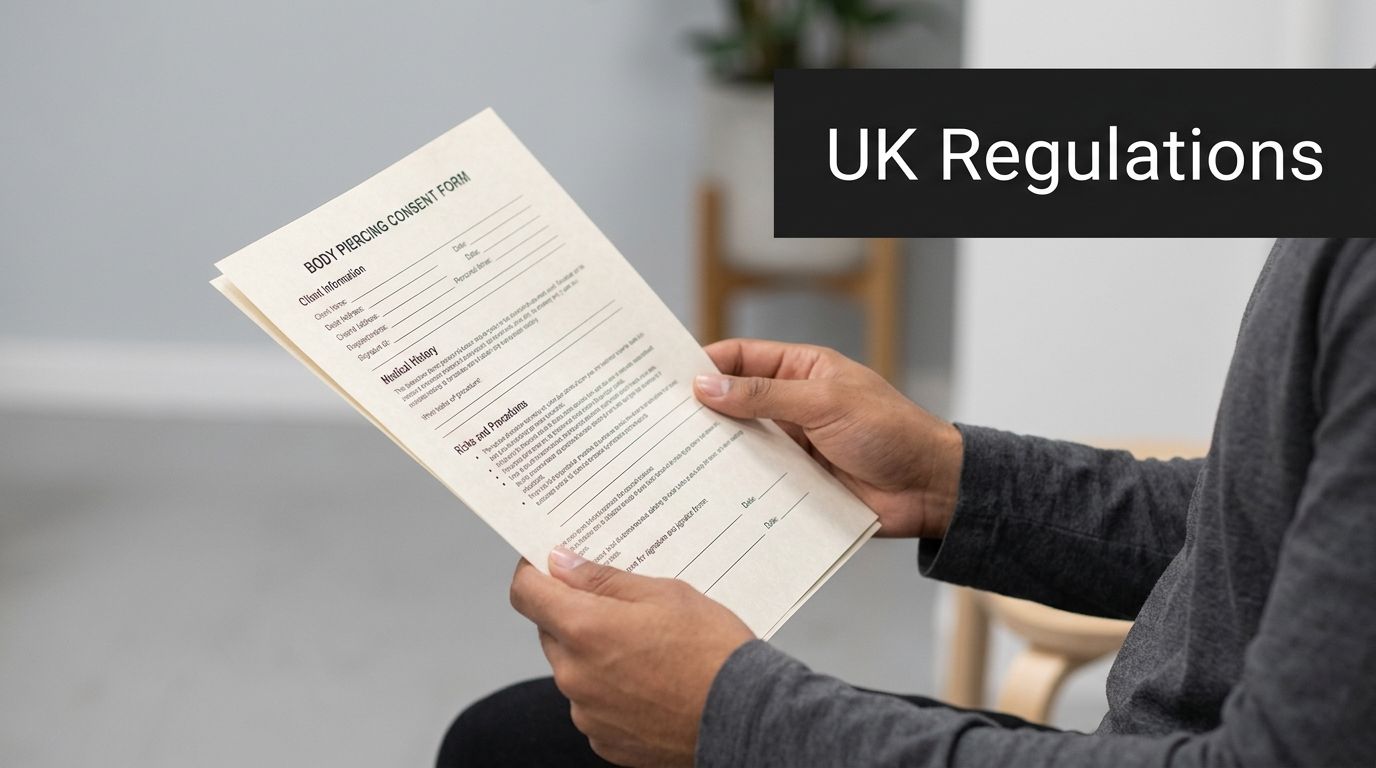
Anyone aged 10 to 15 must be accompanied by a parent or legal guardian for a piercing appointment, and both must bring original valid photo ID. Accepted ID is Passport, Driver's Licence, or UK PASS card only. If surnames differ, a birth certificate must also be provided, according to UK piercing age and ID guidance.
If you're booking for a younger teen, check the details in advance with this page on piercing age rules in the UK.
What ear piercing costs in the UK
Price matters, but cheap shouldn't be your main filter.
According to UK ear piercing cost guidance from Airtasker, a standard earlobe piercing typically ranges from £20 to £70 in the UK, with common pricing for one or both ears often sitting in the £28 to £60 range. The same source notes that cartilage piercings commonly range from £30 to £50, while industrial piercings can range from £45 to £70.
That spread usually reflects location, studio reputation, jewellery quality, and the complexity of the piercing. A professional studio isn't only charging for the moment of piercing. You're paying for sterile technique, proper jewellery, informed placement, and aftercare support if anything becomes awkward during healing.
The Piercing Appointment What Really Happens
You're in the chair, the consent form is done, and your heart is beating a bit faster than usual. That part is normal. A well-run studio in the UK should feel more like a clean treatment room than a rushed retail counter, especially if you are choosing a needle piercing rather than a gun.
The appointment usually starts with a short conversation, even if you have already decided what you want. Your piercer checks the placement, the anatomy of your ear, and the jewellery choice together because ears are not flat pieces of paper. A placement that looks right on one person can sit awkwardly on another, especially with helix and other cartilage piercings. If you wear glasses, earbuds, a helmet, or keep your hair tucked behind one side, say so. Those small details affect comfort.
The consultation and marking
The mirror becomes your best tool at this stage.
Your piercer cleans the skin, marks the spot, and asks you to check it from more than one angle. A few millimetres can change how balanced a lobe stack looks or whether a helix sits neatly along the rim. Good marking is like measuring before drilling a hole in a wall. It is much easier to adjust before the piercing than after it.
This is also the point where the needle versus gun difference matters most. A professional studio will use a sterile single-use needle for cartilage because it creates a clean channel through the tissue. A gun uses blunt force. On a soft lobe, that is already less controlled than a needle. On cartilage, it is a poor choice and can cause extra trauma, pressure, and swelling. If a studio offers gun piercing for cartilage, treat that as a reason to leave.
Jewellery selection
Starter jewellery is selected for healing, not just appearance.
Your piercer should choose jewellery with enough room for early swelling and a shape that stays stable. For many first-time clients, that means a flat-back stud rather than a ring. Rings move more, catch more easily, and can make an already tender piercing harder to settle.
Implant-grade titanium is a common starting point in reputable UK studios because it is well suited to fresh piercings and easy for many people to tolerate. If your piercer recommends a different size or style than the one you had in mind, there is often a practical reason. They are trying to give the piercing the best start.
The actual piercing moment
Once you are happy with the mark, your piercer positions you and asks you to keep still. They may steady the ear by hand or with a receiving tube, depending on the placement. Then the needle passes through, and the jewellery follows immediately after.
It is quick.
Most clients describe it as a sharp pinch followed by pressure and heat. Cartilage often feels more intense than a lobe, but the sensation usually passes fast. Watery eyes, a flush in the face, or a brief adrenaline wobble can all happen. None of that automatically means anything is wrong.
A needle appointment often feels calmer than people expect because it is controlled from start to finish. There is no loud click, no sudden spring-loaded jolt, and no guessing about how the jewellery was forced through the tissue.
Before you leave
The final few minutes matter as much as the piercing itself. Your piercer should check the jewellery, clean away any spotting, and explain what is normal over the next few days. Mild swelling, warmth, tenderness, and a little bleeding can happen early on.
You should also leave knowing how to look after it without overdoing it. If you want a clear routine to follow once you get home, this guide to after ear piercing care breaks down cleaning, sleeping, and common mistakes in plain English.
A good studio will also tell you when to come back for a downsize if your jewellery is intentionally a little longer to allow for swelling. That follow-up is one of the quiet signs of a careful piercer. It shows they are planning for healing, not only for the appointment itself.
If you want the safest route for a first piercing, book with a studio that uses needles, stocks implant-grade jewellery, and takes time over placement. In Croydon and Bournemouth, trusted local studios usually make booking available online, so you can check age rules, jewellery options, and appointment slots before you set foot in the studio.
The Complete Guide to Piercing Aftercare and Healing
You get home, look in the mirror, and notice the ear feels warm, slightly swollen, and more noticeable than it did in the studio. That moment catches a lot of first-time clients off guard. In many cases, it is the start of normal healing, not a sign that anything has gone wrong.
The appointment is short. Healing is the longer part, and it responds best to a calm routine.
Start with a simple approach
Professional aftercare is usually less dramatic than people expect. A fresh piercing behaves more like a small wound with jewellery placed through it. It needs cleanliness, stability, and time. It does not need constant attention.
Piercers often use the phrase LITHA, short for Leave It The Hell Alone. The meaning is straightforward. Do not poke it, twist it, test it, or keep checking whether it is still sore.
Your basic routine at home
Keep the routine boring. Boring heals well.
- Use sterile saline if your piercer recommends it: A gentle rinse is usually enough.
- Wash your hands before touching the area: Clean hands reduce the chance of transferring irritation or bacteria.
- Let clean water run over the piercing in the shower: This helps loosen dried discharge without scrubbing.
- Pat dry with clean kitchen roll or another disposable paper product: Fabric towels can hold moisture and snag the jewellery.
- Keep the jewellery in place: Removal interrupts healing and can cause the channel to shrink or close.
If you want a clear day-by-day routine, this guide to after ear piercing care explains cleaning, sleeping, and product choices in plain English.
What slows healing down
The biggest aftercare mistakes usually come from good intentions. People want to help the piercing along, so they clean too often, move the jewellery, or reach for strong products.
Avoid alcohol, peroxide, thick ointments, and homemade salt mixtures unless a medical professional has told you otherwise. Avoid twisting the jewellery to "stop it sticking". Jewellery does not need to be rotated through a healing channel. In practice, extra movement often causes the tenderness people were trying to prevent.
Pressure matters too. A new ear piercing can become irritated because it is being compressed for hours at a time. Side sleeping, over-ear headphones, motorcycle helmets, snug hats, hair snagging around the backing, and phones pressed against the ear can all keep a piercing in a low-level cycle of swelling and recovery.
Irritation is common, and it often looks more dramatic than it is
Many first-time clients commonly become confused. An irritated piercing can look angry without being infected.
A helpful way to read it is to look for a pattern. Irritation often flares after a clear trigger, such as sleeping on that side, catching it while changing clothes, or cleaning it too aggressively. Infection is discussed in the next section, but simple irritation usually settles when the trigger is removed and the aftercare routine is simplified.
Signs that often fit irritation include:
- Tenderness after pressure or knocking
- Light redness that fades and returns
- A small bump near the entry or exit point
- Clear or pale crusties
- An ear that improves when left alone
If you sleep on your side, a travel pillow works like a pressure relief ring. Rest your ear in the centre hole so the piercing is not carrying the weight of your head.
Healing takes longer inside than outside
A piercing can look settled on the surface while the channel underneath is still fragile. That is why early jewellery changes cause trouble so often, especially with cartilage.
Lobes usually calm down faster. Cartilage usually takes much more patience. That difference comes up a lot in UK studios, especially when clients book a helix or tragus because it looks simple from the outside. Cartilage is firmer, less forgiving, and more likely to complain if it is bumped, slept on, or fitted with the wrong length jewellery.
Here is a practical guide to common ear piercing timelines.
| Piercing Type | Pain Level (1-10) | Initial Healing (Downsizing) | Full Healing Time |
|---|---|---|---|
| Lobe | 3 | Often discussed at follow-up if swelling settles well | Usually shorter than cartilage |
| Upper lobe | 4 | Often discussed at follow-up if needed | Variable |
| Helix | 6 | Commonly reviewed once initial swelling reduces | 6+ months |
| Tragus | 6 | Often reviewed after early swelling stage | 6+ months |
| Conch | 7 | Usually assessed once jewellery length is no longer needed | 6+ months |
| Rook | 7 | Reviewed based on swelling and placement stability | 6+ months |
Pain scores are only rough comparisons. Your anatomy, stress level, and the exact placement all affect how it feels.
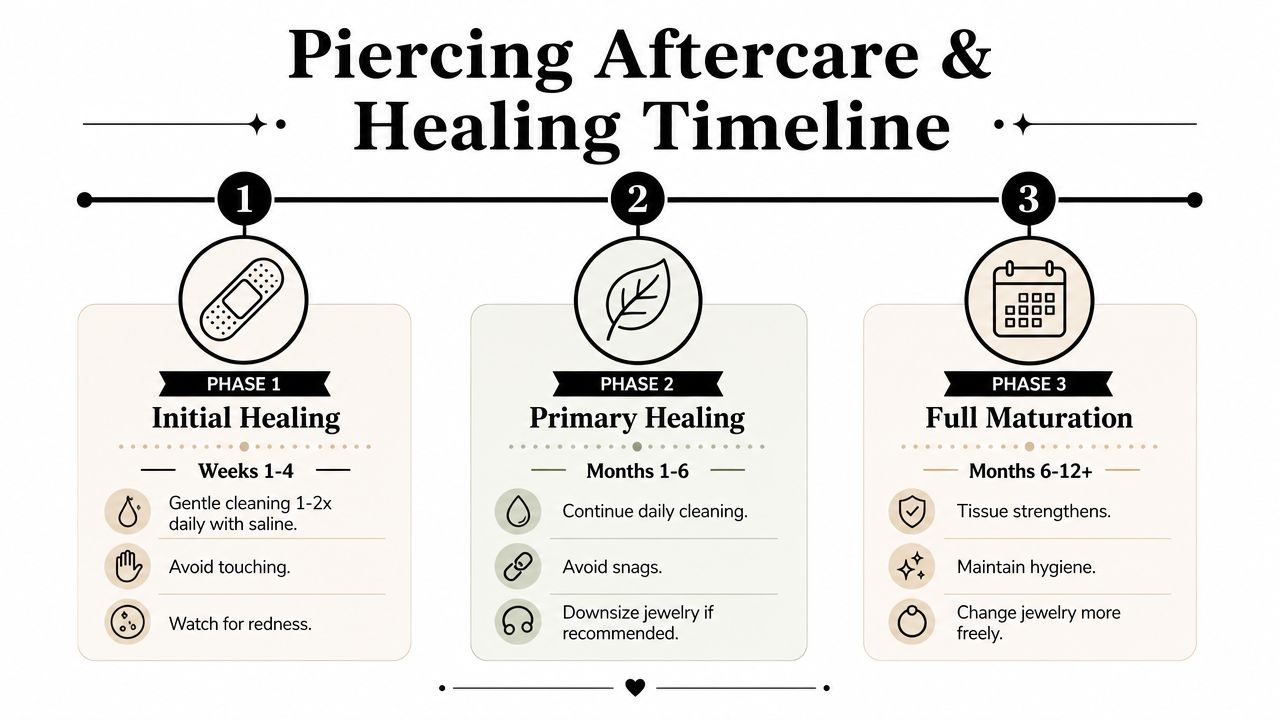
Healing works in phases
The first phase is the reactive phase. The ear may feel warm, look a bit pink, and seem more swollen in the evening than it did in the morning. Mild crusting can happen too.
The second phase is the settling phase. In this phase, people often get overconfident because the piercing starts to feel easier, then suddenly gets irritated again after one bad night's sleep or one accidental snag. That up-and-down pattern is common.
The final phase is the maturing phase. The outside may look fine, but the inside is still strengthening. That is why piercers in careful studios, including reputable needle-only studios in Croydon and Bournemouth, often book a downsize before they suggest any jewellery change for style. A shorter post reduces excess movement, and less movement usually means fewer bumps and flare-ups.
Patience helps more than products do.
Troubleshooting Common Issues and When to Seek Help
Most healing problems are manageable if you read them correctly. Panic usually makes things worse. So does guessing.
A piercing that's annoyed and a piercing that's infected can look similar at first glance, especially to a first-timer. The key is to look at the whole pattern, not one symptom in isolation.
Normal healing versus common irritation
Normal healing can include mild redness, light swelling, tenderness, and dried discharge. Irritation often adds a more obvious trigger. You slept on it, caught it with a jumper, changed your shampoo, wore headphones for hours, or cleaned it too aggressively.
A true infection usually feels more intense and more persistent. The area may become increasingly hot, the redness may spread, and discharge may look thicker and more concerning.
A simple decision check
- Ask what changed: Did you bump it, sleep on it, or touch it more than usual?
- Look at the discharge: Pale crusties are different from thicker yellow or green pus.
- Check the trend: Is it gradually calming, or getting worse day by day?
- Contact your piercer first: They see irritated piercings all the time and can often spot the cause.
- Seek medical help if symptoms escalate: Don't wait if the ear looks increasingly unwell.
Cartilage needs extra respect
Cartilage complications deserve faster attention. An estimated 30% of ear piercings involve the upper, cartilaginous area, which carries significantly higher infection risks. A documented doubling in auricular perichondritis incidence in England and Wales has been linked to this trend, and local health officials found that 95% of GPs had treated complications from high piercings, according to the clinical report on ear-piercing complications published on PMC.
That doesn't mean cartilage is a bad choice. It means you should treat it as a piercing that needs patience, proper technique, and faster action if something feels off.
If a cartilage piercing becomes increasingly swollen, hot, and painful, don't assume it will sort itself out.
When medical advice matters
Your piercer is your first stop for most healing concerns. A GP or urgent medical service matters when symptoms suggest more than simple irritation.
Seek medical advice promptly if you have:
- Spreading redness
- Noticeable heat that's increasing
- Yellow or green pus
- Pain that's worsening rather than settling
- A general feeling of illness alongside the piercing issue
Don't remove jewellery on your own unless a medical professional tells you to. That decision depends on what's happening and where the piercing is.
Ready for Your Piercing Book With the Experts
By this point, the pattern is clear. Safe ear piercing isn't about bravery or luck. It comes down to choosing a studio that uses the right method, fits you with appropriate jewellery, and gives you proper support after the appointment.
That matters whether you're getting simple lobes, a first helix, or a more considered cartilage placement. It matters if you're an adult booking for yourself and it matters even more if you're a parent helping a younger client through the process. Clean technique, single-use sterile needles, implant-grade jewellery, and clear aftercare aren't extras. They're the baseline.
For clients in Croydon and Bournemouth, Timebomb Tattoo & Piercing offers the kind of environment first-timers usually hope for. Professional, calm, and set up to do things properly.
If you're ready to book or you want to ask a few questions first, call 01202 9000 50 or send a WhatsApp message to 07752913846. If you're nervous, say so. Good piercers hear that every day, and a good studio will make the experience feel clear instead of intimidating.
If you want help finding a safe studio, comparing placements, or booking with trusted professionals in Croydon or Bournemouth, visit Piercing Near Me. It's a practical place to start if you want getting ear pierced to be done properly from day one.