
You're probably here because you want a new piercing, or you're trying to replace an earring that keeps making your ear sore, itchy, or angry. Then you start reading product descriptions and suddenly every shop is throwing around words like “implant-grade”, “hypoallergenic”, “ASTM F136”, and “medical metal”.
That's where many get stuck.
As a piercer, I see this all the time. Someone comes in wanting a simple helix, conch, or lobe piercing, and what they really want is straightforward advice. They want jewellery that looks good, feels comfortable, and gives their piercing the best chance to heal without drama. They don't want to become a metal expert just to buy an earring safely.
The good news is that you don't need to memorise metallurgy. You just need to know what matters, what questions to ask, and what warning signs to avoid.
Your Guide to Safe and Stylish Piercings
A first piercing appointment can feel oddly technical. You might be choosing between a tiny bezel-set stud and a plain ball end, and then the conversation turns to things like threading, polish, titanium grades, and sterilisation pouches. For a first-time client, that can sound like too much information all at once.
The simplest way to think about it is this. A fresh piercing is a tiny wound. The jewellery you put into that wound either helps your body stay calm, or gives it one more problem to deal with. When clients understand that, the material choice starts to make sense very quickly.
The confusion usually starts with one word
“Titanium” sounds simple, but it isn't specific enough on its own. Plenty of jewellery is sold as titanium, even when the seller doesn't clearly state the exact grade, the finish, or whether there's any proper documentation behind it. That's why two earrings can both be labelled “titanium” and still behave very differently in the body.
A safe piercing choice isn't about buying the fanciest piece. It's about choosing jewellery with a clear, verifiable material standard.
A client might tell me, “I wore cheap studs before and they seemed fine.” Then they get a cartilage piercing and suddenly the same approach doesn't work. That's not unusual. Cartilage can be less forgiving than a healed lobe, and low-quality jewellery often shows its flaws much faster there.
What you need to leave with
By the end of this guide, you should be able to do three practical things:
- Recognise the key term: You'll know why ASTM F136 matters more than a vague “hypoallergenic” label.
- Spot better jewellery: You'll know what details make jewellery safer for a fresh piercing, including finish and construction.
- Buy with more confidence: You'll know how to check whether a piece is likely to be genuine and where people in the UK often get misled.
If you're in Croydon or Bournemouth, that last part matters even more. Good local piercers should be able to explain exactly what they're using and why, in plain language, without brushing off your questions.
What Exactly Is Implant Grade Titanium
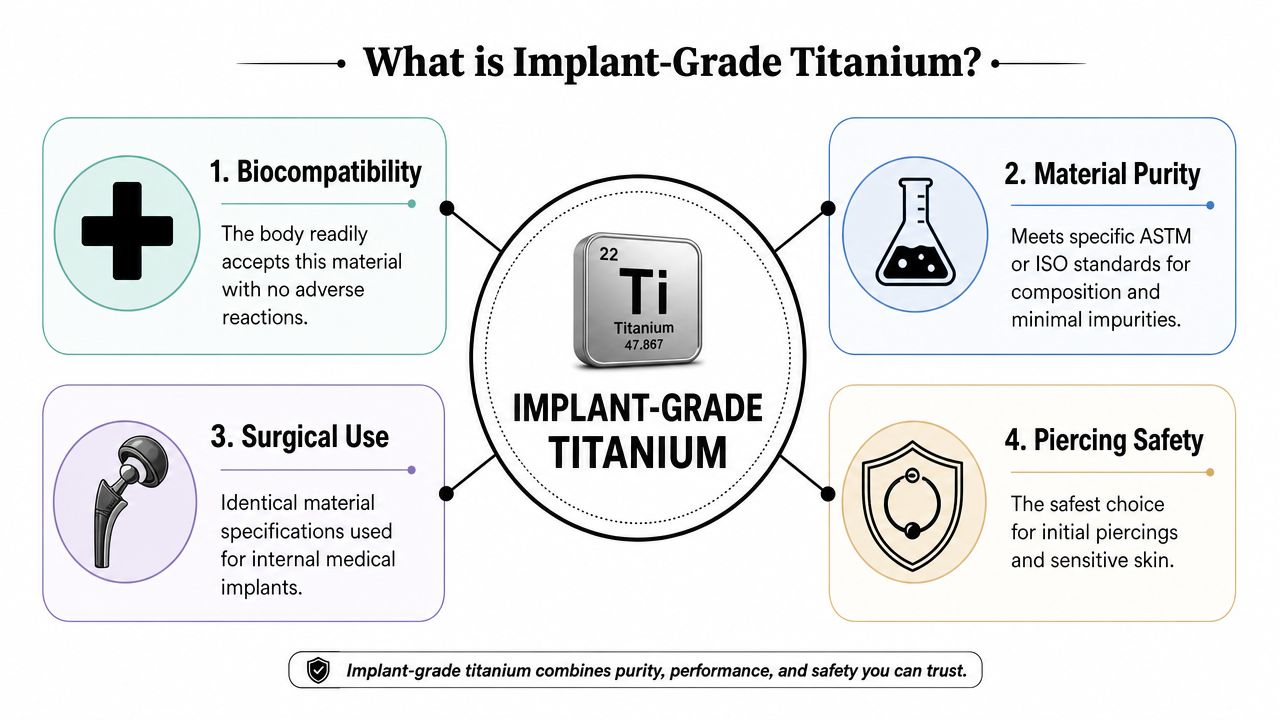
When piercers talk about implant grade titanium earrings, they don't mean “nice titanium” or “better than average titanium”. They mean a specific material standard used where metal has to sit safely in or against the human body.
That's why the phrase “implant-grade” matters. It points to a recognised specification, not a marketing mood.
The standard you want to hear
The key term is ASTM F136. According to this explanation of implant-grade titanium earrings, implant-grade titanium earrings must meet the ASTM F136 standard, which is the same metallurgical specification used for hip replacement joints, bone screws, dental implants, and pacemaker casings in the UK, ensuring compatibility with sensitive human tissue.
That medical comparison helps people understand the point. No, your earring isn't a pacemaker casing. But the reason the same specification matters is simple. It tells you the material has been selected for contact with the body where compatibility matters.
Why your ears care
Your body isn't reading a product label. It only reacts to the material that touches your skin and tissue.
If that material is stable and suitable, healing tends to be calmer. If it contains something irritating, has a poor finish, or isn't what the seller claimed, your piercing may become uncomfortable for reasons that seem mysterious until you change the jewellery.
One reason titanium gets recommended so often is that the right grade removes a major problem from the equation: nickel. Nickel is a common trigger for metal sensitivity, so jewellery that doesn't contain it gives many clients a cleaner starting point.
Practical rule: If a seller says “titanium” but can't tell you the grade, that answer isn't good enough for a fresh piercing.
Not all titanium is the same
A frequent point of misunderstanding occurs. “Titanium” is a family name, not a guarantee.
Some titanium used in jewellery may be lower grade, softer, or not identified clearly enough. For body jewellery, you want precise information rather than broad claims. That's also why a reputable studio or jewellery supplier should be comfortable discussing specification, polish, and brand.
If you want to see examples of jewellery sold specifically for body piercing, implant-grade titanium piercing jewellery is the category to look for, rather than general fashion earrings with a titanium tag.
Titanium Compared to Other Piercing Metals
Clients often ask a fair question. If titanium is so good, what's wrong with everything else?
The honest answer is that not every other metal is bad. Some can work well in the right context. The issue is that fresh piercings are less tolerant, and vague labels make it easy to buy something that sounds safe without being the best choice.
The quick comparison
According to this discussion of regular titanium versus implant-grade titanium, ASTM F136 titanium is nickel-free and hypoallergenic, making it the recommended grade for initial piercings in the UK, whereas commercially pure titanium (Grades 1–4) is softer and less suitable for piercing posts due to its lower strength.
That gives us a useful benchmark. The question isn't just “Is it metal?” The question is whether it's suitable for a healing channel, stable enough for long-term wear, and unlikely to irritate sensitive tissue.
Piercing Metal Comparison
| Material | Biocompatibility | Nickel Content | Weight | Best For |
|---|---|---|---|---|
| Implant-grade titanium | Excellent for most sensitive clients | Nickel-free | Light | Fresh piercings, long wear, sensitive ears |
| Surgical steel | Can be acceptable for some people, but less forgiving | May contain nickel | Heavier than titanium | Healed piercings for people without nickel sensitivity |
| Solid gold | Can be suitable if well-made and appropriate quality | Varies by alloy | Moderate to heavy | Healed or fresh piercings when sourced properly |
| Gold-plated jewellery | Poor choice for healing | Underlying metal may vary | Varies | Fashion wear, not ideal for fresh piercings |
| Niobium | Good option for many sensitive clients | Generally chosen for low-reactivity wear | Moderate | Healed piercings and selected fresh piercings where available |
| Unspecified “hypoallergenic” metal | Unclear | Unclear | Unclear | Best avoided until verified |
Why steel confuses people
“Surgical steel” sounds reassuring, and that wording catches people all the time. The problem is that a medical-sounding name doesn't automatically make a piece the safest option for a new piercing. For some wearers, steel is fine. For others, especially those prone to nickel sensitivity, it can become the source of itching, redness, or irritation.
Titanium avoids that particular gamble because the recommended implant-grade option is nickel-free.
If you're weighing up those two materials, this guide to surgical steel vs titanium gives a useful side-by-side overview.
Gold can be lovely, but details matter
Gold jewellery can be excellent when it's made well and selected properly for piercing use. The trouble is that many buyers mix up solid gold, gold alloys, and gold plating as if they're interchangeable. They aren't.
A plated piece may look polished and expensive online, but the surface layer can wear, exposing whatever sits underneath. That's one reason plated jewellery is a poor match for healing tissue. Fresh piercings do best with materials that are stable all the way through, not just coated on the outside.
If the material description is vague, assume you need more information before putting it in a healing piercing.
Where niobium fits in
Niobium doesn't get talked about as much, but it's a respectable option in piercing. Many people tolerate it well, and professional piercers often view it as one of the better alternatives for sensitive clients.
Still, implant-grade titanium remains the common first recommendation for fresh piercings because it combines low reactivity, low weight, and a strong reputation in professional use.
Why Material Matters for Fresh and Healed Piercings
A fresh piercing has one job. Heal cleanly.
That sounds obvious, but clients often focus on placement and style first, then treat the jewellery material as a minor detail. In reality, the material is part of the healing environment. If the jewellery is irritating, rough, or unsuitable, your body spends energy managing that as well as healing the piercing.
Fresh piercings need a calm environment
The early stage of healing is when your piercing is most vulnerable. Swelling, tenderness, crusting, and sensitivity are all easier to manage when the jewellery isn't adding extra friction or chemical irritation.
That's why professional piercers are so particular about safe initial jewellery. It isn't fussiness. It's wound care with style attached.
A good comparison is a plaster on a cut. You wouldn't choose the cheapest sticky material if you knew it would rub, trap dirt, or irritate the skin. Jewellery works in a similar way. The wrong piece can interfere with comfort and healing even when the piercing technique itself was sound.
Healed piercings can still turn fussy later
This surprises people more than anything else. A piercing that has been calm for years can suddenly start becoming itchy, sore, or inconsistent with certain earrings.
According to emerging UK clinical data shared in 2025, 45% of repeat piercers in Croydon and Bournemouth opt for titanium due to nickel sensitivities developing post-childhood, which pushes back against the idea that implant-grade materials only matter for first piercings.
That tracks with what many piercers see in practice. Someone wore all sorts of earrings as a teenager. Then, later on, certain metals start causing irritation they never noticed before.
Healed doesn't mean permanently tolerant. It just means the channel is no longer an open wound.
Why switching can help
If your old lobe piercings have become unreliable, implant-grade titanium earrings can be a sensible reset. They remove one of the most common metal-related problems and make it easier to work out whether the issue is the jewellery, the fit, or something else such as pressure from sleeping or headphone use.
Clients often describe the difference in simple terms. Their ears just feel quieter. Less heat, less itching, less drama.
For repeat piercers in places like Croydon and Bournemouth, that matters. Material choice isn't only about getting through the first healing period. It's also about having jewellery you can wear long term without wondering whether today will be another irritated-ear day.
A Practical Guide to Buying Titanium Jewellery
Buying titanium jewellery should be simple, but online listings often make it messy. A product title may say “hypoallergenic titanium” while the description says almost nothing useful about grade, certification, finish, or construction.
That's where a checklist helps. You don't need to inspect metal like a lab technician. You just need a few solid filters.
Start with verification, not colour or price
The first question is not “Do I like it?” It's “What exactly is it?”
According to this article on implant-grade titanium and traceable documentation, 30% of “hypoallergenic” titanium jewellery sold on UK Etsy listings lacks traceable ASTM documentation, which leaves sensitive-ear clients vulnerable.
That's a useful warning sign for online shopping. “Hypoallergenic” is not a material grade. It's a sales word unless it's backed up by specific documentation.
If you're comparing options for fresh lobes or cartilage, the best earrings for newly pierced ears should always be those with a clear material standard rather than just a comforting product label.
What to look for in person or online
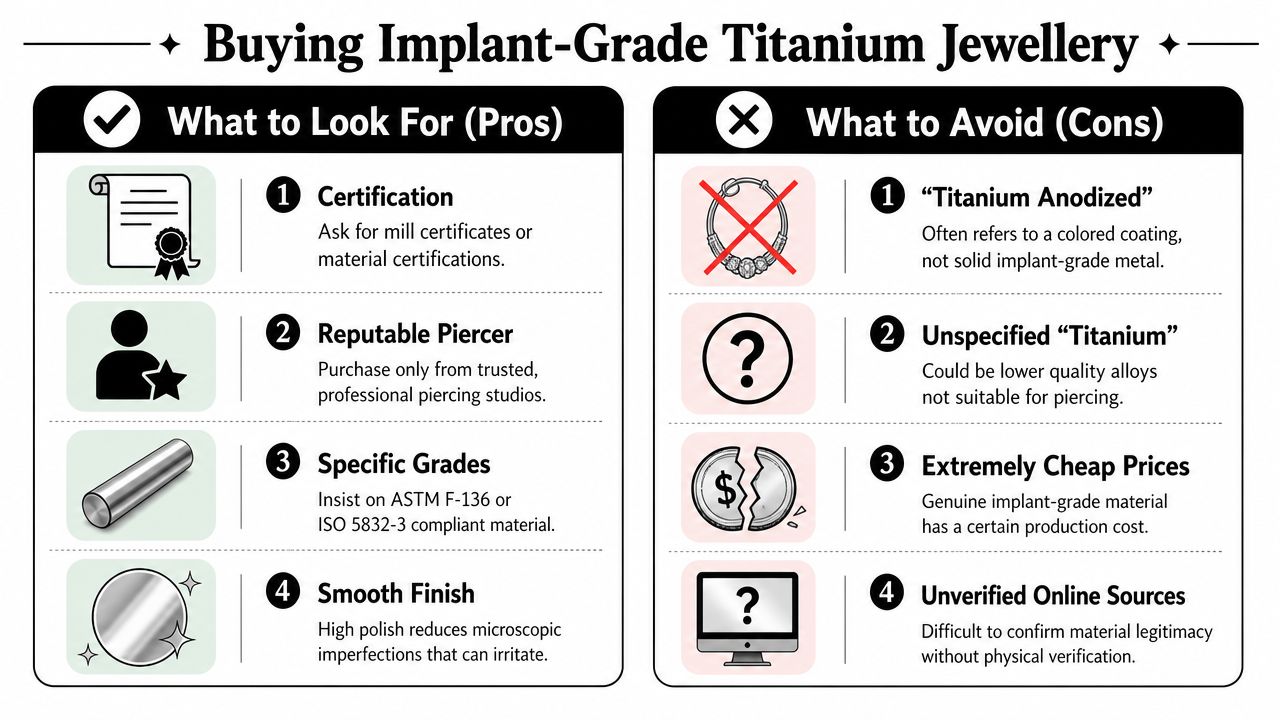
- Specific grade listed: Look for ASTM F136 clearly stated, not hidden behind general claims like “sensitive skin friendly”.
- Smooth finish: High-quality body jewellery should feel and look polished. A rough or poorly finished post can irritate delicate tissue.
- Safe construction: Internally threaded or threadless jewellery is preferred because it avoids dragging rough external threads through the piercing channel.
- Trusted seller language: Reputable sellers usually name the brand, the material grade, and the style clearly instead of relying on vague adjectives.
Plated, coated, anodised, and misunderstood
People often confuse anodised titanium with plated jewellery. They are not the same thing.
Anodising is a process used on titanium to create colour without applying an ordinary plated layer in the way fashion jewellery often does. That's why coloured titanium from a reputable piercing supplier can still be a safe option. A mystery “gold titanium” fashion stud from an unverified shop is a different story entirely.
Brand names matter in piercing
In everyday shopping, caring about brand names can feel superficial. In body piercing, it often isn't. Known manufacturers usually have consistent standards, reliable polish, and proper traceability.
Here's a simple buying filter:
- Ask for the exact material grade
- Ask who made it
- Ask whether documentation exists
- Check the threading style
- Skip anything that sounds evasive
Jewellery that's unusually cheap and strangely vague often costs more later in irritation, troubleshooting, and replacement.
Questions to Ask Your Piercer
A good piercer won't be annoyed by sensible questions. In fact, clear questions usually make the appointment better because both sides know exactly what's being used and why.
You don't need to sound technical. You just need to be direct.
Five questions that tell you a lot
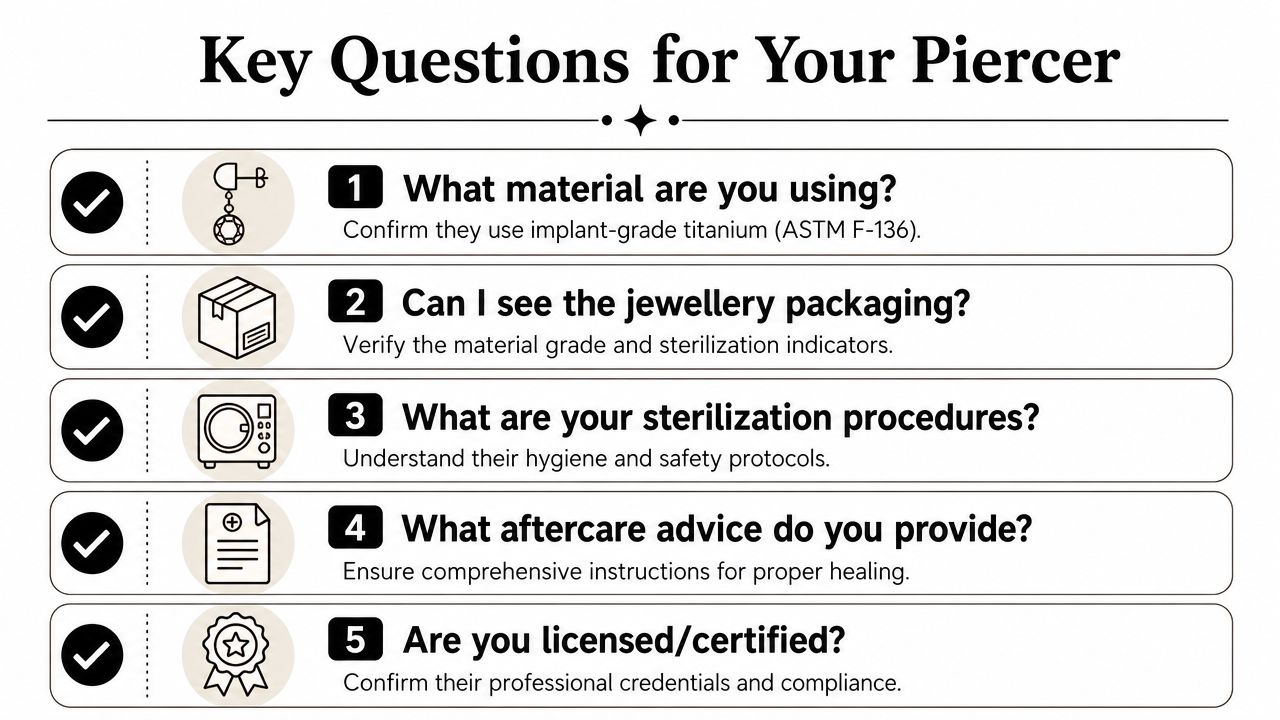
What material are you using?
You're listening for a precise answer, ideally implant-grade titanium with the correct grade named.Can I see the jewellery packaging?
Professional studios should be comfortable showing you sterile packaging and product details.What style of jewellery is this?
This helps you understand whether it's threadless, internally threaded, and suitable for your anatomy.Which brands do you stock?
In the UK, verified manufacturers of implant-grade titanium jewellery include Junipurr, Anatometal, Industrial Strength, Neometal, Inari UK, People's Jewelry, LeRoi Fine Jewelry, Clickerino, Infinite, and Kiwi Custom Titanium, all meeting UKAPP standards for mill-certified purity.What aftercare do you recommend if this piercing gets irritated?
You want practical, personalised guidance rather than a rushed one-line answer.
What a strong answer sounds like
A strong answer is calm, specific, and easy to follow. The piercer should be able to explain the jewellery choice in normal language, not hide behind jargon.
A weak answer usually sounds slippery. “It's just hypoallergenic” or “Don't worry, we use good stuff” isn't enough when someone is putting metal through your body.
The best studios don't act defensive when you ask questions. They answer them clearly because safety is already built into how they work.
Book Your Safe Piercing in Croydon or Bournemouth
If you're choosing between studios, material standards should be near the top of your list. A clean environment, experienced piercer, single-use sterile needles, and properly verified jewellery all work together. You want the whole process handled with care, not just the final look.
For clients in Croydon and Bournemouth, it helps to choose a studio that's comfortable discussing jewellery grades, safe styling options, and aftercare without rushing you. That matters whether you're planning a first lobe piercing, a cartilage piece, or replacing old jewellery that's started to irritate your ears.
If you'd like to book, ask a question, or talk through jewellery options first, call 01202 9000 50 or send a WhatsApp message to 07752913846. If you're unsure which piercing suits your anatomy or whether titanium is the right upgrade for older piercings, that's exactly the kind of conversation worth having before the appointment.
Piercing Near Me helps you find safe, professional piercing services with a focus on trusted studios in Croydon and Bournemouth. If you want experienced piercers, implant-grade jewellery, and clear advice before you book, it's a practical place to start.