
You're in the studio chair, excited for the piercing and suddenly less excited by the jewellery tray. One option is labelled titanium. Another says surgical steel. Both look clean, polished, and perfectly fine. One costs more. One sounds familiar. The choice often prompts a pause at that point.
That pause is sensible.
The surgical steel vs titanium question isn't just about looks or budget. It affects comfort, irritation risk, and how smoothly a piercing settles. For fresh piercings, the right material can make healing much easier. For healed piercings, the answer can be more flexible. The problem is that many clients are comparing names, not standards.
That's where confusion starts. “Titanium” often refers to a specific implant-grade material. “Surgical steel” can mean several different things, and the label alone doesn't tell you enough. In practice, that gap matters more than is commonly understood.
From a professional piercing point of view, the first question isn't “Which metal is best?” It's “What exact grade is this piece, and is it appropriate for this stage of the piercing?”
Your Guide to Choosing Piercing Jewellery
Most clients don't walk in asking for ASTM paperwork. They ask a simpler question. “What should I get pierced with?” That's the right place to start, but the useful answer depends on more than the metal name on a tag.
For a fresh piercing, jewellery sits in a wound while your body deals with swelling, pressure, and movement. The jewellery needs to be stable, well finished, and suitable for prolonged wear. For a healed piercing, the calculation changes. Your tissue is usually less reactive, and style or price may matter more.
The practical way to view this is:
- Fresh piercing: Choose the safest, least reactive option available.
- Healed piercing: You may have more flexibility, but material quality still matters.
- Sensitive skin or past reactions: Don't guess. Treat that history as important.
- Online shopping: Be cautious with vague labels, especially “surgical steel” with no proper specification.
Clients often assume this is a simple titanium good, steel bad conversation. It isn't. High-quality implant-grade jewellery exists in more than one material. Low-quality jewellery also exists under reassuring labels.
Practical rule: Don't buy jewellery based on the sales name alone. Buy based on the exact grade, finish, and whether it suits a fresh or healed piercing.
The rest of the decision gets easier once you separate marketing language from actual material standards.
Understanding Implant Grade Metals
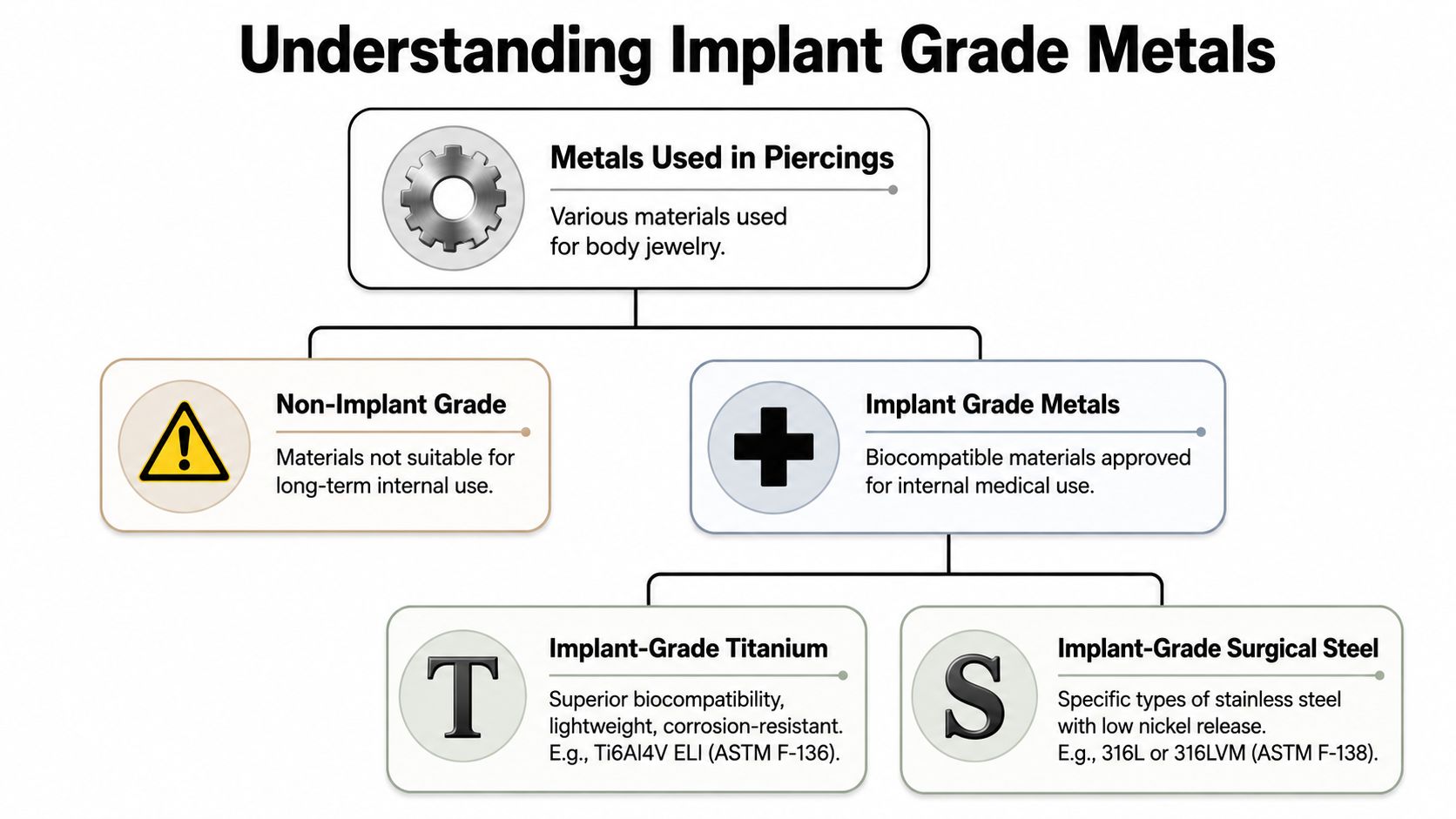
The phrase implant grade matters because it tells you the material is being identified by a recognised specification, not just by a broad retail label. In piercing, that distinction is one of the biggest markers of quality.
What implant grade usually means in practice
With titanium, studios often refer to implant-grade titanium, commonly sold under specifications such as ASTM F-136. With steel, the equivalent conversation is more specific than many clients expect. Proper implant-style steel should be identified by its exact grade, such as ASTM F-138, rather than described only as “surgical steel”.
That's the core issue. The term surgical steel is a broad label, not a universal standard. Independent piercing education has repeatedly highlighted that without verified paperwork showing the specific alloy grade, the term is often used for cheaper, uncertified metals that can cause problems, as explained in this independent discussion of implant-grade standards and “surgical steel” terminology.
Why the label alone isn't enough
From a studio perspective, “surgical steel” on its own doesn't answer the questions that matter:
- What exact alloy is it
- Was it made to a recognised implant specification
- Can the supplier prove that with documentation
- Is it suitable for a fresh piercing, or only for healed wear
That's why experienced piercers don't stop at the display card. They look at what the jewellery is.
If you want to see examples of how reputable studios separate material type from proper specification, it helps to browse a curated UK body jewellery selection rather than relying on generic marketplace listings.
Jewellery names sell products. Material specifications protect clients.
The simple distinction clients should remember
Think of it this way:
| Term on the label | What it tells you |
|---|---|
| Titanium | The metal family |
| Implant-grade titanium | A specific standard of titanium suitable for body use |
| Surgical steel | A broad retail label |
| Implant-grade steel | Steel identified by a specific recognised standard |
That's why standards literacy matters. It shifts the conversation from “steel or titanium?” to “what exactly am I being pierced with?”
A Direct Comparison of Core Differences
The cleanest way to approach surgical steel vs titanium is to compare what matters in the chair, during healing, and in day-to-day wear.
| Feature | Implant-Grade Titanium (ASTM F-136) | Surgical Steel (316L/ASTM F-138) |
|---|---|---|
| Nickel content | Nickel-free as a base metal | Contains nickel |
| Weight | Lighter in the body | Heavier at the same size |
| Fresh piercings | Strong professional choice | Usually not first choice for healing |
| Healed piercings | Excellent | Can suit some healed piercings |
| Allergy risk | Lower for sensitive wearers | Higher if nickel is an issue |
| Cost | Usually higher upfront | Usually more budget-friendly |
Composition and skin response
Titanium's practical advantage starts with the fact that it is nickel-free as a base metal. That matters because nickel sensitivity is common enough that many professional studios prefer not to gamble with it during healing.
Steel is different. Even high-quality steel contains nickel, so whether someone tolerates it depends on the exact alloy, the finish, the quality of manufacture, and the wearer's own sensitivity. In healed piercings, some people wear it with no issue. In fresh tissue, it's a less forgiving choice.
Weight and comfort
The biggest measurable physical difference is density. Titanium is about 4.5 g/cm³, while stainless steel is around 8.0 g/cm³, making titanium roughly 45 to 50% lighter at similar volume according to this materials comparison of titanium and stainless steel density.
That sounds technical until you apply it to an actual piercing. A lighter barbell puts less downward force on a healing navel piercing. A lighter stud creates less pull in cartilage. A lighter piece tends to move with the body more gently.
If a piercing is already swollen, irritated by sleep, or placed in a high-movement area, heavier jewellery rarely helps.
Biocompatibility in real life
“Biocompatibility” can sound abstract, but in the studio it means something simple. How likely is this material to sit harmlessly in the body without creating extra drama?
Titanium generally does that better. It's widely treated as the safer option for healing tissue and for clients who already know they react to certain metals. Steel can still be a good material in the right context, but it asks more of the wearer. That's fine in a settled piercing. It's less ideal in a new one.
Cost and long-term value
Steel usually wins on entry price. If you're building a jewellery collection for healed piercings, that can matter. Titanium usually costs more, but for initial jewellery the extra spend often buys a safer start, lighter wear, and fewer avoidable issues.
That's how I'd frame it in studio terms. Titanium is usually the better healing tool. Steel can be a sensible wardrobe material later, provided it's properly specified and your skin tolerates it.
Why Titanium Is the Standard for Initial Piercings
Fresh piercings need calm conditions. The best initial jewellery is the option least likely to add friction, weight, or chemical irritation to tissue that is already trying to recover.
The UK safety context
In the UK, piercing standards have long been shaped by the EU Nickel Directive. For items intended to contact broken skin, the nickel limit is 0.05% nickel by mass, and for items intended for prolonged skin contact the limit is 0.5 µg/cm²/week nickel release. Within that same context, 316L surgical steel is significant because it typically contains 6 to 13% nickel, while titanium is nickel-free as a base metal, as outlined in this discussion of implant-grade versus surgical steel and the nickel rules influencing UK piercing practice.
That regulatory history explains why reputable UK studios often default to titanium for new piercings. It isn't just habit. It's a safety-led decision.
What that means during healing
A fresh piercing is vulnerable. It swells. It catches on clothing. It gets slept on by accident. It deals with aftercare products, skin oils, and normal daily movement. Jewellery that is lighter and free from nickel gives that tissue fewer problems to solve.
In practical studio work, titanium is the material that causes the fewest unnecessary arguments with the body. That's why it's become the benchmark.
For clients choosing first jewellery, a proper titanium piercing jewellery range usually reflects this same priority. The point isn't trend. The point is safe healing.
Where titanium makes the biggest difference
Titanium is especially useful for:
- Cartilage piercings: Less weight means less pressure.
- Navel piercings: Lower mass reduces pull during movement.
- Clients with metal sensitivity: Nickel-free material removes a common trigger.
- Any first piercing: It keeps the starting point simple and safe.
Fresh piercings don't need “good enough” jewellery. They need jewellery that gives healing the fewest obstacles.
That doesn't mean titanium is magic. It won't fix poor aftercare, bad angles, wrong sizing, or constant irritation from sleeping on the area. But it does remove one major variable, and that matters.
When Surgical Steel Can Be an Option
Surgical steel does have a place. The sensible place is usually fully healed piercings on people who don't react to nickel and who are buying from a source that can identify the material properly.
That's an important distinction. This isn't a defence of mystery metal sold under a comforting label. It's about properly specified steel being used in the right setting.
Good use cases for steel
A healed lobe piercing is a common example. Once tissue is settled and stable, many clients want more styles, more backups, and lower-cost options for everyday wear. Steel can work well there.
It can also suit people who like the brighter, whiter look that steel often has compared with titanium's slightly greyer tone. For some clients, that visual preference matters.
Where caution still makes sense
Steel becomes a poor choice quickly if any of these apply:
- You've reacted to earrings before
- The piercing is still healing
- The seller can't identify the exact grade
- You're buying from a low-cost listing with no paperwork and vague wording
If your ears have always been fussy, it's safer to treat that as meaningful information. A guide to hypoallergenic earrings for sensitive ears can help clarify what to prioritise if you already know your skin is selective.
The balanced answer
Steel isn't automatically bad. It's just more conditional.
For healed wear, certified steel can be durable, polished, and more affordable. For initial jewellery, it's usually not the material I'd want sitting in a new piercing. That's the difference clients need. Not a blanket rule, but the right material for the right stage.
Jewellery Aesthetics Colour and Style Options
Safety comes first, but clients don't choose jewellery by chemistry alone. They choose what they want to wear every day. The look and finish of a piece matters, especially once a piercing is established and you're building a collection.
Natural colour and finish
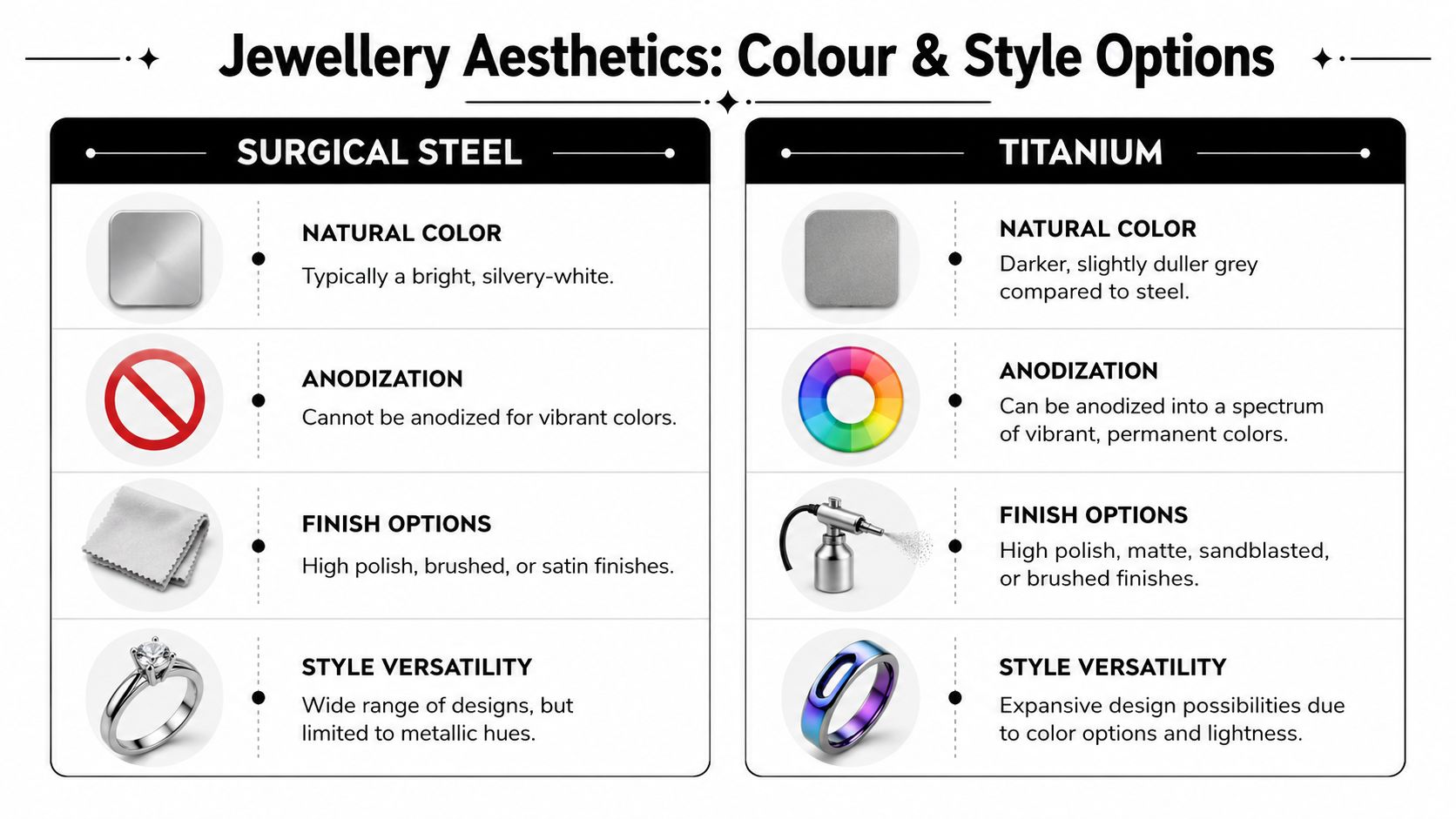
Steel usually has a brighter, cleaner silver appearance. Many clients like it because it reads as crisp and highly polished. Titanium tends to look slightly darker and more muted in its natural state.
Neither is better. It's preference.
Steel also works well in classic polished pieces, especially if you want a traditional jewellery look without extra colour. Titanium often suits a more modern feel, particularly in minimalist threadless ends and lighter-weight pieces.
How colour is created
The difference becomes more important.
Titanium can be anodised. That means the surface colour is changed through a controlled oxide layer rather than by adding paint. In practice, that gives studios a broad colour range while keeping the piece suitable for body wear.
Steel is usually coloured by coating, often through PVD. That can look good, especially when new, but it is still a surface treatment rather than a colour shift within the metal's oxide layer.
What that means for wear
If a client wants colour in a piercing that still needs careful treatment, anodised titanium is usually the more reassuring route. If a client wants a black or gold steel piece for a healed piercing, a well-made coated option may be perfectly reasonable, but it needs to be looked after and monitored.
A simple way to compare the style side is this:
- Choose titanium if: you want colour options, lighter jewellery, or a material often preferred for sensitive wear.
- Choose steel if: you want a bright silver finish and you're wearing it in a healed piercing that already tolerates it.
- Be cautious with coatings if: the piercing is irritated, fresh, or likely to face friction.
Colour isn't just decoration. In piercing jewellery, how that colour is achieved matters almost as much as the shade itself.
How to Verify Your Jewellery Is Body Safe
This is the question I wish more clients asked before paying.
A lot of people still assume a reassuring product name means the item has been properly specified. It doesn't. Professional UK guidance is clear on the practical hierarchy. Implant-grade titanium is the stronger choice for fresh piercings because it is nickel-free and framed as the safer option for healing, while surgical steel is better suited to fully healed piercings due to its nickel content and higher irritation risk for sensitive wearers, as set out in this UK piercing guidance on titanium and surgical steel for healing versus healed wear.
Questions worth asking in a studio
Ask plainly. A good studio won't be offended.
- What exact material grade is this piece
- Is it implant grade
- Can you show documentation for the jewellery line
- Is this your standard jewellery for fresh piercings or an upgrade
If the answer is vague, keep asking.
What a strong answer sounds like
A strong answer names the material precisely. It doesn't hide behind “surgical steel” or “medical quality”. It tells you whether the piece is implant-grade titanium, implant-grade steel, or something else entirely.
The best studios also know where their jewellery came from and can explain why they use it.
You don't need to become a metallurgist. You just need to stop accepting labels that don't identify the actual material standard.
That one habit protects you from a lot of poor-quality jewellery.
Making the Right Choice for Your Piercing
If you want the shortest practical answer to surgical steel vs titanium, here it is.
For a fresh piercing, choose implant-grade titanium. It's the standard for good reason. It avoids nickel, keeps weight down, and makes healing less complicated.
For a healed piercing, the decision is broader. If you know your skin is tolerant and the jewellery is properly specified, steel can be a reasonable option. If your skin has ever reacted badly, or if the piercing is in a fussy placement, titanium is still usually the safer bet.
The simplest decision guide looks like this:
- New piercing: Implant-grade titanium
- Cartilage or navel: Implant-grade titanium
- Known metal sensitivity: Implant-grade titanium
- Healed lobe on a budget: Properly specified steel may be fine
- Any jewellery with vague labelling: Leave it alone
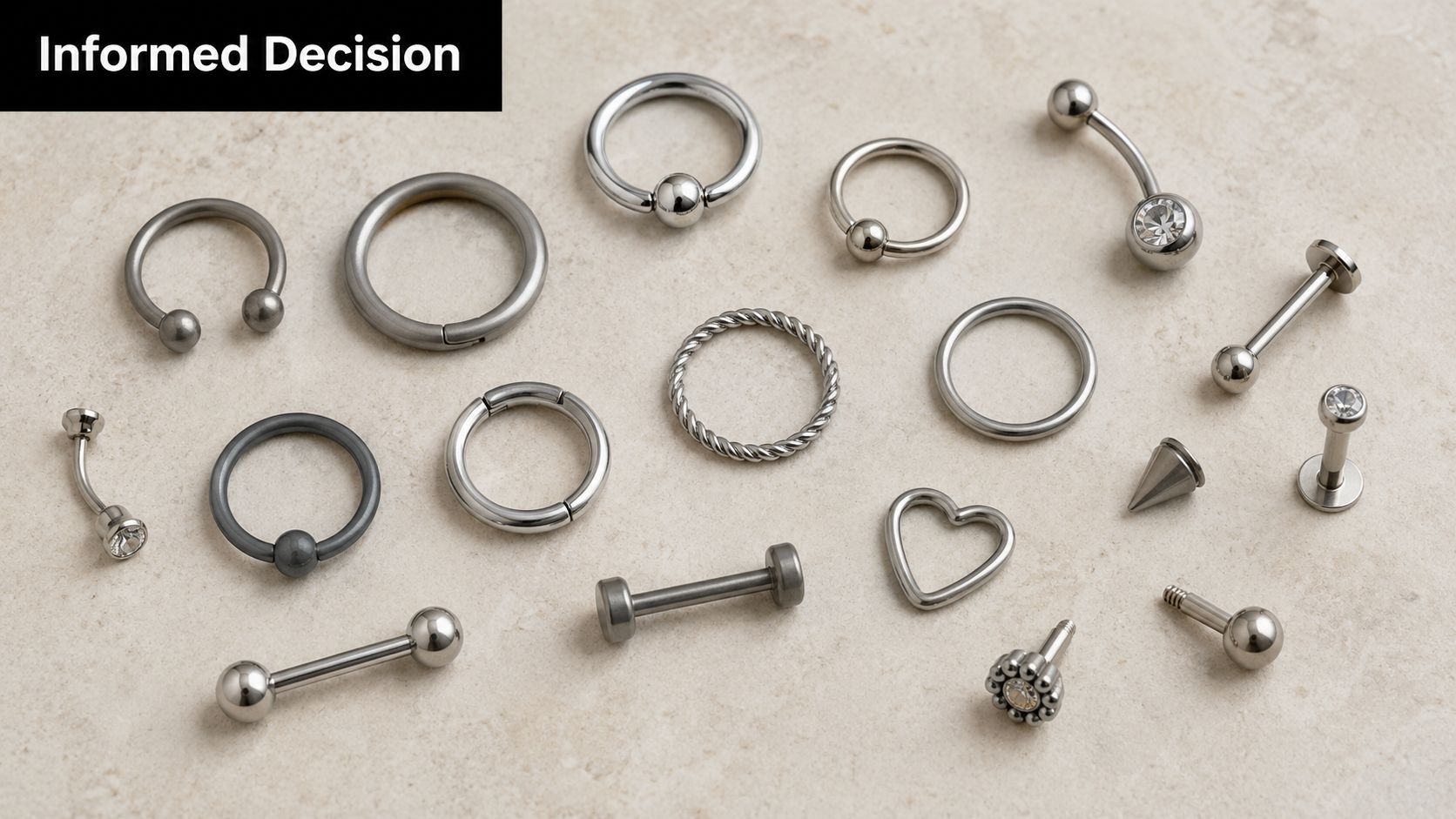
Clients usually feel more confident once they stop asking “Which one is cheaper?” and start asking “Which one is right for this piercing right now?” That's the question that leads to better results.
If you want personalized advice before booking, speak to a professional studio directly and ask about material grade, jewellery sizing, and whether the piece is intended for fresh or healed wear.
If you're looking for trusted guidance, safe jewellery standards, and help finding a reputable UK studio, Piercing Near Me is a strong place to start. You can explore studios, compare jewellery options, and get support before you book. For direct help, call 01202 900050 (Bournemouth) / 020 8686 7730 (Croydon) or message WhatsApp 07752 913846 (Bournemouth) / 07902 490584 (Croydon).
Trackbacks/Pingbacks