
You're probably doing what most first-time clients do. You've picked out a piercing you love, you're excited to get it done, and then one question starts nagging at you: how do you know the studio is safe?
That concern is sensible. A piercing should feel creative and personal, but it also needs to be clinical where it counts. The tool used to make the piercing holds greater importance than often acknowledged, and the standard you want to see is simple: a sterile, single-use needle opened for you, used once, then disposed of properly.
A lot of confusion comes from people mixing up piercing needles, syringes, tattoo equipment, and older methods like piercing guns. The safest studios make that process easy to understand, and you should never feel awkward asking what's being used and how it's disposed of.
Your Guide to a Safe and Stylish Piercing
If you're booking your first helix, nostril, navel, or lobe piercing, it's normal to be half excited and half cautious. Most clients aren't worried about the jewellery. They're worried about cleanliness, pain, and whether the person doing the piercing follows proper hygiene standards.
The best answer to all three concerns starts with single use needles. In the UK, that isn't a vague preference or a studio trend. It's the baseline for safe practice.
According to UK guidance on single-use medical devices, single-use medical needles are defined as devices intended for use on an individual patient during a single procedure and then discarded, and they are explicitly prohibited from being reprocessed or reused, even on the same patient.
Why this matters to you
That rule protects two things at once:
- Your health: A fresh sterile needle reduces contamination risk.
- Your comfort: A new needle is sharp and precise, which helps create a cleaner piercing channel.
A piercing done with proper tools usually feels calmer and more controlled than people expect. You'll still feel it, of course, but a reputable piercer is trying to create a clean opening for jewellery with as little tissue trauma as possible.
Practical rule: If a studio can't clearly explain that their needles are sterile, single use, and opened in front of you, walk away.
Safety should feel visible
Good hygiene in a piercing studio shouldn't be hidden in the back room. You should be able to see signs of it in the setup, the packaging, the work area, and the disposal process.
That's what gives clients peace of mind. You're not being “difficult” by checking. You're acting like an informed client, and any professional piercer should respect that.
What Exactly Is a Single Use Piercing Needle
A professional piercing needle isn't just “a needle”. It's a purpose-made tool designed to create a clean channel for jewellery placement. The easiest way to think about it is like a precision instrument. It's made for one job, one client, one procedure.
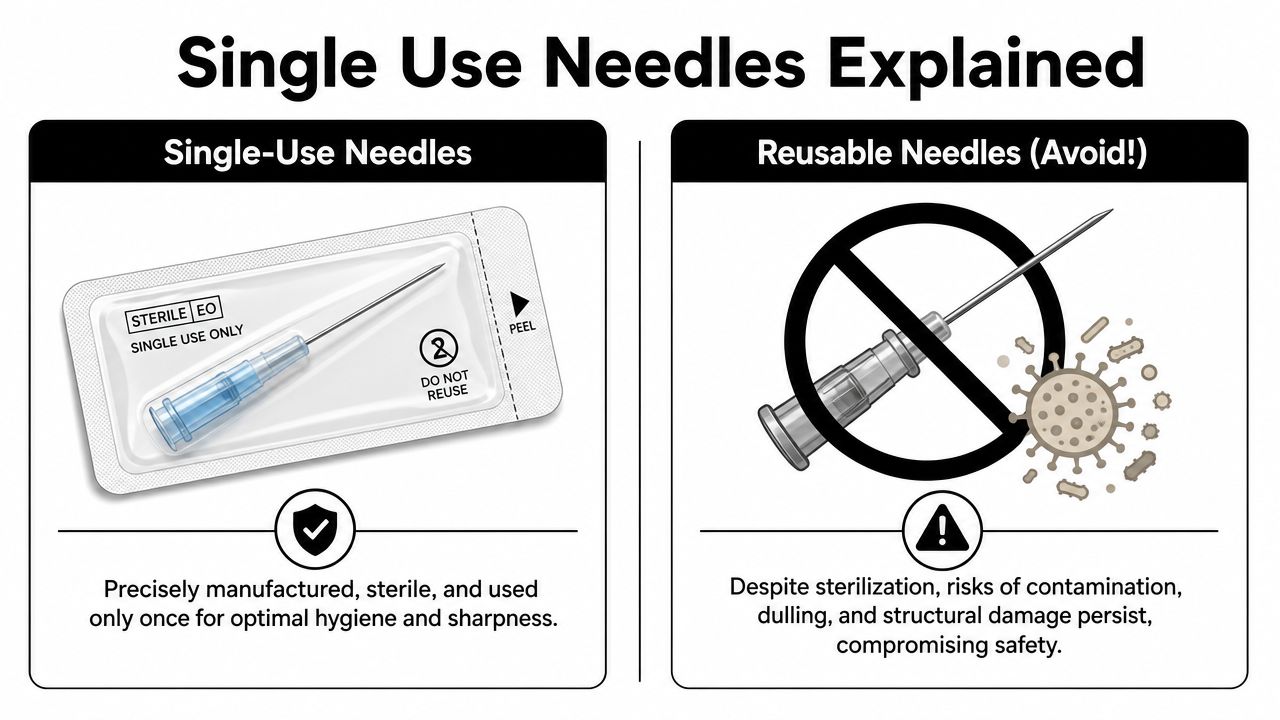
A key point many clients never get told is this: body piercing needles are specifically tapered, non-coring, and hollow-bore instruments designed to create a clean channel for jewellery, unlike syringes, which are made for fluid delivery. UK MHRA guidance also states that any device designated single-use must not be reprocessed or reused, as summarised in this explanation of how single-use syringes help reduce the spread of diseases.
Piercing needle versus syringe
People often hear “needle” and imagine the kind attached to a syringe at a GP appointment. That's where the confusion starts.
Here's the practical difference:
| Tool | Main purpose | What it does |
|---|---|---|
| Piercing needle | Creating a clean passage for jewellery | Opens tissue in a precise way for safe jewellery insertion |
| Syringe needle | Delivering fluid | Designed for injection, not jewellery placement |
That doesn't mean the terms never overlap in casual conversation. It means the design matters. A proper piercing needle is built around placement, tissue handling, and clean transfer of jewellery.
Why good studios avoid blunt-force methods
A safe studio doesn't rely on shortcuts. One of the biggest examples is the difference between a professional needle and a piercing gun. If you want a plain-English breakdown of that comparison, this guide on piercing gun vs needle is useful.
Piercing guns force jewellery through tissue. A professional needle is designed to create space more cleanly. That distinction matters a lot in cartilage, where extra trauma can make healing harder.
A proper piercing setup should look deliberate, sterile, and calm. Nothing about it should feel rushed or improvised.
The myth of the “re-sterilised” needle
Clients sometimes assume that if something has been sterilised, it must be safe to use again. That's where the language around single use needles matters.
“Sterile” and “single use” are not the same instruction. Sterility describes condition. Single use describes permitted use. Once a tool is designated for one procedure only, that's the end of its life in practice.
That's why a reputable piercer won't say, “It was sterilised, so it's fine.” They'll say, “It's sealed, sterile, and brand new.”
Why Needle Reuse Is a Major Red Flag
Needle reuse is one of the clearest warning signs that a studio doesn't understand, or doesn't respect, proper piercing safety. Even if the room looks tidy, reuse changes the risk profile immediately.
The reason isn't only infection control. It's also about what happens to the needle itself after it has already gone through tissue.
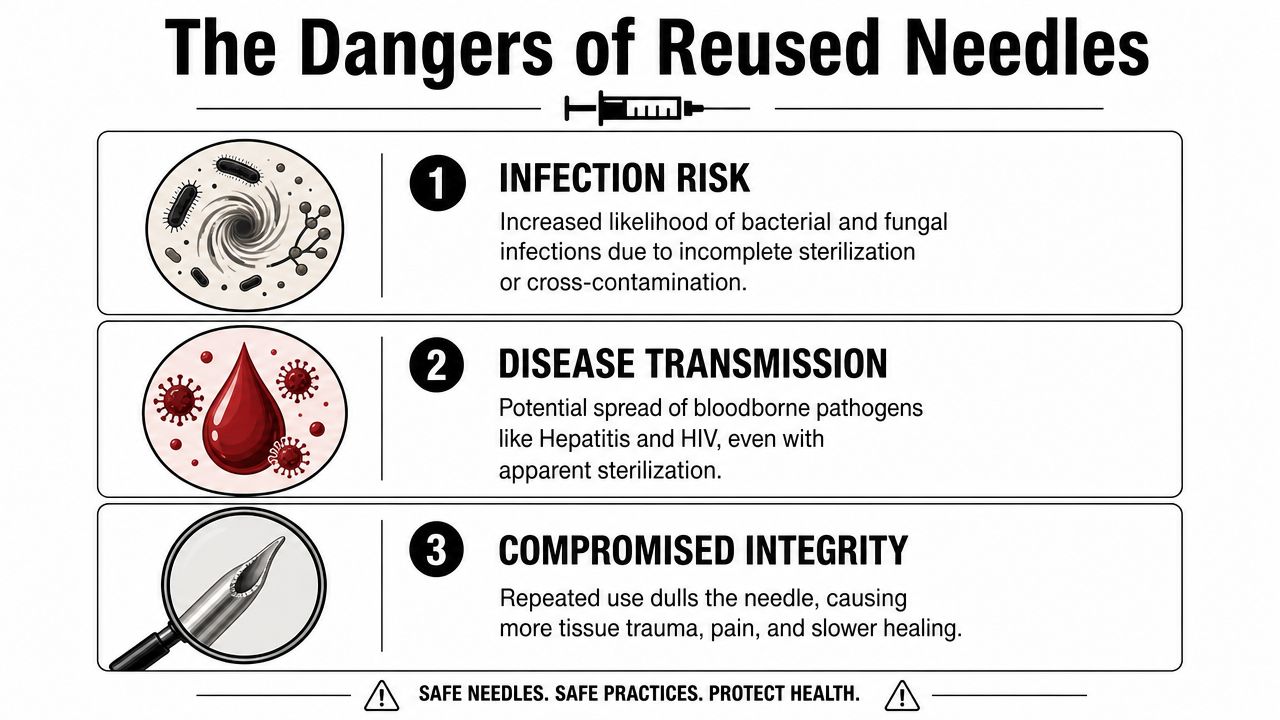
According to the NC3Rs guidance on single-use needles, reusing a needle, even once, causes it to dull significantly, increasing pain and tissue damage. The same guidance notes that used needles are clinical waste and must be disposed of in puncture-resistant sharps bins to prevent cross-contamination and the spread of blood-borne viruses.
Dulling changes the piercing experience
A fresh needle is sharp and consistent. A used one isn't.
That matters because tissue responds better to a clean pass than to a blunter instrument. When the edge degrades, the piercing can feel rougher, and the tissue may react with more irritation.
In simple terms, a reused needle can mean:
- More pain during the piercing
- More tissue trauma afterwards
- A less calm start to healing
Reuse creates contamination risk
Piercing involves contact with blood and body fluids. That's why used needles are treated as clinical waste in the UK. Once a needle has been used, it's no longer part of a clean setup. It becomes something that must be contained and removed safely.
The handling of sharps disposal makes studio professionalism easy to spot. A studio that treats sharps disposal seriously is usually a studio that treats every other hygiene step seriously too.
If a piercer hesitates when you ask how needles are disposed of, take that as useful information.
What proper disposal tells you
You don't need specialist training to recognise safe behaviour. You just need to know what normal looks like.
A responsible piercer uses the needle once, then puts it straight into a puncture-resistant sharps bin. Not on a tray. Not “for later”. Not out of sight while they keep working.
That immediate disposal is a sign of discipline. It protects the client, the piercer, and anyone else in the studio.
Your Safety Checklist at the Piercing Studio
By the time you sit in the piercing chair, you shouldn't be guessing. You should be able to spot the signs of a professional setup quickly and confidently.
This checklist keeps things simple. You don't need to inspect every tool in the studio. You just need to look for the details that tell you the team follows proper standards.
Start with the packaging
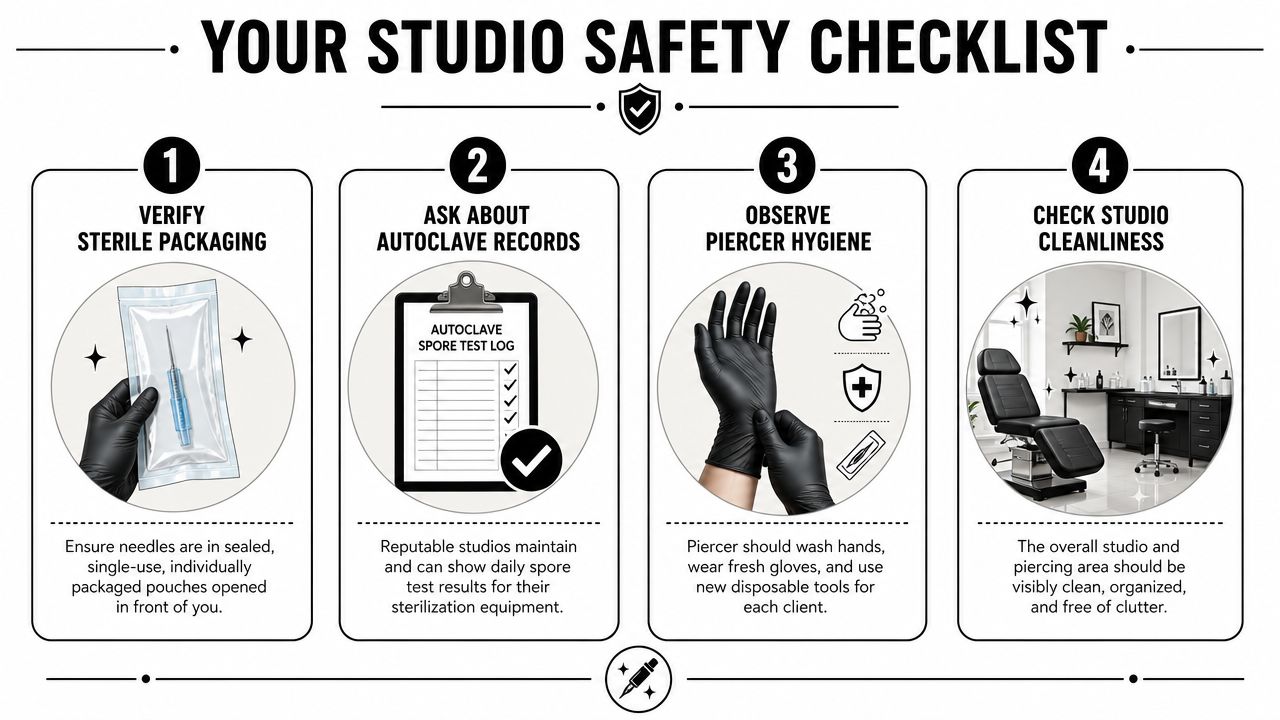
In the UK, professional piercing needles are typically manufactured in standardised gauge sizes, are CE marked and UKCA certified, and must be delivered in sterile packaging, as described on this product information page for standard hypodermic sterile needles for injection single use pack of 100.
That means you can look for practical signs, not vague promises.
- Sealed pouch: The needle should arrive in an individual sterile pack.
- Opened in front of you: You should see the package opened at the time of your procedure.
- Marked packaging: CE marking and UKCA certification are worth checking for on the pack.
Check the setup, not just the sales talk
Studios can say all the right things online. The treatment area tells the truth.
Look for:
- Fresh gloves: Your piercer should put on new disposable gloves for your appointment.
- Organised workspace: Clean trays, clean surfaces, and no clutter around the piercing area.
- Correct needle size: The piercer should be able to explain the gauge they're using and why it suits the placement.
If you're still deciding where to go, it helps to compare studios that focus on hygiene and technique. This list of professional piercers near me gives you a starting point.
Know what the sharps bin should tell you
The sharps bin is one of the clearest visual cues in the room. If a studio handles needles properly, you'll usually see a proper disposal container nearby.
A quick reference helps:
| What to look for | Why it matters |
|---|---|
| Puncture-resistant sharps bin | Shows used needles are contained safely |
| Clearly designated clinical waste container | Indicates the studio follows formal disposal practice |
| Immediate disposal after use | Reduces handling risk and cross-contamination |
Ask direct questions. “Will you open the needle in front of me?” and “Where does it go after the piercing?” are both completely reasonable.
How Timebomb Tattoo Demonstrates Best Practice
A good studio experience feels straightforward from the moment you walk in. You ask questions, the piercer answers clearly, the tools are laid out neatly, and nothing about the process feels hidden.
That's what strong practice looks like at Timebomb Tattoo & Piercing. Clients can see a clean setup, a professional consultation, and a procedure built around sterile, pre-packaged, single-use needles.
What a client can expect
The process is reassuring because it's visible. The needle is opened for the client, jewellery choice is discussed carefully, and the workspace is prepared in a way that feels orderly rather than rushed.
Studios that work well with first-time clients also explain placement, healing expectations, and aftercare in plain English. That matters just as much as the piercing itself, because confidence often comes from understanding what's happening.
Timebomb also reflects another sign of good studio discipline. Used needles go straight into designated sharps disposal rather than being left on a tray or workstation.
Safe practice and good style can go together
A clean procedure doesn't mean a cold or impersonal one. It means the creative part of piercing rests on solid hygiene habits. That's especially important if you're choosing a cartilage piece such as a helix. If you're looking at that style specifically, this guide to a stud helix piercing gives a useful example of what to expect.
If you want to ask questions before booking, you can call 01202 9000 50. If you prefer messaging first, the WhatsApp number is 07752913846.
Common Questions About Single Use Needles
Clients usually ask practical questions once they understand the basics. That's a good sign. It means you're thinking like someone who wants both a safe procedure and a piercing that heals well.
Does a single-use needle make the piercing more expensive
It's better to think of a sterile single-use needle as part of the normal cost of proper professional practice. It isn't an optional upgrade. It's one of the core safety standards behind a well-run piercing appointment.
If a lower price seems to come with vague answers about tools or hygiene, that's not a bargain. That's a warning.
Does a fresh needle hurt less
A piercing is never sensation-free, but a fresh, purpose-made needle is there to create a cleaner result with less unnecessary trauma. That's why clients often find the experience more manageable than they feared.
Pain also depends on placement, anatomy, and aftercare. Still, the quality and condition of the tool absolutely matter.
Can I keep the needle afterwards
No. In the UK, used single-use needles must go straight into clinical waste disposal. UK body piercers are legally required to dispose of them immediately into yellow-lidded sharps bins, and those bins must be collected by a licensed contractor, as explained in this guide to sharps disposal requirements in the UK.
What if I feel awkward asking to see the packaging
You shouldn't. A professional piercer won't be offended by sensible safety questions. In fact, they'll usually be glad you asked, because it shows you care about the process and understand what good practice looks like.
The right studio won't try to rush you past your questions. They'll answer them clearly and carry on professionally.
If you're looking for a safe, supportive place to start, Piercing Near Me helps you find professional piercing services with a strong focus on hygiene, experienced piercers, and clear aftercare so you can book with confidence.