
You've probably done this already. You see a helix ring, a conch hoop, or a neat little cartilage stud on someone else and think, “I'd love that look.” Then the next thought arrives just as quickly. What about the needle, the healing, the sleeping awkwardly, and whether you'll still want it months from now?
That hesitation is normal.
For a lot of people, ear cuffs for non pierced ears are the easiest way to test the look before committing to a real piercing. You get to see how a cuff sits on your ear, whether you prefer a subtle metal band or something more decorative, and whether that placement feels like you. If you've been curious about cartilage styling but not fully ready for a permanent hole, cuffs sit in a very useful middle ground.
They're also practical for people who like change. One day you might want a slim silver helix-style cuff. Another day, a chunkier gold conch look. No appointment needed, no healing period, no long-term commitment.
Your First Step into Ear Styling Without Piercings
A common first-time scenario goes like this. Someone loves the look of a cartilage piercing, buys a few studs or hoops online, then realises those pieces won't work without an actual piercing. That's usually when ear cuffs start making sense.
They let you try the silhouette before you choose the commitment.
If you're in Croydon, Bournemouth, or anywhere else in the UK, that matters more than people sometimes realise. Ear anatomy varies quite a bit. A placement that looks perfect in a photo might sit differently on your own helix or conch. A cuff gives you a low-pressure way to experiment with that.
Why people start with cuffs
Some readers want the style but aren't ready for the process of a professional piercing. Others aren't worried about the piercing itself. They just want to be sure they like the placement first.
Ear cuffs help with both.
- Style testing: You can try a helix look, a conch look, or a stacked-ear look without making anything permanent.
- Outfit flexibility: You can wear one for a night out, then skip it entirely the next day.
- Lower pressure decision-making: You don't need to decide immediately whether you want a long-term piercing.
Practical rule: If you keep reaching for the same cuff in the same spot, that's often a sign you're narrowing in on a piercing placement you'll genuinely enjoy long term.
A useful way to think about them
An ear cuff isn't a replacement for every piercing. It's better to think of it as a fitting-room version of cartilage jewellery.
That framing helps if you're torn. You don't have to pick one side straight away. You can wear a cuff for a while, learn what shape and placement suits you, and only then decide whether a real helix or conch piercing would be worth it.
That's especially reassuring for first-timers, because uncertainty is usually the hardest part. Once you've seen the look on your own ear, the decision gets much easier.
How Ear Cuffs Stay On Your Ear
Old clip-on earrings have given non-pierced jewellery a bad reputation. Many people assume ear cuffs work by pinching hard in the same way. A good cuff doesn't.
It stays on because the shape is designed to sit around cartilage, not squash the earlobe.
The basic mechanism
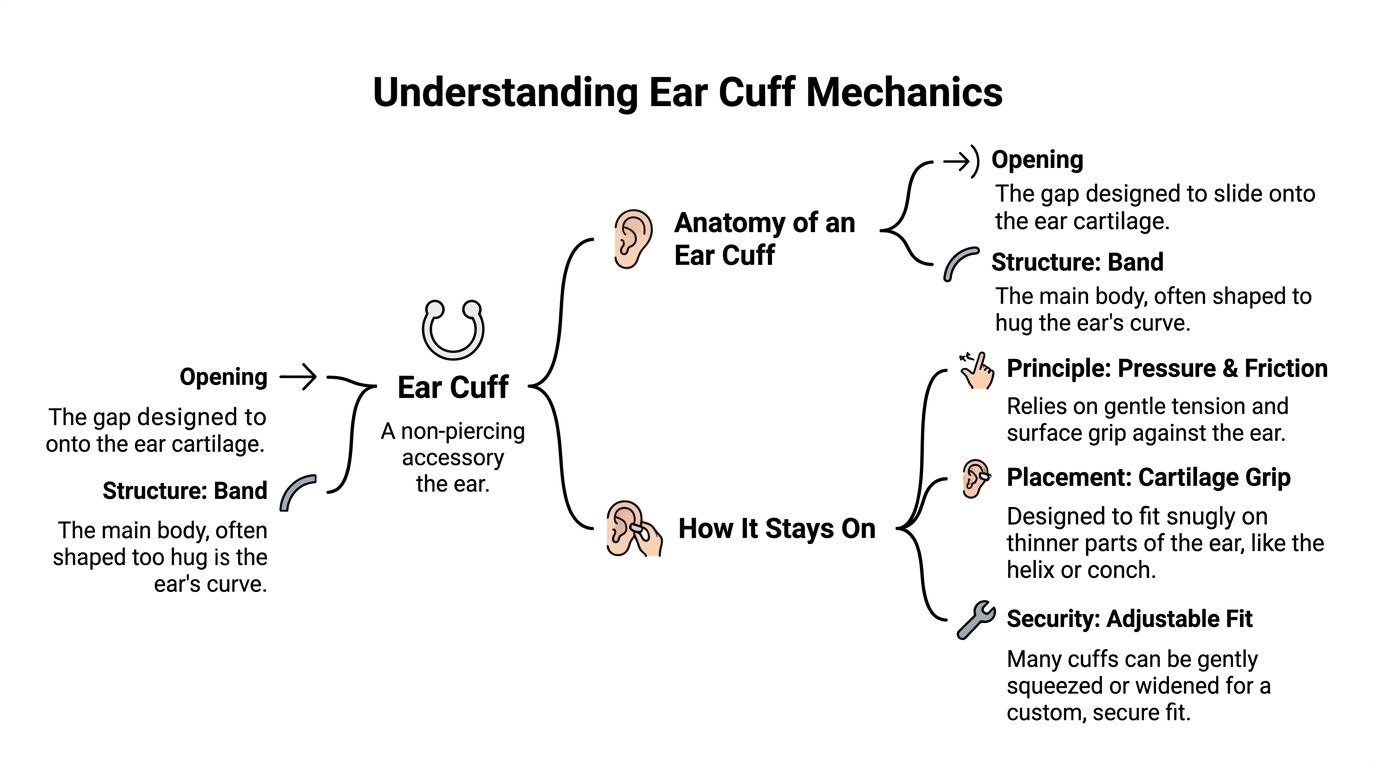
Think of an ear cuff like a small open ring shaped for the edge of the ear. It has a gap, and that gap slides onto a thinner part of the ear first. Once it's in place, the cuff rests against the cartilage with light tension.
A well-made cuff should feel closer to a snug ring than a clamp.
In the UK, ear cuffs for non-pierced ears typically use a spring-tension mechanism calibrated to exert 0.8–1.2 Newtons of radial force on the auricular cartilage, creating a secure hold without piercing by using the ear's natural elasticity. That force range is noted in relation to British Medical Association guidance on non-invasive jewellery and is intended to help avoid pressure-related problems during 6+ hours of continuous wear, as described on Scream Pretty's ear cuff collection page.
Why placement matters more than force
People often think a slipping cuff means it needs to be squeezed harder. Usually, it means it's in the wrong place.
The ear isn't one even thickness from top to bottom. Some areas are thinner and easier to slide onto. Other areas are thicker and help hold the cuff securely once it's rotated into position. If you force a cuff where it doesn't naturally sit, it'll either fall off or become uncomfortable.
A secure cuff should feel present but not painful. If you're constantly aware of it pressing into your ear, the fit is off.
What a good fit feels like
You're aiming for three things at once:
- Stable hold: It shouldn't drop off when you move normally.
- Light pressure: You should feel gentle contact, not sharp pinching.
- No hot spots: One tiny point of intense pressure is a sign to remove and readjust.
A quality cuff is thoughtfully engineered jewellery, not a gimmick. Once you understand that, it becomes much easier to shop well and avoid pieces that only look good in photos.
Finding Your Perfect Ear Cuff Style and Material
Style is where the excitement often lies. Material is where many people make mistakes.
The best ear cuffs for non pierced ears do both jobs well. They create the look you want, and they feel wearable against skin that may be sensitive to certain metals.
Choosing by placement
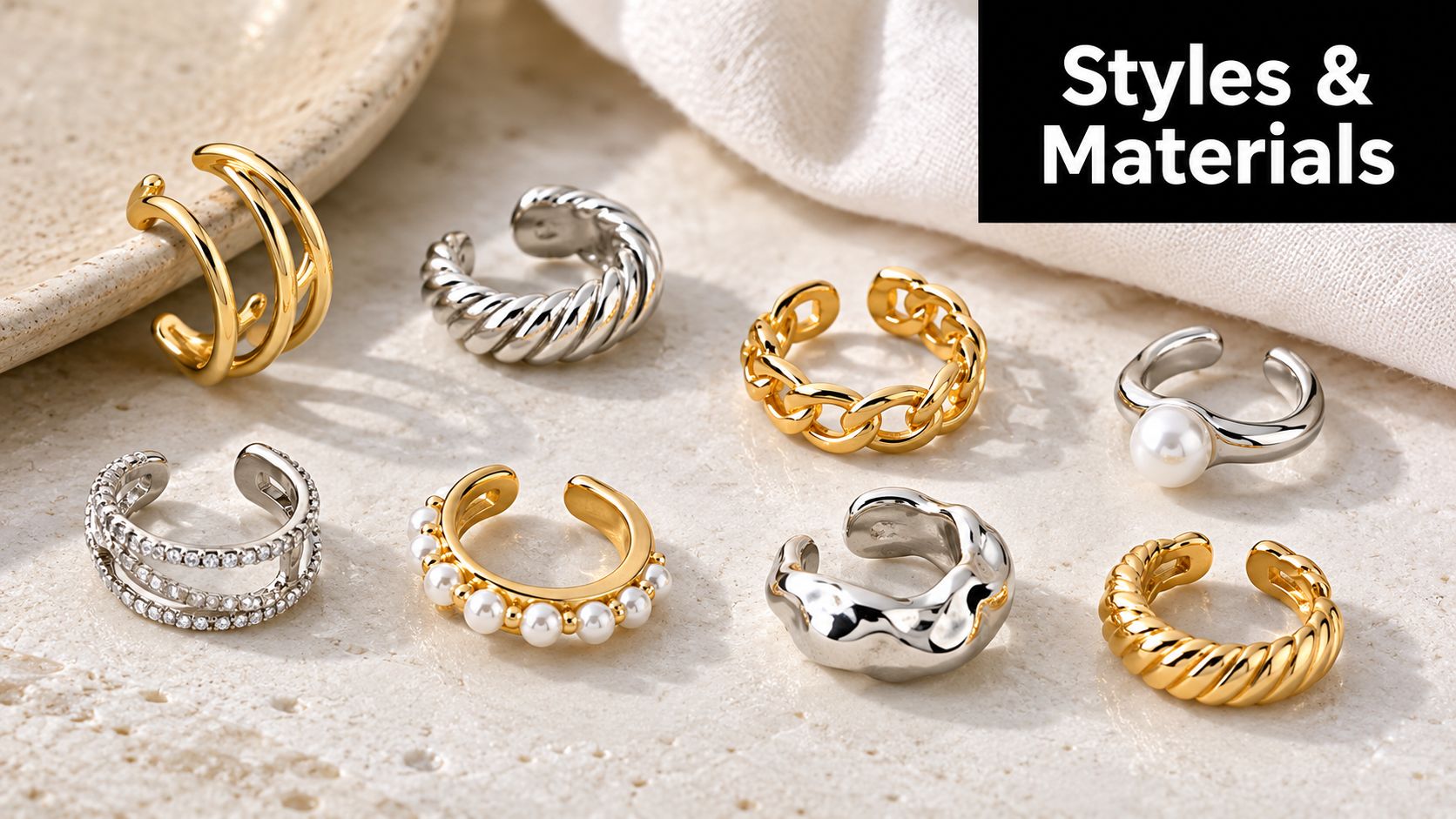
Ear cuffs are specifically engineered to wrap around the outer cartilage of the ear, such as the helix or conch, mimicking the visual placement of a helix or conch piercing without any needle penetration or permanent modification. That structural difference is what makes them so appealing for anyone chasing a cartilage look without committing to a piercing, as outlined in Mara Paris's guide to ear cuff types.
The easiest way to choose is by the look you want to imitate.
Helix-style cuffs
These sit along the outer rim of the ear and are usually the simplest starting point. A plain band in silver or gold gives a very clean, believable cartilage effect.
They suit readers who like a subtle look and want something easy to wear with existing lobe jewellery.
Conch-style cuffs
These sit more towards the inner bowl area of the ear. They often look bolder because the conch area is more visually central.
If you like a statement hoop look but aren't ready for a conch piercing, this style is often the closest visual preview.
Decorative and layered cuffs
Some cuffs include stones, chains, double bands, or a wrapped design. These are more fashion-led and less about mimicking a single piercing exactly.
They work well if your goal is a curated ear rather than a minimal one.
Choosing by material
Material affects comfort, finish, and how fussy the piece is in day-to-day wear.
| Material | What it's like | Best for |
|---|---|---|
| Sterling silver | Bright, classic, easy to style | Everyday minimalist looks |
| Gold-plated silver | Warm tone, fashionable, versatile | Readers who wear mostly gold |
| Titanium | Often preferred by sensitive skin wearers | Low-reactivity option |
| Cheaper base metals | Can look good at first but may irritate | Occasional fashion wear only |
A simple rule helps here. If your skin reacts easily, prioritise low-reactivity metals over trend-led finishes.
Matching style to your decision stage
If you're using a cuff as a trial run for a future piercing, choose a plain design first. It shows placement more clearly.
If you already know you just want non-pierced styling, then decorative cuffs make more sense. At that point, you're shopping for expression rather than testing a future commitment.
A Guide to Fitting and Styling Your Ear Cuff
The biggest mistake beginners make is trying to clip the cuff straight onto the thickest part of the ear. That almost always leads to pinching, frustration, or a cuff that won't sit properly.
A gentler method works better.
How to put one on
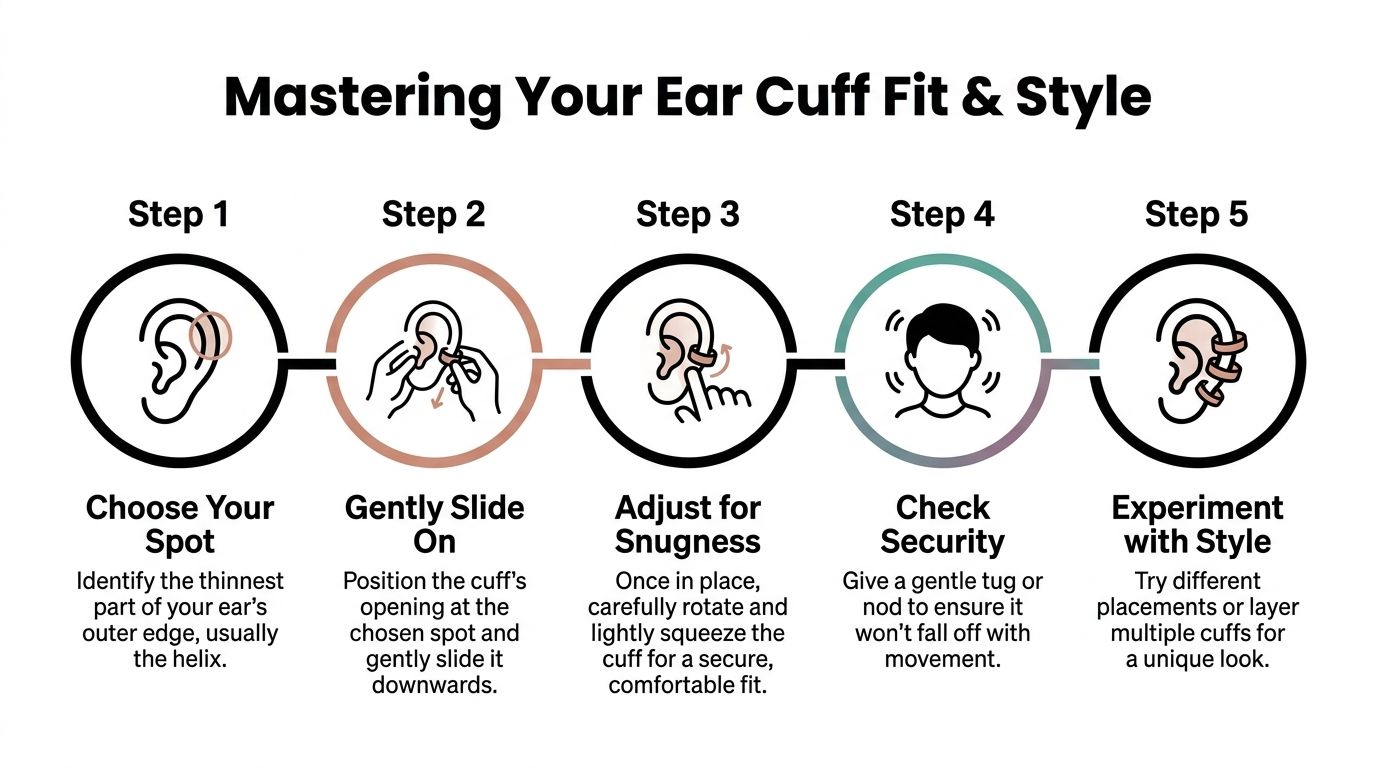
- Find a thinner entry point on the upper outer ear.
- Slide the cuff onto that narrower area gently. Don't force it.
- Move it into position by rotating or sliding it to where you want the final look.
- If the cuff is adjustable, make a very small fit change with your fingers.
- Check security by moving your head naturally. You're testing normal wear, not trying to yank it off.
Small adjustments matter. Big squeezes usually cause problems.
If a cuff hurts during fitting, stop there. Remove it, reset, and try again with position before changing the tension.
How to take it off safely
Removal should be the reverse of fitting. Slide it back towards the thinner part of the ear, then lift it away.
Don't pull it directly off the widest area. That's when people scrape the skin or bend the cuff out of shape.
Three easy styling directions
If you're unsure how to wear ear cuffs for non pierced ears, start with one of these combinations.
Minimalist
Wear one slim cuff on one ear, then keep your lobes simple. A small stud or tiny hoop works well.
This look suits work, weekends, and anyone who wants the effect to feel understated.
Stacked
Use two cuffs at different heights on the same ear. Keep the metal matching so the ear looks intentional rather than busy.
If you like close-set jewellery looks, you may also enjoy the neat profile of huggie earrings for everyday ear styling.
Statement
Choose one chunkier cuff or a gem-set piece and let it do most of the work. Keep the other ear quieter.
This is often the best option for people who don't usually wear much jewellery but want one strong accent.
A quick fit checklist before you leave the house
- Mirror check: The design should face outward, not disappear behind the ear.
- Movement check: Turn your head, tuck your hair back, and see whether it shifts.
- Comfort check: It shouldn't leave you counting the minutes until you can remove it.
Good styling starts with good fitting. If the cuff sits properly, almost every outfit looks more polished.
Essential Safety Comfort and Care Advice
Ear cuffs look simple, but cartilage is still cartilage. It can get irritated if jewellery presses in the wrong way or stays on too long.
That's why comfort advice matters just as much as style advice.
How long is too long
A 2025 NHS England report on non-invasive jewellery-related dermatitis found a 14% increase in GP visits for ear cartilage irritation among women aged 16–30 in the South East, including Bournemouth and Croydon areas. The same report linked 68% of those cases to non-pierced jewellery such as cuffs worn for 6+ hours daily, as cited in this ear cuff guide discussing the NHS England report.
That doesn't mean ear cuffs are unsafe. It means wear time and pressure matter.
Cold weather can also make skin feel less forgiving, so a cuff that felt fine on one day may feel tighter on another.
Signs your ear needs a break
Watch for these early warnings:
- Persistent redness: A slight mark after removal can happen. Ongoing redness is different.
- Throbbing or warmth: That usually means the area is being stressed.
- Tenderness the next day: Your ear shouldn't still feel bruised after short wear.
- Dry, reactive skin: Metal sensitivity or friction may be involved.
If your skin is easily annoyed by jewellery in general, it helps to read up on hypoallergenic earrings for sensitive ears and lower-reactivity options.
Simple habits that reduce problems
You don't need a complicated routine. A few sensible habits go a long way.
- Rotate your wear time: Don't treat every cuff like an all-day piece.
- Remove before sleep: Pillows create pressure and movement you can't control.
- Keep the cuff clean: Wipe it regularly so residue doesn't sit against the skin.
- Don't chase security by over-tightening: Fit should come from placement first.
Cartilage irritation often starts quietly. If something feels a bit off, don't try to “push through” it.
Mindful wear is what keeps ear cuffs enjoyable. The goal is style without soreness.
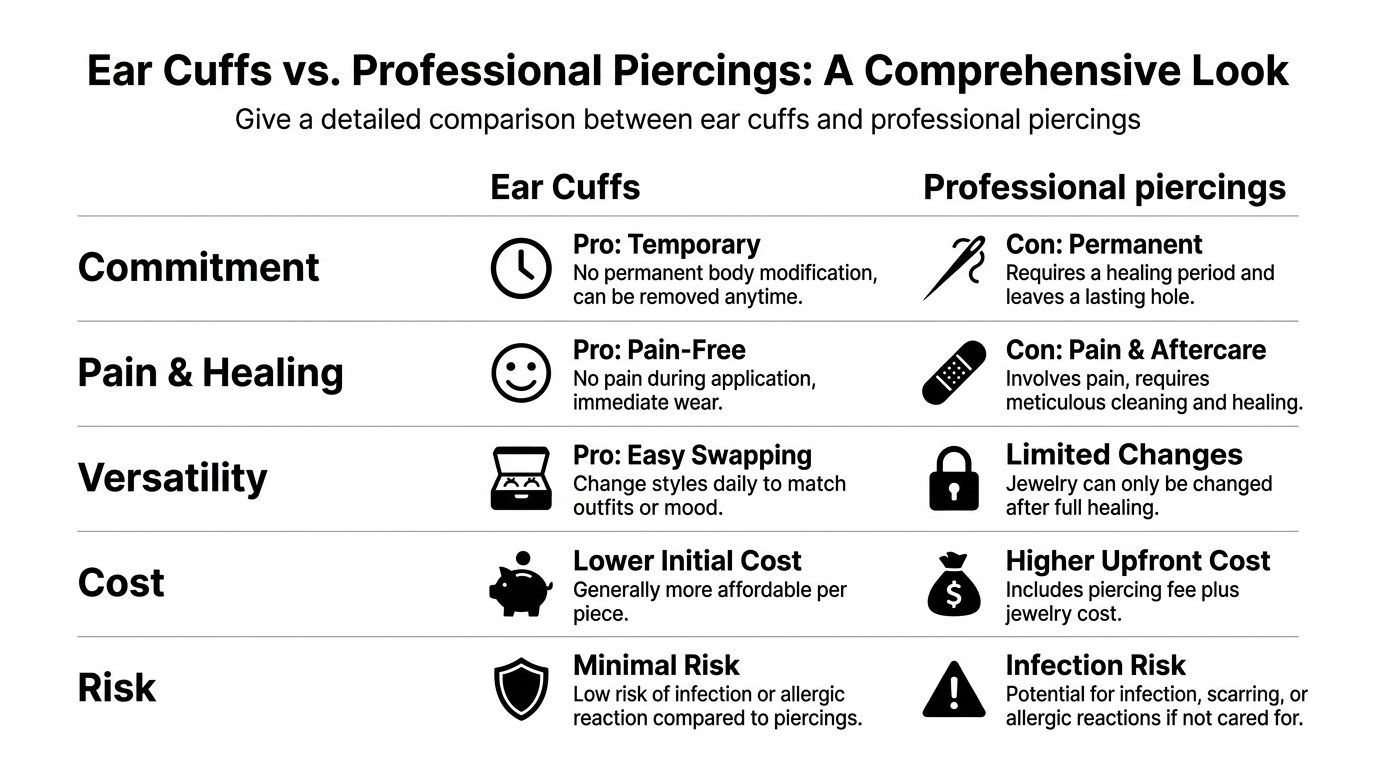
Ear Cuffs vs Professional Piercings A Clear Comparison
This isn't a contest with one correct winner. Ear cuffs and professional piercings solve different problems.
Cuffs are flexible. Piercings are durable.
Why cuffs have become a lasting option
The global ear cuffs market was valued at USD 1.25 billion in 2025 and is projected to reach USD 2.45 billion by 2034, with a CAGR of 8.2%, according to Intel Market Research's ear cuffs market report. That kind of projected growth supports what many wearers already know. Ear cuffs aren't just a passing novelty for indecisive shoppers. They've become a serious category in their own right.
Still, long-term wearers often notice a dividing line. Once you love one exact placement and want jewellery there every day without fitting, adjusting, or pressure points, a piercing starts to make more sense.
Ear Cuffs vs Professional Piercings at a Glance
| Feature | Ear Cuffs | Professional Piercings |
|---|---|---|
| Commitment | Temporary and removable | Long-term body modification |
| Pain at the start | No needle involved | Brief piercing pain |
| Healing | No wound to heal | Requires healing time and aftercare |
| Daily wear | Needs correct fitting each time | Much easier once healed |
| Jewellery changes | Easy to swap instantly | Best changed after healing |
| Placement testing | Excellent for experimenting | Best once you know what you want |
| Long-term convenience | Less convenient for constant wear | Better for permanent styling |
Who tends to prefer each option
Ear cuffs usually suit people who like variety, occasional wear, or testing a look first.
Professional piercings usually suit people who want a placement to become part of their everyday appearance. They're especially appealing when you're tired of readjusting jewellery or you want access to a broader range of fitted cartilage pieces.
For readers considering that next step, it helps to understand the difference between fashion cuffs and ear cuff piercings that create a permanent cartilage look.
If you've worn the same cuff placement again and again, you may already have your answer.
The better choice depends on your goal. If you want freedom, choose the cuff. If you want permanence and convenience, choose the piercing.
Ready for the Real Thing How to Book Your Piercing
Some people try an ear cuff once and move on. Others keep coming back to the same spot on the same ear until the decision is obvious.
You may be ready for a professional piercing if you've been wearing a cuff in one placement regularly, you know which metal tone you prefer, and you're more interested in a lasting result than a temporary styling option. At that point, the cuff has done its job well. It helped you test the look without rushing into anything.
That shift also fits the wider UK interest in non-invasive ear styling. In the United Kingdom, the ear cuffs market was valued at USD 1.2 billion in 2024 and is forecast to reach USD 2.5 billion by 2033, with a projected 8.5% CAGR from 2026 to 2033, according to this United Kingdom ear cuffs market projection. For many wearers, cuffs are the starting point. A smaller group then decide they want a permanent, everyday version.
If you're at that stage and want to speak to a professional studio in Croydon or Bournemouth, the easiest next step is to ask about placement, jewellery options, and healing expectations before you book. A proper consultation should feel calm, clear, and personalized for your ear anatomy.
For direct booking support, call 01202 9000 50 or message on WhatsApp at 07752913846. If you're choosing between a helix, conch, or another cartilage placement, talking it through first usually makes the decision much easier.
If you're ready to move from experimenting to booking, Piercing Near Me helps you find safe, professional piercing options with trusted studios in Croydon and Bournemouth. You can explore placements, learn about sterile needle piercing and implant-grade jewellery, and take the next step with confidence. For booking help, call 01202 9000 50 or send a WhatsApp message to 07752913846.