
Solid 14ct or 18ct gold is the only safe gold choice for an initial navel piercing in the UK. It must be solid, suitable for contact with broken skin, properly polished, and never plated or made from an unknown alloy.
You may be looking at a polished gold belly bar online, comparing a delicate chain with a classic curved barbell, or wondering whether a beautiful piece bought from a high-street jewellery shop can go straight into a fresh piercing. The colour can look perfect while the construction creates irritation, pressure, or a reaction during healing.
The UK has a particularly useful framework for avoiding that mistake. The navel piercing became mainstream in 1993, after Christy Turlington and Naomi Campbell appeared with pierced navels at a London fashion show, while Aerosmith's Cryin’ video featured Alicia Silverstone being pierced in the same year. A UK survey of 10,503 people later found that the navel was the most common body piercing site, accounting for 33% of non-earlobe piercings. This UK body jewellery overview provides that historical and survey context.
Choosing the Right Gold for Your Navel Piercing
A fresh navel piercing is a small wound with jewellery passing through it. Treating it like an ordinary accessory is the most common buying error. A low-priced gold-coloured belly bar may look attractive in a product photograph, but plating can wear away and the base metal may not be appropriate for prolonged contact with healing tissue.
For an initial gold belly bar, begin with one rule: choose solid 14ct or solid 18ct gold only. UKAPP guidance allows initial jewellery made from solid 18k or 14k gold, provided it isn't plated and has a good surface polish. London body-piercing codes use the same solid 14ct or 18ct benchmark for gold used in body piercing. UKAPP's jewellery verification guidance explains why material verification, finish, and construction matter.
What to check on the label
A hallmark helps you understand fineness, but it doesn't replace a piercer's assessment of whether the item is made for a piercing. UK hallmarking uses parts-per-thousand marks, with 375 corresponding to 9ct gold, 585 to 14ct gold, and 750 to 18ct gold. For a piece going into a new navel piercing, the relevant choices are 585 or 750, alongside evidence that the item is solid and suitable for body piercing.
Look for clear wording such as:
- Solid construction: The description should say solid gold, not gold plated, gold filled, vermeil, or gold coloured.
- Known fineness: A clear 14ct or 18ct specification is more useful than just saying “real gold”.
- Smooth finish: The surface should be well polished, without scratches, pits, rough seams, or sharp edges.
- Controlled alloy: Ask whether the manufacturer can confirm the alloy composition and nickel content.
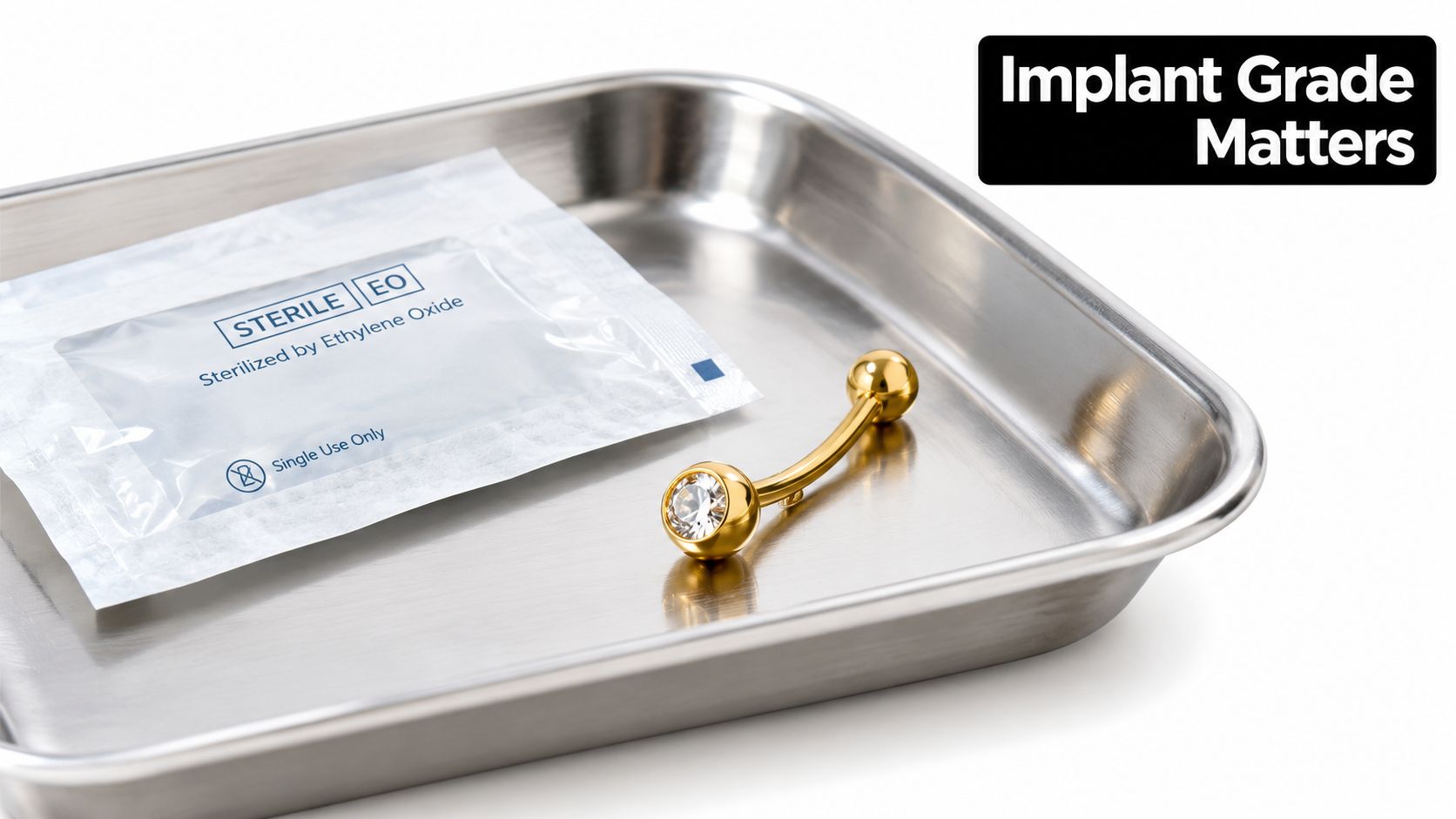
- Sterile presentation: Initial jewellery should be pre-sterilised and packaged appropriately by the studio.
Practical rule: A gold colour tells you what the jewellery looks like. It doesn't tell you what touches your skin.
Fashion jewellery often prioritises decoration, low cost, and fast production. Professional piercing jewellery prioritises a stable surface, predictable dimensions, controlled materials, and a finish that won't catch on developing tissue. That difference matters more than whether the gold is yellow, white, or rose-toned.
Understanding Gold Karats and Alloy Choices
Gold karat describes the proportion of gold in an alloy, not the colour or quality of the design. Pure gold is too soft for many jewellery applications, so manufacturers combine it with other metals to create a harder material. Think of the gold as the binder in a building material, and the additional metals as the components that change its strength, texture, and behaviour.
For navel jewellery, 14ct and 18ct solid gold sit within the accepted UK range for jewellery contacting broken skin. Local authority guidance connects that range with reducing the risk of allergic reactions, bacterial harbouring, and jewellery adhering to newly formed tissue. It also stresses that jewellery should be sterile and of a suitable grade before insertion. Barnet's body-piercing code sets out this professional approach.
How the fineness marks work
The hallmark number is easier to understand if you read it as parts of a thousand:
| Mark | Gold standard | What it tells you |
|---|---|---|
| 375 | 9ct | Lower gold fineness, outside the preferred 14ct to 18ct range for an initial navel piercing |
| 585 | 14ct | A recognised 14ct fineness mark |
| 750 | 18ct | A recognised 18ct fineness mark |
A 14ct piece isn't automatically suitable just because it carries the right fineness. A manufacturer can still use an unsuitable alloy, produce a poor surface, or sell a design that is too heavy or awkward for a healing navel. Fineness is one checkpoint, not the whole safety assessment.
Comparing the practical options
Solid 14ct gold offers a balance of durability and gold content. It's widely available in navel designs and may be a sensible choice for someone who wants a premium material without choosing the higher gold content of 18ct.
Solid 18ct gold contains more gold and is also within the professional range. Its suitability still depends on the alloy, finish, construction, and the skill of the studio fitting it. Higher gold content doesn't make a poorly made or bulky item appropriate.
9ct gold, represented by the 375 mark, contains a larger proportion of other metals. UK piercing guidance doesn't place it in the preferred initial range for gold jewellery contacting a fresh piercing.
Plated or unknown gold is the clearest option to reject. The outer coating can wear, chip, or expose a different base metal. A gold-coloured surface is not a substitute for a traceable solid alloy.
For a deeper look at choosing appropriate materials, use this guide to solid gold piercing jewellery. The useful habit is to assess fineness, alloy control, finish, sterility, and shape together, rather than letting colour or a gemstone make the decision.
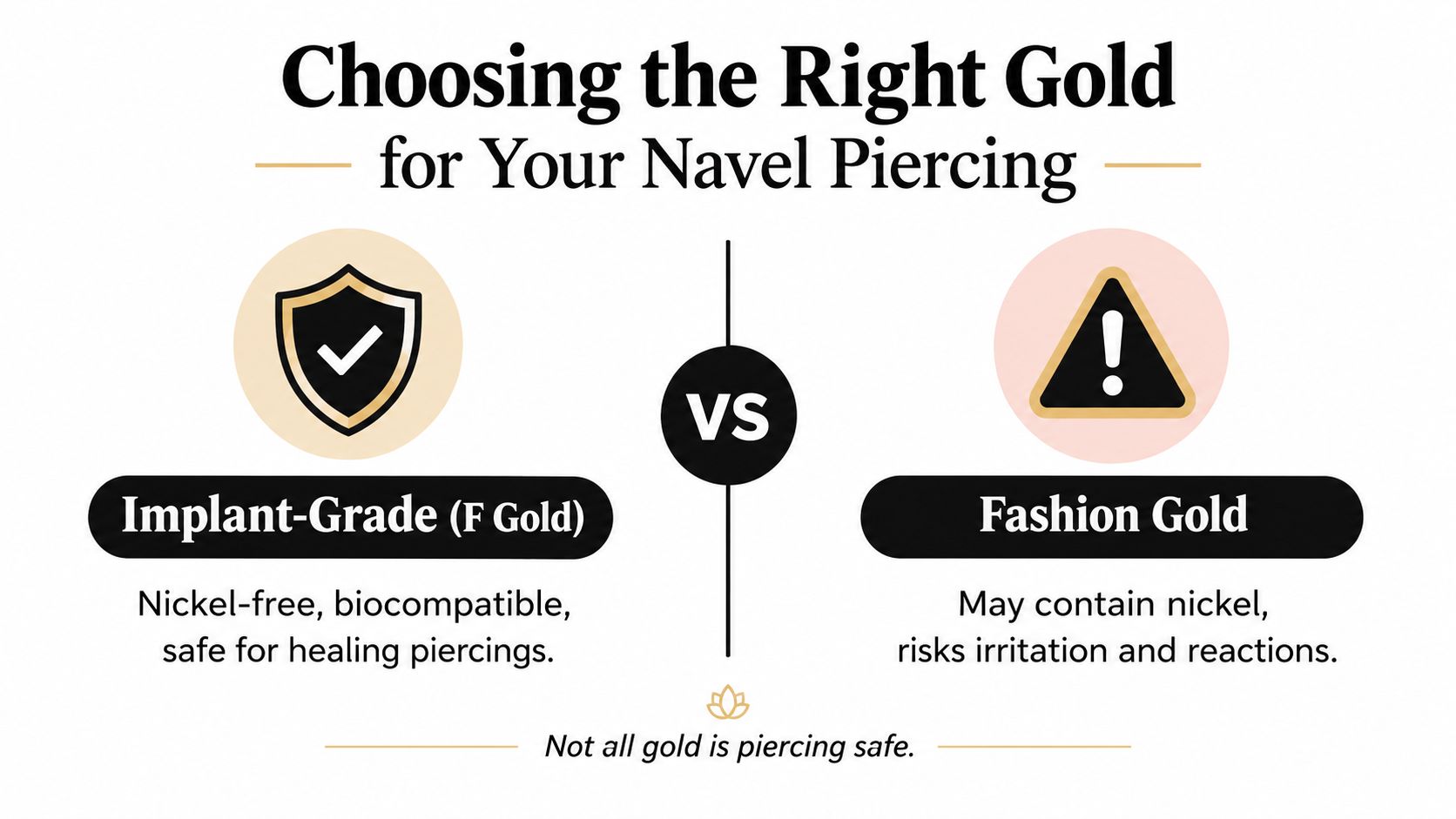
Implant-Grade versus Fashion Gold Explained
“Implant-grade” is a material and manufacturing conversation, not a marketing synonym for expensive. In practical terms, it means the jewellery has been made and finished to a standard intended for safe, prolonged contact with the body. A fashionable gold-plated ring may be attractive, but it doesn't offer the same assurance about its base metal, coating durability, or surface.
For gold navel jewellery, ask the seller or piercer four direct questions:
- Is the piece solid 14ct or 18ct gold?
- Can you confirm the alloy and nickel content?
- Has the surface been polished smoothly?
- Is it suitable for a fresh piercing, or only for a fully healed one?
A responsible answer should be specific. “It's hypoallergenic” is less useful than documentation showing what the alloy contains and how the item meets relevant product-safety requirements.
Nickel release is a measurable issue
UK product-safety guidance sets nickel-release limits for jewellery intended for prolonged skin contact. The limit is 0.5 micrograms per square centimetre per week, while the limit for the post assembly used in piercings is 0.2 micrograms per square centimetre per week. Coated products must maintain compliance for at least two years of normal use. The National Association of Jewellers product-safety guidance provides these technical limits.
These figures matter because gold itself isn't a guarantee that a piece is reaction-free. Gold jewellery is an alloy, and the other metals affect how the item behaves against sensitive skin. Suffolk guidance notes that 14ct to 18ct gold may be considered suitable only when the manufacturer can guarantee nickel content. Some piercers also avoid gold for fresh piercings when softness, wear, or the specific alloy creates uncertainty.
Surface quality changes the experience
A microscopic scratch can behave like a snag point. A rough seam can trap residue. A damaged coating can expose the metal underneath. During healing, those small manufacturing flaws can create repeated mechanical irritation every time the jewellery moves.
That's why a professional will often prefer a simple, polished, low-profile design over a dramatic piece with chains, textured edges, or a large setting. The safer choice isn't necessarily the plainest forever. It's the piece that puts the least unnecessary stress on a healing channel.
The meaningful distinction is not “luxury gold versus cheap gold”. It's traceable, controlled, well-finished jewellery versus an item whose materials and construction are uncertain.
A reputable studio should also assess whether the jewellery is appropriate for your anatomy, sterilise it before insertion, and explain how it should sit. If the seller can't answer basic questions about alloy composition or intended use, don't use the piece as initial jewellery.
Selecting the Perfect Size and Style
A navel bar can look perfect in a product photo yet feel uncomfortable once you sit, bend, or dress for work. After the gold and construction have been checked, sizing determines whether the jewellery stays settled or behaves like a loose handle that catches on clothing.
UK retail listings commonly show navel jewellery with a 1.6 mm gauge and 8 mm or 10 mm lengths. One retailer lists 14ct yellow and white gold belly-button pieces from £125 to £225, depending on the stone and design. These UK navel jewellery listings illustrate the dimensions and price range shoppers may encounter, but a retail specification is not a personal fitting recommendation.
Understand gauge and length separately
Gauge is the thickness of the bar. A 1.6 mm bar describes the jewellery's diameter, not whether it suits your piercing. A product labelled as a belly bar can still be the wrong size for the channel or surrounding tissue.
Length is the distance between the ends of the bar. An 8 mm piece may sit neatly on one person, while a 10 mm piece may leave more comfortable room on another. Tissue depth, the shape of the navel, the channel's position, and any remaining swelling all affect the measurement. Bar length works like the clearance around a door. Too little space creates pressure, while too much allows unnecessary movement.
Have a piercer measure the piercing rather than choosing from a generic online chart. This matters especially when replacing jewellery. The size used during early swelling may not be the size that sits correctly once the tissue has settled, and a mature channel may still need a different length after changes in weight or anatomy.
A properly fitted bar should sit securely without pinching, pressing into the tissue, or hanging far enough to catch on a waistband.
Match the design to the stage of healing
A simple curved barbell is generally easier to manage than a hanging design. It has fewer parts to catch on waistbands and moves less when you bend, sit, or stand. A small top or bottom detail can provide a gold finish without creating a long lever that pulls on the piercing.
Chains, dangles, shields, and large stones are better reserved for a fully settled piercing. Their weight and movement can tug at the channel, especially if clothing catches them. Decorative gold jewellery may look refined but remain unsuitable for daily wear when its shape presses repeatedly against the navel.
| Style | Main advantage | Main concern |
|---|---|---|
| Simple curved barbell | Stable, versatile, and easier to keep clear of clothing | Less dramatic visually |
| Small gemstone barbell | Adds colour or sparkle without a large profile | The setting must be smooth and secure |
| Chain or dangle | Creates movement and a statement look | More likely to snag or pull |
| Large shield | Strong decorative impact | Bulk and pressure can reduce comfort |
Anatomy also determines whether a traditional navel placement is suitable. A defined upper rim may support a standard curved barbell, while a shallow or collapsing navel may need a different assessment from a professional piercer. Choose the fit and placement together, rather than expecting the piercing to adapt to a favourite design.
For further examples of navel piercing jewellery, compare styles while treating the listed measurements as starting points. The suitable piece is the one that sits securely, allows natural movement, and avoids creating another friction point.
Aftercare and Lifestyle Considerations
Gold doesn't shorten the healing process by itself. A well-made piece can reduce avoidable material problems, but your clothing, movement, cleaning routine, and exposure to water still determine how comfortable the piercing becomes.
UK piercing guidance describes navel healing as slow. Depending on the person and the piercing, healing may take 3 to 6 months, or 6 to 12 months in some cases. This UK piercing-care guide highlights friction from waistbands, belts, tight jeans, swimming, and moisture retention around the navel as key concerns.
Build your routine around friction
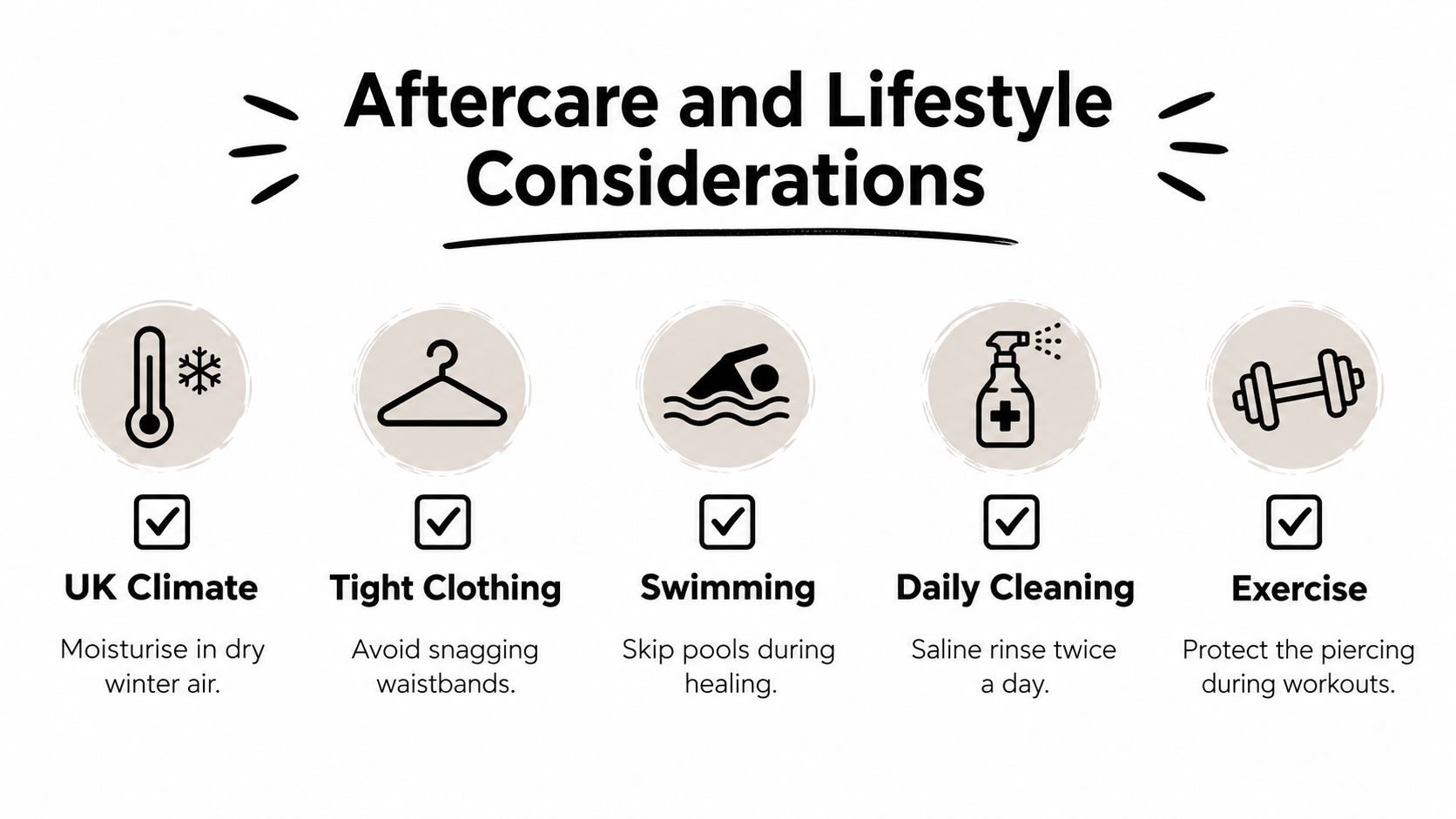
High-waisted trousers, rigid denim, belts, and tight gym clothing can press directly on the jewellery. Sitting folds the abdomen, while bending can push the bar against the upper and lower edges of the navel. Choose softer, looser clothing where possible, and check that seams or waistbands don't cross the piercing.
Keep the area dry after washing. Moisture held inside the navel can leave the surrounding skin uncomfortable, particularly when clothing covers the area for long periods. Don't rotate the jewellery, pick at crusting, or apply lotions and oils directly over the piercing unless a qualified professional has advised you to do so.
A realistic healing routine
Independent UK piercing guidance recommends cleaning with sterile saline twice daily, avoiding tight clothing, and not changing the jewellery too early. One UK studio describes 6 to 8 months as the most common healing window, recommends avoiding submerging the piercing in water for at least 6 weeks, and suggests a check-up around 6 weeks after the piercing. This UK belly-piercing guide sets out those practical milestones.
Use a gentle routine:
- Clean carefully: Use sterile saline and let it soften residue rather than scraping it away.
- Dry completely: Pat the area dry with clean, disposable material after bathing or showering.
- Protect during exercise: Avoid movements or clothing that compress, drag, or repeatedly catch the jewellery.
- Delay swimming: Follow your piercer's advice before entering pools or other bodies of water.
- Watch the trend: Ongoing worsening pain, spreading heat, or increasing swelling needs professional medical attention.
Normal early healing can include tenderness, mild irritation, and some discharge. Symptoms that become progressively worse, spread beyond the immediate area, or concern you should be assessed by a healthcare professional. Don't remove jewellery during a suspected infection without medical or professional advice.
Comfort check: If your waistband touches the jewellery every time you sit down, the problem is the fit of your clothing and routine, not the colour of your gold.
For a more detailed routine, use this belly button piercing aftercare guide. Decorative gold should wait until the channel is fully settled, even if the outside looks calm.
Making Your Final Purchasing Decision
You are standing at the studio counter with a gold navel bar in hand. The colour looks right, but the safer decision depends on what sits beneath the finish, whether the dimensions suit your anatomy, and whether your piercing has healed enough for a change. If you have not been pierced, arrange an anatomy assessment and discuss gold with a professional. If the piercing is healing, ask your piercer to measure it before ordering a replacement.
Use this checklist before paying:
- Material: Confirm that the jewellery is solid 14ct or 18ct gold, not plated or hollow.
- Fineness: Look for the relevant 585 or 750 mark where applicable. In the UK, a hallmark can support the stated fineness, but it does not replace checking the full construction.
- Alloy: Ask whether nickel content is controlled and whether the maker can provide compliance information.
- Finish: Reject pieces with rough seams, sharp edges, pits, scratches, or damaged coating. A smooth surface is easier on a healing channel, much like a polished edge is less likely to catch on fabric.
- Sterility: Initial jewellery should be sterilised and opened by the studio for insertion.
- Dimensions: Confirm the gauge and length with a piercer rather than guessing from an online listing.
- Design: Choose a low-profile, lightweight style for healing. Chains and bulky decorations can wait until the channel is settled.
- Lifestyle: Check the effect of waistbands, work clothing, exercise, swimming, and any routine that keeps the navel covered.
Value is more than the price tag
A cheaper gold-coloured item may cost more if it irritates the piercing, needs replacing, or leads to early jewellery changes. A higher price alone does not prove better quality. Judge the amount against solid construction, verified material, careful finishing, suitable dimensions, and professional fitting.
A separate UK body-jewellery seller lists 14K gold belly-button styles from £112 and states that its 14K gold is hallmarked in England. Prices for 14ct gold navel jewellery vary widely by design and stone, so compare construction and certification rather than the headline price.
Gold can be a lasting choice, but colour comes last. Confirm the material, fit, surface, and timing first. If a seller cannot answer clear questions about alloy, construction, sizing, or hallmarking, choose another supplier.
Piercing Near Me connects clients with studios offering single-use sterile needles, implant-grade jewellery, anatomy assessments, and personalised aftercare in Croydon and Bournemouth. Visit Piercing Near Me to explore navel piercing options, book a consultation, or contact the team on 01202 900050 (Bournemouth) / 020 8686 7730 (Croydon) or WhatsApp on 07752 913846 (Bournemouth) / 07902 490584 (Croydon).