
You're in front of the mirror, holding a ring that looks simple until you try to line up the bead and realise it's not a tiny hoop at all. A captive bead ring is a mechanical piece of body jewellery, and the difference between “looks fine” and “fits properly” comes down to tension, gauge, diameter, and material. Get those four things right and the ring sits neatly. Get them wrong and you're dealing with pressure, slipping beads, irritation, or a change that should've stayed in the studio.
What a Captive Bead Ring Actually Is
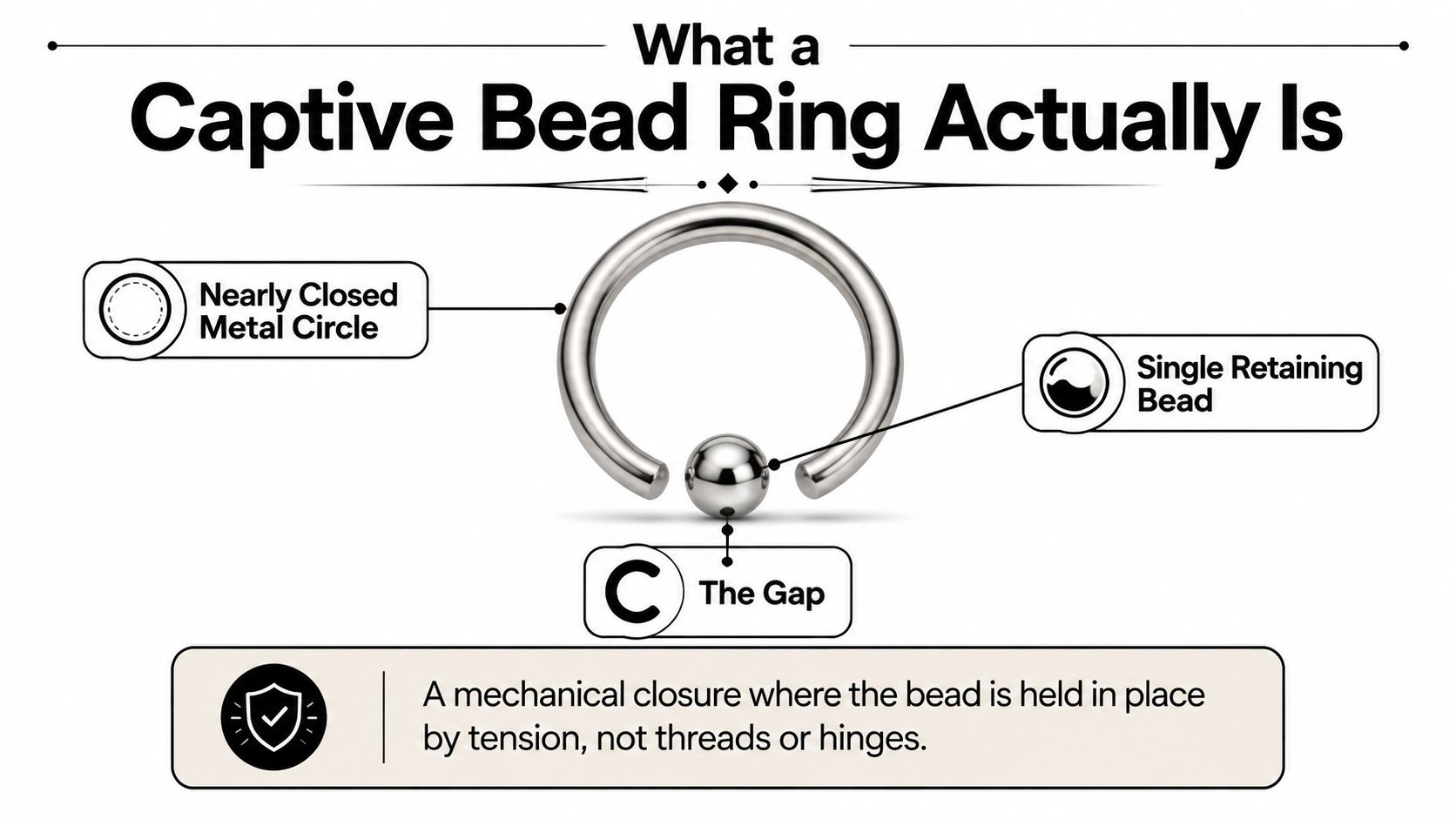
A captive bead ring is almost a full circle of metal with a small gap, and the bead is held in place by the ring's own tension rather than by a thread or hinge. That's the part most first-timers miss. It looks decorative, but it works like a spring.
In the UK, captive bead rings are tied to the modern body-piercing wave that became widely visible in the early 1990s, when pierced navels moved into mainstream fashion and ring jewellery became a familiar look in ears, nostrils, navels, and more navel piercing history. That history matters because the style didn't grow up as a novelty. It became a standard format because it suits a lot of placements.
The easiest way to picture it is a 1.2 mm titanium ring with a 4 mm bead in a healed lobe. The metal circle does the holding, the bead completes the shape, and the gap is what makes the system work. If the ring is opened too far, the tension weakens. If it's too tight, the piercing feels squeezed.
Practical rule: if the bead seems to “snap” in and sit snugly, the ring is using its tension properly. If it wobbles, the fit needs checking.
| Component | What it does | What to check |
|---|---|---|
| Ring body | Forms the circle and provides tension | Smooth finish, correct gauge |
| Bead | Closes the gap visually and mechanically | Correct bead size, secure seating |
| Gap | Lets the bead be inserted and removed | Not overly spread, not pinching tissue |
Anatomy of a Captive Bead Ring
The ring body is the main structure. It should feel like one continuous loop when it's closed correctly. The bead should look like part of the design, not an afterthought stuck into a crack.
The key thing to notice in shop is this. A captive bead ring is not “just a ring”. It's a ring that relies on elastic tension to keep the bead in place, which is why handling it feels different from a clicker or seam ring.
Gauge, Diameter and Bead Size in Plain English
Gauge is the thickness of the metal that goes through the piercing. Diameter is the inside width of the ring, which tells you how much room the jewellery has around the tissue. Bead size is the visible centre piece, the part that is noticed first.
Think of the ring like a springy collar around the piercing. If the collar is too thick, it can feel heavy or forceful. If it's too narrow, it can sit loosely and move more than it should.
UK piercing sizing is often discussed in both gauge and millimetres. A captive bead ring is commonly chosen from 20G to 10G, about 0.8 mm to 2.5 mm, with inner diameters often ranging from 6 mm to 25 mm UK sizing bands. The bead is usually 3 mm to 5 mm in the same type of jewellery bead and ring sizing example. A separate product listing also shows gauge sizes from 20g (0.8 mm) to 8g (3.2 mm) and inner diameters from 1/4 inch (6 mm) to 7/8 inch (22 mm) titanium CBR sizing example.
The reason sizing matters is simple. A ring that's too small presses into swelling. A ring that's too large catches hair, clothing, and pillows more often. That's why self-measuring from a box is never as useful as checking the anatomy in person.
For a quick conversion reference, this guide helps with the numbers, mm to gauge conversion.
| Piercing | Typical gauge | Typical inner diameter |
|---|---|---|
| Lobe | 20G to 16G | 6 mm to 8 mm |
| Helix | 18G to 16G | 6 mm to 10 mm |
| Nostril | 18G to 16G | 6 mm to 8 mm |
| Septum | 16G to 14G | 8 mm to 10 mm |
| Navel | 14G to 12G | 8 mm to 12 mm |
Sizing shortcut: gauge is thickness, diameter is space, bead size is appearance. If you mix those up, you'll pick the wrong ring even when the numbers look close.
When a CBR Beats a Clicker, Seam Ring or Labret
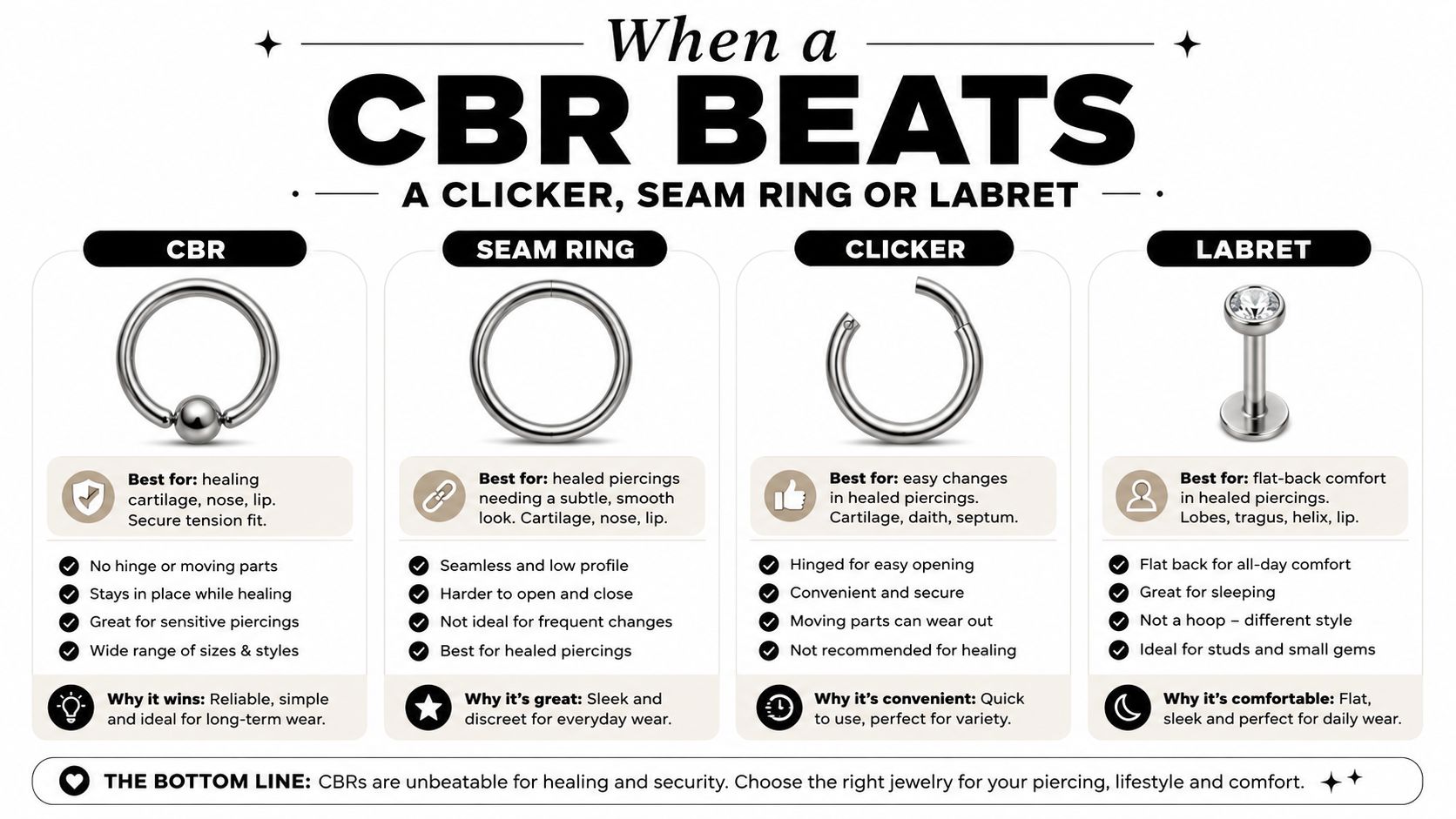
A captive bead ring makes most sense when you want a true ring shape and the piercing has enough room to sit naturally in it. It's a strong choice for healed placements where the jewellery doesn't need to be changed every week. That's where the tension closure becomes an advantage instead of a hassle.
Matching closure to placement
CBRs suit healed septums, daiths, conches, nipples, some navel jewellery, and nostrils where a ring is wanted. Their strength is security once they're fitted correctly. Their weakness is that changing them takes more care than people expect.
Clickers win on convenience. If the piercing site needs frequent changes or the wearer wants a hinged closure that's easy to open and shut, a clicker is usually simpler.
Seam rings suit people who want a minimal look. The closure is nearly invisible when the seam is lined up properly, which makes them visually cleaner than a bead-front ring.
Labrets are different again. They're flat-backed, so they're usually better for ear cartilage comfort, especially when a backing sitting against the skin matters more than a ring shape.
A good rule is this. Choose a CBR when the shape itself belongs in the piercing, not just the closure style.
A ring should match the anatomy first, then the look. If the anatomy doesn't like the ring, the style won't save it.
Opening, Closing and Changing a Captive Bead Ring Safely
A captive bead ring is opened at the gap, not bent sideways like a seam ring. That difference matters because the bead is held by tension, and the ring only works properly if that tension stays even. Fingers can sometimes manage very small jewellery, but purpose-made opening and closing pliers give you far more control.
The motion to use
Start by stabilising the ring and locating the bead. Then use the pliers to ease the gap apart just enough for the bead to release. Once the bead is out, move the ring through the piercing slowly and keep the pressure even.
When the new bead goes in, seat it back into the ring's tension carefully. The bead should feel snug, not loose. If you have to fight the ring to make it fit, the size or the timing is wrong.
A common home mistake is levering the ring open too far. That weakens the tension and makes the bead more likely to slip later. The other mistake is forcing a tight ring into tissue that's still healing. That's where pressure, migration, and scarring start.
If the piercing is fresh, leave the ring alone unless a professional tells you otherwise.
For a first-time change, the safest move is usually to let a piercer do it. A healed piercing and a calm, well-lit setup are very different situations from swollen tissue and nerves.
Cleaning, Aftercare and Healing Windows
Clean hands first. Then use sterile saline or plain warm water, and leave the piercing alone once you're done. That simple routine lines up with UK NHS-style advice to avoid unnecessary touching, keep the area clean, and be careful with jewellery changes while the piercing heals aftercare and jewellery handling guidance.
What healing usually means in practice
A lobe can often be treated as healed around 6 to 8 weeks, a septum can be 6 to 8 weeks when it's placed well, a helix may take 6 to 12 months, and a navel can take up to 12 months before jewellery changes are really comfortable healing windows and aftercare. Those ranges are exactly why “looks fine” doesn't always mean “ready”.
Don't twist the ring. Don't use alcohol. Don't use hydrogen peroxide. Don't over-clean. Overhandling usually makes a piercing angrier, not cleaner.
| Do and Don't While Healing | |
|---|---|
| Do | Wash hands before touching, use saline, sleep on a clean pillow, leave it alone |
| Don't | Rotate the ring, use harsh chemicals, swim before healing, change jewellery too early |
A simple way to think about it is this. Healing tissue likes stillness. Every unnecessary movement adds friction, and every friction point gives bacteria and irritation a better chance.
For a saline option guide, see saline spray for piercing care.
Common CBR Problems and How to Read Them
A captive bead ring that keeps dropping a bead usually has a tension issue, not a mysterious flaw in the jewellery. The ring has either been opened too far, or the bead size does not match the ring properly. If the bead sits loosely, the closure cannot hold with enough pressure.
Reading the signs without guessing
A ring that feels too tight usually points to a diameter that was chosen too small for the tissue, or to swelling that was not accounted for at the start. That is a pressure problem, and pressure is what can push a piercing towards migration or embedding. In simple terms, the jewellery is squeezing the channel instead of sitting in it.
Skin irritation can also come from the metal, not the shape. UK consumer advice on body piercings stresses choosing jewellery made for long-term wear and paying attention to irritation or allergic reactions, especially if you already know you react to nickel. A studio should be clear about what a ring is made from, because implant-grade titanium is a common choice for long-term wear, and metal disclosure matters more than guessing from the shine. A steel ring can look fine and still be the wrong choice for a sensitive client.
A piece that is moving too much can look harmless at first. If the ring is bouncing, snagging, or settling at odd angles, the diameter may be too large for the placement. In the same way that a loose shoe rubs more than a snug one, a loose ring creates repeated movement that irritates the channel.
Red flag: pain that gets worse, skin that starts to cover part of the jewellery, or swelling that keeps building needs a piercer or clinician, not a home adjustment.
| Symptom | Likely cause | First response |
|---|---|---|
| Bead keeps falling out | Weak tension or wrong bead match | Check fit with a professional |
| Ring feels too tight | Diameter too small | Stop wearing it if it is pinching |
| Skin feels irritated | Material sensitivity or too much movement | Ask about titanium or gold |
| Jewellery is embedding | Ring is undersized for the swelling | Get seen promptly |
Booking a Professional Piercing in Croydon or Bournemouth
A good piercing appointment usually feels calm, not rushed. The piercer looks at your anatomy, talks through the jewellery, and explains whether a ring is the right choice for the first fit. If it isn't, they should say so.
At the Croydon and Bournemouth studios, that process centres on single-use sterile needles, implant-grade jewellery, experienced piercers, and aftercare that's customised to the piercing rather than copied from a leaflet. Walk-ins and appointments are both available, and consultations are part of the conversation rather than an upsell.
The practical part matters. If you're unsure about a CBR, you can ask by phone on 01202 900050 (Bournemouth) / 020 8686 7730 (Croydon) or by WhatsApp on 07752 913846 (Bournemouth) / 07902 490584 (Croydon) before you even sit in the chair. That's useful for first-timers, and it's useful for parents checking options for a teen as well.
A studio visit should feel like this. You explain the piercing you want. The piercer checks the area. You look at jewellery options together. The piercing is carried out with sterile technique. Then you leave with care instructions you can follow.
Choosing Your CBR and Booking with Confidence
Before you book, ask yourself five things. Is the piercing fully healed. Is the gauge matched to the anatomy. Is the material suitable for sensitive skin. Is the diameter right for the placement. Is there a piercer available if something feels wrong.
| Check | Question to ask |
|---|---|
| Healing | Is this piercing fully settled before a ring change? |
| Gauge | Does this thickness suit my piercing and anatomy? |
| Material | Is it implant-grade and clearly disclosed? |
| Diameter | Will this sit without pinching or swinging? |
| Support | Can a piercer help if the bead won't seat properly? |
If you want a ring fitted properly, ask about titanium piercing jewellery and let the studio guide the size from there. The right CBR, fitted by the right person, should feel natural once it's in place.
For the Croydon and Bournemouth studios, call 01202 900050 (Bournemouth) / 020 8686 7730 (Croydon) or WhatsApp 07752 913846 (Bournemouth) / 07902 490584 (Croydon) when you're ready to talk through the options.
Piercing Near Me helps you make the safe choice before you get anywhere near the chair, with clear guidance on jewellery, healing, and studio standards. If you want a ring that fits your anatomy instead of fighting it, visit Piercing Near Me and use the booking details to ask the questions that matter first.